A Proven Trac Record: AAV Retired After 50 Years of Service

When we saw the tanks floating across the river, we knew we could not win against the Americans.

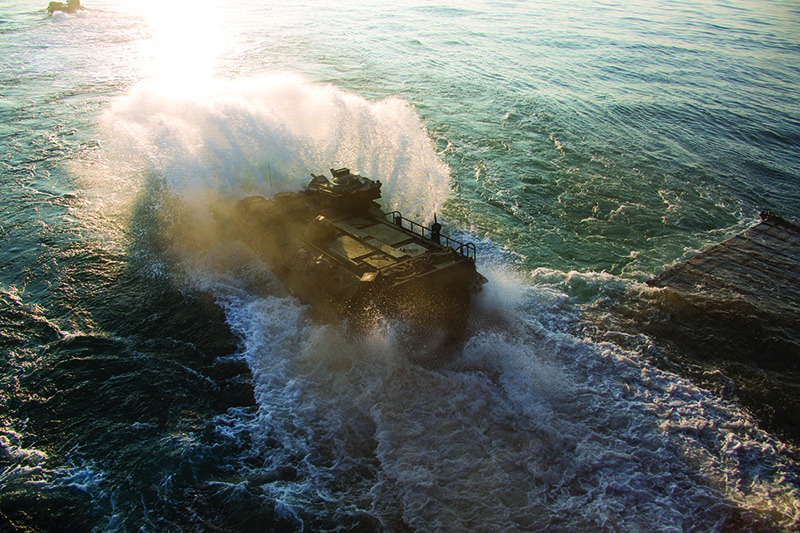
Of course, the Iraqi soldier who uttered these words wasn’t talking about tanks; he was talking about the Marine Corps’ assault amphibious vehicle (AAV) carrying Marines across the Diyala River into Baghdad in 2003. The venerable AAV carried Marines from the Kuwaiti border, through hundreds of miles of desert, on roads and in sand, and finally, across the river.

The Marine Corps has finally retired the AAV7A1 after 50 years of service, where it saw action across the globe—from small Caribbean islands to tsunami relief in Indonesia and even humanitarian missions in North Carolina, Mississippi and Louisiana in the wake of terrible hurricanes. The AAV was a versatile vehicle capable of using caterpillar treads over roads and marginal terrain and impellers to propel itself through water. It came into service in 1972 as a direct descendant of the Roebling Alligator and the landing vehicles, tracked, designed to carry Marines and soldiers from ship to shore during World War II.

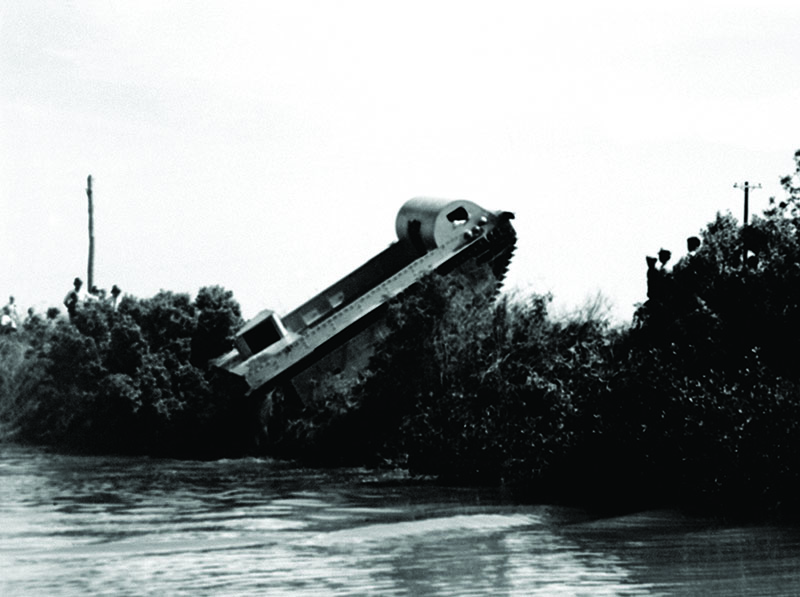
During the 1930s, the Marines trained and prepared for a war in the far-flung islands of the Pacific Ocean. The big question on everyone’s mind was, how could troops and materiel be moved from ship to shore? A question as old as warships themselves. In 1937, Admiral Edward C. Kalbfus, Commander, Battleships, Battle Force, United States Fleet, saw a Life magazine article that featured a unique vehicle. Engineer Donald Roebling had invented a vehicle that used caterpillar treads. It could float and propel itself in water or on land. After witnessing a devastating hurricane in Florida, he had the idea to build a vehicle that could conduct rescues in the marginal terrain of the Everglades.

The admiral told Marine Major General Louis McCarty Little, Commanding General of the Fleet Marine Force, about it, and Little in turn told the equipment board. The equipment board contacted Roebling, who made prototypes based on the Marines’ requirements—and the Marines loved them. However, after testing the vehicle, initially made of aluminum, they asked for changes, preferring it to be constructed of steel for rugged use in the south Pacific. The first production vehicles, known as landing vehicles, tracked, Mk1 (LVT-1), rolled off the line in 1941, and ever since, the Marines have had amtracs, a portmanteau of “amphibian tractor.”

As with most combat-tested equipment, the design and use of the vehicle evolved quickly. Initially, the LVTs did not have a ramp or carry offensive weapons. They were devised as logistics vehicles. Flat-bottomed boats with bow ramps, like the landing craft, vehicle and personnel (LVCP), or landing craft, medium, delivered Marines and equipment to shore.

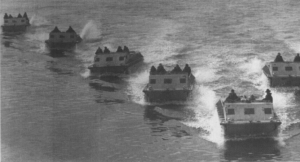
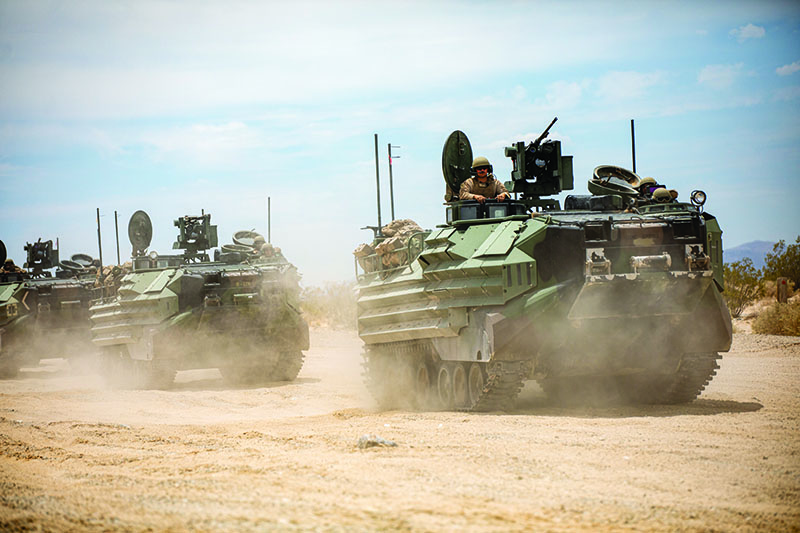
Marines assigned to 4th Assault Amphibian Battalion, 4thMarDiv, Marine Forces Reserve, conduct a platoon movement at the Marine Corps Air Ground Combat Center Twentynine Palms, Calif., as part of Integrated Training Exercise 4-23, June 10, 2023. (Photo by Capt Mark Andries, USMC)

These boats were speedy and carried tons of cargo, but their limitations became apparent as the 2nd Marine Division prepared to land on the Tarawa Atoll. The V Amphibious Corps Commanding General, Major General Holland “Howlin’ Mad” Smith, seeing that the reefs around the atoll would keep the LVCPs from getting close to shore, refused to complete the assault unless he had every available LVT in the Pacific to ferry troops ashore.

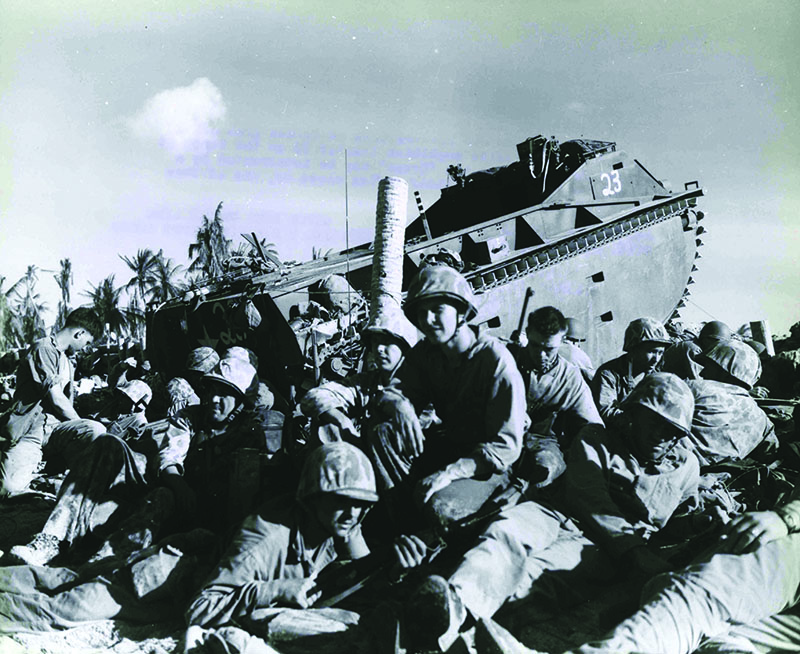
When the Marines made the assault, many of the landing boats got stuck hundreds of yards offshore and were forced to wade to the beach under withering machine-gun fire. The LVTs were able to make it all the way to the island’s seawall if they survived the Japanese defensive fire. This was at great cost to the LVTs though. By the end of the day, most of the vehicles were out of gas or disabled due to maintenance breakdowns or enemy fire. 

Tarawa was a proving ground. There were 125 LVTs—75 LVT-1s from the Guadalcanal campaign and 50 brand new LVT-2s. They performed admirably, though for a short period of time and at great danger. Due to the lack of tank landing ships (LSTs), each LVT at Tarawa had to be craned into the water and loaded with Marines while it bobbed like a cork. Most of the LVTs that reached shore were shot so full of holes that they could not return to the transport ships to take more Marines to shore. Many sank as soon as they tried to reverse off of the reef back into the water. But the LVTs and their crews proved their worth in combat to take combat Marines to shore.

Some limitations remained, however. 

As a logistics vehicle, and as a vehicle whose survival required that it be light enough to float in heavy surf, it lacked heavy armor or offensive weapons. It also lacked a ramp. Marines were forced to load the tub-like cargo area in the rear of the vehicle from the top. On shore it was much harder to unload. Under fire, it was quite deadly. Marines who rode the LVTs to shore laden with heavy combat equipment had to jump several feet down from the top of the vehicle to dismount. Many broke or sprained their ankles and knees in the process. 

The Marines went to work developing an armored version and a version with a ramp in the rear. The armored versions boasted machine guns, and some carried a turret with a 37 mm tank gun while others carried a 75 mm howitzer.

The Marines went all-in on the amtrac. Just months after the Battle of Tarawa, during the invasion of Saipan, they loaded more than 50 LSTs with  Marines and put the LVTs in the well deck. Each LST could launch 15 combat-loaded LVTs in minutes, saving time and making the dangerous process of having Marines climb down a cargo net into a tiny, bobbing amphibious vehicle unnecessary. More than 700 LVTs participated in the operation. Saipan also saw the combat debut of the LVT-4, the first amtrac with a rear ramp; the LVT(A)-1, the amtank which boasted a 37 mm cannon on a turret; and the LVT(A)-4, which carried a 75 mm turret-mounted howitzer. 

As the war progressed, the cargo capacity and horsepower increased. The early models landing on Guadalcanal had a cargo limit of 4,500 pounds and were powered by a 150-horsepower engine. The last unarmored LVT fielded in the war, the LVT-3 (which was fielded out of order, after the LVT-4) had a capacity of 12,000 pounds, two 220-horsepower engines and a ramp in the rear capable of carrying a jeep that could be easily rolled on and off without assistance from a complicated gantry.

Still, the open tubs made the occupants vulnerable to airbursts or Japanese gunners firing down from cliffs. As LVT crews took their vehicles inland, the exposed Marines were picked off by Japanese sharpshooters. Wounded Marines riding LVTs away from the front to aid stations suffered many such incidents.

After WW II, the Marines converted some LVT-3s to carry extra radios and added an aluminum-hinged covering to protect the Marines from shell splinters, designating the newly modified amtracs the LVT-3C, the “C” indicating it was a “command” variant. Marines used this updated LVT in the Inchon landing during the Korean War. But by then, the LVT-3C was old technology, and could only carry WW II-era sized jeeps for equipment. Still, the Marines wanted bigger.

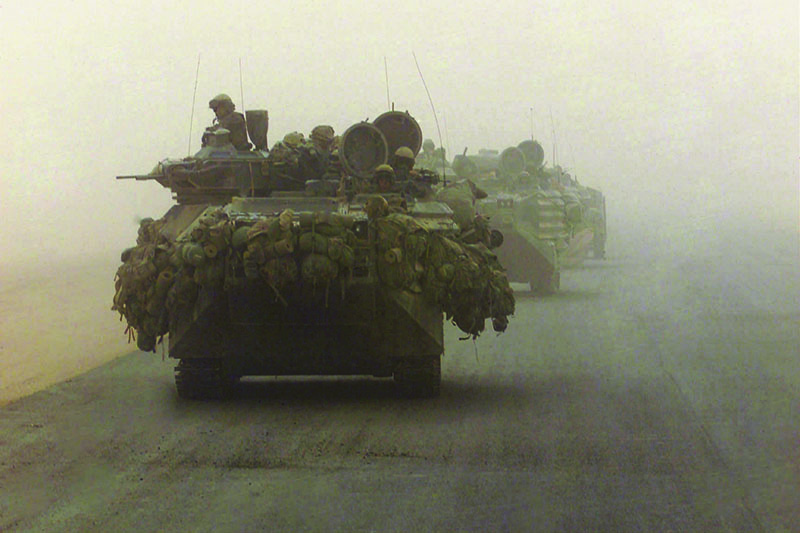
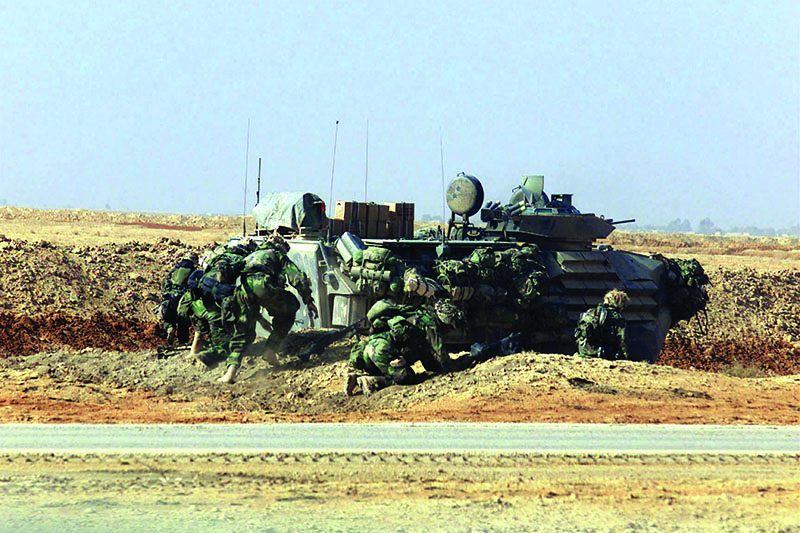
An AAV7A1 from Co C, 1st Bn, 5th Ma­rines, RCT-5, 1stMarDiv, moves along an Iraqi highway during a sandstorm dur­ing Operation Iraqi Freedom. (Photo from Sgt Kevin R. Reed, USMC)

The fact that the Marines still wanted a tracked landing vehicle was somewhat controversial in the age of the atom bomb, and with the advent of guided missiles. Landing vehicles only work if the troops inside can survive the ship-to-shore movement. The threat of nuclear weapons on the battlefield was all-consuming. One tactical nuke could wipe out entire military formations. The Army even reorganized itself into “pentomic divisions” to fight a nuclear war, leaving the Marines as the force that still thought about amphibious assault and tactical amphibious logistics.

Even if a nuclear weapon could wipe out a naval task group and its component landing craft, the Marines still felt there was room to prepare for smaller conventional wars and small wars as the nation’s ready expeditionary force. At the time, propelled with paddle-like grousers on their caterpillar tracks, LVTs spewed water into the air at the back of the craft, making their positions apparent to defenders. Worse, the slow ship-to-shore trek made them potential sitting ducks with long transit times. This put the Marines in amtracs at serious risk. But they plodded along, continuing to design, field, and implement tracked landing vehicles.

One of the major weak points of the design of amtracs to that point was the tracks. They were fragile and prone to breaking. The grousers were like cleats, running along the contact surface of the track and jutting off sharply. On sand, these were ideal, but they would tear up road surfaces. It was one of the many things that the Marines looked to improve with the next generation of landing vehicles. 

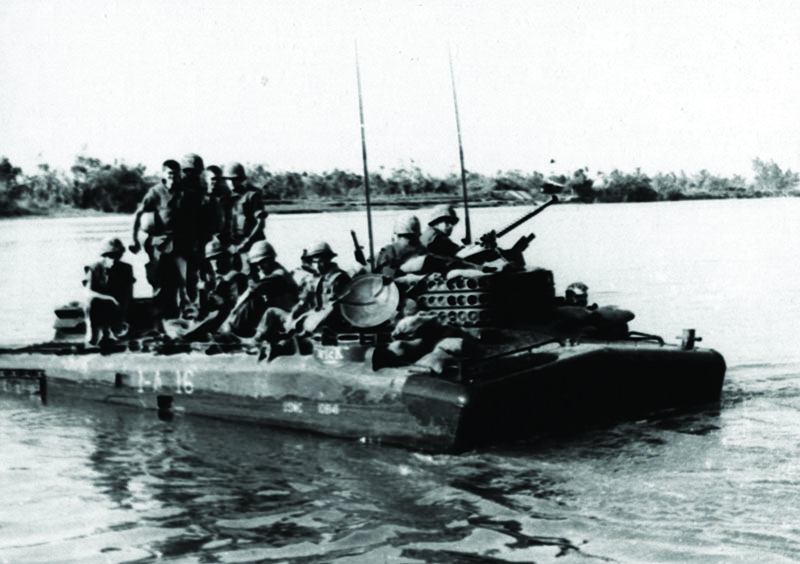
The next iteration of tracked vehicle was the LVTP-5, which first saw service in the mid-1950s. This generation had more roles than the WW II-era predecessors. In addition to an amphibious armored personnel carrier, there were command, mine-clearing and recovery vehicle variants, all built on the same chassis. This was the final generation to have an artillery variant, the LVTH-6, which mounted a 105 mm howitzer. It was also the first and only variant so far to have a bow-mounted ramp. These amtracs saw widespread use in Vietnam but were also used in landings in the Levant and Caribbean. The grousers that propelled the vehicle in the water were much improved in their shape, though the steel treads still damaged road surfaces. 

There were several issues with this family of vehicles. It used an 800-horse-power gasoline engine with fuel tanks that ran along the bottom of the vehicle. These were critically vulnerable to mines. An exploding mine would rupture the gas tanks, setting off an inferno inside the vehicle. Marines using these behemoths in Vietnam often chose to ride on top of the vehicles, setting sandbags around themselves for protection. It was also exceedingly heavy. Its rear-mounted engine sat low in the water, and when traveling it would sag and the intakes would get swamped. The solution was to add a superstructure at the back of the vehicle to keep the intakes well above the water line. 

Development for the current, and final, iteration of these LVTs began as soon as the LVTP-5s hit the fleet. The conflict in Vietnam showed the limitations of the large, very heavy vehicles. Amtrac crews had difficulty moving around, and the Marine Corps took these limitations to heart. 

The first prototypes of their replacement, known as the LVTPX-12, rolled off the assembly lines in the late 1960s. During the development of what would become the LVTP-7, the Marines decided to return to aluminum hulls to reduce weight. Diesel engines replaced the gasoline ones, and were placed at the front, with the ramp in the rear. Using diesel made the new amtrac much less likely to explode when hit. Designers also incorporated a hinged door on the roof, as with the LVT-3C, for ease of loading and escape. Later, these hinged roofs served as a place to load the mine-clearing line charge launchers used in Operation Desert Storm. Importantly, the Marines wanted the new amtrac to be capable of keeping up with tanks. Initially, the personnel variant was slated to have a 20 mm cannon mounted on a turret at the front, but that was scrapped in favor of a .50-caliber machine gun, which lacked the firepower ashore that the Marines desired.

The first LVTP-7s began arriving in the fleet in 1972—more than 50 years ago. The vehicle worked well and had almost all the same variants as the LVTP-5. The Marines wanted to implement a heavy weapons version using the 152 mm Shillelagh weapons system, but the aluminum frame could not withstand the repeated heavy vibrations of the weapon being fired. Though there were multiple attempts to put a more powerful offensive weapon in, the budget shortfalls of the post-Vietnam era made the Marines reevaluate.

But in the post-Vietnam time frame, the Corps turned within in an era of austerity. Planners knew the Marines would not have the larger budgets they had in the years past. Marine thinkers, lamenting the Corps’ turn to jungle warfare, wanted to return to amphibious and littoral warfare, which for the most part had been neglected during Vietnam. The LVTP-7 afforded the Marines the opportunity to turn back to the littorals and large-scale maneuver warfare. The new amtrac could do something its predecessor could not do easily: drive on improved roads due to its rubberized treads, lighter weight and smaller footprint, and it could operate at the same speed as tanks in the same environments. 

During the LVTP-7’s 50-plus year lifespan, it went through multiple upgrades to stay relevant to the Marines, and it even survived the attempt to replace it with the advanced assault amphibious vehicle (AAAV). There were still many hotspots in the world where the amphibious and expeditionary nature of the Marines allowed for multiple deployments, in an era hallmarked by the decline and collapse of the Soviet Union and the rise of Islamic terrorism. Where there was a shoreline to land on, the Marines took their amtracs with them. Marines deployed this vehicle in Beirut and Grenada in the early 1980s. 

During a major service life extension program overhaul period in the mid-1980s, the LVTP-7 received several upgrades, which replaced its powerpack and saw the addition of a retractable bowplane to help it plow through the surf during amphibious operations. The Marines awarded a contract to Cadillac Gage to add an MK19 40 mm automatic grenade launcher alongside the old .50-cal. machine gun in the up-gunned weapons system. However, they were not coaxially mounted; the gunner had to aim each weapon individually. Along with the change, the Marines redesignated the vehicle to the assault amphibious vehicle, or AAVP7A1. 

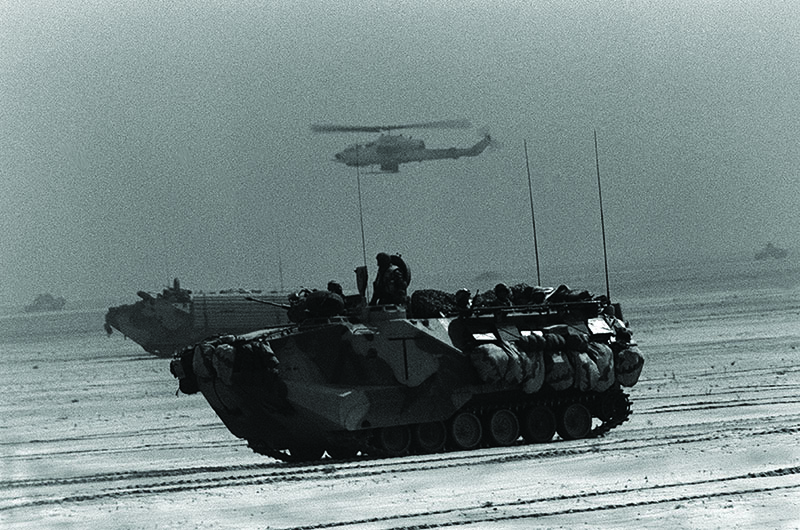
The Marines returned to their first large-scale involvement since Vietnam in Operation Desert Shield and Operation Desert Storm. The AAVs showed their value by keeping up with the tanks across the open desert terrain, carrying Marines and supplies as the task forces punched through the obstacle belts that Saddam Hussein had built in Kuwait to slow them down. Tank units, like 3rd Tank Battalion, used the AAV7CA1 command variant to keep the battalion on task and fighting. A dozen AAVs were tasked to mine-clearing operations, carrying mine-clearing line charges and launchers on top and towing additional charges on trailers behind.

After Desert Storm, the AAV7A1 was nearing 20 years of arduous service. Although it was proving to be a capable combat vehicle, armored personnel carrier and utilitarian vehicle, the Gulf War showed that it would need more improvements to continue operations into the 21st century. New applique armor systems were devised to improve protection against arms fire on the battlefield. The new P900 system, which was essentially two sheets of stacked perforated steel shaped in blocks and bolted to the sides of the vehicle, was quickly upgraded again to the enhanced applique armor kit (EAAK). Its corrugated sheets of composite sandwiched between steel fit the contours of the vehicle and bolted onto the vehicle’s sides and top so as not to interfere with waterborne operations.

The 1990s were marked by landings on foreign shores, like the humanitarian missions in Haiti, Somalia and Kosovo. Although the country lacked a major adversary, the aging AAV fleet was wearing out. It had been in service longer than any one type of amtrac had, and its projected replacement, the AAAV, was still on the drawing board. This made it necessary for the Marines to extend the life of the AAV once again. This time, in the late 1990s and early 2000s, the Marines replaced the running gear and powerpack with those identical to the M2/M3 Bradley Fighting Vehicle, calling the upgrade the reliability, availability, maintainability/rebuild to standard (RAM/RS).

During the aftermath of 9/11, the AAV7A1 RAM/RS with EAAK armor found itself participating in the global war on terror, though it never served in Afghanistan. Its next big deployment would be in Operation Iraqi Freedom in 2003. Unlike in Desert Storm, where several of the Marine task forces walked into Kuwait by foot, the entire Marine Corps that participated in the invasion was mechanized, using humvees, medium tactical vehicle replacements and the venerable AAV. These amtracs crossed the line of departure carrying Marines who braced themselves from the fold-open roofs. Spending hours shut inside the vehicle was uncomfortable and hot, often causing motion sickness.

Marines search the streets in the city of Fallujah, Al Anbar Province, Iraq, look­ing for insurgents and weapons on Nov. 9, 2004, during Operation Phantom Fury. (Photo by LCpl Ryan Lee Jones, USMC)
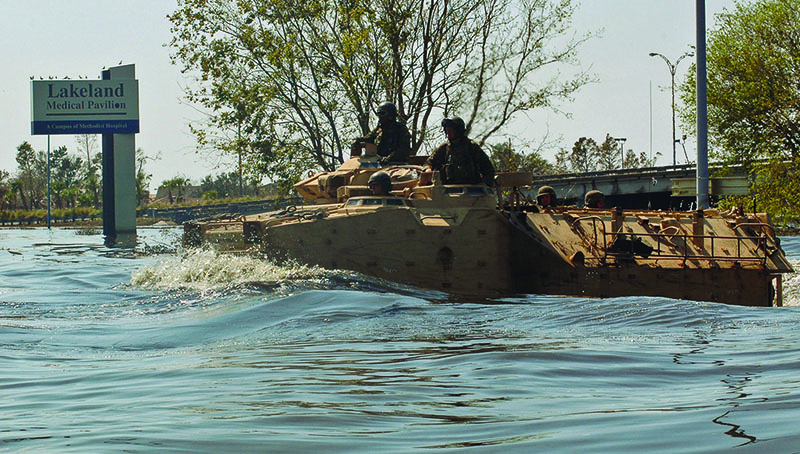
Marines of 4th Assault Amphibian Battalion use their amtrac to search for sur­vivors near New Orleans, La., in the aftermath of Hurricane Katrina. (Photo courtesy of National Archives)

The decision to drive the amtracs all the way to Baghdad as an armored personnel carrier was not without detractors. Many claimed it was too big and not armored enough to risk the effort. And it was designed as a landing vehicle, not an armored personnel carrier. It was vulnerable to rockets, mines and IEDs. When the amtracs reached the shores of the Diyala River, no one was sure that they would be able to float in a shore-to-shore operation due to the excessive wear of the 300-mile trek from Kuwait.

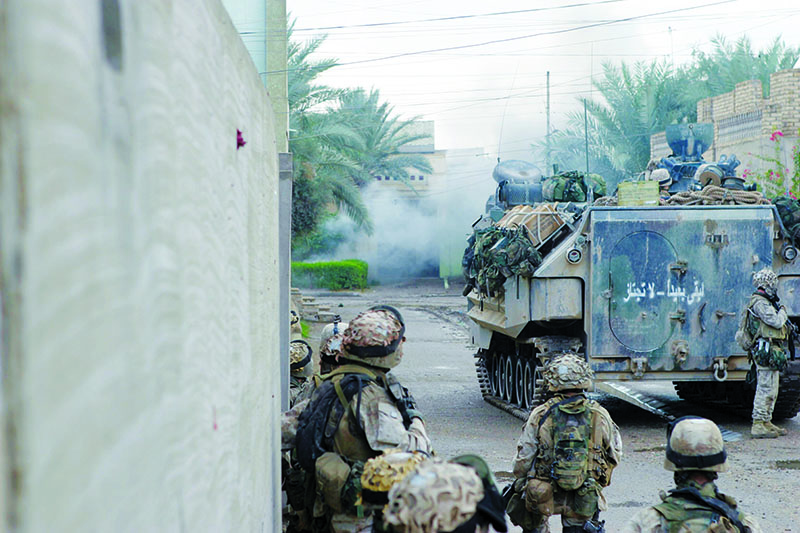
During 2004’s Operation Phantom Fury, as Marines and soldiers methodically worked their way through the streets of Fallujah, rooting out and killing insurgents, Marines used amtracs to deliver supplies to the front and evacuate wounded to the rear. Unfortunately, the AAV was still susceptible to propelled grenades and mortar fire. But IEDs in Iraq soon became a very large problem. The hull of the amtrac was designed to help it float through the water, not to protect it from blasts. This led to AAVs being used less in Iraq, as Mine Resistant Ambush Protected vehicles became available. 

The AAV still proved useful in humanitarian operations around the globe. In 2004, the 15th MEU used AAVs, in conjunction with helicopters and landing craft, air cushion, to provide aid to Indonesia in the wake of a devastating tsunami. The amtrac Marines used AAVs in Louisiana and Mississippi in the aftermath of Hurricane Katrina in 2005, and in 2018 in North Carolina in the wake of Hurricane Florence, to deliver much-needed emergency supplies and evacuate victims. 

By the late 2000s, it had become clear that the AAAV was in trouble. Cost over-runs and reliability issues kept it from being sent to full production. It was redesignated as the expeditionary fighting vehicle, or EFV. The main two issues that the EFV was trying to solve was the vehicle’s slow landing speed and lack of firepower. The AAV was not much faster at waterborne operations than its WW II predecessors: only moving at about 8.5 miles per hour. The U.S. Navy grew concerned about ship-killing missiles if they brought their amphibious ships too close to shore. The Marines wanted to send troops in armored landing craft from nearly 30 miles offshore at high rates of speed and have a vehicle with some fire-power once there. As missile technology improved, the Navy felt that their amphibious ships would need to be even more than 30 miles away from shore—closer to 60—to be protected from missile attack. Having Marines ride in a fast but enclosed box for 60 miles was not feasible, and the EFV was cut. 

The Navy would instead work to make it safe to put their amphibious fleet closer to shore to complete a ship-to-shore land-ing. One course of action the Marine Corps looked at was putting the AAV into a survivability upgrade package and keeping them in service until 2035. They decided instead to change their amphibious assault vehicles from tracked landing vehicles to wheeled ones in the newly fielded amphibious combat vehicle (ACV). Breaking with tradition, the new ACV has eight wheels and sports a more powerful engine, making it capable of traveling on land at 65 miles per hour, though its top speed on water is still roughly the same as the amtracs from WW II. Its shipboard dimensions are smaller than the AAV7A1, though it is heavier, and its survivability against mines and IEDs is much improved. 

The Marine Corps phased out the AAV in September 2025 after more than half a century of service. During that time, the LVTP-7 underwent multiple upgrades to stay relevant to the Corps, survived attempts to replace it and, as the U.S. extricated itself from Vietnam, continued to deploy to global hotspots. With the decline of the Soviet Union and rise of terrorism, wherever there was a shoreline, Marines brought their amtracs. Not bad for a vehicle that was expected to have a service life of 10 years. This marks the first time since before 1941 that the Marines have not possessed a tracked landing vehicle. The AAV’s long history stands as proof of its reliability and adaptability—and of the Marines’ enduring ability to go wherever the country needs them.

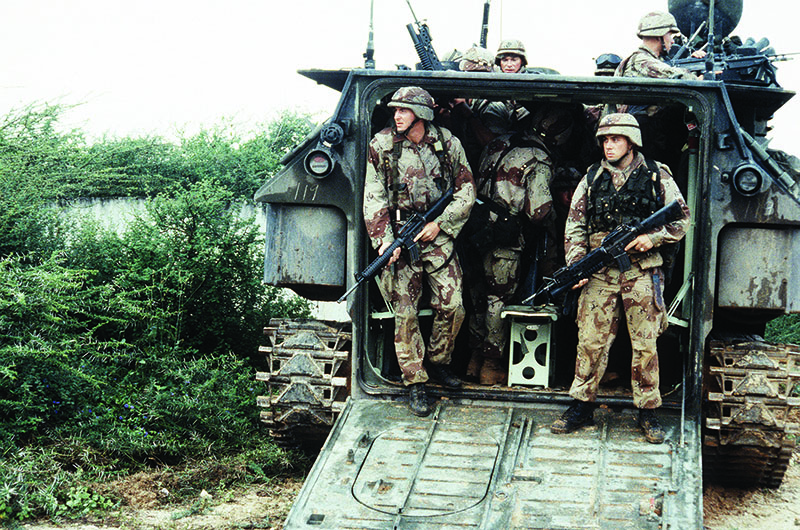
Featured Image (Top): Marines prepare to exit an AAV7A1 during the multinational relief effort Operation Restore Hope. The AAV’s unique ability to move troops, supplies and aid workers across beaches, flooded roads and debris-strewn urban terrain made it invaluable in operations far beyond combat.


Author’s bio:

Kater Miller is an Outreach Curator and Exhibit Chief for the National Museum of the Marine Corps and has been working at the museum since 2010. He served in the Marine Corps from 2001-2005 as an aviation ordnanceman.

Marine Corps Body Bearers: Upholding a Sacred Duty

A hallmark trait of Marine veterans is the immense pride we take in having earned the right to wear the uniform and serve alongside our fellow warriors. Within the active-duty force, numerous entities push this a step further, separating themselves based on military occupational specialty, duty station or unit affiliation. Some of the fiercest and proudest Marines stem from the smallest and most specialized groups. One of these may also be the least recognized yet proudest section stationed at “8th & I.”

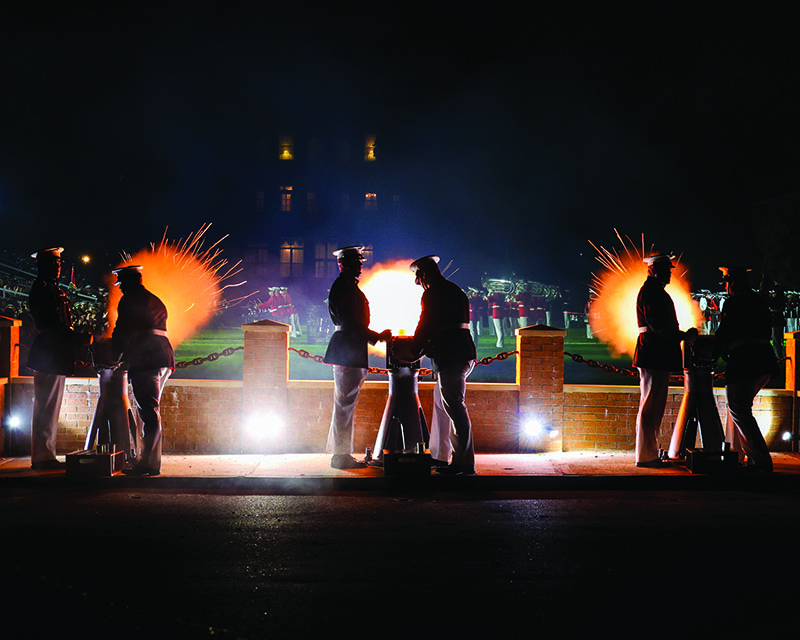
Marine Barracks Washington, D.C., houses no shortage of special units with high-visibility duties. Visitors attending any Sunset or Evening Parade may witness the immaculate marching platoons, the brilliant Silent Drill Platoon, the elite Commandant’s Four Color Guard, or flawless elements of “The President’s Own” U.S. Marine Band or “The Commandant’s Own” U.S. Marine Drum and Bugle Corps. Each Friday night throughout the parade season, while other barracks Marines wow the crowd beneath the spotlights, one small group stands silent in the dark at the end of the field, patiently awaiting their part in the performance. Without introduction or verbal cue, the Marine Corps Body Bearers fire three cannons at the appointed times, casting a smoky haze across the parade deck. For the casual viewer, the true identity of these shadowed figures may feel of less importance, their role in the show less consequential than the Marines flipping rifles, clashing cymbals or saluting a star-spangled general beneath the flagpole. For a Body Bearer, however, this perception fits perfectly in line with their occupational goal; never be in the spotlight, never draw attention to yourself and never distract from the purpose of the ceremony.

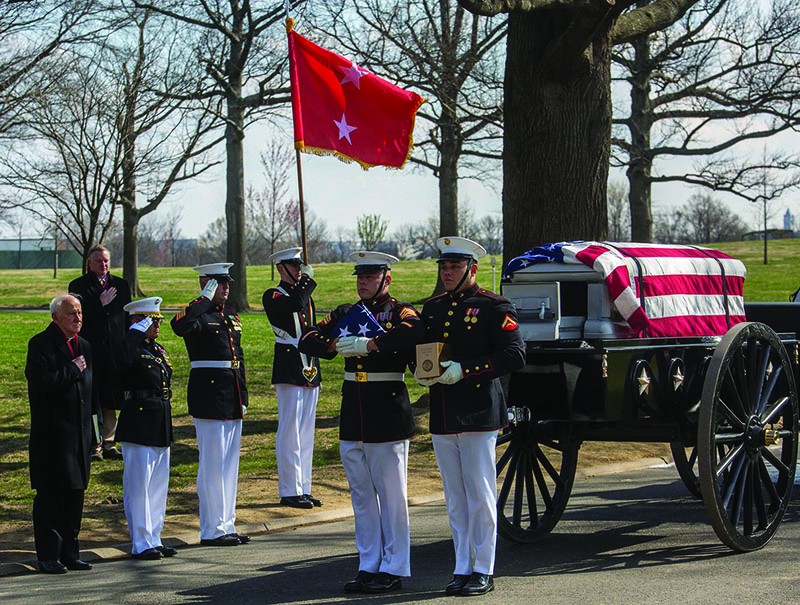
U.S. Marine Corps Body Bearers with Marine Barracks Washington, D.C., conduct the “final raise” at the funeral of Cpl Thomas H. Cooper, a World War II Marine killed in action on Tarawa. Cooper was not repatriated until many years later, at Arlington National Cemetery, Arlington, Va., on March 10, 2022. The final raise serves as a last salute to the fallen Marine.

The true function of these Marines is showcased outside the barracks at Arlington National Cemetery where the section performs funerals for Marines and Marine dependents. The Body Bearers’ precision at each funeral reveals the daily training they endure to perfect their craft. Relentless attention to detail in every movement intentionally keeps the focus off of the Body Bearers and directed toward the Marine being laid to rest.

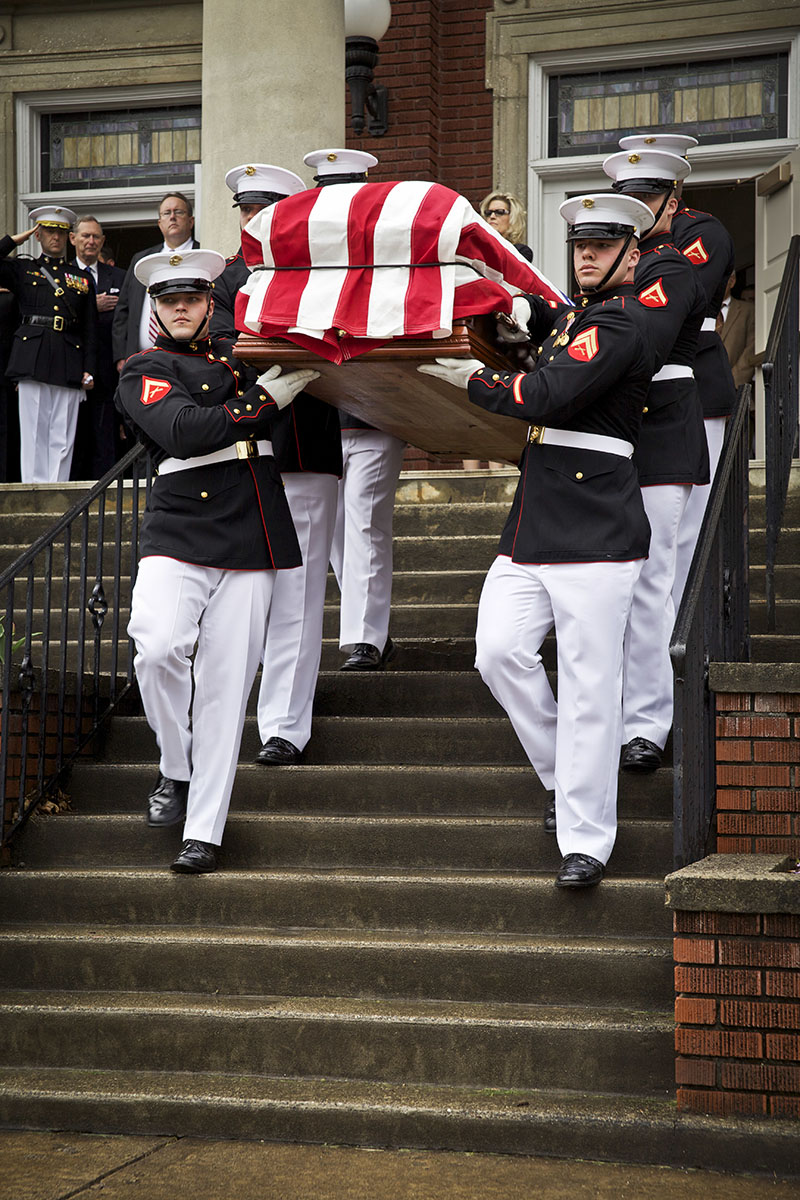
Other branches of service, such as the U.S. Navy and Air Force, maintain similarly dedicated units, highlighting the vital importance of their mission. Though similar in task, the Marine Corps scripts its funerals differently to ensure the fallen Marine and their family remain at the center of attention. While the other branches utilize eight pallbearers, the Marines operate with six, two fewer bodies blocking the family’s view of the casket being transported to the gravesite. Each branch of service trains to carry the casket at waist height, a uniform method adopted during joint funerals. At Marine funerals, though, Body Bearers hoist each casket up to their shoulders from the hearse or caisson all the way to the gravesite. In so doing, family members in attendance witness their loved one in their final journey to his or her resting place, rather than losing sight of the casket amidst a surrounding crowd of splendidly uniformed service members.

Through rain or snow, over ice, gravel or grass, in freezing or scorching temperatures, the Body Bearers execute their duties. Some caskets may weigh upwards of 600 pounds. Some gravesites may lie hundreds of feet away. Regardless, six Marines with stoic faces level the flag-draped casket at their shoulders and march in unison to the appointed place. At the gravesite, in one final and uniquely Marine salute, the Body Bearers face the casket, raise it up above their heads and freeze there for 10 seconds before lowering the casket down to the ground and folding the flag. After a funeral is complete, the Body Bearers prepare to do it all over again in a different section of Arlington, sometimes performing up to three funerals per day.

Accomplishing every funeral to the Corps’ standard of perfection requires each Marine to rigidly maintain his bearing. Any visitor to any gym in the nation will likely roll their eyes at some point watching another nearby patron grunting and hissing and sucking down air as they throw up a bar full of weight, a performance likely captured on a phone for instant upload to social media. This brand of self-serving distraction would clearly be unacceptable for Marines raising a 600-pound casket overhead in a final dignified salute. For Body Bearers, proper bearing is achieved through physical strength—astounding and extraordinary levels of endurance found few other places across the Corps.

“The distance we carry a casket can vary significantly. It can be a little as 20 feet off the road to one we did where it was probably two and a half football fields,” said Corporal Glen Hafemeister, a former Marine Body Bearer who served with the section from January 2023 to August 2025.

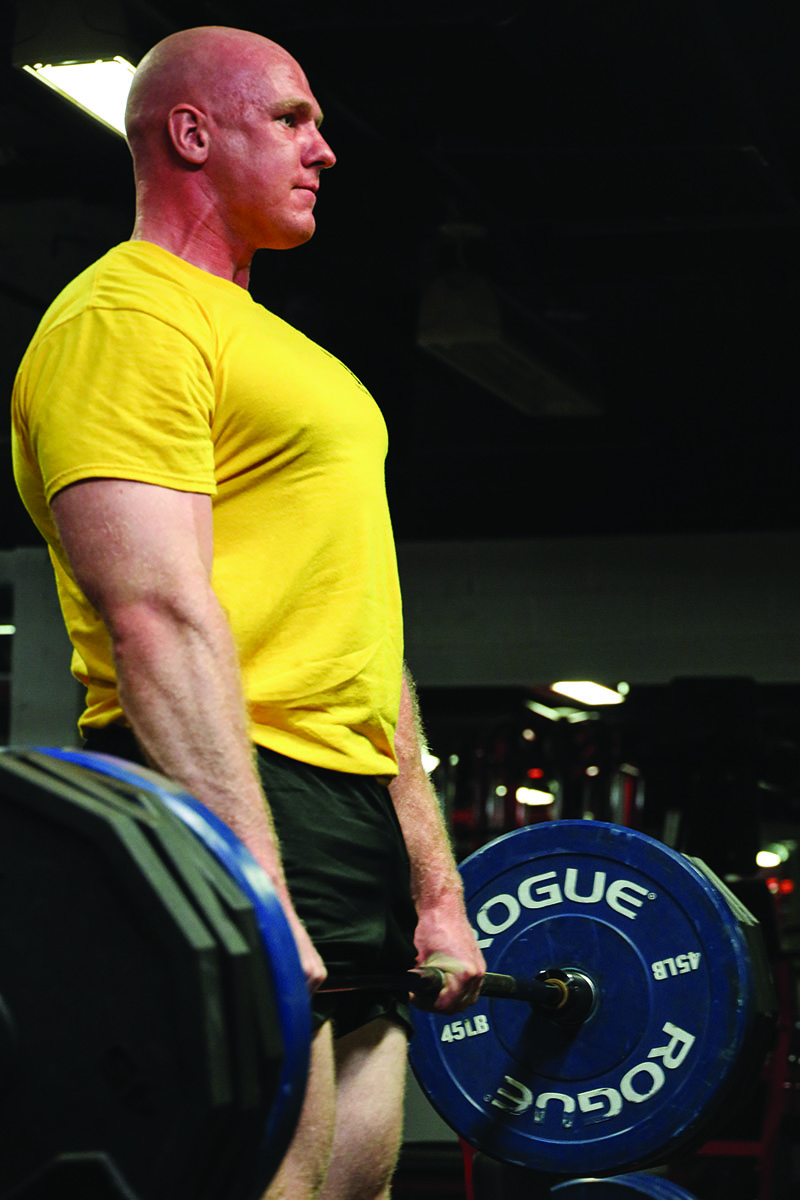
Cpl Jacob Dorton performs deadlifts dur­ing a workout at Marine Barracks Washington, D.C., on Aug. 1, 2025. The workout session, conducted with Muscle & Fitness magazine, gave insight into the Body Bearers’  rigorous training regimen and functional fitness.

 “For the majority of funerals we conduct, you might not need to have the strength that we require, however, there are always going to be a few every month where that strength is absolutely necessary, and we never know if the next funeral is going to be like that.”

Some of the most memorable moments from the history of other elite ceremonial units at 8th & I originated with mistakes made and worked through. Even the Silent Drill Platoon, renowned for precision and perfection, celebrates members who maintained their bearing and finished the performance through mishaps such as a rifle butt slashing open a Marine’s face or a bayonet stabbing into a Marine’s thigh. The Body Bearers’ training, however, mandates that no mistakes are made; perfection at every funeral, every day.

“Every Marine deserves our best, and we’re going to give our all for him,” said Cpl Jacob Dorton, a three-year member of the section. “He is our brother. He earned the title and served honorably. We’re going to give everything we have to give him a flawless funeral. We have a no-fail mission. We can’t have extra Body Bearers following along behind in case one of us falls out.”

“We’re also less than 5 feet away from the family,” added Hafemeister. “We don’t fall out.”

For many prospective Body Bearers, the enormous physical challenge embodies their initial interest and hook. Marines with the section deploy twice a year to both coasts on recruiting tours. They visit graduating classes from the Schools of Infantry at Camp Lejeune, N.C., and Camp Pendleton, Calif., in search of candidates. While on base, they pin up recruiting posters at the local gyms challenging corporals and below already in the fleet to try out and see if they have what it takes. With fewer than 15 slots available, trials are extremely competitive.

Any Marine hoping to join must first score a first-class physical fitness test and combat fitness test. This serves primarily to weed out the candidates who stand little chance of completing phase two: the Body Bearers’ uniquely crafted initial strength test. This minimum requirement consists of 10 repetitions of each exercise, including a 225-pound bench press, 135-pound overhead press, 115-pound bicep curl, and 315-pound squat. Each rep on each exercise must be completed with good form and bearing. The section chooses new candidates from the pool of Marines who complete the initial requirements and demonstrate exemplary character, then cuts them orders to 8th & I. Here, the most grueling phase of training begins.

LCpl Phillip Meckna, left, a Body Bearer with Bravo Company, Marine Bar­racks Washington, conducts morning drill practice with the section at 8th & I, on Sept. 17, 2025. The Body Bearers train daily to uphold the highest standards of pre­cision and discipline while carrying out one of the Corps’  most solemn mis­sions, honoring fallen service members and their families. (Photo from LCpl Brynn L. Bouchard, USMC)

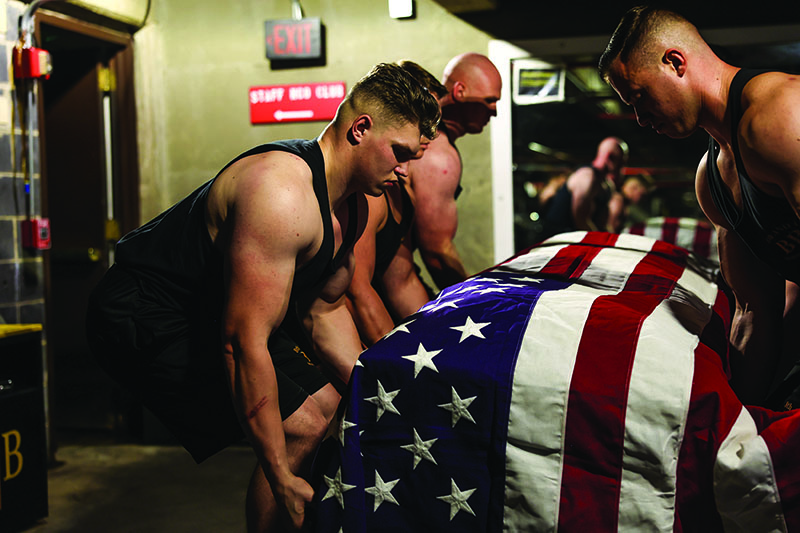
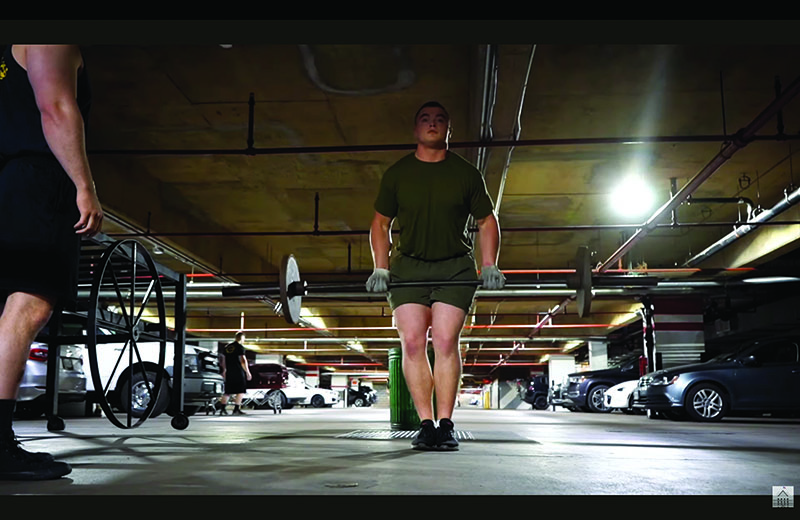
Every Marine arriving in D.C. begins their tour with Ceremonial Drill School (CDS). While most barracks new joins practice marching, rifle drill, and other disciplines with the marching platoons on the parade deck, prospective Body Bearers spend the duration of CDS out of sight, training in the parking garage. Candidates arrive in small groups throughout the year. To accommodate them, Body Bearer CDS operates as a continuous, self-paced evaluation placing new joins alongside experienced Marines in daily training and exercise. Cpl Dorton currently serves as the senior instructor for Body Bearer CDS.

“We train down there to be out of sight,” he said. “We don’t like a lot of attention towards us and the job we do. We want the attention to be on that Marine and his family. That’s why we work towards flawless bearing, so that the family can focus on their Marine, his service and life. We are just there to carry the casket, fold the flag, and walk away so they can have their moment.”

Candidates take six to 12 months to perfect each movement under the intense scrutiny of their peers. A candidate must flawlessly perform every ceremonial movement in coordination with the rest of the team. They must demonstrate perfect bearing under extraordinary physical strain in order to successfully graduate.

A Body Bearer candidate exercises below ground in the parking garage at Marine Barracks Washington, D.C., during Ceremonial Drill School. New candidates train in the Corps’ standard green-on-green until they complete CDS, at which point they earn the section’s coveted black and gold uniform.

As one metric to gauge their bearing, each candidate must pass the final strength test, consisting of the same exercises and weights used in the initial strength test, but with double the repetitions. During CDS, candidates train wearing the Corps’ standard green-on-green. When they graduate, they receive the coveted black and gold tank top displaying the section’s logo and motto, “The Last to Let You Down,” officially signifying the Marine holds a spot within the section and has earned the right to perform the sacred duty at Arlington.

Sergeant Joshua Williams, the Body Bearers’ platoon sergeant, coordinates with the cemetery several weeks in advance. He determines which Marines perform funerals each day and which will remain at the barracks for training or other duties. The amount of support required at the cemetery depends on the type of funeral being conducted, whether a dependent funeral, standard honors for any Marine or full honors for higher ranking enlisted or officers, Medal of Honor recipients, or Marines killed in action or held as prisoners of war. The funeral may have a casket or an urn. The family may request other specifics, such as a horse-drawn caisson. Variations in weather create friction but will not be a reason for delay or cancellation. Ultimately, the Body Bearers will not know exactly what is required of them until they arrive on site.

“I had an experience one day where there was a funeral we didn’t know about that was not on our schedule,” Williams remembered. “We had to get everybody ready with everything they needed and in place in less than two hours. We had another instance where we set up to perform a funeral, and it turned out to be two caskets. In that case, the Marine and his dependent were being buried at the same time, so we had to carry the dependent first, then the Marine.”

Other unique experiences or special circumstances stand out from the hundreds of funerals each Marine completes during the course of their tour. Joint funerals performed with other service branches often prove most memorable. In January 2025, several Marines took part in the funeral services for President Jimmy Carter. Dorton served as a pallbearer, transporting the casket to and from the U.S. Capitol building where President Carter lay in state. Two days later, Hafemeister helped move Carter into Washington National Cathedral for his state funeral.

“We do quarterly sustainment training with the other services to make sure we are always ready to perform a joint funeral,” Hafemeister stated. “That way when we show up, there might be a different team of individuals and each branch has a different drill, but we all have a baseline that we can work off of pretty easily.”

Many Body Bearers hold similar impactful memories from the opposite end of the public visibility spectrum: funerals conducted with a single person, or sometimes even no one else, in attendance.

Body Bearers carry the casket of the 30th Commandant of the Marine Corps, Gen Carl E. Mundy, Jr., USMC (Ret), during a funeral service at the First Methodist Church in Waynesville, N.C., on April 19, 2014. (Photo from Sgt Mallory S. VanderSchans, USMC)
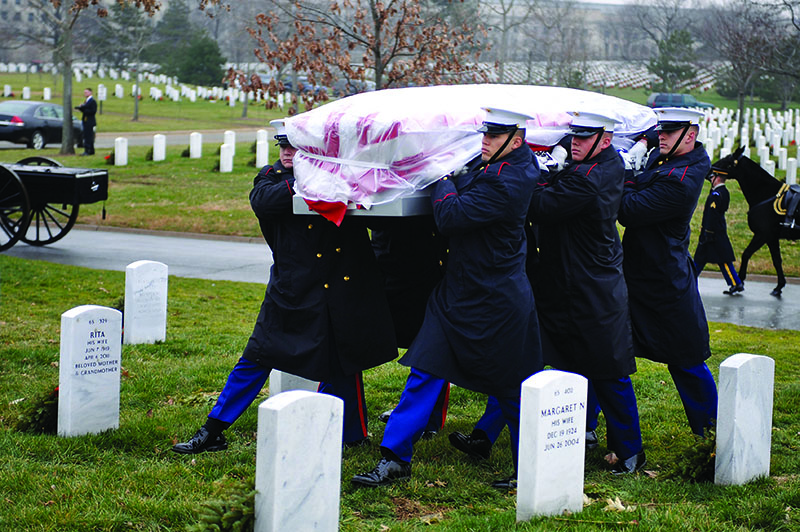
Body Bearers prepare to march with the remains of MajGen John A. Studds, USMC (Ret), during a full honors funeral at Arlington National Cemetery, Arlington, Va., on April 10, 2018. (Photo from Sgt Robert Knapp, USMC)
Cpl Jacob Dorton, center,
 LCpl Ethan Barlow, left, and Sgt Joshua Williams, Body Bearers assigned to Marine Barracks Washington, D.C., take part in caisson refamiliarization training at Joint Base Myer-Henderson Hall, Va., on May 13, 2025. (Photo from LCpl Kiara Rawls, USMC)

“No matter how many people are there, it doesn’t matter if it is a private first class or the President of the United States, the whole country watching or nobody watching, the training and attention to detail that will go into that funeral are identical,” Hafemeister added.

Regardless of the experiences that may come after, many of these Marines cherish most the memory of their first funeral.

“That one will always stand out to me,” said Dorton. “Just the nerves I had beforehand going into it and then, during and after, being able to see the impact that I had on that family really meant a lot to me. It kind of cemented in my mind why I wanted to do this job.”

“Being on my first casket was an honor,” Williams reflected. “I could feel the presence of that Marine, even though they were deceased. At the end, a family member whispered, ‘Thank you for all that you do.’ For me, that reinforced the reason why we do what we do. The reason why I love what I do is the impact and comfort we give the families. You never forget that feeling.”

A Marine’s time with the section varies greatly. Some, especially those joining from duty stations already in the fleet, might spend as little as two years with the Body Bearers. Others, particularly those joining straight out of School of Infantry, could potentially spend their entire four-year enlistment there. Hafemeister began his enlistment as a 0331 machine gunner with 1st Battalion, 6th Marines, at Camp Lejeune. After more than two and a half years and 250 funerals completed with the Body Bearers, he left active duty. Williams is one of the less typical members who joined from the fleet, will remain with the section for four years, and intends to reenlist. He began his career as an automotive mechanic with 1st Battalion, 12th Marines, in Hawaii, before finding the Body Bearers’ recruiting poster at the gym. Now, with less than a year left in his tour at 8th & I, Williams is preparing to return to the fleet as a senior sergeant. His time with the Body Bearers has prepared him for the future in multiple unique ways.

“Going through CDS was very, very challenging,” he stated. “Going through anything else in the Marine Corps after that will seem fairly easy.”

Whether a Body Bearer, a marching platoon member, a machine gunner or a mechanic, every Marine possesses the drive to be the best, and believes they are. Relentless perfectionism and unwavering dedication to honoring our heritage are foundational to wearing our cloth. The Marine Corps Body Bearers demonstrate this daily, both on display at Arlington and in the privacy of the barracks parking deck. Their professionalism serves as an understated, little recognized, yet hard-to-match example of commitment to these core values.

Body Bearers conduct ceremonial cannon fire during the conclusion of a Friday Evening Parade at Marine Barracks Washington, D.C., on May 16, 2025. The final cannon salute signifies the end of the parade, honoring the Marine Corps’ traditions of precision, professionalism and ceremonial excellence. (Photo from LCpl Brynn L. Bouchard, USMC)

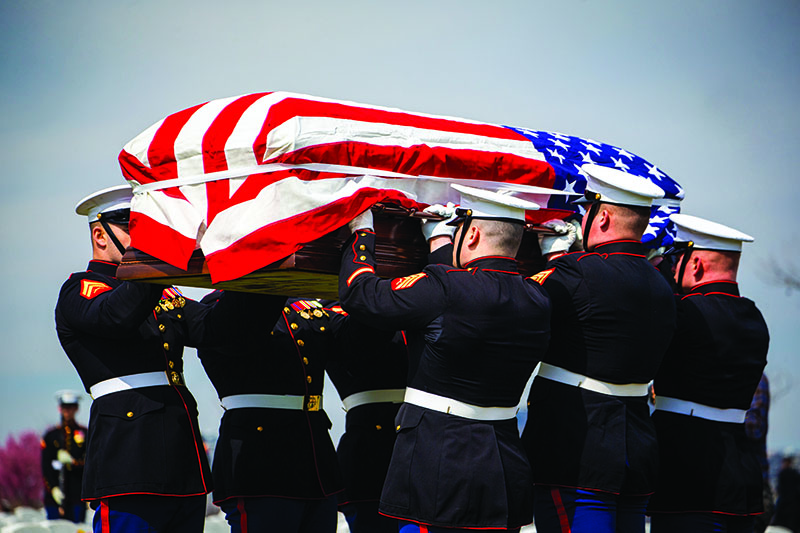
Featured Photo (Top): Body Bearers carry the casket of Gen Samuel Jaskilka, USMC (Ret), the 16th Assistant Commandant of the Marine Corps, to its final resting place at Arlington National Cemetery, Arlington, Va., on Jan. 26, 2012. With only six Body Bearers around the casket, and the casket carried at shoulder-height, the Marines make every effort to keep the focus of the ceremony on the fallen Marine.


Author’s bio:

Kyle Watts is the staff writer for Leatherneck. He served on active duty in the Marine Corps as a communications officer from 2009-2013. He is the 2019 winner of the Colonel Robert Debs Heinl Jr. Award for Marine Corps History.

“History in Motion”: Newly Digitized Film Collection Brings Marine Corps’ Past to Life

The theater aboard USS Yorktown (CV-10) at Patriots Point Naval & Maritime Museum in Mount Pleasant, S.C., went dark March 29, National Vietnam War Veterans Day. Archival films of the Vietnam War lit that darkness. In the audience, Medal of Honor recipient Major General James Livingston, USMC (Ret), and other Vietnam War veterans and families watched their shared history.

It was a remarkable opportunity to see their generation of Marines in action—and it’s an opportunity that is increasingly available to all Marines and their families, thanks to a partnership between the Marine Corps History Division and the University of South Carolina Libraries that is preserving and making public over a thousand hours of historic films from the Division’s archives.

The United States Marine Corps Film Repository is one of the most comprehensive archives of its kind, containing thousands of films that span the 20th century. Moving Image Research Collections (MIRC) at the University Libraries is actively in the process of digitizing the films and adding them to a free, search-able database that anyone can access.


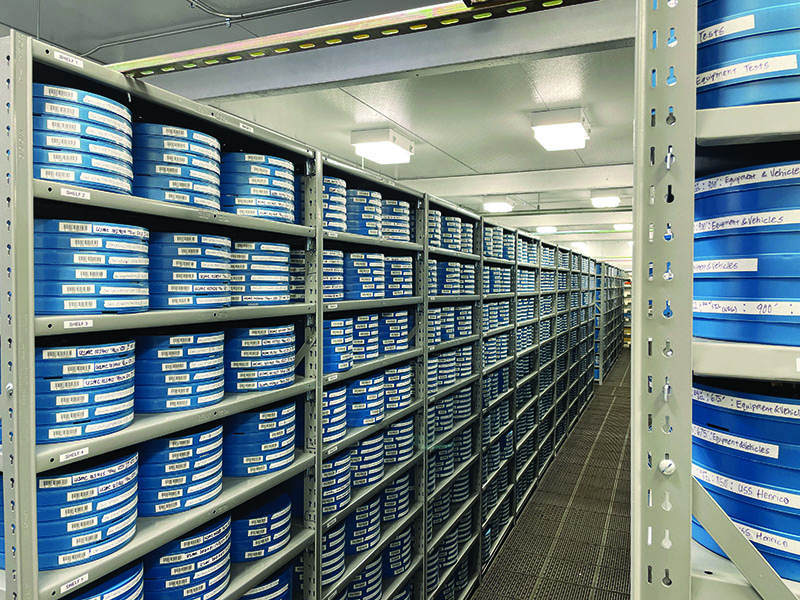
Thousands of restored reels can be found in the LtCol James H. Davis Vault.

The films bring to life the Marine Corps experience in a way that both allows veterans to re-engage with memories and helps their families and friends understand more fully what that experience was like. 

MajGen Livingston knows firsthand about living with the memory of a battle that people at home can only ever imagine. He was awarded the Medal of Honor while serving as the commanding officer, Company E, in action against enemy forces in Dai Do, Quang Tri Province in the Republic of Vietnam, according to the award citation.  

Livingston visited the MIRC last year to see where the U.S. Marine Corps Film Repository calls home. This wasn’t the first time he had come to see the collection, however. He made the trip to Columbia in 2017 for the ribbon-cutting of the new cold storage vault and digital scanning center that now holds the collection. The vault—both temperature and moisture controlled—is lined with shelves upon shelves of film canisters, each individually labeled and identified by carefully trained hands. At the time of the ribbon-cutting, few of the films had been digitized and even fewer were available to the public.  

By his second visit in June 2025, thousands of films were available to be digitally sifted through, watched and enjoyed. No longer stuck in preservation-grade canisters, the films brought the history MajGen Livingston and his fellow Marines lived through back to life in front of his eyes. Beyond his own memories, he was able to access the shared endeavor that all Marines embrace when they earn the eagle, globe and anchor.

“The United States Marine Corps Film Collection is more than old films—it’s our history in motion,” he said. “It’s the story of courage and sacrifice told through the lens by those who lived it.”  
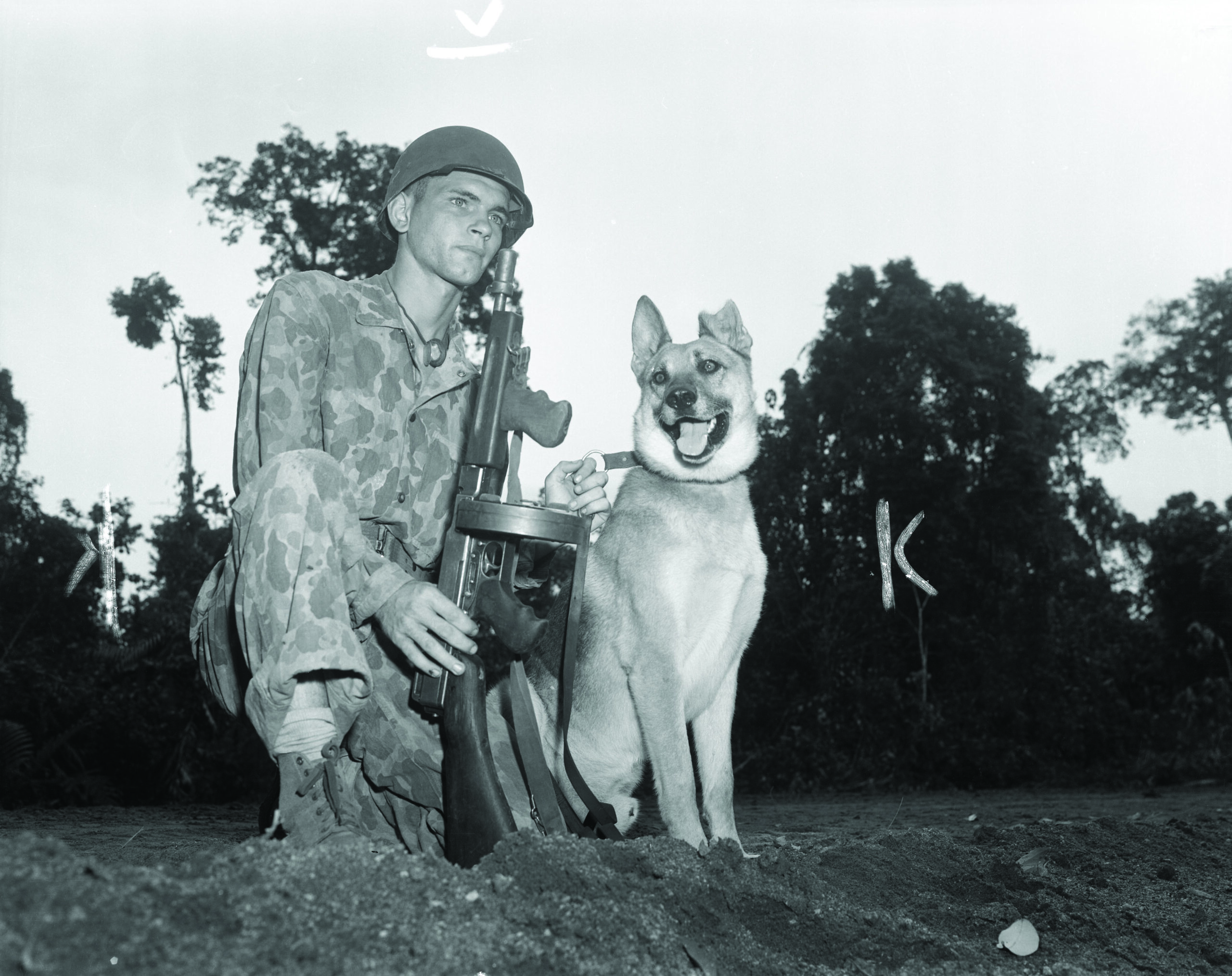
The films came to the University of South Carolina Libraries when the Marine Corps University reached out to MIRC in 2015, with the goal of finding a permanent storage facility for the canisters, which had been housed at Quantico, Va., for generations. The Marine Corps University wanted to provide the materials with a state-of-the-art home, and the films to be preserved, digitized and shared with the wider community. MIRC’s expertise and experience with archival film made them an obvious choice for the vast collection. 


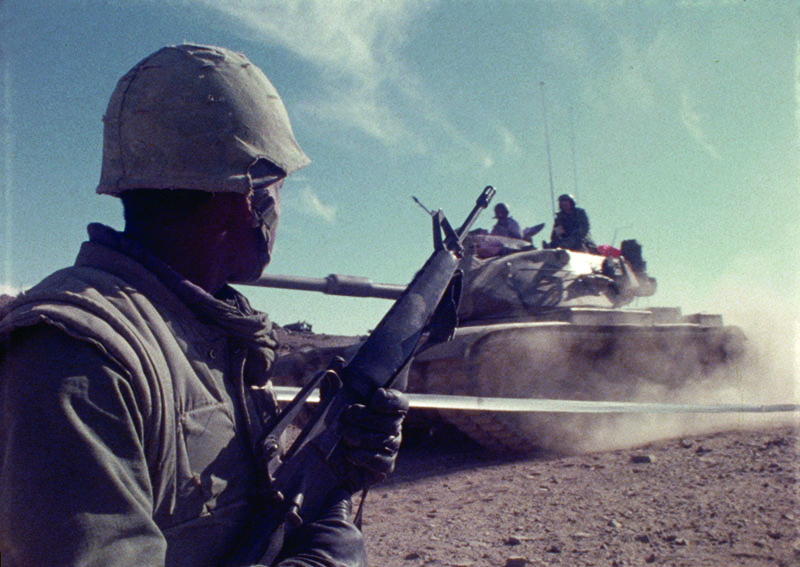
Left: A combat engineer looks on as an M-60 tank rumbles by during a training exercise at Twentynine Palms, Calif., in 1980.

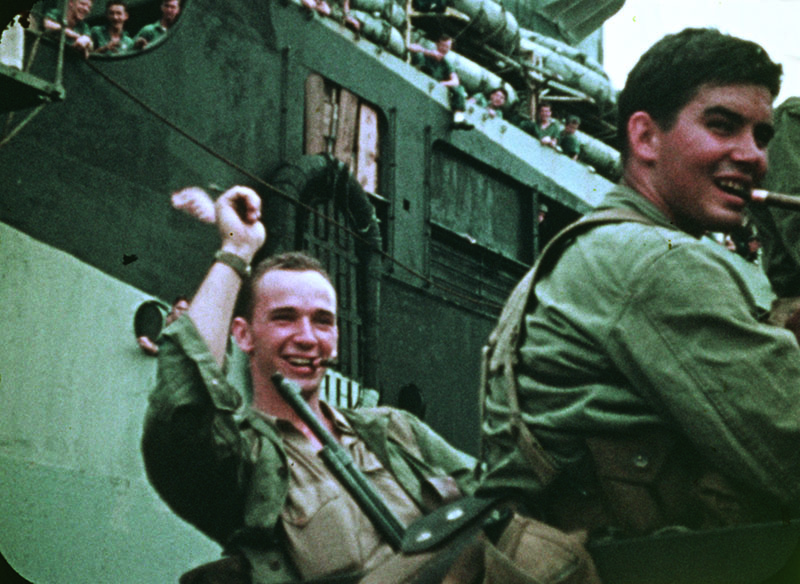
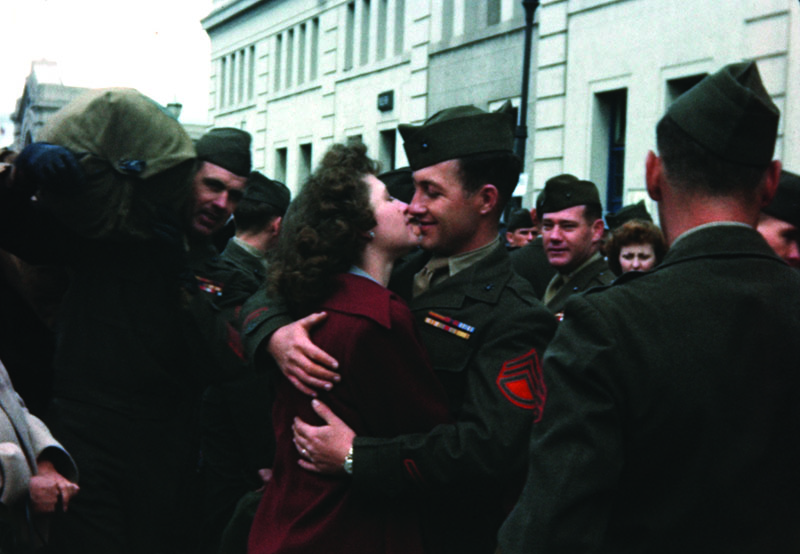
Center: Marines celebrate their return home from Iwo Jima in 1945.

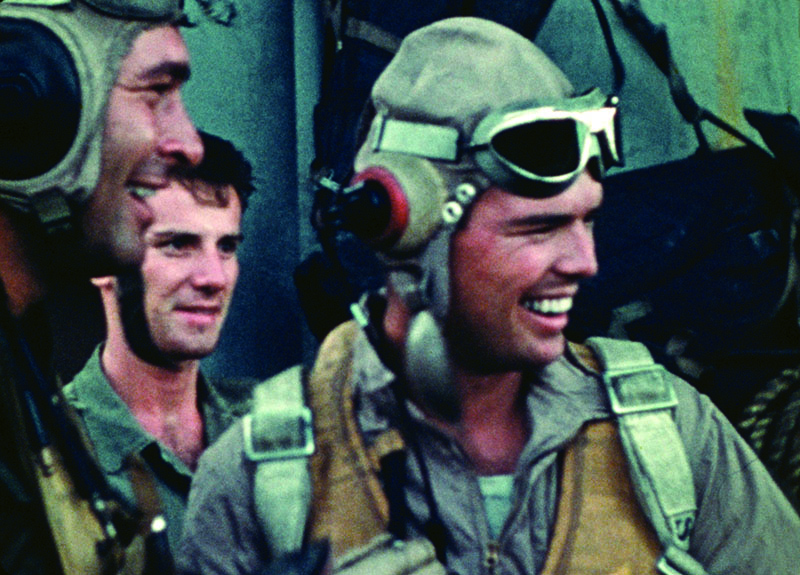
Right: Pilots from VMF-351 celebrate on the decks of USS Cape Gloucester (CVE-109) after a 1945 aerial victory.

USC Libraries’ ultimate task was, and is, to care for and conserve these films. In doing so, they hope to give the public an important piece of their collective history.  

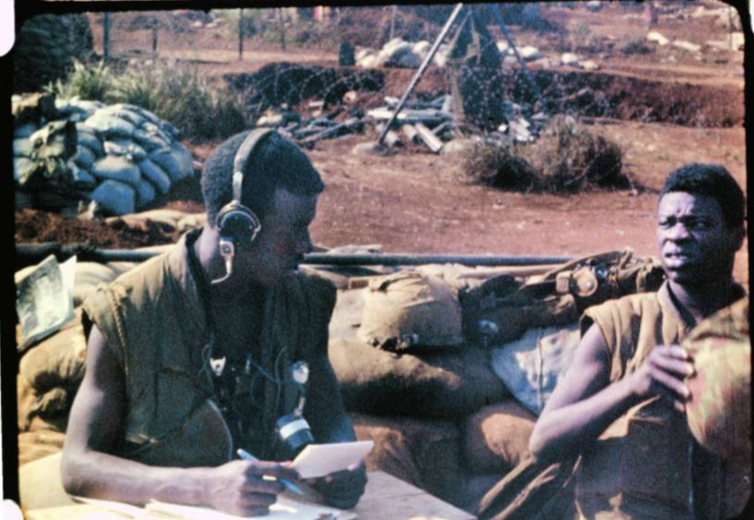
The collection captures more than just Vietnam footage. The United States Marine Corps Film Repository is one of the most comprehensive archives of Marine Corps footage in our nation, holding over 19,000 reels of 16 and 35 mm films dating from the 1910s through the 1980s. They document the operations of the Corps throughout the 20th century. Footage includes clips from World War II, the Korean War and the Vietnam War, giving viewers glimpses of what it was like on the front lines of battles that still live in public memory today.
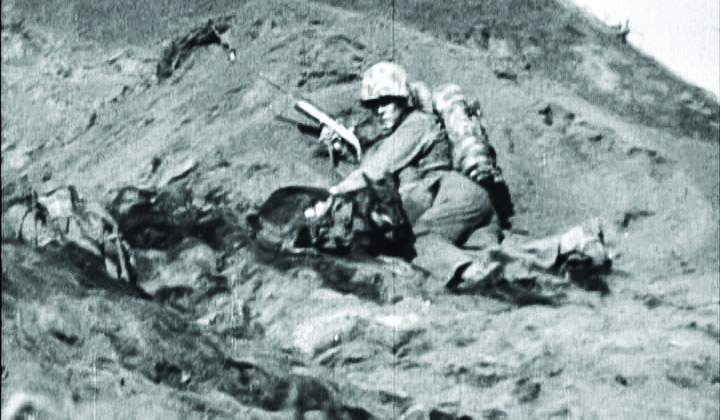
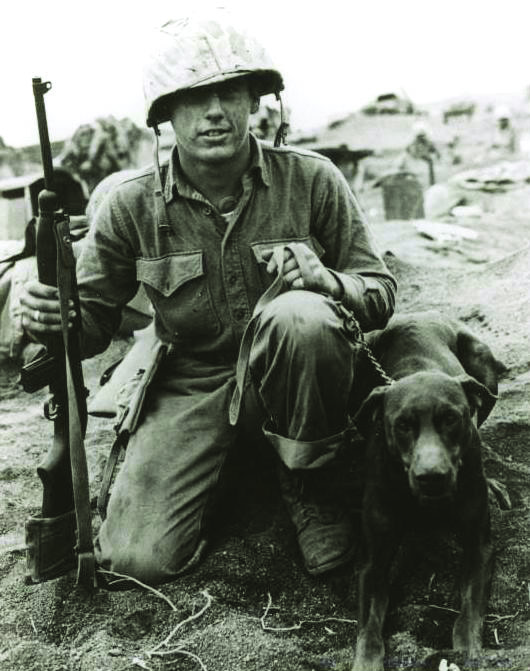
Combat is just one of the many facets of Marine Corps life the films capture. The collection also contains peacetime films of training, testing and public relations activities. These films give detailed insight into the life of soldiers while they’re deployed, from the most routine daily activities to highly specialized training. Viewers see Marines laughing, cooking, joking around, training and conversing with each other as if they were at a barbeque back home. 

In fact, one of the most important impacts of the films is the way they humanize our nation’s soldiers and bring them to the forefront of our minds, showing us who they were beyond the battles they fought. Seeing these films allows current and future generations to remember who these Marines were and what they fought for in a way that goes beyond learning about their sacrifice in the two-dimensional world of history books. Now, through USC Libraries’ efforts, the experiences of these American heroes are readily available to any scholar, researcher, student, veteran or casual viewer who wants to see this history for themselves.  

While such a vast archive of films capturing several generations of Marine Corps life might seem to present an overwhelming amount of information to the typical viewer, the digital collection is maintained in a specifically organized and curated online platform that is freely available and searchable by the public. That makes it easy for viewers to approach the films in whatever way they’d like, whether it’s dipping in and out of the films at random, exploring a particular time period or researching specific information about a particular battle.

To make this possible, the films go through a multi-step process to conserve the fragile material and ensure they are readily available online, with keyword searching and easy identification on MIRC’s database.   

Dr. Greg Wilsbacher, Curator of the U.S. Marine Corps Film Repository, oversees this process as well as the staff who operate it. Various staff members, students and even volunteers assist in conserving such a vast and significant piece of America’s past.  

“Being stewards of the Marine Corps’ film heritage is a privilege for all of us in the University Libraries who work on the project—students, staff and volunteers,” said Wilsbacher. “Every day, we see the best of America on film, men and women who have committed themselves to the defense of the nation. Every day, we watch this history unfold in some distant corner of the world or on a base here at home. Every day, we are humbled by the personal sacrifices captured on film. Keeping this history alive and available for all is one way we can honor all Marines, past and present.” 


A screenshot from a film of Marines of 1stMarDiv as they are greeted by loved ones upon their arrival in San Francisco, Calif., March 5, 1951. 


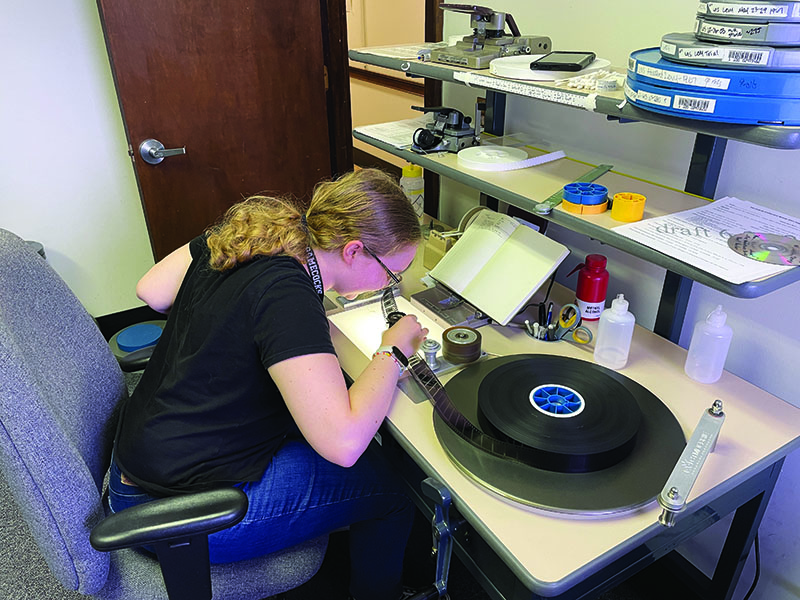
The processing of each film in the collection begins with an inspection by a careful hand on a film bench to check for and repair any damage that might have occurred to the reel. A protective film leader is added to the beginning and end of each reel to ensure no further damage occurs. Film technicians then assign a new inventory number to the reel and begin to gather basic information about the content of the film so that it can be described in the record. That information contains everything from general location and date, if available, to what can be seen going on in the film, and any other notable identifying information.  

Once the film has been generally described and, if necessary, repaired, it is then moved to a preservation-grade film storage can where it gets a new label, barcode and other identifying features. The films are then placed into cold storage in the Lieutenant Colonel James H. Davis Film Vault, named to honor a University of South Carolina alumnus and family member of longtime library supporters Richard and Novelle Smith, who funded the vault.  

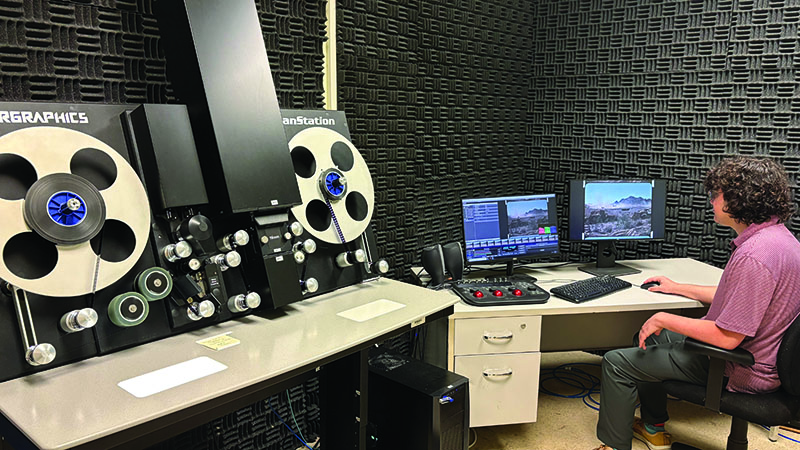
When the films have been processed, they are ready for digitization. Staff bring the films to the John S. Davis Scanning Center, named after another Marine and South Carolina alumnus of the Smith family. There, they are scanned at 2K resolution. Staff create online streaming copies of the films before reviewing them in their entirety to be catalogued and described in as much detail as possible for the average viewer. Only then are the videos able to be placed online in a keyword-searchable database. 

The thorough cataloging process ensures that films can be searched by location, time period, units or topics. If viewers want to see combat footage or public press relating to Iwo Jima, all they need to do is type it into the search bar and let the database retrieve the footage. If a viewer has a family member they know served in the 1st Marine Division, they can search unit specific footage without sifting through thousands of films.  


Films from the History Division’s collec­tion are first inspected by hand on spe­cialized tables like the one used by Kat Favre of University of South Carolina Libraries. The process ensures that the films are properly identified and that it is safe for them to be digitized.
Moving Image Research Collections uses state-of-the-art film scanning equipment to recover the history of the Marine Corps and make it available to the public. Sam Heidenreich is one of two scanning technicians performing the skilled task.

This degree of searchability has been especially helpful for people looking to reconnect with a presumed lost history of their loved ones. A recent visitor to MIRC, retired LtCol Robert Barrow, after leaving the university, went home and spent all afternoon searching through the repository. Barrow ended up finding footage of his father, General Robert H. Barrow, 27th Commandant of the Marine Corps from 1979 to 1983, who passed away in 2008, during his time of service. It’s footage that Barrow never thought he would get the chance to see for himself.  

“The tour we had last year was truly inspiring,” said LtCol Barrow. “Just as a test, I asked to see what footage the website might have on my father. To demonstrate the ease of search … in a matter of seconds, [Dr. Wilsbacher] pulled up some footage I never knew existed on Dewey Canyon in Vietnam. I shared one link with my siblings that showed only the hands and watch of a Marine reviewing a map in the field in Vietnam. They all came back with the same conclusion: ‘Those are Dad’s hands and definitely his watch.’ ” 

That ability to witness the experience of a loved one whose service may have taken place halfway around the world, or even before the viewer was born, is transformative. Many Marines have lived through extraordinary events, fighting for freedom and liberty on foreign coasts, while their families were at home unable to imagine what their loved ones went through overseas. Often, these memories have remained shrouded in the past, unable to be fully articulated to those who were not there to experience them. The United States Marine Corps Film Repository preserves these stories for generations to come. Now, USC Libraries’ digitization of the films makes them accessible to all and brings them vividly to life for both those who have lived through them and those who have not. 

Featured Photo (Top): A Marine holds a slate for PFC Baker of Combat Camera during the filming of a training exercise at Onslow Beach, N.C., August 1952.


Author’s bio:

Abigail Cole is a staff writer and photographer for University of South Carolina Libraries in Columbia, S.C. Her work has appeared in The New York Times

Executive Editor’s note: These films are available to watch by anyone, anywhere, at any time. Visit digital.library.sc.edu/marinecorps to get access to the Marine Corps Film Repository. To searchthrough the films, click the “Watch the Films” tab at the top of the page. The re–pository is keyword searchable.

A Corps Experience: Hollywood Writer Graham Roland Got His Start as a Marine

In 2000, Hollywood scriptwriter Graham Roland enrolled in college, halfheartedly taking classes at Cal State-Fullerton when he decided he needed a challenge. He wanted to become a writer but needed money for school. A California resident who spent his summers with his dad in Oklahoma, Roland was also looking for a male role model in his life and found it in the Marine Corps.

“Coming out of high school, I was an OK student, not a great student,” Roland said. “I had already formulated this idea I wanted to write and hadn’t really focused in on writing for film and television yet, but I knew that I needed something to write about.” 

Initially motivated by the promise of the GI Bill, a couple of key experiences inspired Roland to join the Corps. A friend of his had joined the Marines right after graduation, and his transformation left an impression on Roland.

“I saw him when we came back and he was like a totally different person. … His personality, the way he carried himself … [In school] he was a knucklehead, he wasn’t very focused. He was a good student … after boot camp leave. That really changed him. That stuck in my mind.”

Roland enlisted in the Corps in 2000 at a recruiting station in the Bay Area and completed boot camp at Marine Corps Recruit Depot San Diego. He trained for two months at Fort Sill, Okla., to become a forward observer, 0861 MOS, in artillery, and the base was about two hours from where his dad lived.

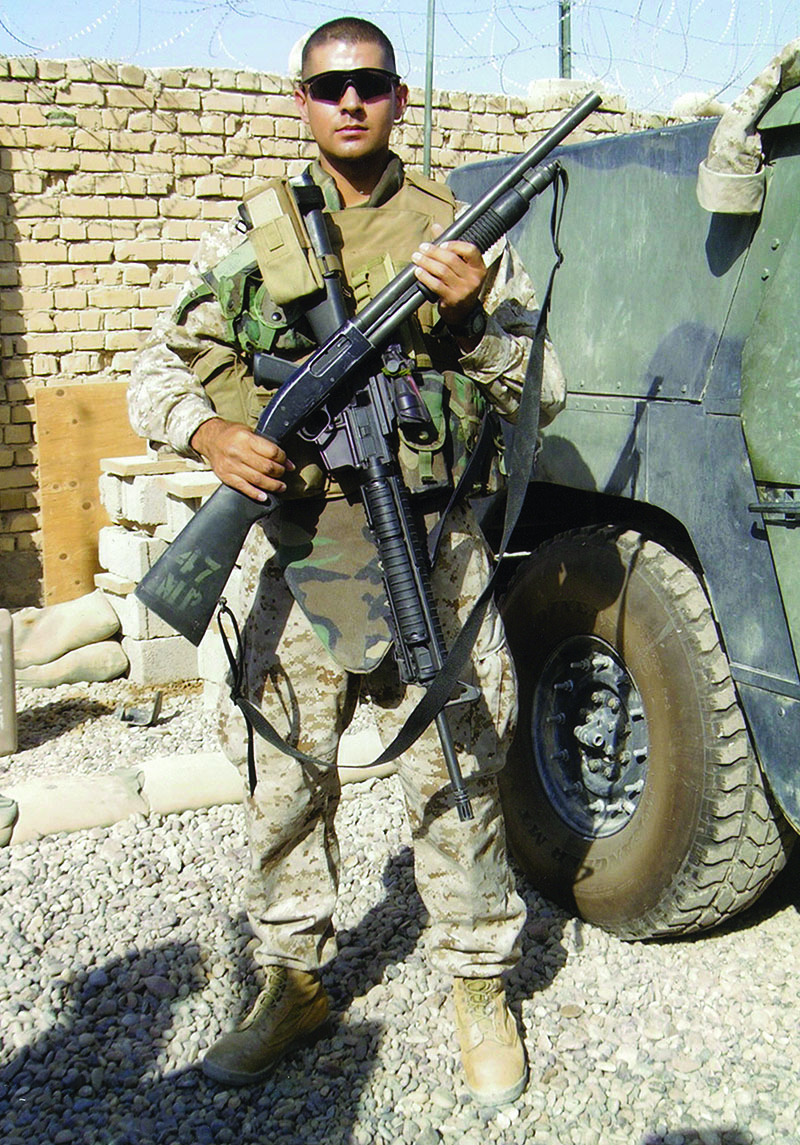
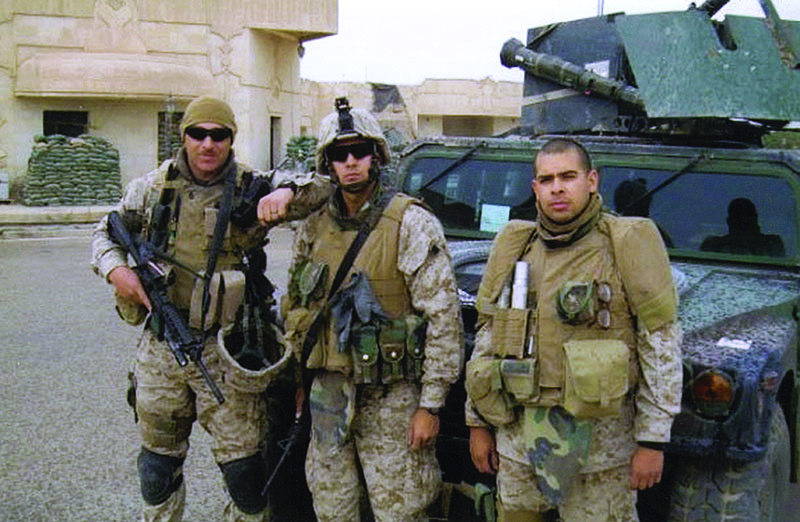
Cpl Graham Roland, center, with GySgt Dallas Miller, left, and LCpl Roberto Mancha, waiting to leave the wire at Camp Ramadi, Iraq, December 2005. 

Roland had come of age in the ’90s, and believed there wouldn’t be another ground war. The ’90s involved a lot of bombing people, and Desert Storm happened fast. But by the time he deployed to Fallujah in 2005, the Corps didn’t need forward observers. He had been taken out of his artillery battery, where he was a reservist in Seal Beach, Calif., and put with an active-duty field military police (MP) company, the only MP company in the 1st Marine Division. Roland didn’t do anything artillery focused during the deployment. Instead, his unit executed convoy security and prisoner transfers in country. They also did security for Personal Security Detachment missions around the election, escorting high-value individuals.

“[We would] take them to a house in Ramadi. Watch the house, they would come out and we would take them back to Camp Fallujah.” In hindsight, he said he liked how it turned out. He didn’t know what it would have looked like to be in an artillery battery during the occupation phase of OIF. He had friends he trained with who had been part of OIF 1 in 2003. When it came time for Roland to go the war, “it had shifted into such a different place,” he said. “I am grateful for how it happened.” 

Within his MP company, Roland, a corporal at the time, led a small unit of 25 to 30 reservists. The reservists attached to three platoons. Most of his platoon was active duty, doing their second or even third tour in Iraq.

“They whipped us into shape, told us what to expect, and I felt a great measure of comfort being with these guys because they had done it before,” Roland said. He got to see much of the country during deployment because his team, while based in Fallujah, was constantly moving between Baghdad and Ramadi. His team even went to the Syrian and Jordanian borders. “We were on the move a lot,” he said. “It was an exciting job to have.”

 Having arrived in Fallujah in September, his team spent the winter working almost exclusively at night. They didn’t have a lot of enemy contact or activity during the winter, but that changed as the weather turned and got warmer, with longer days around mid-February 2006. Roland recalled, “The last couple of months of our deployment, things really started to pick up. We went through a period of a couple of weeks [where we] got hit with IEDs three or four times in a really short period of time.” Nobody was severely injured because their vehicles were up-armored, although a few of his teammates were concussed. Roland’s own vehicle was hit. He didn’t see the IED, but his driver saw it and swerved the truck violently, thinking it looked like an 88 mm mortar wired with a piece of detonation cord. 

“I don’t remember the incident,” Roland said, “but the aftermath of it … being in shock and looking for the people that might have set it off.” 

They finished the mission and headed back to base. He remembers the adrenaline. “I was young, we all were young. I thought naively that nothing bad was going to happen to me. Nothing really did … it was scary, but physically I was OK.

“The IED was on my side, and had he not [swerved] we would have rolled right over it. The one soft spot in the humvees was the undercarriage; he could have driven right over it. … Who knows, it might not have done any damage … that was the first time I felt like, ‘This is real.’ ” 

It was jarring for him, and near the end of the deployment, it put him in a “different mental space for the rest of [his] time in country.” 

“I was very hyper-focused, and so hyper-aware, every time we left the base; we were all counting the days; ‘We’re almost home, nothing bad can happen.’ ”

After their deployment, some of the Marines whom he had served with in Iraq ended up going to Afghanistan. “The stories I heard, it was much more kinetic, and the fighting was much more [like] Vietnam. For us, our deployment was like fighting ghosts. You would get hit with an IED, or someone would shoot off a couple of rounds at your direction, and they would just be gone.” 

He remembers the frustration of the enemy taking cheap shots but never having the ability to confront them. He remembers enemy attacks as poorly executed and not very effective. “In our battalion, we had a couple of people KIA doing security at a polling station when a suicide bomber was in line and detonated his vest. It was in our battalion, but not my platoon or company.”

Roland shared a vivid memory from his deployment. “[There was] a guy that was, in hindsight, doing a dry run to see what our reaction would be. … We were on our way back to Abu Ghraib, and he was coming at us from a frontage road. We passed him, and the .50-cal from the truck behind us engaged him. He didn’t stop. ‘Shots fired’ came over the radio, and we stopped. [Our] gunner put a lot of rounds in the engine block and wind-shield, completely disabled the vehicle. I thought that guy was dead. We surrounded the vehicle, and he came out. 

“He survived and, even with all those rounds, he had only lost his thumb. It was like a miracle. There was nothing in the vehicle. … We had given so many different warnings with flares, used our escalation of force (EOF), and everybody knew the EOF rules.

“This guy went way past it. … You could tell they were planning something, and this was the dry run. They were poking the bear to see how we would react to it.”

A lot of Roland’s memories of Iraq are in the gray-green night vision goggles. His team wore the old, heavy ones that give you headaches. He and his team had to learn to drive and operate at night, wearing them for hours on end. They would operate blacked out (with no lights) and experienced lot of tense moments that were so “eerily spooky that you didn’t know what was going on, and it ended up being nothing.”

His team called their trail vehicles “ghost vehicles,” and when he got promoted in country to sergeant, he was put in charge of one of them. Roland’s job at the end of his deployment was to be the first one out of the wire, to check to make sure there was nothing laid out in the road. He’d be “getting out of the truck and deciding if it [was] enough to call explosive ordnance disposal on a pile of trash in the road. Either we had extra-ordinarily good luck or, by combination, they just weren’t very good.” His team’s experiences were after the Battle of Fallujah, “so it wasn’t totally safe, but nothing like it was.”

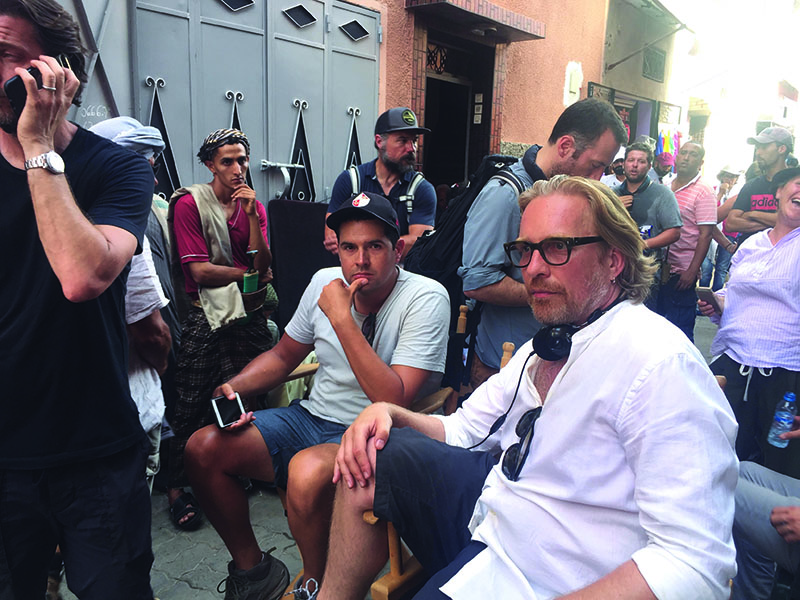
Graham Roland, left, brings his Marine experiences on set with director Morten Tyldum during the filming of “Jack Ryan,” Season One, June 2017, Marrakech, Morocco. (Photo courtesy of Graham Roland)

Roland’s enlistment was up six months after he returned. He had a year of college left. He changed his major from film and took a writing class taught by TV writer/producer Robert Engels (“Twin Peaks,” “Andromeda,” “SeaQuest DSV”). Engels was teaching a class that had never been offered at the university before, on the one-hour TV drama. Roland had taken other writing classes but had “no aspirations at all to be a TV writer. I wanted to work in features and be a director. I thought my career was going to be very different.”

He wrote a spec script, a hypothetical episode, of his favorite series, “The Sopranos.” He turned out his first round of pages for the professor about three weeks into class. At the end of one class, Engels said, ‘Who’s Graham?’ Roland responded with, “That’s me.” He said, “Oh, yeah, the Marine guy … Walk with me to my next class.”

Engels told him, “I really like your writing, but I’m curious about your experience in the Marines. I’m wondering if you can write me an original pilot about being a Marine and your experience overseas. It doesn’t have to be true; it just has to be inspired by that.”

Roland said, “I think I can do that.”

Engels replied with, “If you can do that, I will give you an ‘A.’ All you have to do is finish it. It doesn’t have to be good. Give me 50 pages of you and your story.”

He wasn’t doing this with anybody else in the class; he was making them spec their favorite TV show. Engels wanted to see what Roland could do. Roland “rogered up” and finished the script. Engels gave him notes as if he were a working writer. 

When he finished, Engels said, “I think you can do this for a living.” 

Roland had never met a working TV writer, and this experience boosted his confidence. Engels helped him get a manager within a couple of weeks of graduation. The manager told him to move out to LA. 

“He really got the ball rolling,” Roland reflected. Engels’ practical advice and support stemmed from his own experience as a working writer on “Twin Peaks,” a show Roland loved growing up. Telling Roland he thought he could “make a living at this,” he said, was maybe the “biggest thing that ever happened to me, career-wise.”

“It went from being like, ‘We’ll see how it goes,’ to a tangible kind of thing where this guy believes I can do it, and now I believe I can do it. I got very lucky. That same spec I wrote about being in Iraq, it got me a manager, an agent and my first job on the show ‘Prison Break,’ all within a year.” 

He’d been back from deployment for less than two years when he started his career on “Prison Break.” Using his Marine Corps experience as a touchstone, Roland said, “Really, had I not had that [deployment] experience, I could have never written that script. … Looking back on it, I didn’t know anything. … I knew very little about being a writer. I learned about being a writer after I got a job being a writer.”

Early in his writing career, although he was inspired by certain shows, Roland was unable to sit down and have a clear concept of what made “a good drama.” He struggled to tell someone what made a good scene and settled for things he thought were “cool.” Conveying authenticity, though, was something he was good at.

Authenticity is what people respond to in his writing. 

“All those moments and characters … that I came across in my deployment [were given an outlet in that] script,” he said. The script was science fiction, not based in reality at all, but “it was the setting … the world … how Marines talked to each other. How the characters interacted was what people responded to.”

The script he wrote led to his second job on “Lost.” He had the opportunity to co-write three episodes for the hit show. The opportunity introduced him to producer and showrunner Carlton Cuse, who he has worked with several times since. They even produced one of Roland’s own shows together. “That spec did everything for me,” he said. “It changed my life.”

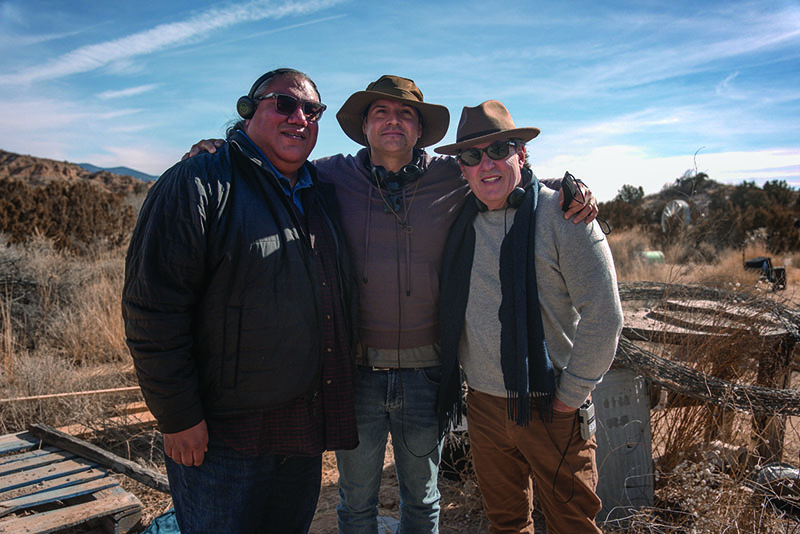
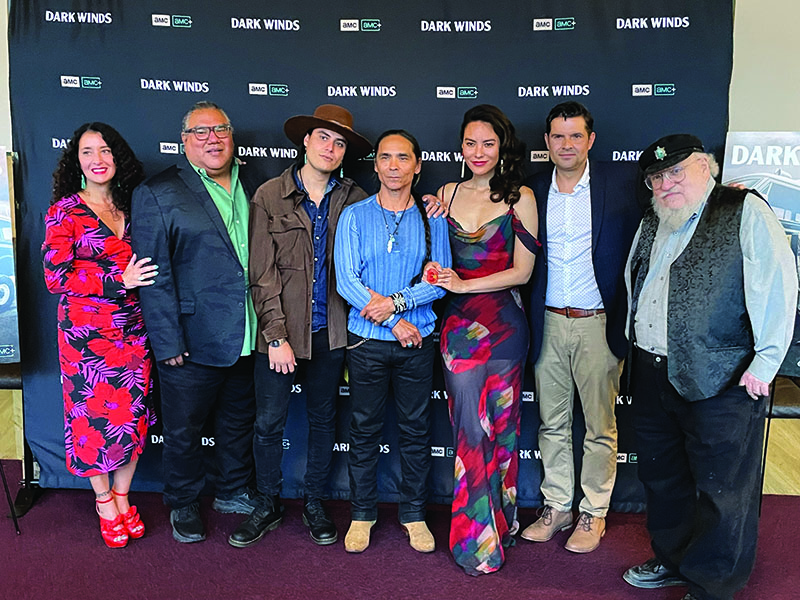
On set of “Dark Winds,” Season 2 (left to right): director, Chris Eyre; co-creator, Graham Roland; and showrunner, John Wirth. 

Roland carries the Marine Corps’ training with him—the perseverance and putting in the hours to continue pushing forward when “you think you can’t anymore. That is definitely something I got from being a Marine … and the tactfulness and chain of command. All of those things I learned there has played a role in my career.”

Roland drew on his Marine Corps service to co-create the hit Amazon Prime Video “Jack Ryan” series. “I had done some traveling, but I had never been to a place that was seemingly so different from my home [than when I was in Iraq]. These people are a lot more like me than people realize. That was born out of being around them every day. Their lives were kind of existing around us. Seeing the majority of them just wanting the same things we all wanted—take their kids to school, take care of their families, be able to work, [although] yes, there were differences. … When we decided to do a story on Islamic extremism, the antagonist for that season was a Middle Eastern terrorist. I remember … thinking, ‘If I am going to do this, I am going to do my best to show that person’s story too.’ ”

Graham Roland, second from right, with the cast and producers of “Dark Winds” at the show’s premiere in Santa Fe, N.M., June 2022. (Photo courtesy of Graham Roland)

He wanted to show “how they could have gotten to that place. That is why the pilot started out with the [character] when he was a little boy. You find out that this extremely traumatic event happened to him and his brother. There is a scene in one of the episodes I wrote where he is playing an Arabic version of Monopoly. They were all little attempts to say this person is misguided and lost, but I think, at the core of it, there is more to the story and to people, that [they] are more similar than dissimilar. I don’t think I could have done that storyline had I not deployed and had that experience.”

Roland’s new series, “Dark Winds,” which airs on AMC, is based on the novel series Leaphorn & Chee, written by decorated Army World War II veteran Tony Hillerman. He has strong characters who are military veterans throughout the show. The lead character, Joe Leaphorn, portrayed by Zahn McClarnon, is a Korean War veteran. Sheriff Gordo Sena, played by A Martinez, is shown as a World War II veteran. 

“I got everything I thought I wanted out of [the Marine Corps,]” Roland shared, “and a lot more. The things that I carry with me are those friendships that are unlike any other you’ll ever have. … When I see them, it is like no time has passed.” The Corps was a “tough experience,” but, he said, “I wouldn’t change anything about it. Some of my favorite memories are from that period. They are all usually based around those friendships.”

Featured Image (Top): Future Hollywood writer Graham Roland in Camp Fallujah, Iraq, September 2005.


Authors Bio:

LtCol Joel Searls, USMCR, is a journalist, writer and creative who serves in COMMSTRAT for the Marine Corps Reserve. He has completed the Writer’s Guild Foundation Veterans Writing Project, is a produced playwright, a commissioned screenwriter and an entertainment consultant. His most recent feature film-producing project is “Running with the Devil,” and his most recent TV series producing project is “Top Combat Pilot.” He is a graduate of The Ohio State University.

The Battle of Khe Sanh: A Fourth Touchstone Battle for the Marine Corps

FIRST-PLACE WINNER: Leatherneck Magazine Writing Contest

Executive Editor’s note: The following article received 1st place in the 2025 Leatherneck Magazine Writing Contest. The award is provided through an endowment by the Colonel Charles E.  Michaels Foundation and is being given in memory of Colonel William E. Barber, USMC, who fought on Iwo Jima during World War II, and was the recipient of the Medal of Honor for his actions at the Battle of Chosin Reservoir during the Korean War. On Jan. 1, we will begin accepting submissions for the 2026 Leatherneck Magazine Writing Contest.


Belleau Wood, Iwo Jima and the Chosin Reservoir are the Marine Corps’ three touchstone battles—names that hit like a mortar round in the chest. They’re the gold standard: Marines charging into hell, bleeding for every scrap of ground and coming out on top when the odds say we shouldn’t. I carried those stories with me through my time at 3rd Battalion, 6th Marines, Scout Sniper Surveillance and Target Acquisition (SS STA) 3/6, Camp Lejeune, N.C., until I hung up my uniform on Jan. 25, 2004. 

As the Corps turns 250, I’ve been chewing on what other fight deserves to stand with those giants. For me, it’s the Battle of Khe Sanh, Vietnam, 1968. That siege wasn’t just a battle—it was a crucible, a 77-day gut check that forged Marines into something unbreakable. It belongs up there with the big three, and here’s why.

Khe Sanh started in January 1968, when the North Vietnamese Army (NVA) clamped down on the Khe Sanh Combat Base, a speck of dirt near the DMZ and the Laotian border. About 6,000 Marines and allies—mostly the 26th Marine Regiment—found themselves surrounded by 20,000 to 40,000 NVA troops. The enemy’s plan was straight out of its playbook: besiege, bombard and bury, just like they did to the French at Dien Bien Phu. For 77 days, those Marines took a pounding—over 10,000-15,000 rounds of artillery and rockets, in addition to U.S. bombing, and  more than 1,000 rounds a day at the worst of it. Hill 881 South, Hill 861, the main base—they became islands in a sea of mud and fire. Supplies ran thin, the weather was a soup of fog and rain, and the NVA kept coming. But the Marines didn’t just hold—they fought.

That’s what makes Khe Sanh a touch-stone: the sheer stubborn will it took to stay in the fight. I picture those grunts in their trenches, caked in red clay, patching bunkers after every barrage. Resupply drops came under fire, with C-130s and Hueys dodging antiaircraft guns to get ammo and chow through. It was chaos, but it was controlled chaos, the kind I saw in my own small way at Lejeune with SS STA 3/6. We weren’t in combat, but we kept the battalion’s gears turning—logistics, comms, planning. Khe Sanh was that on steroids: Every Marine, from the commanding officer to the newest private, locked in to keep the machine running. Patrols slipped out to hit NVA positions, artillery crews fired until their barrels glowed, and air support—Marine, Navy and Air Force—dropped over 100,000 tons of bombs, turning the hills into a wasteland. When Operation Pegasus rolled in with Army and Marine reinforcements in April, the NVA limped away, leaving bodies and broken plans behind.

Air Force F-100s deliver close air sup­port following an assault on ARVN Ranger positions, Khe Sanh, 1968.

Khe Sanh mirrors Belleau Wood, Iwo Jima and Chosin in ways that cut to the bone. Belleau Wood was raw guts—Marines rushing German lines, taking casualties but never stopping. Khe Sanh had that same fire, just pinned down instead of charging. Iwo Jima was about digging in, making a volcanic rock a fortress—Khe Sanh’s hills were the same, only with jungle and mud instead of ash. And Chosin? That frozen march out of a Chinese trap, outnumbered 10 to one? Khe Sanh was its echo—surrounded, outgunned but never outfought. The difference is the siege itself: 77 days of unrelenting pressure, a modern test of what Marines can endure. It wasn’t about maneuvering or grand strategy; it was about standing fast when everything said to break.

Now, some will argue Khe Sanh doesn’t fit because we pulled out after the siege. The base got torched and abandoned in July ’68, and critics say that stains the victory. Fair point: Nobody’s raising a flag over Khe Sanh today like we did on Suribachi. But touchstones aren’t about holding dirt forever; they’re about what the fight reveals. Khe Sanh was a slugfest that messed up the NVA’s Tet Offensive, tying down divisions they needed elsewhere. It cost them thousands—estimates run from 10,000 to 15,000 dead—while we lost under 500 KIA. More than that, it was a middle finger to the idea that Marines could be cracked. I’d tell those doubters victory isn’t just a map pin; it’s the message you send. Khe Sanh screamed, “You can’t take us.”

Khe Sanh was that spirit writ large—Marines doing the dirty, thankless work to hold the line. I remember a gunny who’d been at Chu Lai in ’69, not Khe Sanh, but he talked about Vietnam like it was yesterday. He’d say, “You don’t win by running—you win by staying.” That’s Khe Sanh: staying when every instinct says go. I left the military in ’04, honorable discharge in hand, but that lesson stuck.

In the White House situation room, President Lyndon B. Johnson (second from left) examines a scale model of the Khe Sanh Combat Base, Feb. 15, 1968.

It’s what I’d tell the boots today: Stand your ground, because that’s what Marines do.

The battle’s legacy runs deep. It showed combined arms at its peak—air strikes syncing with arty, infantry holding the perimeter. I can see the forward air controllers on those hills, calling in Phantoms while mortars pounded the treeline. It’s a blueprint for how we fight now—integrated, relentless. Khe Sanh also cemented small-unit leadership. Lieutenants and sergeants kept their squads tight, kept them believing, even when the sky was falling. That’s the Corps I knew: NCOs running the show when it counts. And the vets? I’ve met a few—gray-haired, quiet types at VFW halls. They don’t brag, but you see Khe Sanh in their handshake, their nod. It’s the same steel you feel from Chosin survivors or Iwo vets—a brotherhood forged in the worst of it.

Khe Sanh’s place as a touchstone isn’t just about ’68; it’s about 2025 and beyond. It’s a reminder that wars change but Marines don’t. We adapt, sure—Vietnam wasn’t Belleau Wood’s trenches or Iwo’s beaches, but the core stays: Fight hard, fight smart, fight together. Khe Sanh teaches that isolation isn’t weakness; it’s a chance to prove what you’ve got. I’d tell any Marine to study it. Feel the weight of those 77 days. It’s not just history—it’s us, at our toughest, our proudest. Belleau Wood, Iwo Jima, Chosin—they’ve got a brother in Khe Sanh. On our 250th, let’s give it the honor it’s earned.

Marines of 1st Platoon, Company K, 3rd Battalion, 4th Marines, salute as the American flag is raised during a memorial service at Khe Sanh. Joined by soldiers of the Army of the Republic of Vietnam, the ceremony paid tribute to those lost during the 77-day siege. (Photo by SSgt Fred Lowe III, USMC)

Author’s bio:

HM3 Brian Nielson served with 3rd Battalion, 6th Marines, Scout Sniper Surveillance and Target Acquisition (SS STA) 3/6 at Camp Lejeune and was honorably discharged in 2004. Nielson served as the senior corpsman of SS STA on Camp Lejeune and is the founder and CEO of Kern + Bellows, a defense contractor specializing in re-cruitment and advertising.

The Great Hagaru-ri Airlift: Six Momentous Days in the Korean War 

On Nov. 27, 1950, the 5th and 7th Regiments of the 1st Marine Division were in Yudam-ni, a mountain hamlet on the western side of the Chosin Reservoir, positioned for a thrust west across the upper reaches of the Taebaek Mountains and a link-up with the American 8th Army. The Marine offensive would be part of the “Home by Christmas” offensive, the grand design of the U.S. Commander in Chief, Far East, General of the Army Douglas MacArthur, to end the Korean War. As proposed in his double envelopment strategy, found in Roy E. Appleman’s “South to the Naktong, North to the Yalu,” the X Corps, which included 1stMarDiv, and 8th Army would act as giant pincers, ensnaring and destroying the remnants of the North Korean People’s Army (NKPA) that were fleeing north after the breakout of the 8th Army from the Pusan Perimeter and the successful amphibious landings of 1stMarDiv at Inchon in September. 

In developing this stratagem, MacArthur’s war planners seemingly disregarded reports that Chinese Communist Forces (CCF) were amassing in southern Manchuria, and that perhaps tens of thousands of them had already crossed into North Korea by the middle of October, writes Appleman. 
Entrapment and Breakout

The 5th and 7th Marines began moving west and were shortly engaged, not by the disorganized units of the NKPA but by the hardened troops of the 79th and 89th Divisions of the CCF’s IX Army Group, 3rd Field Army. A third division, the 59th, struck to the rear at the Toktong Pass to interdict the main supply route (MSR). After four days of violent combat, the 5th and 7th Marines began a fighting withdrawal to Hagaru-ri, the division’s forward operating base some 14 miles south. They brought with them all their wounded and dead; and they did so during one of the coldest winters seen in northeast Korea—blustery, snowy Siberian winds dropped the temperatures into the minus 30s, causing weapons, artillery and vehicles to malfunction. Moreover, though they had been issued cold-weather gear, an alarming number of cold-weather casualties began to appear—hypothermia, chilblains, trench foot and frostbite of the face, hands and feet.
The 7th Marine Regiment at Yudam-ni prepares to depart, ready to fight its way back to Hagaru-ri and on to the sea for extraction in December 1950.

Meanwhile, more divisions of the IX Army Group struck south at Hagaru-ri, Koto-ri and Chinhung-ni and cut the MSR in several places. The hardest hit was Hagaru-ri. There, on the night of Nov. 28—“Hagaru’s Night of Fire,” according to Lynn Montross and Nicholas Canzona’s “The Chosin Reservoir Campaign”—the 58th Division attacked the southwest defensive perimeter and threatened to overrun a medical battalion hospital and the partially completed airstrip, which Lieutenant Colonel John H. Partridge’s 1st Engineer Battalion had been working on since the division arrived in Haragu-ri on Nov. 15. Fortunately, with the help of a detachment of engineers who left their heavy equipment and took up arms, the attack was thwarted. 

As the fighting in the southwest wound down, another CCF division attacked East Hill, the largest of the hills surrounding Hagaru-ri. During the ensuing seesaw battle, the Chinese Communists took the hill and resisted several attempts to dislodge them. By the morning of Nov. 29, the only force preventing a CCF breakthrough at East Hill was a ragtag group of defenders—administrative and supply personnel, and bits and pieces of infantry units—bolstered by several tanks and machine-gun emplacements.

Though seriously outnumbered, the doughty defenders of Hagaru-ri had held the line, and further CCF attempts to breach the defensive perimeter would fail.

During the early morning of Dec. 1, General Oliver P. Smith met with his division surgeon, Captain Eugene R. Hering Jr., at the division command post at Hagaru-ri. Smith recorded the reason for the meeting in his aide-mémoire (war journal) entry for that day: “The casualties in his installations were piling up and he was concerned over his ability to provide suitable medical care. At that time he had about 600 casualties at Hagaru-ri awaiting evacuation.” Hering expected “400 additional casualties” to arrive from the east side of the Chosin Reservoir, where the 7th Infantry Division’s 31st Regimental Combat Team had been decimated by several CCF divisions, and many, many more from the 5th and 7th Marines, who were fighting their way back to Hagaru-ri. “The only solution to our casualty problem,” wrote Smith, “was the completion of the C-47 strip.” However, he noted that “the Engineers considered the strip to be only 40% completed”; nonetheless, “it was decided to bring in a C-47 on a trial run.” 

At about the time of their meeting, General William H. Tunner, commander of the Combat Cargo Command of the U.S. Far East Air Force, received a message from Colonel Hoyt Prindle, his liaison officer with X Corps—a composite of 1stMarDiv and the 3rd and 7th Infantry Divisions, commanded by Army General Edward M. Almond. In the message, Prindle related the important details of recent staff meetings at the Corps headquarters in Hungnam, which can be found in Tunner’s book “Over the Hump”: “I am in General Almond’s outer office and waiting to get in to see him. I attended briefings both last night and this morning … The situation at and near the Chosin Reservoir is critical. We must exert every possible effort to airdrop supplies and ammunition into that area in order to get the 1st Marine Division out or we will be lost. There are already between 900 and 1,000 casualties that urgently need air evacuation now. If we don’t get them out, they won’t get out.”

Prindle also briefed Tunner on the status of the landing strip at Hagaru-ri: “A 3,200-foot strip being hacked out of the frozen earth will be ready by 4 p.m. this afternoon. It may or may not be under enemy fire. We will have to take that chance. If usable it will help the air evacuation situation and also re-supply the unit that is near the strip. The support of others must be handled by air drop.”

He further expressed the need for immediate action, stating that “roughly ten Chinese Red divisions” were “closing in” on Hagaru-ri and that waiting a “few more days” was not an option. He wrote, “The roads to this area are cut in a number of places and everyone will have to fight his way out.”

Later that same morning, Prindle again messaged Tunner: “I just came out of Almond’s office and he asked me to express to you in the strongest terms the urgency of the situation in the Chosin Reservoir area. Re-supply of those units will have priority over all other requests.” Prindle emphasized in his closing remarks that “the drop situation and the relief of the 1st Marine Division is most urgent,” and recommended a course of action: “It is a C-47 operation entirely from the way I look at it … if we are able to air land into the strip which is located one mile south of the southern end of the reservoir.” C-47s and their Marine Corps variant, the R4D, were large, multi-engine transports that could carry up to 6,000 pounds of cargo, 28 troops or walking wounded, or 18 stretcher cases—and more often than not carried far more.

Tunner, who had directed the 1948 Berlin Airlift, agreed with Prindle. After receiving the approval of his superior, Lieutenant General George E. Stratemeyer, commander of the U.S. Far East Air Force, he recalled telling Pringle, “I am going to move every C-47 I’ve got up there.” He also committed to using “two squadrons of C-119’s … to do air drops of ammunition, clothes, and anything else” the Marines needed.

According to Paul C. Fritz’s article “The Kyushu Gypsy Squadron in Korea” in Air Power History, word was soon passed to the 21st Troop Carrier Squadron (TCS)—the “Kyushu Gypsies”—at Itazuke Air Base in Japan to dispatch 11 C-47s to Yonpo Airfield, the aviation facility closest to the port city of Hungnam, the southern anchor of 1stMarDiv’s MSR.

Last Days at Hagaru-ri 

The first Gypsy C-47 touched down at Hagaru-ri on the afternoon of Dec. 1, but, according to “The Chosin Reservoir Campaign,” the landing and subsequent takeoff were anything but uneventful: “It was a tense moment, at 1430 that afternoon, when the knots of parka-clad Marine spectators watched the wheels of the first FEAF C-47 hit the frozen, snow-covered strip. 

The big two-motored aircraft bounced and lurched its way over the rough surface, but the landing was a success. An even more nerve-racking test ensued half an hour later when the pilot took off with 24 casualties. It seemed for a breath-snatching instant that the run wouldn’t be long enough for the machine to become airborne, but at last the tail lifted and the wings got enough ‘bite’ to clear the hills to the south.” 

Several more planes of the 21st TCS flew into Hagaru-ri after that, offloaded their cargoes and left for Yonpo fully loaded with casualties. The last arrival of the day, a Marine Corps R4D heavily laden with ammunition, broke its landing gear on touchdown and crashed. A total of 211 casualties were flown out of Hagru-ri that day: 157 by C-47s and 54 by Stinson OY-1 aircraft and Sikorsky HO3S-1 helicopters of Marine Observation Squadron 6. 

According to Captain Annis G. Thompson’s “The Greatest Airlift: The Story of Combat Cargo,” few planes flew in and out of Hagaru-ri without experiencing damage from harassing enemy groundfire or mishaps.

In fact, the Air Force considered the flights to be so dangerous that it prohibited flight nurses of the 801st Medical Air Evacuation Squadron based at Yonpo from participating in them; only aeromedical technicians of the squadron provided in-flight care. 

When casualties from Hagaru-ri arrived at Yonpo Airfield, they were triaged by X Corps medical clearing teams to one of the three fully staffed and equipped hospitals in the Hungnam area; to the hospital ship, USS Consolation (AH-15), moored in Hungnam Harbor; or flown to a military hospital in Japan. 

The evening of Dec. 1, survivors of the embattled 31st Regimental Combat Team began arriving at Hagaru-ri. About 1,050 of those making it to safety required evacuation.

On Dec. 2, “an all-out effort was made to evacuate the casualties on hand by both C-47 and liaison plane,” Smith wrote in his aide-mémoire. Nine hundred and sixty casualties were flown to Yonpo that day. According to Gail B. Shisler’s book “For Country and Corps: The Life of General Oliver P. Smith,” things were so busy at the airfield, that it reminded Smith of LaGuardia Airport.

At about this time, Fritz, the assistant squadron officer of the 21st TCS, flew into Hagaru-ri, and later wrote of the experience: “Hagaru-ri lay in a bowl formed by mountains in all directions, except on the north side, which opened to the reservoir, a long narrow lake extended northward. The hamlet and our newly hacked airstrip area were protected from excess water by a long east-west dike about twenty-five high. The airstrip was oriented north-northwest to south-southeast, with the north end pushing right up to the dike. These features dictated landings north, with a guarantee of no over-shooting, and takeoffs south.”

Fritz also noted that runway was “about 2,500 feet” and that there was a “parking area for three C-47s.” Between the hamlet and airfield to the west was a “drop zone for C-119s,” above which “Marine Corps and Navy fighter aircraft droned in lazy circles.” But what he found most memorable was what he saw in and around the makeshift terminal: “After parking, I learned that people can overcome unbelievable difficulties. To an ex-Minnesotan and ex-infantryman/officer, this was a composite of a disaster and catastrophe. Severe cold greeted us, with a horrible stench—a pungent combination of vehicle exhausts, fired gunpowder, smoke from bonfires, and men’s bloody clothing over unwashed bodies.” Those ambulatory casualties who were waiting to be evacuated were “huddled speechless in knots, their eyes vacant from witnessing untold horrors, unshaven for days, and wearing blankets draped over their shoulders.” Everyone was disabled in one way or another: “Many hobbled about with walking poles or canes fashioned from tree limbs. Some were barefoot with bright-red or gangrene-blackened feet. One man who boarded my C-47 flipped away all of his toes like rotten apples before getting aboard. Not a word was spoken—a brief flicker in their eyes was their thanks for our ‘magic-carpet’ that would whisk them away to safety and medical attention.”

Some 464 casualties were evacuated to Yonpo on Dec. 3. At dusk, when air operations ceased, most of the casualties remaining at Hagaru-ri were those unable to be transported out and those among the survivors of the 31st Regimental Combat Team trickling in.

Sometime that day, Capt Hering went to the division command post to see Gen Smith. In his oral history transcript in the Marine Corps University Archives, Smith would remember that Hering was “fit to be tied” because he realized that some men with minor wounds or mild frostbite were gaming the system. Apparently, medical malingerers “would go down to the strip and get a blanket and a stretcher and then groan a bit,” and try to talk their way onto a flight. “It was our fault probably,” Smith admitted, “because the Air Force had sent up what they called an Evacuation Officer, and the doctor [Hering] assumed that the Evacuation Officer would see that the proper people got aboard the planes, but that was not his function at all; he was just thinking in terms of planes, not on what was flown on the planes.” As a stopgap measure, Hering promptly introduced a stationed at the loading area of every outgoing plane. “Nobody after that got on any plane without a [doctor-issued] ticket that showed that he was due to get out,” said Smith.

Hering also issued strict, multilevel triaging procedures for frostbite casualties, documented in a 1stMarDiv special action report dated Oct. 8-Dec. 15, 1950: “All frostbite [cases] were screened three times, once by their own unit surgeons, again by the medical companies and finally by a team consisting of the Division and Regimental surgeons and a senior line officer from each regiment. As a working criterion, those with large blisters or large discolored areas [Grade 3 frostbite] were considered candidates for evacuation.” 

Borderline cases were referred to Hering, who later explained the simple but austere standard—the “Lessenden Rule”—that he used to decide for or against evacuation in his article, “Combat Medical Practice”: “This sorting of frost-bite added greatly to our medical burden and was … almost brutally done, as we needed every man capable of bearing a rifle … I personally passed on all controversial cases, using as my criteria the feet of the 5th Regimental Surgeon [LCDR Chet Lessenden]. He refused to be evacuated although he could not walk without great pain, but insisted on riding in an ambulance with his medical section. Those worse than we evacuated, those less fought their way back.”

Marines of the 2nd Battalion, 5th Marines, set up a command post in the hills around Chosin Reservoir.

Just after 7 p.m. on Dec. 3, the lead element of the column from Yudam-ni entered the Hagaru-ri defensive perimeter, and about twenty hours later, the rear guard arrived. As noted in one account of the heroic withdrawal from Yudam-ni in “The Chosin Reservoir Campaign,” “The four-day operation passed into history. Some 1,500 casualties were brought to Hagaru, a third of them being in the non-battle category, chiefly frostbite cases. It had taken the head of the column about 59 hours to cover the 14 miles, and the rear units 79 hours.” 

The medical needs of the arriving casualties overwhelmed the medical facilities and personnel at Hagaru-ri. Yet, as Capt Hering later recalled, “Somehow they were sorted, those in need given resuscitation and definitive care, sheltered, warmed, and fed.” The critically wounded were shunted to the two medical battalion hospitals, Charlie and Easy Med, which were near the airstrip. 

The commanding officer of Easy Med, Navy Lieutenant Commander Charles K. Holloway Jr., a veteran of the Second World War and one of the most experienced surgeons in the division, vividly remembered the challenges he faced on Dec. 4, as recounted in his unpublished manuscript “Escape From Hell: A Navy Surgeon Remembers Pusan, Inchon, and Chosin”: “We had so many patients lying, sitting, and standing that we could hardly see the floor. The 300 triple-deck bunks of our expanded capacity were simple wooden frames that held the patients’ own litters. I stacked patients like sardines in the commandeered pyramidal tents, 25 casualties in a circle around the center stove.

Their own body heat and warmth from the heater kept them from freezing until we could load them on planes in the few hours of safe operation left at the airstrip. There was not much else we could do for them at the time, but it was enough to save most of them.”

Those requiring “emergency surgery, and there was surprisingly few, managed to get it.”

CAPT Eugene Hering, USN, 1st Marine Division surgeon, right, shows Secre­tary of the Navy Francis P. Matthews the hospital at Hamhung.

Those whose surgery could be delayed “were evacuated by air to get needed surgical treatment later at the First Marine Division Hospital in Hamhung.” Those “who had made the supreme sacrifice for their buddies” were placed in a “morgue tent” erected in front of the hospital.

Dec. 5 was 1stMarDiv’s last full day at Hagaru-ri, and the rush was on to evacuate the remaining casualties. That day, according to Air Force historian William M. Leary’s book “Anything, Anywhere, Any Time: Combat Cargo in the Korean War,” the 21st TCS “flew 44 missions into the perimeter … the 1st Marine Aircraft Wing flew 10, and a detachment of C-47s from the Royal Hellenic Air Force flew 8.” Together they “brought in 254,851 pounds of freight and 81 replacement Marines” and evacuated “1,561 casualties.” Regretfully, wrote Leary, “there was neither the time nor the space on the airplanes to bring out all the bodies of the dead.”

While the busiest day of the airlift unfolded, correspondents scrambled to file their last-minute reports from Hagaru-ri. All civilians and nonessential personnel were directed to leave by the end of the day, as Gen Smith had ordered 1stMarDiv to begin the breakout from Hagaru-ri the following morning.

Their dramatic stories, accompanied by maps, filled the front pages of the nation’s newspapers. Their common theme: The oldest and most venerated division in the Marine Corps, the finest group of fighting men in the world, was in mortal danger of being annihilated by an overwhelming force of Chinese Communists. An estimated nine divisions had taken up positions along the MSR with the avowed intent of exterminating the 1st Marine Division. When a reporter asked Gen Smith whether he was retreating or withdrawing from the Chosin Reservoir, he replied that he had done neither. There is no retreating or withdrawing when you’re surrounded, he was purported to say, you can only attack. His response was quickly transmuted by the press into perhaps the most memorable phrase of the war: “Retreat, Hell! We are just attacking in a different direction.” Smith had refused General Tunner’s earlier offer to fly out the entire division—“It just didn’t occur to us that we wouldn’t be able to fight our way out,” he later said, according to the Marine Corps University Archives transcript.

During the snowy, sub-freezing morning of Dec. 6, the 7th Marines passed through the Hagaru-ri defensive perimeter and proceeded along the MSR toward Koto-ri, some 11 miles to the south; the breakout from the Chosin Reservoir had begun. “Twenty miles of icy, winding, mountain road barred by a 6,000-foot pass with enemy spread on both sides, stand between the Marines and the open road to the ocean,” wrote war correspondent Keyes Beech that day.

A wounded Marine sips hot coffee from a canteen cup while awaiting evacua­tion to a rear area hospital for treatment.

While this was unfolding, the evacuation of the remaining casualties continued. At noon, the director of operations for the Combat Cargo Command, Colonel Robert D. Forman, flew into Hagaru-ri to direct the final evacuation flights. Accompanying him was Michael James of the New York Times, who later described the final moments they spent at the airstrip: “By this time the whole area was a sea of flames. Not only were Marines burning their surplus stocks, but two slightly damaged C-47 transports, neither of which could be flown out due to lack of immediate repairs, went up in flames.

Colonel Forman who flew the last transport out … was notified by radio jeep that there was one more wounded man desperately in need of expert medical attention. For one hour Forman waited while the enemy closed in on the field. Eventually a jeep drove up with the last casualty who was taken aboard.” 

As the plane lifted off through a swirling snowstorm and hail of enemy gunfire, countless Chinese Communist foot soldiers swarmed over the abandoned airfield. 

An Unparalleled Aeromedical Operation

The following day, General Stratemeyer sent a redline message to the Chief of Staff of the U.S. Air Force, General Hoyt Vandenberg, reporting that 4,369 wounded Marines and soldiers had been evacuated by the Combat Cargo Command during the six-day Hagaru-ri airlift, as documented in “The Three Wars of Lt. Gen. George E Stratemeyer: His Korean War Diary.” By any standards, it was a historic achievement—a “very outstanding performance,” commented Stratemeyer in a dispatch to General Tunner. Time magazine was so impressed with the airlift that it featured Tunner on its Dec. 18 cover, calling him the “Airlifter.”

Marine tanks maneuver around a blown bridge south of Koto-ri as the allies push to break out from a Chinese Communist encirclement en route to the beachhead at Hungnam, December 1950.

Gen Smith was unsparing in his praise of the Hagaru-ri airlift. “I believe the story of this evacuation is without parallel,” he wrote in his aide-memoir. “Credit must go to the troop commanders whose determination and self-sacrifice made it possible to get the wounded out, to the medical personnel whose devotion to duty and untiring efforts saved many lives, and to the Marine and Air Force (including Greek) pilots who accomplished this difficult task without a fatal accident in spite of the hazards of the weather and the rudimentary landing strip.” 

The “fabulous” airlift ushered in a new era in combat medicine, Hering said in a press conference after 1stMarDiv reached the safe environs of Hungnam, prompting one exuberant Kansas City Star reporter to label aeromedical evacuation as the “great medical weapon” of the war. Later, Hering would clarify its role in military medical operations in the article he wrote for The Military Surgeon journal: “Air evacuation is only a link in the chain of casualty care. It is a strong member of the team, but it is not the whole answer. Every other member of the team must be utilized under most conditions, from the company aid men all the way through to the evacuation hospital, the naval hospital ship, and the base hospitals in the zone of the interior. It is a wonderful adjunct, our greatest advance in the evacuation of casualties, but still an adjunct.”

Featured Image (Top): Casualties are loaded onto a C-47 at Hagaru-ri for evacuation during the Battle of the Chosin Reservoir, December 1950. Over six days, more than 4,300 casualties were flown out under constant threat of enemy fire.


Authors:

Dr. Eugene Ginchereau is a military historian and retired Navy physician. 

André B. Sobocinski serves as the historian at the U.S. Navy Bureau of Medicine and Surgery.


Steel Curtain: The Ambush of Second Platoon

In July 2005, the 13th Marine Expeditionary Unit (MEU) put to sea from California with Battalion Landing Team (BLT) 2nd Battalion, 1st Marines, embarked. The deployment began in typical fashion. Marines made port calls and participated in exercises through Australia, the Philippines and other Southeast Asian countries. By September, the MEU had sailed into the Red Sea and on to Egypt. As the Marines transited the Suez Canal, word disseminated of their next operation. The BLT was headed to combat in Iraq.

The new orders proved largely expected. Throughout the previous year, numerous MEUs supported the fighting in Fallujah, Najaf and other areas of Iraq. Even 2/1 had previously experienced an identical situation in 2003 as part of the 15th MEU, surging north from Kuwait with the initial invading force. By 2005, several invasion veterans lingered in the battalion. Considerably more had fought through the battalion’s next Iraq deployment during the First Battle of Fallujah in April 2004. Now on its third deployment in as many years, senior leaders called on the BLT to support the largest Marine Corps operation in Iraq since Operation Phantom Fury. The main effort focused on arresting control of the wildest part of Iraq’s “Wild West,” the Al Qa’im region.

Then-GySgt Michael D. Fay produced numerous paintings and drawings during Operation Steel Curtain. In this scene, Capt Ross Parrish, the Fox Co Commander, coordinates his forces over the radio in Karabilah, Iraq, during combat on the Marine Corps Birthday.

Al Qa’im made up the northwest corner of Iraq along the Syrian border. In 2004, while 2/1 battled insurgents some 200 miles down the Euphrates River valley, other Marines faced uprisings throughout Al Qa’im. On April 14, 2004, in Karabilah, Corporal Jason Dunham was mortally wounded smothering a grenade and saving the lives of two other Marines. He became the first Marine to receive the Medal of Honor since the Vietnam War. Conditions worsened as the year progressed, culminating in November when virtually all American forces departed Al Qa’im to support Operation Phantom Fury in Fallujah. The battle forced insurgent leader Abu Musab al-Zarqawi out of the city. He retreated northwest and reestablished a base of operations in Al Qa’im. Zarqawi cemented his control over the region throughout 2005, despite a persistent Marine presence and limited offensive operations. The approach of Iraqi parliamentary elections, however, demanded a secure environment in which to conduct voting. The balance of power in Al Qa’im would not truly be tested until the arrival of 3rd Battalion, 6th Marines, that August.

The Marines of 3/6 occupied Camp Al Qa’im, based several miles south of the urban centers along the Euphrates River. One company operated out of another American outpost called Camp Gannon, guarding over the Syrian border crossing in Husaybah. The Marines executed Operation Iron Fist at the beginning of October, sweeping through portions of Karabilah and Sadah and establishing forward battle positions across the region. The battalion was spread thin manning each position, most engaging the enemy in daily firefights to hold their ground. 

3/6 occupied the Al Qa’im region prior to BLT 2/1’s arrival. Beginning at the western edge, Operation Steel Curtain aimed to clear through Husaybah and Karabilah before pushing east into Ubaydi.

As 3/6 maintained the foothold in Al Qa’im through the remainder of the month, BLT 2/1 flew into Iraq. Both battalions would work together through the next phase of the Marines’ attack plan, dubbed Operation Steel Curtain, to clear the entire region, building by building, and drive out the insurgency before the election. The BLT transitioned rapidly from the MEU training mindset to mental preparation for imminent combat.

“Everything felt pretty surreal as I remember it,” said Justin VanHout, then a lance corporal in 2/1’s Fox Company, 2nd Platoon, 1st Squad. “Everything happened so fast. We flew from Kuwait up to Al-Asad and staged there. They sent a convoy up from Kuwait bringing all of our equipment. About that time, we got word there was some sort of accident, a vehicle rollover, and we lost our first Marine. Lance Corporal Christopher Poston. I think that moment kind of set a demeanor for a lot of us, like, ‘Well, here we go.’ Kind of gave us the impression that we were actually in it.”

LCpl Jeff Jendrzejczyk, an 0351 assaultman attached to 2nd Plt, Fox Co, BLT 2/1, rests during combat operations in Karabilah on the Marine Corps Birthday. Michael D. Fay produced a painting based on this photograph titled “The Other Side of Exhausted.”

“For me, things still weren’t hitting that we were actually in a combat zone,” added Shawn Studzinski, another lance corporal in 2nd Platoon’s 1st Squad. “We’d be walking around base at Al-Asad and all of the sudden an alarm would go off because there was a mortar strike, but still it’s not clicking. Then, on one of our company’s first missions, we were barely outside the wire when one of our 7-tons hit an IED. Everybody made it out OK, but that really kind of woke me up.”

By Nov. 5, VanHout, Studzinski and the rest of 2nd Platoon had staged at the Syrian border crossing on the outskirts of Husaybah, prepared to attack east into the city. Fox Company occupied the left flank of 2/1’s advance. Their objective was to clear a modern grid-style section of the city known by Marines as “the 440 district” for the number of buildings it contained. Tense house-to-house fighting erupted across the front in spurts, increasing in frequency and ferocity as the Marines advanced. Grenades, rockets or tank main gun rounds frequently preceded grunts kicking in doors to soften up the enemy inside. The Marines worked methodically through Husaybah for three days, then moved directly on to Karabilah. After nine days of fighting, anyone left to oppose the Marines fled east down the Euphrates.

Through Steel Curtain’s opening days, 3/6 operated as the main effort. As the battalion advanced, rifle platoons re-mained behind to establish new battle positions and prevent the enemy’s return. By Nov. 13, 3/6 occupied nine separate positions sprinkled throughout Husaybah, Karabilah and Sadah. There was only one city that hadn’t been cleared. That task fell to BLT 2/1.

The city of Ubaydi lay in the center of a heart-shaped bend in the Euphrates at the eastern edge of Al Qa’im. The main road running directly up the center of the heart divided Ubaydi into “old” and “new” sections. Old Ubaydi consisted of sparsely populated farmland and anti-quated structures. New Ubaydi looked mostly like the modern urban center the BLT Marines had advanced through in Husaybah. Commanders called in supporting U.S. Army units to sweep through Old Ubaydi, while also securing any avenues of escape to the north across the river. BLT 2/1 was tasked with clearing the new city. Shooting it out in the streets morphed into point-blank combat house to house, with booby traps and hardened defensive positions greeting Marines behind each barricaded door. The insurgents’ backs were against the river, and with Americans waiting on the opposite bank, they faced the oncoming wave of Marines with no option but to hold out and fight to the death.

The grunts marched into their as-sembly areas outside Ubaydi under the cover of darkness on the night of Nov. 13. They moved dismounted into the city due to the significant threat of IEDs surrounding the area, especially along the roads. Tragically, their concerns proved well founded. As the battalion approached Ubaydi before dawn on Nov. 14, Major Ramon J. Mendoza Jr., the Echo company commander, stepped on a pressure plate. The resulting explosion killed Mendoza and wounded other Marines in the vicinity.

Marines from Fox Co, BLT 2/1, push into the palm grove standing between the edge of New Ubaydi and the Euphrates River. Many of the enemy who ambushed 2nd Plt on Nov. 16 were killed as they fled into this wooded area.

The BLT assaulted north shortly after sunrise. A new level of intensity hindered their progress. From Fox Company’s 1st Platoon, LCpl Christopher M. McCrackin burst into one house, triggering a hidden explosive device. Shrapnel tore into his body, leaving him mortally wounded. Several hours later, Cpl John M. Longoria breached a door with his fire team and ran into five insurgents armed with machine guns. In the ensuing firefight, Longoria was shot in the neck and killed.

“There was one point where our [standard operating procedure] was to put a grenade, M203 round or SMAW rocket into every building before Marines went in because you just didn’t know what you were going to meet on the other side of the door,” said Jeff Jendrzejczyk, an 0351 assaultman and SMAW gunner attached to Fox Company, 2nd Platoon, 2nd Squad. “I fired 113 SMAW rockets in combat. Most of those were in Ubaydi.”

LCpl Jeff Jendrzejczyk, an 0351 assaultman attached to 2nd Plt, Fox Co, BLT 2/1, fires a SMAW rocket in Ubaydi, Iraq

For two days, Fox Co pushed through the city, emerging from the urban maze into a sprawling countryside of farmland leading up to the Euphrates. On the morning of Nov. 16, the company spread out on line to sweep across the remaining ground. 2nd Platoon fell in the company’s center. A complex of 20 farmhouses and other structures stretched across several hundred meters along the Marines’ path—the last buildings between them and the river. A large grove of palm trees stood beyond the houses, obscuring the Marines’ view of the riverbank.

Three rifle squads filled out 2nd Platoon. 1st Squad cleared through structures around the outer rim of the complex, while 3rd Squad moved up the center. 2nd Squad remained behind, providing ground security for the BLT’s tank platoon.

“1st Squad was moving along this long stone wall towards a building on the edge of a collection of farmhouses,” VanHout said. “We stopped for a minute and all of the sudden there was a big boom. Something went off on the other side of the wall. Next thing we knew, there was gunfire everywhere and everything is going to hell. We sprinted to the end of the wall and got into our assigned building. Just as we finished clearing the first floor and another team was moving up the stairs, an insurgent burst into the house through an open back door. He had no idea we were in there. Shawn Studzinski and several others were still in the hallway when the insurgent started firing. Sparks were flying everywhere and one of our engineers got shot through the wrist. I was just inside a room next to them. I remember watching Shawn like in slow motion. He turns, drops to a knee, perfect freaking Marine form, and ‘Boom! Boom!’ Double-taps the guy right in the chest.”

“The insurgent fell into a room down the hall … and we could see his feet sticking out into the hallway,” said Studzinski. “We could see he was still moving. The engineer who was shot started screaming behind me. One of the team leaders yelled at us to frag the room. I kept watch on the doorway while VanHout moved up and pitched a grenade into the room. Somehow, the guy was still alive after it went off, so we captured him and turned him over to the Iraqi forces with us.”

“I made it up to the roof and someone told me to start firing 203 rounds into the palm grove beyond the houses,” VanHout said. “I looked down into the courtyard outside the house and saw a blown-up car and dead cow blown to pieces. I was trying to connect all the dots; the explosion, the gunfire, the insurgent we killed. In that moment, we were all so isolated inside that house. We had no knowledge of what was going on with the rest of the platoon. In hindsight, I think that initial explosion was the kicker that started everything that morning. But at the time, we had no idea that 3rd Squad and some of the other guys were in total mayhem.”

As the shooting began, 3rd Squad moved toward the buildings near the center of the complex. The squad oper-ated short-handed with only two fire teams. One team set up in a building to provide overwatch while the remaining team prepared to make entry into a farmhouse 75 yards away.

Nineteen-year-old LCpl Ben Sanbeck stacked up with his fire team outside the front door. Sanbeck took point with Cpl Joshua J. Ware next in line and two more Marines behind him. Ware pushed his hand against Sanbeck’s shoulder, silently signaling the junior Marine to dart right once they made it through the door. Over the preceding days, every Marine in 3rd Squad had expended their fragmentation grenades clearing house to house. The only thing Sanbeck possessed was a flashbang.

Above: In this heartbreaking depiction, Michael D. Fay captures a glimpse of the emotional and chaotic scene inside the casualty collection point on Nov. 16, 2005.

“I threw the flashbang through the door and all that did was stir the hornet’s nest,” Sanbeck reflected today. “That gave them timing. They knew as soon as it went off, we were coming through the door. I rounded the corner and as soon as I made entry, the insurgents already had a grenade in the air. It landed between me and Ware and went off before I could even yell ‘Grenade.’ Then an RPK machine gun opened up and chaos ensued.”

The Marines unknowingly made entry into a barricaded insurgent stronghold: the enemy’s last stand. Numerous enemy fighters lay behind toppled wardrobes or other objects providing cover. Others carved small mouse holes through walls at waist level, directing their fire just below the Marines’ body armor. More of the enemy waited outside in other structures or concealed within the palm grove, waiting to engage additional Marines coming to rescue those who ended up inside.

Sanbeck’s momentum carried him through the doorway and into a room off the main hallway just inside. Three machine-gun bullets grazed off his helmet as he fell. The grenade blast decimated both his legs and blew his M16 out of his hands. The grenade mortally wounded Ware, who slumped in the hallway. A machine-gun bullet struck the next Marine in line in the center of his helmet, ricocheting off the night vision goggle mount and knocking him back through the door. The last Marine in the stack also fell back outside the front door with shrapnel wounds from the grenade blast.

“I was so beat up from that grenade, I’m pretty sure the enemy thought I was dead,” Sanbeck said. “There was so much blood coming out of my legs, I’m pretty sure at some point I probably lost consciousness. I was stuck inside that room, knowing the rest of my team was pinned down outside, trying to figure out where they were, but they couldn’t hear me over all the gunfire.”

From their overwatch position 75 yards away, the remainder of 3rd Squad watched in horror as their fellow fire team shattered. They were close enough to see and hear what was going on, but too far away to communicate. Each team possessed personal short-range radios. Amidst the gunfire and explosions, no one from the team inside the stronghold was answering. Cpl Jeffry A. Rogers, LCpl John A. Lucente, LCpl Joshua Mooi and a combat engineer attached to the squad immediately sprinted toward the house.

Insurgents opened fire as the Marines dashed over the open distance. One bullet tore through the engineer’s leg. Rogers helped him move to cover while Mooi and Lucente reached the house and staged outside the front door. The last two Marines from Sanbeck’s fire team lay bleeding and dazed just inside. Mooi and Lucente snatched them both and moved them 25 yards under fire to another structure nearby.

“That building became our casualty collection point simply because we brought the wounded there and that was the best we could do,” remembered Mooi today. “This very quickly went from a casualty incident to a mass casualty incident.”

In the aftermath of the ambush on Nov. 16, 2005, one of the structures where enemy fighters took shelter stands in ruin.

Staff Sergeant Robert Homer pushed up to the front door as Rogers, Lucente and Mooi returned to search for Sanbeck and Ware. As 2nd Platoon’s platoon sergeant, Homer immediately communicated the situation over the radio and ordered 1st and 2nd squads to collapse on the house. Standing at the front door, Mooi shouted through the opening trying to locate Sanbeck, who struggled to respond over the roar of gunfire. Finally, the Marines lay down enough covering fire for Mooi and Lucente to push inside and drag Sanbeck out by his Kevlar vest.

Rogers, Lucente and Mooi stacked up again at the front door, determined to recover Ware. A burst of machine-gun fire tore through Lucente’s abdomen as they pushed back into the house, mortally wounding him. As he lay dying, Lucente passed a grenade to Mooi. He shoved it through the mouse hole in the wall where the enemy fire originated, killing the enemy gunner behind it.

Second Lieutenant Donald R. McGlothlin, the platoon commander of 2nd Platoon, entered the house and pushed passed Mooi and Lucente, placing himself between his Marines and the enemy trying to kill them. He returned fire as Mooi dragged Lucente back outside. Mooi returned and finally recovered Ware while McGlothlin remained engaged.

LCpl Joshua Mooi, painted by Michael D. Fay during Operation Steel Curtain. For his outstanding heroism, initiative and dedication to his fellow Marines on Nov. 16, 2005, Mooi received the Navy Cross.

“I was outside talking to Rogers, and I asked him where the Lieutenant was,” Mooi remembered. “I didn’t realize that he never came back out. I knew I had to go get him, so I went back inside. That was the last conversation I had with Rogers.”

Mooi pushed back into the house on his own and located McGlothlin lying mortally wounded from grenade shrapnel and machine-gun bullets. As he neared a stairwell leading to the roof, Mooi encountered an insurgent standing on a landing, throwing grenades over the roofline into the courtyard. Before the enemy could react, Mooi shot and killed him. As Mooi dragged McGlothlin out the front door, he discovered that in the time it took him to kill the insurgent and remove McGlothlin, Rogers had also been shot and killed. The scene outside the house juxtaposed absolute chaos with astounding heroism, as wounded Marines and corpsmen treated and packaged for evacuation others who were more wounded than themselves.

Simultaneously, 2nd Squad walked behind a line of tanks several hundred feet away, advancing toward the farmhouses. The tanks throttled up and bolted toward the enemy fire when the ambush kicked off. 2nd Squad sprinted behind the last tank, trying to keep up. Tiny explosions impacted the dirt around them as they ran from insurgents targeting the Marines. The last tank finally stopped, and the Marines took cover. Cpl Javier Alvarez, the 2nd Squad leader, picked up the phone on the back of the tank and directed the crew to put a main gun round into the house where the enemy fire originated. The Marines plugged their ears as the 120 mm cannon roared. They trudged alongside once again as the tank rolled out, enemy rounds still cracking through the air.

“I was focused on engaging the area next to us where a lot of enemy fire was coming from, so I wasn’t paying attention to the radio to know what was going on,” Alvarez remembered. “Someone told me to have the tank put another main gun round into the building in front of us, only about 40 feet away. I relayed that to the guy inside the tank, and he said he couldn’t because there were friendlies inside. I looked around the side and saw Cpl Rogers down injured next to the building. There were insurgents popping out and shooting at us and our machine guns were engaging them. It was really close. I had been in my own world and had no idea what was going on in that house. It was chaos.”

Alvarez organized his squad and sprinted across the open area between the tank and the house. He emptied one magazine into the windows and reloaded as he ran. Abrupt punches across both his legs stole his attention. Bloodstains on his trousers rapidly increased in size, flowing from multiple gunshot wounds. Somehow, the injuries failed to take him down. He inserted a fresh magazine and continued sprinting until he fell against the side of the house beneath an open window. Seated upright with his back to the wall, Alvarez spread his legs out in front of him. Multiple bullets tore through both thighs and his left calf, each wound bleeding steadily.

A Marine pulled tourniquets for both of Alvarez’s legs. As he placed them high on Alvarez’s thighs, an insurgent appeared in the window above them and shot the Marine in the head. The round struck off his helmet, knocking him to the ground between Alvarez’s legs in a daze. Alvarez lifted his rifle and emptied another magazine into the window.

“I brought my rifle down to reload and was looking off to my right,” Alvarez said. “When I looked back down, I saw a grenade rolling around next to me. There were friendlies inside, a stacked team in front of me, a Marine behind me, a Marine in between my legs; instantly I just thought, ‘I need to get this away from us.’ So, I picked it up and tried to throw it away, but as I turned to release it, it detonated.”

The explosion went off an arm’s length above his head, causing Alvarez to black out. He came to seconds later and im-mediately felt his hand burning. When he raised his arm, he discovered the hand was completely gone. The Marines around him lay wounded by the blast. Homer ignored his own injuries and ran up to Alvarez, placed a tourniquet on his devastated arm, and assisted him to the casualty collection point (CCP).

Hospital Corpsman Third Class Jesse Hickey accompanied 2nd Squad up to the house. He immediately went to work treating the wounded Marines piling up outside. The insurgent inside lobbing grenades over the roofline maintained a steady barrage until Mooi finally pushed through the house and killed him. Hickey, Homer and numerous others suffered wounds upon wounds as the explosives detonated.

“It was just grenade after grenade after grenade,” remembered Jendrzejczyk, who also made the dash under fire with Alvarez’s 2nd Squad. “Me and Doc Hickey carried Rogers’ body to the collection point, then went back to grab Lucente. When we went to pick him up, a grenade came out the window and Doc took all the shrapnel from that. Now, he’s there trying to bandage himself while I’m trying to bandage Lucente. It was just absolute chaos.”

“Our other platoon corpsman, Doc Eric Rust, had almost the same wounds as me,” said Sanbeck. “He took a grenade to the legs while he was bent over working on somebody. Our corpsmen were just remarkable. We called them, ‘Devil Docs’ because they were really just Marines with band-aids. They aren’t supposed to be in the fight like that, and yet here is Doc Rust shooting his 9 mm pistol with one hand and putting a tourniquet on with the other. I don’t think anything in medical school prepared him for that.”

Lance Corporal Roger W. Deeds served as a machine-gun section leader attached to 2nd Plt. As Marines began to fall in and around the house, Deeds handed off his machine gun to another Marine and sprinted forward to help. He assisted the corpsmen treating the wounded and prepared them for evacuation. Like so many others, Deeds responded when the platoon sergeant called for help. He remained exposed outside the house providing covering fire until he too was mortally wounded.

Homer crossed the deadly 25-yard kill zone between the house and the CCP numerous times, moving casualties away from danger. Grenade shrapnel stitched across his side, leaving him severely wounded, yet he refused to join the others piling up at the CCP. Mooi eventually found Homer at the CCP after they both helped evacuate separate casualties to inform him Lt McGlothlin was dead and Homer was now in command.

After evacuating Lucente, Jendrzejczyk realized he was the most medically trained Marine available at the CCP.

“I had gone through advanced combat lifesaver training in Egypt before we flew into Iraq,” he said. “That probably helped me the most. I threw down my rocket and was able to help the corpsmen because nobody else was really trained, and both corpsmen had been hit. There were enough rifles around that I didn’t need to go out there and fight the fight. What I needed to do was help with the mass casualty [situation], so I focused on the CCP and trying to get all these wounded Marines to the medevac bird while the fighting was still going.”

Mooi returned to the house once again, following his conversation with Homer. After watching his entire squad wiped out in the fighting, Mooi determined to personally finish what they had started.

“I decided, it took all of them, so it was either going to take me, too, or we were going to win this,” he stated. “At the time, I’m a 19-year-old infantry Marine; like, I thought I was untouchable. I ran back to the house and took point on a mixed team from 2nd Squad. Someone passed me a hand grenade because I didn’t have one. I tossed it inside, then went back in.”

Several Marines followed Mooi as he led back through the house clearing room by room. They engaged more insurgents, eventually arriving at the back door. Mooi burst into the light with his rifle shouldered at the ready.

“We came rolling out the back door into the yard. There was a pile of fuel barrels right there, and a guy with a machine gun lying next to them. I turned and fired a couple rounds at him as he turned and fired a couple rounds at me. I don’t know if I hit him, but he definitely hit me. I am the luckiest person in the world. Three of the rounds he fired hit my rifle magazine and did not go through. Another round hit the upper receiver and got stuck in the bolt carrier group. That all would have been in my neck and face. I went to fire again and realized my rifle was down, so I rolled back to try to get back inside the house. The Marine behind me opened up and was able to kill the insurgent.”

By the time Mooi and the Marines from 2nd Squad finished clearing the house, the majority of casualties outside were moved to the CCP. First Squad arrived from their supporting position to assist with the casualties.

“Everything was happening so fast,” VanHout said. “So fast it really kind of rocked us. We cleared through our house and got onto the roof, then we got the call over the radio about the mass casualty incident and immediately moved down and were trucking back along the stone wall towards the CCP. As we were coming back that trail, that’s the first time all of us in 1st Squad saw one of our casualties coming out of the battle the rest of the platoon was in.”

“We got to a little break in the wall and I saw a Marine dragging another body,” Studzinski remembered. “I realized the person he was dragging was wearing our cammies, then saw the name tape on his back and it was Ware. Then I turned towards the building where all the fighting was going on and saw Cpl Rogers’ body leaning up against a pillar of the carport parking area. Lt McGlothlin was lying nearby, and I could see in his face that he was dead as well. We moved towards the CCP and as soon as I was about to go through the door, I saw another Marine lying face down. I saw the name tape on the back of his Kevlar and it was LCpl Deeds. The first thought that immediately came into my brain was that he just had a daughter born while we were on ship. I went inside and saw Cpl Alvarez with a chunk out of his leg and his hand looking like a fist full of spaghetti. I went into another room and saw Lucente laying on the ground with Jendrzejczyk and Doc Hickey working on him, while another Marine was working on Doc Hickey because he was wounded too.”

“By that point, most of the combat in that main house was over, and we were already starting to get Blackhawks in for medevac,” VanHout added. “I don’t know what adrenaline was doing to the timespan, but this was only a matter of 15 or 20 minutes. I remember seeing Lt McGlothlin at the CCP leaned up against a wall with a poncho liner over him, half blown off by the breeze. It was the most surreal moment of my life. A couple of us went to him and started getting him ready to go on the helicopter. We brought him to the chopper, and I thought I was watching a scene from ‘Apocalypse Now’ or something, with blood running out of the bird and down over the skids. I just couldn’t believe it. But, we loaded him up and I just turned around and went back looking for the next guy.”

While 2nd Platoon’s battle raged inside the house, the Fox Company command group set up on the roof of a three-story building nearby. Captain Ross Parrish, Commanding Officer, Fox Company, ordered a 100-round fire-for-effect mor-tar mission into the palm grove beyond the house. Numerous enemy fighters fleeing the buildings were cut down in the trees by falling explosives. Standing next to Parrish, Capt Brian Gilbertson masterfully worked the radio coordinating air support. A C-130 transport pilot by trade, Gilbertson attached to Fox on the deployment as their forward air controller. Less than 30 minutes after the shooting started, he had U.S. Army and Marine Corps helos on the ground evacuating casualties. Simultaneously, he vectored in Cobra gunships from Marine Light Attack Helicopter Squadron 369, pouring rockets into the palm grove.

While Fox Co remained in Ubaydi for several days, a Marine etched marks on the side of one building tallying the enemy dead. By the time the Marines departed, the count reached 57.

“We reconsolidated at the command post after clearing the house,” said Mooi. Miraculously, he emerged from the ferocious firefight without a scratch. “There was stuff going on all around that building now; tanks shooting main gun rounds into it, helicopters flying all around doing gun runs. There was a mortar team on the roof at the CP just letting it rain down into the palm grove where the remaining bad guys were at. It was beautiful. We were at the point where all the support weapons are doing their job, so all the ground guys kind of slowed down. That’s when everything really started to sink in, and all the adrenaline started to fade.”

The fighting lasted less than an hour. The house where 3rd Squad encountered the insurgent stronghold partially col-lapsed under a barrage of tank main gun fire. Thousands of bullet holes, scorch marks, and spalling marred the outside walls. The BLT remained in Ubaydi for three more days patrolling around the same area. At some point, a grunt began scrawling tally marks on one of the buildings counting the enemy dead who lay where they fell. By the time the battalion departed, the tally reached 57.

Operation Steel Curtain closed successfully achieving its goal. The Marines of 3/6 remained in Al Qa’im to oversee the elections. BLT 2/1 pulled out of the region to the city of Hit, where they remained through Christmas. After the new year the battalion returned to their ships, and the 13th MEU sailed home.

Fox Co’s 2nd Platoon completely disintegrated in the aftermath of Nov. 16.

“We went into Ubaydi with 43 Marines,” said Jendrzejczyk. “Only 17 of us walked out. That changed all of us forever.”

The survivors amalgamated into other platoons, left to wonder how many of their brothers fared after disappearing from the battlefield on medevac helicopters. The wounded dispersed through hospitals across Iraq, Germany and eventually the United States, all of them only later learning the full extent of what happened to their platoon.

Sanbeck underwent his first surgery to save his legs while still in Iraq. Despite the heavy dosage of morphine coursing through his bloodstream, doctors made him sign a waiver stating he understood they might have to amputate both lower limbs. As more casualties from the battle arrived, Sanbeck overheard someone listing the Marines who had been killed. Only then did he understand how devastating the ambush had been.

Alvarez woke up in a hospital in Germany with burns across his face, eardrums blown, shrapnel throughout his body, four gunshot wounds in his legs, and his hand completely gone. He went unconscious and was intubated during the flight to Bethesda, Md., where his long road to recovery began. Alvarez’s rapid evacuation immediately severed him from contact with his platoon. Without any telephone numbers or an account on social media, Alvarez struggled to reconnect with the remainder of 2nd Platoon.

Capt Parrish undertook the monumental task of piecing together the ambush in the weeks following Nov. 16. On the voyage home, he asked his Marines to write witness statements detailing their individual points of view. The resulting picture of the battle revealed the awesome depth of selfless heroism exhibited by many Marines that day. Parrish next determined to ensure his Marines were appropriately recognized and worked with his staff to author citations for individual medals.

“November 16th is certainly an exception from my 30 years in the service,” Parrish reflected today, now a colonel still on active duty nearing retirement. “It’s what we train for, but those kinds of high intensity, close quarters engagements don’t occur that frequently. Those Marines fought like lions. I couldn’t be more proud of them. When fatigued, when under duress and under fire, with an enemy that has you ambushed, they flipped the script with their level of proficiency, professionalism and violence.”

The awards churned slowly through the Corps’ bureaucracy. After three years, Robert Oltman, the commanding officer of BLT 2/1 during their time on the 13th MEU, received promotion to colonel and a transfer to Marine Corps Base Quantico, Va. Oltman never lost sight of his Marines from 2/1 and those who died in Iraq. He regularly drove across base to the awards branch to inquire on the status of the awards. He became a persistent visitor, personally ensuring the packages for each of his Marines worked through the system.

“There were a lot of heroes that day that nobody knows about,” Oltman said. “So many Marines did so many extraordinary things that allowed more people to come home than may have, had they not taken the actions they took.”

Joshua Mooi left active duty in August 2008 and returned home to begin civilian life around Chicago, Ill. That fall, he received a call informing him the Marine Corps had awarded him the Navy Cross, a medal for valor second only to the Medal of Honor. He flew to Camp Pendleton, Calif., the following January, where Oltman proudly presented him with the medal. Mooi did not stand alone. Homer, Alvarez, and Doc Hickey shared the stage, all receiving Silver Stars. The family of Lt McGlothlin came forward to posthumously accept a Silver Star on his behalf. Numerous others received Bronze Stars with combat distinguished devices, including Lucente and Deeds recognized posthumously. Additionally, Oltman pinned Navy and Marine Corps Commendation Medals with combat distinguished devices on Marines such as Jendrzejczyk, and Navy and Marine Corps Achievement Medals with “V” on many others like Sanbeck. Still more came forward to receive a Purple Heart.

“I had it all written down at some point because it was just mind-blowing how many citations and commendations were awarded,” Sanbeck remembered. “When we had that ceremony, more of Fox Company went forward for some kind of award from Col Oltman than not. Here are all the young guys in the battalion looking at us like, ‘Holy cow, these are the guys training us now.’ It reminded me of when I came to 2/1 and all my seniors were receiving awards for things they did in Fallujah.”

The passage of 20 years has done little to dull the memory or pain of Nov. 16. For the Marines of 2nd Platoon, the awards they received serve as a persistent call to memory of the brothers they lost.

“I have carried that day with me ever since,” said Jendrzejczyk. “The guys who were there, we very rarely talk about it. What we lived through wasn’t just combat. It was hell. Through it all, we forged a bond that it doesn’t matter the distance or the time that goes by, nothing is going to erase that. We all know Steel Curtain is still there, and if we are struggling and need to talk about it, we can. We always try to remind ourselves that we need to live a life that they would have been proud of.”

“We all live for who we lost and try to do them proud,” echoed Sanbeck. “We were so young and everything happened so fast. I don’t think a day goes by that I haven’t thought about them or that I haven’t made a decision based on that. I think early on, a lot of us didn’t want to have fun in life because we had guilt and felt like you shouldn’t enjoy life. A lot of us were mad and angry at the world for losing what we had and trying to fit into ‘normal’ civilization with no one understanding and listening to people complain about such simple, meaningless things. Now, I think it’s more of a mentality where a lot of us feel like, ‘You know what, they wouldn’t want us to live like that.’ Not everyone can just make that shift, but for me, I don’t leave any rock unturned in life now. If there’s something I can go do and enjoy it, I’m going to go do it. It’s time to take ahold of life, because that’s what they would have wanted us to do.”

BLT 2/1 holds a memorial service in Iraq for the Marines killed in action. During three months in country, the BLT suffered nine killed and many more wounded. Five of the KIA died on Nov. 16.

“Sixteen November: The Line Held”

By Devon Wilfong

In eternal memory of:

2ndLt Donald R. McGlothlin

Cpl Jeffry A. Rogers

LCpl Roger W. Deeds

LCpl John A. Lucente

Cpl Joshua J. Ware

The sun rose slow on foreign sand,

Where war had scarred the 

  river’s hand.

Fox 2/1 moved house to house,

Through Ubaydi’s deathtrap, silent, 

  doused.

They knew the risk, they knew the cost,

Each man beside them worth more 

  than lost.

Then thunder broke from 

  walls unseen—

An ambush split the desert scene.

No time for fear, no room for doubt,

Just fire and smoke and shouted route.

The alley screamed, the rifles spoke,

And every breath drew heat and smoke.

They fought with grit, they fought 

  as one,

Five lives were taken before 

  day’s done.

But not before their courage roared—

Their names now etched in 

  Marine Corps lore:

2ndLt Donald R. McGlothlin, bold,

Who led them straight into the fold.

Cpl Jeffry A. Rogers, fierce and fast,

Who stood defiant to the last.

LCpl Roger W. Deeds, unshaken, 

  proud,

Who faced the storm and never bowed.

LCpl John A. Lucente, sharp and true,

At just nineteen, he saw it through.

Cpl Joshua J. Ware, all heart and fire,

Whose will outlasts the gunman’s ire.

They did not run. They did not bend.

They held the line until the end.

And though they fell on foreign ground,

Their echoes in the Corps resound.

So raise your glass and say their names,

Not lost to time, nor war’s cruel games.

For they remain in memory sealed—

On Sixteen November, the line held.


Author’s bio: Kyle Watts is the staff writer for Leatherneck. He served on active duty in the Marine Corps as a communications officer from 2009-13. He is the 2019 winner of the Colonel Robert Debs Heinl Jr. Award for Marine Corps History.

Featured Image (Top): 2nd Plt, Fox Co, BLT 2/1, entered Ubaydi on Nov. 14, 2005, with 43 Marines. When the operation ended a few days later, only 17 walked out unscathed. The survivors are pictured here preparing to leave the city. Then-GySgt Michael D. Fay accompanies the platoon in this photo, leaning on the truck door in the foreground.

Uncovering the Origins of Marine Corps Birthday Celebrations

On Nov. 10 across the globe each year, Marines in every clime and place don dress blues with freshly mounted medals and slip on high-gloss Oxford shoes, or the spit-shined “Hershey’s,” to celebrate the Marine Corps Birthday. We listen intently to Major General John A. Lejeune’s message read aloud, feeling goosebumps as we listen to “The Marines’ Hymn.” We envision ourselves in a grand formation spanning the ages, surrounded by the historic pageantry of brother and sister Marines across 10 generations. This year, we celebrate a special milestone, the “Sestercentennial,” celebrating 250 years as the finest all-domain fighting force the planet has ever known. 

To understand the context behind how we celebrate our birthday, Leatherneck recently explored the National Archives, Marine Corps History Division, the Library of Congress and other online repositories. Along the way, we discovered a cast of unsung trailblazers who tirelessly supported the Marine Corps’ most storied leaders in codifying what is today’s most coveted and time-honored tradition. Their contributions, preserved yet faded by time, shaped today’s celebrations through art, writings and recommendations. From the crimped and brittle materials emerged a passion for tradition still vibrant today. Their teamwork may have also proved crucial in helping leaders secure the Marine Corps’ existence. 

Our modern celebrations were born out of uncertain times. One hundred years ago, as the Marine Corps approached its 150th birthday, postwar sentiments might have derailed the Corps from reaching that date. To reinstill public confidence, preserve our legacy and galvanize our place as America’s premier “force in readiness,” the Marine Corps had some work to do to avoid extinction. 

Following the Great War, the “postwar disarmament period” found the Marine Corps struggling for existence. Downsizing shrank the Corps from a 75,101 peak end strength in 1918 to 27,400 by 1920, a nearly two-thirds diminishment in manpower. America wanted time to recover and to prosper in hard-won peace, having made the world safe for democracy.

An isolationist fervor emerged and dominated the political climate. In a speech, U.S. Senator Warren G. Harding asserted, “America’s present need is not heroics but healing; not nostrums but normalcy; not revolution but restoration; … not surgery but serenity.” His comments reflected common sentiments to leave international problems overseas for a return to domestic “normalcy.” Harding’s views would elevate him to such prominence that he secured his inauguration as President of the United States on March 4, 1921. Calls to broaden U.S. Navy downsizing added to the sentiment. On Nov. 12, 1921, Secretary of State Charles E. Hughes declared in front of an international audience in Washington, D.C., that the United States needed to limit naval capabilities, as should the other major world powers, including Great Britain and Japan. He proposed a 10-year shipbuilding holiday and 66 ships to be scrapped. Reports indicated that the attending audience responded with “wild applause,” indicating popular support for what represented large-scale disarmament. This led to deep budget cuts, military downsizing and a bureaucratic reset, echoing the challenges of our modern interwar period. Marine Corps senior leaders had a legitimate cause for concern.

Commandant Lejeune remained focused, driving what later became the Marine Corps’ “first enlightenment,” emphasizing unique expeditionary and amphibious capabilities. He knew that, to remain relevant, our Corps needed to change. He reorganized the headquarters, developed schools, instituted Advanced Base Force training, modernized equipment and built rapid-deployment amphibious capabilities. The Marine Corps already had a suitable place to train, educate, experiment and deploy expeditionary might, well proven during World War I. The Marine Barracks Quantico, Va., had emerged as a powerhouse for expeditionary deployment that MajGen Lejeune himself developed while serving as one of the first commanding generals.

BGen Smedley D. Butler takes the oath of office as the Director of Public Safety for Philadelphia, January 1924.

Quantico’s real estate boasted capabilities for all warfighting domains, representative of the Marine Air-Ground Task Force. The base offered ample space to quarter troops, conduct artillery and infantry maneuvers and sustain troop transport by water and rail. Brown Field, now Officer Candidates School, teamed with biplane aircraft, undoubtedly frequented by the Corps’ first Marine aviator, Alfred A. Cunningham, the base assistant adjutant and inspector. The Quantico pier regularly docked Navy steam-powered ships for swift embarkation. 

When MajGen Lejeune had been selected for his two-star grade and Commandant on July 1, 1920, he appointed his right-hand man, Brigadier General Smedley Butler, to succeed him. The insightful two-time Medal of Honor recipient continued the Commandant’s intent by further developing the base, expanding schools, training for Advanced Base Force operations and showcasing Marine expeditionary capabilities to the public. The base hosted a variety of public events, including football games at the new stadium (now Butler Stadium) to rally public support. Most visible to the public, Butler and his Marines conducted a series of marches to reenact battles at the Wilderness and Gettysburg, showcasing modern equipment and tactics. He and the Commandant hosted influential political leaders, including President Warren G. Harding and former Secretary of the Navy Josephus Daniels.

MajGen John A. Lejeune (back to photographer) orients President Warren G. Harding and former Secretary of the Navy Josephus Daniels during a Marine Corps Civil War re­enactment at the Wilderness Battlefield just outside of Fredericksburg, Va., 1921.

However, MajGen Lejeune needed to continue to develop ways to appeal to the public, while at the same time inculcating the shared pride that esprit de corps delivers. Documents show that Lejeune was keenly aware of the importance of public awareness through the media. Not only did celebrating the Marine Corps build a sense of institutional pride, esprit de corps and unity within, but the occasion could serve to garner public support as well. But there was a problem. Until 1921, the Marine Corps’ founding date was believed to be July 11, 1798, due to a law signed by President John Adams establishing the Marine Corps as an independent branch of military service. 

Major Edwin North McClellan, a studious, prolific writer assigned to lead the Historical Section of Headquarters Marine Corps (HQMC), played a key role in the establishment of Nov. 10, 1775, as the Marine Corps’ birthdate. 

Reviewing McClellan’s many writings showed variances in the Marine Corps’ exact origins, complicated by 11 state navies, including all but two of the original colonies, New Jersey and Delaware. He grappled with questions on when to draw the line on what constituted the original Marines. Evidence supported going as far back as the first British Royal Marines on American soil, state-appointed Marines or Marines who served on the first American warships to fight in the Revolutionary War aboard the sloop Liberty and the schooner Enterprise. He had to parse through a confusing start where the 1775 resolution created the Continental Marines, but they were disbanded after the Revolutionary War. The 1798 Act later reestablished the Marine Corps under the new U.S. Constitution, which led some to view that date as a new “founding” moment, until historical research prioritized the earlier date. McClellan settled on what came from the American people via the Second Continental Congress resolution signed on Nov. 10, 1775, in Philadelphia, Pa. Accordingly, he delivered his recommendations to the Commandant on Oct. 21, 1921, on what celebrations he thought most appropriate to mark the occasion each year. Maj McClellan’s work formed the genesis behind Marine Corps Order No. 47, Series 1921, read aloud today, signed by MajGen Lejeune on Nov. 1, 1921.  

Despite all these efforts, critics continued to argue about the Marine Corps’ disbandment. One of these critics, Brockholst Livingston, a wealthy, influential New York resident, wrote a letter to the Secretary of the Navy on June 13, 1923, asserting that “a plan should be outlined in which the Marine Corps would be joined with the Line [Navy], doing away with Marines entirely.” He argued that retaining the Corps would be purely sentimental and less a matter of economy. Livingston proposed that most duties performed by Marines could be assumed by the Navy and that camps at Quantico and Parris Island, S.C., should be abandoned. He asserted that other capabilities could be absorbed by the Army, such as overseas garrisons in Peking, Haiti and Santo Domingo. He likened these changes to replacing horses with motor power, or sailing ships with electric drives, by “replacing obsolete organizations with modern ones.” 

MajGen Lejeune, ever the consummate professional, replied to Livingston’s letter within six days, thanking him for furnishing him a copy and stating that his concerns would “receive due consideration.” He then drafted and delivered a memo to the Secretary of the Navy, pulling no punches between professionals. He posited that Livingston’s arguments were a “fallacy,” arguing that Marines had been employed aboard naval vessels since the earliest times. Commandant Lejeune went on to argue they should be retained, that the Navy did not train Sailors to operate ashore and that the Army did not have “sufficient numbers in times of emergency” nor the proper training or organization to operate promptly and in harmony with Naval forces. In his final argument, Lejeune declared that Marines “are abreast of the times in the use of modern methods which they employ in their operations,” and that “they are as modern and up to date as any troops or any body of armed men in any country in the world.”   

As the Marine Corps continued the fight to exist, the 150th anniversary rapidly approached. The Corps’ birthplace in Philadelphia, Pa., emerged as a natural choice to celebrate the occasion. However, in the early 1920s, the city was hardly a place to support parades and ceremonial events or play host to dignitaries. The crime rate had escalated. Bootlegging and police corruption ravaged the city and threatened peace and public safety. So, the city mayor, W. Freeland Kendrick, frustrated with police union influences and corruption, turned to his friend BGen Smedley Butler for help. He petitioned President Calvin Coolidge, who succeeded Harding following his death, to select Butler to take charge as the city’s director of public safety, and, in an unprecedented peacetime measure, Coolidge granted his request. In December 1923, Commandant Lejeune relieved BGen Butler of his Marine Expeditionary Forces, U.S. Fleet command. The Commandant granted him one year’s leave from the Marine Corps to assume his civilian duties, and in the process, he set the stage for a city-wide crime-fighting field day to enable preparations for Sesquicentennial events. 

Immediately following his oath in January, Butler swapped his Marine Corps uniform for a police uniform and began work in earnest, summoning police leadership, captains and lieutenants and directing them to clean up the city within 48 hours or he would replace them with Marines. He moved a cot into his headquarters, disbanded the police union and initiated what resulted in a mass exodus of criminals from Philadelphia. Adjacent cities, including New York, reportedly set up barriers to keep “the undesirables from coming within their gates.” Crime rates went down. Of the 1,200 saloons raided by Philadelphia police under Butler, 973 were closed for illegal bootlegging. Butler served two years at the post, extending his second year by request. In his final year, having set the conditions for safe celebrations, he hosted the Commandant and numerous dignitaries in what became the first major Marine Corps Birthday celebration of its kind. 

BGen Smedley D. Butler takes the oath of office as the Director of Public Safety for Philadelphia, January 1924.

As the Marine Corps Birthday Sesquicentennial approached, planning began in earnest. David D. Porter, a Brevet Medal and Medal of Honor recipient, Commanding Officer of the Marine Corps Eastern Recruiting Division Headquarters in Philadelphia, submitted recommendations to MajGen Lejeune on how to celebrate the occasion appropriately. In his Feb. 27, 1925, letter, he credited an enlisted Marine, Quartermaster Sergeant Victor H. Rogers, with the following eight recommendations, listed verbatim:  

“That a short history of the Corps be written and that same be read to all commands on that day.

That all ships be ‘dressed’ with flags, etc., on which Marines are stationed.

That a holiday be declared at all posts, etc.

That special athletic events be held.

That a dance or other suitable entertainment be held in the evening. 

That a special dinner be served, the same as on Christ-mas, etc.

That a special story be written by the Recruiting Bureau and distributed to the newspapers, together with appropriate pictures.

That the Recruiting Bureau issue an appropriate poster for display on ‘A’ signs.”

Tablet unveiling where the original Tun Tavern once stood with Navy Secretary Curtis Wilbur, Pennsylvania Governor Gifford Pinchot and MajGen John A. Lejeune in attendance.

Philadelphia’s Thomas Roberts Reath Marine American Legion Post No. 186 sponsored the venue with the active co-operation of the mayor of the city of Philadelphia and the Philadelphia Chamber of Commerce. Their membership boasted the only chapter that consisted solely of Marine Corps veterans nationwide. The sequence of events would begin on Nov. 10, 1925, with a bronze tablet dedicated at Tun Tavern’s original site, followed by a parade in the afternoon, then a birthday party celebration and dinner conducted at the Ben Franklin Hotel, to be followed that evening with a separate “Military and Naval Ball” sponsored by the Marine Post at the Bellevue-Stratford Hotel. More than 1,200 people would be invited to the dinner and 2,500 to the ball that would follow. This is widely accepted today as the “first” formal Marine Corps Birthday Ball. 

The Tun Tavern tablet, sculpted by John J. Capolino, is a historic marker commemorating the birthplace of the Marine Corps.

Preparation took months leading up to the events. National Archives documents support that invitation letters went out to 56 military, civilian and local dignitaries, including 15 state governors, 16 senators and 20 representatives responsible for Naval affairs. Many written replies expressed sincere regret due to scheduling conflicts with Armistice Day celebrations the following day and other events. An HQMC memo showed pencil annotations next to the names of eleven field- and company-grade staff officers who could not attend. This initial celebration would be optional for Marine Corps attendees. However, formal tasks went out from HQMC for troop support from all East Coast Marine Corps installations, including Quantico, the Navy Yard, Philadelphia and the Eastern Recruiting Division.

To kick off the first event, the distinguished guest entourage presented the bronze tablet at Tun Tavern’s original site. One of the first artists commissioned by the Marine Corps, John Joseph Capolino, created the token. He also is credited with producing a series of large murals depicting the Corps’ early history, hung in the first Tun Tavern replica built the following year for the Sesquicentennial Exposition of 1926. Today, copies of the prints line the third-floor walls of the U.S. Marine Corps History Division, Marine Corps University, in Warner Hall. The original tablet is no longer at the site in Philadelphia and resides today at the National Museum of the Marine Corps, though not on display. The artifact is now covered in patina and aged greenish with corrosion but still bears the legible inscription.

After the tablet dedication ceremony, a parade immediately followed. The parade featured a special float containing a birthday cake with 150 candles at the top, along with 13 American flags. Four Marines accompanied the cake, dressed in period and colonial uniforms. The traditional eagle, globe and anchor depicted the fouled anchor opposite in appearance today, with the anchor oriented diagonally behind the globe from left to right. 

Marines march through the streets of Philadelphia in the Marine Corps’ Sesquicentennial Parade on Nov. 10, 1925. (Photo courtesy of National Archives)

Following the parade, Marine senior leadership, dignitaries, Marines and their guests headed to the Ben Franklin Hotel for the banquet. Later that evening, the culminating event at the Bellevue-Stratford Hotel followed. Newspaper clippings out of the National Archives, Smedley Butler and John A. Lejeune collections, show that the event was broadly circulated in print and well attended. The Evening Star, a Washington, D.C., newspaper, reported that Secretary Wilbur declared during the banquet, “The accomplishments of the United States Marine Corps from the day of its foundation, November 10, 1775, to the present time have more than fully justified the wisdom of its establishment.” The event succeeded in capturing the attention, the imagination and the appreciation of a grateful nation. In essence, the entire team of Marines, active, on leave and veteran, coalesced together not only to reignite our heritage but to rekindle America’s love for her Marines. Indeed, these original celebrations not only delivered the Marine Corps’ case for preservation but ignited a torch of tradition that we bear in ceremony to this day. Standing on the shoulders of our ancestral teammates, we bear the same responsibility to preserve our storied legacy as we celebrate our 250th year. 

The words below from MajGen John A. Lejeune to President Calvin Coolidge to commemorate the 150th in 1925 ring as true today for the Sestercentennial as they did back then: 

“Marines have therefore traditions to uphold, traditions of loyalty, well exemplified not only by our motto, ‘Semper Fidelis,’ but by the heroism of our predecessors,” Lejeune wrote in the Oct. 21, 1925, memorandum. “Our country is now at peace, but we have still the obligation faithfully to carry out the duties assigned us and keep ourselves in readiness should our nation again be engaged in war, to defend her as of old.”

From left to right: Col John Muckle, Secretary of the Navy Curtis Wilbur, Assistant Secretary of the Navy Theodore D. Robinson, Assistant Secretary of War Hanford MacNider, MajGen John A. Lejeune and BGen Smedley D. Butler at the celebration of the Marine Corps’ 150th Birthday.

Featured Image (Top): A Marine Corps Birthday cake, surrounded by Marines dressed in uniforms representing leathernecks of the past, sits atop a drivable float that was used in a parade in Philadelphia, Pa., to celebrate the Marine Corps’ 150th Birthday, Nov. 10, 1925. 


Authors’ bios: LtCol Brad Anderson, USMC (Ret), is a freelance writer and researcher for Leatherneck. 

Katie Cashwell is a veteran Marine. She is a graduate of the Uni-versity of Mary Washington with a degree in historic pres-ervation. She has spent decades providing research supporting recoveries of America’s Missing in Action. She was instrumental in researching the lost graves of Tarawa. 

The Rifle, the Creed And the General: Honoring the Legacy Of Major General William H. Rupertus

In March 1942, just months after the bombing of Pearl Harbor, the Marine Corps Chevron published a short but powerful piece titled “My Rifle: The Creed of a United States Marine.” Its author, then-Brigadier General William H. Rupertus, was serving as the commanding officer of Marine Corps Base San Diego, Calif. A career Marine and seasoned marksman, he understood better than most that a Marine’s rifle was more than a weapon—it was a lifeline.

That simple yet stirring creed, written during a time of global chaos and national mobilization, would go on to define the ethos of the United States Marine Corps for generations. As we celebrate the 250th anniversary of the Marine Corps, I want to share the story behind the rifle creed and the man who wrote it. He was my grandfather.

MajGen William H. Rupertus began his Marine Corps career as a competitive shooter and expert marksman. While commanding 1stMarDiv in the Pacific, Rupertus instilled in his Marines the same discipline and respect for the rifle that defined his own service. His legacy endures through the Rifleman’s Creed, a reflection of his belief that a Marine’s rifle is his most trusted companion in battle.

A Marksman from the Start

Rupertus joined the Marine Corps in 1913 after transferring from the U.S. Revenue Cutter Service (USRCS). He had graduated from the USRCS Academy second in his class but was denied sea duty due to his diagnosis with Bright’s Disease, which was supposed to kill him within three to five years.

Determined, he set his sights on the Marine Corps and graduated first in his class from the Marine Officers’ School. By 1914, he had been chosen, along with several classmates,  to serve on the Marine Corps rifle team, a prestigious group that competed at the national level and symbolized the Corps’ elite marksmanship tradition. In addition to his duty on the USS Florida (BB-30), his early career centered on the rifle team and the disciplined culture it required.

Rupertus was not just a competent marksman—he was an Expert, earning several awards and the Distinguished Marksman badge.

Later, he spent time at the Marine Corps Headquarters in Washington, D.C., working closely with legendary marks-men and instructors, shaping the next generation of Marine riflemen. In an era when precision shooting was still revered and rifle qualification meant something personal, Rupertus helped instill a culture of marksmanship that remains a hallmark of the Corps to this day.

When he was stationed in China as a commanding officer with the 4th Marines, he also oversaw many rifle matches, a popular activity for these “China Marines” and competing countries.

Why He Wrote the Creed

After the Japanese attacked our fleet at Pearl Harbor on Dec. 7, 1941, catapulting us into World War II, the Marine Corps expanded rapidly, and thousands of new recruits filled training depots. In early 1942, Rupertus headed from Marine Corps Base San Diego, where he oversaw one of the nation’s largest hubs for preparing new recruits, to New River, N.C., to join General Alexander A. Vandegrift in the formation and training of the 1st Marine Division.

These young men came from all over the country, many with no military background and little experience with firearms. But they were ready to fight.

Rupertus had witnessed the brutal Japanese military tactics in China during the 1937 Battle of Shanghai while with the 4th Marines on his second duty tour in China; he and many of the officers and men there had predicted the Japanese would attack the United States.

Rupertus understood that the rifle had to become personal and sacred to each Marine if it was going to save their lives and win the ground battles in the Pacific. According to family and Marine Corps lore, Rupertus wrote the creed on a piece of paper in late February 1942 after reflecting on the importance of personal responsibility, discipline and survival in combat. He wanted every Marine, especially those new to the service, to understand that their rifle was not merely another piece of issued equipment.

And so, in quiet reflection, he wrote “My Rifle: The Creed of a United States Marine.”

“This is my rifle. There are many like it, but this one is mine. … My rifle is my life. I must master it as I master my life.”

Upon publication, the creed was immediately embraced. While the Chevron is no longer in print, Rupertus’ words have become a permanent fixture in the soul of the Corps.

A Quiet Tradition

William H. Rupertus went on to command 1stMarDiv during some of the most brutal fighting of the Pacific War, including Tulagi, Guadalcanal, Cape Gloucester and Peleliu. His belief in the rifleman, forged on the rifle range and articulated in the creed, never wavered.

When you understand the background, this rifleman’s creed is poetic, brutally practical and profound, knowing what America, our allies, the Marine Corps and all of the U.S. military were facing in 1942. And what we face today.

Since the creed was first published, it has been memorized by generations of Marines and other branches of our military. It’s been recited in the movies “Full Metal Jacket” and “Jarhead” as well as the popular video game “Call of Duty: Modern Warfare.” Though modern boot camp training no longer has recruits reciting it aloud daily, its words still echo in the ethos of every rifle range and combat zone where Marines serve.

Rupertus, right, meets with Col Jerry Thomas, left, and Gen A.A. Vandegrift, on Guadalcanal.

ADM Chester Nimitz presents Rupertus with the Navy Cross on Oct. 1, 1942, on Guadalcanal.

A Legacy Carried Forward

Though he fought hard, Rupertus did not see the end of the war. He died of a heart attack in March 1945 at the Marine Corps Barracks Washington, during a party with fellow veterans of 1stMarDiv.

In recent years, while researching his military background, I learned to recite the rifle creed myself. It’s more than military prose. It’s a reflection of who my grandfather was: precise, principled and utterly dedicated to the mission and the Marine. Above all, understanding that in the fog of war, a Marine must rely on what he knows best: his rifle, his training and his brothers and sisters in arms.

Over 80 years later, the rifle creed still speaks not only to the Marine Corps but to anyone who understands what it means to take responsibility, to train with purpose and to treat their tools—and their mission—with respect.

As we honor 250 years of the Marine Corps in 2025—and reflect on the nation it has served for two and a half centuries—I offer this story in remembrance of a man who knew that the heart of the Corps beats in the chest of every rifleman and riflewoman. Because before the battles, before the medals and before the victories—there was a Marine and his rifle.

Semper Fidelis.

Then-BGen William H. Rupertus outside of his com­mand post on Guadalcanal, November 1942.

Author’s bio: Amy Rupertus Peacock is a daughter and granddaughter of U.S. Marines and co-author of the book “Old Breed General.”

The Battle of the Emerald Wadi

From the Leatherneck Archives: March 2015

Editor’s note: The following article, written by the commander of Weapons Company, pro-vides a firsthand account of 3rd Battalion, 6th Marine Regiment along the Emerald Wadi in Al Qa’im, Al Anbar Province, Iraq, in October 2005. 

The 3rd Battalion, 6th Marine Regiment deployed to the Al Qa’im region of Iraq in late August 2005. When 3/6 assumed control of the battlespace from 3/2 late in the summer of 2005, the entire region was strongly influenced by insurgents and foreign fighters.

Operation Iron Fist began on Oct. 1, 2005, in the towns of Sadah and eastern Karabilah in the Al Qa’im region of Al Anbar province. Task Force 3/6 was given the arduous mission of clearing insurgents and disrupting the lines of communication along the Euphrates River Valley from Syria. The intent was to establish battle positions (BPs), maintain a presence in the towns and create relationships with the locals. The mission was accomplished, and both towns were cleared as the battalion began to conduct patrols and build a rapport with the local population. 

The Emerald Wadi, running left to right above, is the dry creek bed separating eastern and western Karabilah, Iraq. The 3rd Bn, 6th Marines’ Scout Sniper Plt, known as Reaper, was tasked with maintaining observation of its two bridges.

After the success of Operation Iron Fist, elements of Weapons Company, 3/6 oriented to the west along the dried creek bed known as the Emerald Wadi in order to disrupt and interdict insurgents attempting to move to the east. According to Captain Brendan Heatherman, the commanding officer of Co K, 3/6, the positions along the wadi led the insurgency to believe that a push into Karabilah and Husaybah from the east was imminent. This mistaken belief would be especially beneficial in later months during Operation Steel Curtain when 3/6 came from the opposite direction.

Lieutenant Colonel Julian D. Alford, CO, 3rd Bn, 6th Marines, assigned Weapons Co’s First Mobile Assault Platoon (MAP 1), led by First Lieutenant Jeremy Wilkinson, and its Scout Sniper Plt (Reaper), led by Gunnery Sergeant Donald Rieg, with the mission of maintaining continuous observation of the two bridges (one north and one south) over the Emerald Wadi separating western and eastern Karabilah. Gunny Rieg had recently taken command of the platoon when 1stLt Tom Wilberg was wounded after his up-armored HMMWV (high-mobility, multipurpose, wheeled vehicle) struck an improvised explosive device (IED) a few days earlier. 

Gunny Rieg, along with two four-man sniper teams (Sergeant Jeremy Riddle’s and Lance Corporal George Hatchcock’s teams), established a position in a building along the wadi. It was a typical large two-story concrete house with a walled roof that provided clear observation of both bridges and good fields of fire. The house, known as Reaper base, also had an unusually tall and thick concrete-walled yard where two or three gun trucks could be parked. 

It did not take long for the enemy to take umbrage at Reaper’s presence, and they launched a volley of rockets, mortars, small-arms and machine-gun fire at Reaper’s position. During the fight, one Marine finished staging ammunition and equipment in a ground-floor room when a C5 rocket exploded in the house, narrowly missing both the Marine and the ammunition. Reaper exchanged fire across the wadi for at least two hours until shortly after nightfall. 

It was an indication of what was to come for the next 21 days. 

On the morning of Oct. 7, other Reaper teams and two tanks (Tiger teams 3 and 4) arrived, and improvements for the defense of the house began immediately. The plan was for Tigers 3 and 4 to rotate with Tigers 1 and 2 every few days. Loopholes were created, and sandbags were trucked in to reinforce the walls and sniper hides. During the day, the enemy launched more than a half-dozen rockets and rocket-propelled grenades (RPGs) at the house and tanks—with little effectiveness. The tanks returned fire with main gun rounds at the enemy firing positions, silencing the rocket and RPG fire. Sporadic and inaccurate small-arms fire was received throughout the day, which proved to be more annoying than effective. The pattern continued for the next two days. 

CAMP AL QA’IM, Iraq (Oct. 26, 2005) — A shot helmet, belonging to Lacey Springs, Ala., native Lance Cpl Bradley A. Snipes, antitank assaultman, 3rd Mobile Assault Platoon, Weapons Company, 3rd Battalion, 6th Marines, rests on a benched marked as property of Weapons Company, 3rd Bn., 6th Marines. (Official U.S. Marine Corps photo by Sgt. Jerad W. Alexander)

On Oct. 10, a squad of “Kilo” Co Marines arrived from BP Chosin to help with security as sniper teams were pulled from Reaper base to conduct other missions. Capt Heatherman, the Co K commander, said, “We didn’t feel our mission was to go out and find firefights because they would find us.” His words were proven true that day as the squad from Kilo Co was welcomed by the enemy opening up with RPGs and small-arms fire. 

Reaper teams led by Sgt Riddle and Sgt Thomas Smith departed Reaper base early the next morning across Route Diamond to set up an ambush on an enemy firing position. At 0700, two men were spotted with rockets moving to another firing position. Shortly afterward, rockets were fired at Reaper base, causing no damage. Knowing the probable egress route the men would take, the Reaper teams prepared for their return. The two men, carrying their rocket launchers, soon returned the same way they had come; they would not fire at Reaper base, or anyone else for that matter, again. 

Later that day, one of the Tiger teams engaged with and killed three men who were preparing to launch RPGs from a house across the wadi. Two main gun rounds ensured no fire was received from that house again. Later that night, mortar rounds landed just outside the house walls. Reaper remained on alert throughout the night, expecting a night attack that did not materialize.

The morning of Oct. 12 dawned with sporadic rifle fire on Reaper base, but the origin of the shots could not be determined. Two hours later, Sgt Smith was in the firing position on the north side of the house when he spotted two insurgents shooting at the base. He took two shots with his heavy barrel M16, putting one man down immediately and hitting the other. The second insurgent managed to find cover before he was killed. It had become clear that as long as Reaper base was occupied, the insurgents would try to force out the Marines. 

The leadership of 3/6: Capt Clinton Culp (CO, Wpns Co); Capt Conlon Carabine (CO, Co I); Capt Justin Ansel (CO, H&S Co); Maj Chris O’Connor (S-3); LtCol Julian “Dale” Alford (Bn CO); Maj Toby Patterson (Bn XO); Capt Rich Pitchford (CO, Co L); Capt Brendan Heatherman (CO, Co K); Capt Mike Haley (CO, Co B, 3rd AA Bn) and Capt Robb Sucher (CO, Wpns Co, 1st LAR).

LtCol Alford sent one of the battalion’s forward air controllers, Capt Ryan Pope, call sign “Zero,” and his radio-telegraph operator, Corporal Kevin Williams, to assist in the fight. They went right to work as, yet again, machine-gun and mortar fire was inbound. With marking assistance from the tanks, Marine Light Attack Helicopter Squadron (HMLA) 369, the “Gunfighters,” made several gun runs on the insurgent firing position and forward observer.

At the same time, Kilo Co was under mortar attack at BP Iwo Jima. Cpl Scott Royal’s Reaper team 2 and LCpl Hatch-cock’s team 7 had moved to a building in eastern Karabilah to observe Main Supply Route (MSR) Diamond, west of BP Iwo, looking for the insurgent mortar crews. Within five minutes of the mortar fire stopping, two men forced their way into the building where the Reaper teams were located but were shot by the security man on LCpl Hatchcock’s team as they entered the building. The insurgents started to fire on Reaper base early on the morning of Oct. 13 and continued to do so with small arms until midday when machine guns began firing from multiple positions. 

Kilo Co’s 3d Plt had a BP to the south, and it began to receive fire as well. The accuracy of the insurgents’ rounds seemed to improve dramatically. Reaper identified one building across the wadi from which insurgents were firing; Zero had the Gunfighters engage with hellfire missiles, and the fire from the enemy decreased significantly. 

Cpl Eliel Quinones, or “Q” as his fellow Marines called him, was in the “crow’s nest” on the roof of Reaper base when he took a single round to the head. The round cracked his skull, removing his hair and portions of his scalp, yet somehow he remained conscious. As he was pulled out of the firing position and moved into the house, he managed to identify the building from which the insurgent shot him. A medevac was called for, but Army helicopters were out too far to assist. 

Zero and Cpl Williams worked diligently to get a UH-1N Huey on station from the Gunfighters to conduct the medevac, and with two tank teams and a light armored reconnaissance (LAR) platoon providing covering fire, the Huey was able to conduct the medevac. In an incredible feat of flying prowess, the helicopter put down in the tiny landing zone, with less than 6 feet from the rotors to light poles. It took less than eight minutes from the time Cpl Quinones was hit until the time he was placed in the Huey. He was awarded a Navy and Marine Corps Achievement Medal with combat “V” for his efforts in identifying the source of fire despite his wounds. 

Marines from the Scout Sniper Plt on the roof of Reaper base in October 2005. (Photo courtesy of Maj Clinton A. Culp, USMC (Ret)

As the insurgents’ accuracy increased, Reaper Marines took more and more care with their movements, even ducking behind curtained windows. A C5 rocket sailed just over Reaper base and hit the house to the south. It missed Reaper base by only a foot or so. 

On Oct. 14, Zero vectored in ScanEagle, to take a look at the buildings and road just to the west side of the buildings that were directly adjacent to the wadi. As the afternoon began, enemy machine-gun and small-arms fire began anew. ScanEagle located the source of fire, and a GBU-12 bomb was dropped on the position. Shortly afterward, the tank platoon commander was struck by small arms while moving down MSR Diamond. The tanks returned fire as the tank moved back to a covered position for the medevac. As the sun went down, so did the incoming fire.

The morning of the 15th brought more of the same, including more accurate small-arms fire from one or two shooters. The tank teams needed to pull back to the railroad station at Al Qa’im (3/6’s main base) for some maintenance, so the LAR Plt took up positions to Reaper’s immediate flanks. No sooner had it pulled into position than it began to receive RPG fire. The platoon returned fire while Zero dropped another GBU-12 on the insurgents’ position. Insurgent fire died off for the rest of the day.

Before sunup on Oct. 16, Cpl Royal’s and Sgt Erik Rue’s Reaper teams moved to a hide position that would cover the flank of the LAR Plt. At 0815, the teams spotted two insurgents moving along MSR Bronze with RPGs and AK-47s in order to get a firing position on the light armored vehicles (LAVs) and tanks. The enemy was dispatched, but the teams began to take fire from other insurgents. 

As the LAR Plt moved to extract the teams, more insurgents were spotted mov-ing to get a line of fire on the LAVs. Mean-while, Zero brought in rotary-wing close air support (CAS), and it seemed the per-fect time to try the MK19, which had re-cently been installed on the roof of Reaper base after one of the snipers had remarked, “If 240s are good, MK19s are better!” 

The tall mount was then taken off a cargo HMMWV and sandbagged on the roof and a tarp placed over it for concealment. The MK19 thumped away as the Gunfighters made a few runs in support of the extraction. The engagement escalated as more insurgents moved to isolate the Reaper teams; even 3rd Plt, Kilo Co got into the mix as the fire and movement spilled over into its sector. LAR Plt and the Reaper teams were able to return to the Reaper base around 1230. Every vehicle had taken multiple small-arms and machine-gun hits. Each also had at least one flat tire and several near misses of RPGs. At least 18 insurgents had been killed with no Marine casualties. 

Brass litters the rooftop of Reaper base after one of many firefights during October 2005.

The next few days were relatively quiet, and on the 19th, Air/Naval Gunfire Liaison Co’s (ANGLICO’s) Wild Eagle 3-1 arrived on deck to assist Zero with the CAS fight. One of the Reaper teams spotted several insurgents setting up a mortar on a roof-top. After waiting until the insurgent mortar team was ready to fire, Reaper opened up with the MK19. It took a few rounds to get on target, but all five insurgents and their weapon system were eliminated. The battalion took a hard hit that same day when a suicide vehicle was driven into a squad of Marines from Co K just north of BP Iwo Jima. LCpl Norman Anderson III was killed and every other squad member wounded. The next day brought another near miss from a C5 rocket, which impacted the house to the south again. 

On the morning of Oct. 22, a large dust cloud formed in front of one of the tanks after an RPG impacted less than one meter in front of it. The tanks returned fire with .50-caliber rounds and a main gun round. About an hour later, Reaper teams spotted two insurgents with AKs and RPGs trying to sneak across MSR Diamond; the teams dispatched them. Only light fire was received throughout the rest of the day and for the next few days. 

After a relatively quiet few days, six insurgents were spotted on MSR Diamond on Oct. 25; one was shot before the LAVs maneuvered on the insurgents’ anticipated route and caught them in the open. Mortar fire was called in to close off the insurgents’ egress. At the same time, Reaper base was receiving small arms and machine-gun fire. Tanks returned fire with the help of a Hellfire missile from one of the Gunfighters’ Hueys. 

The highlight of the day occurred shortly after the engagement ended as LtCol Alford reenlisted Sgt Riddle on the roof of Reaper base. 

The morning of the 26th started at 0625 as more than 20 insurgents with AKs and RPGs were spotted moving on the west side of the Emerald Wadi. Reaper base, tanks and LAR were put on “stand-to,” and air was requested. Reports were received of several of the insurgents placing IEDs along the roads on the west side of the bridges that crossed the wadi. Both 3rd Plt, Kilo Co and MAP 1 were put on notice as well. Before the air arrived on station, the tanks and LAR Plt maneuvered into position and mortars were called in as Reaper, tanks and LAR engaged. Several of the insurgents fell in the initial volley, and the rest fled into the surrounding buildings. The insurgents tried to consolidate their position and returned AK, RPK (Soviet light machine gun) and RPG fire to no avail as rotary-wing and fixed-wing CAS arrived on station. 

From left: Sgt Thomas Smith, Reaper team 5 leader; Cpl John Stalvey; and Cpl James Guffey, Reaper team 1, before the Battle of the Emerald Wadi. Cpl Stalvey, one of the battalion’s snipers, was killed by an IED, Oct. 3, 2005.

Capt Phil Laing and his LAR Co arrived at the same time for a battle handover. The 27th saw light small-arms fire which Laing’s company easily returned. On the morning of the 28th, 1stLt Durand Tanner’s MAP 2 arrived to extract Reaper. The LAR Co provided cover for Reaper as they withdrew to Al Qa’im to rest and refit for the next mission: Operation Steel Curtain.

The Scout Sniper Plt, with the help of MAP 1, 3rd Plt, Kilo Co, tanks, LAR and CAS had kept the insurgents looking in the wrong direction for 22 days. Alford later reflected proudly, “Those boys had a hell of a fight for those three weeks, and it allowed us to move behind the enemy and attack them in the rear. Classic operational flanking movement.” 

The Battle of the Emerald Wadi was a critical element in 3/6’s ability to consolidate combat power in Al Qa’im before the launch of Operation Steel Curtain.

Executive Editor’s note: The November issue of Leatherneck will include an article about the “Fox” Co, 2/1 Marines who were fighting in New Ubaydi during Operation Steel Curtain.

Author’s bio: A prior enlisted Marine, Maj Clinton A. Culp was commissioned in 1997 and served as an advisor to the Afghan Commando Battalion during Operation Enduring Freedom and as the CO of Weapons Co, 3rd Bn, 6th Marines during Operation Iraqi Freedom. He re-tired in 2009.

Featured Image (Top): A Marine sniper from 3/6 takes a well-earned break.

Team Rubicon Answers the Call After the Texas Floods

Team Rubicon has made a name for itself by leading from the front and being on the ground in some of the world’s largest and most significant catastrophes. 

Most recently, the humanitarian organization was in Texas, supporting the relief efforts from the floods that devastated the state’s south-central region. They arrived in Kerr and Tom Green counties less than a week after the tragic floods on July 4; by July 10, Team Rubicon volunteers, known as Greyshirts, were deployed to remove debris blocking homes and provide muck-out services for the survivors. 

“Our Greyshirts stepped in pretty early, and we were initially helping with the volunteer coordination,” said Jeff Byard, Marine Corps veteran and senior vice president of operations. “You can see the best of humanity and the worst of humanity in a disaster. … [There was] a lot of outpouring from all over Texas and beyond. There was such a volume of spontaneous volunteers that it made our workload a little lighter, which was good.”

Team Rubicon’s Greyshirt volunteers were already on the ground on July 10, providing support less than a week after the Texas floods killed more than 130 people.

Team Rubicon had 30-man operations running in Kerr County, where Camp Mystic and the bulk of fatalities occurred. Many of the homes were destroyed, and a lot of the area was actively conduct-ing search and rescue, said Byard. Vol-unteers conducted a traditional muck out by removing drywall, flooring and everything down to the studs in order to eliminate mold growth.

“Everyone that you talked to either had a direct fatality or they were one person removed,” Byard said. “The emotion was really thick. It was a heavy one for many of our first-time Greyshirts to walk into.”

In the aftermath of the Texas floods, Team Rubicon’s Greyshirts conducted a variety of tasks including damage assessments, clearing routes, removing debris, performing expedient home repairs and mucking out flooded homes.

Much of the firm’s top leadership was on-site to lead and support the operations. Jim Brooks, the new CEO—a former Navy SEAL and CIA officer—exper-ienced the devastation firsthand during his fourth morning on the job in Hunt, Texas.

“We’re driving down here in a three-vehicle convoy with our strike team, and you just begin to see the flood zone, and the debris far and wide across a very large river valley,” Brooks said. “And you see toilet seats 25 feet up in a tree hanging from branches. Immediately, you just feel how chaotic, how scary, it was. What that disaster must have been like as it was unfolding. A bunch of families were disrupted here, and you go in and you see their lives; their homes that were sitting here along what was normally a flowing, simple, peaceful river, and you see that they were immediately destroyed.”

Brooks was on-site with Team Rubicon co-founder Jake Wood, a Marine Corps veteran who is now serving as the organization’s executive chairman of the board. Wood believes that Brooks has the moxie to lead the organization in a future filled with larger, impactful weather events.

Jake Wood, center, and Jim Brooks, right, meets with Greyshirts about ongoing Team Rubicon oper­ations. A surge of volunteers impacted by the Texas floods joined forces with Team Rubicon to support their communities.

“I’m excited for Jim,” Wood said. “You know, we’re 15 years into this organization, and the one thing that we can’t afford to be is complacent. This organization has been founded with a bias for action. I think we’ve always operated with that urgency … leaning into those moments. I think that’s more important now than ever. Disasters are increasing in frequency and cost. We’re sitting here in the midst of one of the worst flooding disasters in the history of the country, and this is going to continue to happen. So, this organization has to continue to scale, has to continue to innovate. We have to continue to expand the capabilities that we can bring into communities, the types of missions that we can meet in the future. Jim Brooks brings this incredible ground as an executive who has operated at scale within large, complex enterprises. He has demonstrated the ability to innovate, and I think he’s just going to shepherd us into this next version of Team Rubicon, which is going to be bigger and more badass.”

Team Rubicon Greyshirts clean dirt and debris from the inside of a home after devastating flooding in Texas.

Team Rubicon started in 2010 in re-sponse to the 7.0 earthquake that dev-astated Haiti. Wood saw a critical need for help and responded with a proactive team of eight to Port-au-Prince three days later. His small team provided care and support for thousands of survivors and changed the world for humanitarian aid. They trailblazed beyond the normal world of disaster response. The name for Team Rubicon comes from the boldness of Julius Caesar as he crossed the Rubicon River in Italy, passing the point of no return. 

Team Rubicon has pressed forward to lead from the front for hundreds of operations, including global crises. They have responded to support relief for numerous hurricanes, snowstorms, small tornadoes and flooding. Their board of advisors has included many high-profile leaders such as General David Petraeus, General Stanley McChrystal, General James T. Conway, Andy Bessette, Jeff Dailey and Jeff Smith. The team is now over 180,000-plus strong. 


From Desert Storm to Team Rubicon

Team Rubicon Senior Vice President of Operations Jeff Byard joined the Marine Corps in the delayed entry program at 17 years old and was in boot camp the Monday after graduating from high school, a memorable experience given what was going on at the time.

“We were awakened in mid-August by a drill instructor and told Iraq had invaded Kuwait,” Byard said. “ ‘All the 0300s step forward,’ said the DI. Half of the platoon stepped forward. The DI told them, ‘You’re all going to die in a chemical gas attack. Get back in the rack.’ ”

Byard said he was shocked, adding that he had convinced his mom to sign for him to enlist, assuring her that he would be fine.
But the situation had now changed for Byard, and he de­ployed for Desert Storm. After he returned, he was put on a Marine Expeditionary Unit to the Mediterranean and was meritoriously promoted on ship. For his last year and a half, he was stationed in Parris Island, S.C., and was the basic weapons instructor for all of the infantry weapons.

At the end of his initial four-year enlistment, he wanted to “stay in, move from infantry to light armored infantry, [but] they had no more boat spaces,” so he decided to get out and attend college.

His initial involvement with Team Rubicon was as a FEMA appointee; he joined the non­profit permanently in February of 2020 after having dinner with fellow Marine Team Rubicon executive David Burke.

“I saw an opportunity with a lot lined up,” Byard said. “The mission is awesome: help people.”
The organization’s strong culture resonated with him, as did the Team Rubicon Marine Corps roots. He said it gave him “the ability to still do what [he loves] doing … the field-level disaster response. It is the chaos and teamwork.”

Byard said he had a moment of reflection during Hurricane Laura in 2020, while working in the heat of southern Louisiana. His team was placing a blue tarp on the roof, and he stood there, thinking.

“I got emotional as it dawned on me, over my career, I probably ordered a million blue tarps through my work with the state of Alabama,” Byard said. “It dawned on me that I had never put a blue tarp on a roof. It was my first time doing that during a disaster. It brought a sense of personal satisfaction and told me this is where I needed to be.”
His purposeful experiences continued with Team Rubicon. One of his learning points was going from the government to a “for impact” organization.

“When you move into providing impact, you don’t manage volunteers,” he said. “You lead and inspire vol­unteers. Any leader needs to have the adaptability gene. In our business, whether government or for impact, people look at emergency management, disaster response or humani­tarian work. It’s all people’s work. You’re helping people that have been dev­astated. It is a chaotic environ­ment. If you’re a people person, that’s a con­stant improvise, overcome and adapt. Squarely rooted in the Marine Corps.”
Byard loved his time in the Corps, meeting lifelong friends from 2nd Battalion, 4th Marines, whom he still talks to today. The Corps continues to influence his leadership style and success, and he bases his foundational approach on his Corps leadership experiences.

“Operationally, from the Marine Corps, I view our oper­ations as getting Greyshirts to the need. Then get out of there. Don’t be the 3,000-mile screwdriver.”

It’s basic Marine Corps small unit leadership, he said, empowering his people to lead and do the right thing.
“Our job is resources, give them the tools, get the Greyshirts to the need and they will figure out how to overcome and adapt. Our job is a resource provider.”

Team Rubicon has developed a quick reaction force. If a storm hits and if they have the right trained Greyshirts with equipment, they don’t necessarily go through their normal planning process, said Byard. “Speed to need, and … we need to be there when the need is there.” Byard hopes to have a Greyshirt leader in every county and parish in the country.

LtCol Joel Searls, USMCR


To support Team Rubicon in their disaster relief efforts, visit https://team
rubiconusa.org/

Featured Image (Top): Team Rubicon Greyshirts at a flood zone while responding to the Texas Hill Country floods. (Photo courtesy of Team Rubicon)

Author’s bio: LtCol Joel Searls, USMCR, is a journalist, writer and creative who serves in COMMSTRAT for the Marine Corps Reserve. He has completed the Writer’s Guild Foundation Veterans Writing Project, is a produced playwright, a commissioned screenwriter and an entertainment consultant. His most recent feature film-producing project is “Running with the Devil,” and his most recent TV series producing project is “Top Combat Pilot.” He is a graduate of The Ohio State University.