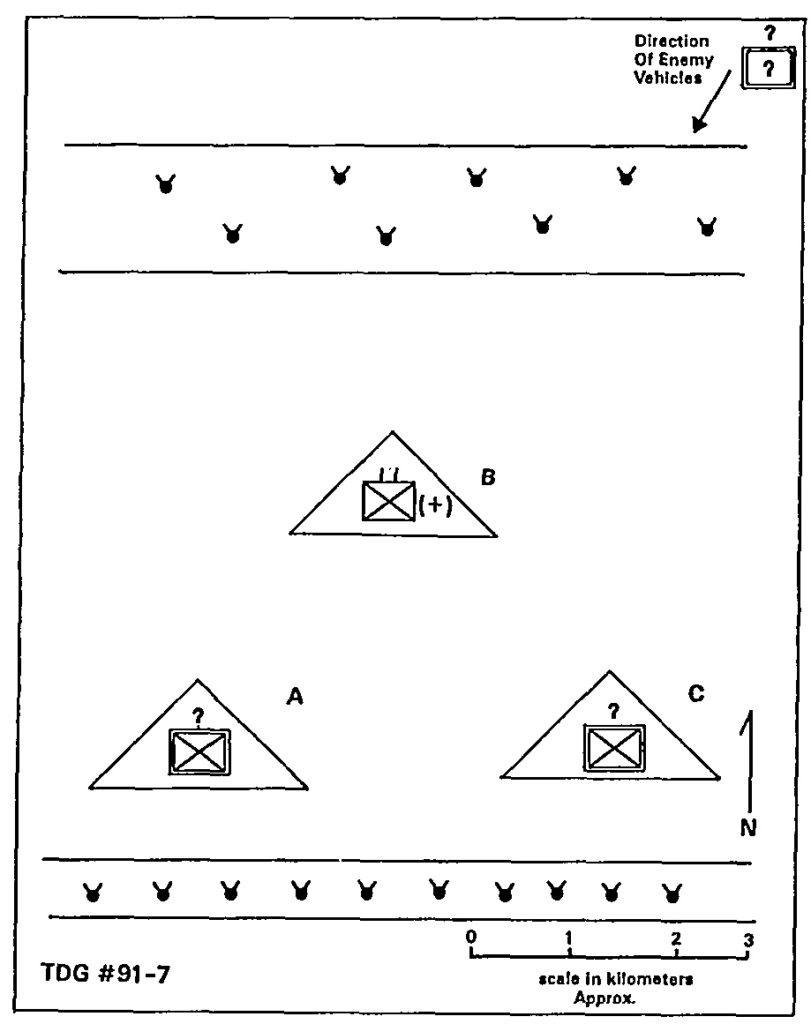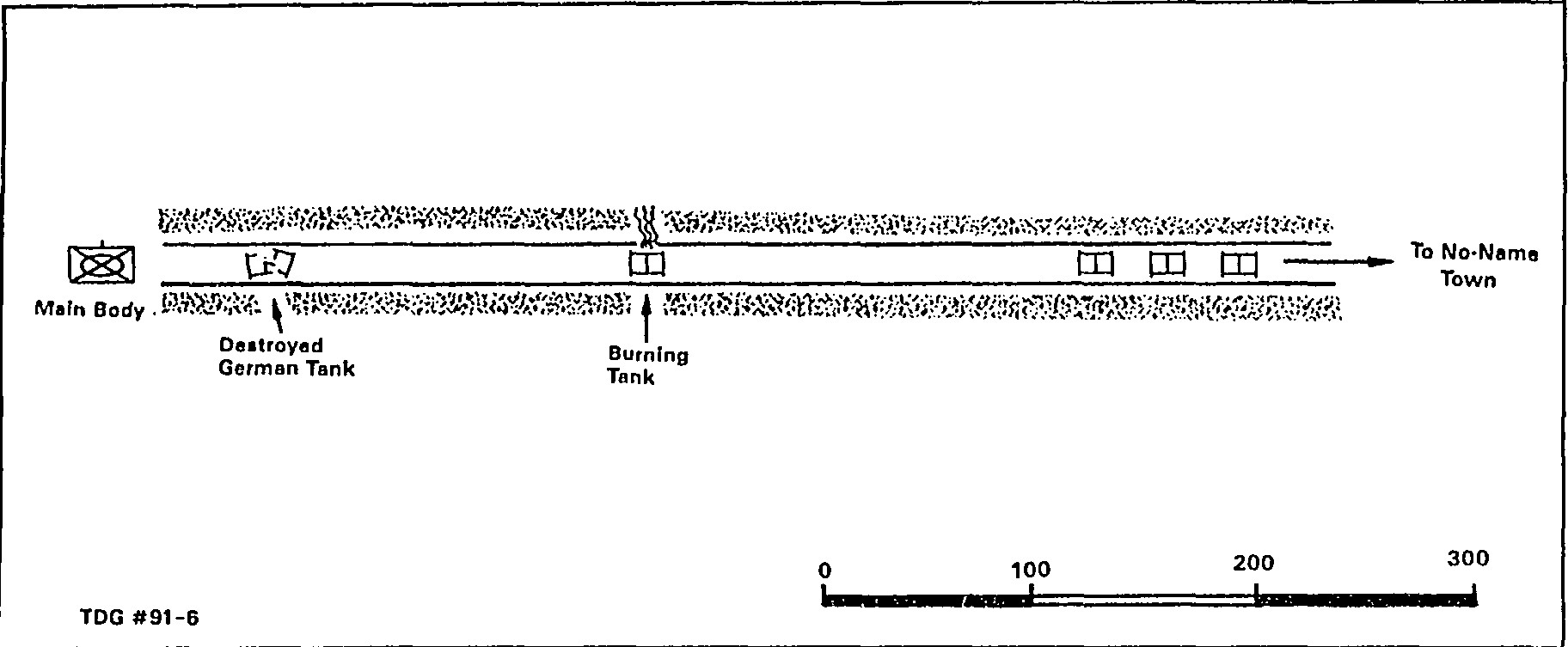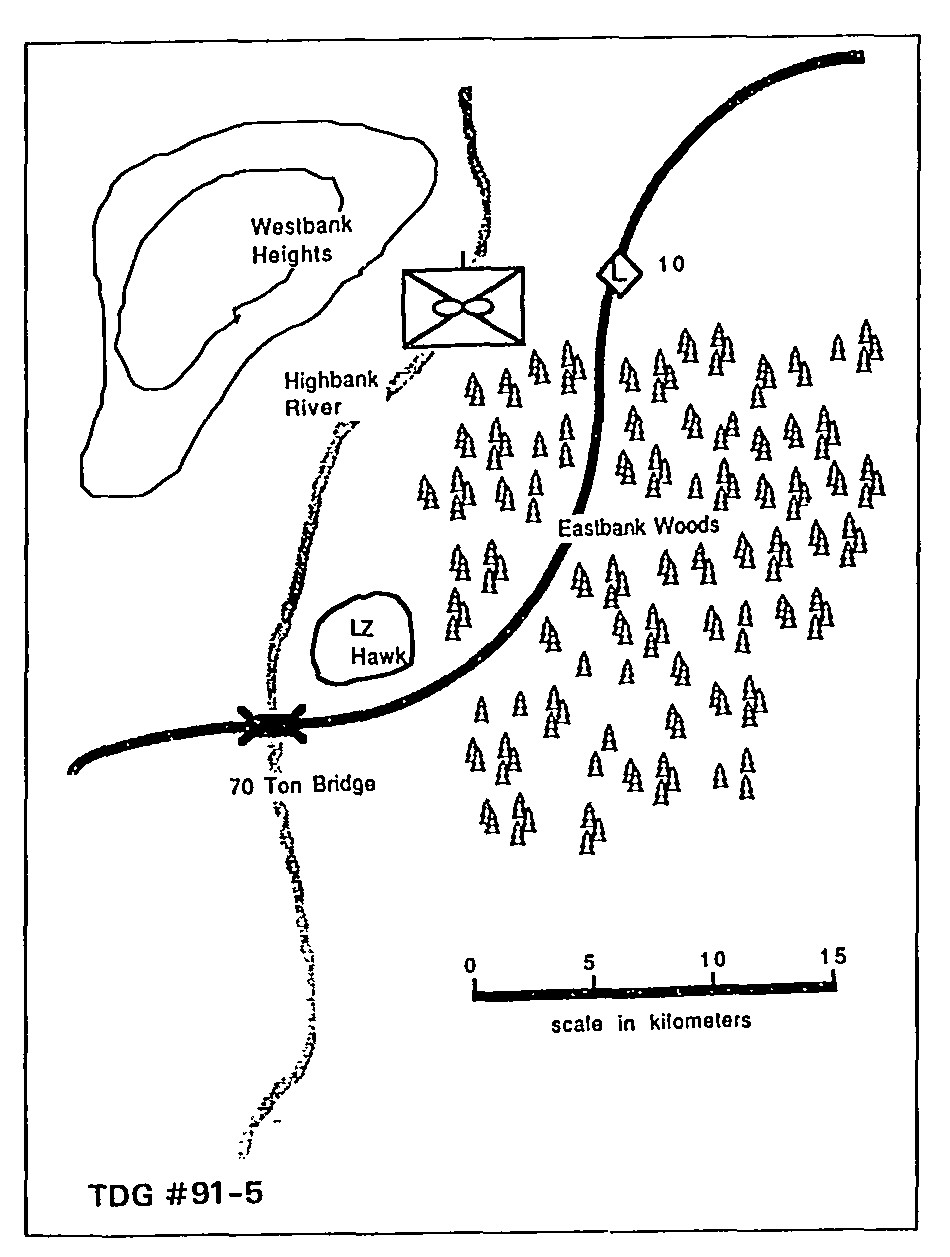
The Infantry Company in the Desert

by Col Michael D. Wyly

With nearly a third of the Marine Corps deployed in the desert, opposed by a large tank threat, every Marine ought to be thinking seriously about how to fight tanks. Such thinking raises questions at a number of levels. Confronting a tank-heavy enemy with one of our Marine air-ground task forces (MAGTF) organizations is one thing, a problem to be solved by generals and colonels alike. There is a different set of problems to be solved by companies, platoons, and squads of Marine infantry and for combat service support Marines, problems of close combat against tanks that loom as overriding for a lance corporal and drive into insignificance any theories of fighting the MAGTF. Make no mistake: colonels and generals also need to be vitally concerned about combat at this level.

Marines are infantrymen. The Marine expeditionary force, combined arms force that it is, remains fundamentally an infantry unit. Therefore, Marines ought to be able to answer the question: What does infantry do against tanks in the desert?

Focusing on the company level, this problem is designed to begin a dialog in answer to that question.

Background

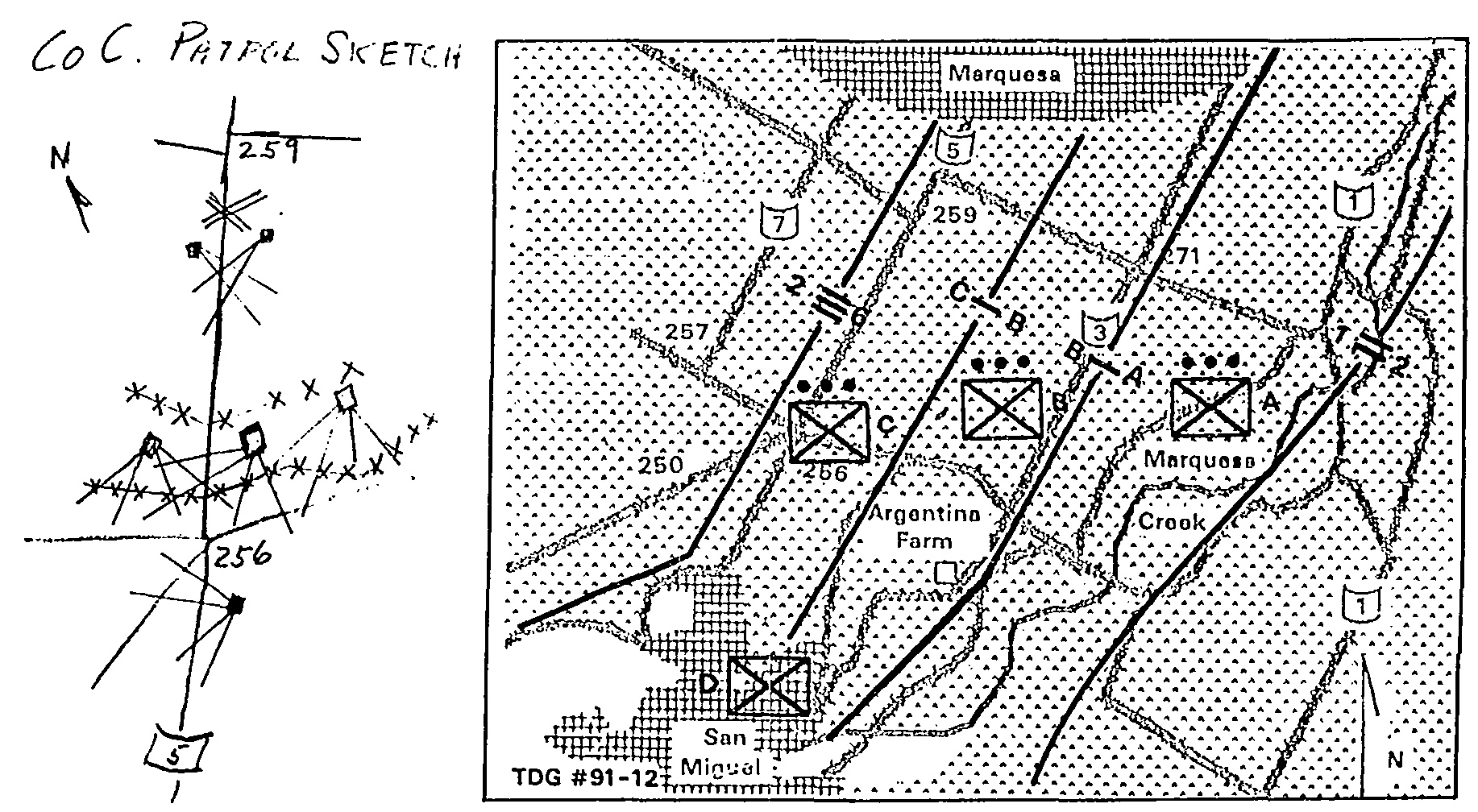
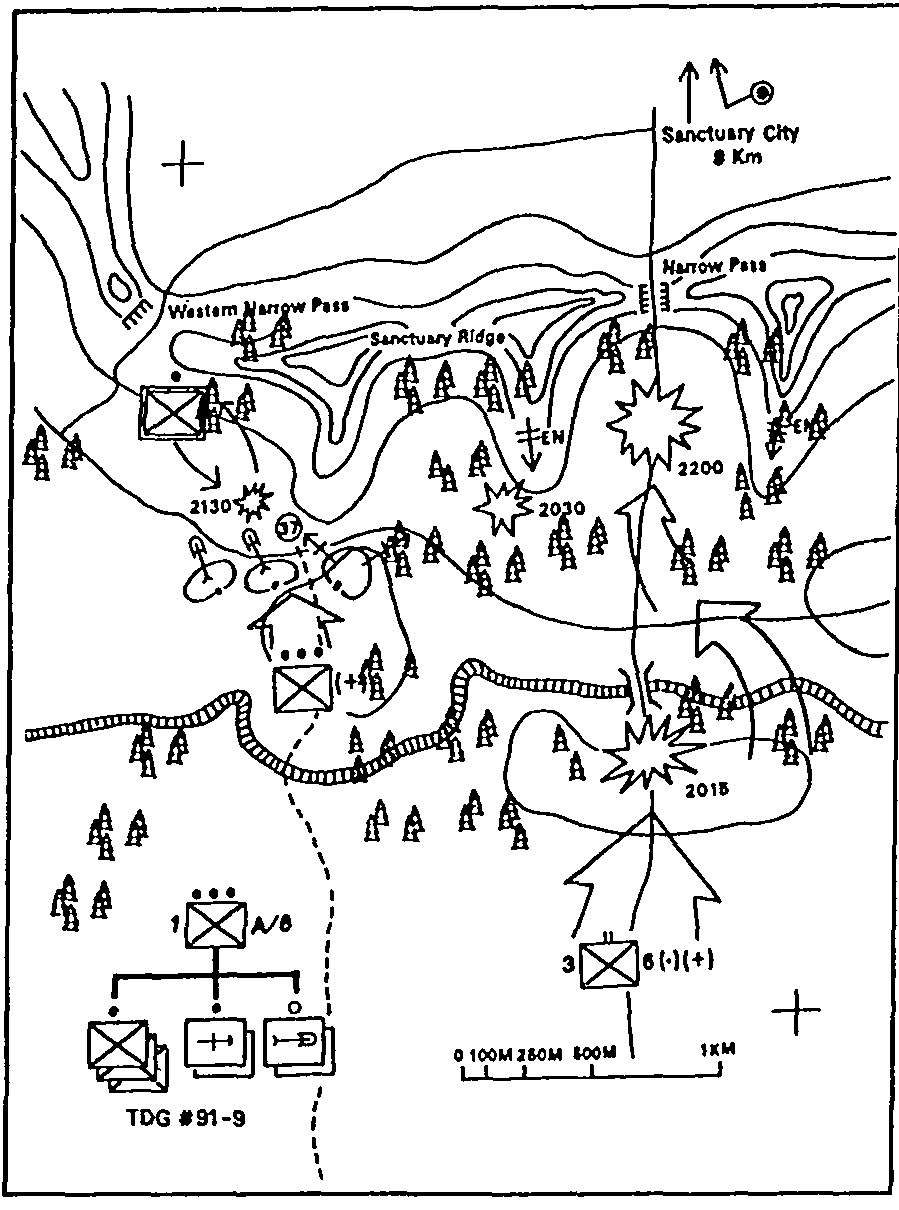
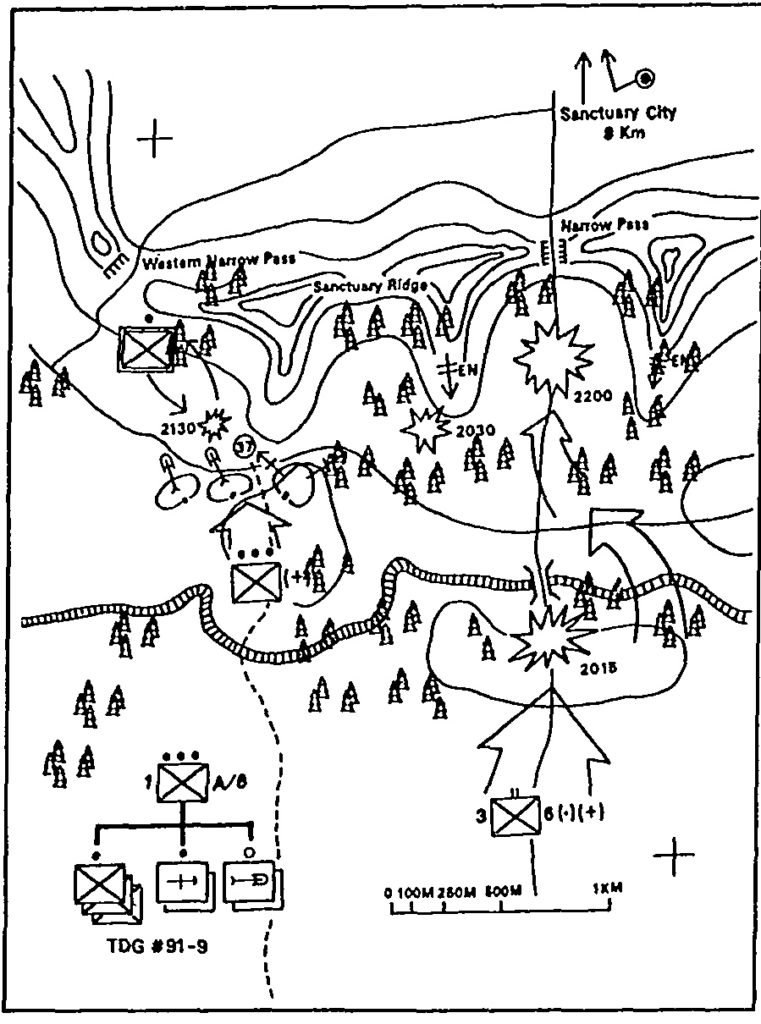
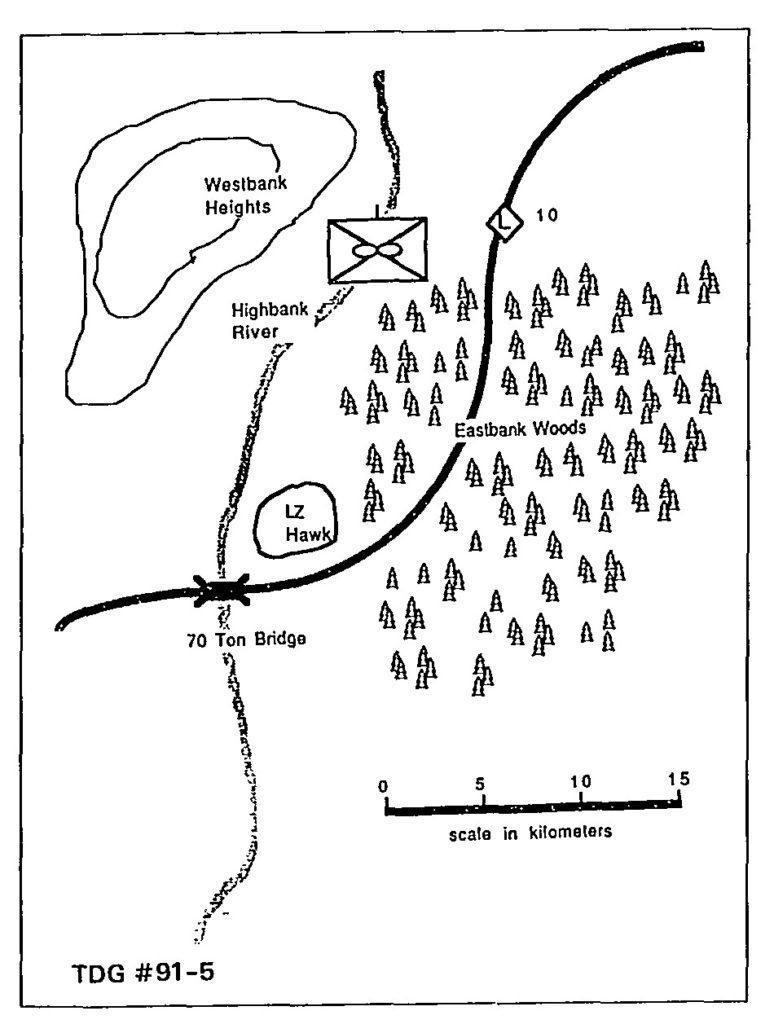
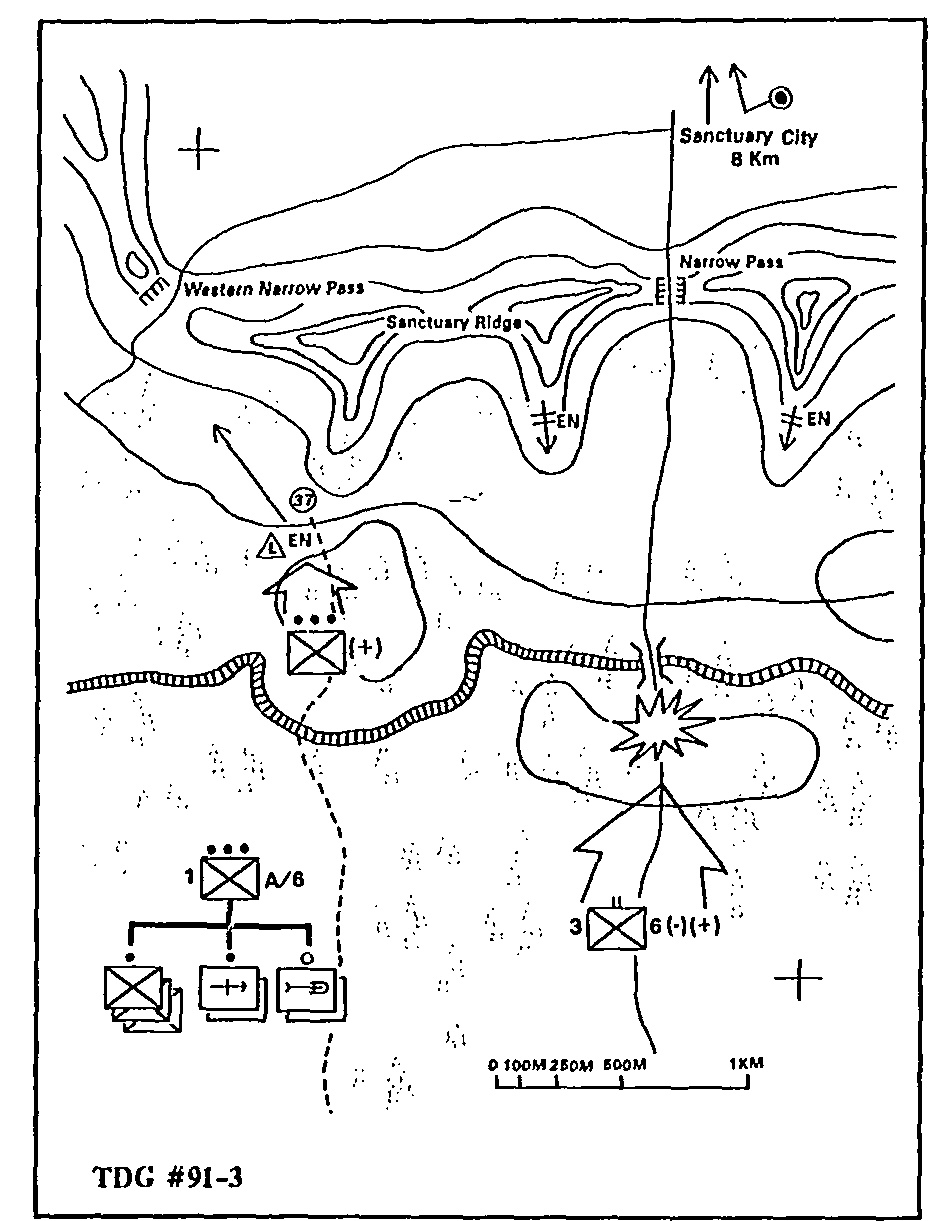
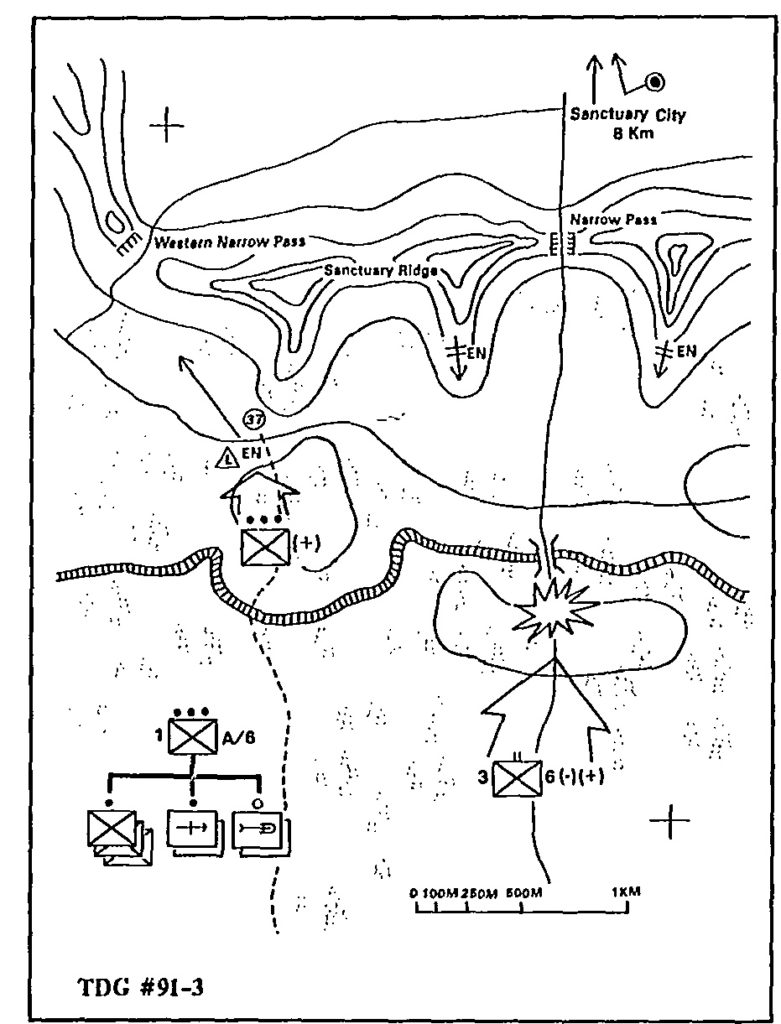
You are commanding officer, Company A, 1st Battalion, 7th Marines (1/7). It is 0530, 12 December 1990. Mounted in amphibious assault vehicles (AAVs), you have been moving south to north across the open Southwest Asian desert, following an intensive but indecisive battle against enemy mechanized forces. You, Company B, 1/7, and Company A, 1st Engineers, have been placed under the leadership of commanding officer, 1st Tank Battalion (-) (+), following the battle. He is operating as part of Task Force Mauler, a combined arms task force whose mission is to find and destroy an enemy armored brigade.

Your company includes detachments from the Dragon, TOW, and 81mm mortar platoons. In addition to your tables of organization (T/O) allocations of small arms, automatic weapons, and machineguns, your inventory of weapons includes:

2 TOWs (HMMWV-Mounted)

8 Dragons

6 SMAWs

8 AT4s

27 LAAWs

10 AT (antitank) mines

2 81mm mortars

1st Tank Battalion (-) (+) is the easternmost thrust of a number of multiple thrusts that comprise Task Force Mauler’s move north. As the leading element assigned to 1st Tank Battalion (-) (+), you have been performing reconnaissance and screening missions. The battalion commander, who habitually leads from the front, is moving with a small mobile command group some 1,000 meters to your north and west. Company B, 1/7, is moving slightly behind Company A, two to three kilometers to the west, The engineer company has been moving along with you. The tanks-approximately two companies of them-have been moving behind you.

Situation I: 0600, 12 December

Monitoring the battalion tactical net, you hear the battalion commander order the tank companies to halt. A logistic train is approaching, and it will rendezvous at their present position to refuel and perform maintenance. Though fueling and repair will be conducted as rapidly as possible, the battalion commander thinks it will be three hours before all his tanks are up and ready. All vehicles in the battalion are critically short of fuel, including your AAVs. Priority will go to fueling the tanks, but you must either accommodate the logistic train in your position or dismount and send your vehicles back to where the tanks are fueling, depending on the situation, as the fuel your vehicles have onboard will not last more than another hour. You discuss this over the radio with your battalion commander and halt your company in the position shown on the diagram. By the time you halt, the distance between you and the tank companies has widened to about three kilometers.

The battalion commander now calls you on the radio as follows:

The tanks are going to refuel and refit in their present position. The threat is still to the north. It’s possible that 50 to 100 tanks with infantry could be down here in less than an hour. I want the two rifle companies to protect us while we refuel. Alfa, You orient towards the north and east. You are the focus of effort. Bravo, you orient towards the north and west.

1st and 2d Battalions, 11th Marines are both in range to give us artillery support if we need it HMLA-369 is on the deck with 10 UH-1Ns and 10 Whiskey Cobras that can be in action here in less than five minutes. The wing has launched dawn patrols; if any enemy tanks materialize, you can expect EA6Bs and Harriers to attack immediately.

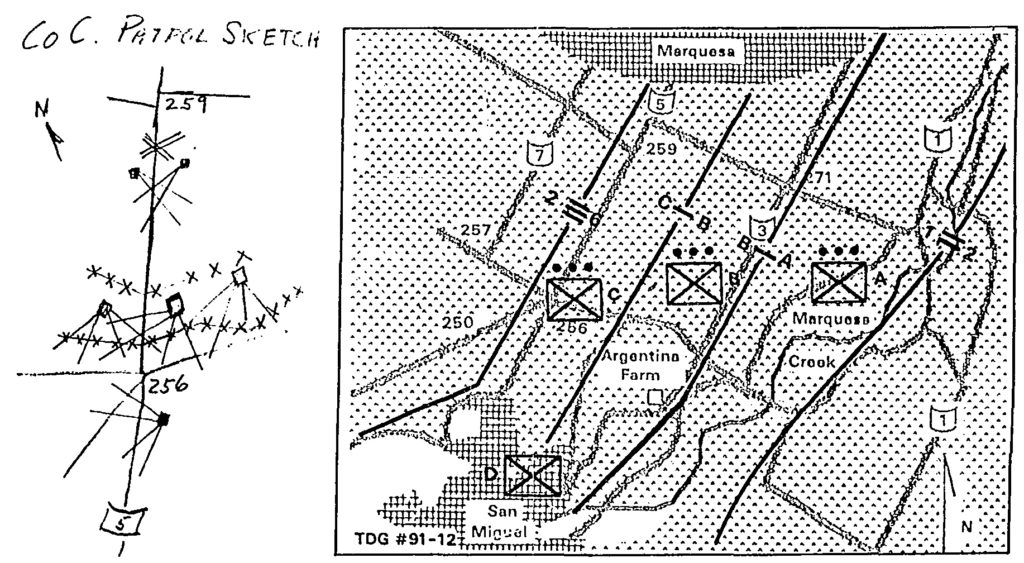
The terrain is fundamentally featureless desert, save the single ridge near Company A’s present position, shown on the diagram. This ridge rises to a maximum of 10 meters in height, is approximately 1,500 meters in length, east to west, and 200 to 300 meters in depth, north to south. Though otherwise featureless at the macro level, it does, of course, offer the normal indentations and depressions that individual infantrymen can use to hide and to afford themselves a modicum of protection. Although approximately level, there is a gentle slope, never more than 3 degrees, downward on either side of the dotted line shown on the diagram.

Requirement I

Who should determine at this point where and how you should position the forces that are at the disposal of Company A-the battalion commander or the company commander?

Assuming the role of either the company commander, the battalion commander, or both, submit your concept for employing Company A and its attachments. Where will they be positioned vis-a-vis the tanks?

Situation II: 0700, 12 December

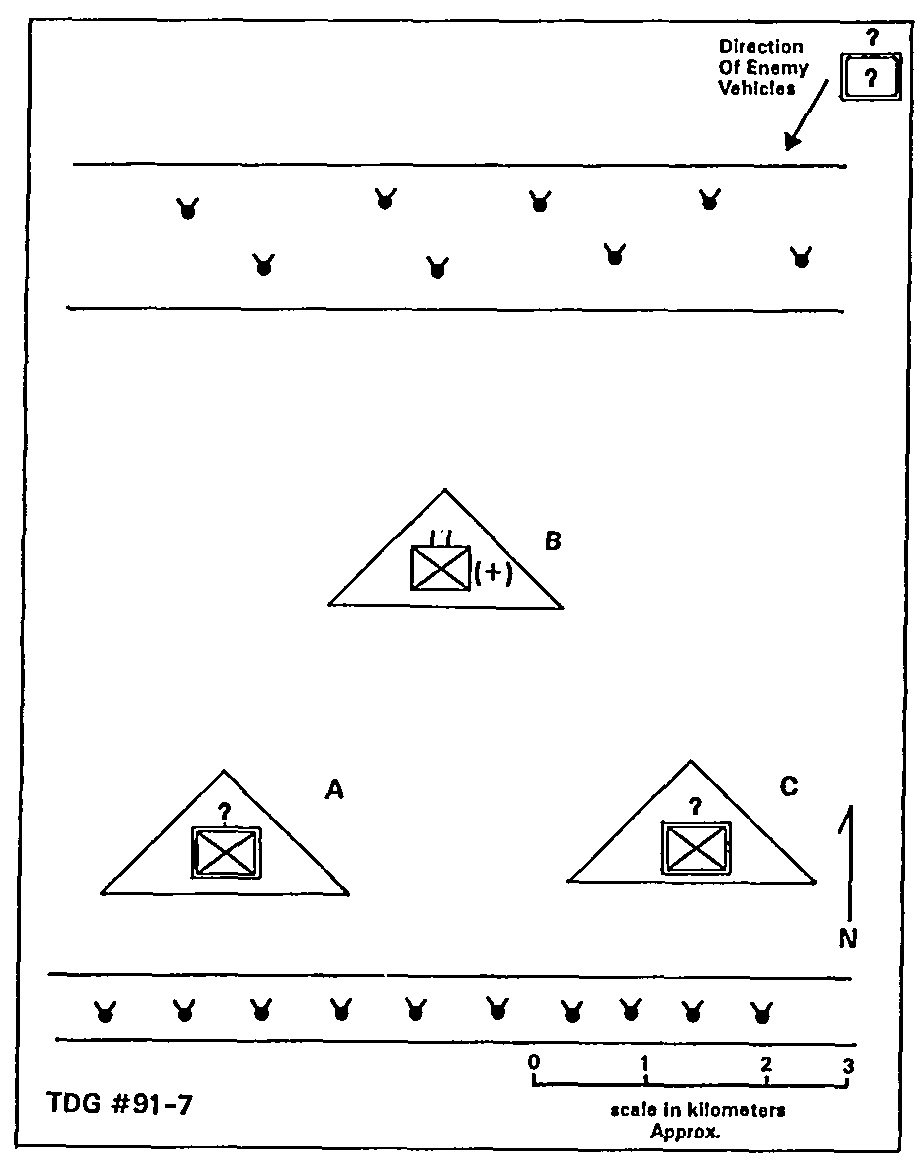
In the morning twilight, dust plumes are visible on the horizon, following reports from aerial reconnaissance that at least 50 tanks are heading due south, directly towards your position. Aerial recon confirms that the tanks are T-62s. They are followed by as many BTRs, probably carrying infantry. Indications are that they are unaware of your location but are hopeful of locating you and surprising you. U.S. Marine attack air begins its attack 6-8 kilometers north of your position; however, enemy fighters are on the scene as quickly as the Marine planes arrive. You see two Marine Harriers go down, apparently from ZSU-23 fire.

Requirement II

Draw a separate, enlarged diagram of your company position, showing how you will emplace the additional weapons available to you. (See Background above.) Include enough detail in your diagram to show how these weapons are integrated with your T/O weapons and the infantry units of Company A, including, where appropriate, detail at the squad and/or fire team level. (Use of improvised symbols, numbers, or letters to identify weapons is permissible.)

Send your solutions without delay to the Marine Corps Gazette, TDG #90-9, P.O. Box 1775, Quantico, VA 22134.

Enemy Strongpoint or Friendly Gap?

by Col John E. Greenwood, USMC(Ret)

The Situation

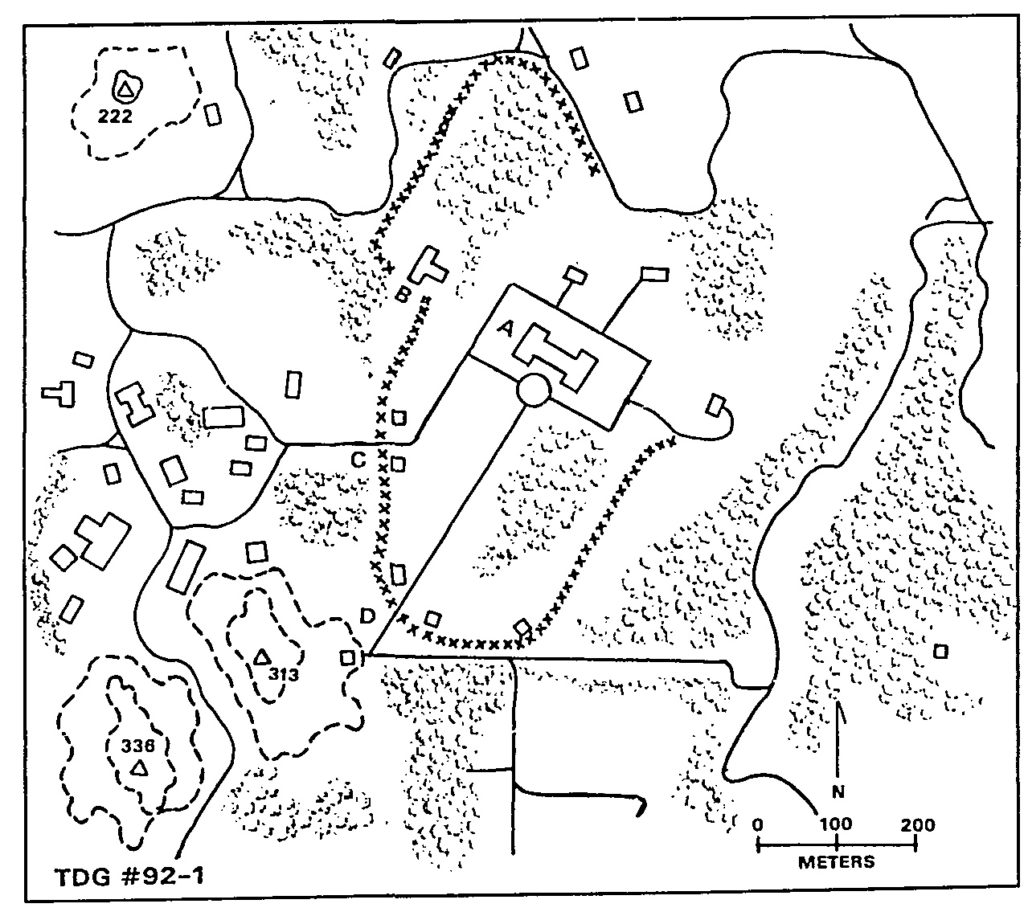
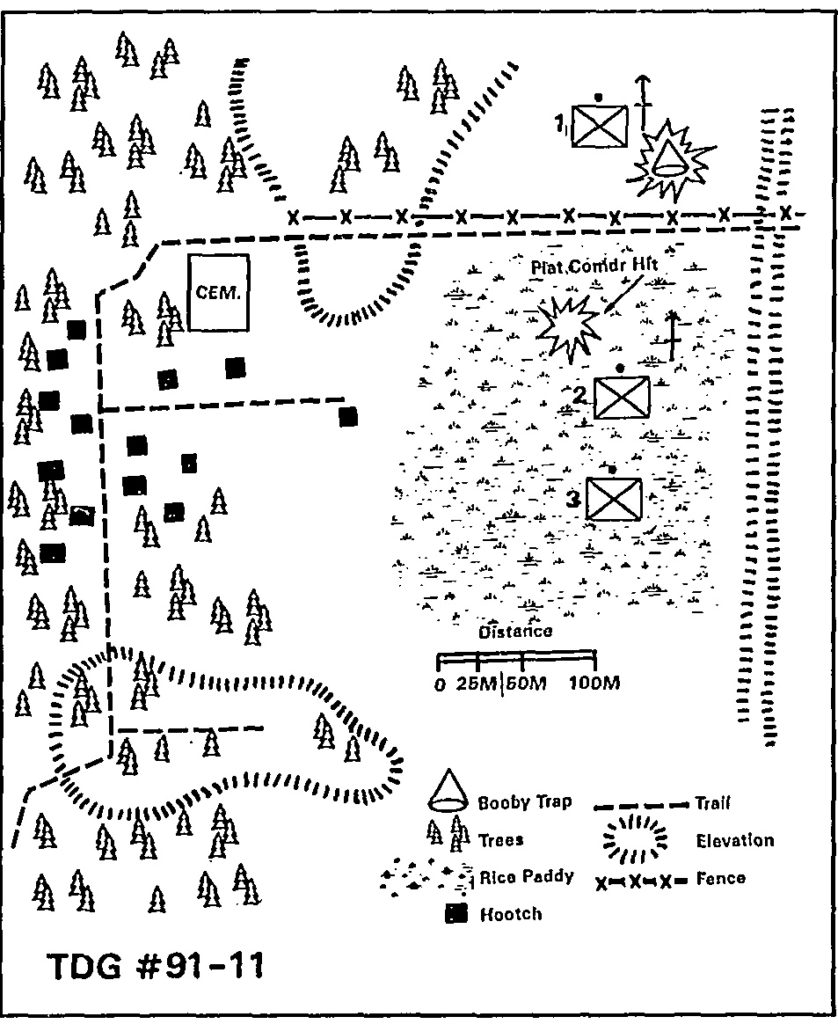
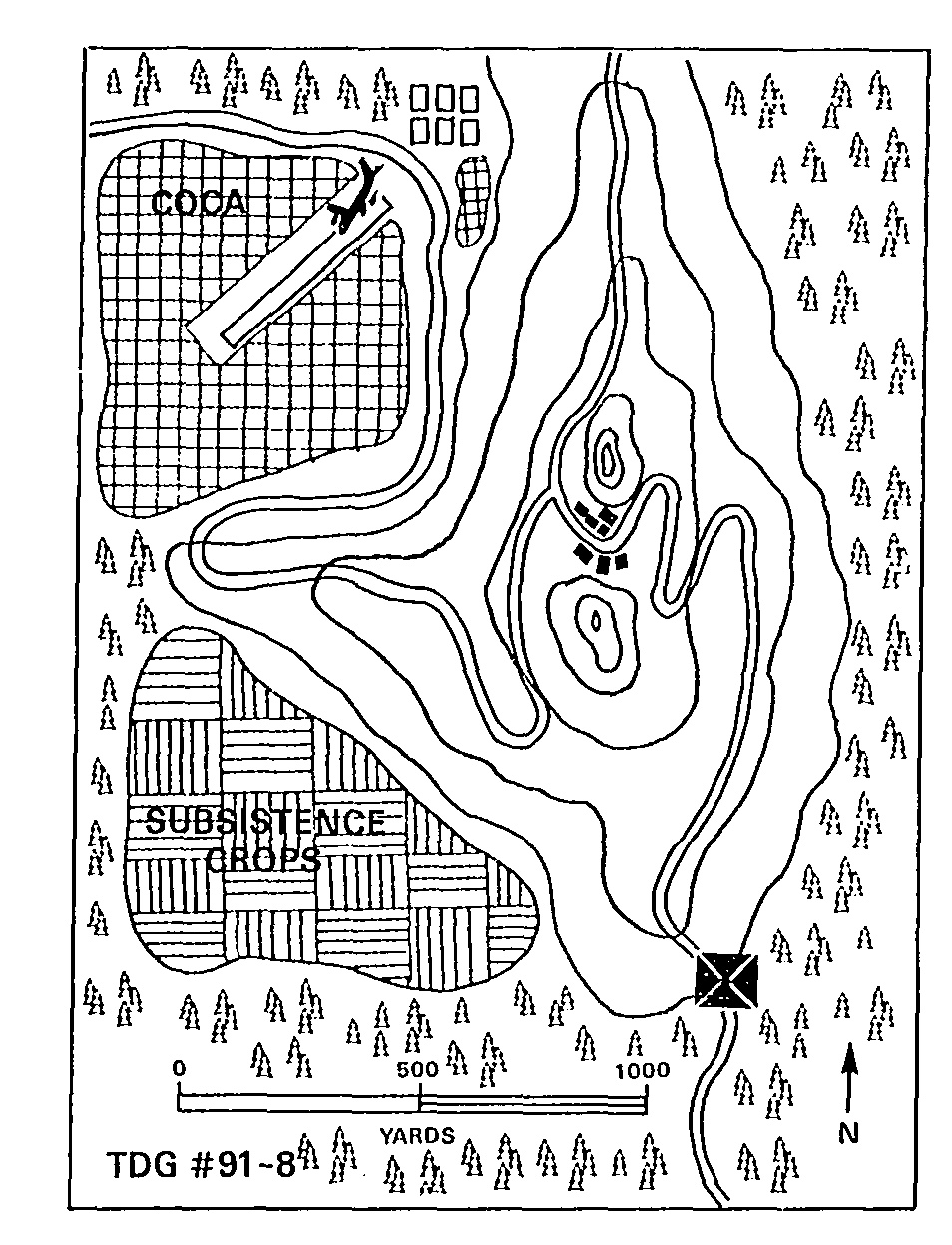
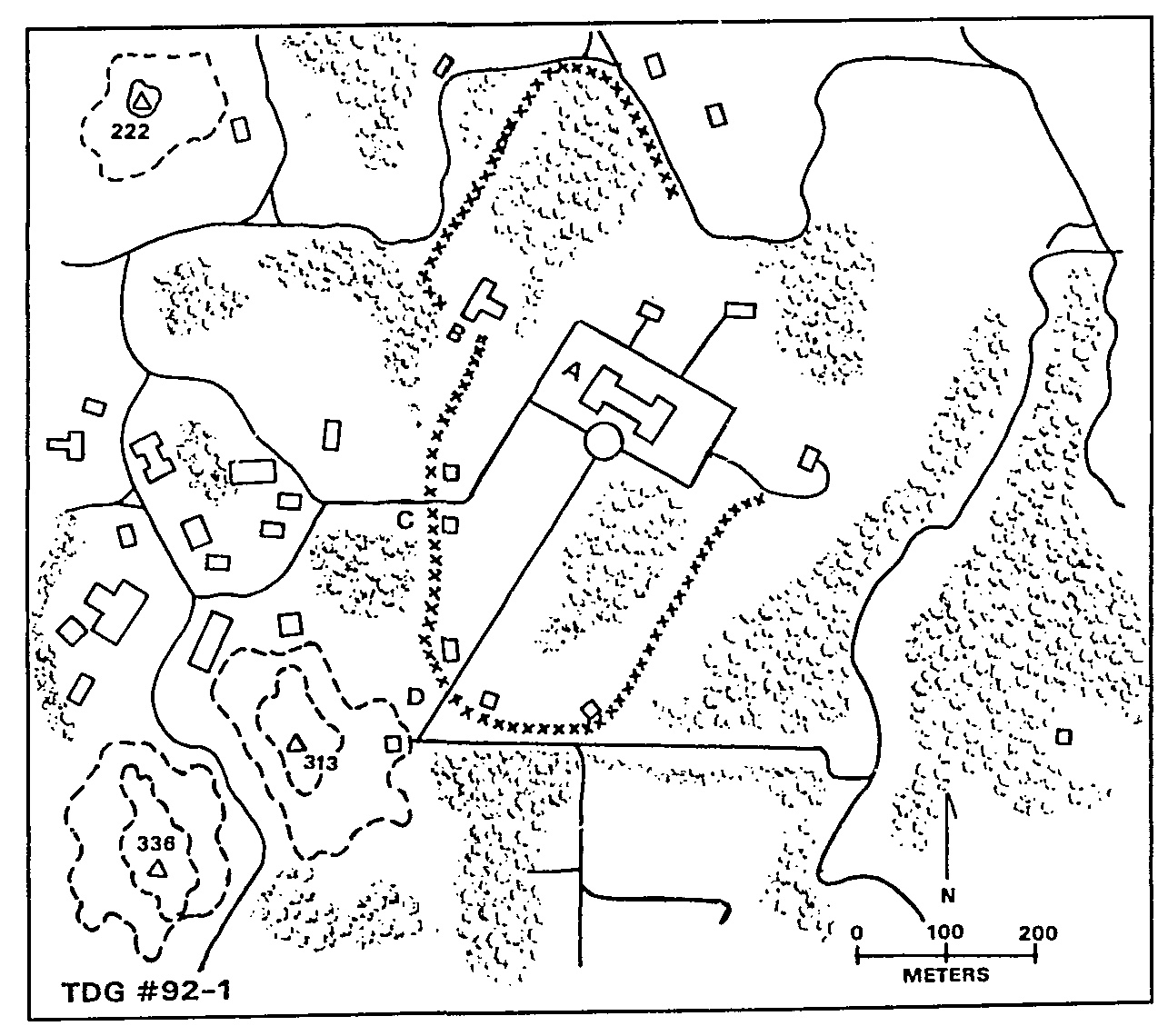
You are the commanding officer of the 3d Battalion, 5th Marines (three rifle companies) reinforced with two platoons of tanks and a combat engineer platoon. You have been in reserve during the initial stages of a deliberate attack by 5th Marines. After overcoming several enemy elements in hasty defensive positions, the regiment encountered a well-developed fortified area, the commanding officer of the 5th Marines gives your battalion the mission of attacking this strongpoint and securing it (creating a gap) so that follow-on mechanized forces can continue the attack against lucrative targets in the enemy rear. In addition to your organic and attached units, you have close air support and artillery fires available to you.

Working through intelligence channels up to the MEF level, your S-2 obtained the attached sketch of the enemy position and determined that the area is held by a unit organized along the lines of a Soviet motorized rifle company but estimated to be at about 75 percent strength. Some of the positions shown on the sketch have not been completed, and some are dummy and alternate positions. In general the enemy bunkers and vehicles are well camouflaged. Observation/listening posts, minefields, and antiarmor ambushes have been detected forward of the position.

The Requirement

Your unit is presently located several hundred meters south of the area shown on the sketch. Develop the plan you will use to carry out your orders and attack the strongpoint area. Describe how you intend to organize your assets and the sequencing of your attack. Send your solution without delay to the Marine Corps Gazette, care of Tactical Decision Game #90-8, P. O. Box 1775, Quantico, VA 22134. The Gazette’s TDG Board will select several solutions for publication in the December issue.

Enemy Over The Bridge: A Thwarted Plan

by Col John E. Greenwood, USMC(Ret)

Readers will recognize this scenario as the continuation of TDG #90-1, “The Enemy Over the Bridge.” The actions described here are based on a solution submitted by Maj Claes Henrikson, an instructor at the Company Commander’s Course, Armored Troop Combat School, Swedish Army.

The Situation

You are the executive officer of 2d Battalion, Sixth Marines consisting of a rifle company on trucks, two rifle companies on foot, a tank company, and a TOW section. As the lead element in a major division offensive, your battalion was moving to an assembly area in preparation for an attack north across the river at 0400 tomorrow morning. Although the assembly area, bridge, and riverbank were supposed to be in friendly hands, at 2000 your battalion discovered this was not the case. An enemy force of at least company size has seized the bridge and occupied your assembly area.

Recognizing the importance of the bridge and the need to move at once if the division attack is to proceed as scheduled, the battalion commander directed the mobile force of Company E (in trucks), supported by Company A (tanks), and the TOW section to attack the bridge by East Farm Road within one hour. As this was the main effort, he accompanied the force with his mobile command group. Companies F and G were directed to attack immediately to the northwest across East Hill toward Hamlet, the original assembly area, and West Farm. The intent of this attack was to gain control of the main roads leading south, protect the deployment and advance of the main force, and divert the enemy’s attention from the bridge.

As executive officer, you moved behind Company F and were coordinating the attack of the two companies in the south. Briefing and preparation for the attack by both mobile and ground elements took longer than expected as troops were tired and had been looking forward to resupply and rest in the assembly area. At 2110 Company G reported that elements on East Hill heard loud explosions and an intense firefight to the northeast. It seemed clear that the mobile force had contacted the enemy, but neither you nor Company G on East Hill were able to raise anyone with the mobile force on any radio net. Periodic small arms could be heard for several minutes, then enemy artillery began impacting in the vicinity of East Farm. At approximately the same time, Company F reported contact with the enemy south of the original assembly area. At about 2120, you received a garbled, panicky report from a radio operator on the conduct of fire net. The mobile force had been ambushed with heavy casualties. It is stopped on the road, disorganized, and now under artillery fire.

As the battalion executive officer, what would you do?

Requirement

Within a 10-minute time limit respond to the above question by describing the actions you would take, the frag orders you would issue, and the reports you would make. Explain the rationale supporting these decisions and provide a sketch map showing the positions to be assumed by battalion elements.

The Raid on Gazebo Ridge

by Capt John F. Schmitt

The Situation

It is dawn, the morning after a typically chaotic and bloody desert battle during Operation HOLY WARRIOR. You are the first sergeant of Company A, 2d Light Armored Infantry Battalion. The company’s last remaining commissioned officer was killed in the opening moments of yesterday’s battle; since then you have commanded the company. As of this morning, Company A consists of six light armored vehicles with 25mm chain guns (LAV-25s) each carrying only two or three scouts; two assault gun variants (LAV-AGs); two TOW variants, (LAV-ATs); and an air defense variant equipped with Stinger, a 2.75 Hydra 70 rocket system, and a 25mm gun (LAV-AD). The 25mm chain gun on the LAV-25 fires He (high explosive) and AP (annor piercing) rounds with a maximum effective range of about 1,500 meters. The 105mm assault gun variant has an effective range of about 2,500 meters. The battalion has been in intense combat for five days running, and you are hoping for a day off to pull maintenance. No such luck: as your gunner heats up the morning coffee, a messenger arrives with instructions to report to the battalion command post immediately.

You arrive at the command vehicle; the battalion commander, a captain who began the campaign as your company commander, says with a smile, “Good morning, skipper.” (Lucky he put you through all those tactical decision games, you muse.) He gets down to business:

We’re here. [Pointing on the map with a pencil.] The Indigenous Division is here. [Another jab some 25 miles to the east.] The enemy is here on Gazebo Ridge, in between, giving the Indigenous boys a beating. Our division has orders to relieve the pressure on the Indigenous Division. Unfortunately, fuel is low. Division has enough for a limited operation-a reconnaissance in force-which naturally will be us. We will make a raid directly into the enemy rear while the rest of the division pulls back for replenishment. First sergeant, your boys will be on the right; I can give you a section of two TOW Cobras in direct support. Bravo on the left; Charlie and Delta are reserves, on the right and left respectively. We’ll have one battery of self-propelled arty in direct support.

I can’t give you any instructions about what to do until we meet the enemy. If in doubt, raise as much havoc as you can-mindful of the fuel situation-but do not get committed to a set battle. If he attacks in force, pull back; use your superior speed to break contact. But it’s imperative that you act boldly to take some pressure off our friends in the east. We move out in one hour. Any questions?

You meet the Cobra section leader, who will come up on your company frequency. You agree that he will hover out of sight to your rear until you call for him.

You organize the LAV-25s into two sections of three vehicles each, gear up, make a radio check with battalion, and move out to the east across the scrubby desert. At least the comm is working for once, you think; that’s a good sign. But when it goes down-which experience tells you it will-your company has a tried-and-true standing procedure: “Do as I do,” or as the captain used to call it, “Follow the leader.”

You approach the rear of the enemy position-a low, crescent-shaped escarpment-apparently unnoticed. You are less than four miles away. In the distance to your left you can see the vehicles of Company B advancing in dispersed formation toward the enemy positions farther north. You see an enemy tank detach itself from a small cluster on the extreme left of the enemy position and move directly across your front to the other flank. Through your binoculars you see the enemy tank commander look over at you, apparently without recognition, and wave. You return the greeting.

You try to raise battalion on the radio, but comm is dead. The Company C commander tells you he will relay messages to battalion.

You see an artillery battery position in the hollow of the crescent pounding away at the friendly forces to the east. You see trucks and clusters of troops going disinterestedly about their morning chores. You see clusters of five or six tanks on either flank of the position, the crews milling about dismounted, and field guns lining the escarpment, also firing to the east. At the center of the crescent, among a cluster of smaller vehicles, you spot an enormous, two-story command vehicle, which you recognize as a captured U.S. model. Amazingly, the enemy seems unaware, or at least unconcerned, of your approach.

You are now nearly within the horns of the crescent. The cluster of enemy tanks on the far left starts to show signs of life; one by one you see the diesel signatures of the engines revving up. You sense it is the moment of truth. . . .

The Requirement

In a time limit of five minutes, describe the actions you will take in the form of the fragmentary order you will issue to your subordinates. Include an overlay and a brief explanation of your plan. Send your solution to the Marine Corps Gazette, care of Tactical Decision Games (90-6), P.O. Box 1775, Quantico, VA 22134. The Gazette will publish several solutions in two month’s time.

The Battle of Mount Giddy

by Capt John F. Schmitt

This tactical decision game is a little different from previous ones for a couple of reasons. First, it is of a broader scope than previous problems; one might even argue that it verges on being an operational decision game rather than a purely tactical one. Second, it is a Marine air-ground task force (MAGTF) problem-designed for a Marine expeditionary brigade (MEB) commander-in which the requirement is for the broad integration of ground, air, and logistics elements rather than just the tactical control of subordinate units on the ground.

The Situation

You are a MEB commander fighting in a coastal desert that offers excellent mobility and freedom for mechanized and motorized forces save for the ridgelines, which tend to channelize vehicle movement. The theater strategy calls for the Joint Task Force (JTF)-of which the MEB is part-to mount a major land offensive toward the north out of the Damoose region. The MEB’s mission is to protect the JTF’s southern flank, i.e., its rear, as the JTF attacks north. You are authorized to trade space for time as long as you deny the enemy the Damoose-Brut line, Brut being a key port and airfield and Damoose being a key logistics node.

Your MEB command element (CE) and brigade service support group (BSSG) are located at Damoose. Your aviation combat element (ACE) is located at Brut. The air situation is one of relative parity, the enemy being stronger in air defense assets while you are stronger in offensive air assets. Your ground combat element (GCE) consists of a motorized infantry battalion (minus) in the vicinity of Mount Giddy with a company detached at Huffy, a battalion of amphibious assault vehicles near Gooselub, another along the railroad west of Bed Lake, a light armored infantry company (reinforced) also guarding the right flank near Berra. and a tank battalion (minus) in reserve near Nevertheless. The enemy has a superiority of roughly two to one in ground forces

You plan to conduct a delaying action, trading space for time. You intend to fall back only under pressure, making the enemy pay for every inch of terrain but avoiding decisive engagement. Since yours is a subsidiary mission, you do not intend to force a decision but rather to forestall one. The JTF offensive has been underway nearly a week and to this point the enemy on your front has played into your hands by remaining relatively inactive, probing but not threatening your forward defensive positions. He has irregular forces equipped with light vehicles operating out of the barren desert to the west who periodically try to cut the Damoose railroad, an important line of communication. Intelligence has been reporting a buildup of enemy armored and mechanized forces and supplies south of Gooselub over the last 48 hours. The G-2 anticipates the enemy will mount an offensive in that sector within the next 72 hours.

As it turns out, however, the enemy buildup in the south is actually a wellexecuted deception. Instead of striking Gooselub, the enemy attacks in strength at Mount Giddy supported by massed offensive airpower. The GCE commander also reports that the light armored company and mechanized battalion on the right flank are under attack but holding their own, as is the battalion at Gooselub. But he reports that he cannot make contact with the motorized battalion at Mount Giddy, which apparently has been overrun. Within 12 hours scattered situation reports indicate that enemy mechanized and armored forces have reached Nevertheless, where they are being engaged by the reserve tank battalion, and are beginning to bypass Huffy headed north along the littoral plain.

By all accounts a major offensive has penetrated your left front and is pouring unchecked into your rear. As the MEB commander, what will you do?

The Requirement

Develop a MEB plan that includes a general concept operations (with intent) and broad missions for your GCE, ACE, and combat service support element as appropriate. (Leave it to your staff to work out the details.) Then provide a brief explanation of your plan. Send your solution without delay to the Marine Corps Gazette, c/o Tactical Decision Games, P.O. Box 1775, Quantico, VA 22134. The Gazette will publish several solutions in two months’ time.

Gap at the bridge

by Capt John F. Schmitt

Knowing your enemy means, understanding his capabilities and general intentions. But it also means seeing things the way he sees them, thinking the way he thinks, with the aim of anticipating his actions and thereby gaining the upper hand.

This tactical decision game may look familiar to some readers. It is, in fact, TDG 90-1, “The Enemy Over the Bridge,” with one very significant difference: This time you are the enemy. How will knowing how you reacted to “The Enemy Over the Bridge” influence your actions now that the shoe is on the other foot?

The Situation

You are the commanding officer, 1st Battalion, 5th Marines. The division is halted temporarily, but the division commander plans to resume the offensive toward the south as soon as logistics can be brought forward. You have been operating north of the river against enemy reconnaissance and security elements. The enemy holds the riverline and the bridge in strength. (You believe the river to be unfordable.) Intelligence indicates that the enemy is planning an imminent offensive north across the river-sooner than your division can be ready to attack in strength. Your mission, which gives you broad latitude in the manner of execution, is to take whatever actions you can to disrupt the enemy attack in your sector.

A reconnaissance patrol by one of your companies discovers that the enemy forces that were holding the bridge have withdrawn. The company commander has already begun to infiltrate his company across the bridge. You decide to exploit the situation by getting your entire battalion south of the river with an eye toward mounting a spoiling attack. In the process, one of your companies has an engagement near the bridge with an enemy scout car, which flees west on the river road. You contact regiment and explain the actions you have set in motion. The colonel tells you he will reinforce with all the forces he can muster-infantry and tanks will begin to arrive in two to three hours. You have the priority of fires for all supporting arms, he tells you.

The time is about 2000; darkness is descending. Elements of your surveillance and target acquisition (STA) platoon report that Hamlet shows no signs of enemy activity. As your leading companies move into the triangular wood west of Hamlet, another STA team located on the high ground south of the wood reports an enemy column approaching from the south headed toward your position. The STA team sends the following report:

Enemy force, estimate at least battalion strength, moving north on Hamlet road, at the intersection south of the pass; covered tracks, jeeps, infantry on foot; I can hear tanks in the distance but do not have a visual.

Simultaneously, a short firelight breaks out with what appears to be an enemy patrol moving into the triangular wood from the south. You suspect it may be the advance guard of the enemy column. What do you do?

The Requirement

Within a five-minute time limit, give your solution in the form of the fragmentary order you would issue to your subordinates and support it with an overlay sketch. Then give a brief explanation of your actions-the key considerations and assumptions that shaped your decision. Send your solution without delay to the Marine Corps Gazette, care of Tactical Decision Games (90-4), P.O. Box 1775, Quantico, VA 22134. The editor will select several solutions to be published in two month’s time.

“Film at eleven”

by Capts Bruce I. Gudmundsson and John F. Schmitt

The following is the third in the Gazette’s series of tactical decision games similar to those used at the Marine Corps University as a tool for developing tactical decisionmaking capability. Think of commander’s intent, concept of operations, focus of effort, and frag orders, and send us your solution.

The Situation

You are a rifle company commander fighting in an arid desert environment that offers exceptional mobility for wheeled and tracked vehicles. You are supported by a platoon of assault amphibian vehicles (AAVs), enough to mount your entire company. After intense fighting at the front for several weeks, the battalion commander has assigned your company to rear duty providing security for the Mobile Combat Service Support Detachment (MCSSD). As the ground combat element (GCE) advances north, the MCSSD plans to move in that direction and establish a forward supply point at Oasis, some 25 kilometers north but still another 25 kilometers south of the front. While the front is generally to the north, there is no clear delineation between friendly and enemy territory; you long ago learned the importance of allaround security. Irregular enemy forces mounted on small trucks and equipped with heavy machineguns are known to operate in the area.

Oasis is the only source of water in the region. The local population lives in adobe dwellings, which will not normally withstand anything larger than small arms. The only masonry structures are the two-story community center and the pump house. In the center of town is a large plaza. Surrounding the buildings are irrigated fields of “short” crops that meet the needs of the local people. The local population is of the same ethnic group as the enemy, although actual support is sometimes less than enthusiastic.

The time is 1400. The MCSSD commander tells you he wants to occupy Oasis by 1200 tomorrow, and he expects you to secure the settlement by that time. From experience you know that each oasis has a small militia force consisting of the adult males of the settlement, equipped with small arms, rocket-propelled grenades (RPGs), machineguns, and possibly light mortars. The fighting skills of these outfits vary greatly. Some are looking for any excuse to lay down their arms; many fire off a few rounds to satisfy their sense of honor before surrendering; only a few fight tenaciously. However, there seems to be no way of anticipating how the forces will act from settlement to settlement. In the case of Oasis, the S-2 estimates the militia to be between 100-150 strong. He can tell you nothing more than that.

As you are grumbling about the lineage of the S-2, the MCSSD commander comes up to you and says: “One more thing; there’s a cable TV news team covering the MCSSD that’s looking for a little action. I’ve told them they can accompany you as you secure the Oasis. Cooperate with them, but keep them out of trouble.” The news team comes equipped with its own camera van. You are introduced to the correspondent, whose smug, mustachioed face you recognize. He says: “Let’s get something straight, Captain. The public has a right to know what’s going on over here. I want to be right where the action is. If you try to keep me from doing my job, it could be embarrassing for you.”

The Requirement

You do not feel particularly friendly toward the news team, but you have other things to worry about. How will you approach the problem of securing Oasis? Within a 10-minute time limit, write the fragmentary order you will issue to your rifle platoons and weapons sections and your instructions for the camera crew. Include a statement of your intent, any plans for supporting fires and an overlay of your scheme of maneuver. Then write a brief (300 words or less) explanation of the rationale for your plan. Remember, since every battlefield situation is unique and there is no right or wrong answer, we are not so much interested in what you would do as why you would do it. Send your solutions to the Marine Corps Gazette, Tactical Decision Games, P.O. Box 1775, Quantico, VA 22134. Solutions will be published in August.

The Attack on Knob Hill

by Capt John F. Schmitt

Note: “The Attack on Knob Hill” is the second in a series of tactical decision games that the Gazette plans to continue for the foreseeable future. The intent of the series is to provide a Marine Corps-wide forum for discussing tactics. Readers are encouraged to submit their solutions for publication. This can be done easily by drawing a sketch and writing the critical parts of a frag order on overlay paper. The author’s solution for each scenario and one or two others selected by the editor will be published two months after the scenario is introduced. Due to deadlines, solutions must be received at least one month before publication; i.e., solutions for “Knob Hill” must be received by I June to be considered for the July issue. The Gazette suggests that units might want to use the games at officers’ calls or professional development classes and would welcome unit as well as individual solutions.

The Situation

You are a rifle platoon commander fighting in a jungle environment against U.S.-trained and U.S.-equipped forces. The areas not covered by thick forest, such as Knob Hill, are covered by grass three to four feet high. You have been operating in the region for several weeks and are quite familiar with the terrain and the local population, which is generally friendly (but may be just as friendly to the enemy). The company commander gives you the following fragmentary order:

Reconnaissance reports that an enemy infantry force of approximately platoon size has established a patrol base on Knob Hill [several kilometers to the north]. They have been operating out of this base for 24 hours and have made one helicopter resupply. [Due to the thick vegetation in the region, Knob Hill is one of the few pieces of terrain accessible to helicopters.] Your mission is to attack and destroy that enemy force on Knob Hill. I can spare you two machineguns and the company mortar section.

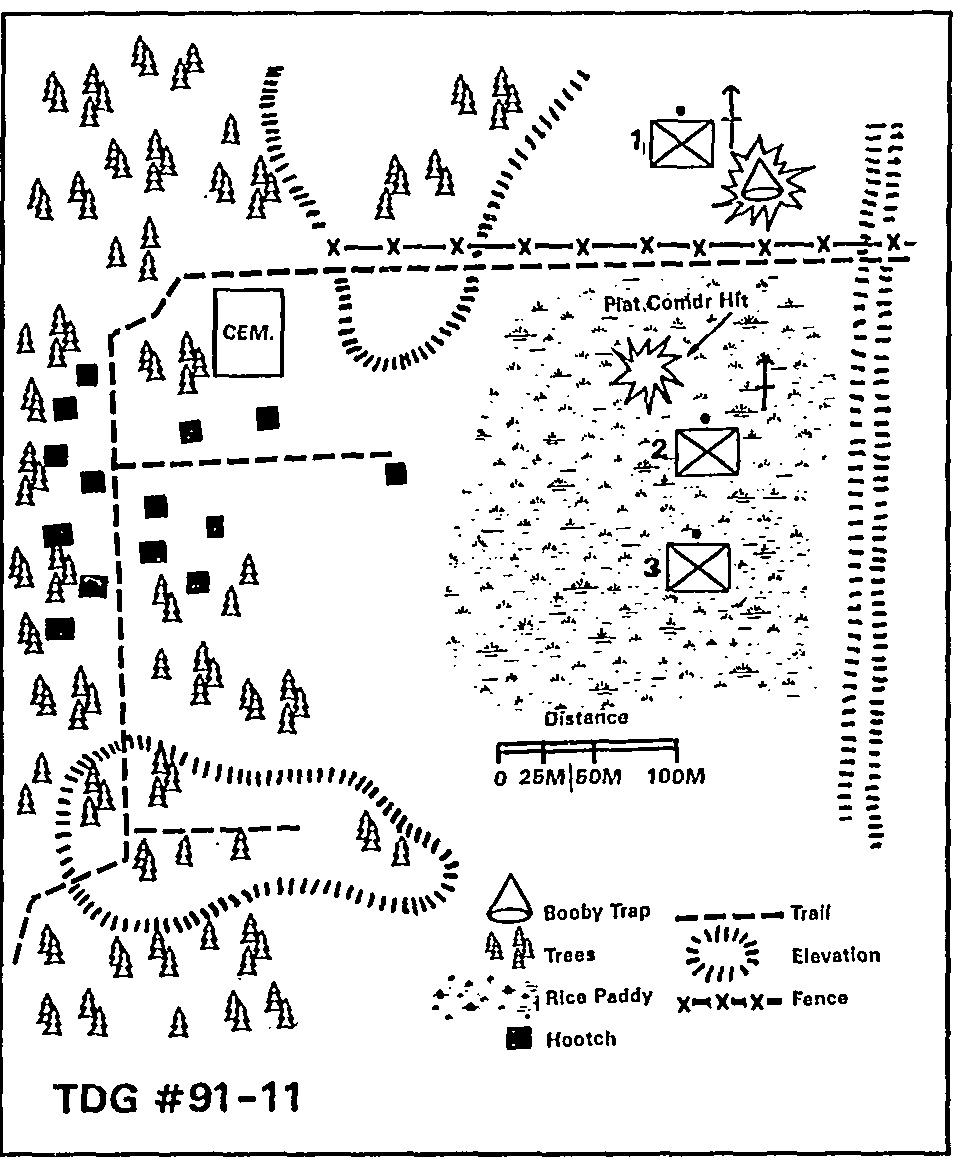
You move your platoon into an assembly area. It is 2200. The moon is half. You instruct your platoon sergeant to effect resupply and have the platoon get some rest. Your platoon is well trained in night operations, and if you can get a good fix on the enemy positions, you have in mind to launch a non-illuminated night attack. You take a radio and the squad leaders for a leaders’ reconnaissance, bringing along two additional dependable Marines (Taylor and Bell) for security. You approach the objective from the south on a well-worn animal track. En route you come across a local farmer, for whose young son you once provided medical care. With one of your squad leaders translating, the farmer tells you that the enemy platoon is no longer on Knob Hill, but at dark moved into the low ground somewhere north of the hill. He says he could not ascertain the exact location without arousing suspicion, but he says that the enemy has left a four-man listening post (LP) on the topographical crest and a machine gun team on the southwest slope. During the day on “El Knobbo,” he tells you, “there was much digging of holes.”

Moving closer you are able to confirm that the LP and machine gun are where the farmer said they were. From the LP you hear quiet laughter and conversation; you see the glowing tip of a cigarette. You are not able to locate any additional enemy positions on the objective. It is now 0015. What do you do?

The Requirement

Within a 10-minute time limit, prepare the fragmentary order you will issue to your squad leaders and weapons platoon attachments-including the intent of your plan. Include plans for supporting fires and an overlay for your scheme. Then give a brief (250 words or less) explanation of your rationale. Send your solution to the Marine Corps Gazette, Tactical Decision Games, P.O. Box 1775, Quantico, VA 22134. My solution (which is by no means the only solution) will be published in July along with one or two others selected by the editor.

The Enemy Over the Bridge

by Capt John F. Schmitt

The following is an example of a tactical decision game like those in use at the Marine Corps University as a tool for developing military judgment and decisionmaking ability. The basic idea behind these deceptively simple games is to create a hypothetical battlefield dilemma of some sort and require the players to develop a solution under pressure of a time limit. The games work best in groups up to about a dozen, where Marines can argue the merits of various plans. The games are designed to teach students how to think rather than what to think, the rationale being that since each battlefield situation is unique it is futile to try to provide the right answer in advance for every conceivable situation. In fact, as in war, there are no absolute right or wrong answers. As long as a solution reflects the tenets of maneuver warfare, it is the “right” answer.

The Situation

You are the commanding officer, 3d Battalion, 6th Marines. Your battalion consists of two rifle companies on foot, one rifle company in trucks, a tank company (minus), and a TOW section on HMMWVs.

Friendly forces hold the bridge and the riverline. (You believe the river to be unfordable.) Reconnaissance elements are operating north of the river. Tomorrow morning the division begins a major offensive north across the river, with the division’s main effort in 6th Marines’ zone. Your battalion will spearhead the regiment’s attack.

You are to occupy the assembly area shown on the map west of Hamlet in preparation for the morning attack across the river commencing at 0400. You are moving north toward the assembly area as shown. At 2000, your surveillance and target acquisition (STA) platoon, which is forward reconnoitering the route, reports enemy infantry occupying your assembly area in strength and continuing to reinforce. The size of these enemy units is unknown but estimated to be at least a company. Further, the STA platoon commander reports he has just met a reconnaissance team that was operating north of the river but has been forced south across the river under fire. The reconnaissance team leader reports there is no sign of friendly forces holding the riverline or the bridge and that enemy infantry with some light vehicles has been moving across the bridge for at least 30 minutes. This is all the information the STA and reconnaissance Marines can tell you.

As the battalion commander, what will you do?

Requirement

Within a five-minute time limit, give your solution in the form of the fragmentary order you would issue to your subordinates-to include the intent behind your plan-and support it with an overlay sketch. Then give a brief (200 words or less) explanation of the reasons behind your decision, the key considerations that led you to choose your course of action. Since there is no school solution to a problem like this, the emphasis is not so much on the course you take as in the reasons behind that course. Send your solution without delay to the Marine Corps Gazette, care of Tactical Decision Games, P.O. Box 1775, Quantico. VA 22134. My solution and one or two others chosen by the editor will be published in the June issue.

Designing good TDGs

by Maj John F. Schmitt, USMCR

Marines are coming to recognize the value of tactical decision games (TDGs) as a tool for teaching better decisionmaking. The key to a valuable learning experience is a well-designed scenario, one that poses a challenging problem and describes a realistically complex and uncertain tactical situation in clear, concise terms. I have learned the hard way that as simple as the games appear-after all, they are nothing more than a sketch map and a couple paragraphs of textthey can be surprisingly difficult to design. Based on having written over 30 TDGs for the Gazette, I offer the following suggestions for designing effective TDGs.

The TDG as a Story

Think of the TDG as a short action story-like something out of a Tom Clancy or Harold Coyle novel or, even better, out of one of the Horatio Hornblower novels by C.S. Forester. Set the stage, introduce the characters (in this case friendly and enemy units), add more and more events and information (some of it confusing), and build to a suspenseful climax. But instead of telling how the story turns out, stop right at the climactic moment and require the player to finish the story. Make the player describe how the protagonist (i.e., commander) gets out of the predicament you put him in. As with an action story, the idea is to create a tense and risky situation requiring resolution, one that illustrates some significant tactical concept, technique, or insight.

A Picture Is Worth a Thousand Words

I draw a sketch of the scenario before I try to write the text. People tend to think in terms of images rather than in text, and I find that the scenario develops in my mind faster and more clearly when I work from a drawing rather than from a written description. I try to fill in as much of the detail as possible before I start writing: I fill in the terrain and vegetation; I place friendly and enemy forces on the map; I work out scale, time-distance factors, and spatial relationships, capturing as much of the situation as possible on the map. Only then do I start to write, and the written scenario is a simple matter of describing what already exists on the map.

Format of the TDG

When it comes to writing the scenario, I generally use the following format:

* Start by telling the players who they are so that when they read or hear the scenario they know what point of view to take. Then tell them what assets they have. For example: “You are the commander of Company B, 1st Battalion, 5th Marines. In addition to your organic assets, you have a Dragon section and a tank platoon attached.”

* Next, describe the general situation: the terrain, weather, time of day, type of enemy, overall mission and intent of friendly forces, etc. It is helpful to provide a general orientation so the player can quickly get his or her bearings, e.g., “The enemy is generally attacking from east to west.”

* Describe from general to specific. For example, if the TDG is a battalion problem, describe the division’s situation, then the regiment’s, then the battalion’s. Describe the general enemy capabilities and activities, then describe specific enemy units.

* As specific events occur, describe them chronologically. The last thing you describe should be the event that puts the finishing touches on the dilemma. It should be the trigger event-the thing which makes it clear that a decision must be made.

Types of TDGs

From a design perspective, there are two basic types of TDGs:

* “Here’s your mission.” You provide the situational factors including enemy size, disposition, and activities; own dispositions; terrain; weather; etc. You assign a basic mission, like attack or defense. The object of the game is for the player to come up with a plan to accomplish the mission. This is the simpler type of TDG and it can be valuable for exercising the ability to estimate the situation or understand the tactical implications of terrain. The second TDG ever to appear in the Gazette, TDG #90-2 “Attack on Knob Hill” (May90), is a good example of this type of scenario. In that simple scenario, the player was a platoon commander assigned the mission of attacking Knob Hill in order to destroy an enemy force there.

* “Now what?” In this type of TDG, the scenario provides all of the above, plus more. Picking up where the former type of TDG leaves off, the scenario explains that as you begin to execute your plan some unforeseen event occurs that changes the whole scenario. The object now becomes to react to the new situation in a way that is consistent with the higher commander’s intent. One way to create a “Now what?” TDG is to create a “Here’s your mission” TDG, solve it yourself, and then create a new problem by having something go wrong with the execution of the solution. The first TDG ever to appear in the Gazette, TDG #90-1 “Enemy Over the Bridge” (Apr90), is a good example of this type of scenario. In that scenario, the player was a battalion commander ordered to move into an assembly area in preparation for an attack across a river the following morning. But as the scenario develops the player learns that a sizable enemy force occupies his assembly area and that the friendly forces supposedly holding the bridge are nowhere to be found.

Potential Sources for TDGs

* History. Pick one of your favorite battles involving one of your favorite commanders. The Harper Encyclopedia of Military History by R. Ernest and Trevor Dupuy is a good place to go for ideas. Military atlases are also helpful. Modernize the weapons and organization. Adjust the scale if necessary (in general, dispersion and engagement ranges have increased through history). Caveat: Don’t fall into the trap of thinking that the way the battle turned out historically is the “right” solution. Making only a few “minor” changeslike modernizing weapons-can alter the whole dynamic of the problem.

* Own experiences in exercises or operations. The above caveat applies. Even minor changes to the scenario may change the original situation in fundamental ways, so don’t get hooked on actual results. For example, TDG #94-3 “Picket Duty” (Mar94) was based on an actual experience, but in drawing it up I unintentionally changed the terrain in a way that altered the whole problem.

* Create a dilemma; start out with a basic problem. For example: “How would you react if you were engaged with a large enemy force to your front and another appeared on the flank?” Then fill in the situational factors: terrain, vegetation, size and type of units, etc.

Start with a basic mission. For example: “What sorts of situations is a company acting as the advance guard for a movement to contact likely to encounter?” Again, fill in the situational factors. (This can be an especially useful technique for working through contingencies or immediate-action drills in preparation for an upcoming mission.)

* Random engagement. Start with any piece of terrain, real or imaginary, and throw the forces in randomly. Have the enemy force appear from one or more directions and have the friendly force appear from another. Or have one of the forces stationary. Assign plausible missions to both sides (but don’t tell the player what the enemy’s mission is) and fill in the other situational factors.

Fog and Friction

Clausewitz said that friction distinguishes real war from war on paper. In order to be good, a TDG must be realistic. In order to be realistic, it must have fog and friction built into it.

The TDG should have a healthy dose of uncertainty. Don’t give the player perfect intelligence. There are two basic \vays to create uncertainty. The first is through a lack of information. Just leave some of it out. For example, you get a report of contact, but you don’t know the size or type of the enemy force. The second is through ambiguity-making some information unclear, inconclusive, or even contradictory. (A technique I sometimes use is to have the map and text disagree slightly.) Either way, the results are the same. The player \vill have to make certain assumptions in order to develop an estimate of the situation based on incomplete information.

The TDG should incorporate friction in the form of things not going as planned or expected. A good TDG should usually provide a good example of Murphy’s Law at work-units get lost or show up late (or early), communication breaks down, the enemy does something unexpected, etc.

Characteristics of a Good TDG

In addition to fog and friction, a good TDG exhibits these qualities:

* Interesting. This is the most important quality. Like a good action story, the TDG should get the reader engrossed in the dilemma. The best TDGs cause a momentary sense of dread, as the player thinks: “How do I get out of this one?”

* Challenging. The TDG should pose a significant predicament. It should force a tough decision. This is not the same thing as merely creating a situation in which the player faces overwhelming odds. A squad coming face to face with an enemy division might be in a tough situation, but the decision of what to do-get out of there-is probably pretty obvious. In a good TDG, the decision should be challenging.

* Plausible. The players ought to recognize that the situation could realistically happen, or else the game will lack credibility. This is not to say that situations should only be “doctrinal,” predictable, or probable. War is full of nondoctrinal, unforeseeable, and improbable events. The key is to make those events believable. Time and space factors must be reasonable and relate realistically to conditions of weather, terrain, and visibility.

* Proper amount of detail. The scenario should have enough information for the players to act but not so much information that the game becomes unrealistic or laborious. If the player has to spend too much time and effort just getting read into the situation, he will lose interest. The trick is to describe a difficult situation in simple terms. A good rule of thumb for length is two double-spaced pages.

* Proper type of detail. This means that the information provided should relate to the level of the game. For example, a squad TDG requires a map with microterrain (folds in the ground, small clumps of woods, fences, individual buildings, etc.) and a scale in hundreds of meters (or less). By comparison, a division TDG should show main avenues of approach, major obstacles and major geographical features (ridge lines, rivers, urban areas, etc.), and should have a scale in tens of kilometers or more. For a battalion TDG, show companies and battalion-level attachments on the map. These are the “moving pieces” that concern the battalion commander. For a platoon TDG, show squads, etc.

* Allowance for multiple interpretations and solutions. Normally there should not be only one reasonable way to solve the TDG. There may be one proper course to take, but there should be several possible ways to go about it. The idea is to give players a chance to exercise creativity. This also means that the map should have enough surrounding terrain for “outside the box” solutions. If the map is too narrowly bounded it may restrict players’ options.

* A reasonable time limit. A strict time limit for coming up with a solution is an important way of introducing an element of stress to the exercise. But the imposed time limit should be consistent with the scenario. For example, these is no reason to require a solution in 5 minutes when according to the scenario the operation will not commence for several hours. Ideally, the time limit should come right out of the scenario. For example, the enemy advance guard will crest a hill in about 10 minutes and discover our entire battalion, and so the player has less than that much time to make a decision. (Using the half-rule, 5 minutes would be a good time limit in this case.)

* Accuracy. TDGs (and particularly solutions) should reflect accurate knowledge offeree structure, weapons characteristics, and weapons employment concepts.

Start With a Problem, Not With a Solution

It is usually better to start with a question or problem and to allow the players to create solutions than it is to start \vith a specific solution and to work backwards to create a scenario to support it. In the latter case, the scenario usually turns out to be obvious and contrivedalmost like a leading question for which there is one obvious “right” answer.

Other Design Hints

* Reverse scenarios. After you have designed a TDG, create another one by using the same scenario from the enemy point of view. I have found that this technique can be extremely useful in getting players to try to “get inside the enemy’s head.”

* Tilt the terrain. Use the same basic scenario, but tilt the map 90 degrees and see how the dynamics of the scenario change.

* Continuations. After you have designed a TDG, take one solution and apply it to the scenario to create the next problem: “Okay, you started to execute your plan and then this happened. Now what do you do?” Sometimes it can be instructional to play out a battle through several moves.

* Change some variables. Try changing the scenario from daylight to darkness, from foot infantry to mech, from desert to forest. Change the enemy force from a platoon to a company. Change some of the time-distance factors and see how that changes the dynamics of the problem.

* Special operations. Special operations, like hostage rescues, etc., generally require a lot of very detailed planning information and are consequently difficult to design. This is not to say that it can’t be done; it usually requires a more detailed scenario (and can run the risk of becoming difficult for the player to get into). The same is true to a lesser extent for any deliberate operation. In my experience, TDGs are best suited for hasty situations. For deliberate situations, a conventional planning exercise may be better.

* TDGs seem to work best from the platoon to the battalion level. At lower levels, scenarios and maps tend to require much more detail. (In fact, at the small-unit level a map view may not even be appropriate at all. Since small-unit leaders often do not use maps, a panoramic view of the terrain seen from ground level may be more appropriate-but harder to do.) At higher levels, decision cycles tend to be longer and the scenario often must describe a situation developing over a longer period of time with more factors to consider. Again, this is not to say that TDGs below platoon level and above battalion level will not work; they may just require a little more care in setting up the scenario properly.

Conclusion

There are many ways to design a good TDG-probably as many techniques as there are designers. The best approach I can suggest is trial and errorjust take a crack at it and figure out what works. In my experience it won’t be time wasted. The thought process in trying to design a TDG is as valuable a learning experience as playing one.

Bermside Ambush

by 1stLt Michael A. Hanson

Situation 

You are a Squad Leader in Company B, 1st Battalion, 7th Marine Regiment. Your squad is conducting a patrol moving north, parallel to a road situated on a berm about one and a half meters above ground. The terrain surrounding the berm is flat with multiple scattered rock piles about one meter tall. Your squad takes fire from a light machine gun across the road about 100 meters ahead. As you instinctively lunge for cover, you see an enemy infantry squad maneuvering toward you from behind the berm on the opposite side of the road. They begin throwing hand grenades across the road at your Marines. The first few explode far enough away that none of your Marines are hit, but the grenades are getting closer. You hear enemy voices.

You have a thirteen Marine rifle squad with a standard complement of M203 grenades, M67 fragmentation grenades, and one AT4 Rocket. What do you do?

Requirements

What commands do you give your squad in your frag order?

Provide a sketch depicting the actions you expect your fire teams to take as a result of your frag order.

Submit your solution by email to [email protected] or to the Marine Corps Gazette, TDG 01-19, Box 1775, Quantico, VA, 22134. The Gazette will publish solutions in an upcoming issue.

>Author’s Note: This scenario is adapted from one described in Colder Than Hell: A Marine Rifle Company At Chosin Reservoir, by Joseph Owen. It has been updated to reflect current rifle squad table of organization and equipment. The terrain has also been modified for simplicity.