A Letter from the Editor
Members of the Association and Gazette readers,



Sales Office Gazette

Members of the Association and Gazette readers,
>Editor’s Note: This article is a synthesis of five articles originally published between 2017 and 2018 on the foreign policy and national security site War on the Rocks. >LtCol Cuomo is an Infantry Officer and MAGTF Planner currently participating in the Commandant of the Marine Corps Strategist Program at Georgetown University.
>LtCol Cuomo is an Infantry Officer and MAGTF Planner currently participating in the Commandant of the Marine Corps Strategist Program at Georgetown University.
>>Capt Garard is an Unmanned Aircraft Systems Officer assigned to the Ellis Group and currently serving with Task Force Southwest in Afghanistan.
>>>Maj Cummings is an Infantry Officer and currently serves on the faculty of the Expeditionary Warfare School, Marine Corps University.
>>>>LtCol Spataro is an Unmanned Aircraft Systems Officer currently serving as the Commanding Officer of VMU-1.
The Marine Corps’ current amphibious paradigm was born almost a century ago. At the time, bold leaders recognized a compelling need for change and exploited an opportunity to make our Service relevant to the needs of the Navy and our Nation.2 Ever since, capability advancements have been integrated with new concepts and nested within our amphibious doctrine. From the Higgins boat—which enabled large-scale amphibious forcible entry operations—to close air support, air reconnaissance, radio communications, helicopter-borne assaults, and AAVs, all of these evolutionary changes helped to make the Navy-Marine Corps Team a significant value add for U.S. policymakers. The progression in the 1960s to incorporate Marine Amphibious Units and then to episodically rotating MEUs in the 1980s did the same.
Today, we believe our Service has another once-in-a-century opportunity to return to being the most relevant for the Navy and our Nation. Exploiting this opportunity, however, will first require our Service to accept that the current national security and defense strategies now describe a threat environment that limited capacity, episodic MEUs and reactionary, large-scale MEBs are unable to adequately address.3 These strategies grapple with a world where authoritarian regimes—including one whose economy might eclipse the size of our own within the next decade—increasingly challenge the rules-based international order that has benefitted our Nation for the past 70-plus years. (See Figure 1.)
They also grapple with a situation where we are challenged by “an ever more lethal and disruptive battlefield, combined across domains, and conducted at increasing speed and reach.”5
Our Service’s current force design remains inherently framed by a large-scale, two MEB amphibious joint forcible entry operation (JFEO) foundation. This framework must evolve concomitant to these new challenges and their “increasing speed and reach.”6 The current force design framework has not been updated to incorporate the threat’s compressed O-O-D-A loop where ubiquitous sensing is not militarily unique but commercially enabled leading to sense-to-decision loops (human or otherwise) occurring at machine speed.7 Nor does it account for the reality that the threat’s lethality ranges are now measured in hundreds to thousands of miles.8 As such, our Corps’ current approach to manning, equipping, and training largely disregards the threat our Navy must face to get us into a position of operational relevance. It also disregards what the Navy must do to provide sustenance and protection for the projecting force.9
With these facts in mind, this article’s purpose is four-fold: (1) to further explain why our Service’s current two MEB amphibious JFEO organizing construct is antiquated, (2) to present a new “big idea”10 for our Corps based on the National Defense Strategy (NDS) intent and its “global operating model” framework, (3) to help visualize the big idea moving from theory to practice, and (4) to provide eight recommendations to implement this new big idea opportunity on behalf of the American people.
A Valuable Amphibious Paradigm That No Longer Solves the Right Problem
When assessing future U.S. maritime capability requirements, a 2017 Center for a New American Security (CNAS) report stated, “The Marines need to find a new role for themselves, separate and distinct from joint forcible entry/amphibious operations or once again risk extinction.”11 Defense experts from the Center for Strategic and Budgetary Assessments (CSBA) previously reached a similar conclusion. In a report written for the Pentagon’s Office of Net Assessment, titled “Strategy for a Post-Power Projection Era,” they wrote:
Given projected resource constraints … as well as the decreasing value of many instruments of traditional power projection, the United States should also divest of those legacy forces that are unlikely to be survivable or effective in robust A2/AD environments: large surface combatants that are intended to project power against land-targets from close-in ranges … short-range tactical aircraft that depend on vulnerable forward bases … high signature amphibious assault forces that deploy vulnerable landing craft and require large, secure beachheads; [and] heavy ground combat brigades that have immense logistical requirements.12
During his tenure in charge of the Pentagon, former Defense Secretary Robert M. Gates reinforced both reports’ conclusions when sharing his skepticism of policymakers ever ordering Marines to conduct a large-scale storming of a beach again.13 That skepticism would likely only be attenuated by our principal competitor’s ongoing intensive military modernization program and the resulting erosion of comparative advantage long enjoyed, if not assumed, by our policymakers.14
Crashing head-first into this surface, the 2016 Marine Corps Operating Concept (Washington, DC: HQMC) describes the Service’s requirement to conduct “large-scale, forcible entry operations … provided by up to two MEBs.”15 A year later, writers assigned to the staffs of Combat Development and Integration Command and Marine Corps Intelligence Activity similarly explained their belief in the Service narrative position associated with fighting “in major operations to include two MEB JFEO.”16 In 2018, our Service’s posture statement to Congress stated, “38 L-Class Amphibious warships are required to meet a 2.0 MEB Joint Forcible Entry requirement.”17 What may come as a surprise to some Gazette readers, this two MEB amphibious JFEO force design foundation, despite the occasional indications18 that our Service would embrace prioritizing disaggregated,19 dispersed,20 or distributed21 operations, has remained the force development aim point for decades. As just one case in point, in 2006 Service leaders explained to Congress that “to support Joint Forcible Entry Operations, the Marine Corps shipbuilding requirement is two amphibious MEB Assault Echelons.”22 In other words, regardless of what and how much has changed in the international security environment, the Marine Corps still holds steady to the belief that our force design must be married to multi-MEB amphibious JFEO. This framework is constraining the necessary conceptual and organizational adaptation required to honor the threats our Nation currently faces.
This is not a new problem for the Marine Corps. Let us rewind the clock 73 years. In July 1946, Gen Roy S. Geiger, a Marine legend who commanded III Amphibious Corps a year earlier in the Battle for Okinawa, was the senior Marine present at an atomic weapons test at the Bikini Atoll in the western Marshall Islands. The test was named OPERATION CROSSROADS and the purpose was to determine the effects of a potential adversary’s atomic weapons on warships.23 More than 90 ships and other craft served as the targets during the test. After one of the atomic weapons exploded 520 feet above the objective area, five ships sank and 80 percent of those remaining received severe physical damage. Had the ships contained Marines and sailors embarked, observers concluded that radiation effects would have incapacitated the majority of them. After observing the test and contemplating a world with increasing numbers of such destructive weapons, Gen Geiger sent a letter to the Commandant. He stated, “future amphibious operations will be undertaken by much smaller expeditionary forces, which will be highly trained and lightly equipped, and transported by air or submarine.”24 Notably absent, is any mention, much less overwhelming budgetary prioritization, of any type of high-water speed, amphibious armored fighting vehicle.
Since Gen Geiger sent his letter 73 years ago, U.S. policymakers have only ordered a single large-scale amphibious forcible entry operation that even remotely fits a multi-MEB JFEO description. This mission occurred 69 years ago at Inchon in South Korea against North Korean Army troops.25 The North Korean Army remains one of the potential adversaries used by our Corps to justify why American taxpayers should continue to invest in a two MEB amphibious JFEO capability. Yet, today its military has both anywhere from 20 to 60 nuclear weapons and long-range precision weapons that did not exist when Gen Geiger wrote his letter.26 Moreover, Michael Beckley recently explained, “The geographic reality is that Chinese forces can occupy North Korea before U.S. reinforcements even mobilize for an attack.” The myriad challenges mount, “China has at least 150,000 troops perched … only sixty miles from North Korea’s main nuclear sites and two-thirds of its missile sites.”27 The context in and technologies with which the only large-scale amphibious forcible entry operation took place are vastly different from any perceived operations that might take place today to the point that such context, like what is described by Beckley, negates its very political feasibility.
The overall global proliferation of long-range precision weapons, early warning surveillance systems that can track ship movements by the second, and especially nuclear weapons, are likely the primary reasons why Secretary Gates and the CNAS and CSBA scholars challenged our Service’s decades-old multi-MEB amphibious JFEO organizational design and associated investments. These facts are also likely why Congress, in the 2019 National Defense Authorization Act (NDAA), mandated that the Pentagon provide the American people with an assessment describing the “ability of power projection platforms to survive and effectively perform the highest priority operational missions described in the National Defense Strategy.”28 Additionally, they are likely why the Senate-approved 2019 NDAA language required the Pentagon to both describe “the feasibility of the current plans and investments by the Navy and Marine Corps to operate and defend their sea bases in contested environments” and to determine “whether amphibious forced entry operations against advanced peer competitors should remain an enduring mission for the joint force considering the stressing operational nature and significant resource requirements.”29
Clearly, Congressional pressure is mounting to explain why American taxpayers should continue spending more than $43 billion annually on a Marine Corps. The pressure has reached a level such that, after reading the Senate’s recent NDAA challenge to our Service’s multi-MEB amphibious JFEO foundation, one long-time defense observer wrote an article, “Wither the Marines.”30 Moreover, Congress’s overall confusion about our Corps’ future value has led to multiple members openly questioning what we do for the Nation.31 For example, Representative Mike Gallagher, a Marine intelligence officer and one of our legislative branch’s most ardent Naval Service advocates, has recently written multiple articles repeatedly requesting “a new story about what the future fleet will do and how it will differ from today’s fleet.”32 He has also expressed in testimony his serious concerns about how our Corps’ operational concepts and budgetary priorities are “always on the wrong side of the cost curve at every step,” especially with respect to our primary competitors.33
In short, our Corps’ two MEB amphibious JFEO mission focus and organizing construct, while at one time incredibly innovative and in demand by U.S. policymakers, has increasingly fewer friends given changes in the international security environment and our reluctance to evolve with the changing character of warfare. One of our Corps’ legends predicted this would be the case more than 70 years ago. It is time to reimagine ourselves— and our Corps now has the perfect opportunity to do so.
A New Marine Corps Big Idea to More Effectively Enable the NDS
Fortunately, the NDS provides the structure through which our Corps can creatively destroy and reimagine itself to become an essential component of the joint force for many decades to come.34 Its global operating model is built on four layers—contact, blunt, surge, and homeland—and highlights the necessity of continuous global coverage in key strategic locations.35 The NDS describes forces in the contact layer as those “designed to help us compete more effectively below the level of armed conflict.” Those in the blunt layer are to “delay, degrade, or deny adversary aggression.” Surge layer forces are described as “war-winning” and able to “manage conflict escalation.” Finally, forces in the homeland layer are specifically focused on defending United States’ territory.37
Our Corps’ senior leaders have explained that to operate effectively in the contact and blunt layers “Marine forces must be combat-credible and oriented on warfighting to provide credible deterrence.”38 They have also explained that these forces “must re-posture in a manner consistent with being the Nation’s sentinels—preventing large-scale war and managing crises as an extension of the Naval force.”39 We argue that fully embracing these words—and prioritizing first and foremost dominating the time domain through a persistent offensive defense-in-depth force design—are the foundation of what should be our Corps’ new big idea. This persistent engagement will afford our Corps the ability to leverage our maneuver warfare philosophy through the use of small, independent, comprehensively lethal units.40 Properly employed, these units will be more than capable of deterring the potentiality of revisionist powers attempting to seize strategic terrain as part of a fait accompli strategy.
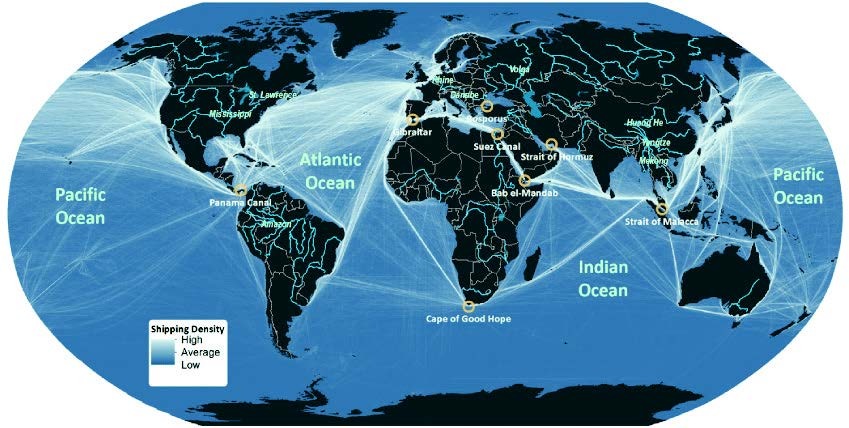
The NDS global operating model (See Figure 2) is a significant departure from the previous joint operations construct in which operations were episodically employed and phased in spatially circumscribed and predetermined areas.41 In the past, phases ended along prescribed timelines. It was contingent. The underlying assumption was that forces were able to step outside of the construct itself, to remove themselves from the portion of the world where violent political action transpired. But as Robert Kaplan observes in The Revenge of Geography, “The core drama of our own age … is the steady filling up of space, making for a truly closed geography where states and militaries have increasingly less room to hide.”42 This is one reason why the new model is global in contrast with yesterday’s theater operating model. (See Figure 3.)
Figure 3. More than 99 percent of global digital communication traffic moves via undersea cables, including those owned by U.S. companies such as Facebook, Google, and Microsoft.45 But there are other reasons. As the National Cyber Strategy elucidates, “Economic security is inherently tied to our national security.”43 Americans cannot afford for the Pentagon to segment a battlespace when U.S. global trade with foreign countries totaled $5.2 trillion in 2017 and relies on worldwide instantaneous connectivity via a limited number of strategic maritime chokepoints.44 Nor can Americans afford for the Pentagon to try to completely cordon off the homeland as immune from the same persistent competition and potential conflict indicated by the model’s layers. We exist in a world with global interconnection, persistent surveillance, and ubiquitous signals that challenge the freedom to maneuver to which the U.S. military has become accustomed.46 Consider, for example, that commercial satellite companies such as Planet Labs capture “every square foot of the globe, sending 1.4 million images … to Earth for processing, generating unprecedented perspective, awareness, and insight about the world below” every day.47 Consider, as well, that such sensing and connectivity technologies have enabled ordinary citizens to reveal in real-time both the highly classified Osama Bin Laden raid and the most recent U.S. presidential visit to Iraq.48
When military planners were able to circumscribe “over there” from the continental United States, the Marine Corps was afforded a temporal freedom for mobilization. The time and effort required to deploy forces, including the dozens—if not hundreds—of ships needed for multi-MEB-sized amphibious JFEO, were uncontested until the forces were in the area of operations. This is no longer an acceptable nor a realistic planning assumption, as RAND’s most recent U.S.-China military scorecard makes abundantly clear.50 This is why we believe our Commandant has emphasized the future challenging nature of “needing to fight to get to the fight,” if Marines are not already where they need to be when the fight begins.51 (See Figure 4.)
This is also why we believe the foundation of our Corps’ new big idea should anchor on dominating the time domain52 by employing highly maneuverable, forward-partnered amphibious close combat units53 that operate persistently throughout the contact layer’s key maritime terrain54 with a Clausewitzian attack-defense55 mindset.56 These units’ Marines should maximize the emerging technological spectrum, including but not limited to remotely piloted, artificial intelligence-enabled scalable autonomous, and loitering munitions systems.57 They should also be seamlessly integrated with the Navy as part of a department-wide combined littoral warfare strike force effort, similar in many ways to Wayne Hughes’ Minutemen58 squadron concept and what Milan Vego recommended in his seminal article on the world’s littoral regions.59 In this case, these persistently forward-partnered littoral strike forces would actively deny key terrain while leveraging relatively inexpensive amphibious fast attack combatants,60 some of which would be equipped individually with fifteen to twenty Marine-sized close combat units capable of collecting on, striking, and maneuvering against adversaries at unprecedented ranges both at sea and ashore.61 The other amphibious fast attack combatants would be equipped with long-range anti-ship missiles to target adversary ships.62
We envision this new littoral strike contact layer capability to be supported by a variety of blunt layer forces. These forces can be anywhere from mere minutes, to hours, to potentially a few days or weeks away. The mere minutes away blunt layer capabilities would include theater- or global-range joint force cyber and all-weather sea-based and ground-launched conventional missile fire support. The latter of these two capabilities, enabled by the anticipated U.S. withdrawal from the Intermediate-Range Nuclear Forces (INF) Treaty (particularly the conventional missile aspect), Congress’s 2018 NDAA mandate for the Pentagon to “establish a program of record to develop a conventional road-mobile ground-launched cruise missile system with a range of between 500 to 5,500 kilometers,” and the distributed amphibious close combat units’ sensing and communications skills, would create a daunting situation for potential adversaries.63 If they attempted to use overt military force to overrun one of the contact layer units to challenge a U.S. mutual defense treaty or to threaten any other vital U.S. security interests, they would quickly find “the width of the killing zone” that they have to maneuver through “would be measured, not in hundreds or thousands of yards, but in hundreds or thousands of miles.”64
The hours away capabilities would incorporate a variety of sea- and air-delivered strike capabilities, if not already located in potential firing positions at the start of the crisis. The few days or weeks away capabilities would include L-class ship-based, Navy-Marine Corps units that would have increased potential to execute missions such as long-range raids, TRAP, and embassy reinforcement due to the Service implementing key changes such as the Close Combat Lethality Task Force guidance,65 fielding Block IV upgrades for the F-35B,66 and fully embracing manned-unmanned teaming.67 (See Figure 5.) Importantly, the amphibious close combat units would decrease the total capacity need for L-class ships while increasing their survivability. Reducing from the current goal of 38 to 25 L-class ships makes available “blue-green” force structure, procurement dollars, and sustainment resources to field the more than 100 amphibious fast attack combatants required for the close combat units that would anchor the contact layer force. What’s more, this change, like a fractal, enables the Naval force to exponentially increase persistent and cost-imposing power projection.
Of course, these contact layer forces, as well as those that might be called in from the blunt layer to support them, would be backed by America’s superior nuclear arsenal, diplomatic acumen, and economic strength. They are but one element, albeit an essential one, in a multi-layered, multi-dimensional approach to compel our adversaries to our will in the service of our national interests. Overall, this new big idea focused on dominating the time domain and leveraging a persistent, forward-partnered offensive defense-in-depth mindset would allow the joint force to turn current revanchist powers’ A2/AD [anti-access/area denial] advantages upside down and inside out. The big idea would also categorically deny a swift military victory to any irredentist action against our joint force, U.S. treaty ally, or strategic partner.
Moving the Big Idea from Theory to Practice
To see how this new persistent amphibious capability would fit into the NDS’s global operating model, let us imagine a world in which the Marine Corps embraces its implementation in at least five strategic locations: the South China Sea, the Strait of Malacca, the Bab-el Mandeb Strait, the Barents Sea, and the Bering Strait.
The South China Sea is simultaneously a place where more than $1.2 trillion of the U.S. economy flows annually and one of the top potential great power conflict flashpoints in the world.69 It is also a region where the U.S. Indo-Pacific Commander has testified China now controls “in all scenarios short of war with the United States.”70 Recalling Thucydides, Frank Hoffman described Beijing exploiting its position in the region in similar manner to a modern day Melian Dialogue with Chinese characteristics: “The mighty do what they can and the small suffer what they must.”71 Recently, a Chinese warship sailed within 45 yards of a U.S. Navy destroyer as it was executing a freedom of navigation exercise in the area.72 A few days prior to that incident, U.S. Air Force B-52 bombers conducted a show of force in this same region.73 These actions were in response to China’s growing militarization of artificial islands in the strategic region and subsequent threats to U.S. and allied military and civilian vessels operating in it.74 These exchanges are clear examples of “grey zone” or “below the threshold of conflict” contact layer activities. Despite all the attention these actions have gained, Patrick Cronin and Hunter Stires recently identified a critical problem with them: without persistence, U.S military activities that attempt to reinforce freedom of navigation or object to Chinese territorial claims are ineffective because they are “inherently transitory.”75 Consequently, they argue, these actions “do not have an appreciable impact on the behavior of local civilian mariners and aviators, who will once again be subject to Chinese harassment as soon as the Americans sail [or fly] away.”76
The foundational problem with the current U.S. approach is the lack of an integrated strategy that appreciates the competition with China is, first and foremost, one over the rules-based order, especially in the global maritime commons. Implementing the new big idea will help fix this problem. Rapidly maneuverable Marine close combat units embarked with Naval forces on fast-attack combatants and serving under a joint force maritime component commander (JFMCC) would enable executing a generational littoral “counterinsurgency campaign” similar to the one for which Cronin and Stires called.77 This capability would be “coupled with vigorous diplomacy” focused on achieving, as they describe, “an essential victory for U.S. and allied arms and the rules-based international order they defend.”78 It is important to emphasize that what we are proposing can only work if these amphibious close combat units are persistently located and thoroughly integrated with the rest of the elements of national power and our allies and partners.
Let us now shift 1,250 nautical miles to the southwest to the Malacca Strait. This strait is described as the 21st-century “Fulda Gap.”79 More than 15 million barrels of oil pass through the strait each day, including around 82 percent of China’s 9 million-barrel daily import requirement. (See Figure 6.)80 Beyond oil, around 25 percent of total global trade by volume moves daily through the strait, along with more than 30 terabits per second of transoceanic data.81 Needless to say, the Strait of Malacca is strategic maritime terrain—to the extent that to control the Strait of Malacca is to control the South China Sea. Thus, Beijing’s efforts to economically sway into its orbit countries located adjacent to the strait, such as Malaysia, should not be a surprise.82 Nor should China’s efforts to develop closer relationships with the Royal Malaysian Navy, which currently includes providing littoral missions ships, a variety of weapons, and increased bi-lateral training exercises.83 Beijing’s aggressive push to establish a foothold adjacent to the Strait of Malacca is not isolated to Malaysia though. It is increasingly expanding across the countries of Southeast Asia, many of whom are members of the Association of Southeast Asian Nations (ASEAN).84 Ominously, a recent poll of ASEAN member countries found two-thirds of the respondents believe U.S. engagement in Southeast Asia has declined and one-third have “little or no confidence in the United States as a strategic partner and regional security provider.”85
Now let us imagine a Marine Corps that embraces the proposed new big idea in a geo-strategic crisis where China sought to seize part of a treaty ally or partner’s territory near the Strait of Malacca. This location possesses Reliable Acoustic Path arrays that provide intelligence on submarine movements87 and undersea network nodes.88 More than 220 undersea cable systems are responsible for over 99 percent of all transoceanic digital communication.89 Of the 685 undersea cable network nodes—where the cables transition between land and sea—366 are located on islands, many of which are located in the Indo-Pacific region.90 U.S.-based digital communications’ companies, who make millions of dollars daily due to these cables, protest against China’s intentions and encourage the White House to respond.91
From U.S., allied, and commercial surveillance capabilities, imagine in this scenario the JFMCC responsible for the area receives information that many thousand Chinese assault troops, embarked on naval shipping, are sailing toward the location at approximately sixteen knots.92 This force is 300 miles from its expected objective. At this point, the JFMCC has around twenty hours to develop and implement a plan that helps U.S. policymakers blunt the attack.
A forward-partnered amphibious close combat company—composed of around 200 Marines trained to operate in more than 12 separate teams—is already on the ground operating with special operations and allied forces in the country where the attack is expected. This is not a disingenuous scenario inject but a fundamental aspect of this strategy and the Marine Corps’ persistent engagement mindset. The JFMCC, in conjunction with the “country team,” orders the Marines to move into positions to blunt the adversary assault. The Marines, with their partner forces who have trained to this scenario in previous exercises, move via organic all-terrain vehicles and local transportation to assume these positions three hours later. With more than 100 loitering munitions, located in dense vegetation, this close combat company—in essence, a revolutionary airfield-less mini-MAGTF—is prepared to sense, swarm, and if necessary, neutralize adversary naval vessels at ranges out to multiple dozen miles.93 Additionally, this unit has a limited number of platforms that range out to 500 miles while carrying up to 20-pound payloads.94
Simultaneous with this mini-MAGTF’s actions, the JFMCC orders three more close combat companies to insert into a larger offensive defense-in-depth. MV-22s fly one of these units in from an amphibious ship located 500 miles away and it arrives 3 hours later. A second close combat company inserts as part of a littoral strike force from a separate ship and is in position within a similar timeline. This company is prepared to blunt the adversary attack on land or from their fast attack combatants with long-range anti-ship missiles. And in coordination with our allies, the third close combat company launches via MV-22s from a new British naval base in another part of the contact layer and covers 1,200 miles to arrive 5 hours later.95
The JFMCC, along with U.S. and allied policymakers, now has a force of more than 1,000 personnel on the ground, armed with nearly 1,000 loitering munitions, as well as grenades, rifles, machine guns, rockets, mortars, and long-range anti-ship missiles. This force is supported by the MAGTF’s growing medium-altitude long-endurance UAS capabilities and prepared to engage the adversary from every direction, at ranges as far out as 500 miles.96 It also has the capability to instantly leverage theater- and global-range joint cyber and conventional missile fires. Moreover, because of the innovative efforts of young logistics Marines, this force can 3D print hundreds more loitering munitions from locations near their defensive positions.97 Additionally, autonomous vehicles can deliver these weapons directly to the distributed close combat units.
At this point, the adversary has ten hours remaining on its movement across the ocean. American and allied policymakers communicate to leaders in Beijing that a force is in position and prepared to uphold international law and U.S. mutual defense treaty obligations. What do you think the Chinese leaders would do next? We are inclined to think these Chinese policymakers would re-evaluate the outcome of their decisions and call off the attack. Regardless, our Corps’ new amphibious forward-partnered capability would have strategic effects for our Nation. If the Chinese troops continue their movement, our reimagined mini-MAGTFs can monitor and affect them in real-time. This includes bringing overwhelming swarming firepower to bear should the Chinese troops cross our ally’s twelve-mile international territorial boundary, or well beforehand. Additionally, if any of the adversary troops ever gets ashore, the Marines can then close with and destroy them with rifles, grenades, and bayonets. This is precisely the type of persistent capability that we envision our Corps, based on the proposed new big idea, possessing for our Nation.
Switching from this strategic vignette, let us move 4,000 nautical miles west to the Bab-el Mandeb Strait and see more opportunities to leverage the new big idea in the contact layer. Nearly 10 percent of the global oil supply—4.7 million barrels per day—passes between the 18 miles separating Ras Menheli, Yemen and Ras Siyyan, Djibouti.98 Referred to as a “deadly geopolitical cocktail,” the strait is subject to everything from Somali pirates to Houthi anti-ship missile attacks spilling over from Yemen’s ongoing civil war.99 Additionally, China’s first overseas military base, for “international obligations,” is located in Djibouti.100 Unsurprisingly, China’s “Belt and Road” initiative has significant infrastructure investment in Djibouti funded by predatory loans that indebt the country.101 China also recently secured a 99-year lease for a port in Sri Lanka, providing its growing maritime force access to a key location along the main shipping route between the Bab-el Mandeb Strait (as well as the Strait of Hormuz, another piece of key maritime terrain) and the Malacca Strait.102
China’s base in Djibouti is only eight miles away from American forces at Camp Lemonnier and, as the U.S. National Security Advisor recently highlighted, is already interfering with their activities by conducting laser interference against pilots operating in the region.103 The same counterinsurgency model recommended by Cronin and Stires applies here, as do the combined force littoral strike capabilities for which Hughes and Vego have called. By embracing the new big idea, Marines will be able to simultaneously help support the Navy and special operations forces, reassure strategic partners, and counter Beijing’s attempts to increase its influence in the region.
Spinning the globe again, we travel north 4,000 nautical miles to Svalbard, Norway. (See Figure 7.) This was the site of a number of military operations during World War II, most importantly as key maritime terrain for Germany to maintain war weather stations.105 Svalbard is 550 nautical miles north of Murmansk and adjacent to the Barents Sea, where Russia is constructing artificial islands.106 Svalbard is also home to the Doomsday Vault for the world’s seeds.107 It has the northern-most set of undersea cables that are likely to be networked as the Arctic continues to melt.108 This is not a region unfamiliar to our Corps. Recently, our Service increased its persistent presence in Norway conducting exercises while maintaining an established Marine Corps Pre-Positioning Program-Norway.109
With the proposed new big idea, we suggest a modification to deter Russia and to increase cooperation with our allies. Currently, the Norwegian Coast Guard only has one vessel, yet it requires more to conduct all the operations required for Svalbard.110 This provides an excellent partner mission opportunity for an augmenting persistent littoral strike force. Moreover, last year Russia conducted an exercise simulating an invasion into Svalbard, which if carried out could invoke Article 5 of the North Atlantic Treaty.111 Russian possession of Svalbard would enable their A2/AD capabilities, protect their nuclear submarines, and enable sea control into the Barents Sea complicating NATO efforts. We believe amphibious-based close combat forces, with both their organic lethal fires and instantaneous access to theater- and global-range joint cyber and conventional missile capabilities, would serve as a vital deterrent to help prevent such a scenario from ever happening in the first place.
Turning now toward the other entrance to the Arctic, 2,100 nautical miles over the North Pole, we find the Bering Strait. Unlike during the Cold War, when sea ice concentrations in the region prevented dependable transit routes for trade, cargo shipping along the Northern Sea Route in 2017 achieved a record high of 9.7 million tons.112 This was a 35 percent increase from 2016, with experts forecasting much greater growth in the years ahead. U.S. Navy strategist, Rachael Gosnell, recently commented that the “Bering Strait will open for an extended period starting around 2020, the Northern Sea Route around 2025, and the Transpolar Route around 2030.”113 She also described how plentiful natural resources have already sparked great interest in the region. Russia is acting on these interests by conducting major infrastructure building efforts and large naval exercises.114 China has also employed its navy in the region.115 Unfortunately, despite this key maritime terrain being adjacent to Alaska, neither the U.S. Navy nor the Marine Corps have a visible, persistent presence in the region. U.S. Senator Dan Sullivan, a Marine representing the state of Alaska, has increasingly expressed concerns about these deficiencies during Congressional testimony.116 This is yet one more opportunity for our Corps to implement the proposed new big idea. In this case, our new mini-MAGTF littoral strike force proposal would help support an already over-tasked U.S. Coast Guard element protect 10,000 kilometers of U.S. coastline, which is 50 percent of America’s coast.117 These forces could also partner with our Canadian allies who have similar challenges in the region.
These are just five pieces out of dozens of potential key maritime terrain locations. The selection of the South China Sea, Strait of Malacca, Bab-el Mandeb Strait, Barents Sea, and Bering Strait should not imply that this is where competition might become conflict, but to serve as talismans for potential crisis spots. This analysis could have equally described maneuver in and around the Strait of Hormuz, the Suez Canal, the Bosporus Strait, the Panama Canal, and the East China Sea, among many others. While it is unwise to debate precisely where or when a conflict trigger will occur, it is increasingly imperative to have a credible force at this point first and this force must be connected to the full might of our Nation. Given the world’s increasingly closed geography, achieving this powerful, persistent presence requires fundamental change to how our Service thinks about its mission and relevance to the Navy and our Nation.
Top Eight Actions Required to Implement the New Big Idea
With the new strategic guidance and big idea vision in mind, what follows are the top eight actions that our Corps should embrace to maximize its future value for our Nation:
Embrace expanding the competitive space.118 Instead of the current episodic MEU and multi-MEB amphibious JFEO surge capability focus, philosophically commit to prioritizing contact and blunt layer missions that maximize our Nation’s ability to constantly compete with revisionist powers and violent extremist organizations.119 (See Figure 8.) This will enable forward persistence in ways that reassure allies and partners, while deterring and, if necessary, helping to defeat potential adversaries in short order. The current lack of persistent and distributed presence near key maritime terrain means our Service has much work to do to achieve this goal.
Double down on reinvigorating Maneuver Warfare. Our big idea not only proposes a way to leverage the changing character of war in our favor, but also the very structure of democracy, capitalizing on what David Blair has called the Chaos Imperative.121 The Chaos Imperative is to liberal democracies as maneuver warfare is to the Marine Corps. It seeks to inject disorder into a system that requires order to perform. Just like MCDP-1 Warfighting the Chaos Imperative seeks to “create a turbulent and rapidly deteriorating situation with which the enemy cannot cope.”122 Calibrated chaos is one of our innate advantages in a great power competition with a centralized, repressive, and controlling authoritarian state such as China. It proposes a way to leverage the structure of our democratic system, like our warfighting philosophy, to outperform our enemy in deliberate chaos and complexity. In other words, calibrated chaos, as a principle, should be considered our best friend. The Marine Corps’ new big idea should strive to maximize the competitive advantages of this chaotic trade space. While the generals’ war might belong to the Chinese General Staff, a captains’ war, or even better, a sergeants’ war, belongs to us.
Update our Service concepts in full partnership with the Navy. The ongoing “Littoral Operations in a Contested Environment” and “Expeditionary Advanced Base Operations” concept efforts are a start. These should be revised based on the NDS guidance, the forthcoming new National Military Strategy, in anticipation of the U.S. withdrawal from the INF Treaty (again, with a particular focus on the implications of lifting the conventional missile constraints), and with a clear prioritization on maximizing the ability to provide persistent, distributed, and lethal capacity throughout the contact layer’s key maritime terrain.123 They should also be signed by the Secretary of the Navy, our Commandant, and the Chief of Naval Operations. Our Nation cannot afford any conceptual daylight between the Naval Services going forward.
Focus force design on supporting essential naval tasks as described in the Chief of Naval Operation’s recently published “A Design for Maintaining Maritime Superiority.”124 These tasks are near identical to those described by our 29th Commandant, Gen Alfred M. Gray and LtGen George J. Flynn in their 2015 “Naval Maneuver Warfare Linking Sea Control and Power Projection.”125 Accordingly, let the multi-MEB amphibious JFEO organizing construct fade away into the history books. Focus, instead, on reinventing ourselves in conjunction with the Navy such that within the next 5 years the Naval force has more than 50 persistent, forward-deployed complementary sensing, screening, and transformatively lethal, mini-MAGTFs located in key maritime littoral regions. Redefine our Naval Service “readiness” metrics in this way as well.
Redesign the amphibious component of the 30-year Naval shipbuilding plan. As per Representative Gallagher’s repeated requests, work closely with the Navy and Congress to create a new plan that meets the NDS contact and blunt layer intent. Continuing to request only more billion-plus dollar amphibious ships, each operated by 400 to 1,000 Sailors, is unaffordable given current budget constraints. Nor does it address what is required for operational relevance given the NDS guidance. The new plan should incorporate a more valuable amphibious shipping approach, which includes around 25 large “L” class ships (LHD/LHA/LPD) maintained at high readiness rates to operate in the blunt layer. And instead of replacing the current fleet of LSDs with the LPD Flight 2 ships at $1.4 to $1.6 billion each, request more than 100 relatively inexpensive amphibious fast attack combatants to enable simultaneous forward-partnered persistent operations throughout the contact layer’s key maritime terrain.126
Fully implement the Close Combat Lethality Task Force guidance.127 The evolution and modernization of MAGTF small units in accordance with this guidance combines seamlessly with our Commandant’s intent to reinvigorate maneuver warfare. As such, it also enables adapting our forward deployed and forward stationed force posture, especially for units in the Western Pacific. Congress has already been informed that these forces need to become more lethal, maneuverable, and survivable.128 These units should become the central components of the new big idea and the contact layer foundation, including the ability of forces within it to quickly transition to blunting activities.
Double down on our Corps’ growing relationship with Special Operations Command. Our Service is currently learning myriad invaluable lessons while working in ad hoc manners alongside the special operations community in multiple combat zones. In accordance with the new Marine Corps–Special Operations Command Concept for Integration, Interdependence, and Interoperability, these lessons should be institutionalized.129 They should also inform the new amphibious close combat units’ capability development such that these forces can best reassure allies and partners located in the world’s key littoral regions. This coordination reiterates to strategic competitors and violent extremist organizations alike that challenging the rules-based international order will not be tolerated and that any attempt to do so will be soundly defeated.
Prioritize all aspects of manned-unmanned teaming. The robotics and autonomous systems opportunities that now present themselves, largely derived from software defined commercial technologies, can enable the new amphibious close combat mini-MAGTFs with persistent sensing, communications, and fires.130 Our Service should embrace the velocity of commercial advancements and what this means for affordable capability development through rapid prototyping and hypothesis validation while also adopting advanced manufacturing for iterative small batch production. Simultaneously, we should think deeply about how other MAGTF elements, both manned and unmanned, can support these Gen Geiger-envisioned smaller forces. As just one example, persistence, multi-thousand-mile range, and high reliability redefines on-station aviation support potential. A remotely piloted aircraft’s time in the chalks now only requires minutes at a forward arming and refueling point in exchange for days of sensing, communications bridging, and effects thereby redefining sortie generation possibilities. This one capability allows reimagining what organic and scalable remoted services support is possible for these mini-MAGTFs. Scalability is provided by autonomous, line-of-sight, relayed, or even CONUS reachback leveraging networked capabilities across enterprises while gracefully degrading to essential services for the new close combat units. This, combined with the organic capabilities of the new amphibious close combat units, shifts the collective capability menu for tactical visionaries and strategists for the next century to iterate in numerous permutations and combinations.131
Turning Crisis into Opportunity
One of the world’s greatest innovators, Alexander Graham Bell, once said, “When one door closes, another door opens, but we so often look so long and so regretfully upon the closed door, that we do not see the ones which open for us.”132 Perhaps this quote applies to our Corps, too long yearning for the multi-MEB amphibious JFEO closed door to re-open anew and for being too satisfied with limited capacity, episodically rotating MEUs. Or, perhaps, given what our policymakers have tasked us to do, our Corps has been justifiably too focused on fighting in predominately land campaigns over the past eighteen years to embrace a new amphibious paradigm. Regardless, our policymakers have now given us fundamentally different strategic guidance—and with this guidance comes an enormous opportunity for our Corps to reimagine itself through the open door that the Navy and our Nation need most. The eight recommended big idea actions provide the broad framework to help us exploit this opportunity.
By increasing our Service’s ability to provide the Navy and U.S. policymakers with transformatively lethal amphibious close combat units, which are, simultaneously revolutionary mini-MAGTFs, we will ensure that the global operating model contact layer has the persistent, forward-partnered strategic forces required to meet the NDS’s intent. Additionally, by providing similarly transformative contributions to the joint force blunt layer, we will ensure that Marines can help counter adversary aggression reinforcing anywhere in the world within a week or two, if not in days, hours, or even in a minute or less. Combined, these new Marine Corps contact and blunt layer contributions will provide U.S. policymakers the most precious of all capabilities—time.
>For footnote information, please visit https://www.mca-marines.org/wp-content/uploads/Not-Yet-Openly-at-War-But-Still-Mostly-at-Peace.pdf.
>Mr. West is a former Assistant Secretary of Defense and combat Marine. He has written ten books about Marines in Vietnam, Iraq, and Afghanistan. His latest is The Last Platoon: A Novel of the Afghanistan War.
After U.S. combat in Iraq and Afghanistan sputtered to an unsatisfactory finish, the Marine Corps pivoted to preparing for a war with China. The pivot, called Force Design 2030, calls for “a nimble force capable of employing long-range fires in support of fleet operations.”1 The key warfighting employment envisions seizing and then hopping from tiny islands in the South China Sea in order to fire missiles at Chinese warships. To pay for this, the Corps has given up its tanks and many artillery tubes. This transformation has been ongoing for two years. Sufficient time has passed to pose five questions:
1. Vital for Sea Control?
Force 2030 assumes the Navy needs Marines to prevent the Chinese fleet from sortieing across the Pacific. U.S. admirals will gladly accept the offer of the 2030 force. But sea control is not in mortal peril without Marine aid. Our naval aviators and attack submariners believe they are quite capable of sinking those Chinese vessels. In addition, thousands of missiles are lodged on board hundreds of U.S. Navy vessels. Conversely, the mission is not needed to insure the viability of the Marine Corps. The public prizes Marines as tough, disciplined warriors who without exception have fought in any clime or place. Congress and presidents support the Marine Corps as a stand-alone Service.
2. Warfighting Credibility
During any pre-war crisis, China will threaten any nation that grants landing rights. So, it is unlikely any nation will grant permission for Marines to land. The Chinese will have a plan for neutralizing every landing spot. Once hostilities begin, the Navy must place its amphibious ships in harm’s way to land Marines with scant organic firepower. This means the Navy must bring sustainment. But Wake Island in 1941 showed the Navy might decide not to send a relief force. In sum, island hopping in enemy waters is very high-risk.
Separate from capability is the issue of strategic credibility. Does the Chinese fleet really intend to reprise World War II in the Pacific? Yes, two novels—Ghost Fleet and 2034—have featured a Chinese fleet sailing 6,000 miles to seize Hawaii and to drop nuclear bombs on U.S. cities. But to do so in real-life, those Chinese ships must refuel while avoiding our lethal attack submarines and carrier battle groups. Why would China throw away its fleet?
In war, the center of gravity rests upon the determination of the opposing peoples. China, under blockade and without fuel, will be ground down—if American spirit refuses to quit. But the Chinese leadership will be confident that their society can endure privations longer than can American society. Worldwide shipping will cease, and cyber networks will be severely disrupted. Will the public endure months of hardships, including the loss of electric power, massive financial disruption, and the severe rationing of basic goods?
Rallying his countrymen during the Nazi 1940 bombing of England, Prime Minister Churchill declared, “I see the spirit of an unconquerable people.”2 Recently, the historian Niall Ferguson wrote, “Americans today appear to have a much lower tolerance for risk than their grandparents and great-grandparents.”3 In a war, our national will is what China will test.
An article in the Wall Street Journal opined, “the generation born between 1995 and 2012 is far more risk-averse and more physically safe than its elders.”4 Does America as a society have the grit of “the greatest generation” during World War II? Would we pull together as a nation, or would our sharp cleavages result in the acceptance of Chinese terms?
3. Opportunity Costs
That existential challenge transcends our military. For the Marine Corps, the narrower question is whether the benefits of Force 2030 outweigh its opportunity costs. Over the past century, America has fought six major wars and a dozen smaller conflicts. Naval planners foresaw the 1942–45 War in the Pacific; all other wars and crises were not anticipated. So, the odds are about five to one that the next conflict will not be a naval conflict with China. Force 2030 may be a force in stasis, never employed.
Force 2030, however, did give up tanks and many howitzers. Defense Secretary Jim Mattis and retired Gen Robert Neller invested heavily to modernize the essence of the Marine Corps—the squad. Their shared assumption was that close-in combat remained the lodestone of the Marine Corps. Under Force 2030, the squad will fight without tanks or continuous close-in fire support. Marines employed tanks in Vietnam, in DESERT STORM, and in the march to Baghdad. If the next conflict requires tanks or sustained fire support, Marines will have to task organize with Army units, lining up in a queue alongside the National Guard. Command relationships will be complex and time-consuming, enervating the Marine core concept of maneuver warfare. Force 2030 runs the risk that the next conflict will require what has been discarded, meaning Marines will not be the first to fight.
4. Disconcerting China
Nonetheless, because China poses the largest threat to American interests, Force 2030 is a bargain if it deflects China from its incremental, irredentist aggression. The historical precedent for this is the Maritime Strategy, circa 1978–88. Following the fall of South Vietnam in 1975, the Pentagon shifted from counterinsurgency to deterring a Soviet blitzkrieg against NATO. Funding and strategy concentrated on an anti-armor defense along the inner-German border, with the Navy playing a small role and reduced funding.
The Navy responded with a study called Sea Plan 2000 that advocated horizontal escalation. While Soviet armor was attacking south against West Germany, American carriers and submarines would surge north, sinking Soviet ships and submarines, including those with nuclear missiles. After wargaming, this evolved into the “Maritime Strategy,” embraced by the CNO and Secretary of the Navy. President Reagan authorized carrier exercises in the Norwegian Sea, threatening the Kola peninsula. In response, a thoroughly alarmed Russian CNO pleaded with the Politburo for a major increase in funding. Instead, Gorbachev became more convinced that Russia could not compete militarily against America, thus hastening the end of the Soviet Union.
Similarly, Force 2030 should apply such horizontal escalation, publicly advertising that its long-range missiles are not merely anti-ship; instead, they can also strike targets inside the Chinese homeland. If Chinese warships hid in port, Marine missiles would still go in after them. No sanctuary would be given. Force 2030 would then get Beijing’s full attention, resulting in much diplomatic sputtering and a heavy Chinese investment in defense. Thus, during peacetime, explicit horizontal escalation by Force 2030 would have an outsize effect enhancing deterrence, just as the Maritime Strategy had upon the Soviet Union. Viewed through this geopolitical aperture, Force 2030 is a bargain for America’s security.
5. Is Force 2030 Tied To a Firm National Policy?
However, unlike in the case of the Maritime Strategy, our national policy does not support Force 2030. For a quarter of a century, presidents from both parties have chosen not to take action as China built its littoral forts. U.S. combatant ships occasionally venture into the South China Sea to support international transit rights, but no effort has been made to quarantine or otherwise apply leverage to force China to deconstruct its forts.
Instead, in a feat of policy jiu-jitsu, the administration has used the island-hopping strategy to shrink the overall size of the amphibious force. The Marine Corps recommended constructing eight light amphibious ships to transport small packets of Marines among the contested islands, rather than risk sending in large amphibs. The administration decided that light amphibs could substitute for the construction of larger amphibs.5 The Marine Corps was penalized for its strategic initiative.
Whether our policymakers place real value in Force 2030 is easy to determine. Simply propose an exercise, to include landing rights, inside the South China Sea. If the White House approves and through diplomacy secures landing rights, then Force 2030 will move from a paper concept to an operational reality that will genuinely disconcert China. If the answer is no, then we do not have a firm policy to check Chinese irredentism. In that case, the Marine Corps should not devote more resources that degrade the Marine ethos of being ready for combat in any clime or place.
Put bluntly, our policy toward China is too erratic to sustain Force 2030 for the next twenty and more years. Because our national policy dares not risk even an amphibious exercise in the South China Sea during peacetime, it is highly unlikely our ships would operate there during war. My novel, The Last Platoon, described the heroic futility of Marines pursuing a wrong-headed policy in Afghanistan. Let us not repeat that mistake. There is no policy that firmly supports island-hopping in the South China Sea.
Notes
1. Gen David H. Berger, Force Design 2030 (Washington, DC: March 2020).
2. Eric Larson, The Splendid and the Vile (New York, NY: Crown, 2020).
3. Niall Ferguson, “How a More Resilient America Beat a Midcentury Pandemic” Wall Street Journal, (April 2021), available at https://www.wsj.com.
4. Abigail Shrier, “To Be Young and Pessimistic in America” The Wall Street Journal, (May 2021), available at https://www.wsj.com.
5. Mark Cancian, “Stormy Waters Ahead for Amphibious Shipbuilding Plan” Breaking Defense, (July 2021), available at https://breakingdefense.com.
>Dr. Hoffman retired from the Marine Corps Reserve in 2001. He is a graduate of the University of Pennsylvania’s Wharton School and holds a doctorate from King’s College, London. He spent much of the first 33 years of his government career in the Department of the Navy in variety of roles, including a Force Structure Analyst, Advanced Concepts Developer, and Strategic Planner. He is currently a Researcher and Professor at the National Defense University. These remarks are his own and do not represent the views of the DOD.
The headline in the Saturday New York Times on 1 June 1918 read “Marines—First to Fight.” The day before, a brigade of Marines attached to the U.S. Army’s 2nd Division had raced to the front to halt a breakthrough threatening Paris. They stopped the Germans cold, and five days later, the brigade successfully counterattacked at Belleau Wood—becoming the first publicly identified American unit to enter combat in World War I. Ever since that epic battle, the Corps has embraced “First to Fight,” initially as a recruiting slogan and then as an ethos that reflects its place in the country’s security architecture. As part of that ethos, the Marine Corps has promoted an institutional mindset about a high level of readiness for crises both small and large. Since 1952, the Corps has been designed and postured as an amphibious “force-in-readiness” poised for immediate use in a wide variety of missions, exploiting its expeditionary tool kit and naval mobility. When faced with a crisis, Marines believe one of the first question from the White House should be: “Where are the Marines?”
Marine Force Design 2030
The Marine Corps has earned its reputation within battle, but it has also excelled at anticipating demands for new capabilities to deal with the changing character of war. After the end of the Cold War, as it adapted to the age of terrorism and a generation of operations in Iraq and Afghanistan, the Marines made small steps forward. When he became Commandant of the Marine Corps last year, Gen David H. Berger signaled that the time for distinctive change had arrived.1 In articulating his vision of a future Marine Corps, Gen Berger concluded:
The rapid expansion of China’s area-denial capabilities, coupled with its pivot to the sea as the primary front in a renewed great-power competition, have fundamentally transformed the environment in which the U.S. military will operate for the foreseeable future. For the first time in a generation, sea control is no longer the unquestioned prerogative of the United States.2
His guidance was seen as both revolutionary and refreshing by pundits and reformers. It was seen as refreshingly frank, taking on cherished assumptions, and willing to reduce personnel to gain funding for needed modernization.3 Subsequently, the Commandant has shown that he was willing to gore a few sacred cows and has detailed the proposed force changes developed for a 21st-century Corps aligned with the National Defense Strategy.4 This plan has generated both plaudits and concerns from defense analysts outside the Corps and retired Marines. Any change would be controversial, especially when you move away from combat proven capabilities to accept tradeoffs and embrace a different future. In this short article, I briefly detail the proposed changes, assess the general shifts represented in the design, and evaluate some issues related to the plan. This assessment indicates that the capability and capacity changes are aligned with both the National Defense Strategy in general and the changes in the projected operating environment.5
Force Design 2030
The design includes a number of increases and decreases in capacity. Some of the shifts are significant, including the elimination of tanks and the large reductions in truck-towed cannon. The Marines have been using tanks since World War II and used them in Iraq and Afghanistan for mobile shock power, especially in urban fighting. Their shock and firepower in combat is valuable. But they, like the artillery, are heavy and reduce the agility of the force. In particular, they are of limited value in the emerging realities facing us in maritime operations in the Pacific where greater distances and precision is needed against near-peer competitors. The gist of the major changes is displayed in Table 1.
The new plan also alters the ACE of the Marine air-ground team, cutting 108 airplanes by eliminating squadrons and aircraft totals assigned to fighter/attack squadrons. Three unmanned vehicle squadrons are added, as is a refueling squadron that will help extend the operating range of the fifth generation F-35 Lightning being procured.
Another significant change is the expansion of missile batteries to extend the range of Marine fires. This shift allows the Corps to support what Andrew Krepinevich has called “Archipelagic Defense” in the Pacific.6 To support such an approach, U.S. ground forces would be postured in and around the first island chain and apply cross-domain capabilities to deny freedom of maneuver to adversary surface forces. Marine units would deny the People’s Liberation Army (PLA) Navy use of the seas with shore-based anti-ship cruise missiles from distributed operations in the Pacific. At the same time, other land-based air with missile defense assets—including Patriot, THAAD, and possibly railguns—would ensure the PLA could not use its air power. This strategy is in line with ideas expressed years earlier by Dr. T.X. Hammes.7 The new Marine concept being tested to operationalize this mission is Expeditionary Advanced Base Operations (EABO), and it has been subjected to several years of study and war gaming.8 This concept and others like Littoral Operations in Contested Environments extend the Corps’ unique naval skill sets and strengthen its integration with the Navy for maritime operations in the Pacific.9
Capability Shifts
There are six distinctive shifts in this design. These are shifts in degree, not necessarily in kind. Each appears consistent with the emerging environment, as well as the intent and vectors of the National Defense Strategy issued in January 2018.10
Assessment
As noted earlier, the proposed shifts in the unique Marine set of capabilities are derived from the National Defense Strategy and do reflect the priorities and desired investments that the Pentagon’s planning documents calls for. A good strategy should document choices and clear prioritization, and its implementation should strive to align means to ends. The Pentagon did that in its strategy and framed explicit priorities as well as the risks for lower priorities. Some risk comes from making choices. Especially at this time of crisis and limited resources, discipline in execution should become critical for U.S. military leadership as we attempt to maximize our security. Force Design 2030 details clear tradeoffs and investments in line with those thrusts. While the force design holds up well against the shifts suggested by that strategy and today’s dynamic security environment, two areas warrant comment.
Joint force design. Joint interoperability at the strategic level is important. One cannot objectively evaluate the Marine force design in the absence of a holistic understanding of the other Services, so an understanding of how the Joint force is designed would be helpful. In the past, the Services resisted the idea of Joint force “interdependence.” With best case defense budgets in the future declining or at a plateau, an integrated Joint force design is more salient than ever—making it imperative to ensure there are no gaps and far less redundancy in the overall armed force. How the Marine Corps changes impact the U.S. Army’s armor force needs to be understood. Even more important will be clarity on how the Navy supports the Marines when deployed in expeditionary operations Navy support in terms of theater-level mobility, intelligence and surveillance, and logistics may be more salient than ever. I am sure that the Commandant realizes this and engaged with the Chief of Naval Operations to generate an integrated naval design.
Strategic and operational risk. The cardinal virtue in defense planning, the late Colin Gray often stressed, is prudence.13 This includes a reasonable appreciation for uncertainty, the consequences of choices, and the need for adaptability. There is some risk involved in shaping the force for the Pacific. I have always held that forces that can achieve multiple missions should be considered at a premium over single purpose forces. Force designs that cover multiple strategic futures are preferable to a design oriented on one threat, although such specialization is needed for key capabilities. As Secretary James N. Mattis said when he rolled out the latest defense strategy, the United States
cannot adopt a single preclusive form of warfare. Rather we must be able to fight across the spectrum of conflict. This means that the size and the composition of our force matters.14
It matters since the Joint force has to cover a wide range of missions and terrain; they have to be rugged and reliable, instead of exquisite and expensive.
In his initial guidance, the Commandant signaled that while he conceived of the Marine Corps as the Nation’s force-in-readiness, it was not designed to operate across the range of military operations (ROMO):
but rather, a force that ensures the prevention of major conflict and deters the escalation of conflict within the ROMO.15
That is a redefinition of the Corps’ mission as articulated by Marines since the end of the Cold War. Gen Berger’s intent was to create a Corps
optimized for naval expeditionary warfare in contested spaces, purpose-built to facilitate sea denial and assured access in support of the fleets.16
He explicitly noted that this “single purpose-built future force” could be used in many other missions around the globe, but the force would not incorporate investments for those contingencies.17 The new force structure reflects that guidance.
Yet, reforming the Marines solely around one scenario, instead of multiple futures and challenges, reduces versatility to some degree. A study on alternative Marine Corps force designs several years ago that I produced with a colleague concluded:
The future will be highly complex, and a premium should be placed on versatile forces, not narrow, specialized or single-purpose assets. The Corps must find a new balance between maintaining the enduring traditional logic of its role as soldiers of the sea and meeting the challenges of a new security environment. It cannot just become a smaller version of its pre-Iraq force design.18
This has led some, including myself, to publicly express concerns that the force design stressed one mission in one theater.19 The critics accurately point to the versatility of the Marines in scenarios over the last fifteen years like Iraq.20 Other analysts and Marine veterans expressed this same concern,
a Marine Corps that is custom-designed for distributed operations on islands in the Western Pacific will be poorly designed and poorly trained for the land campaigns it is most likely to fight.21
However, a detailed look at the published report on the design reveals a robust force with sufficient flexibility over multiple tasks. With its tailorable force building blocks, along with the additional precision strike assets, the 21st-century Marine Corps retains utility across numerous contingencies, including conflicts like eastern Ukraine and the likely proxy wars of great power competitions.22 These are far more likely in eras of great power competition, especially a contest between nuclear armed competitors as we have now. Yet, Force Design 2030 reduces risk in the Pacific theater and accepts some readiness tradeoffs in potential secondary tasks or unknown crises. That is a risk in all force development efforts.
Strategy and force planning are about choices with different risk tradeoffs with constrained resources. The new Marine force is more strategically shaped, and it prudently reduces risk in what U.S. strategy defines as the primary challenge of our times. But it has not eliminated the Corps’ ability to respond to many scenarios as an overview of threats shows.23 Force Design 2030 is not a hammer with only one purpose, retaining the ability to defeat an array of rivals. In fact, the Corps’ agility, lethality, and resilience are enhanced in key ways and targeted to meet strategic requirement rather than general utility. Yet, the Marine “Leatherman tool” task organization remains, with new attachments.
Every Marine will have different ideas about how to tweak this plan. There could be more of a hedge, perhaps more unmanned systems, or adjust the missile/artillery mix in order to retain some artillery. These can be sustained in the Marine Reserve as a hedge against uncertainty.24 We can almost certainly expect communications and logistics difficulties as the creative operational concepts are put to the trial, and future adversaries will exploit them. The Marine Corps Warfighting Laboratory is no doubt aware of this and is studying a range of potential solutions. More details on counter-UAS capabilities are needed. The possibility of intensive urban operations needs to be considered, Fallujah’s deadly battle come to mind.25 That said, reformed Marine infantry units, with increased firepower, man/machine teaming, and long-loitering armed UAS support should remain capable of urban fighting.
Thus, these are near-term, strategy-driven changes based upon clear strategic priorities, as well as known adversary capabilities and changes in the character of modern warfare. The next generation of Marine innovators are promoting a number of creative concepts worthy of consideration.26 They begin the path toward more transformative changes tied to advances in technologies like artificial intelligence, robotics, additive manufacturing, and hypervelocity missiles.27 These should continue to be explored via experimentation over the next few years.28 Their true battlespace potential will emerge over time and will be part of the continuous process of rigorous force development and change that the Marine Corps has demonstrated for generations with helicopters, remotely piloted vehicles, tilt-rotor planes, etc.
Conclusion
Ultimately, this is not a radical shift of force capabilities or capacity. Nor is it risk free. But it is a response to strategic direction that recognizes stronger competition from adversaries who have gone to school on our methods and invested to thwart our power projection approach. In so many ways, the force design represents a measured step forward in response to both strategic direction established in the National Defense Strategy and to emerging challenges in the strategic environment.29 The proposals take the Marines two long strides forward into the 21st century. Gen Berger has crafted a positive vision about how the Corps should posture itself for this unfolding century, vice a repeat of the old missions and outdated tactics from the last one. Clearly, in such a dynamic age, we need more than just a shrunken version of the Corps pre-Iraq 2001 force structure. Given the intensive efforts that major states have made in developing robust anti-access capabilities against the predictable pattern of deploying U.S. forces, the Marine plan is actually overdue.
Rather than radical, the shifts in the 2030 plan are quite deliberately measured. The Marines are not just “First to Fight,” but often also “First to Adapt,” and Force Design 2030 reinforces that history. When future Presidents call to “send in the Marines,” will they still be both ready and successful? The answer to that question seems to be a clear “Yes.”
Notes
>For footnote information, please visit https://www.mca-marines.org/wp-content/uploads/Still-First-to-Fight.pdf.
2022 LtGen Bernard E. Trainor Military Writing Award Winner: First Place
>Capt Holden is a Marine Officer currently assigned to USSOUTHCOM where he has worked in security cooperation and collections management billets as well as managing a variety of projects implementing cutting-edge technological solutions to address the range of threats in the AOR. He previously served in the INDOPACOM AOR with 3d Mar and Combat Logistics Battalion 3, where he deployed in support of the PACOM Augmentation Team Philippines and aboard the USNS SACAGAWEA in support of Task Force KOA MOANA 17 to support a range of partner nation engagements across the Pacific.
Marines across the Corps are working to adjust the tools and capabilities in their arsenal in the face of historic challenges, as demonstrated by the changes of Force Design 2030.1 The threat landscape is changing with the rise of China as a peer competitor, the resurgence of Russian aggression, and the proliferation of technologies that put capabilities in the hand of a wide range of actors.2 These new threats demand an adjustment of time-honored tactics and operational tenants to remain lethal. Lethal autonomous weapons (LAWs) have the potential to reshape some battlefield fundamentals. These “killer robots” are defined by the DOD as “a weapon system that, once activated, can select and engage targets without further intervention by a human operator.”3 Perhaps their greatest impact will be seen when they are integrated into unmanned aerial systems (UAS) and loitering munitions (LMs). This combination possibly holds the key to giving Marines the edge in achieving combined arms effects in some of the most challenging operations that the future holds.
One of the most pressing scenarios shaping Marine Corps investments and planning is the possibility of a conflict with the People’s Republic of China (PRC) in the first or second island chains of the Western Pacific.4 Planning documents envisage a tough fight, characterized by widely dispersed battlespaces among isolated islands, supporting Expeditionary Advanced Basing Operations. The Marines have a deep historical understanding of the challenges this will present, as the Pacific campaign of World War II stands as a well-known testament to the difficulty of conducting such a fight. Much of the terrain is punishing jungle, the distances make timely support and relief of forces a critical consideration, and the dispersion of the potential areas of conflict mean that many assets traditionally supporting a maneuver force may be out of range to assist. Further complicating this conflict is the 21st-century arsenal of weapons that the PRC has invested in to deny the United States an ability to bring traditional power projection to a conflict like this without significant risks, usually referred to as anti-access/area denial capabilities (A2/AD). Systems like DF-21D anti-ship missiles, anti-submarine weapons, and densely integrated air defense systems threaten to strip the Marines of the future of a key ingredient to their success: air superiority projected from naval platforms.5 The PRC is keenly aware of the reliance of U.S. forces on air support. It can be guaranteed that they will do everything in their power to deny that to Marines in the event of a conflict, primarily by putting naval assets at risk if employed. Suppose the Navy cannot safely move assets into a range that provides fire and air support. In that case, the Marines will be forced to find other ways to compensate for this degradation of available airpower to support operations.
The Marine Corps fights in a way that is dependent on the ability of their aviators to provide support to ground maneuver forces. These air platforms are essential in producing the combined-arms effects, which are a key tenant of Marine Corps warfighting philosophy, enshrined in the most foundational doctrine.6 Combined arms involves using different weapon systems and capabilities to offset the inherent weaknesses of each platform while putting the adversary in the horns of a dilemma. An enemy soldier facing direct fire may have the option to remain behind cover, but if the safety of that cover is taken from them by using indirect fires as well, then an adversary only has the choice to stay in place and die or move and die. The mutually supporting nature of combined arms, when applied successfully, allows an adversary to choose how he accepts his fate, not if. Air power is a staple of this not just for the Marines but for the modern U.S. military in general. During operations in Iraq and Afghanistan during the 2000s, it was common for tens of thousands of close air support sorties to be flown annually. This figure does not even take into account the tens of thousands of ISR, refueling, airlift, and personnel recovery sorties that were required as part of support to that.7 If the Marine Corps is unable to guarantee the airpower, which is so important for creating the combined-arms effects that underpin their warfighting style, it will be a significant challenge in a future conflict. There must be a way to mitigate the potential loss of this capability.
The ability of China to push back the naval platforms that would typically provide this air support certainly has its limits. It is unlikely that the PRC could effectively deny the vast spaces of the Pacific to all U.S. naval assets. Furthermore, seized or expeditionary airstrips on U.S.-controlled islands could act as unsinkable aircraft carriers, but this course of action also poses unique risks and considerations. Not all potential areas will have the landmass to support a modern airstrip or will be in range of one. Additionally, the Marines will need to either maintain facilities that they currently hold or have access to, establish expeditionary facilities, or seize those that can support their air assets. This will be a tall order without air support and, once completed, may not be a truly permanent solution. Any such expeditionary airstrip will be a major target for the PRC, especially given their increased capabilities in intelligence, surveillance, and reconnaissance, which will allow them to detect such facilities or the presence of U.S. aircraft at them. While the United States still has a technological lead on long-range sensing, the PRC launched over 70 space assets in 2020 alone with over 250 total satellites in orbit by 2022.8 Many of these are assessed to be dual-use civil-military, with many of the same sensing capabilities now extending into the Pacific, which have aided the United States in executing actions against distant adversaries for so long.9 Furthermore, if an island or airstrip needs to be taken from enemy control before establishing a location for air support, there is still a significant period during the maneuver actions where there is a gap in air capabilities. That gap could well mean the difference between successfully taking the area or being pushed back, and it must be compensated for. Seizing and holding existing airstrips or creating expeditionary airstrips will be a critical element of any operation in a conflict of this type, but the growing capabilities of the PRC to sense and act against those facilities means there are significant drawbacks.
Emerging technologies hold the potential to greatly enhance the capabilities of the forces which can adopt them most effectively, most quickly. LAWs are one such technology (or more accurately, combination of technologies) that potentially hold the solution to this gap. This technology involves a combination of advanced robotics (air, ground, or maritime) and broad artificial intelligence (AI). The Second Nagorno-Karabakh War in the Fall of 2020 offers a glimpse of the potential benefits these types of systems can provide. Azerbaijan, having lost the first conflict with Armenia in 1994, invested heavily into UAS technologies and LMs in the lead-up to the war.10 The Azeries used their UAS and LMs to compensate for a lack of traditional airpower and achieved impressive combined-arms effects against well-entrenched personnel, armor, and logistical support of the Armenians.11
Three of the most important systems used were the Bayraktar TB2 (Turkish), the Harop, and the Orbiter (LMs made by Israeli companies) were integrated into the battle plans and allowed Azerbaijan to compensate for a small conventional air force at a fraction of the cost or support required.12 These UAS and LMs provided a significant advantage over the Soviet-styled capabilities of their adversaries and demonstrated some key advances of UAS technology when paired with broad AI capabilities. The Azeris used LMs produced by Israel and Turkey with devastating effects on the battlefield. Part of their effectiveness was a limited AI interface which allowed a human-in-the-loop or human-out-of-the-loop relationship with the weapons, providing a level of control but also relieving personnel of monitoring the weapons full time until a target was identified.13 Once fired, the munitions would loiter over a designated zone until targets matching pre-set parameters were identified, which notified a human controller who could decide to engage. This early type of AI integration to weapon systems was incredibly effective.14 In addition to the immediate battlefield success, the combat application provided invaluable long-term training in the AI systems and algorithms. These underpin the weapons’ ability to accurately identify and engage targets while proving the value of attritable systems which used technological advances in AI to act as LAWs.15 The opportunity to train AI algorithms in a conflict and to apply changes to make the capabilities more robust will only enhance their capabilities in the future.
The Marine Corps should begin developing, testing, and integrating LAW UAVs and LMs to help maintain the ability of maneuver units to conduct long-range precision strikes in areas that may be potentially denied to traditional aircraft. While the algorithms and technologies that underly the capabilities witnessed in Nagorno-Karabakh are still relatively new, the sustained rate of technological change means that these capabilities will likely mature in a relatively short timeframe.16 UAS and LM LAWs would help mitigate the potential degradation of the U.S. ability to project air support from naval platforms and provide maneuver units with the ability to conduct precision fires at a relatively low cost in terms of manpower and equipment. Israeli Harop systems are designed to be fired from a launcher, similar to a HIMARs, and travel a thousand kilometers or nine hours to a target or loitering. Much of the flight can be preprogrammed and requires much less hands-on support from an operator than a traditional UAS platform because of its automated functions. If it is not expended, it can be recovered and reused. The Orbiter LMs have similar recovery capabilities but are smaller and cheaper.17 The combination of portability, cost-effectiveness, and low manpower requirements are all areas that the Marine Corps is notorious for emphasizing when developing new capabilities.
Whether the Marines move to develop and integrate these capabilities, adversaries are already making strides. While the Israeli and Turkish systems demonstrated in the Nagorno-Karabakh War are commercially produced systems, other nations are working towards their own platforms. The PRC is moving ahead in the development of systems with these capabilities and has shown a sharp interest in the technologies which underpin LAWs themselves, such as AI. Defense writer Christian Brose has documented the PRC’s efforts toward developing AI, a fundamental element of effective LAWs. His analysis examines some of the benefits the PRC enjoys in the race for AI, derived from their top-down authoritarian structure. This concentration of power allows them to marshal resources, direct private and government collaboration, and access data from the world’s most populous country without the democratic concerns over privacy and human rights.18 The Chinese military is already actively experimenting with AI-based technologies, seeking to integrate them into their overall defense strategy at every echelon while gathering data that will refine these initial AI efforts along the way.19 The PRC has accelerated AI development under President Xi Jinping, directing efforts to clarify AI development and implementation policies, including military applications.20 The 2015 policy ”Made in China 2025” clearly codified the acceleration and described the plan to make China a leader in advanced technologies (foundational to AI) by 2030. In 2017, the PRC issued its “Next Generation Artificial Intelligence Development Plan,” explicitly laying out a path to the national development of AI in a dedicated policy document.21 This plan included a raft of government support, including research subsidies, venture capital, incubators for technology, and the creation of special zones for the development of AI.22 The PRC has conducted tests of swarms of autonomous UAVs, and Chinese weapons manufacturers have advertised systems with LAW capabilities, such as the machinegun-armed Blowfish A3 helicopter UAS by Ziyan.23 These systems are coming to a battlefield near you, with the potential to reshape the pace and conduct of fighting.
While the United States does not currently have a prohibition against LAWs, they also do not publicly acknowledge to fielding any yet.24 A variety of Defense Advanced Research Projects Agency, DOD, and other government programs at the publicly available level have invested in the technological foundations that are required for LAWs such as AI and a wide range of unmanned systems.25 The Marine Corps has a unique mission that will require the types of advantages provided by LAWs, compensating for highly contested airspace, increasing the organic lethality of maneuver units, and helping to bridge the gap between going ashore in the islands of the Pacific and establishing enough control to allow friendly aircraft to begin supporting operations. Perhaps the Marines need a few good killer robots to support a few good men in their next fight.
Notes
1. Mark Cancian, “Analyzing the Biggest Changes in the Marine Corps Force Design 2030 Update,” Breaking Defense, June 14, 2022, https://breakingdefense.com/2022/06/analyzing-the-biggest-changes-in-the-marine-corps-force-design-2030-update/#:~:text=FD%202030%20structures%20the%20Marine,simple %20to%20maintain%20and%20sustain.
2. Office of the Director of National Intelligence, 2022 Annual Threat Assessment of the U.S. Intelligence Community (Washington, DC: March 2022).
3. Department of Defense, Directive 3000.09, Autonomy in Weapon Systems (Washington, DC: November 2012).
4. Office of the Secretary of Defense, Military and Security Developments Involving the People’s Republic of China: 2021 (Washington, DC: November 2021).
5. Ibid.
6. Headquarters Marine Corps, MCDP 1, War‑fighting (Washington, DC: 1997).
7. Anthony H. Cordesman and Marrisa Allison, “The U.S. Air War in Iraq, Afghanistan and Pakistan,” The Center For Strategic and International Studies, October 14, 2010, https://csis-website-prod.s3.amazonaws.com/s3fs-public/legacy_files/files/publication/100610_AfPakAir.War.Stats.pdf.
8. Defense Intelligence Agency, Challenges to Security in Space: Space Reliance in an Era of Competition and Expansion (Washington, DC: March 2022).
9. Military and Security Developments Involving the People’s Republic of China: 2021.
10. International Crises Group, “The Nagorno-Karabakh Conflict: A Visual Explainer,” CSIS,
March 8, 2022, https://www.crisisgroup.org/content/nagorno-karabakh-conflict-visual-explainer.
11. John F. Antal, Seven Seconds to Die: A Military Analysis of the Second Nagorno-Karabakh War and the Future of Warfighting (Philadelphia: Casemate, 2022).
12. Ibid.
13. Ibid.
14. Ibid.
15. Christian Brose, The Kill Chain: Defending America in the Future of High-Tech Warfare (New York: Hachette Books, 2020).
16. Congressional Research Service, “Artificial Intelligence and National Security,” November 2020, https://crsreports.congress.gov/product/pdf/R/R45178/10.
17. Seven Seconds to Die.
18. The Kill Chain: Defending America in the Future of High-Tech Warfare (New York: Hachette Books, 2020).
19. Army Mad Scientist, “How China Fights,” The Convergence Podcast, December 9, 2021, https://5e1729439f1d05-67192808.castos.com/podcasts/5043/episodes/47-how-china-fights-with-ian-sullivan-kevin-pollpeter-amanda-kerrigan-peter-wood-elsa-kania-andrea-kendall-taylor-and-doowan-lee.
20. Elsa Kania, “China’s Artificial Intelligence Revolution,” The Diplomat, July 27, 2017, https://thediplomat.com/2017/07/chinas-artificial-intelligence-revolution.
21. Scott Kennedy, “Made in China 2025,” Center for Strategic and International Studies, June 1, 2015, https://www.csis.org/analysis/made-china-2025; and China State Council, “New Generation Artificial Intelligence Development Plan,” Digichina, August 1, 2017, https://digichina.stanford.edu/work/full-translation-chinas-new-generation-artificial-intelligence-development-plan-2017.
22. Emily Parker, “How Two AI Superpowers—the U.S. and China—Battle for Supremacy in the Field,” The Washington Post, November 2, 2018, https://www.washingtonpost.com/outlook/in-the-race-for-supremacy-in-artificial-intelligence-its-us-innovation-vs-chinese-ambition/2018/11/02/013e0030-b08c-11e8-aed9-001309990777_story.html.
23. The Kill Chain; and Patrick Tucker, “SecDef: China Is Exporting Killer Robots to the Mideast,” Defense One, November 5, 2019, https://www.defenseone.com/technology/2019/11/secdef-china-exporting-killer-robots-mideast/161100/.
24. “Artificial Intelligence and National Security.”
25. Ibid.
2022 LtGen Bernard E. Trainor Military Writing Award Winner: Honorable Mention
>LtCol Shankar is a CMC Fellow at the Hoover Institution, Stanford University. He has served a combined 28 months in Operation IRAQI FREEDOM and Operation ENDURING FREEDOM as a counter-IED Analyst, Assessments Analyst, and Communications Officer, and holds a PhD in Operations Analysis from George Mason University, Fairfax, VA.
At present, the role of the 06xx communicator is primarily focused on operating and maintaining equipment. The highly dynamic and technical nature of this occupational field (occfield) has previously allowed little room for responsibilities beyond the fundamental activities of network storage, transport, and security. However, the consolidation of this complexity to cloud network management, commercial satellite service rentals, and web-based software applications will transform this setting.
Moreover, today’s communicators are charged with the overarching responsibility of Assured Command and Control (C2)—setting the optimal conditions for a commander to issue orders, receive feedback, and make decisions. Consequently, network capabilities only cover only a fraction of this task. The management of knowledge and information also underpins this definition, but communicators do not yet embrace this role.
The combination of these emerging circumstances requires a significant adaptation of our occfield. In particular, manpower gained from centralized and outsourced capabilities can be shifted to information management, truly fulfilling the mission of Assured C2. The subsequent sections further develop this premise.
Current State
Assured C2. Command is the lawful authority and influence a commander has over his subordinates; control is the feedback loop that occurs between the issuance of the commander’s orders and the assessment of their effect. Of these two elements, assured control should most interest communicators. Control can be boiled down to a science and largely delegated to a staff for action. Information and knowledge management drive the feedback loop that creates Control.
Following this logic, the assurance of control, through information management, goes far beyond the mere provision of a tactical network. The goal of information management is to create knowledge and shared understanding, eventually leading to the end state of decision making. This is done through the advancement of raw data along a cognitive hierarchy, using filters and fusion within the staff. It includes the establishment of battle rhythms, reports requirements, meaningful staff collaboration, and data management. Specifically, this management includes the storage, categorization, analysis, manipulation, and transit of the data. At present, communicators largely only focus on storage and transmission, passively enabling C2 but not actively assuring it.
Network consolidation. The consolidation of cloud storage, network infrastructure, data centers, and application servers is emerging across all three MEFS. Today, when units exercise or deploy, they often reach back to the local communications battalion for these services rather than build them from scratch in the field. Moreover, some units even temporarily procure these capabilities as-a-service, where setup and maintenance are centralized and outsourced to commercial vendors. As a result, few units build servers anymore, relegating many data systems administrators to helpdesk tasks focused on user account paperwork and the configuration of end-user devices. The same is true for transmission systems operators in units where satellite communications are procured as-a-service.
The emergence of the Marine Corps Enterprise Network (MCEN) in field environments has reinforced this centralization effort. The MCEN contends to be the single network solution, with a seamless user transition from garrison to deployed environments. This cloud capability significantly reduces the complexity of server architectures in the field, shifting this burden to predominantly civilian organizations that are better trained and resourced for this role. Upcoming tactical exercise testing and experimentation will likely iron out the remaining hurdles in this endeavor.
This reliance on resilient satellite links for cloud reachback has been criticized because it cannot be depended upon during high-intensity phases of warfare. During these periods, enemy forces will likely jam and/or geolocate these satellite signals, reducing their ability to transmit data. However, most regimental-sized units have adapted to this challenge, relying on resilient, line-of-sight radio networks in the absence of full mesh secure and non-secure internet. Consequently, short-burst communications are, once again, becoming an adequate method of controlling a unit.
Kill chains. Information flows along a kill chain, from sensor to shooter. A sensor draws raw data from the operating environment. Examples can include an intelligence asset, an aerial reconnaissance platform, a social media site, or a forward observer. A shooter places an effect on a target, whether it be kinetic or non-kinetic. A kill web is a two-dimensional kill chain with multiple sensors and shooters, forming a web of exponentially greater options for a commander.
Communicators are charged with enabling the shortest kill chains to commanders, where length is determined by time, not physical distance. The kill chain is akin to the OODA loop, where commanders observe and orient (sense), then decide and act (shoot). This model is conceptually synonymous with information management, where data is collected and processed into information, knowledge, and wisdom (sense), then presented for a decision (shoot).
Presently, communicators see kill chains as strings of transmissions systems, firewalls, network switches, routers, servers, and end-user devices that allow the efficient and reliable flow of information, but they do not see a role in optimizing and processing the information itself. Instead, this secondary role is stovepiped among the various warfighting functions in the kill chain, likely without oversight or synchronization, resulting in inefficiency, suboptimal tempo, and subpar decision making.
Information Environment. The newly established warfighting function of Information, as certified by the release of MCDP 8, includes cyber, space, and influence operations. Specific MOSs in the 17xx occfield were already established to tackle the tasks within these missions. The cyber-MOSs are focused on offensive and defense cyber operations, the space MOSs are dedicated to space control activities, and the influence MOSs are rebranded combinations of the former psychological and information operations. However, the mission of Assured C2 remains with the 06xx community. It neatly serves as the foundation for all warfighting, to include information maneuver and its subcomponents; the information feedback loop that underlies control is the essence of decision making. For this reason, Assured C2 is the most vital component of the information environment.
Future State
The 06xx occfield should capitalize on the opportunities that lay ahead. First, the community must accept the emergence of commercial, as-a-service solutions for tactical networks and embrace the opportunity to export network complexity to an outsourced solution. This includes the use of the MCEN as the warfighting network in tactical environments. Our MEFs are already poised for this transition, as they have each now centralized domain ownership within the senior communications node. The MCEN still needs to prove ready and regular responsiveness to helpdesk matters, and it must allow flexible network permissions to appropriate leaders at the tactical edge. Further experimentation should be conducted during full-scale GCE exercises, where network complexity and friction are at their highest. Once this is achieved, the MCEN should be adopted as the warfighting network. Without the MCEN fully serving its central purpose, efforts to run tactical networks continue to be duplicated at each MEF, creating a manpower tax that prevents investment in vital assured C2 and information management roles.
Second, the force structure gained from these outsourced solutions, particularly within the 067x community, should become information managers. These Marines should be trained in the use of data categorization, manipulation, and analysis tools, as well as basic application development. This includes a familiarization of popular C2 applications that provide the common operational picture, chat messaging, and fires deconfliction. These Marines must have a cursory understanding of staff processes and have a curiosity for owning and improving these processes without being summoned to do so. The newly formed 0673 application developer MOS can likely serve this purpose.
Third, communications chiefs should be introduced to staff processes, information management, and modern data science tools in career-level training. Without this, S-6 shops will fail in this mission, depending solely on the enthusiasm of a young company-grade or field-grade officer to drive this effort. Information management is as much art as it is science, and it requires an understanding of people and culture, largely gained through years of experience, to ensure success. Our senior enlisted leaders provide this function.
Lastly, officers holding the 0602 MOS should be skilled in the true meaning of Assured C2, fully grasping the underlying concepts of staff roles and responsibilities, shortening kill chains, and optimizing decision making. They should also have a basic understanding of data science and associated software tools. Within C2, these officers should be focused on control, rather than command, since this is the element of C2 that is chiefly owned by the staff. This role goes beyond equipment strings; it requires a strong understanding of all seven warfighting functions and how a staff works to help a commander make decisions. Additionally, this G-6/S-6 officer should have the authority to optimize this information flow across the staff.
In this future state, communicators would be responsible for establishing the entire staff’s battle rhythm, ensuring huddles and meetings are optimally scheduled to enhance and refine information flow. Collaboration would be planned and outlined prior to execution. Reports would be formatted, transmitted, and stored efficiently. The staff would use C2 applications interactively, with appropriate permissions and ground rules set by the G-6/S-6. Customized applications and spreadsheet tools would be developed by the G-6/S-6 to assist with this fusion. Data conditioning and curation could be delivered in hours or days rather than through the current, multi-year acquisition process. Automated tools would mine free text reports for data correlations across all warfighting functions. For instance, a tool might be developed to scour all safety incident reports from the last year, discovering a correlation between a lack of tactical vehicle training (G-4), inaccurate map data (G-2), and unserviceable tactical radios (G-6).
Marines in the 062x and 063x fields would continue establishing and maintaining the transport layer of tactical networks. This includes local area switches, both wired and wireless. It also includes satellite terminals (when not outsourced), as well as the employment of single-channel radios, particularly during times of degraded communications. Fully trained 0671s could provide manpower to the MCEN hubs and spokes, while 0673s could serve as information managers under G-6/S-6 leaders, enhancing information flow and decision making across entire command staffs. In this manner, Assured C2 would be met in its fullest meaning.
Concluding Remarks
Remaining in our current state is not an option. The burdensome, iron mountain tactical networks that we haul to the field and establish as our own zip code will no longer support the demands of our Corps. Instead, mobile, lightweight footprints that reach back to server farms and data centers are now becoming customary. Moreover, an aggregated cybersecurity effort at the Marine Corps Cyber Operations Group is much preferred over our ailing, haphazard security efforts in the field. This is best accomplished with one network—the MCEN.
Contrarians have also resisted commercial cloud and satellite solutions to tactical networks under the premise that they would not be reliable during a high-intensity conflict. This would likely be true inside the weapons engagement zone of the conflict, but not outside of it, where much of the decision making is happening. Tactical commanders inside the weapons engagement zone are trained and prepared to use resilient, line-of-sight links to pass critical information during short, designated time intervals. The consistent need for large data pipes at these positions is no longer expected or justified.
Moreover, the longstanding resistance to inheriting the role of information management in the 06xx community must end. Chiefs of staff and executive officers are overwhelmed with modern legal and administrative obligations and, therefore, cannot also ensure effective information management throughout the staff. Assigning the task to a short-timer in the G-3/S-3 is also no longer sufficient. The role must be adopted by a primary staff officer that understands all warfighting functions with the skills and authority to impact the commander’s decision making. This is especially important as we adopt Force Design 2030 and the Commandant’s Planning Guidance, where decentralized control underpins nearly every premise. The 06xx community is poised to take on this role.
Furthermore, a full inheritance of information management, killchains, and tactical network transport reinforces our occfield’s status as warfighters, not just enablers. Success in this future environment demands a holistic understanding of MAGTF operations, building more versatile leaders within our MOS community. This, in turn, could lead to higher retention and better opportunities for career advancements. The time is right to make this bold, but necessary, change in our community.
>Author’s Note: Credit is due to BGen Joseph Matos for sharing his thoughts on the future of our occfield. I equally thank Col Joe Broome for his fierce position on reenergizing our community. Lastly, thanks to my dear friend, LtCol Charlie Bahk, for his efforts in developing the 0673 MOS and blazing a trail for its future.

10 November 2022 A MESSAGE FROM THE COMMANDANT OF THE MARINE CORPS
70 years ago, Army Major General Frank E. Lowe was quoted as saying, “The safest place in Korea was right behind a platoon of Marines. Lord, how they could fight.” That testimonial rings as true now as it did then, and will remain so tomorrow. As we celebrate the 247th anniversary of our Corps’ founding, we reflect on nearly two and a half centuries of exceptional prowess, while also taking objective stock of where we are today and how we will prepare for future battlefields. Our birthday provides us a chance to focus on the one thing common to our success in the past, present, and future: the individual Marine. Victories are not won because of technology or equipment, but because of our Marines.
Since 1775, Marines have fought courageously and tenaciously in every conflict our country has faced. Through the Revolution, the Spanish-American War, World Wars in Europe and the Pacific, conflicts in Korea and Vietnam, and operations in the Middle East, Marines consistently earned a reputation as the world’s elite fighting force. We inherit and take pride in this reputation, evolved over time by Marines acquitting themselves with honor and distinction on every battlefield in every clime and place. Battlefields change, and Marines have always adapted to the environment and the changing character of war—but the reason we fight and win is immutable. It’s the individual warfighters, and their love for each other, that makes our Corps as formidable a force today as it has been for the past 247 years. It’s our ethos and our unapologetic resolve to be the most capable and lethal fighting force that sets us apart from the rest.
Current events around the world remind us that peace is not guaranteed. While we are justifiably proud of our past and pay tribute to the remarkable warfighters who came before us, we understand that the stories of yesterday cannot secure our freedom tomorrow. We must be ready to respond when our Nation calls. It falls on Marines who are in uniform today to write the next chapter of our Corps. The solemn responsibility of maintaining our illustrious warfighting legacy rests upon your shoulders. I know that you are up to that task. The battlefields of tomorrow are uncertain. The future characteristics of warfare are uncertain. But one thing is certain—wherever Marines are called, they will fight and win—today, tomorrow, and into the future
Happy 247th Birthday, Marines!
Semper Fidelis,
David H. Berger
General, U.S. Marine Corps
Commandant of the Marine Corps
LtCol Wilson is an Infantry Officer with combat tours in both Afghanistan and Iraq. He is currently serving as a Planner at the Marine Corps Warfighting Lab.
2021 Gen Robert E. Hogaboom Leadership Writing Contest: Honorable Mention
“The sort of words a man says is the sort he hears in return.” 1
—Homer, Iliad
In the chilly desert spring of 2006, a young rifle platoon commander spent the better part of three days planning his unit’s first vehicle-mounted patrol through Ramadi, Iraq—the sprawling capital of the Anbar province and the nation’s hotbed of a raging insurgency. He checked and rechecked intelligence reports and conducted a detailed map and imagery study. He attended debriefs of relevant previous patrols and performed physical reconnoiter by riding along with adjacent units transiting the general area to be patrolled. He attempted to do all the preparatory actions he had perfected during training in the hills of Quantico, VA, the blackwater swamps of eastern North Carolina, and the wind-whipped high desert of Twentynine Palms, CA. Yet, after all the orders had been issued and the pre-combat inspections long completed, four body bags held the remains of men he led while another clung to life in the back of a dust-covered helicopter racing east to a regional trauma center. Responsibility for their injuries would be the young officer’s to bear for the rest of his days. He moved on, carrying the questions, the confusion, and, of most consequence, the fault.
The Marine Corps defines leadership as, “the sum of those qualities of intellect, human understanding, and moral character that enables a person to inspire and to control a group of people successfully.”2 Marine leadership education primarily focuses on the application of effective principles and techniques. Emphasis is placed on the organization’s leadership philosophy and structural design to a lesser extent. However, the lasting negative implications of leading on the battlefield are rarely addressed. Subsequently, bound by conflated definitions and an illogical model of cause and effect, Marine leaders often unjustly bear the burden of fault. When the smoke clears, many of the Corps’ leaders are ill-prepared to march forward under the weight of leadership in battle.
Understanding and reframing the topic of fault centers on the concepts of authority and responsibility. Authority is the power to influence or command thought, opinion, or behavior.3 Responsibility is the liability to be called to answer, account for, or be legally reviewed.4 Early on, Marine leaders learn that authority must be delegated while responsibility absolutely cannot be. The basis for that lesson is rooted in Department of the Navy regulations, which explains that “the commanding officer may … delegate authority to subordinates … such delegation of authority shall in no way relieve the commanding officer of continued responsibility for the safety, well-being and efficiency of the entire command.”5 The regulation continues by explaining that, “The responsibility of the commanding officer for his or her command is absolute,” and “The authority of the commanding officer is commensurate with his or her responsibility.”6 The regulation also explains that the title of commander applies to all those serving as officers-in-charge of units or standing duty as direct representatives of a commanding officer. Even in its regulatory-based accuracy, the notion of transferal of authority (but not responsibility) has challenging by-products in a real-world application.
What Is Said Versus What Is Meant
The authority, and chiefly the responsibility, of commanders is inextricably linked to accountability, both in the success and failure of a unit. Accountability is when a person is subject to giving an account or being answerable.7 As students in The Basic School, Marine officers are inundated by the adage that a platoon commander is responsible for everything the platoon does or fails to do. MCWP 6-11, Leading Marines, provides the institutional underpinning for this ubiquitous sentiment by boldly professing, “How Marines perform will depend on the kind of leadership they have, by the example and courage demonstrated by their leader.”8 The publication further emphasizes the notion saying, “A unit led by an able and aggressive leader who commands respect because he set the example and demonstrated courage and confidence will perform any task asked of them.”9
Conversely, the document makes little to no references to possible inverse outcomes in unit performance. Based on that key omission, one could conclude that poorly performing Marines or unit failure is exclusively indicative of some leader deficiency. That is often the exact conclusion reached by Marine leaders reacting to failures occurring under their charge. Their deduction could be correct, as a direct correlation between failure and their performance or competence may exist. On the contrary, it is likely that in many situations no correlation exists. Without qualification, the ideas represented by definitive and ideal concepts and statements such as those in Leading Marines, create rigid rules that leave little room for necessary exceptions to account for reality.
Beyond the omission of alternate and negative outcomes in performance, or the specific association of leadership on those events, the topic is void of a major reality. Leaders, while wielding significant influence, only control certain elements of a multilayered cause-and-effect equation, which governs outcomes. The equation consists of endless cycles of preparation, circumstances, actions, reactions, and chance. Of primary significance for leaders on a battlefield, as former Marine General and Secretary of Defense, James Mattis often reminded his forces, “the enemy gets a vote”10 by deciding key elements of engagements, which significantly influence the outcome. Not only does the enemy get a vote but so too do the myriad of other influences that impact the outcomes such as weather, and emotional, psychological, and physical health. Presently, Marine leadership models view cause-and-effect interactions as linear calculations, where a leader’s input sequentially drives outcomes. The equation is:
A + B + C = D
• A: The subordinate or unit being led
• B: The task or mission
• C: The leader’s influence
• D: The desired outcome, objective, or end state
The equation lies at odds with a leader’s true sphere of influence and the factors that affect it. Leaders have considerable responsibility for preparation, mitigation, and appropriate reactions. However, “war is hell,” and even leadership executed perfectly rarely produces perfect outcomes. On a battlefield, imperfect outcomes frequently translate into young men and women murdered by a determined and oftentimes simply lucky enemy. It is incorrect to view war as governed by individual actions or decisions at a single place or in time. MCDP 1, Warfighting, communicates an appropriate message on the realities of combat, explaining that war is a series of non-monolithic interactions between countless independent yet interrelated decisions and subsequent actions simultaneously.11
“Subordinate leaders at the lowest levels enforce load discipline to ensure that Soldiers do not voluntarily carry excess weight.”
—Army Techniques Publication 3-21.18, Foot Marches
What Has Been Forgotten
A juxtaposition of the words responsible and fault reveal a key distinction in definitions:
• Responsible: liable to be called to account for.12
• Fault: responsibility for wrongdoing or failure.13
Defining fault by using the word wrongdoing creates with it a distinct connotation. The failure of a Marine or unit cannot always be proceeded by the wrongdoing of a leader. Yet, Marine leaders are conditioned to operate in extremis, without regard for this underemphasized fact. Accordingly, many Marine leaders link overall responsibility with unjustified fault. Context of the chaotically dynamic and often violent situations in which Marine leaders carry out their duties is obstructed when the word wrongdoings is not fully considered.
A more realistic formula must be used to accurately educate the Corps’ leaders on navigating complex scenarios. In the simplified and idealistic equation of A + B + C = D, the values of A (the subordinate or unit being led) and B (the task or mission) are constants, with little impacting the values once they are set in the formula. The value of D (the desired outcome) ties directly to the inputs of C (the input of the leader) more than all others. If the formula does not result in the value of D equaling the desired outcome of B (the task or mission), the equation fails based on the input of C: the leader. The problem with this representation lies in the gross oversimplification of the factors present in a wartime Marine leader’s cause-and-effect scenario. A more realistic equation would include a minimum of three other factors, such as:
The addition of these factors adjusts the equation to:
A (E + W)X + B (E + W)X + C (E + W)X = D
The sum of the enemy’s vote and the environmental factors magnifies exponentially by any black swan events and then multiplies each of the original factors in the model. X (the black swan) will not always be present, but one cannot discount the probability of its impact should it be, as it can serve as a devastating spoiler. The challenge in the updated equation centers on the leader having little capacity to control or influence the values of factors E, W, or X. Additionally, there is a limited ability for the leader to predict the occurrence or intensity of those inputs—specifically the black swans. Further still, the leader is restricted in his or her ability to proactively mitigate or react to those new factors. Simultaneously, those factors have a considerable direct influence on the values of A, B, C, and most importantly but indirectly, D—the outcome. It is unreasonable to place sole responsibility for a negative outcome on the leader.
What This Is Not
Most Marines universally receive the suggestion of removing a leader’s responsibility for failure as blasphemous. That reality is rooted in the incorrect interrelation of burden and responsibility. Viewed through a traditional lens, this argument could be perceived as an attempt to relieve leaders from blame. It is not. This is not a conversation about blame, but one focused solely on the appropriate application of responsibility. The goal is not to remove all fault, as doing so is impossible. Humans are imperfect, thus, leaders will always harbor fault centered on those imperfections, even if no one else knows of the shortcomings. The goal should be to develop leaders who are able to execute the correct appropriation of fault by educating them on what fault is and where it lies. Specifically, Marine leaders must improve the ability to identify how fault relates to responsibility, both directly and indirectly.
“For the rest of my life—each time I look in the mirror I will be acutely reminded of my shortcomings, and a piece of my heart will chip away, for in the shadows of my eyes I will see their faces, staring back at me—for the rest of my life.”15
—B.P. McCoy, The Passion of Command
What Matters and What Can Be Done
When forced, I have attempted to explain my truth by telling people my hands are covered in the blood of those five Marines from Ramadi, but I am the only person who can see the red dripping from my palms. I was their platoon commander and am wholly responsible for all they did and failed to do, and what happened to them. Fifteen years passed before a conversation planted a seed that forced me to reconsider the myriad of factors that occurred deadly morning. Though I should and do bear complete responsibility for the deaths of four men and the serious injury of a fifth, much of the fault that has burdened me for most of my adult life is perhaps not mine alone. The equation was not simple. The enemy exercised his vote by choosing the time, location, and mechanisms of engagement as he launched a complex ambush. The rarity of rain in the harsh, dry desert added the predictable but impactful environmental factor of weather. The illusive and anomalist black swan came from concrete interference with electromagnetic waves and erroneously and disproportionally distorted satellite images.16
I have spent a decade and a half holding a rightful responsibility that is mine forever. Nothing will or should change that. Conversely, for the first time, I am contemplating whether the fault I have borne has been appropriate in magnitude and scope. Writing this truth evokes a real fear that I will be looked upon as a man simply seeking absolution. I am not. My hope is that by questioning the level of fault I have held and perhaps coming to a deeply emotional and somewhat paradoxical conclusion, I might persuade others to challenge accepted leadership approaches. Doing so can prevent them from loading their packs with unnecessary emotional and psychological weight.
I often reflect on the simple and obligatory annual exchanges I have with the sole survivor of the enemy’s attack that faithful day in the spring of 2006. Each time, in some form or fashion, I tell him, “I love you, I’m glad you made it, and thank you for not hating me” on his “alive day”—April 2nd. In turn, I have always received something that resembles reassurance that it was not my fault. Perhaps, these words are simply me finally processing all the reassurances of arguably the most credible person in this matter after fifteen years.
Frankly, a career anchored to armed conflict has conditioned me in ways that have become who I am and will likely be forever. Accordingly, in writing this, as Homer wrote, I am speaking “the sort of words” I wish to hear, while accepting my ears may never capture their full context. I am, however, hopeful the Corps’ future leaders can be different. I am optimistic that future generations of warrior leaders are routed away from the path too many like me have walked. Tomorrow’s Marine leaders must be fully armed with an understanding of responsibility and fault and capable of differentiating their definitions and cataloging them appropriately. I pray that when they stand as old Marines, reminiscing on losses incurred in youth, they have carried the correct load on all the mental and emotional hikes in between. The burden of leadership is rightfully a heavy one. A poorly designed formula for load calculation only adds unnecessary weight to an already substantial pack. Doing so increases the probability of a figurative buckled knee as the catalyst to catastrophic failure.
1. Homer, The Illiad (New York: Viking Adult, 1991).
2. Headquarters Marine Corps, Marine Corps Manual w/CH 1-3, (Washington, DC: March 1980).
3. Merriam-Webster, s.v. “Authority,” https://www.merriam-webster.com/dictionary/authority.
4. Merriam-Webster, s.v. “Responsible,” https://www.merriam-webster.com/dictionary/responsible.
5. Department of the Navy, United States Navy Regulations w/CH 1, (Washington, DC: September 1990).
6. Ibid.
7. Merriam-Webster, s.v. “Accountability,” https://www.merriam-webster.com/dictionary/accountability.
8. Headquarters Marine Corps, MCWP 6-11, Leading Marines, (Washington, DC: November 2002).
9. Ibid.
10. Jon B. Alterman, “The Enemy Gets a Vote,” Center for Strategic & International Studies, May 16, 2018, https://www.csis.org/analysis/enemy-gets-vote.
11. Headquarters Marine Corps, MCDP 1, Warfighting, (Washington, DC: June 1997).
12. “Responsible.”
13. Merriam-Webster, s.v. “Fault,” https://www.merriam-webster.com.
14. Nassim N. Taleb, The Black Swan: Second Edition: The Impact of the Highly Improbable (New York, NY: Random House, 2007).
15. B.P. McCoy, The Passion of Command: The Moral Imperative of Leadership, (Quantico, VA: The Marine Corps Association, 2007).
16. It rained in Ramadi on April 2, 2006, for one of the only times during the seven-month deployment. Consequently, falling rain obscured vision and standing rainwater provided concealment for IEDs on the roadways. Additionally, the protective qualities of the Modified IED Counter Electronic Device being used to protect the patrol from radio-controlled IEDs were degraded/lost when the vehicle carrying the device rounded a corner and the signal was absorbed/deflected by the concrete building façade. Consequently, the last vehicle in the patrol was unprotected and was struck by an IED placed in a rain-covered manhole, killing four of the five occupants. Lastly, distortion of imagery based on the angle in which a satellite took photographs presented an alley as a road on printed versions of the imagery. That misrepresentation led to the patrol having to deviate from the primary planned route.

Maj Swift is an Infantry Officer, with the 4th Light Armored Reconnaissance Battalion. He ended his active service as Weapons Company Commander, 3d Battalion, 5th Marines, and is an active member of The Warfighting Society.
2021 Gen Robert E. Hogaboom Leadership Writing Contest: First Place
“Do you wish to rise? Begin by descending. You plan a tower that will pierce the clouds? Lay first the foundation of humility.”
—Saint Augustine of Hippo
The ancient Babylonians practiced a strange ritual during each New Year’s celebration. The King, festooned in royal garb, stood outside the city walls, alone before a statue of the god, Marduk, who the Babylonians believed had granted the King his position of power and leadership. Beneath the watchful gaze of his people manning the high walls a high priest approached. He stripped the King of his vestments and violently slapped him across the face. Having humiliated the King in front of his people, the high priest then ordered the King to kneel beneath Marduk, recant his sins, and reaffirm his dedication to his subjects.1 While this ritual had many purposes, some of which historians have yet to decipher, there remains one purpose chief among them: elevating humility as an imperative for leadership.
While Marines will instantly recognize the leadership traits associated with the Corps’ most famous person (JJ), verb (TIE), and subsequent noun (BUCKLE), humility is a stranger.2 The Corps’ chief mnemonic device is seemingly inane, yet the traits it stands for are used to provide a leadership framework young leaders can fall back on. While helpful, stringently following these traits without a moderating leadership principle can see leaders down a path of overconfidence, presumptuousness, and prey to cognitive bias. The infamous JJ DID TIE BUCKLE needs an update. Our leadership principles need one final trait, humility, to bind them together and forge leaders into eternal students capable of adaptation, collaboration, and critical decision making.
A Quick History
It is no coincidence that human and humility look and sound so similar. Both words originate from the Latin word humus; literally “earth” or “mud.” From humus, to humilis, to humilitatem, and then humility we can follow a word as it rises from being “of the earth,” to “insignificant,” to simply “modest.”3 Humility, born of modesty, this final “quality or state of not thinking one is better than others” is, unfortunately, in increasingly short supply yet is in dire need as leaders ascend hierarchical organizations.4
“Perfection is impossible without humility. Why should I strive for perfection if I am already good enough?”
—Leo Tolstoy
Beware Success
Humility guards leaders against hubris and overconfidence. Contemporary psychological research reinforces how critical a healthy dose of humility is to curtail the deleterious effects of hierarchical success. Professor Dacher Keltner of the University of California, Davis calls this conundrum “The Power Paradox.”5 His research has found that while leaders typically gain success, and thus power, through traits and actions that “advance the interests of others,” those very traits fade “when they (successful leaders) start to feel powerful or enjoy positions of privilege.”6 The oft-cited refrain, power corrupts, has been born out in Professor Keltner’s studies, where people rise “on the basis of their good qualities … their behavior grows increasingly worse as they move up the ladder.”7 At a certain level, after great success, the traits they once needed are no longer useful or relevant.
Professors David Owens and Jonathan Davidson, on the other hand, call it the “Hubris Syndrome.”8 It is the same malady. As leaders climb the hierarchal ladder, success after success, the very positive traits that enabled success strip away one by one. Instead, they are replaced with leadership traits and characteristics far more associated with hubris. Owens and Davidson view, “Hubris Syndrome as developing after power has been held for a period of time” and diagnose it as an actual change in a leader’s psychological personality.9 While not every leader becomes consumed by hubris, Owens and Davidson argue that routinely successful leaders are more likely to develop negative leadership traits and are subsequently “resistant to the very idea” that they have changed at all.10 Such leaders see themselves as successful and feel no imperative to adapt, change, or modify what they see as behaviors that led to their very success in the first place. Clearly, this research is concerning in an organization as hierarchical as the Marine Corps and DOD writ large where leadership decisions can have drastic implications.
Fortunately, while the research concerning organizational and hierarchical success paints a dark picture, it is not deterministic. In fact, the deleterious effects of power need not be. Instead, if acknowledged, addressed, and prioritized in organizational leadership training and education they can be curtailed entirely.
“Humility is the solid foundation of all virtues.”
—Confucius
Recommendations
Introducing humility into Marine Corps leadership culture and education may seem an unnecessary challenge; another principle, among many, that is not fully embraced across the force. Yet, humility is unconsciously practiced daily and embedded into our organizational culture. Humble leadership simply needs to be acknowledged and properly framed for leaders to understand the centrality of humility to personal development, leadership success, and organizational health. Leaders can:
1. Reflect: Leaders are Thinkers
Much as our greatest military leaders read, many also wrote. They reflected on their learning, interactions, and experiences to develop a deeper understanding of their environments, enemies, and, most importantly, themselves. GEN Ulysses S. Grant exemplified this approach. His ability to reflect on his “own behavior” enabled him to “think clearly about command responsibilities” and be honest with himself.11 Furthermore, Grant’s constant self-reflection consistently benefited his strategic thinking. It slowed down his decision making. It ensured pride did not “cloud the process.”12 Slowing down, reflecting, and thinking allow leaders to check themselves, question biases, and interrupt flawed thinking. Type or write a rolling journal. Write letters to friends, family, and mentors. Take notes in books and articles. Think, and think about thinking. Reflection is free, it merely requires prioritization and time and is crucial for leadership growth and excellence.
2. Practice Graciousness and Transparency
Some of the gravest casualties of military hierarchy and discipline are gratitude and transparency. Subordinates do as they are told because that is what they are expected to do. Similarly, outside of operational restraints, withholding information can be used by leaders as a tool of influence and authority. Yet, practicing graciousness and transparency can lead to respect, understanding, and buy-in. Simple practices, like saying thank you, recognizes individual contribution and imbues a sense of value in subordinates. Similarly, practicing radical transparency with a team reveals a leader’s humanity, warts and all. Paired with competence and integrity, this builds trust across an organization. Humble leaders make these practices a habit and build environments around them where it is safe to constructively fail, embrace uncertainty, engage in dialogue, and innovate.13 Those who prioritize graciousness recognize the contributions of others while vulnerable leaders connect with their teammates on a more fundamental, human, level. Both humility-based leadership practices generate buy-in, fidelity, and ownership across the organization. They can be easily practiced with a handshake, a thank-you card, a personalized note written on a 3×5 card, or a meaningful “rank on the table” conversation between professionals.
3. Practice Selflessness: Leaders Eat Last
From time immemorial Marine leaders have been taught the “Leaders Eat Last” principle. In fact, it is almost comical to watch the awkward shuffle of Marine officers and staff non-commissioned officers during meals. Each leader jostling to be last in line at the chow hall or to serve each other food during a warrior’s meal after the junior Marines have taken their fill. This culture of servant and selfless leadership is correlated to what Professors David Effelsberg, Marc Solga, and Jochen Gurt describe as manifestations of “transformational leadership.”14 While most Marine leaders who eat last are not transformational leaders, through these authors’ studies, and many Marines’ anecdotal observations, this style of leadership leads to team members transcending self-interest for organization-wide benefit. Simply put, selflessness begets commitment and sacrifice at all levels in an organization. Whether it be leaders eating last at the field mess or merely demonstrating servant-based leadership in garrison, selflessness should be embodied by leaders at all levels and reinforced and encouraged throughout leadership development pipelines as a key element of humble leadership.
Why Not Humility? The Myth of the Mask
Yet, for all its advantages, humility is not one of the core leadership traits made famous by the Corps’ notorious mnemonic device. Indeed, detractors would argue that the embodiment of humility carries great risk. It runs counter to the oft-cited “Mask of Command,” the practice of creating psychological distance between the leader and led. By separating these groups, the mask enables impartial and judicious leadership. More importantly, it reinforces the hierarchical norms of military culture, a cornerstone of martial discipline and effectiveness. Finally, this mask not only protects decision making from emotion but enables two traits celebrated in Marine culture: decisiveness and courage, both critical in the face of grave risk. For some, humility is not the answer.
Often, however, the mask of command merely protects doubtful leaders from humiliation, a risk fundamental to authentic leadership. In fact, while decisive and courageous, some of our greatest leaders routinely risked failure and humiliation. This only furthered their success. Through their humility, they set the conditions to learn from their mistakes, grow as leaders, and foster unity and cohesion. Through their authenticity and competence, their men knew them, and in some cases, loved them. Simply put, discarding the mask allows for the abasement of pride and, subsequently, true growth as a leader.
Conclusion: The Humble Leader
Humility is the secret sauce of leadership. If we reflect and think deeply, we can recognize humility as a cornerstone of all great leaders. Humility keeps leaders calm in the face of calamity by providing reflective context. Humility keeps leaders grounded when they are high, by reminding them of how they succeeded in the first place, to whom they should be grateful, and of what to be wary of. A healthy dose of humility slows us down, helps us think, encourages us to be open to new and innovative ideas, to grow and rectify our blind spots and weaknesses, and to listen across an organization. Humility tempers over-confident enthusiasm as it strengthens judgment. It humanizes leaders and creates conditions for effective and adaptive teams. It is the critical shadow leadership trait that enables the reflective development of all others.
While the Babylonian New Year’s Ceremony was indeed strange, the ritualistic slapping ended with a particular exhortation for the king’s renewed and awakened leadership. After thorough humiliation in front of his subjects and upon receiving the king’s affirmations, the high priest would respond in kind. He would affirm to the king; yes, the king had indeed been a just leader who had done right by his subjects. Yes, he had maintained order and peace. But most importantly, yes, through his willingness to be humiliated, the king had demonstrated his worth and right to his title, responsibilities, and burdens of leadership. We may not be kings today, but Marine leaders bare just as great a responsibility for the lives and welfare of our Marines and sailors. We should not need a humbling slap to remind ourselves of this honor.
1. Jennifer Laing and Warwick Frost, Royal Events: Rituals, Innovations, Meanings, (Milton Park: Routledge, 2017).
2. JJ DID TIE BUCKLE is the Marine Corps’ leadership mnemonic device. It stands for Justice, Judgment, Dependability, Integrity, Decisiveness, Tact, Initiative, Endurance, Bearing, Unselfishness, Courage, Knowledge, Loyalty, and Enthusiasm.
3. Online Etymology Dictionary, s.v. “Humility,” https://www.etymonline.com/word/humility.
4. Google Staff, “Google Books Ngram Viewer,” n.d., Google Books, https://books.google.com/ngrams/graph?content=humility&year_start=1800&year_end=2019&corpus=15&smoothing=4&case_insensitive=true.
5. Dacher Keltner, “Don’t Let Power Corrupt You,” Harvard Business Review, October 2016, https://hbr.org/2016/10/dont-let-power-corrupt-you.
6. Ibid.
7. Ibid.
8. David Owen and Jonathan Davidson, “Hubris Syndrome: An Acquired Personality Disorder?” Brain, February 12, 2009, https://academic.oup.com/brain/article/132/5/1396/354862.
9. Ibid.
10. Ibid.
11. Michael Hennerlly, “The Reflective Leader: A Major Lesson From the Memoirs of U.S. Grant” Foreign Policy, December 1, 2017, https://foreignpolicy.com/2017/12/01/the-reflective-leader-a-major-lesson-from-the-memoirs-of-u-s-grant.
12. Ibid.
13. Jeanine Prime and Elizabeth Salib, “The Best Leaders Are Humble Leaders,” Harvard Business Review, May 12, 2014, https://hbr.org/2014/05/the-best-leaders-are-humble-leaders.
14. David Effelsberg, Marc Solga, and Jochen Gurt, “Getting Followers to Transcend Their Self-Interest for the Benefit of Their Company: Testing a Core Assumption of Transformational Leadership Theory,” Journal of Business and Psychology 29, no. 1 (2014).

Maj Messenger is an Air Command and Control Officer currently serving as the Direct Air Support Center Division Head at Marine Aviation Weapons and Tactics Squadron One. He is an Expeditionary Warfare School graduate and a Weapons and Tactics Instructor.
2021 Gen Robert E. Hogaboom Leadership Writing Contest: Second Place
There is a great scene from the hit series Ted Lasso. It begins with a challenge at the oft frequented local Richmond pub. Ted sticks his neck out to “stick it” to the ex-husband of the current club owner, who is, shall we say, a bit of a jerk. The challenge is a game of darts, and the match is all but lost when Ted begins a seemingly nonsensical rant about his childhood. The details of this scene will resonate with Gazette readers who also enjoy watching the mustachioed American wade his way through the nuances of life across the pond. For those unfamiliar, the lines that Ted—played by actor Jason Sudeikis—delivers with impeccable timing are below:
Guys have underestimated me my entire life and for years I never understood why—it used to really bother me. But then one day I was driving my little boy to school, and I saw a quote by Walt Whitman, it was painted on the wall, and it said, “Be curious, not judgmental.” I like that. (Throws triple 20). So I get back in my car and I’m driving to work and all of the sudden it hits me—all them fellas that used to belittle me, not a single one of them was curious. You know, they thought they had everything figured out, so they judged everything, and they judged everyone. And I realized that their underestimating me—who I was had nothing to do with it. Because if they were curious they would have asked questions. Questions like, “Have you played a lot of darts, Ted?” (Throws triple 20). To which I would have answered, “Yes sir. Every Sunday afternoon at a sports bar with my father from aged 10 until I was 16 when he passed away. Barbecue sauce. (Throws triple bullseye to win).”1
Please excuse the long quote—justice is not as sweet without context. If you have a pulse and a soul maybe you got goosebumps reading that. I sure did while watching it unfold. In this day and age, most things enter and exit our brains at hyper speed. It is only when the emotional sides of our brains are lit up that events form lasting and powerful memories. For me, this scene was one of them. There is something about the underdog taking down a bully and serving justice that is so rewarding to watch. A strong argument to be made as to the reason for this—especially in Marine circles—is that we all want to be the hero. The hero is a leader that exhibits strength in dire situations. Now, Ted was just playing darts, but that scene is a microcosm of life in the Marine Corps as a leader. Since we are all leaders in the Marine Corps, the lessons espoused from this scene span across the ranks.
Gen John A. Lejeune captured it best stating,
The young American responds quickly and readily to the exhibition of qualities of leadership on the part of his officers. Some of these qualities are industry, energy, initiative, determination, enthusiasm, firmness, kindness, justness, self-control, unselfishness, honor, and courage.2
Perhaps this quote was the impetus behind the leadership traits. The traits are laudable, but at the end of the day, the most important thing about being a leader is getting others to follow you. It makes sense to Marines. In the chaos of battle, there needs to be a voice that rises to the top and compels men and women to act and act decisively. How do you do that? Be curious.
I doubt there are many Marines that would question the sentiment that first and foremost the Marine Corps is a people organization. We do more with less and put the onus of innovation and mission accomplishment on the talented men and women that wear the cloth. It is a special thing to wear U.S. Marines on your chest and something we all take pride in—in a unique way from the other Services. I remember an instance at Officer Candidate School when I saw two sergeant instructors working out in a random field with old rusty weights. I was equal parts proud to be a part of the Corps (with a full respect for the fact that Chesty himself probably pumped with those weights) while terrified of the future and what I had gotten myself into. This instance and others like it, like marching at the cyclic rate across the bridge to Bobo chow hall, form the bedrock of what it means to be a Marine. Shame they took that bridge down, but I am sure they have found other ways to make Officer Candidate School the best-worst experience ever.
On a balmy morning at Camp Barrett in Quantico, I had missed a belt loop while dressing for formation at The Basic School. Out of nowhere, I felt my belt loop getting tugged at. I looked over my shoulder to see The Basic School staff platoon commander (SPC) appear out of thin air. We locked eyes, nothing was said other than maybe an “aye sir,” and life went on. My SPC could have ignored it or chewed me out, but instead, he chose to gently let me know that I was better than that and he expected more. I’ll be damned if I’ve ever missed a belt loop since. I hate that I think of my SPC every time I route my MCMAP belt through my trousers, but I guess there are worse things. The point is, that my SPC was a great leader, and I have often reflected on certain situations and wondered how he would handle them. Obviously, an SPC should be a great leader given their influence on the officer population of the Corps.
With the small size of the Marine Corps, every one of us that wears the uniform has just as much of an influence, whether it is obvious or not. This influence manifests in a myriad of ways. It can be through actions (how you carry yourself) or words (what you say or fail to say). Maybe it is an intangible touch on a Marine’s shoulder to ask them how things are going at home or a kneecap discussion about life goals. Whatever the form, what you say and do at any rank and in any leadership capacity matters.
Okay, be curious, not judgmental. How do we as leaders in the Marine Corps interpret that? I full-heartedly believe that if every leader in the Marine Corps could carry this with them and internalize it, we would have better retention and less toxic leadership. The impact that we all have on each other with our actions and words is immeasurable. For our time in uniform, sure, but in life as well. It does not matter if they were a peer, subordinate, or senior, when people have said things to me that fired up my amygdala, I remembered. Luckily for me, most of it has been positive, but I doubt every Marine is so lucky. Some of the tidbits include: good leaders question everything, sweep out the sheds, lead from the middle, make other leaders, bloom where you are planted, there is no left sock, seek initiative, be a good dude, I am proud of you, we need you, good presentation. I will spare the negative statements, but those stick with me as well, as I am sure the readers can attest. I will say, any time I have wanted to get out of the Marine Corps it has been because of the actions or words of leaders I thought (and hoped) were better.
As luck or divine intervention would have it, as this article was in draft form (the last day of the contest), a LTC Dietzman dropped an unrivaled parallel in my lap. At the time, I was attending the Maritime Staff Planner’s Course at Naval Base Point Loma. He was speaking about adult learning. It was a primer for the course to get the students in the right frame of mind. In his class, he discussed the Buddhist concept of Shoshin. It goes like this, “Shoshin is a word from Zen Buddhism meaning ‘beginner’s mind.’ It refers to having an attitude of openness, eagerness, and lack of preconceptions when studying a subject, even when studying at an advanced level, just as a beginner would.”3 This concept resonated with me in a dramatic way. Most of us have been exposed to the idea of cognitive bias. If we believe something to be true or false, we are likely to look at a problem through that lens. Likewise, if we as leaders fail to see the uniqueness in every single Marine, we may fall into the trap that everyone is exactly as they appear on the surface and thinks just like us. But if we are curious, we can remove the veil and see things for what they really are. I will use myself as an example.
I will let you (and any of my future Marines I may be privileged to lead in the future that read this article) in on a secret: I am my harshest critic. The space between my ears comes up with some terrible things at times, completely opposite from some of the wonderful things people have told me throughout my life. My internal dialogue sometimes sounds like this: why did I say that? Everyone else is way smarter than me. I’m in over my head. I need to be a better father and husband. I wish I wasn’t wearing this shirt! You get the idea. I torment myself. It is not just my dialogue, I judge my daily interactions with people and how I perform during certain events, like a presentation for work for example. It is never good enough for me even if people tell me I did a good job. I do not know why I feel this way, but I also do not think it is unique to me. If you have ever been in a class where the instructor is pulling teeth to get student participation, it is either because the class is boring, or it is thought-provoking and people are afraid to put themselves out there—for fear of being judged. I participate in those classes and do just fine, on the surface, but on the inside, I question everything. For something as small as a class introduction, I have to pull my heart out of my throat and take a few deep breaths before it is my turn. My thought is that I feel this way because the stakes are high as a service member in the Marine Corps. We deal in people’s lives, the very same people that will answer the call and be expected to perform at a high level in combat. The man or woman to our left and right. Failure is not an option for any of us from private to general, but we all falter at times.
I care deeply for my Marines, my job, and my performance. I never want to be looked at as someone that is not carrying their weight. But I had a moment recently where my loyalty to my profession faltered—if only just to me. I had been dealing with family issues with my sister, my second daughter was born, and I suffered a back injury requiring an ER visit. When it rains, it pours. I did not want to feel the way I did, but I wondered if Marine Corps life was for me anymore. As I ascended the stairs to the office all of it went away—sort of. We in the Marine Corps have an uncanny ability to compartmentalize and focus on the task at hand. Things started to shape up as time healed the initial whiplash that took place from the injury and my daughter settled into a more manageable routine, but I wondered if my colleagues noticed the fatigue on my face. The fatigue of life, and then I began to wonder how many Marines walk their duty station halls with family issues on their mind or trauma from past experiences, and I realized something important. We are all doing our best to deal with the complexities of life while also juggling permanent change of station orders, parenthood, being a son or daughter, a sibling, or a friend. It is hard. It has taken a few pages to get here, but finally, we have arrived at the point of this article. You never know what people have going on in their lives, find out, after all—we are a people business. Uphold the standard, sustain the transformation, but be curious, not judgmental.
1. Andy Nesbitt, “Ted Lasso’s 11 funniest and Most Inspirational Lines from Season 1,” USA Today, July 23, 2021, https://amp.usa today.com/amp/117650198.
2. Headquarters Marine Corps, MCRP 6-11D, Sustaining the Transformation, (Washington, DC: June 1999).
3. Wikimedia Staff, “Shoshin,” Wikipedia, n.d., https://en.wikipedia.org/wiki/Shoshin.
Warfighting steals a page from Clausewitz’s On War by proposing the Zweikampf, or “two-struggle,” as the essential, universal definition of war.1 It defines war as a violent clash between two independent and hostile wills—each trying to impose itself upon the other by force and constrained only by its own limits and the countervailing efforts of the other. In Clausewitz’s time, the term Zweikampf was used to describe wrestling matches, duels, trial by combat,2 and even the fights between Achilles and Hector before the walls of Troy. A critical insight of the term is that it is a serious mistake to think of the enemy as an inanimate object to be acted upon like an anesthetized surgery patient—a seemingly obvious point that has been violated repeatedly throughout history. Instead, the enemy is an intelligent will that does everything in its power to achieve its own objectives. Maneuverist No. 2, “The Zweikampf Dynamic,” (MCG Oct 2020), argues that the two-struggle is inherently nonlinear and that that nonlinearity makes war fundamentally uncertain, unpredictable, and frictional. It also argues that this way of thinking about war is foundational for, and may even be distinctive to, Marines. (See Figure 1.)
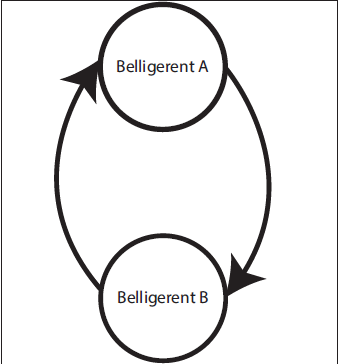
The Zweikampf implies cohesion within each fighter and symmetry between fighters. Once we involve more than a single actor on each side, however, we find ourselves dealing with alliances or coalitions of various sorts—whether between states, within states, or among actors of any kind. This, of course, leads to Sunzi’s notion of attacking alliances and Boyd’s of attacking cohesion. Moreover, while belligerents in the two-struggle may have different strategic objectives and may employ different capabilities in different ways, the Zweikampf is essentially symmetrical in that both belligerents are attempting to get their way by applying force directly against the other. This certainly seems to be true for Clausewitz, as both metaphors he uses when introducing the concept, wrestling and dueling, are symmetrical.3 Clausewitz was an observer of the Napoleonic wars after all, and so his natural focus would be on regular armies maneuvering directly against each other. The assumptions of cohesion and symmetry do not in any way weaken the concept of the two-struggle.
Is the Zweikampf really universal after all?
But after witnessing nearly twenty years of warfare in Afghanistan and Iraq, we cannot help but question if the Zweikampf is a universal construct after all. It strikes us as something of a stretch to argue that the two-struggle has applied cleanly to those conflicts—as well as to many others throughout history. Perhaps the Zweikampf applies more narrowly to what we now call regular warfare, and there is an entire other category of war that the Zweikampf construct does not capture in its essence and for which another construct might provide more and better insights. We speak of various forms, now most commonly called irregular warfare, in which the belligerents, in addition to fighting each other, must also struggle for control over a contested population.4
The Dreikampf
For these other forms of warfare, we propose a construct we will call the Dreikampf, or “three-struggle,” in which the third actor in the struggle is the common population that both belligerents struggle to impose themselves upon in addition to struggling to impose themselves upon each other. (See Figure 2.)
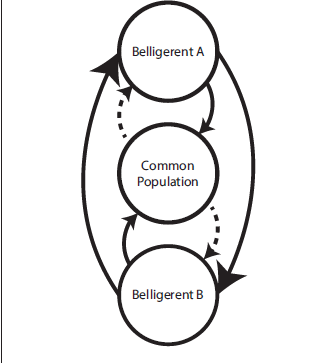
Dreikampf as we propose it is not simply any conflict with more than two combatants—which is actually most wars. Wars with multiple combatants are commonplace, but they will tend to coalesce into two-struggles as the various combatants align into two camps based on their overlapping interests. The alliances may be relatively stable and enduring, as were the Allied and Central Powers in the First World War, or they may be continuously shifting, as with the various actors in the Syrian conflict today. But the point is that at any particular time and place, the multifaceted struggle will tend to coalesce into two camps, and the Zweikampf dynamic will prevail. As an example, the Chinese Nationalists and Communists fought for control of China in the 1930s. In 1937, Japan invaded, adding a third actor to the struggle, and the two Chinese factions, irreconcilable enemies up until that point, formed a united front against Japan. The Nationalists and Communists eyed the other with suspicion, and even clashed occasionally, but generally cooperated in the defeat of Japan, which both saw clearly as the greater, common threat. Once Japan was defeated, they returned to fighting each other in an existential struggle the Communists eventually won in 1949.
The Nature of the Three-Struggle
The characteristic essential for a three-struggle as we have proposed is the existence of a common, contested population that seeks to maintain its independence from either of the belligerents. The existence of the Dreikampf in no way invalidates the key lessons of the Zweikampf but rather is additive to them—or, more accurately, multiplicative. The nonlinearity that leads to unpredictability and friction in the Zweikampf is also inherent in the Dreikampf—only much more so. The simple addition of a third variable to the equation multiplies the complexity; we know from physics that, in contrast to two-body problems, three-body problems do not submit to closed-form solutions and in fact are chaotic under most conditions.5 (The classic demonstration of scientific chaos, which Clausewitz almost certainly witnessed, is a magnetic pendulum suspended over three magnets: the pendulum follows an erratic and seemingly random path, pulled by the three magnetic fields, sometimes captured briefly by one of them before careering off wildly again, never repeating the same path.) This may help explain why so many such conflicts historically have defied ultimate solution and instead required prolonged management over time.
More important than the addition of a third independent will to the struggle is the fundamentally different nature of the population from the other two belligerents. We are not fans of the term asymmetrical warfare to describe different operational approaches, but here the relationships genuinely are asymmetrical. Where the relationship between the two-struggle belligerents is essentially symmetrical, as we have said, the relationship between each belligerent and the population is far from it—and this diversity increases the complexity and difficulty even more. The interactions among the three interlocked wills are more varied, and these greater degrees of freedom are a primary driver of complexity. (See the discussion of complexity in Maneuverist No. 3.) The population generally does not attempt to impose defeat on either belligerent through force because it usually possesses neither the capability nor the interest. It must be subtler and more indirect, employing influence rather than coercion. Most often, its aim is not to impose itself on a belligerent but to maintain and maximize its own freedom of action vis a vis that belligerent. Basic power theory says that all power relationships are reciprocal even if they are far from balanced. Even a prison population finds ways to exert influence against its armed guards, and so it is with the Dreikampf.
Finally, populations are not likely to be as monolithic as the two other belligerents, nor as consistent and coordinated in their actions.6 The contested population almost always will comprise multiple subgroups, each with different, if potentially overlapping, objectives, means, and methods. Again, this variability only tends to increase the complexity of the dynamics.
The three-struggle itself may be transitory, as once the contested population falls under the control of one belligerent or the other the conflict reduces to a multifaceted Zweikampf, as discussed above. But we suggest that, even if sometimes transitory, the three-struggle is an important concept because it manifests different dynamics than the two-struggle.
The Zweikampf is a deceptively simple model that produces surprisingly complex dynamics. The Dreikampf is a more variable and complicated model that multiplies that complexity geometrically. It is not surprising, therefore, that Western armies traditionally have shown little interest in Dreikampf conflicts, after which they are quick to return to preparing for “real war”—which of course means Zweikampf. We have seen this in the U.S. military. Most recently, we seem to have forgotten the hard lessons learned in the Vietnam War—“No more Vietnams!”—only to have to go through the pain of relearning them in Afghanistan and Iraq. We do not dispute the rise of potential peer adversaries today, but we cannot help but wonder if the desire to return to “real war” is contributing to the current single-minded focus on Great Power conflict—or to the belief that it will be strictly regular. Even in future warfare against peer adversaries—even totalitarian states—we suggest that the popular will is likely to exert itself directly. Hostilities are not likely to end with the defeat of an enemy state’s regular military forces. In an age when societies are simultaneously fragmented and empowered by the democratizing effects of information technology, populations are less likely to abide by the decisions reached by their governments or the results achieved by governmental military forces—as we witnessed in Iraq in 2004. Dreikampf is not likely to disappear, no matter how hard we may wish it. To paraphrase a popular life quote: “Dreikampf is what happens when you’re planning for Zweikampf.” We suggest that we ignore that at our own peril.
Dreikampf and Insurgency
Dreikampf is not synonymous with insurgency/counterinsurgency, although we suggest it may provide insight into the dynamics of many such conflicts, just as the Zweikampf continues to provide insight into regular warfare. Not all insurgencies are three-struggles. Nor do all insurgents employ irregular methods, although many do because they lack the resources to engage the established order on an equal footing, at least initially. Although not often thought of as such, the American Confederacy, for example, was an insurgency seeking to establish its independence from the United States. But the American Civil War was a classic Zweikampf fought primarily using regular warfare. The Confederacy could fight this way because it was able at the outset of the conflict to appropriate the national warmaking resources located in the Southern states.7 The Civil War was not a three-struggle because the American people were not an independent entity (or a unitary one). When Gen William T. Sherman cut a destructive swath through the South on his March to the Sea in 1864, he understood that the population of the South was an integral part of the Confederacy and not a separate thing. No application of population-centric counterinsurgency doctrine would have won the Southern populace over to the Northern cause. The same was true of the Northern population.
Conversely, not all three-struggles are insurgencies. The War in Afghanistan was a conflict between the United States and the Taliban in which the Afghan population, at least initially, had little interest beyond wanting to be left alone to pursue its interests without the interference of any national government.
The point is that the proposed Dreikampf is not simply synonymous with insurgency or even narrowly a construct of insurgency. Not all insurgencies are Dreikampfe, and not all Dreikampfe are insurgencies. There is, however, a class of insurgency in which the popular will is central, protracted popular war,8 which is common enough that it is synonymous with insurgency in many people’s minds. Which is another way of saying that Dreikampf will remain a frequent challenge in the future.
Implications of the Dreikampf
The key insight of the Dreikampf is this: Just as the Zweikampf asserts that the enemy is not an inanimate object to be acted upon, so the Dreikampf asserts that neither is the population an inanimate object to be controlled or influenced at will. The population is not merely “human terrain” to be fought through or a prize to be won, but rather is a third independent, or at least semi-independent, will with its own interests that do not align with either belligerent. (If they did align with one of the belligerents, the conflict would not be a Dreikampf.)
As with the Zweikampf, it is not merely the characteristics of the individual contestants in the three-struggle that give the conflict its essential nature but the even more complex and now asymmetrical interactions among the three. We suggest that this makes the Dreikampf dynamic chaotic and exceedingly challenging.
Importantly, the Dreikampf model is not necessarily an argument for a hearts-and-minds, population-centric counterinsurgency doctrine. One of the requirements the tripartite construct imposes on each belligerent is how much time or effort to devote to the other belligerent and how much to the population. For the latter, the question is how much effort, and what kind, to exert against either of the two belligerents. And for all parties, there is a question of how the two efforts relate to each other within the broader concept of operations.
One key implication is the critical importance of understanding the true dynamics of the conflict at hand. There are a few ways to go wrong. It is always an option—a temptation even—to treat a Dreikampf as a Zweikampf either by ignoring the contested population and focusing on defeating the enemy militarily or by treating the population as part of the enemy even when it is not. The former risks ignoring a potentially valuable ally, which may or may not be a fatal mistake. The latter likely will drive the population into the enemy’s camp, becoming a self-fulfilling prophesy. The converse mistake is to treat a Zweikampf as if it were a Dreikampf, wasting time and effort trying to win over a population that has already sided with the enemy. Similarly, it is a serious miscalculation to underestimate the population’s determination not to be controlled by either belligerent, wasting time and resources that could better have been put to defeating the enemy. In either of the last two cases, a tendency to try to win over a population that will not be won over seems to be a dangerous tendency of population-centric counterinsurgency doctrines. Some populations may not be co-opted, only subjugated.
The overriding insight of the Dreikampf model, again, is the importance of recognizing the population as an independent will with its own interests and objectives, always maintaining the ability to adapt and surprise.
Conclusion
We have argued that Chapter 1 of Warfighting, “The Nature of War,” is the most important in the book because it establishes for Marines a common and compelling understanding of the nature war, which is a fundamental prerequisite for determining how to fight. Foundational to that description in Warfighting is the concept of the Zweikampf with all its implications. Warfighting starts by asserting the Zweikampf and then proceeds to discuss its subject consistently in that context. Nowhere does it address specific forms of warfare, such as regular and irregular, but many readers over the years have inferred a regular warfare bias. The Zweikampf model itself may help explain that interpretation. (While it may have attempted to address war in timeless and universal terms, FMFM/MCDP 1 was a product of the Cold War era, as were most of its early readers.)
We sense from recent and historical operational experience that the Zweikampf may not be a universal model after all, and we wonder if it may be time to expand the taxonomy of war to acknowledge a class that is better described by the Dreikampf model. In fact, an increasing number of Marines who are not products of the Cold War seem to be arguing, on these pages and elsewhere, that MCDP 1 as written does not meet current requirements. If Warfighting is to be revised, we suggest that this issue might be worthy of consideration.
Notes