


The Battle of Khe Sanh: A Fourth Touchstone Battle for the Marine Corps
By: Brian NielsonPosted on November 15, 2025
FIRST-PLACE WINNER: Leatherneck Magazine Writing Contest
Executive Editor’s note: The following article received 1st place in the 2025 Leatherneck Magazine Writing Contest. The award is provided through an endowment by the Colonel Charles E. Michaels Foundation and is being given in memory of Colonel William E. Barber, USMC, who fought on Iwo Jima during World War II, and was the recipient of the Medal of Honor for his actions at the Battle of Chosin Reservoir during the Korean War. On Jan. 1, we will begin accepting submissions for the 2026 Leatherneck Magazine Writing Contest.
Belleau Wood, Iwo Jima and the Chosin Reservoir are the Marine Corps’ three touchstone battles—names that hit like a mortar round in the chest. They’re the gold standard: Marines charging into hell, bleeding for every scrap of ground and coming out on top when the odds say we shouldn’t. I carried those stories with me through my time at 3rd Battalion, 6th Marines, Scout Sniper Surveillance and Target Acquisition (SS STA) 3/6, Camp Lejeune, N.C., until I hung up my uniform on Jan. 25, 2004.
As the Corps turns 250, I’ve been chewing on what other fight deserves to stand with those giants. For me, it’s the Battle of Khe Sanh, Vietnam, 1968. That siege wasn’t just a battle—it was a crucible, a 77-day gut check that forged Marines into something unbreakable. It belongs up there with the big three, and here’s why.
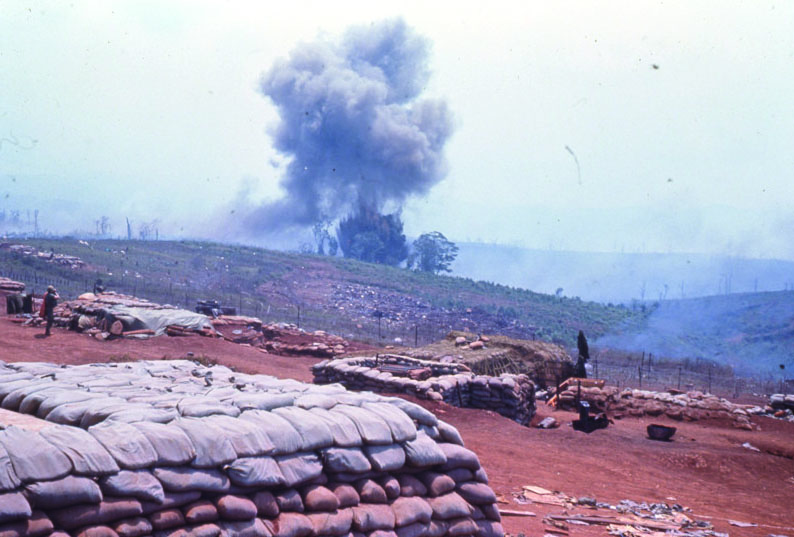
Khe Sanh started in January 1968, when the North Vietnamese Army (NVA) clamped down on the Khe Sanh Combat Base, a speck of dirt near the DMZ and the Laotian border. About 6,000 Marines and allies—mostly the 26th Marine Regiment—found themselves surrounded by 20,000 to 40,000 NVA troops. The enemy’s plan was straight out of its playbook: besiege, bombard and bury, just like they did to the French at Dien Bien Phu. For 77 days, those Marines took a pounding—over 10,000-15,000 rounds of artillery and rockets, in addition to U.S. bombing, and more than 1,000 rounds a day at the worst of it. Hill 881 South, Hill 861, the main base—they became islands in a sea of mud and fire. Supplies ran thin, the weather was a soup of fog and rain, and the NVA kept coming. But the Marines didn’t just hold—they fought.
That’s what makes Khe Sanh a touch-stone: the sheer stubborn will it took to stay in the fight. I picture those grunts in their trenches, caked in red clay, patching bunkers after every barrage. Resupply drops came under fire, with C-130s and Hueys dodging antiaircraft guns to get ammo and chow through. It was chaos, but it was controlled chaos, the kind I saw in my own small way at Lejeune with SS STA 3/6. We weren’t in combat, but we kept the battalion’s gears turning—logistics, comms, planning. Khe Sanh was that on steroids: Every Marine, from the commanding officer to the newest private, locked in to keep the machine running. Patrols slipped out to hit NVA positions, artillery crews fired until their barrels glowed, and air support—Marine, Navy and Air Force—dropped over 100,000 tons of bombs, turning the hills into a wasteland. When Operation Pegasus rolled in with Army and Marine reinforcements in April, the NVA limped away, leaving bodies and broken plans behind.
Khe Sanh mirrors Belleau Wood, Iwo Jima and Chosin in ways that cut to the bone. Belleau Wood was raw guts—Marines rushing German lines, taking casualties but never stopping. Khe Sanh had that same fire, just pinned down instead of charging. Iwo Jima was about digging in, making a volcanic rock a fortress—Khe Sanh’s hills were the same, only with jungle and mud instead of ash. And Chosin? That frozen march out of a Chinese trap, outnumbered 10 to one? Khe Sanh was its echo—surrounded, outgunned but never outfought. The difference is the siege itself: 77 days of unrelenting pressure, a modern test of what Marines can endure. It wasn’t about maneuvering or grand strategy; it was about standing fast when everything said to break.
Now, some will argue Khe Sanh doesn’t fit because we pulled out after the siege. The base got torched and abandoned in July ’68, and critics say that stains the victory. Fair point: Nobody’s raising a flag over Khe Sanh today like we did on Suribachi. But touchstones aren’t about holding dirt forever; they’re about what the fight reveals. Khe Sanh was a slugfest that messed up the NVA’s Tet Offensive, tying down divisions they needed elsewhere. It cost them thousands—estimates run from 10,000 to 15,000 dead—while we lost under 500 KIA. More than that, it was a middle finger to the idea that Marines could be cracked. I’d tell those doubters victory isn’t just a map pin; it’s the message you send. Khe Sanh screamed, “You can’t take us.”
Khe Sanh was that spirit writ large—Marines doing the dirty, thankless work to hold the line. I remember a gunny who’d been at Chu Lai in ’69, not Khe Sanh, but he talked about Vietnam like it was yesterday. He’d say, “You don’t win by running—you win by staying.” That’s Khe Sanh: staying when every instinct says go. I left the military in ’04, honorable discharge in hand, but that lesson stuck.
It’s what I’d tell the boots today: Stand your ground, because that’s what Marines do.
The battle’s legacy runs deep. It showed combined arms at its peak—air strikes syncing with arty, infantry holding the perimeter. I can see the forward air controllers on those hills, calling in Phantoms while mortars pounded the treeline. It’s a blueprint for how we fight now—integrated, relentless. Khe Sanh also cemented small-unit leadership. Lieutenants and sergeants kept their squads tight, kept them believing, even when the sky was falling. That’s the Corps I knew: NCOs running the show when it counts. And the vets? I’ve met a few—gray-haired, quiet types at VFW halls. They don’t brag, but you see Khe Sanh in their handshake, their nod. It’s the same steel you feel from Chosin survivors or Iwo vets—a brotherhood forged in the worst of it.
Khe Sanh’s place as a touchstone isn’t just about ’68; it’s about 2025 and beyond. It’s a reminder that wars change but Marines don’t. We adapt, sure—Vietnam wasn’t Belleau Wood’s trenches or Iwo’s beaches, but the core stays: Fight hard, fight smart, fight together. Khe Sanh teaches that isolation isn’t weakness; it’s a chance to prove what you’ve got. I’d tell any Marine to study it. Feel the weight of those 77 days. It’s not just history—it’s us, at our toughest, our proudest. Belleau Wood, Iwo Jima, Chosin—they’ve got a brother in Khe Sanh. On our 250th, let’s give it the honor it’s earned.
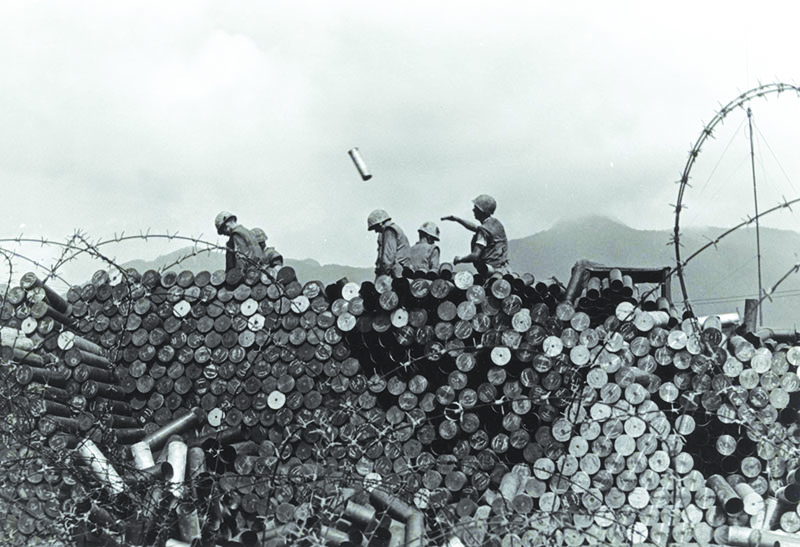
Featured Image (Top): During the 77-day siege of Khe Sanh, Marines stacked tons of expended 105 mm shell casings, a testament to the intensity of the bombardment. (Photo by Sgt T.H. Nairns, USMC)
Author’s bio:
HM3 Brian Nielson served with 3rd Battalion, 6th Marines, Scout Sniper Surveillance and Target Acquisition (SS STA) 3/6 at Camp Lejeune and was honorably discharged in 2004. Nielson served as the senior corpsman of SS STA on Camp Lejeune and is the founder and CEO of Kern + Bellows, a defense contractor specializing in re-cruitment and advertising.


