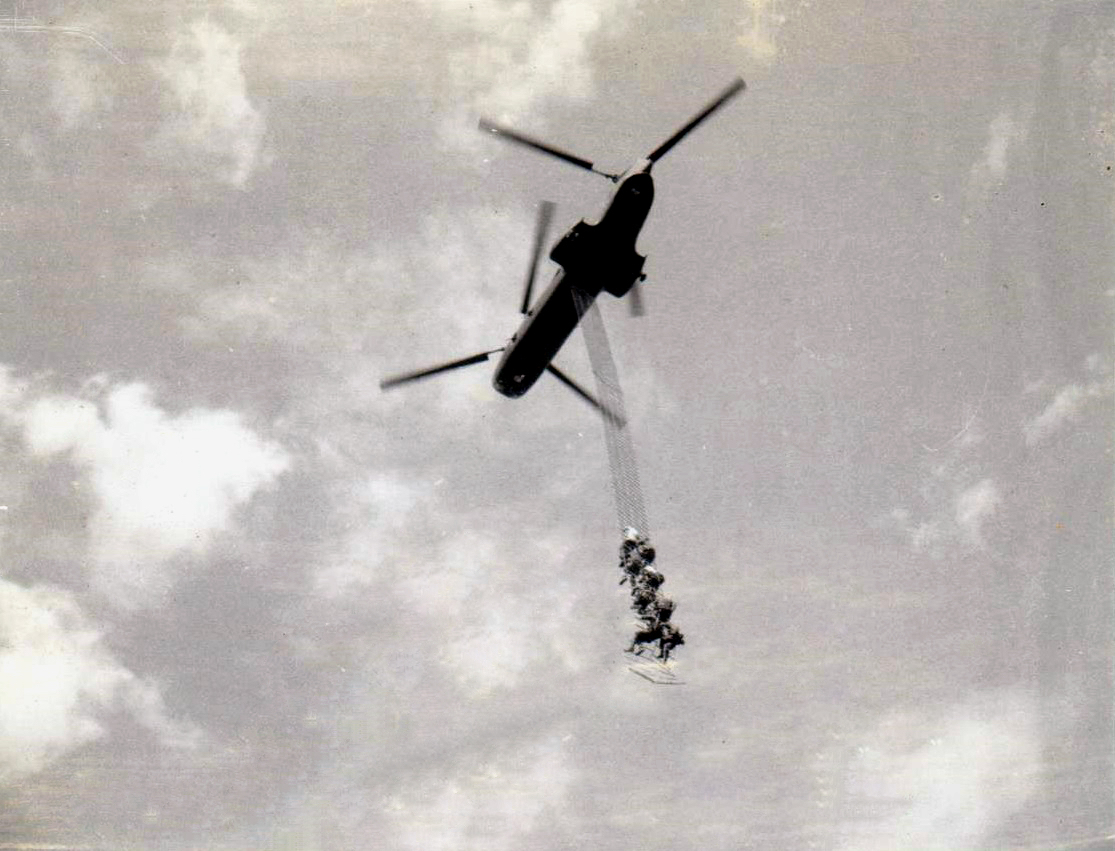
Modern Day Marine: The Future of Fighting Now

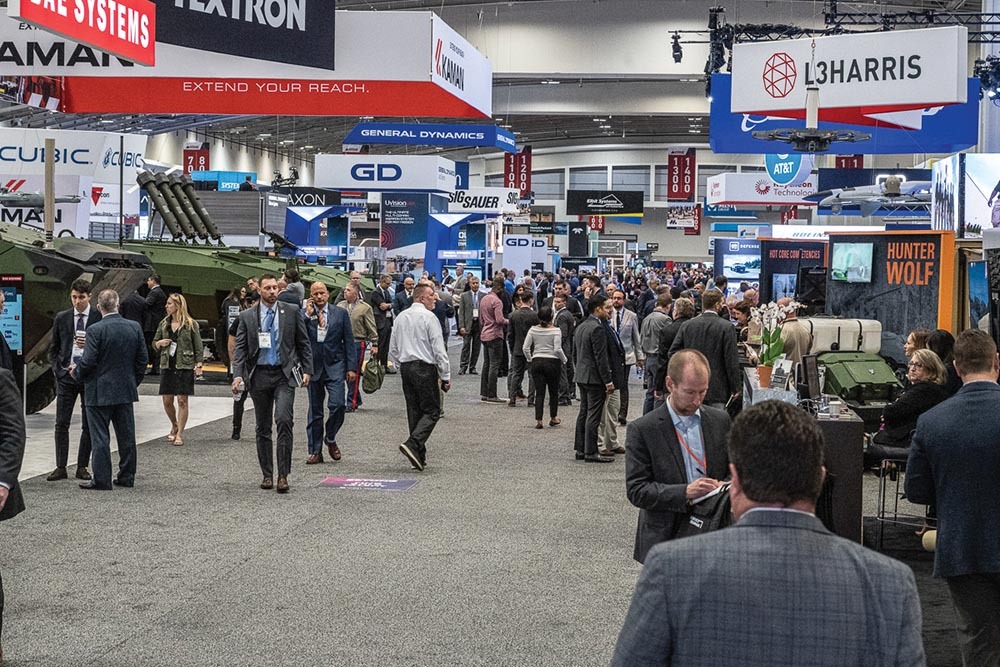
For Colonel Stuart W. Glenn, it’s an opportunity to test his skills in military strategy at the Commandant’s Cup Wargaming Tournament finals. For Lance Corporal Omariyon Wright, it’s a chance to “stay in the know… [about] all the modern-day technology, weapons, vehicles” and other equipment coming soon to the fleet. For Marines of all ranks, Modern Day Marine is a highlight of the year, providing the premier venue for learning about the state of the Corps and gaining an inside perspective on its areas of growth. 

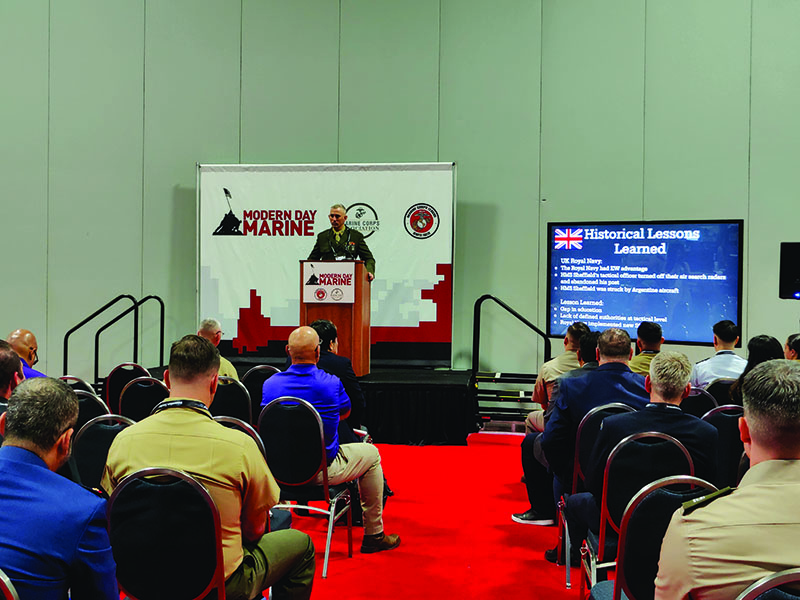
Throughout the three-day expo, speakers delivered professional military education briefings at stages like this one, the Marine Zone, scattered throughout the show floor. Topics ranged from leadership to laser weapons and everything in between. Here, Capt Joseph Sporleder and some of his fellow students at the Expeditionary Warfare School present on the future of electronic warfare in the Marine Corps.

“The future of warfare is right now, so seeing what we have, current capabilities and what future developments we’re currently making is pretty cool,” said Sergeant Bryan Arteaga Celeiro, an air traffic control Marine who attended the 2025 expo, which is cohosted by the Marine Corps Association and the Marine Corps League.

Of special note at this year’s show was the preponderance of products aimed at training and education. From virtual reality (VR) and augmented reality (AR) headsets to recoil-simulating dummy rifles, Marines at the expo were given ample opportunity to try out high-tech training systems designed to help improve mission-critical skills in a variety of military occupational specialties. With the 39th Commandant’s Planning Guidance directing the Marine Corps to “fully integrate constructive and virtual training into [its] exercises… [to] train with the full complement of [its] new capabilities,” Leatherneck paid special attention to companies exhibiting training systems, including some that are already in service.

A major area of focus this year was training systems, such as this one for the Joint Light Tactical Vehicle.

InVeris Training Solutions

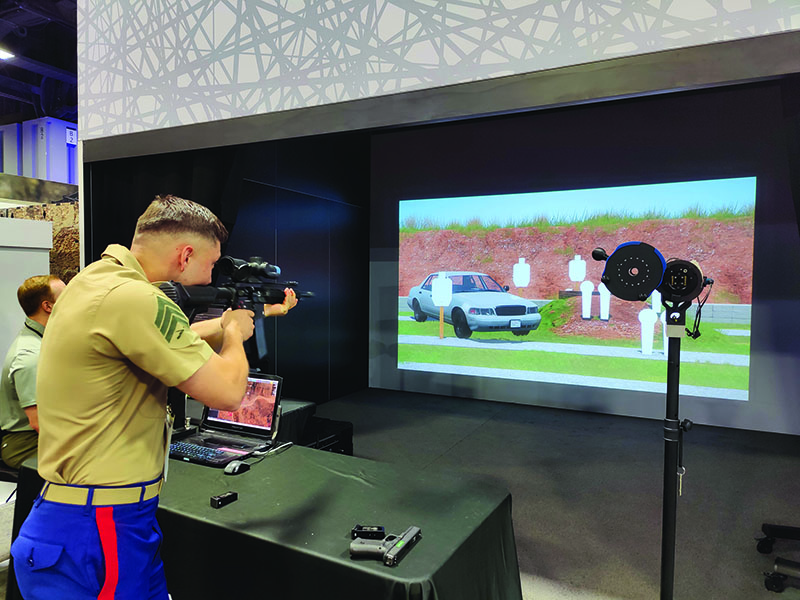
Some of the crowd favorites at this year’s Modern Day Marine were the firearm training systems (FATS®) exhibited by InVeris Training Solutions. Throughout the expo, a near-constant stream of Marines and civilians passed through InVeris’ booth and fired off tens of thousands of simulated rounds at virtual targets and computer-generated hostiles.

Most Marines and soldiers are already familiar with the company’s FATS 100MIL as the Indoor Simulated Marksmanship Trainer (ISMT) and Engagement Skills Trainer (EST), respectively. It uses a projector and screen to create a virtual shooting range for up to five shooters (or up to 15 with three systems linked together) to practice with replica pistols, rifles, shotguns, grenade launchers and various crew-served weapons. Virtual ranges can be configured with a variety of static and moving targets and simulate the effects of environmental conditions on ballistics, applying the correct amount of drop and wind drift depending on distance.

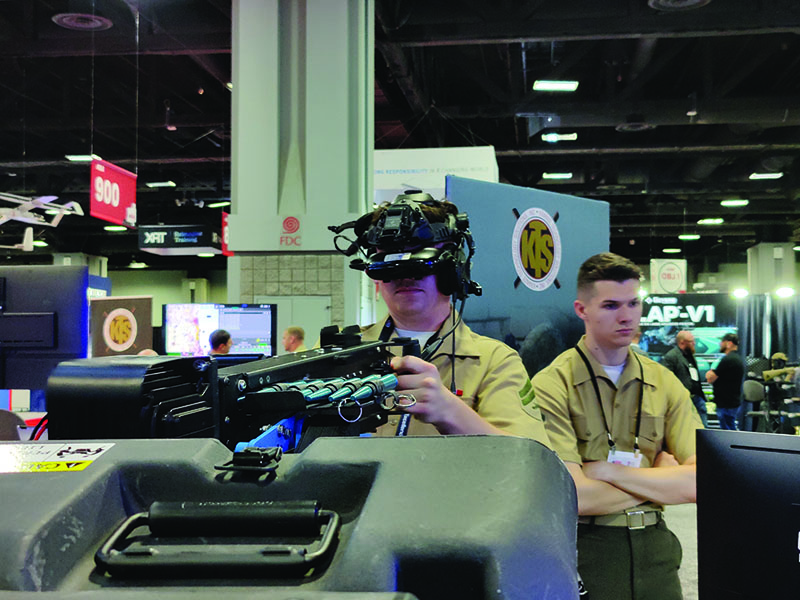
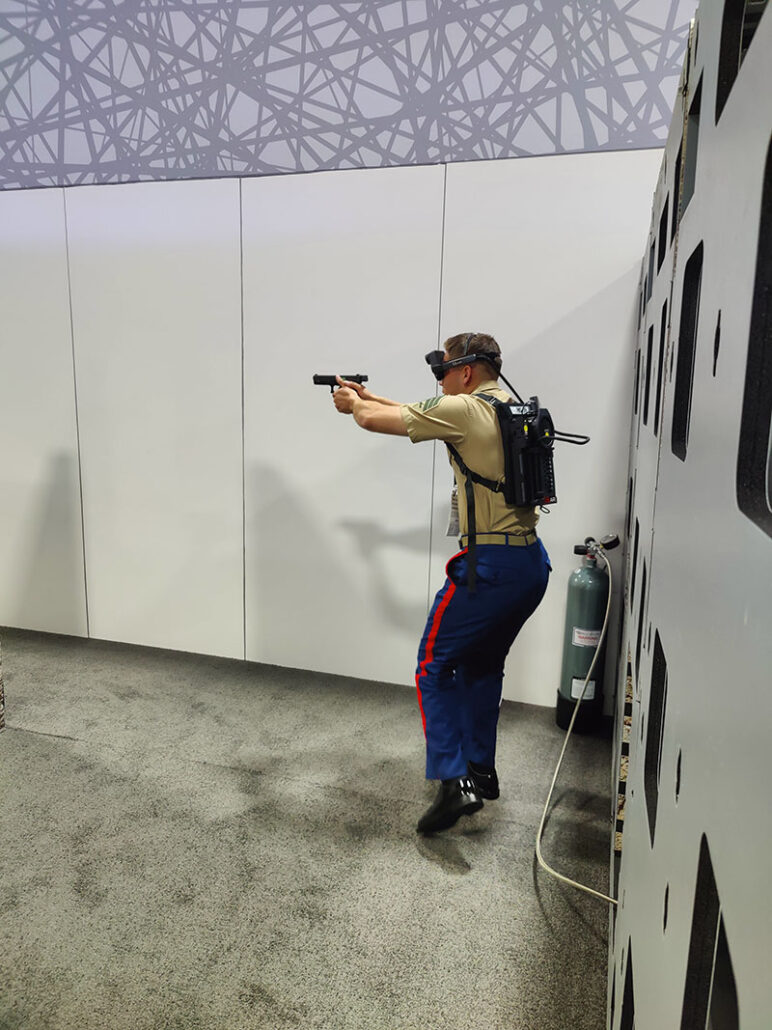
While the ISMT (above) is good for practicing basic marksmanship, the FATS AR (below) creates a fully three-dimensional virtual environment to train Marines for urban combat. Through an augmented reality headset, Sgt Carlos Castro sees computer-generated enemy combatants as vividly as if they were in the room with him. (Photos by Sam Lichtman)

The FATS AR takes virtual firearms training into the third dimension, using a lightweight augmented reality (AR) headset to transform any indoor environment up to 10,000 square feet in size into a simulated shoot house for up to four users at once. Enemy combatants and civilians behave realistically, either using AI or a human operator monitoring the situation from outside. After clearing the shoot house, shooters can walk back through and watch a playback of themselves in real time to analyze their own performance.

Every “firearm” compatible with InVeris’ training simulators has nearly identical weight, balance and controls to the live-fire model from which it is rebuilt, and even simulates about 60 percent of a realistic recoil impulse using a gas blowback system feeding from a compressed air capsule in the magazine. The weapon can be programmed to hold a preset number of “rounds” per magazine and lock the bolt or slide back on empty, just like a real firearm. Magazines are recharged between sessions using a large scuba-type tank holding enough compressed air for about 45,000 shots, allowing shooters to practice all day for literal pennies on the dollar.

This isn’t just a high-tech version of an arcade game, though—a suite of onboard electronics wirelessly linked to a control computer offers highly sophisticated analytics to assist each shooter in correcting bad habits that would have otherwise gone unnoticed. After a shooting stage is completed, the software shows the operator how long it took for each shooter to begin firing, engage each target and transition between targets, with a line showing the point of aim throughout. Are you slapping the trigger, holding your firing hand too low on the grip or jerking the rifle under recoil? InVeris’ software can help your instructor show you exactly where you need to improve your shooting.

In addition to aiding basic marksman-ship practice without the need for a real range or live ammunition, InVeris’ virtual firearm trainers provide a safety benefit, as they allow novice shooters to practice handling their service weapons with no risk of negligent discharge. The safety benefits also extend to personnel in com-bat arms MOS’s; whereas firing a live mortar produces the type of concussive blasts that have been linked to traumatic brain injury, simulated shots are perfectly safe.

InVeris does not claim that their FATS can completely replace live-fire marksmanship training, but military and law enforcement organizations around the world have already recognized the value in these simulations. The U.S. Army and Marine Corps use the FATS 100MIL virtual range, as mentioned above; the Air Force and Coast Guard use the FATS AR, and the U.S. Marshals Service has evaluated it.

Ultimate Training Munitions

Virtual firearms training with sim-ulated recoil is certainly impressive technology, but for force-on-force training, a different solution is needed. As its name suggests, Ultimate Training Munitions (UTM) offers a line of nonlethal ammunition and conversion kits that allow existing firearms to use it.

Conceptually similar to Simunitions, UTM’s solution consists of drop-in re-placement bolt carrier groups for rifles, submachine guns and machine guns, and replacement slide assemblies for pistols. Special magazines which are identical in size to standard ones but are physically incapable of loading UTM ammunition and vice versa are also used. Even if a live round were to be force fed into a UTM weapon or the other way around, the primers are in different locations, preventing a potentially catastrophic accident.

The UTM bullet contains a spherical plunger which continues moving forward when the projectile impacts a target, spraying out a small amount of marking paint more reliably than paintball-type projectiles. A firearm training system is useless if it does not offer adequate accuracy, so the UTM bullet includes a driving band—like on an artillery shell—which allows the rifling in the host firearm’s barrel to stabilize the projectile just like an ordinary bullet. The company claims better than 2-inch groups at 27 yards with 5.56 rifles such as the M4 and M27, entirely adequate for close-quarters battle-type scenarios.

To enable force-on-force training with its marking ammunition, UTM also offers a variety of protective gear, such as face masks compatible with helmets and communications devices. Because the projectiles travel at a modest 300 to 375 feet per second, face protection and padding around sensitive body areas are the only specialized equipment needed to prevent serious injury to someone shot with UTM rounds. Because of the lack of penetrating power, a military unit or law enforcement agency using UTM equipment can use the aptly named Portable Training Facility system to quickly construct a shoot house using metal poles and tarpaulin-like walls and doors.

For realistic training outside force-on-force scenarios, UTM conversion kits also work with “battlefield blanks,” which create realistic noise and recoil without firing a projectile, and “silent blanks,” which still cycle UTM actions without creating any potentially dangerous muzzle blast.

Although a UTM-converted firearm is even less powerful than a paintball gun, its blowback action generates a realistic recoil impulse and cyclic rate of fire, enhancing training. Firing a converted HK MR556 (similar to the M27 IAR) inside UTM’s plexiglass enclosure at the expo was a highly immersive experience: the recoil, the action noise, the sound of spent casings bouncing off the floor and even the smell of burnt powder all mimicked the sensations associated with a live firearm and real ammunition. Al-though hearing protection was not required, the sound of the gunshots was similar to that of a real gunshot heard through hearing protection.

Due to its greater complexity to manufacture, UTM ammunition is more expensive than standard lethal ammunition, but like InVeris’ FATS, its purpose is not to replace live-fire marksmanship train-ing. Instead, UTM firearms and ammuni-tion allow military and law enforcement personnel to “train how they fight,” prac-ticing close combat as realistically as possible so as to maximize performance on the actual battlefield. Air Force Security Forces, Coast Guard, Army and SOCOM (including MARSOC) per-sonnel have already been training with UTM kits; the Marine Corps has a program of record for it as well, meaning UTM may soon become widespread in infantry units.

Cole Engineering Services’ Stinger Training System

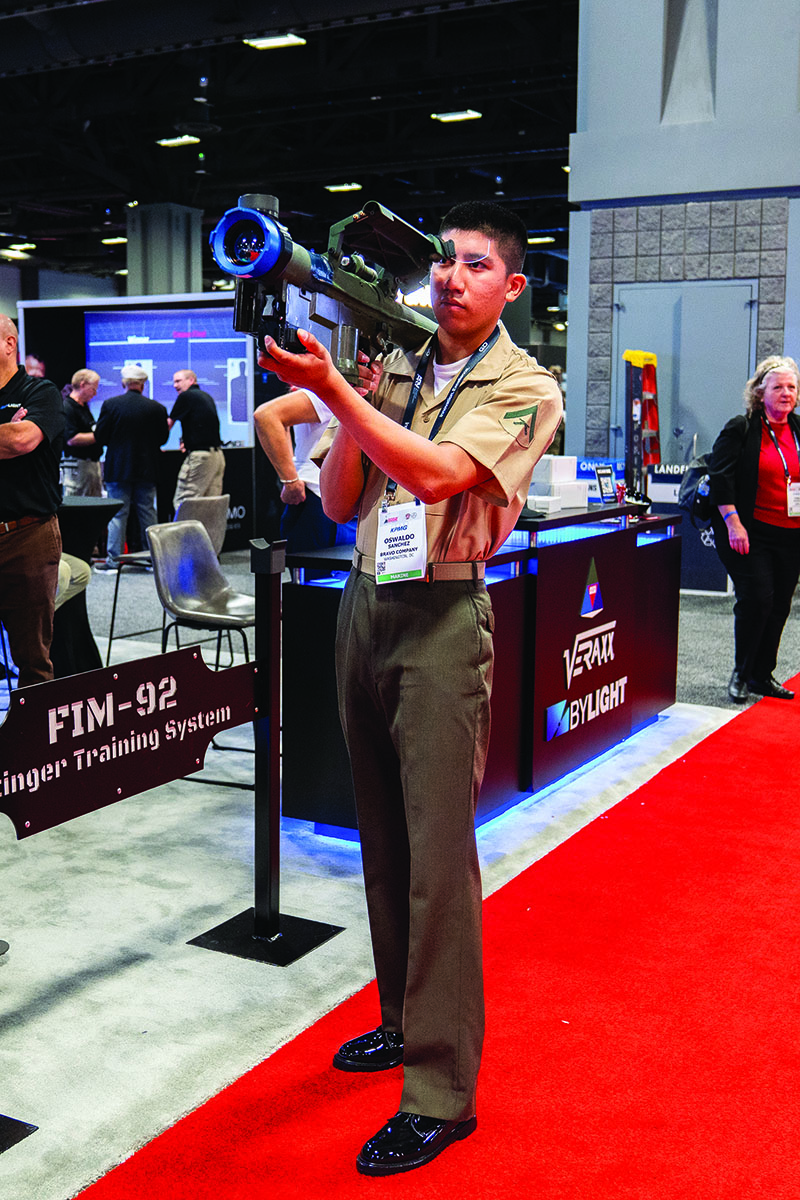
Given the enormous cost of each mis­sile, a LAAD Marine might not have many opportunities to fire one outside combat. The Stinger training system promises to address the resulting train­ing gap, allowing its users to practice firing any number of simulated shots in force-on-force exercises for a negligible marginal cost. (Photo by Amanda Higgs)

At its large booth along the show floor’s main thoroughfare, By Light Professional IT Services showed off its child companies’ vehicle and small arms trainers. Cole Engineering Services displayed its modular training systems for the FIM-92 Stinger surface-to-air missile and crew-served mortars, all built around an electronics package dubbed the “cyclops.” Cole’s Stinger training system consists of a dummy gripstock and launch tube, the former of which has a socket for the “cyclops.” Once the “cyclops” has established a wireless connection to a computer or smartphone, the user operates the launcher exactly as he or she would a live one, while the electronics log analytics in real time throughout the firing cycle. The entire system can be used by itself or connected to a computer network that automatically adjudicates “hits” and “misses” for force-on-force exercises, which is how the Army has utilized the Stinger trainer so far. For training with mortars and other heavy weapons, the “cyclops” can be swapped over to other dummy launchers, its onboard software automatically adjusting to the different behavior of each weapon.

The Army already uses Cole Engineering Services’ Stinger trainer, and the company is eager to obtain a Marine Corps contract. Due to the considerable cost of Stinger missiles and the disposable battery coolant units they consume, Low Altitude Air Defense (LAAD) gunners ordinarily have little opportunity for practice, potentially inhibiting combat effectiveness. Given the proliferation of small unmanned aerial systems (UAS) on the modern battlefield, an electronic training system such as this one could be more valuable than ever in remedying that training gap and ensuring LAAD gunners are already proficient before they ever fire live missiles.

MVRsimulation’s Deployable Joint Fires Trainer

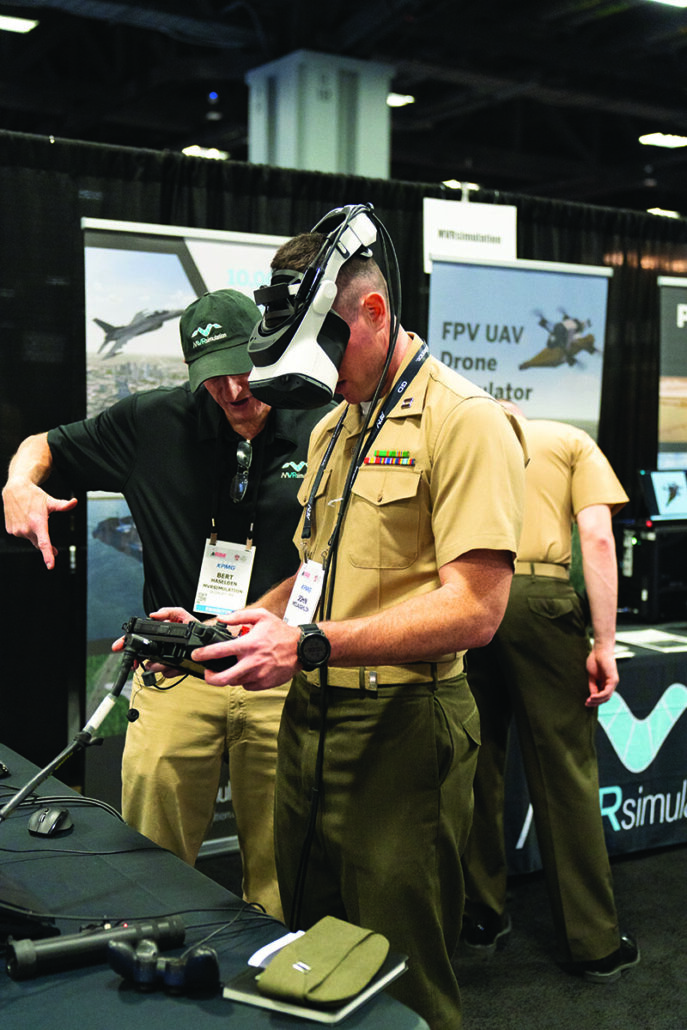
The high-tech training systems on display at this year’s Modern Day Marine were by no means limited to small arms. MVRsimulation demonstrated its mixed-reality Deployable Joint Fires Trainer (DJFT), which the Air Force and III MEF already use to train joint terminal attack controllers (JTACs) and forward observ-ers (FOs). First fielded three years ago, the DJFT consists of three portable work-stations with peripherals designed to emulate the real equipment, such as radios and laser designators, that JTACs and FOs use. The physical hardware is visible inside the computer-generated environment projected in the virtual reality headset, allowing the user to interact with it seamlessly. This blending of the real and virtual worlds creates an almost uncanny level of immersion.

The ongoing conflict in Ukraine has shown the value of small, inexpensive UAS in modern warfare. MVRsimulations demonstrated its DJFT at Modern Day Marine with an off-the-shelf handheld gaming device as a controller for an FPV drone. Other controllers emulate radio equipment and laser designators, allowing users to train with a wide variety of hardware.

The three stations are configured for an observer, an instructor and a role player, the latter of whom uses a hands-on throttle-and-stick controller to fly aircraft in the simulation. All three users interact with each other through a virtual recreation of real-life locations, run on MVRsimulations’ Virtual Reality Scene Generator engine or the Modern Air Combat Environment produced by Battlespace Simulations. The computers inside each station are built with the same components one might find in a high-end professional workstation or gaming computer and run Windows 10, ensuring compatibility with other hardware and software. Each machine is light enough to be carried by two people in its packed state and has a unified onboard power supply, needing only one wall outlet for the entire station instead of one for each component inside.

Forterra’s AutoDrive and Allen Control Systems’ Bullfrog

The past few years have seen an explosion in unmanned ground vehicle (UGV) development. Companies such as Pratt Miller and Oshkosh Defense have developed small UGVs with adequate mobility to keep up with a Marine rifle squad as it moves over rough terrain, providing integrated logistics and fire support at the small unit level. All that capability comes at a cost, however. Every infantryman designated to control a UGV is a Marine not using his or her rifle, which could pose a problem in combat. Clearly, before UGVs are widely fielded in the Marine Corps, a solution is needed to eliminate the task of leading vehicles around like pack animals.

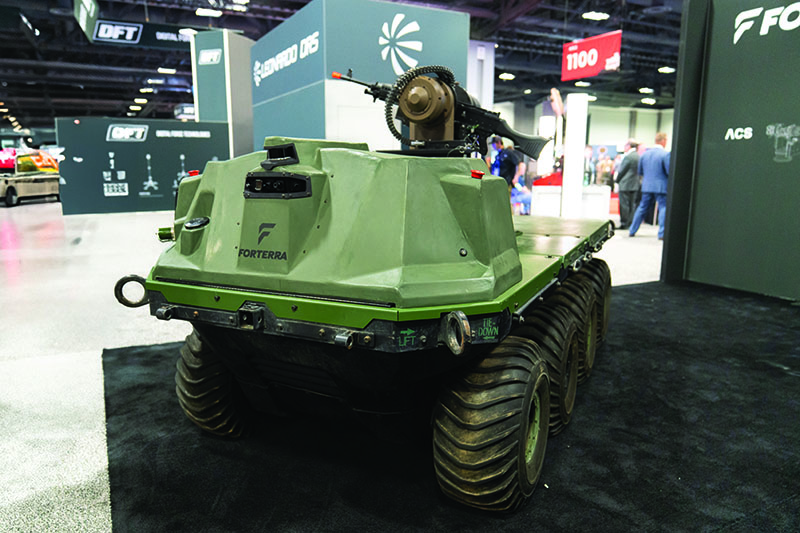
To that end, Forterra (formerly Robotic Research Autonomous Industries) spe-cializes in UGV autonomy. Their flagship product, AutoDrive®, is a retrofit package consisting of a 50-pound ruggedized computer “brain” connected to a sensor suite, capable of autonomously driving an otherwise manned or remotely con-trolled ground vehicle. The brain is more durable than a human driver, and all the sensitive electronics inside are shielded against electromagnetic interference to prevent disruptions to the mission. Although an AutoDrive-equipped vehicle can be controlled wirelessly by a remote operator anywhere in the world, its onboard software allows it to intelligently navigate to a designated location using the best available route while recognizing and avoiding environmental hazards.

This unmanned ground vehicle is equipped with an M240 machine gun, allowing it to provide fire support to a Marine rifle squad as well as carry­ing supplies over rough terrain. AutoDrive’s intelligent autonomy allows the vehicle to function either independently or under remote control, depending on the availability of a remote operator.
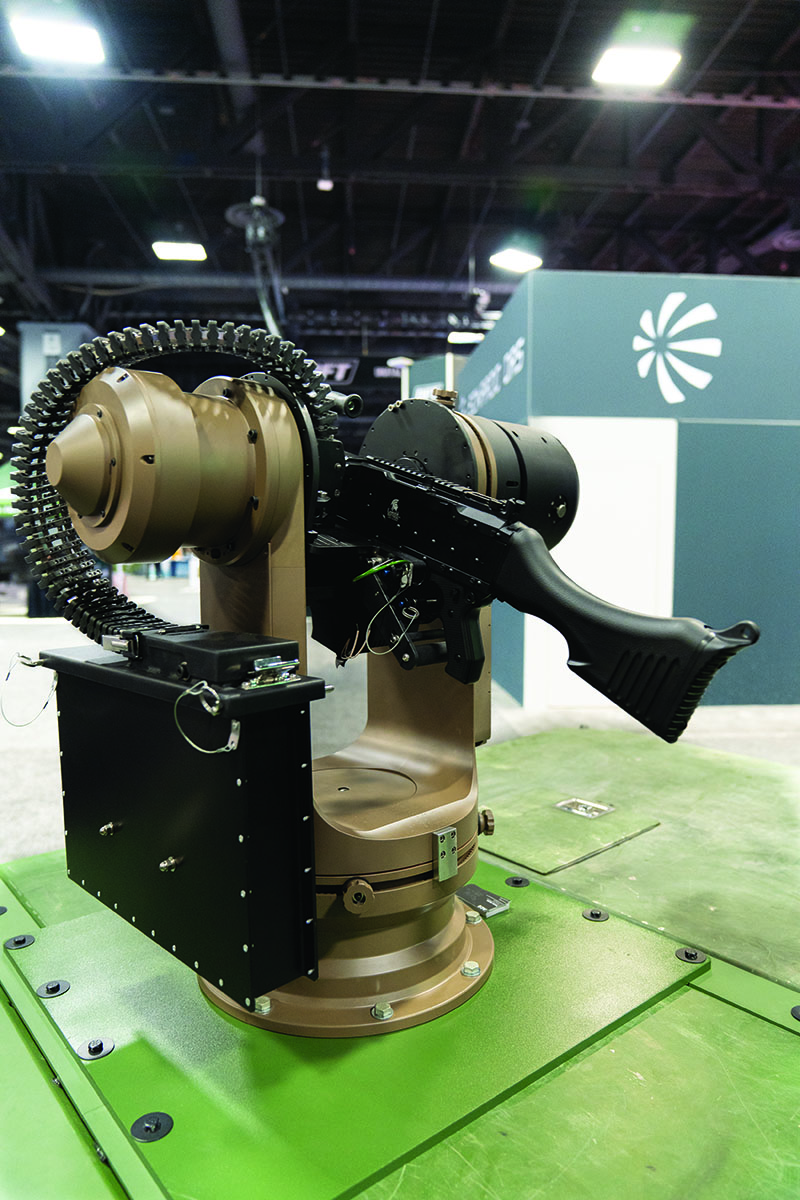
Allen Control Systems builds variants of its Bullfrog autonomous weapon station for the M240, M2, M134 minigun and M230 30 mm autocannon

For UGVs operating at the squad level, this level of autonomy is crucial. An AutoDrive-equipped vehicle can trans-port extra supplies and ammunition, evacuate wounded Marines, patrol a perimeter or provide fire support to a squad in contact with the enemy, allowing Marines to focus on the mission instead of a controller. With autonomous vehicles providing organic logistical and fire support at the squad level without the need for additional vehicle crews, an infantry unit can bring more supplies and heavier weapons into battle.

To enable autonomous UGVs to fight alongside Marines in the field, Forterra is working with Allen Control Systems to provide remote weapons stations. The latter company’s Bullfrog system is essentially a small robotic turret designed to operate an unmodified M240B machine gun. Bullfrog uses an infrared camera, artificial intelligence-based targeting software and an onboard ballistic calculator to autonomously identify targets, aim the weapon and adjust its fire. The system is accurate enough to ensure a first-round hit on a standing man-sized target at up to 800 meters, with its range limited only by weather conditions and the inherent precision of the weapon and ammunition. With its superior reaction time over a human gunner combined with a traverse rate of 400 degrees per second and the ability to fire directly overhead, the Bullfrog is ideal for engaging small, fast-moving enemy UAS. Its software currently requires authorization from a human supervisor before it pulls the trigger, but a human operator is not technically necessary for the system to function.

AutoDrive and Bullfrog can interface with existing command, control and communications (C3) networks to share information about the battlespace with friendly units. Even onboard the same vehicle, a Bullfrog turret can instruct the AutoDrive “brain” to search for new targets, for example.

Forterra has demonstrated AutoDrive units on a wide variety of vehicles, ranging from small UGVs to joint light tactical vehicles (JLTVs) and even High Mobility Artillery Rocket Systems. The company is also pushing for wider adoption on commercial vehicles, such as forklifts and trucks, to remove human operators and therefore increase safety at industrial sites such as ports.

BAE Systems’ Amphibious Combat Vehicle (ACV)

The ACV was indisputably one of the stars of this year’s show. It has replaced the 1972 vintage AAV7 platform as the Marine Corps’ frontline armored personnel carrier, offering improved safety and mobility as well as a host of other modern features. This ACV-L variant is designed to transport cargo in logistics-contested environments.

The centerpiece of the show was BAE Systems’ amphibious combat vehicle (ACV), the Marine Corps’ replacement for its geriatric assault amphibious vehicle (AAV) fleet. Given its crucial role in the Corps’ mission of expeditionary war-fare, the ACV program has had a high pro-file, especially after a series of rollover accidents in 2022 and 2023. To address the resulting concerns, the Marine Corps has updated its training for vehicle crews to emphasize the new vehicle’s different handling characteristics from the legacy AAV.

The ACV’s most obvious external difference from its predecessor is its wheeled motive system. The debate between wheels and tracks has raged fiercely for decades, but generally speaking, wheels offer greater speed, whereas tracks spread a vehicle’s weight more evenly to provide better mobility over soft ground. With its centralized tire in-flation system, though, the ACV can dynamically reduce the air pressure in its own tires for operation on soft beach sand, for example. Unlike the tracked AAV, which becomes effectively immobile if a track separates or becomes dislodged, an ACV can still move under its own power with up to two of its eight wheels damaged. One additional benefit the wheeled motive system offers is increased comfort for the vehicle’s occupants. Far from a mere convenience feature, this reduces fatigue on the crew and passengers, improving their combat effectiveness.

Safety is a major area of emphasis in the ACV’s design. Although the vehicle has a somewhat high center of gravity, this is a by-product of its use of a V-shaped hull, which offers much greater protection from mines and improvised explosive devices than legacy vehicles’ flat-bottomed hulls. In the event of a rollover, individual seats with har-nesses protect the occupants from injury much better than the primitive bench seats found in the AAV. Although the use of individual seats reduces passenger capacity in relative terms, the standard ACV-P variant can still transport a full squad of Marines in safety and relative comfort.

BAE Systems offers the ACV in four variants. The ACV-P is the standard armored personnel carrier configuration, transporting 13 combat-loaded Marines and armed with a .50-caliber machine gun in a remote weapon station. This variant is by far the most numerous, with more than 300 examples already in Marine Corps service. For direct fire support against fortified positions and light armored vehicles, the ACV-30 gives up five seats in the passenger compartment to replace the machine gun with a 30 mm autocannon turret. Thirty units have been delivered so far, with up to 150 more on order. The ACV-R variant is an armored recovery vehicle mounting a crane and winch to tow disabled vehicles and pro-vide mobile maintenance support; so far, three examples have been produced for testing. The ACV-C is a dedicated com-mand platform, further reducing passen-ger capacity to seven and replacing the remote weapon station with a mounted M240 to free up space for C3 equipment. According to BAE, the ACV’s 690-horse-power engine gives all variants equal or superior mobility and range on both land and water as compared to the AAV.

At this year’s Modern Day Marine, BAE Systems showcased the ACV platform’s modularity with a test chassis in a logistics configuration, its passenger compartment and remote weapon system replaced with a cargo area and a crane similar to that on the ACV-R. This variant is not one the Marine Corps has specif-ically requested, but BAE hopes to dem-onstrate its utility in providing logistical support in contested environments. The crane can hoist up to 4,000 pounds, al-lowing it to lift a power pack (engine and transmission) to aid in repair and main-tenance of other ACVs in the field. The payload bay can store 500 cubic feet and up to 1,000 pounds of cargo, such as fuel containers, spare tires and ammunition; its roof can be opened to allow for direct loading and unloading with the crane.

Designed for frontline combat, the ACV-P and ACV-30 feature the so-called Integrated Combat System (ICS), a sophisticated battle computer that provides increased situational awareness and can help aim the remote weapon stations. Using touchscreen interfaces or physical controls, an ACV crew can work together with the ICS to efficiently locate and destroy a threat before it has a chance to shoot back. The ICS’s semi-autonomous nature allows it to track small, fast-moving targets that would otherwise be difficult for a human gunner to hit. With airburst or proximity-fuze munitions, remote weapon stations on ACVs have been demonstrated shooting down small UAS moving at up to 18 miles per hour. Similar systems have already seen combat use in Ukraine, with at least one recorded shootdown of a cruise missile.

XR Training

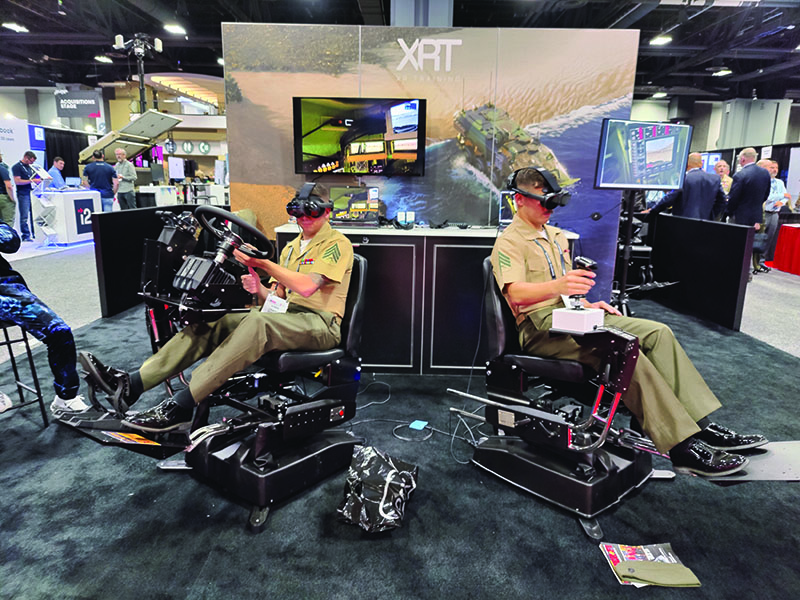
To support the ACV program, the Ma-rine Corps put out requests for simulation hardware and software to help ACV drivers and gunners build proficiency outside the vehicle. In February 2024, XR Training was awarded a contract to produce their aptly named Driver Train-ing System (DTS), a custom solu-tion developed specifically to meet the Marine Corps’ needs. So far, XR Training has delivered 81 such systems to Marine installations around the world and is presently working with the Corps to introduce the Gunnery Training System, which is very similar in form and function.

Each DTS unit consists of a seat, a set of hand and foot controls mimicking those of a real ACV and an augmented reality headset, all connected to a laptop computer running the simulation software. The use of augmented reality instead of monitors offers superior immersion; unlike with fully physical or fully virtual solutions, the user can see the physical controls he or she is manipulating inside the simulated environment projected by the headset. The controls and seat are connected to a common chassis, which can articulate like an amusement park ride to simulate the feeling of acceleration and travel over uneven terrain.

Although the Marine Corps has only adopted the Driver Training System, XR Training also offers a complementary Gunnery Training System, which can network with the former to allow two crewmembers to train together.

These features combine to create a level of immersion that not only improves the quality of the training, but can even make that training enjoyable. For a generation of Marines raised with video games, the ACV-DTS is essentially a high-tech driving simulator that helps them hone the skills they use every day in 18-series MOS’s. XR Training offered Marines at the expo the chance to trial the system.

After a session on the DTS, MDM attendee Sergeant Chayce Quaranta was quick to point out the value of such realistic simulated training. “I think it’s a good training tool,” he said. “It’s immersive and seems inexpensive.” In his opinion, the system’s video-game-like nature promises to increase its value as a training aid. “With Marines getting excited about that, they’re more likely to learn.”

While Quaranta maneuvered the simulated ACV through a combat zone, Sgt Bryce Jones manned the Gunnery Training System and engaged targets with the vehicle’s remote weapon station. “This does a really good job of showing how hard it is to stay on target in a moving vehicle on rough terrain,” observed Jones, a former crew-served weapons instructor. “Every MOS, I think, should have some level of simulated training.”

Another major area of consideration in the DTS design is modularity. As well as enabling the use of commercial off-the-shelf components to save cost and make maintenance easier, this design paradigm makes the system easy to reconfigure to simulate other types of vehicles should the need arise. Additionally, the entire unit can be fully disassembled in less than half an hour and transported in two Pelican-style cases.

MDM: Hands-On Educational Experience

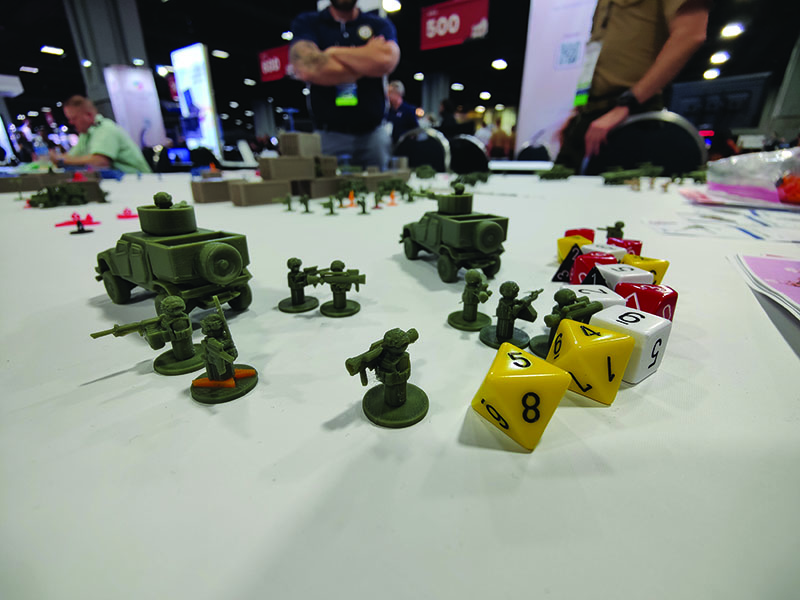
As in every year, attendees at Modern Day Marine 2025 were treated to the opportunity to see future technology and try it out for themselves. From the Objective 1 Wargaming Convention area to the numerous vehicle and small arms simulators set up for demonstration, Marine visitors were encouraged to participate in the expo. “I expected to get hands-on, but not this hands-on,” said LCpl Michael Walsh after using a JLTV simulator.

One major draw at every Modern Day Marine expo since 2023 has been the Objective 1 Wargaming Convention, where designers demonstrate educational war games and teams compete for the Commandant’s Cup. Professional wargaming for educational and analytical purposes has seen a resurgence in recent years in the Marine Corps and other services, with the General Robert B. Neller Center for Wargaming and Analysis on MCB Quantico now open.

In addition to the acres of high-tech gear, Modern Day Marine hosts numerous professional military education briefings running nearly constantly over its three-day duration. These help place all the fancy gadgets on the show floor into their proper context as essential tools for pres-ent and future warfighters. The expo is a valuable experience “if you’re just looking for a glimpse of how much tech is out there and how the military can actually use it,” according to Master Gunny Sergeant Felipe Lopez, a defense logistics manager at CD&I, “but also you get a glimpse of what the Marine Corps actually provides to the nation—what the Marine Corps is capable of doing and just [how] being equipped with the right gear set makes us that much more lethal.”

Between the near-constant briefings and demonstrations at half a dozen presentation areas and the thousands of corporate, government and nonprofit ex-hibitors, there is always something to see or do at Modern Day Marine, and it only improves with each year. Every Marine attendee interviewed for this article had something positive to say about this year’s expo, but Sgt James Sellers, an air traffic control communications technician, put it the best: “Come to Modern Day Marine!”

Author’s bio: Sam Lichtman is a free-lance writer and editor who specializes in small arms technology and military history. He has a weekly segment on Gun Owners Radio. He is a licensed pilot who lives in Virginia.

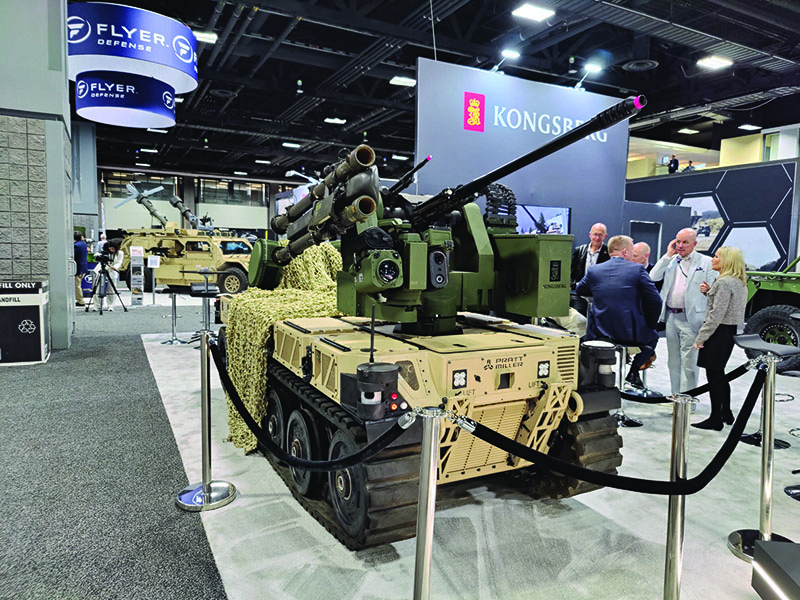
Featured Image (Top): Modern Day Marine offers an opportunity to see and learn about new military hardware designed for the battlefields of the future. Built by Pratt Miller Defense, a subsidiary of Oshkosh, this unmanned ground vehicle (above) was just one of the several unmanned systems on display at the expo.


Celebrating America’s Music: The 225th Anniversary of “The President’s Own”

On Wednesday, July 20, 2022, the Marine Band performed at a
gala concert at the Zofin Palace in Prague, Czech Republic. (Photo by GySgt Rachel Ghadiali, USMC)
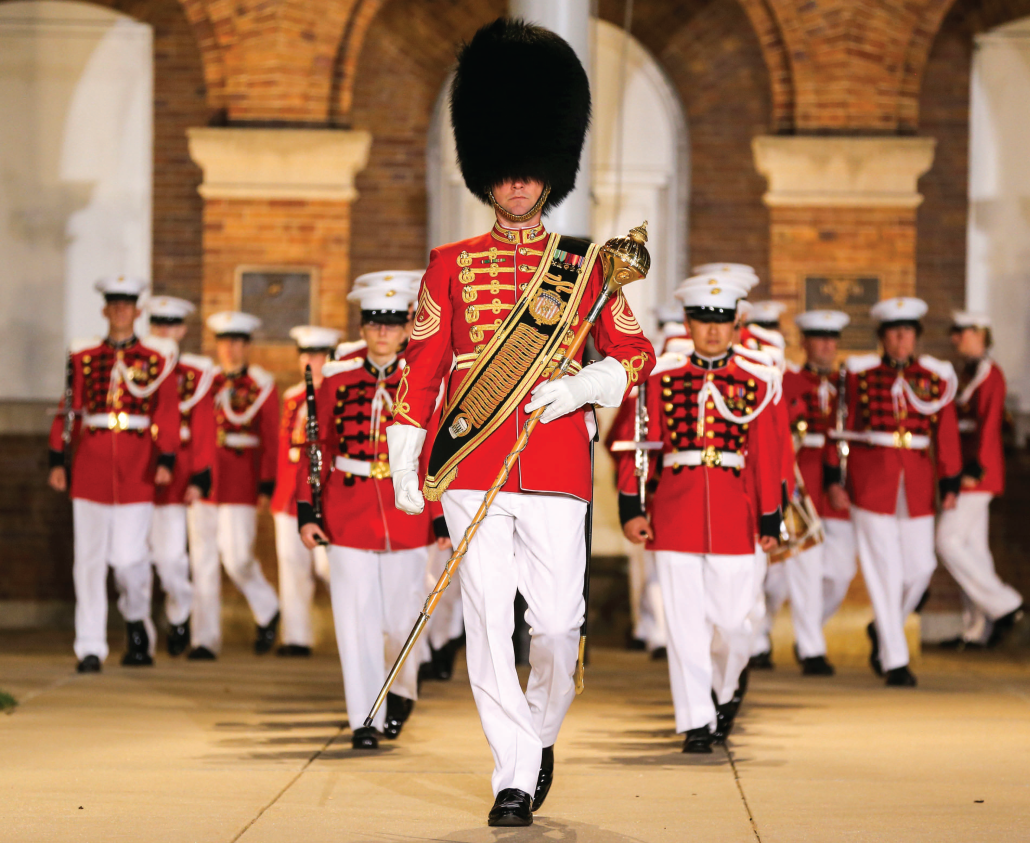
MGySgt Duane King, the drum major of The President’s Own, leads the band down Center Walk during the Friends and Family Friday Evening Parade, Marine Barracks Washington, D.C., April 26, 2019.
Courtesy of LCpl James Bourgeois, USMC

This year marks several significant milestones in the legacy of “The President’s Own” United States Marine Band. July 11 marks the band’s 225th anniversary, and although the organization looks nothing like it did in 1798, its enduring fame and popularity has changed little as the band remains the oldest professional band in the nation.

Less than three years after President John Adams signed an act of Congress establishing the United States Marine Band, the nation’s third president, Thomas Jefferson, claimed the band as his own following his inauguration, bestowing upon the organization their prized nickname and their musical duties have evolved over the years, extending far beyond the White House and Washington, D.C.

It proved to be a struggle to find and enlist the original 32 drummers and fifers in 1798. The band procured financing only through the Commandant’s “suggestion” that the officers in his young Corps of Marines donate roughly 50 percent of a month’s paycheck. Today, the organization operates with stunning sophistication and organic support, consisting of well over 100 musicians and full-time staff.

The band has performed through some of the most signifi­cant events in American history. On Independence Day in 1848, the band celebrated the laying of the cornerstone of the Washington Monument. Members stood alongside Pres­ident Abraham Lincoln in 1863 as he delivered his im­mortal Gettysburg Address. A century later, in 1963, the world witnessed “The President’s Own” on TV as they led the funeral procession for President John F. Kennedy. On Sept. 11, 2002, the band helped Americans honor our fallen at Ground Zero on the one-year anniversary of the World Trade Center terrorist attacks.

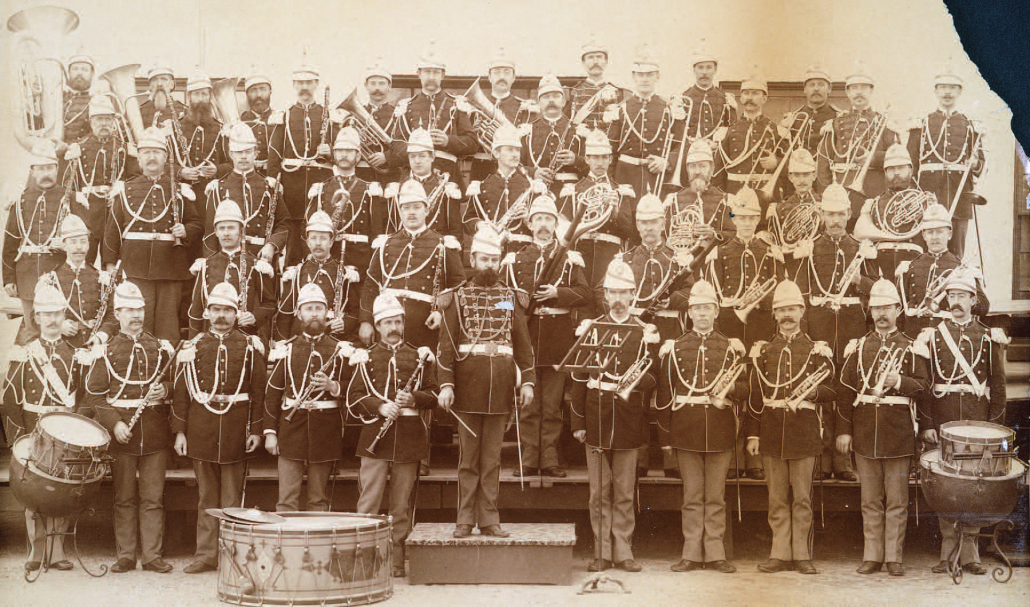
The organization’s high profile and highly public role requires the very best musicians America can offer. As early as 1840, the band officially “separated” from the rest of the Corps. The Marine Corps Manual of that year made the first known distinction between enlistees in the band and enlistees in any other occupational specialty, and 40 years later, in October of 1880, The President’s Own entered its most trans­for­mative period under the leadership of legendary director John Philip Sousa. Only 25 years old, Sousa had already been performing with the band for over a decade. He initiated their first national concert tour, taking the band outside of Wash­ing­ton, D.C., to share their music around the nation. Sousa intro­duced many of his own marches during this time, many of which endure today with their popularity. He also inspired the first phonograph recordings of the band during his tenure. In 12 years as director of The President’s Own, Sousa modernized and expanded the band’s repertoire of musicians and events in an unprecedented fashion.

Sousa’s legacy and enduring vision for the organization enabled many other “firsts” to come in the years fol­lowing his departure. The year 1922 saw the music of the band enter homes across the nation as the Marine Band radio program was broadcast for the first time, building upon Sousa’s efforts to have their music recorded. His vision for the national concert tour expanded further in 1985 as the band performed its first international concert in Rotterdam, Netherlands. Since this first overseas tour, the band has also performed in coun­tries such as Switzerland, Czech Republic, Singapore, Japan, and most notably, in 1990, the Marine Band be­came the only American military band to tour the former Soviet Union before it dissolved into independent states.

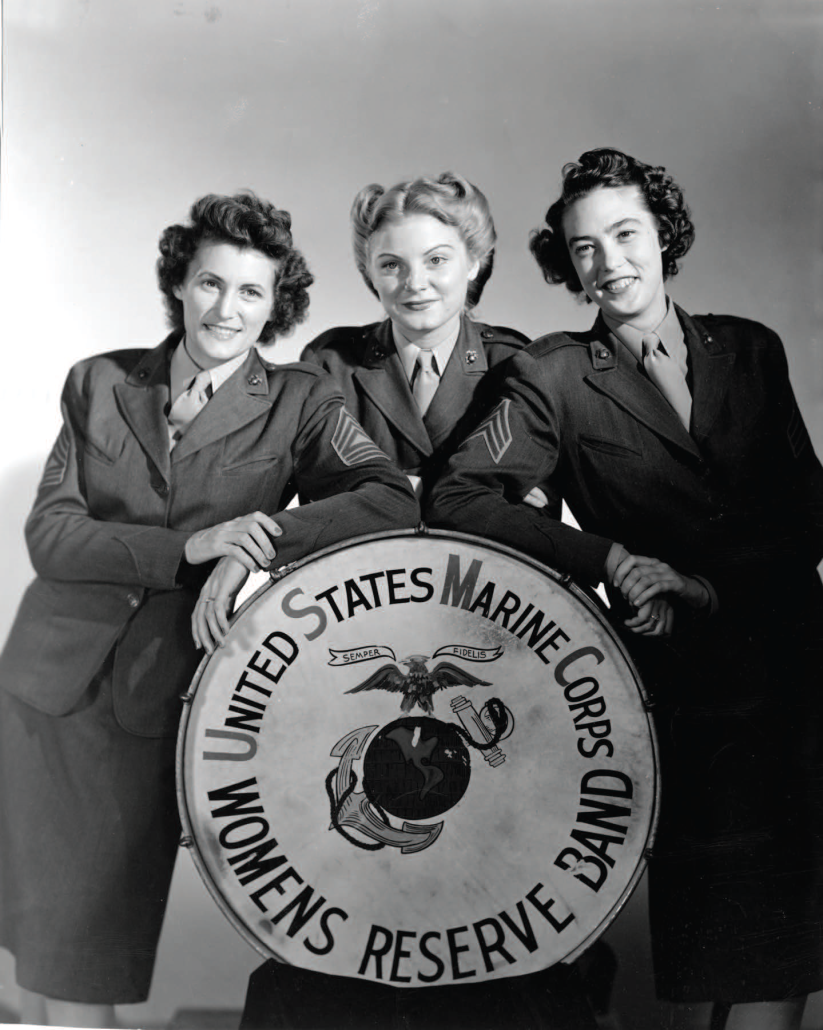
March of this year marked another significant milestone in the band’s history as it celebrated 50 years since the first woman enlisted in The Pres­ident’s Own. In 1943, then-director Captain William F. Santlemann super­vised the formation of the Marine Corps Women’s Reserve (MCWR) Band, a separate entity trained by and operated in conjunction with The Pres­ident’s Own. Santlemann cast a wide net for his auditions, drawing every­thing from professional players at Juilliard to ex­ceptionally talented female Marines serving in the motor pool. Though it lasted only two years during World War II, the MCWR Band toured the U.S., played live on The President’s Own national radio broadcast, and helped the nation celebrate victory in the war and welcome our troops home.

As the most famous director of the United States Marine Band, known for compositions such as “Stars and Stripes Forever,” the official march of the United States Marine Corps, and “Semper Fidelis,” John Philip Sousa maintained an unprecedented level of excellence in his musicians: a standard that has been upheld by every Marine Band director since. Born on Nov. 6, 1854, in Washington, D.C., Sousa grew up near the Marine Barracks where his father, John Antonio Sousa, was a musician in the band.
Sousa served under five presidents during his 12 years as the director of “The President’s Own” before forming his own band, the Sousa Band, which he would lead for nearly 40 years. His presence as a public figure prompted him to pay great attention to his appearance. His uniforms were tailored, and he had a personal valet while on tour with the band. Perhaps one of the most well-known aspects of his public appearance was his use of a new pair of white kid gloves for almost every performance he conducted.
Photos of John Philip Sousa taken while on tour with the Sousa Band in Spokane, Wash., show him wearing these iconic gloves, which he would only use if they were spotless. During one of his tours, he “breezed into a glove shop and ordered 1,200 pairs of white kid gloves at $5 a pair.”
Sousa insisted on a “fresh pair [of gloves] every concert.”
This event, later dubbed Sousa’s “glove mania” in the Boston Post, confirmed the conductor’s unique dressing habit, which would go on to become a part of his public persona.
Now housed at the National Museum of the Marine Corps, these gloves are believed to have been given by Sousa to Earle Poling, owner of the Earle Poling Music Company, who arranged for musical artists like Sousa and his band to perform in Akron, Ohio, on Oct. 11, 1924.
After receiving the gloves, Poling had them dipped in silver as a lasting tribute to the famous conductor.
Jennifer Castro and Briesa Koch

With the MCWR Band paving her way, a 21-year-old French horn player named Ruth Johnson won her audition and be­came the first female to enlist in the Ma­rine Band in March 1973. Women’s roles expanded greatly in the following years with more than 40 women now serving in various playing or administra­tive capacities.

Major Michelle A. Rakers made his­tory with the band, becoming both the first female assistant director and the first female commissioned officer to serve in The President’s Own. Rakers en­listed as a trumpeter/cornetist in 1998 and re­ceived her commission and appointment as assistant director in 2004. Rakers pro­gressed in rank over her career, eventually achieving her position as the band’s executive officer. She held the position for four years prior to retiring after 20 years of service.
“The MCWR Band was an important part of our history,” said Maj Rakers. “Had it not been for them, the paradigm could have taken longer to shift and I may not have had the opportunity to be in [my] position … We owe them an enormous debt of gratitude.”

Like Maj Rakers, the majority of The President’s Own spend their entire career with the band. New positions arise only when current members decide to leave because the unit is restricted in its num­ber of authorized positions. Playing in the organization is a coveted role as vacan­cies are infrequent and limited. Larger sections with numerous Marines playing the same instrument might see one audi­tion per year for new members. Smaller sections, however, can go a decade or more without vacancies. As a result, au­dition­ing for The President’s Own be­comes a nerve-wracking event for the participants.

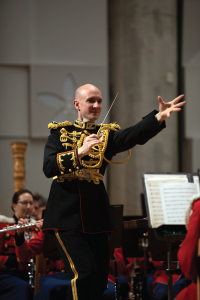
“Auditions are run in a similar fashion to a civilian orchestra,” said Colonel Jason K. Fettig, the Marine Band’s cur­rent director. “The standard expected is exceptionally high due to our high profile and public mission. We invite all to come to our auditions at their own expense. We can have up to 150 individuals com­peting for a single position. Most of our members hold advanced degrees in music, and although that is not a require­ment, we have found that this level of education and experience is needed to be competitive.”

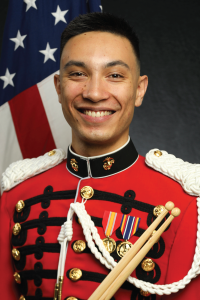
Staff Sergeant Alexander Garde earned his spot as one of the band’s newest percussionists in March 2022. He com­pleted his bachelor’s of music in 2020 from the New England Conservatory in Boston and also studied at the Shepherd School of Music at Rice University in Houston.

“Prior to my position with the band, I took other auditions for professional orchestras and military bands around the country,” Garde said. “The talent and quality of musicianship in this band rivals any musical group out there. Once I was offered a position, I further understood that I was not just joining a world-class performing group, but a historical institution. All of the musicians in the band today, and those who came before me, have shaped American musical tradition throughout the history of our nation. Being able to observe those practices evolving in real-time is incredible.”

Despite his short tenure with the band, Garde dived headfirst into the concert schedule. In July 2022, just four months after enlisting, he traveled to Europe with the band for a concert tour through the Czech Republic, Austria and the Netherlands.

On Sunday, July 24, 2022, the Marine Band performed at Promenadenhof Innsbruck, Kaiserliche Hofburg in Innsbruck, Austria. (Photo by GySgt Rachel Ghadiali, USMC)

“Seeing what our performances meant to the audiences in Europe was unbelievable and showed me just how global the reach of The President’s Own really is,” Garde recalled.

“Performing John Philip Sousa’s ‘The Stars and Stripes Forever’ at a palace in Prague to a sold-out, standing, cheering crowd will forever be a highlight of my career, and, truthfully, of my life.”

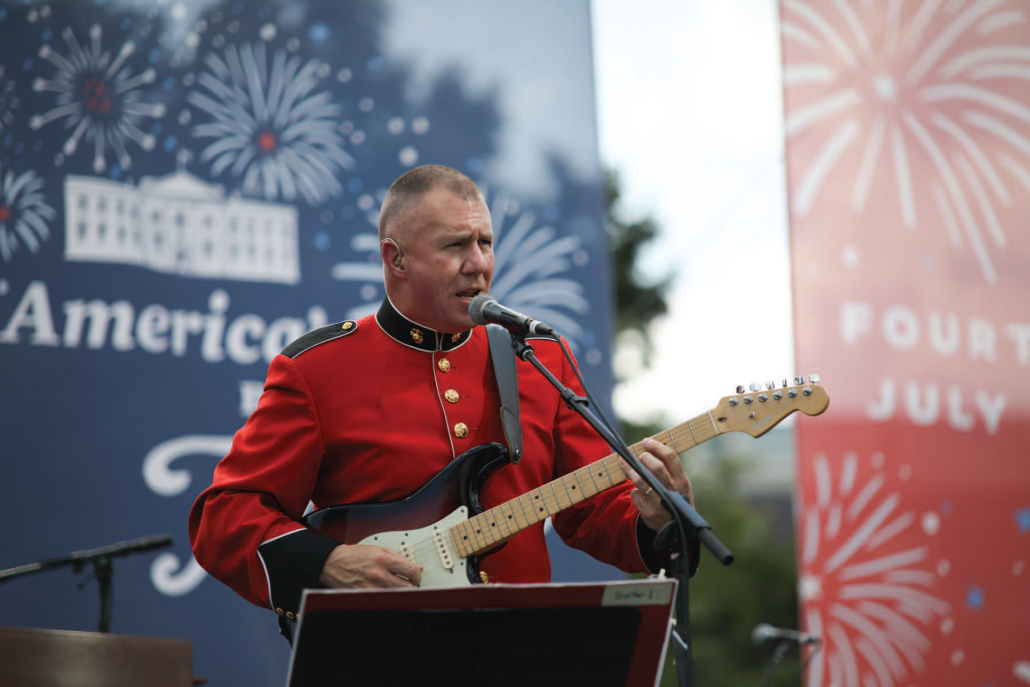
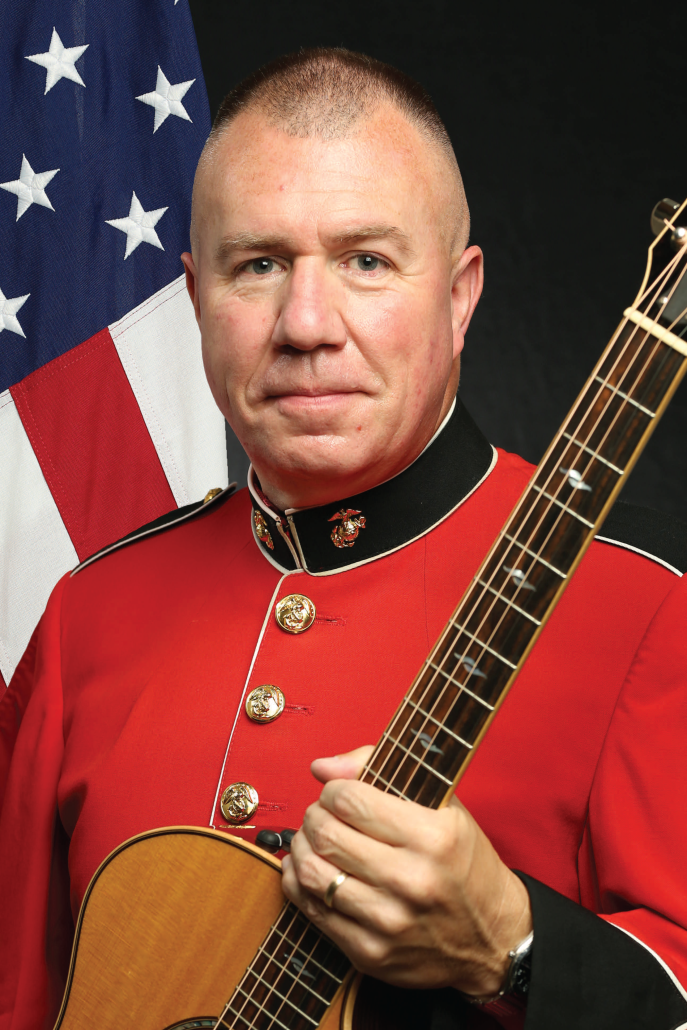
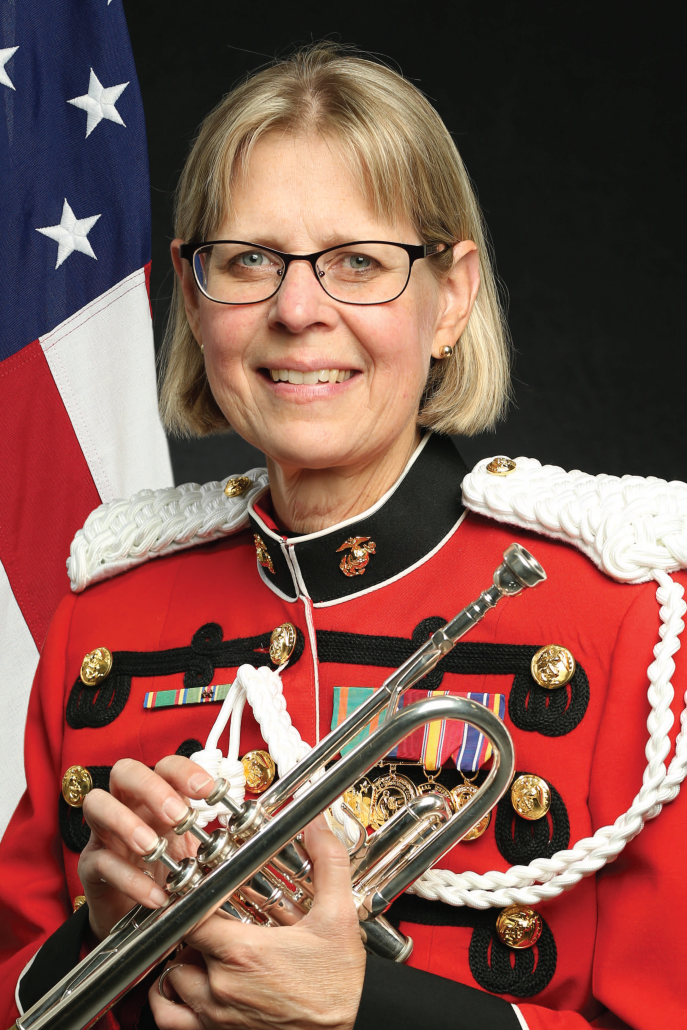
Garde plays alongside many Marines with more than 20 years of experience. Master Gunnery Sergeant Alan Prather, the band’s lone guitarist, has 24 years of service, and MGySgt Susan Rider, a trumpet and cornet player, recently celebrated an anniversary with The President’s Own, reaching 26 years with the band. In September of this year, MGySgt Christian Ferrari will achieve an impressive milestone in his career as another trumpet and cornet player, seeing a full 30 years of service with the Marine Band.

New and experienced members alike carry out their role as Marines with the utmost dedication to the band’s mis­sion, providing music at the request of the President. This strictly musical function enables band members to enter service with a rank commensurate to pay struc­tures of professional civilian orchestras and supersedes the requirement of re­cruit training for all others who seek to earn the eagle, globe and anchor.

Other bands around the Marine Corps exist to meet the musical require­ments of their individual commands. These Marine musicians complete boot camp and Marine Combat Training prior to attending the Naval School of Music in Virginia Beach, Va. This category of musician includes “The Comman­dant’s Own” Drum and Bugle Corps. Though seemingly similar in dress, mission, and high profile, The Com­man­dant’s Own is completely separate from The President’s Own in function, organization, and chain of command.

To carry out their mission, Marine Band members live anything but the “9 to 5” life. They must be prepared to perform on short notice and on any occasion. Groups of varying sizes per­form over 200 times per year at the White House, nearly 20 times per month. Almost every day, members take part in funerals at Arlington Na­tional Cemetery. Evening Parades at Marine Barracks, Washington, fill every Friday night through the summer months. Various other ceremonies keep the band busy in Washington, D.C., but they still manage to execute an im­pressive travel schedule. Members play in schools across the nation, mentoring high school students, and performing numerous other public concerts. Most notably, each October, around 65 Ma­rines depart on the national concert tour, continuing the tradition Sousa originated in 1891.

Executing a performance schedule of this magnitude would seem to leave no time for practicing their craft, but Marine Band musicians create the time.

“Practicing is the constant that al­ways remains, no matter what our schedule is,” said SSgt Garde. “As musicians, we think of playing our instruments like eating food: a neces­sity that we need to do, but also some­thing that we love.”

Many members play multiple instru­ments in order to meet the musical re­quirements of the pieces they perform. In the end, the Marine Band does what­ever is needed to produce a song in the way its composer intended.

“We’ve had basically the same in­stru­mentation in the band for over 100 years, but several instruments make an occasional appearance that aren’t in our normal set up,” said GySgt Charles Paul, the Marine Band’s chief librarian and historian. “For example, the alto flute, bass flute, soprano saxophone, bass saxophone, flugelhorn, etc. The percussion section is where you’ll really see some interesting things like bowed vibraphones, water glasses, and whistles. Based on the music, you could see percussion instruments like a Turkish crescent, a typewriter, a donkey jawbone, a trash can, or rustling leaves. There was even a piece by John Corigliano that called for a shotgun blast.”

On a stage as visible as these Marines occupy, a superior level of preparation is required to overcome challenges when they arise. Inclement weather proves a constant worry for all outside performances. In September 2022, the band performed in a torrential down­pour at the Pentagon on the anniversary of the Sept. 11 terrorist attack. Music sheets disintegrated in the rain and several instruments stopped working. Somehow, the music carried on.

“Even when the weather is fine, we often encounter situations where the plan must be thrown out the window, and we improvise on the spot,” said Col Fettig. “When you have a unit with the capabilities and experience at the level of The President’s Own, as a leader, it gives me the confidence that we can rise to meet any challenge, no matter how unexpected.”

For over two centuries, The United States Marine Band has overcome the unexpected brought about by the ebb and flow of national events. No matter the occasion, no matter the size of the ensemble, no matter the genre of song, The President’s Own continually dem­onstrates their ability to bear their cherished nickname and preserve Ameri­ca’s music.

“I could not be more proud to ac­know­ledge that it is the Marines that have the oldest professional band in the country, and that this organization has been in continuous existence serving our Presidents and our Marine Corps for 225 years,” reflected Col Fettig. “I think that says something very important about the power of music and the arts to bring people, and bring nations, together. No country in the world does that better than the United States of America, and it is the honor of every member of ‘The President’s Own’ to continue to serve in that special way.”

Toys for Tots: 75 Years of Delivering Joy to Children

By Jennifer Castro

Image
William L. Hendricks was a major in the Marine Corps Reserve when he established Toys for Tots in 1947. Hendricks worked in the motion picture industry, and he was presented with an Honorary Oscar for his patriotism after writing and producing the Marine Corps documentary, “A Force in Readiness,” in 1961.

Toys for Tots was founded in 1947 by Marine Corps Reserve officer Major William “Bill” L. Hendricks when his wife, Diane, wanted to donate dolls to a charity that would distribute the toys to children in need. Unable to find such an organization, Diane convinced her husband to create one. Hendricks, who was a public relations director for Warner Brothers Studios, called not only on his celebrity friends to help, he also looked to fellow Marine reservists to get the job done. The project was a huge success: Hendricks’ reserve unit in Los Angeles, Calif., collected and distributed 5,000 toys that year.

The program was officially adopted by the Marine Corps in 1948 and went nationwide almost immediately. Today it is recognized as an official activity of the Marine Corps and is part of the official mission of the Marine Corps Reserve. For the past 75 years, the Toys for Tots program along with the U.S. Marine Corps Reserve have led a campaign to collect new and unwrapped toys, providing millions of gifts annually to underprivileged children during the holiday season.

Perhaps the most familiar part of the campaign is the festive seasonal posters advertising the toy drive.

Of the many artists responsible for creating iconic imagery for Toys for Tots, Marine Corps combat artist Keith McConnell is of exceptional note. He designed nine posters for Toys for Tots including for the 35th, 50th, 60th and 70th anniversaries. McConnell served as a combat artist during the Vietnam War and during Operation Desert Storm. Following his service in Vietnam, he went on to illustrate children’s books and medical texts.

Image
Image
Walt Disney. Courtesy of Toys for Tots.

The Toys for Tots program and its posters have had a long association with cartoonists. The organization’s first poster was personally supervised by Walt Disney in 1948. Disney also designed the original Toys for Tots logo featuring a toy train. Over the years, Toys for Tots posters have featured numerous cartoon characters, including Daffy Duck, Bugs Bunny, Sylvester the Cat, Wile E. Coyote and the Road Runner, as well as Hank Ketcham’s Dennis the Menace and his dog, Ruff.

Image
1972, by Hank Ketcham. Courtesy of Hank Ketcham.

Bob Moore is another notable artist who designed a Toys for Tots poster. A cornerstone of early Disney animation, Moore was a liaison to the U.S. military, producing special projects for the U.S. government during World War II. He designed the Mickey Mouse-themed poster for the 1978 Toys for Tots campaign. The National Museum of the Marine Corps collection contains an original galley proof of the special poster.


Author’s bio: Jennifer Castro is the Cultural and Material History Curator for the National Museum of the Marine Corps.

Click here to view the related Saved Round from the December issue.

“We Came in Peace”

Beirut Marines Find a Voice in Forthcoming Documentary Film

By Sara W. Bock
When Greg Wah shops for Marine Corps-related souvenirs or mementos, he never seems to have any trouble finding items specific to those who served in World War II, Viet­nam, Iraq, or Afghanistan. But con­spicuous­ly absent from the typical lineup of offerings, he says, is a part of the Corps’ history that many seem to have forgotten, but he can’t go a day without remembering: Beirut, Lebanon.

The veteran Marine recalls having just celebrated his 18th birthday—“I was still wet behind the ears,” he quips—when the 24th Marine Amphibious Unit (MAU), with Battalion Landing Team (BLT) 1st Battal­ion, 8th Marine Regiment as its landing force, was ordered to replace the 22nd MAU in war-torn Lebanon after the April 1983 bombing of the U.S. Embassy in Beirut. As the year went on, complex and long-festering hostilities among warring factions and militias led to an influx of small arms, rocket and mortar fire spe­cifically targeting the Marines, who as members of a multinational peacekeeping force were not permitted to adequately defend themselves. America may not have officially been at war, but the reality on the ground told a vastly different story. According to a 2003 article in DAV Magazine, by Oct. 22, the eve of one of the most tragic events in Marine Corps history, seven Marines had already been killed and 64 wounded by enemy fire.

Wah, who says that only in recent years has he begun to process the trauma he experienced in Beirut, is not alone in his sentiments when he expresses frustration about the manner in which the entire mission was handled. In his words, “the whole thing has been swept under the rug.”
Image

Director and filmmaker Michael Ivey, left, interviews retired Marine MajGen James Lariviere about his experiences as a young first lieutenant in Beirut, where he served as a reconnaissance platoon commander with 3rd Bn, 8th Marines. Scheduled for release in October 2023, “We Came in Peace” allows those who were there to tell the “boots-on-the-ground truth.”

Still in production, “We Came in Peace” is expected to premiere next year on the 40th anniversary of the Oct. 23, 1983, suicide bombing that decimated the four-story reinforced concrete BLT 1/8 head­quarters building in Beirut and killed 241 Americans—220 of them U.S. Marines. The date would go down in history as the Corps’ deadliest since the Battle of Iwo Jima in 1945.

The film is a labor of love for Ivey, as well as for Elisa Camara, one of its pro­ducers, who at just 17 years old received the news that her beloved older brother, Sergeant Mecot Camara, USMC, was among those killed in the devastating blast. After she wrote the 2013 book, “American Brother,” in which she told the heartfelt story of Mecot’s upbringing in rural West Virginia, his service in the Marine Corps, and his tragic death, Camara began attending the annual Beirut Memorial Observance Ceremony at Marine Corps Base Camp Lejeune, N.C., held each October, and became closely acquainted with many of the Marines who had served along­side him. There, she found herself part of a “family” bonded by tragedy.

“They were just so embracing of my heartache, and they have their own heartache too,” Camara said with emotion in her voice. “They said, ‘You lost your brother, but you gained a platoon of brothers who will always be there for you.’ ” It came as no surprise, then, that when Dan Brown, who served in Beirut, approached Camara after a 2019 Memorial Day gathering of Beirut Marines and family members in Washington, D.C., and asked for help, she was de­ter­mined not to let him down. His request was straightforward: “Can you help us tell our story, so we’re not forgotten?”
Image

Marine veteran Greg Wah, who served with Co A, 1/8, 24th MAU, is one of the Beirut Marines who shared his story during the production of “We Came in Peace.” (Photo courtesy of Michael Ivey)

That conversation was the impetus for “We Came in Peace,” but it certainly didn’t happen overnight. Camara had pre­viously thought about trying to get a documentary made about the Beirut Marines, but she had no idea where to begin. And then there was the issue of funding. When she’d in­quired with a Los Angeles-based producer, the cost—$500,000 up front—was insurmountable. As fate would have it, a mutual friend connected Camara with Ivey, who also is a West Virginia native and was already familiar with Mecot’s story. A member of the Director’s Guild of America and former com­mentator on National Pub­lic Radio’s long running “All Things Considered,” Ivey had recently made a commitment to creating what he refers to as “work that matters,” when the story of the Beirut Marines fell into his lap.
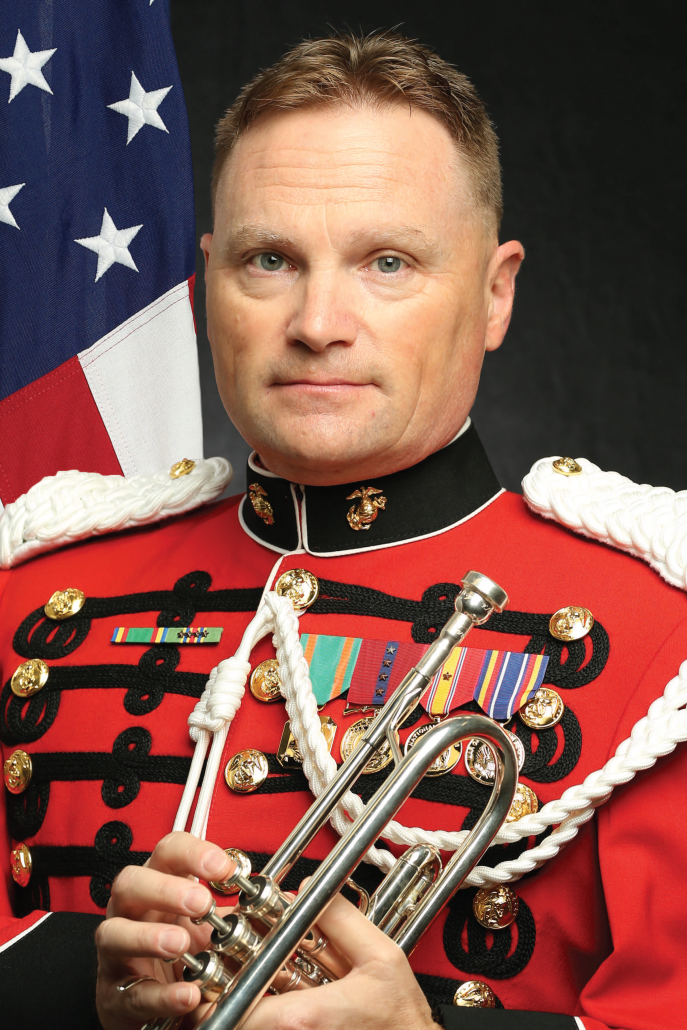
“I feel like the angels are behind this one, and it all starts with Elisa and her brother,” said Ivey, adding that he con­siders it an honor and a privilege to lev­erage his experience as a storyteller to make the film the Beirut Marines and their families deserve.

Image

Mecot Camara’s sister, Elisa Camara, speaks to attendees at the 31st annual Beirut Memorial Observance Ceremony in Jacksonville, N.C., Oct. 23, 2014. Her conversation with a Beirut survivor was the impetus for “We Came in Peace.”

Lacking the funding to get the project started, Camara first set out to create a 501(c)(3) nonprofit organization, the American Brother Foundation, that both honors Mecot Camara’s life and funds the production of the film. Up to this point, “We Came in Peace” has been made possible solely through private donations. Ivey has avoided soliciting completion money from networks, who generally exert a heavy influence over the production process, because he’s determined to keep his promise to let the Marines tell the story themselves. Instead, as donations have trickled in, Ivey has traveled around the country to conduct on-camera interviews, the first of which took place in February 2021. As of late July, he’s collected the stories of 45 different individuals, including General Alfred M. Gray, USMC (Ret), who served as the commanding general of 2nd Marine Division at the time of the Beirut bombing and later as the 29th Commandant of the Marine Corps; retired Colonel Timothy J. Geraghty, who commanded the 24th MAU and the U.S. Multinational Peacekeeping Force; and Lieutenant Colonel Larry Gerlach, the commanding officer of BLT 1/8 who survived the bombing of the headquarters.

For Greg Wah, sharing his story on camera brought back a barrage of mem­ories he had long suppressed.

“I think this documentary is going to bring a lot of healing because a lot of the Marines have done the same thing that I have done,” said Wah, who was shot in the leg on his very last day in Beirut, Nov. 7, 1983, just two weeks after the bombing. “When I got out of the Corps, I didn’t talk to anybody about my experience, not even with my own family […] It was bottled—put in a bottle never to be opened.”

Retired Gunnery Sergeant Danny Joy, a friend of Mecot Camara’s who served with Weapons Company, 1/8, is thankful that he and his fellow Beirut veterans finally have been given an opportunity to tell their story. “No one has ever asked us,” he said with a tinge of sadness in his voice. But while he’s appreciative, that doesn’t mean it’s an easy topic for him to talk about, especially around the anniversary of the bombing each year.

“Every year it comes around and it’s like picking a scab off this wound, and now I’m opening the wound up again. It’s emotional, and really, it’s tough,” said Joy, who describes the survivor’s guilt he and others who made it home continue to struggle with decades later. “There’s certain things you saw that you can’t ever unsee.”

Image

Retired Marine GySgt Danny Joy, who was a corporal serving in Dragon Plt, Weapons Co, 1/8 in Beirut, is one of the 45 individuals who have been interviewed for the documentary thus far. (Photo courtesy of Michael Ivey)

The film, which has received the en­dorse­ment of the fraternal organization Beirut Veterans of America, is devoid of the narration and reenactments that are common within the documentary genre. With neither scripted voiceovers nor actors, both Camara and Ivey insist that the film lives up to its claim of telling the “boots-on-the-ground truth” as told by those who were there.

“We’re not doing some revisionist piece,” Ivey said emphatically.

Camara considers those who have participated by sharing their stories to be collaborators in the project, and notes that the major contributors to the funding of the film thus far have been Beirut veterans themselves.

“It’s deeply personal to everyone in­volved, […] and it’s not an easy story to share,” said Camara. “We want to share it for history, but we also want to share it to honor the ones that didn’t come home, and the ones that live with it every day.”

For Camara, a highlight of the entire experience came when she had the opportunity to accompany Ivey to the home of Gen Gray to film his on-camera interview.

“He [Gen Gray] was wonderful, and the last thing I said before we went out was, ‘I can assure you that this will be done with grace and dignity or we will not do it at all, Sir. I can promise you that,’ ” she recounted. “And he looked at me and he pointed his finger at me and said, ‘I am holding you to that, young lady!’ ”

It’s a commitment she takes seriously. So much so, that last October, in concur­rence with the annual observance cere­mony in Camp Lejeune, they held a private screening of the six-minute trailer and asked for feedback and suggestions from the Marines and Gold Star family members in attendance.

The trailer, which can be viewed on the documentary’s website, is a high-quality sample of the hours of interviews Ivey has conducted to date, featuring honest, raw and emotional accounts that invite the viewer to think critically about an important and often-overlooked moment in America’s history.

“It’s time, especially with what’s going on in the world right now,” Camara said. It’s her hope that future generations of Americans will not only know what happened in Beirut, but also will learn valuable lessons that may help prevent history from repeating itself.

There are still Beirut Marines left to interview for the film, and Ivey also aims to secure funding that will allow him to interview diplomats, journalists, and other international peacekeepers—namely, Italians and French—who also supported the multinational effort. The film also will detail the concurrent suicide bombing of the French Paratrooper Detachment in Beirut on Oct. 23, which killed 58 French servicemembers. He hopes that adding additional perspectives will “broaden the circle” and provide an even greater context for viewers to consider.

For retired Marine Gunnery Sergeant Don Inns, a Beirut veteran who served with Mecot Camara in “Charlie” Co, BLT 1/8, the recent loss of three members of his old platoon in a span of only five weeks served as a reminder of the importance of telling this story sooner rather than later.

“Sadly, they took their stories to the grave nearly four decades after Beirut,” said Inns. “This documentary is our last best hope of illuminating the cause and cost of our country’s entanglement in Lebanon […] Supporting it is the least we can do in remembrance of those that sacrificed the most. It is also the best investment we can make for future generations of Marines, as what’s past is prologue.”
Image

According to Camara, the film will be pitched to Netflix and other streaming platforms, and premieres are anticipated to take place in October 2023 both at Camp Lejeune and in West Virginia. It’s Ivey’s hope that their efforts will help shed light on what really happened in Beirut nearly 40 years ago. “Maybe we can do something to make it right, learn the lessons, recognize the people that were there, recognize that it was an undeclared war, and it can effect positive change,” Ivey said. But most of all, he emphasizes, he’s doing it for those who served and sacrificed there. “They live with this every single day,” he added.

According to Camara, the film will be pitched to Netflix and other streaming platforms, and premieres are anticipated to take place in October 2023 both at Camp Lejeune and in West Virginia.

It’s Ivey’s hope that their efforts will help shed light on what really happened in Beirut nearly 40 years ago.

“Maybe we can do something to make it right, learn the lessons, recognize the people that were there, recognize that it was an undeclared war, and it can effect positive change,” Ivey said. But most of all, he emphasizes, he’s doing it for those who served and sacrificed there. “They live with this every single day,” he added.

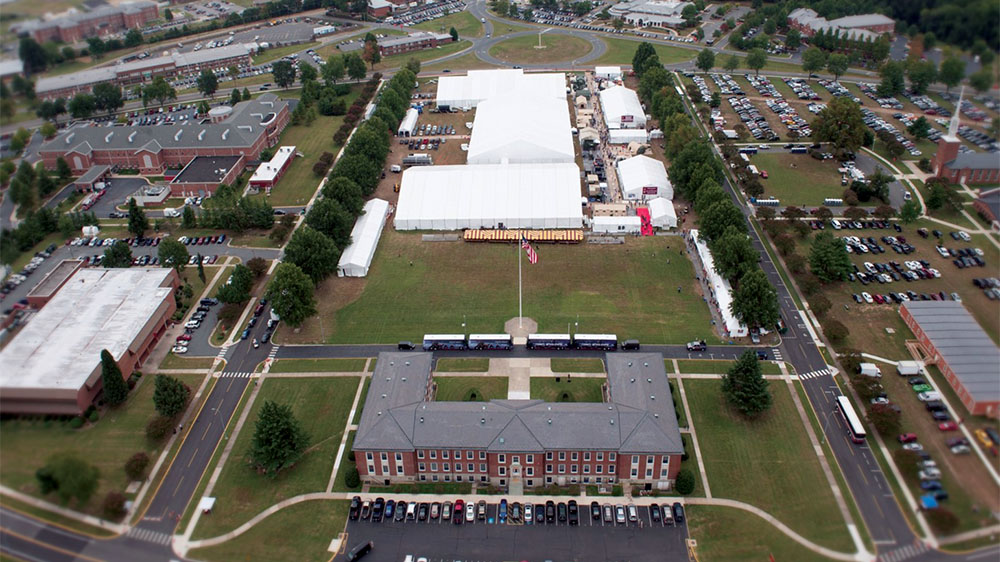
Modern Day Marine

Expo Features Display of Latest Innovations In Gear, Technology

By Sam Lichtman

From May 10-12, representatives from more than 400 defense con­tractors, government agencies, and nonprofit organizations descended on the Walter E. Washington Convention Center in Washington, D.C., for Modern Day Marine (MDM) 2022, hosted by the Marine Corps Association (MCA) and the Marine Corps League (MCL).

In addition to the exhibitors, the MCA and MCL hosted a slate of guest speakers including the Secretary of the Navy, Carlos Del Toro; General David H. Berger, Commandant of the Marine Corps; and several other senior leaders of the Corps. Throughout the three-day expo, they delivered informative presentations on a wide variety of topics ranging from acquisitions to littoral combat. Of note were several briefings covering various aspects of Force Design 2030, Gen Berger’s plan to make the Marine Corps more flexible and adaptable. The briefings and guest speakers, a key component of MDM, provided an opportunity for professional development for the many Marines who attended the expo from throughout the National Capital Region.

Leatherneck sent representatives to the event to learn about the latest in military technology and offer our readers a sampling of what’s new in the industry. Future issues of Leatherneck and marinemilitaryexpos.com will have information about next year’s event, scheduled for June 27-29, 2023.

MCA offers more professional development resources at:
mca-marines.org/professional-development.

Image

Marine Corps Association president, retired LtGen Charles G. Chiarotti, delivers re­marks during the ribbon cutting ceremony at Modern Day Marine 2022 at the Walter E. Washington Convention Center, May 10. The Modern Day Marine expo brings together Marines, veterans and industry partners to collaborate on the innovations and capa­bilities that ensure the Marine Corps is ready to win tomorrow’s battles.

Image

Marines with Bravo Company, 2nd Marine Regiment, 2nd Marine Division, operate a Hunter WOLF Vehicle System down a mountain during training on Camp Dawson, W.Va., Feb. 5.

HDT Global Hunter WOLF

Unmanned vehicles seem to be a popular technology among some of the larger companies in the defense industry. Among others, HDT Global had two examples of their Hunter WOLF (Wheeled Offload Logistics Follower) unmanned ground vehicle on display. The Hunter WOLF is a small six-wheeled ground vehicle with a hybrid powertrain running on electricity with a diesel generator for charging the battery; it is designed to support an infantry squad in any terrain or climate. The vehicle’s compact dimensions allow it to be airlifted to combat zones; a V-22 Osprey is able to carry two of them and the Army’s CH-47 is able to carry six. Its modular design and 1-ton payload capacity allow Marines to convert the Hunter WOLF between a wide variety of configurations. HDT had one set up as a logistics vehicle and another with a remote weapons system at Modern Day Marine; other payload packages are designed for reconnaissance, engineering, and even anti-tank missions. The vehicle is controlled using a small wireless remote or can even be set to autonomously follow dismounted infantry.

The Hunter WOLF has seen use in the Australian Outback as a sort of robotic farmhand, allowing one remote operator to safely and comfortably perform the work of many people in less time. The Marine Corps is currently testing tethered quadcopters powered by the Hunter WOLF’s onboard generator. More information is available at hdtglobal.com/series/hunter-wolf/.
Image

Marines with 1st Battalion, 2nd Marine Regiment, 2nd Marine Divi­sion, rehearse medical evacuation scenarios with an Expe­ditio­nary Modular Autonomous Vehicle (EMAV) during a training event on MCB Camp Lejeune, N.C., June 24, 2021. The EMAV is a highly mobile and fully autonomous ground vehicle.

Oshkosh Defense/Pratt miller EMAV

Oshkosh Defense also brought an unmanned ground vehicle to the show. In development for six years by their subsidiary Pratt Miller Defense in conjunction with QinetiQ, the EMAV (Expeditionary Modular Autonomous Vehicle) is much larger and more than twice as heavy as the Hunter WOLF but retains a similar low profile. It travels on rubber tracks at more than 50 miles per hour over flat ground and can be carried internally aboard the V-22 Osprey and other military transport aircraft. The EMAV can be rapidly reconfigured in the field with more than 40 different mission packages and can carry up to 3 tons. Its software allows it to operate with many types of remote controllers or drive itself with varying levels of autonomy.

Like the Hunter WOLF, the EMAV is designed to support dismounted infantry by carrying supplies and providing electrical power even when no mission package is installed. While moving, its onboard generator can produce up to 3.4 kW of power on a low-voltage rail to charge batteries for optics, night vision devices, laser aiming modules, and other electronics Marines carry. While stationary, the EMAV can output up to 30 kW on its high-voltage rail to help power a small forward operating base.

Oshkosh has delivered four EMAVs to the Army and six to the Marine Corps, which are currently undergoing testing at the Marine Corps Warfighting Laboratory. The Army has been running the EMAV through its Robotic Combat Vehicle–Light (RCV-L) trials program. More information is available at https://www.qinetiq.com/.
Image

Maztech X4-FCS mounted to a civilian rifle on display at Modern Day Marine. While somewhat heavy at 20.8 ounces, its onboard electronics suite offers the same functionality one might expect in the cockpit of a modern aircraft. (Photo by Nancy S. Lichtman)

Maztech Industries X4-FCS

Irvine, Calif.,-based engineering company Maztech Industries made a big splash this year with their X4-FCS device, a weapon-mounted ballistic computer. They brought two units to Modern Day Marine to show off their capabilities.

Developed in collaboration with Magpul, the X4-FCS consists of a ballistic computer integrated into a conventional 30 mm or 34 mm scope mount, designed for use with a low-power variable optic (LPVO) such as the Marine Corps’ new Squad Day Optic (SDO). Powered by two CR123 or four 18650 batteries, it projects a digital overlay into the objective lens of whatever scope is mounted to it to provide more information to the shooter at a glance. The X4-FCS can be programmed in the field with profiles for up to 25 different ammunition types; using atmospheric sensors, it can update its reticle in real time based on the exact ballistic characteristics of each round to show how far it will drop at a given distance. The unit can also sense its own pitch and roll to allow it to compensate for the angle at which the rifle is held. With an optional laser rangefinder attached, the X4-FCS can even display a marker to show exactly where to aim to hit the target—all without the shooter taking his or her eye off the target.

The modular design of the X4-FCS makes it compatible with any rifle scope of the correct size and allows different electronics packages to be added on if newer optical devices, such as better sensors and rangefinders, are ever developed. Maztech is currently working with Magpul on a “smart” magazine which will count the number of rounds inside and tell the X4-FCS what type of ammunition is loaded so it can automatically adjust the reticle for different ballistic properties. To learn more, check maztechindustries.com/x4-fcs.
Image

Since the Marine Corps approved it for use in 2017, the Magpul PMAG has begun to replace all legacy aluminum “G.I.” mag­azines in service; the PMAG’s durable, yet lightweight fiber-reinforced polymer construction makes it an ideal choice for military use.

Magpul Industries

Magpul had a large display this year with many of their new and popular civilian products. Since 2016, a variant of its PMAG GEN M3 has been approved by the Marine Corps as a replacement for old Colt-pattern aluminum “G.I.” magazines to feed the M16A4, M4, and M27. In fact, the updates made between the second generation and current third generation of PMAG included a change to the shape of the magazine body to allow compatibility with platforms such as the M27 IAR. Additionally, the PMAG GEN M3 was designed with different feed geometry to present the rounds at a higher angle, allowing use of the M855A1 EPR (Enhanced Performance Round) without damaging rifles’ feed ramps.

Magpul has been producing the PMAG for decades and the Marine Corps has been issuing it as standard equipment for several years; given its excellent track record for reliability in harsh conditions, it appears that the PMAG is here to stay. For more information on Magpul’s new products for this year, check magpul.com/what-s-new.html.
Image

An example of the Blue Force Gear CHLK battle belt. This one is configured with magazine carriers and a holster for the M18 pistol.

Blue Force Gear

A longtime favorite among military riflemen and civilian shooting enthusiasts across the country, Blue Force Gear had some excellent products to show off at their booth at Modern Day Marine this year. The company already supplies two products to the U.S. military: their famous Vickers sling and a holster for the M320 grenade launcher. Blue Force Gear doesn’t just cut fabric and run sewing machines; they actively work to develop some of the most technologically advanced load-bearing equipment on the market. Their CHLK two-belt system, for example, is advertised to weigh 50 percent less than competing battle belts and is angled and contoured to fit around the wearer’s waist more comfortably with no break-in period.

To manufacture their load-bearing equipment, Blue Force Gear laser-cuts MOLLE-compatible attachment slots out of the material. This design has been gaining popularity in the industry because it allows manufacturers to use fewer pieces of material, making the finished product stronger and lighter.

Blue Force Gear’s website is packed with information on their products as well as the technology that makes them possible. You can learn more at blueforcegear.com/about_us.html.
Image

A display sample of Trijicon’s new Squad Common Optic (SCO) mounted to a dummy rifle. For demonstration purposes, this example is equipped with an offset reflex sight for use at close range or with night vision; the SCO as issued does not include one. (Photo by Nancy S. Lichtman)

Trijicon SCO

Trijicon has supplied riflescopes to the U.S. military since 1987 and shows no sign of slowing down. Hundreds of thousands of Marines have used the RCO [Rifle Combat Optics], a variant of the Trijicon ACOG [Advanced Combat Optical Gunsight] TA31F, since its adoption in 2005. Beginning two years ago, however, the Marine Corps has been replacing the RCO on its rifles and MGO [Machine Gun Optic] (another ACOG variant) on machine guns with Trijicon’s new Squad Common Optic (SCO). Whereas the RCO is a prismatic scope with a fixed 4x magnification, the SCO is a low-power variable optic with a magnification range from 1 to 8 power. While its smaller 28 mm objective lens gathers about 25 percent less light, the variable magnification and user-adjustable brightness make it more useful in both close-quarters and long-range engagements in a wider variety of environmental conditions. Trijicon’s representatives say the VCOG [Variable Combat Optical Gunsight] family, of which the SCO is a member, has the same rugged construction as the RCO and is guaranteed completely waterproof to 66 feet. It is also compatible with the same mounts as legacy Trijicon optics, making it a true drop-in solution for any weapons system already equipped with an RCO or MGO.

Trijicon also manufactures a wide range of sighting systems for the law enforcement and civilian markets, ranging from tritium-illuminated iron sights for pistols to long-range precision scopes for hunting and competition. For more information, visit trijicon.com.
Image

A Hydrogen-Tactical Refueling Point is staged during a demonstration at MCB Camp Lejeune, N.C., on Sept. 16, 2021. The H-Tarp (below) is intended to be used to power unmanned aerial vehicles and meets clean energy demands of the future without downgrading performance.

Office of Naval Research H-TaRP

Without a doubt, the Office of Naval Research (ONR) had one of the most exciting displays on the show floor. They were demonstrating their hydrogen tactical refueling point (H-TaRP), a version of what they call an expeditionary hydrogen generator, developed with MIT’s Lincoln Laboratories. This device is designed to be used at the company level to produce hydrogen pressurized to 5,000 psi to fuel unmanned aircraft, drive fuel cells to generate electrical power, or inflate balloons to loft radio antennae or reconnaissance payloads. Waste heat from the chemical reaction can be used to cook food, dry wet clothing and perform other useful work.

ONR’s engineers describe the H-TaRP as functioning like a giant gumball machine: a hopper at the top dispenses pellets of specially treated aluminum, which fall down and react with water in the reaction chamber to produce hydrogen, heat and aluminum hydroxide. This is the same chemical reaction which takes place inside the flameless ration heater included in MREs. The aluminum can come from any source, even empty beverage cans, and is first “activated” by heating it to 200°F with a small amount of indium and gallium. Any water will work, even unfiltered seawater, and the leftover aluminum hydroxide is non-toxic.

Three variants of expeditionary hydrogen generator are currently in development: the company-level H-TaRP unit displayed at Modern Day Marine, a smaller version for use at the squad level, and an individual unit for charging batteries and other relatively low-power applications. H-TaRP is currently in testing with II MEF at Camp Lejeune, N.C., and can be carried and set up by two Marines in as little as 13 minutes after just an hour of training. For information on ONR and their programs, check their website at onr.navy.mil.

ONR’s TechSolutions program allows Marines and Sailors to submit requests to develop new technologies to solve specific problems encountered in the field. If the technology can be developed within 12 months and for less than $1 million, the TechSolutions office will work with a network of R&D centers to bring it to fruition. To learn more about the TechSolutions program, go to onr.navy.mil/techsolutions/about.html.
Author’s bio: Sam Lichtman is a college student and licensed pilot. He works part-time as a manager and armorer at a Virginia gun store and occasionally contributes content to Leatherneck. He also has a weekly segment on Gun Owners Radio.

MCRD San Diego Marks its Centennial

West Coast Base Blends Historic Architecture With the Corps’ Modern Mission

By Barbara McCurtis
Image

One of the first platoons to graduate from the new West Coast Recruit Depot in San Diego, Calif., was 4th Plt, Co C, on Sept. 28, 1923.

Marine Corps Recruit Depot San Diego is celebrating its 100th birth­­day and its beginnings are quite interesting. Following World War I, San Diego, Calif., was a sleepy border town struggling to establish a stable economic base that would attract new residents and generate prosperity. The main thing the area had going for it was perfect climate.

The city’s chamber of commerce, led by a powerful group of local citizens, began courting the Department of the Navy to select San Diego as its southern Pacific port. Initial efforts were rejected as the Navy did not want to invest in an undeveloped location. The group then began lobbying President Theodore Roosevelt. In 1908, the fleet was passing San Diego on its world tour and the committee made a bold move. They raised more than $20,000 and chartered a fishing boat to take the mayor and a group of directors 600 miles south to intercept the fleet off the coast of Mexico. They pleaded their case on the foredeck of a battleship, and the admirals agreed to stop outside the bay of San Diego as the harbor was too shallow, narrow and dangerous.

When the fleet landed on April 15, 1908, they were greeted with parades, cere­monies, balls, guided tours, dinners and other functions in the homes of prom­inent San Diegans. The visit was such a success the group began to pursue oppor­tunities to improve the harbor. Meanwhile, a rev­olution in Mexico brought the Ma­rines to the area. The United States activated the 4th Marine Regiment to support the existing regime in Mexico. At that time, limited operations had been conducted in many parts of the globe in support of national interests.
Image

Marines aboard MCRD San Diego, Calif., run along Hochmuth Ave., during a 3-mile run to celebrate the Marine Corps Birthday on Nov. 5, 2015.

In March 1911, the 4th Provisional Brigade, under Colonel Charles A. Doyen, sailed from San Francisco to San Diego where they waited on Navy ships for orders south. After a week of waiting, Doyen and his Marines disembarked on March 20 and set up a temporary camp on North Island they called Camp Thomas, in honor of Rear Admiral Chauncey Thomas, Commander of the Pacific Fleet. North Island was one of two islands that transformed San Diego Harbor from a broad bay, wide open to the Pacific Ocean, into a landlocked harbor on the Pacific Coast. A flat spot of sand and scrub growth, the camp allowed the Marines to conduct physical exercises, close order drill and marches under full packs. Marksmanship training was carried out on a range that had been constructed by First Lieutenant Holland M. Smith.

By the end of May the revolution was over, and the 4th Provisional Regiment was disbanded. In 1912, William Kettner, Director of the San Diego Chamber of Commerce, was elected to Congress. Kettner used his new position to find federal funding and eventually persuaded Congress to appropriate $238,000 to dredge San Diego Harbor. This was an important first step in making San Diego a Navy town.

Trouble with Mexico occurred again in 1914, and the 4th Regiment was in camp on North Island under the command of Colonel Joseph H. Pendleton. Col Pendleton saw San Diego as a strategic point for the Marines to train and embark quickly for expeditionary duty. He was not alone in this idea; Marine officers had been recommending a permanent advance base regiment since 1911.

Image

Tents that serve as quarters for leathernecks from 4th Marine Regiment line the beach on North Island, Calif., in 1914.

In camp on North Island, Col Pendleton took every opportunity to generate sup­port for the Marine Corps. Interested in local affairs, he rarely turned down an invitation to attend civic functions. He held an open house every Tuesday and Thursday and hosted the regiment parade for public viewing.

Pendleton’s presence in the city is well-documented in the photographs of the Panama California International Exposition as well as more than 15 articles written on him in the local newspapers. He was sought after as a speaker for civic engagements and soon became a close associate of local leaders to include Congressman Kettner, who became a strong advocate for a permanent Marine Corps installation in San Diego. Before and during the exposition, Kettner pre­pared the city for new military installations when he deepened the harbor and added a coal wharf and fuel oil station and a Navy radio station in Point Loma.

Franklin D. Roosevelt, the Assistant Secretary of the Navy, inspected the area in April 1914 and recommended San Diego as the site for an advanced base. His proposal was approved and the 4th Regiment, ordered ashore at San Diego for an indefinite stay, became the nucleus of the West Coast advance base force. The Marines remained in Balboa Park after the Panama-California Exposition ended, and leased buildings that were part of the exposition and used them for barracks, work spaces and offices.

The 1916 Naval Appropriation Act ap­proved $250,000 to purchase 232 acres of tidal land abutting Dutch Flats, where the San Diego River frequently emptied into San Diego Bay. Dutch Flats was a low-lying marsh near downtown that was covered with water at high tide. Con­gressman Kettner had a home that overlooked the eyesore that was Dutch Flats, and he convinced Pendleton that Dutch Flats was the perfect spot for the Marine base. The San Diego airport was also in Dutch Flats. The airport would be dedicated in 1928, but by 1934 it was crowded with two flying schools; United, American and Western Airlines; Ryan Aircraft and the Marines. Located in the center of the city, the airport’s proximity to downtown gives it little room to ex­pand due to lack of land space and the environmental impact of neighboring communities.

May 15, 1917, reported that Congress had appropriated $250,000 to pay for the land for the Marine base. On Dec. 1, 1921, Col Pendleton raised the flag and the base officially opened. The new San Diego base was the Marine Corps’ first purpose-built installation. Prior to this, Marines were tenants in Navy Yards or occupied former Army or Navy installations and either expanded or remodeled them for their own purposes. The architect for the new base was Bertram Goodhue, the principal designer for the Panama-California Ex­position buildings in Balboa Park.

The original land parcel that abutted Dutch Flats was 232 acres. Eleven dif­ferent land acquisitions from 1916 to 1942 state the base acquired 890 acres. In 1948 the Marines relinquished 245 acres to the airport for construction of a new terminal. The proximity to the airport has created what one commanding general referred to as the San Diego Pause; that interval of time when multiple planes are taking off and individuals speaking outdoors must stop speaking.

Goodhue’s original plan for the base used the Spanish Colonial Revival style architecture featured in the exposition and called for 46 buildings according to a Los Angeles Times report in 1919. The barracks would be linked by a great arcade facing the parade ground; secondary structures would form a long axis behind the arcade creating a series of courtyards. Six major support buildings and small utility structures were completed from 1922 to 1923. During the 1920s and 1930s, the primary function of the base was supporting Marine Corps expeditionary operations. In August of 1923 that changed when the Marine Corps Recruit Training Depot for the West Coast relocated from Marine Barracks, Navy Yard on Mare Island.

The first group of recruits arrived in San Diego on USS Sirius (AK-18). Major E.P. Moses was the officer in charge of recruit training. At that time, the recruit depot had three departments: the recruit detachment, which consisted of all the recruits in training; the personnel section; and the recruit depot detachment which was made up of the depot’s permanent personnel and Sea School. The 4th Reg­iment, nicknamed “San Diego’s Own,” was serving on expeditionary duty and did not return to San Diego until 1924.

In 1924, the base was redesignated Ma­rine Corps Base, Naval Operating Base, San Diego and served as the headquarters for Observation Squadron One, the oldest organized air unit in the Marine Corps. Aircraft were stationed across the bay at North Island Naval Air Station at Coronado, Calif. An emergency expansion of the base began in September 1939 with construction of 27 new storehouses, a defense battalion barracks, mess facilities, hundreds of 16-man prefabricated metal huts for the recruit depot, post exchange, recruit parade ground, neuro-psychiatric building, dental and dispensary quarters, new roads, and a railroad. When the De­partment of the Navy authorized the Ma­rine Corps Women’s Reserve in 1942, several buildings were constructed to house and support female Marines. The first Woman Reserve (WR) officer as­sumed her duties the week of Sept. 25 and by the end of 1943, 187 WRs were sta­tioned on base. When World War II ended, the base focused on demobilization for thousands of Marines returning from the Pacific. WW II had a significant impact on the area; by 1942 San Diego’s popula­tion swelled so much in a single year that it surpassed the projected pop­ulation growth for the next two decades. A large portion of the new arrivals were military personnel and their families.

Image

Marines of “Fox” Co, 2nd Recruit Training Bn, stand in formation during a graduation ceremony at MCRD San Diego, Jan. 15, 2021.

In 1948 recruit training became the principal tenant, and the base was re­designated Marine Corps Recruit Depot San Diego. The Korean War in the 1950s resulted in a need for housing for returning reserve Marines and new recruits. Tents were assembled on the parade deck for billeting, and the base also built hundreds of Quonset huts. The 270 corrugated galvanized steel huts were in the western area of the base with 180 additional huts located adjacent to the parade deck. Each hut housed 24 recruits.

The depot also served as a staging area for reserve Marines recalled to active duty for the Korean War. The Marines were quickly processed through medical, legal and administrative procedures on and then transported to Camp Pendleton to join new units. The units would eventually be shipped out from San Diego’s Broadway pier as they had during WW II. Col Pendleton’s foresight for the base to be quickly able to support expeditionary needs had proved true.

President John F. Kennedy visited the base on June 6, 1963. A pair of brass foot­prints were created on the site where he stood, with his feet at a 45-degree angle, just as Marine recruits stand on the yellow footprints at the start of recruit training. Dating back to at least June of 1963, gen­­erations of recruits have started their Marine Corps training by standing on the yellow footprints painted outside the receiving building at the Recruit Training Regiment.

The rapid construction of facilities for recruits occurred on the depot during WW II, Korea and Vietnam. In 1967, con­struction began on the first two of five new per­manent “H-style” barracks. Each barrack was three stories high and was designed to house 900 recruits. The depot used the Quonset huts and tents to house the large number of men reporting due to the draft before the barracks were completed.

The end of the Vietnam War and sub­sequent fewer recruits in training meant changes on the depot. In 1972, the final H-style barracks were completed, and 242 Quonset Huts were demolished two years later. In 1976 the correctional facility was demolished, and Recruit Training Reg­iment moved into offices on the arcade vacated after Communication and Elec­tronic School moved to Twentynine Palms in 1975.

The depot has had as many as five Ma­rine Corps schools as tenants over the years. Sea School was a tenant from 1921 until its closure in December 1987. In 1965, Field Music School consolidated with a like unit at Parris Island. Recruiters School was established on Parris Island in 1947 and San Diego opened its school in 1971. The two schools eventually were consolidated in San Diego in 1972. Both depots have had their own drill instructor schools since WW II.

The needs of the Marine Corps have always ruled the demolition and con­struction of buildings and tenant com­mands on the depot. In 1976 the depot was redesignated Marine Corps Recruit Depot and Western Recruiting Region after the addition of the recruiting head­quarters. Women were no longer in sep­arate companies and the new enlisted barracks model of two person rooms was developed. By 1985, the Women Ma­rine and Staff Noncommissioned officer barracks were demolished.

In 1987, Headquarters Marine Corps directives increased recruit training in support of basic warrior training. General Alfred M. Gray, the 29th Commandant, was looking for more meaningful physical exercises such as forced marches and confidence courses.
In 1988 the base opened a Command Museum and to this day, the recruits receive history classes taught by docents, most of whom are retired Marines. The docents use the displays in the museum to reinforce Ma­rine Corps history lessons. New Marines escort their families through the museum retelling the history they have learned from the docents on every Family Day.

In 1991, 25 buildings aboard the base were added to the National Register of Historic Places. In addition to the build­ings, 110 acres of land including the parade grounds, was delineated the Historic District. The depot was nominated for the register because of the significant archi­tecture and the arcade, a covered walkway north of the parade ground, more than 1 mile long that contains nearly half of the buildings. Other historic places include the commanding general’s residence and garage, four married officer’s quarters and garages, the depot disbursing office, Headquarters and Service Battalion head­quarters, the Command Museum, and the Recruit Training Regiment headquarters.

In 1996, the 31st Commandant of the Marine Corps, General Charles C. Krulak, established “The Crucible.” Gen Krulak called the Crucible “the defining moment in a young Marine’s life.” It is a grueling test every recruit must pass to earn the title “Marine.” The Crucible and rifle range training for recruits are conducted at Weapons Field Training Bat­talion which is part of the Recruit Training Regiment but located on Camp Pendleton.

Rifle range training for recruits had been conducted on Marine Corps Base San Diego which was about 13 miles north of San Diego and built by the Marines in 1916. In 1942 the Secretary of the Navy redesignated it as Camp Calvin B. Matthews. Progressive and continuing growth of the city of San Diego in the vicinity created hazardous conditions and in August 1964 the property was trans­ferred to the Regents of the University of California. Rifle range training was re­located to Weapons Training Battalion at Marine Corps Base Camp Pendleton and formally dedicated as the Edson Range Area Sept. 21, 1965.

Recruits are bused to Weapons Field Training Battalion in their second phase of training for rifle qualification. They live on the base for two weeks and return to San Diego to start the next phase of training. In the last phase of recruit train­ing, recruits are again transported to Weapons Field Training for the Crucible. One distinctive aspect of the MCRD San Diego Crucible is “The Reaper,” the grueling steep ridge of rugged terrain that recruits hike carrying 55-pound packs to conclude the event.

New facilities constructed in the early 2000s have energy efficient designs that save money. Physical training fields feature artificial turf cutting down on water use. In September 2007 a new 47,360 square foot Recruit Clothing Issue facility consolidated five facilities in one location. The building has four uniform alteration bays, phase lines for clothing issue, administrative offices for staff, a high-bay warehouse, and a DI lounge.

In 2009 construction of two new bar­racks, a recruit rehabilitation facility, and several independent restrooms were planned as part of the Grow the Force Initiative. The project was part of $175 million awarded to MCRD to upgrade facilities. The upgrades allow the Depart­ment of Defense to utilize the base in the case of a large war or natural disaster. The new barracks were designed with “Black/Grey” water recycling, energy saving elec­tronic monitoring systems, separate laundry facilities and a local area network.

Major changes also have affected the training schedule with the start of inte­grated training in 2020. Three female Marines completed DI school at MCRD San Diego for the first time in December, 2020. In February 2021 the first female recruits reported for training and grad­uated in May. The second in­tegrated class started training Oct. 29, 2021 and is scheduled to graduate Jan. 21, 2022.

Integrated training and new efficient facilities are signs of the future. That they take place on this space created 100 years ago is a blend of old and new. The San Diego Chamber of Commerce was seeking a new path for the city in 1911 when it pursued the Navy. When the exposition broke ground in 1911, San Diego was an optimistic, progressive metropolis of almost 40,000 people.

The chamber of com­merce directors were correct: military bases produce pos­itive economic impact. Military-re­lated spending in San Diego County grew by 5.4 percent in 2021. An annual report released by the San Diego Mil­itary Advisory Council reported that government spending associated with the defense industry in San Diego amounts to 25 percent of the local economy. That same report claimed almost 350,000 jobs can be attributed to the defense industry. About 23 percent of the total labor force in the region works, directly or indirectly, in service of the military.


The relationship between MCRD San Diego and the surrounding community has changed over the years. Urban en­croachment has been held at bay yet remains in the background. Friday parades are still popular with visitors. Training methods may change, but the mission of making Marines remains. The iconic architecture of Marine Corps Recruit Depot San Diego is a historic place, one that echoes with the memories of 100 years of marching feet and cadence calls.Author’s bio: Barbara McCurtis served in the Marine Corps from 1976-1998, retiring as a first sergeant. She earned a bachelor’s degree in journalism and worked for a weekly paper. After earning a master’s degree in public history, she was a curator for the San Diego Hall of Champions Sports Museum and served as the director of the Marine Corps Recruit Depot Command Museum. Prior to retirement in 2018, she was the MCRD Historian and the History In­spector for the Commanding Generals Inspection Program.

The 41st Modern Day Marine MILITARY EXPOSITION

UPDATE: Unfortunately, due to the increasing COVID cases in the national Capitol Region, the 41st Modern Day Marine Exposition was cancelled.

At the Crossroads of Force Design

By LtCol Alexander G. Hetherington, USMC (Ret)
The 2021 show theme, “Today’s Innovation, Tomorrow’s Battles Won” signals Modern Day Marine’s position at the nexus of the “theory and practice” of force design—the “theory” inherent in the technological possibilities pioneered by industry and the “practice” embodied by the lived operational experience of serving Marines. As the event enters its fifth decade, its function for zeroing in on what is both possible and needed for an expeditionary force in an age of digital disruption is more vital than ever to ensuring the Marine Corps retains its ability to be a worldwide overnight success in securing national security objectives in 2030 and beyond. As Major General Michael “Mike” Regner, USMC (Ret), National Chairman of the Marine Military Expositions Committee, pointed out, “the ability to shoot, move and communicate are the immutable principles of a credible expeditionary force, but the means and ends of maneuver warfare in the 21st century are challenged by the exponential characteristics of technological acceleration and increasing operational ambiguity, to which has been added a fifth domain imperative to neutralize adversary networks while defending our own. The United States Marine Corps’ ability to deter destabilizing activities is a function of generating the tempo, timing, and situational awareness to reach opportune locations with lethally superior systems that cause our competitors to reevaluate their priorities for challenging international norms and standards.”
WHERE WE HAVE BEENProviding Industry with a Venue to Reach Top Marine Corps Decision-Makers and Primary Users

For the past 40 years, the Modern Day Marine Military Exposition (MDMME) has been an industry forum providing Marine Corps leadership, requirements and procurement personnel, and prospective users—occupationally proficient Marines of every rank and qualification—with a preview of future possibilities for training and equipping the Fleet Marine Force. The first show in 1981, billed as the Modern Day Marine “Force In Readiness Exhibit,” took place at an auxiliary airstrip near Yuma, Ariz., with two dozen companies congregated in the open air to “discuss their products, programs and proposals with prominent decision makers who plan and carry out amphibious operations in our nation’s defense.” In 1982, the MDMME migrated across the country and was staged in various commercial facilities in and around Washington, D.C., before finding a long-term home aboard Marine Corps Base Quantico in 1991.During its first 14 years on base, the show took place at the now-demolished structure of Larson’s Gymnasium, which originally was an aircraft hangar built in the 1930s, located between what is now the modern Quantico Air Facility and the Marine Corps’ original aerodrome, Brown Field, the current location of Marine Corps Officer Candidates School. In 2005, the MDMME made the 1.5-mile move to its current more expansive and centralized location on Lejeune Field, a grass quadrangle and parade ground bracketed by Marine Memorial Chapel, Dunlap traffic circle and the iconic base headquarters building, Lejeune Hall. By 2019, the most recent staging of the live event, it had grown to 76,000 square feet of exhibit space housed in a $1.3 million “Expeditionary Convention Center” that is “deployed and redeployed” annually over a five-week period between late August and early October.

As the indispensable intersection for service-level guidance and industry solutions within the Marine Corps community of interest, Modern Day Marine expects to welcome approximately 350 exhibiting organizations and more than 10,000 attendees, 55 percent of whom will be active-duty servicemembers representing every Marine Corps occupational community, to the 41st MDMME, scheduled to take place over its traditional three-day period between Tuesday, Sept. 21 and Thursday, Sept. 23, 2021. Current exhibitor categories have expanded beyond industry manufacturers and service providers to include Marine Corps research, experimentation, requirements, acquisitions, training and education component commands, government logistics activities, academic research and technology organizations, state and local business development activities and chambers of commerce, and a diverse collection of nonprofit organizations which support the personal and professional needs of active-duty and veteran servicemembers, as well as their families, including the Marine Corps Association.

Image
LtGen Mark Faulkner, USMC (Ret), former President and CEO of the Marine Corps Association, presides over one of the many professional development events organized by MCA throughout the calendar year.

WHERE WE ARE GOING: Providing a Forum to Communicate Service-Level Messages and Institutional Priorities to Key Publics and Stakeholders That Will Support Future Force Design EffortsWhile bringing the show to the Marines has been a MDMME tradition for 30 years, during the winter and early spring of 2020, General David H. Berger, the Commandant of the Marine Corps, chartered an Operational Planning Team to evaluate the increasingly vital role of the event as a key enabler for Force Design 2030, the Marine Corps’ 10-year plan to optimize its structure and capabilities for modern operations. The most significant outcome of this Headquarters Marine Corps evaluation was the decision to move the 42nd MDMME to the Walter E. Washington Convention Center in Washington, D.C., where it will take place from May 10-12, 2022.

Lieutenant General Mark Faulkner, USMC (Ret), former President and Chief Executive Officer of the Marine Corps Association, said the move is necessary. “While Quantico is the crossroads of the Corps, Modern Day Marine is at the crossroads of the whole of government process to plan, program, develop and deploy the layered and integrated capabilities which underpin our national security strategy and the Marine Corps’ role within it as the nation’s premier expeditionary force.”

In addition to sustaining dialogue with industry on capabilities that will catapult the Corps into the future, including long-range precision fires, advanced reconnaissance capabilities, unmanned systems, and the resilient networks which encapsulate the Marine Corps’ Expeditionary Advanced Base Operations (EABO) concept, the MDMME will become a premium venue for demonstrating to Congress and the wider Department of Defense community that major change in existing force structure and ways of doing business are needed in this era of renewed Great Power Competition. Through an enhanced and diversified lineup of presentations, structured networking activities and technology demonstrations, the event will demonstrate the advantage of persistent, survivable units that operate as a component of the Joint Force, as well as by, with, and through our allies and partners, to provide the fleet and joint force commander with a stand-in component possessing the organic mobility and dispersion to compete and deter in a future operating environment characterized by a maturing and proliferating precision strike regime.

Image
MajGen Mike Regner, USMC (Ret), serving as the master of ceremonies at the 2019 Modern Day Marine Grand Banquet.

WHERE WE ARE GOING: Providing a Forum to Communicate Service-Level Messages and Institutional Priorities to Key Publics and Stakeholders That Will Support Future Force Design EffortsWhile bringing the show to the Marines has been a MDMME tradition for 30 years, during the winter and early spring of 2020, General David H. Berger, the Commandant of the Marine Corps, chartered an Operational Planning Team to evaluate the increasingly vital role of the event as a key enabler for Force Design 2030, the Marine Corps’ 10-year plan to optimize its structure and capabilities for modern operations. The most significant outcome of this Headquarters Marine Corps evaluation was the decision to move the 42nd MDMME to the Walter E. Washington Convention Center in Washington, D.C., where it will take place from May 10-12, 2022.

Lieutenant General Mark Faulkner, USMC (Ret), former President and Chief Executive Officer of the Marine Corps Association, said the move is necessary. “While Quantico is the crossroads of the Corps, Modern Day Marine is at the crossroads of the whole of government process to plan, program, develop and deploy the layered and integrated capabilities which underpin our national security strategy and the Marine Corps’ role within it as the nation’s premier expeditionary force.”

In addition to sustaining dialogue with industry on capabilities that will catapult the Corps into the future, including long-range precision fires, advanced reconnaissance capabilities, unmanned systems, and the resilient networks which encapsulate the Marine Corps’ Expeditionary Advanced Base Operations (EABO) concept, the MDMME will become a premium venue for demonstrating to Congress and the wider Department of Defense community that major change in existing force structure and ways of doing business are needed in this era of renewed Great Power Competition. Through an enhanced and diversified lineup of presentations, structured networking activities and technology demonstrations, the event will demonstrate the advantage of persistent, survivable units that operate as a component of the Joint Force, as well as by, with, and through our allies and partners, to provide the fleet and joint force commander with a stand-in component possessing the organic mobility and dispersion to compete and deter in a future operating environment characterized by a maturing and proliferating precision strike regime.

Image
SgtMaj Johnny Baker, USMC (Ret), 64th National Commandant and CEO of the Marine Corps League, right, reconnects with the 12th Sergeant Major of the Marine Corps, Gene Overstreet, USMC (Ret), at the 2019 Modern Day Marine Grand Banquet.

THE MDMME SPONSORS: The Marine Corps League and the Marine Corps Association—A Stable Foundation for the EnterpriseThe MDMME is the most significant annual undertaking in fulfilment of the complementary chartered missions of the Marine Corps League and Marine Corps Association, two organizations single-mindedly dedicated to the professional development, advocacy and outreach activities which support our Corps, its Marines, and the veteran community, as intended by their common founder, the 13th Commandant of the Marine Corps, LtGen John A. Lejeune, the visionary leader who is celebrated to this day as a principal architect of the expeditionary character and ethos of the Corps as we know it.

The Marine Corps League is a national organization of more than 60,000 members and more than 1,000 community-based detachments in its 96th year as the federally chartered nonprofit advocate and veterans’ service organization for the United States Marine Corps. As SgtMaj Johnny Baker, USMC (Ret), the 64th National Commandant and CEO of the Marine Corps League, said, “We are a body of citizens transformed by service to Corps and country who provide daily community examples of the values that will inspire the next generation to earn the title and cultivate the resilience imperative to the proposition of an inside force.”

In 2020, the Marine Corps Association formally joined with the MCL as co-sponsors of the MDMME. In doing so, the MCA brought its 107-year pedigree as the professional association of the Marine Corps, dedicated to leader development and recognition of professional excellence, front and center by initiating closer cooperation with Marine Corps leadership to sharpen the focus of the conceptual design, as well as the scope and quality of presentation content for the event.

“The Marine Corps Association sees the MDMME as a natural extension of its mission to support the Marine Corps in the development of collaborative, cross disciplinary Marine leaders who prioritize learning. By cultivating a desire to know, a bias for identifying gaps in conceptual knowledge, and the intellectual tools to design questions which deliver understanding, we will continue to place the future of the force in capable hands,” said Colonel Chris Woodbridge, USMC (Ret), Editor and Publisher of Marine Corps Gazette, the professional journal of the United States Marine Corps.
Editor’s note: The presentations and panel discus­sions of the 2021 MDMME will be available to view on demand through the MCA website: www.mca-marines.org. Photos courtesy of LtCol Alex Hetherington, USMC (Ret).

Author’s bio: LtCol Alex Hetherington is a retired Marine aviator, primarily serving with the squadrons of MAG-39 flying the AH-1W heli­copter. He is the show director of the Marine Military Expos, sponsored by the Marine Corps League and the Marine Corps Association.

The Marine Corps Association 100 YEARS OF SERVICE

“Scarlet and gold” oozes out of every nook and cranny of Bart­lett Hall. Sporting a cherished post office box of “1775,” most of the 108 full- and part-timers at the Marine Corps Association’s quaint headquarters at Quan­tico, Va., aren’t Marines. Yet, they are as much Marine as anyone who has stood on the “yellow footprints” at boot camp or completed The Basic School.

“I love my work here,” said Sherry Lin­hares, a six-year MCA civilian marketing coordinator and a perky “can do” member of the team. “I love Marines. They are part of my life.”

The Marine Corps will celebrate nu­merous 100-year anniversaries of its units, installations and battles in the 21st cen­tury.
Commemorating its 100 years of service this month, the MCA has been around longer than most service organi­zations. It has more service stripes than every major Marine base, including Quan­tico, and all of the Corps’ air and ground combat units.


“We have a great gang here who work hard to help Marines,” said retired Marine Major General Ed­ward G. Usher III, current MCA president and CEO. “Many of our key people double-hat in crucial jobs. We have strong players, but no bench.”

Marines formed the MCA in 1913 before the Corps had recruit depots, tin hats, tanks and dive bombers. The nation had barely 10,000 Ma­rines. It was a time when field-hatted Marines sailed in large Navy ships, shot well, marched often and landed in small boats to skirmish in strange places. Back then, who could have imagined 182,200 Marines or fights like Belleau Wood, Wake Island, Iwo Jima, Chosin, Con Thien and Fallujah?


While a lieutenant colonel, LtGen John A. Lejeune, the13th Commandant of theMarine Corps, was a member of the executive committee forming the Marine Corps Association in 1913 and drafting its constitution and bylaws, which remain the cornerstone for MCA&F operations.


MajGen Usher’s grandfather was an infantry Marine during the early 1900s. As a wandering youth in Cleveland, Pri­vate Edward G. Usher enlisted in 1902, trained at Marine Barracks Wash­ington, D.C., fought in the Philippine Insurrec­tion, sailed in the battleship Ken­tucky, par­tici­pated in campaigns in China and was discharged in 1906. Buried at Rosecrans Na­tional Ceme­tery in San Diego, the busi­nessman requested that his tomb­stone simply read: “Edward G. Usher, U.S. Marine.”

“Both my grandfather and father [a career Marine] loved the Marine Corps and were life mem­bers of the MCA,” said MajGen Usher. “The Association meant a lot to them, and here I am, running this orga­niza­tion, and we’ve added a Founda­tion to allow us to do even more to support Marines.”

Since 1913, the Marine Corps and its Association have grown up together. In fact, the Corps controlled and staffed the MCA for 60 years before the Pentagon required that MCA become a private entity in the 1970s. Governing board meetings were held in the Marine Commandant’s office for years, and he was the senior member. Some Commandants even wanted the names of nonmember officers and those delinquent in their membership dues. Those days are long gone.

“For a century now, the MCA has stayed true to Lieutenant General John A. Le­jeune’s [13th Commandant’s] vision of providing a forum for Marines of every rank to exchange ideas, preserve our heri­tage and develop professionally,” said General James F. Amos, the 35th and current Commandant. “The hard work of the MCA staff materially contributes to our mission and the advancement of the Corps’ objectives.”

When Lieutenant Colonel Lejeune com­manded the Marine Barracks in Brooklyn, N.Y., from 1911 to 1914, he left his family to make expeditions to Panama, Veracruz, Mexico and Cuba. On Feb. 20, 1913, he sailed with the 2d Provisional Marine Brigade for Guantanamo Bay (Gitmo), a frequent jumping-off spot for Caribbean hot spots.

Two years before, the officers of a similar Marine brigade at Gitmo voted and contributed $5,000 to form the Marine Corps Association, but the action was not formalized.

On April 25, 1913, Lejeune was named head of a three-man executive committee, and the MCA was born. The goal was the professional advancement of Marines and the preservation of the Corps’ history and traditions. Those simple but vital goals remain to this day.

MajGen Edward G. Usher III, MCA&F president and CEO, far right, along with sculptor and artist, Marine veteran Mark Austin Byrd, presents the newly established MCA&F sponsored 1stLt Baldomero Lopez Honor Graduate Award for TBS honor graduates to the TBS commander, Col Dale Alford, in 2012.
MajGen Usher, a third-generation Marine, traces his Marine Corps roots to his grandfather, Edward G. Usher (left), fourth from the right, back row, in this photograph of leathernecks in Co E, 2d Bn, 1st Marine Brigade in Zambales, Philippines, circa 1902. (Photo courtesy of the Edward G. Usher Collection, MCA.)

Despite mostly imagined threats to the Marine Corps’ existence in 1913, the MCA’s founders gave it an internal mis­sion of developing Marines. Unlike many service associations, the MCA does not have a political role and never has lobbied Congress.

“It’s my role, with the support of our fine Marines at the Office of Legislative Affairs, to keep Congress informed of our activities, achievements and challenges. I think we have a great relationship with the folks on the Hill,” said Gen Amos. “I see the MCA’s role as supporting the professional development of our Corps through the Gazette and Leatherneck, professional military education (PME), the reading program and other such activities.”

Bartlett Hall is slightly more than three miles from Quantico’s main gate. Nestled barely inside the base, the three-story red-brick building sits next to Quantico town, within easy walking distance of Little Hall, the Marine Corps University and other familiar landmarks.

“If General Lejeune could see today’s operation, he’d be amazed,” said retired MajGen Harry W. Jenkins, who heads the MCA’s Board of Governors. “We are taking care of the troops, and since we added the Foundation in 2009, we can do even more to help the troops.”

The Hulbert Award for the Marine Gunner of the Year, named after the first Marine Gunner, Henry L. Hulbert, was crafted by former Leatherneck artist and veteran Marine John Chalk. The initial trophy, presented to TBS in 2008 for display by the MCA&F CEO, MajGen Les Palm, USMC (Ret), left, is held by CWO-5 David R. Dunfee, who coordinated the development of the award for the Deputy Commandant, Plans, Policies and Operations, LtGen Richard F. Natonski, right.

LeeAnn Mitchell is the Foundation’s events planner. She coordinates 14 major events a year; many are awards dinners. The MCA&F brings in and hosts Marine honorees and their families at the awards dinners. They are popular, well-attended and growing. More than 400 people attend each dinner, and Gen and Mrs. Amos are frequent guests. Active-duty Marines attend free. Mitchell also recruits and courts the Marine-friendly corporate spon­sors who help foot the bill. MCA&F staffers cheerfully do the grunt work.

Hewlett Packard laptops are ready for delivery to wounded Marines in 2011. From left: Barbara Lewandrowski, Wounded Warrior Regiment; LeeAnn Mitchell, Director, Events and Corporate Sponsorships, MCA&F, who coordinated the laptop donation; Col John L. Mayer, Commanding Officer, WWR; and Greg Lockett, Hewlett Packard.

“These dinners are the Marine Corps’ dinners, not ours. LeeAnn is their un­compensated event planner,” said Tom Esslinger, the MCA chief operating of­fi­cer. A successful career lawyer, Esslinger served in Vietnam as a Marine infantry officer and joined the staff in 2008. “One general officer told me, ‘If it wasn’t for you guys paying for these dinners, we’d hand these awards out at lunchtime in the mess hall.’ ”

Shouldn’t the Marine Corps do these things? Yes, it probably should, but laws prohibit the use of appropriated money for certain things. The MCA and its Founda­tion fills this important gap. It always has been that way.

For example, in 1915, the Corps’ inspec­tor general recommended that the MCA purchase flowers for Marines buried at Arlington National Cemetery. In 1918, the Association bought bronze plaques to place on Navy destroyers named after Marines.

The MCA Foundation was in its infancy when MajGen Usher took over in 2010. It now sponsors programs that help active-duty Marines and attracts the funds to pay for them. In 2012, the Foundation provided 300 unit libraries (mostly books from the Commandant’s Professional Reading List)and more than 8,000 awards to Marines in its significantly expanded Marine Excel­lence Awards Program.

“The money we take in goes into our programs to support Marines. If a Marine commander comes to me, and I start say­ing no, we’ve got a problem,” said MajGen Usher.

“We’re also not competing with other Marine organizations. I don’t want to take money away from the Scholarship Foun­da­tion or our world-class museum,” said MajGen Usher. “We’re all dedicated to support an institution that we love.

“Nonprofit doesn’t mean we can operate in a deficit. We have to make pay­roll, re­cover our costs and provide money for our programs,” said MajGen Usher. “In addition to being the Corps’ pro­fessional associ­ation, we conduct a successful retail operation. It helps us generate revenue to meet our program needs.”

MCA membership today is about 77,000, mostly active, retired and vet­eran Marines but with some mem­bers from other U.S. Armed Forces. The Association’s charter rules out some individuals who would join to support the Corps. With the creation of the Foundation, nonveteran Marine parents and “friends” of the Marine Corps now can get on board as members of the Foundation, helping ensure a strong MCA&F.

The policy is paying off. The Corps’ “friends” are joining and becoming leading customers in the MCA’s e-commerce trade via the Internet. People place orders with the MCA’s online store and call cen­ter in Bartlett Hall. When MajGen Usher completes a planned website improvement effort, it will be even easier to make a purchase, join the Association and Foundation and access Marine-related content.

“In retail, we’ll have a mini-Amazon.com,” predicted MajGen Jenkins. “We’re positioning our­selves to better help the troops for the rest of this century.”

The MCA&F presently has a successful Group Benefits (insurance) program and offers financial planning, banking services and other insurance products through an affinity partnership with USAA. These offerings are a steady source of assurance for Marines who want to ensure their families’ well-being should something happen.

When the well-known source of Marine uniforms and equipment, The MARINE Shop, became available after the death of its founder, retired Major Harry Elms, the MCA, led by its CEO, MajGen Les Palm, stepped in and purchased it in 2007. The popular retail uniform store on the corner of Broadway and Potomac in Quantico town was renovated and now makes it even easier for Marines to wear the best-fitted uniforms.

Master tailor Nhean Keo is one of many world-class tailors who assist Marines at the MCA&F’s The MARINE Shop in downtown Quantico, Va.

The MCA also opened a very popular retail store at MCB Camp Lejeune, N.C., built a new annex to its headquarters in Quantico and initiated a series of professional dinners, including awards dinners, and launched the Marine Corps Association Foundation during MajGen Palm’s tenure as CEO.

The MARINE Shop appeals to all grades, and with The Basic School located at Quantico, many Marine second lieutenants become career-long customers. The MARINE Shop’s expert tailors visit the U.S. Naval Academy, Officer Candidates School and several Naval Reserve Officers’ Training Corps units. In 1972, when the Department of Defense closed out the option of assigning active-duty personnel to military-related associations, the Marine Corps Association shifted from an organization staffed large­ly by active-duty Marines to a civil­ian work force, but the focus on supporting Marines continued to gain momentum.

Gen Louis H. Wilson, the future 26th Commandant, was the MCA’s last active-duty leader. He ordered a management study, and retired Marine Colonel Bevan G. Cass be­came the MCA’s first executive director. The tireless, square-jawed, crew-cut executive had to make the Association profitable in order to continue needed programs supporting the Corps.

“No longer subsidized, the MCA be­came a pay-as-you-go operation,” recalled retired Marine LtCol Robert W. Smith, the Gazette editor in the late 1970s. “The MCA focused on the business side, and ‘Bev’ Cass was the initial driver.”

Cass improved the MCA Bookstore, pro­cured a printing press and shipped Ma­rine Birthday Ball supplies to Marine units. Operating from an old temporary building near Quantico’s Butler Stadium, he set the business tone for his successors.

“Many people believed that the cost of running the MCA with ci­v­il­ians would be so high that we couldn’t survive. I didn’t believe it then, and I’ve been proven right,” said Gen Wilson when he retired in 1979. “The Association was worth saving to continue its work.”

The Association and the Marine Corps Gazette have been almost synonymous since the Association’s founding. Leather­neck magazine took another course to today. In 1917, two enlisted Marines re­ceived per­mission from Brigadier General Le­jeune, the Quantico commander, to publish a paper for Marines. In time, it became Leatherneck magazine.

“While the Gazette is our profes­sional journal, General Lejeune wanted Leather­neck to tell the Ma­rine Corps’ story,” said retired Ma­rine Col Walt Ford, current MCA publisher and editor of Leatherneck since 1999. “General Lejeune placed Leatherneck under the Marine Corps Institute, and both moved to Wash­ing­ton after he became Commandant.”

Leatherneck grew to a colorful 64-page monthly in 1926 with photos, jokes, cartoons, poetry and reports from the field. Its popularity con­tinues to this day. In World War II, the magazine’s notoriety elevated it to a monthly circulation of 300,000. The Leather­neck Association was incorporated in 1943 when it added the professionally enriching, red-covered “Guidebook for Marines” to its offerings.

During the Vietnam War, circulation was at 200,000 monthly. The Leather­neck staff, numbering more than 100 in Washington, received a Meritorious Unit Commendation for its service during the period. The Leatherneck Association moved its offices from Henderson Hall, Arlington, Va., to Quantico in 1975, but, with the loss of its Marine active-duty staff, more dramatic change was needed.

“General Wilson appointed me to study the possibility of merging both associa­tions in 1975 when I was a young brigadier heading the Development Center at Quan­tico,” recalled retired Gen Paul X. Kelley, 28th Commandant. “It was like being in the middle of two armed camps.”

The Kelley committee discovered that both associations had their own book service, magazine, insurance plan and awards program. Although more people read Leatherneck and the “Guidebook for Marines,” and its insurance program was popular, the Leatherneck Association, by merging with the Marine Corps Associa­tion, could obviously support the Corps more effectively.

The current home of the MCA&F, Bartlett Hall, aboard MCB Quantico, Va., was named for former Executive Director BGen George Bartlett and dedicated on Nov. 10, 1986.

We recommended the Leatherneck Association be merged into the MCA in 1976,” said Gen Kelley. “We did the right thing. I’m truly pleased with what our Association is doing today.” When retired BGen George L. Bartlett took over in 1979, the MCA headquarters was located in what is now Butler Hall (Building 1019), not far from Quantico’s railroad station. But this headquarters couldn’t house all of the MCA’s activities.

“Our insurance people worked out of the [top floor of the] Quantico bank, and we had six to eight storage areas scattered around,” recalled BGen Bartlett, still a go-getter at 89. “We had almost nothing in the bank, nothing in our checking ac­count and we couldn’t afford to pay rent even if we had to.”

Operating from his hip pocket, he made things happen. He opened communications with the State Department, shipping Birth­­day Ball supplies to Marine embassy de­tachments around the world. The MCA stepped in to run the Marine Corps Mara­thon for eight years. Then a series of mail campaigns were launched to promote the MCA and its professional magazines to active-duty and other Marine communi­ties. The MCA’s printing press located in Quantico town seldom stopped rolling.

With operations taking off, it was time to consolidate operations under one roof—it was time to build a permanent home.

The Kelley committee recommended that the MCA headquarters be constructed at Quantico. BGen Bartlett handled the detailed negotiations and closely super­vised the building project. The building, appro­priate­ly named Bartlett Hall, was dedi­cated in 1986 on the Corps’ 211th Birthday.

“I’m personally thrilled, but halls should be named after heroes,” BGen Bartlett said. “We signed a 25-year lease. It was a good deal for the Corps and the Association.”

The MCA staff, now able to easily conduct staff coordination, became an even more effective team. Initially, the merger was not popular with the Leatherneck staff. Things improved immediately when BGen Bartlett’s talented MCA deputy, retired Marine Col William V. H. White, became Leatherneck’s editor.

“I did more for the Marine Corps in that Association than I ever did as a general officer on active duty. I’m proud to be a part of it,” BGen Bartlett said.

LtGen Anthony “Tony” Lukeman took over in 1989. (His son, BGen James W. Lukeman, currently commands the Sec­ond Marine Division at Camp Lejeune.) LtGen Lukeman computerized the MCA and kept the business side going, but he took pride in reading every word before both magazines were published.

“I was thrilled to be in the company of writers. There is nothing more important than informing Marines,” said the soft-spoken retired Marine.

When he departed in 1998, the Gazette staff presented LtGen Lukeman with a bronze plaque of his final Gazette edi­torial. “In appreciation for the 115 issues that you so diligently proofread. We thought it only appropriate to return the favor—we could find no errors in this editorial.”

“The two magazines were the most im­portant part of my job,” LtGen Lukeman recalled. “You could be 22 or 90 years old, they bound the generations of Marines. That’s what makes us a special breed.”

Today, Leatherneck and the Marine Corps Gazette are still the most popular MCA member benefit. “Probably the majority of our members join to get the magazine[s],” said Esslinger, “but they join for other reasons as well.”

The Marine Corps Gazette has been the professional journal of Marines since 1916. Col Lejeune wrote the first article. Starting as a quarterly and becoming a permanent monthly in the mid-1940s, Marines have exchanged ideas in Gazette before every major Marine Corps ad­vance­ment—amphibious operations, helicopters, maritime prepositioning, etc.

“We have an ethos of innovation, and the Marine Corps actively seeks input from Marines,” said retired Marine Col John Keenan, the professional journal’s editor.

Shortly after Gen James T. Conway became the 34th Commandant, he visited Keenan’s office. After emphasizing Gaz­ette’s importance, Gen Conway left Keenan with this thought, “If I agree with one-half of the articles and disagree with the other half, you have it exactly right.”

Keenan reads all submissions and per­sonally accepts or rejects most articles. When in doubt, he sends articles to the Gazette editorial board member with subject-matter expertise. The full 14-person board votes on sensitive items and all writing contest submissions.

“The Foundation is elevating our writ­ing awards program to encourage Marines to write,” said MajGen Usher. “We’re dusting off some of the older awards and adding new ones. Winners will now re­ceive cash and a special plaque. Some of those majors, captains and staff NCOs are on to something. We want to get some dialogue going and recognize their efforts.”

Keenan is trying to debunk the myth that Gazette is an officers’ magazine. The Gazette’s diverse active-duty audience begins at the lowest enlisted grade, grows at the NCO level and goes up to the Com­mandant. Enlisted Marines won several writing contests in recent years, and many had their articles published.

“We can do better this year! I challenge all Marines to ‘stretch their brains’ and submit professional articles for publica­tion,” said Sergeant Major Micheal P. Barrett, 17th Sergeant Major of the Marine Corps and a Gazette subscriber for three decades. “The articles are relevant, cur­rent and enhance cognitive fitness. Ma­rines need to exercise their brains constantly. The Gazette helps me stretch mine, and it’s part of my monthly PME.”

One new MCA&F award is the Sergeant Major of the Marine Corps Writing Award that honors the top Gazette article written by an enlisted Marine. SgtMaj Barrett said that with each promotion, Marines spend more time writing, and they must learn to write clearly and persuasively.

“Our Marines need to practice and de­velop writing skills through daily use. This award recognizes enlisted Marines for that commitment,” he said.

Only a few young Marines read printed newspapers, and most receive their news from smartphones or tablets. The MCA is preparing for this evolution in reader­ship. Digital editions of both Gazette and Leather­neck are available monthly for online readers, and plans are underway to make the digital content even more user-friendly for smartphone and tablet users. The focus will be on providing content attractive to members and other readers and in the format preferred.

“Our younger readers want to read online. Other readers prefer the current paper version, and some will do both. Our challenge is to accommodate everyone,” said Keenan.

Right now, about 14,000 members elected to forego the print editions, reading the digital editions online. The online-only readership will grow in the years ahead, and the magazines are making preparations to meet changing preferences.

“We’re committed to print these maga­zines monthly. Each will continue to have quality content and the feel of a first-class magazine,” said MajGen Usher. “At some point, there probably will be a shift from predominantly paper to digital. It will be driven by what our readers want.”

The Marine Corps and its professional Association were joined at the hip for the past 100 years. Since the MCA went private, the two have marched side by side, each having the other’s back. That journey should never end. With a recent 17-year lease, the MCA headquarters will remain at Quantico at least through mid-2026. The MCA has the freedom to support Marines in many ways today, and its new Foundation gives it potential to do even more.

What a century! But, the best is yet to come.

“The MCA supports us in many ways each year, and I’m very grateful for every­thing they do to make our Corps a better warfighting organization,” said Gen Amos. “The staff at MCA should feel pretty good about themselves as they reflect on their 100th anniversary.”