Carrier Killers: Marine Aviators Show Their Versatility in World War II 

Though wearing the gold wings of naval aviators, Marine pilots only occasionally flew from aircraft carriers before World War II. Two understrength scouting squadrons operated from USS Lexington (CV-2) and Saratoga (CV-3) in the early 1930s, and another was briefly assigned to Langley (CV-1). In 1935, leatherneck fighting, bombing and scouting units began cycling through carrier qualification (CQ) periods, but more as a contingency than as part of a particular Navy air group.

Hand in glove with Marine carrier squadrons were landing signal officers (LSOs). Few LSOs were trained before the war, but two, Robert E. Galer and Kenneth A. Walsh, qualified as “paddles” and later were recipients of the Medal of Honor for combat missions they flew in the Solomons. 

In 1943, Naval Air Forces Pacific noted that Marines comprised one-third of the aviators qualifying as carrier pilots. As far as using the flattops went, though, the Marines made only one brief cruise in May 1943, supporting Army troops recapturing Attu in the Aleutians. USS Nassau (CVE-16) embarked 26 F4F-4s and three Marine F4F-3Ps with six pilots and nine enlisted men, ultimately losing one Wildcat and one pilot. Otherwise, no Marine squadrons were using the carriers, and the CQ requirement was dropped.

A year and a half later, a crisis hit. In October 1944, the first kamikaze missions shocked the Pacific Fleet into a chilling realization: More fighter squadrons were needed in the Western Pacific. The purge from CQ was abruptly reversed, but months were required to make up the deficit. An immediate increase in fighters was instituted for Essex class carriers, but until more Navy fighter pilots were trained, Marines would fill the gap.
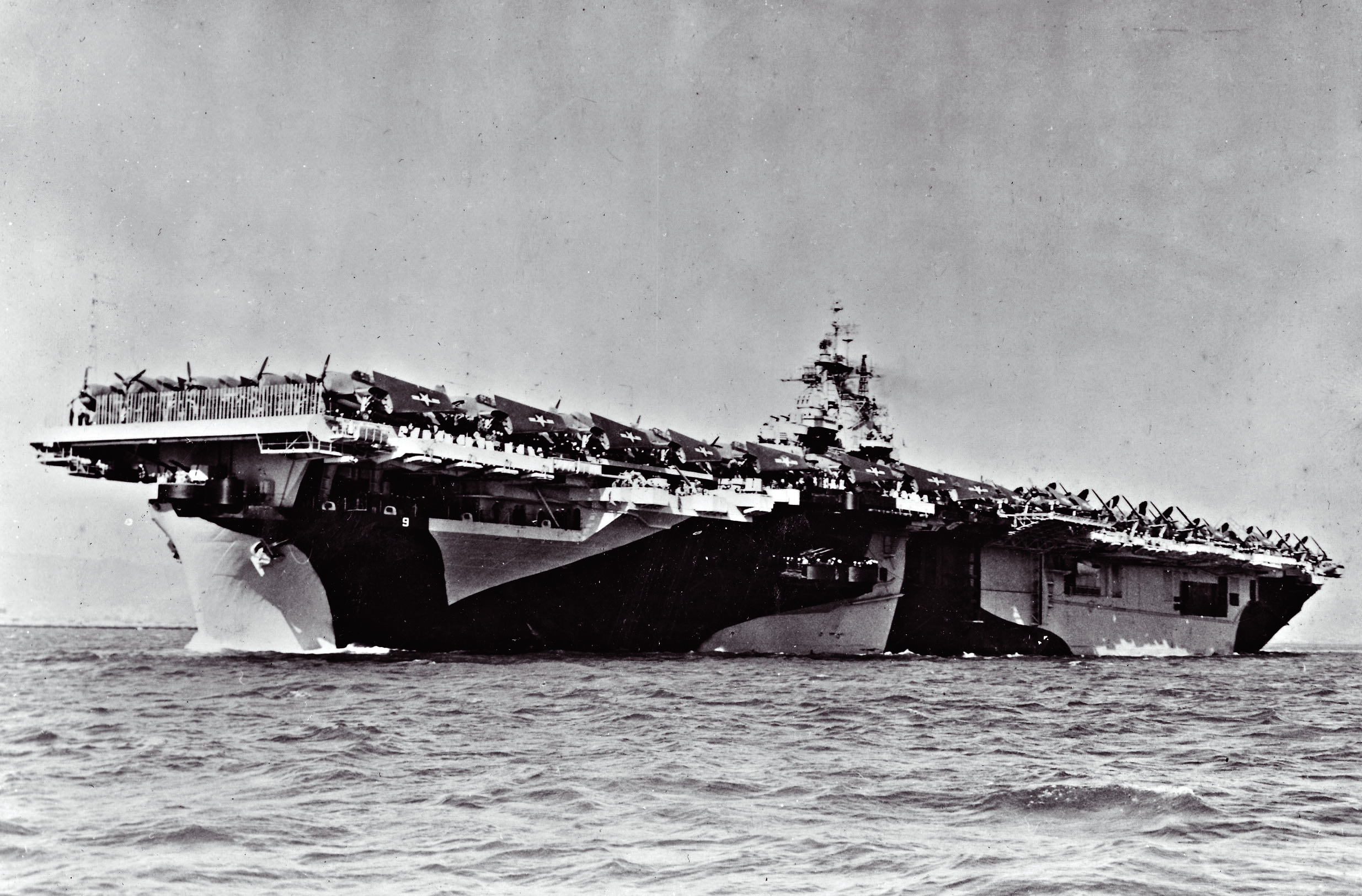
USS Essex (CV-9) departing San Francisco on April 15, 1944. (USMC photo)
The Fast Carrier Task Forces

Two F4U squadrons were available in Hawaii for early embarkation: Marine Fighting Squadrons (VMF) 124 and 213, which reached the Ulithi Atoll on Dec. 28. Embarked on USS Essex (CV-9) with Air Group 4, the Marines sailed with Task Force 38, the Fast Carrier Task Force, on Dec. 30. Despite briefings and practice with the LSOs, two pilots and three F4Us were lost in the first two days. Worse was yet to come.

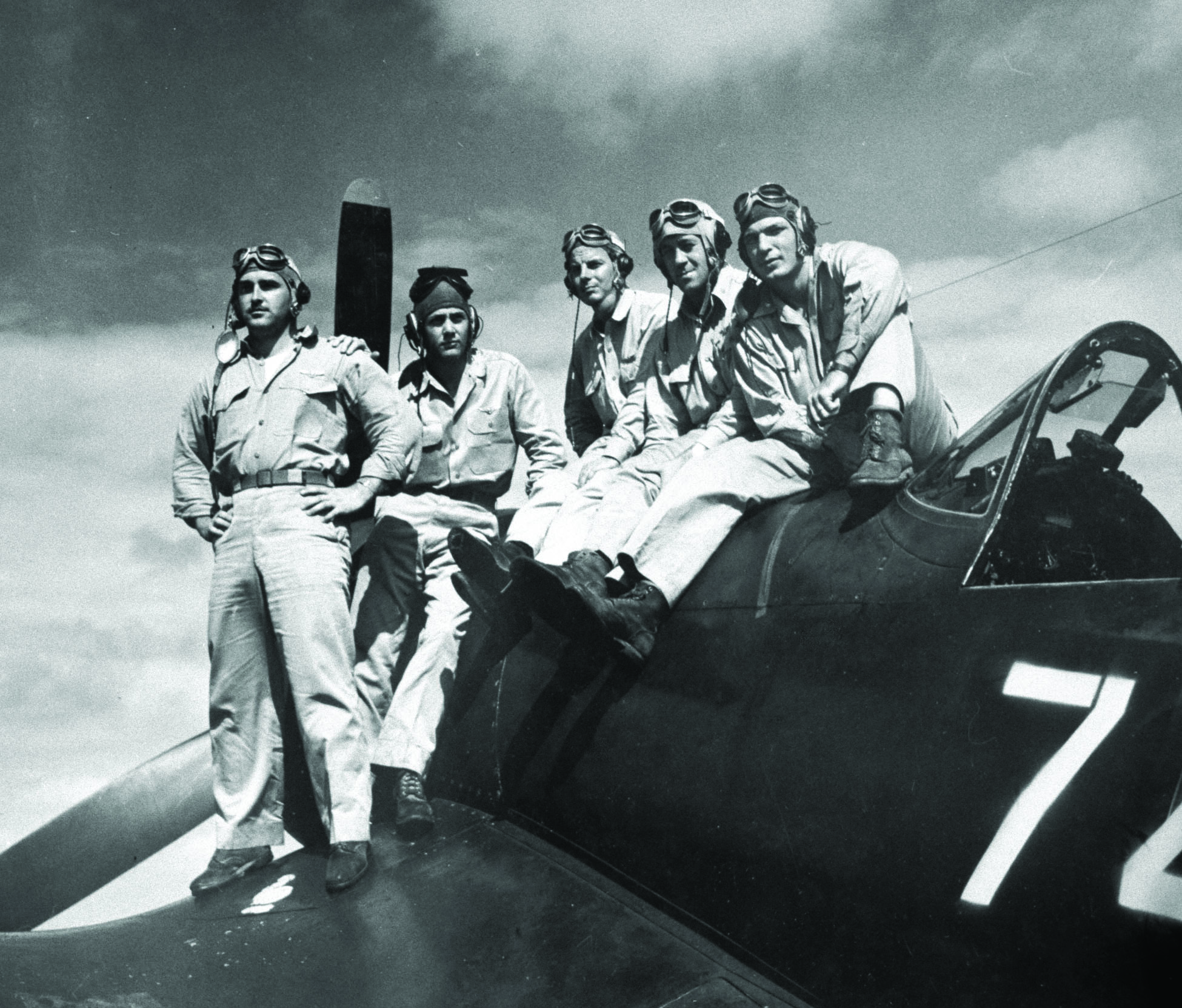
Senior among the 54 pilots was Lieutenant Colonel William A. Millington, commanding officer of VMF-124. 

On Jan. 3, 1945, on Okinawa, Millington claimed the first kill by carrier-based Marines, but one pilot succumbed to navigation error. Another disappeared the next day in heavy weather. After nine days of fleet operations, the Essex leathernecks had lost seven pilots and 13 Corsairs. None of the Navy’s Fighting Squadron (VF) 4 Hellcats were lost to weather or operational causes at the time, highlighting the need for increased instrument training among Marine pilots.

On Jan. 12, the fast carriers struck Japanese naval and air bases in French Indochina. The Corsairs shot up a dozen planes on the ground, losing one in the process (though the pilot returned to Allied control). The day’s most tragic loss was a B-24 Liberator that inexplicably failed to heed radio and visual challenges from the Corsair combat air patrol (CAP). When the Marines were fired upon, they attacked the unmarked bomber, which seemed to be Japanese flown. They destroyed the Liberator, which, in fact, belonged to the 14th Air Force.

Upon exiting the South China Sea, within range of Formosa, the task force was attacked on Jan. 20 and 21. Essex F4Us claimed eight victories, but another carrier, USS Ticonderoga (CV-14), suf-fered heavy damage.

When the fast carriers sortied again in February, three more ships embarked Marine squadrons. VMF-112 and 123 sailed on USS Bennington (CV-20), 216 and 217 joined USS Wasp (CV-18), and USS Bunker Hill (CV-17) became the first ship to embark three Corsair squadrons: VF-84, VMF-221 and VMF-451. 

Together, the squadrons totaled 133 F4Us and 216 pilots—one-sixth of the fast carriers’ fighter strength. The new units had received intensive carrier and instrument refreshers and would be spared the operational losses that plagued Millington’s men. However, Commander Otto Klinsmann, the Essex air group commander, had been lost off Formosa, so Millington “fleeted up.” He was the first Marine to command a Navy air group. 

He later recalled the Marines’ introduction to fast carrier warfare: “We were warned about the kamikazes—indeed, the Essex had been hit by one just before our cruise. We would have to shoot them down before reaching the fleet, for it was their tactics that were doing the most damage. As a result, we abandoned defensive tactics when we went after the kamikazes. The Navy really feared them, more than the Marines [did]. They used destroyers as pickets, and we flew CAP over them. The kamikazes would go after the pickets, these being the first ships they came across. By the time of the Okinawa operation, they were no longer trying to establish air superiority, merely trying to destroy ships with kamikaze tactics.”

The February strikes were among the most ambitious to date. The task force struck the enemy’s home islands, launching missions over Tokyo itself. The weather precluded a full-scale application of airpower, however, and strikes were canceled on the 17th, the second day of the operation. Still, the Marines claimed 21 aerial victories and 60 grounded planes, losing nine F4Us and six pilots. Especially hard hit was Bennington’s VMF-123, as antiaircraft fire knocked down three Corsairs, though two pilots were rescued. The skipper of VMF-217, Major Jack Amende, fell to a Zeke (A6M Zero), and three other Wasp Corsairs were lost—one on launch.

Recalling the Tokyo strikes, Millington explained, “Our offensive fighter sweeps against enemy airfields were conducted without external ordnance—we just used our guns. When attacking airfields, we would go in en masse to dilute the anti-aircraft fire. Sometimes we would do a second sweep, depending on the defenses, dividing the airfield up and each flight taking a different segment. Later, we conducted ground attack missions using rockets and bombs.” 
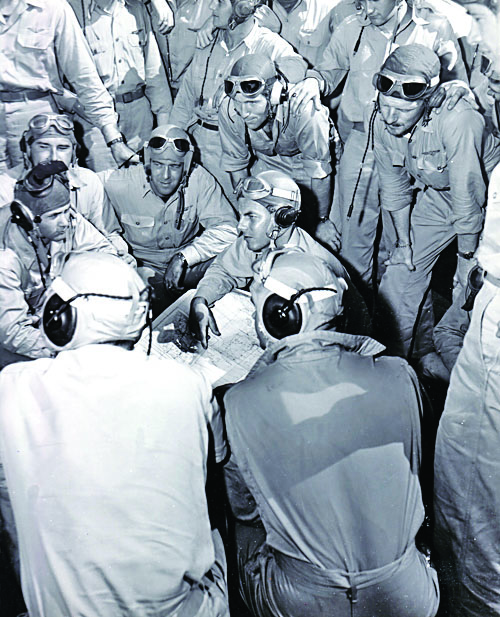
LtCol William A. Millington, center, briefs the pilots of VMF-124 and VMF-213 aboard USS Essex on Jan. 1, 1945. (USMC) 
A pilot from VMF-511 prepares for a night mission aboard USS Block Island (CVE-106),providing essential air support during the Okinawa campaign and conducting strikes against targets in the Sakishima Gunto. (USMC)

The first carrier strikes against Japan were significant in that naval aviation had taken the war to the enemy homeland. But more important to Marine aviation was the tactical support given assault troops at Iwo Jima. Millington had helped prepare the close air support plan and led the D-day mission on Feb. 19. The Essex group commander took 24 F4Us and 24 F6Fs down on the beaches in a well-timed operation coordinated with naval gunfire. Napalm, rockets and liberal strafing helped suppress Japanese defenses as the aviators fired barely 200 yards ahead of the infantry. Ground commanders gratefully noted that full enemy resistance did not arise until after the Marines were ashore.

The fast carriers continued supporting the bloody struggle ashore until D+3. It was back to Japan on Feb. 25, where the weather again blocked effective air operations. Of the nine carrier planes lost, two were Bennington Marines, including Major Everett Alward of VMF-123.

Upon return to Ulithi in early March, Essex and Wasp lost their leathernecks as Air Groups 4 and 81 rotated out. However, 75 Marine mechanics volunteered to remain in the two carriers, lending their knowledge of Corsair maintenance.

Joining the task force were two more Marine units, VMF-214 and 452 on USS Franklin (CV-13) with Air Group 5. Operations began off Kyushu on March 18; primary targets were enemy airfields, as Task Force 58 fliers claimed more than 100 shootdowns. The Marines bagged 14 and lost only three.

On the 19th, the fast carriers were hit by conventional and suicide attacks while sailing within 60 miles of Shikoku. With 31 planes on deck, Franklin was hit by a pair of 550-pound bombs. “Big Ben” went dead in the water for almost four hours and finally was towed out of range. Sixty-five Marines were among the 800 dead, as VMF-214 and 452 were knocked out of the war on their second day of carrier combat. 

Bennington and Bunker Hill Marines pressed on. Twenty-four-year-old Major Herman Hansen of VMF-112 led four divisions into 20 Zekes near Kanoya, claiming nine kills without loss. VMF-123 had a running fight against stiff odds, losing three and claiming nine. Three more F4Us were jettisoned with extensive battle damage. Captain William Cantrel, a Solomons veteran who, though badly wounded in one foot, stayed in the fight, downed two assailants and organized cover for the withdrawal. Back aboard, he collapsed from blood loss and received a well-deserved Navy Cross. 

Carriers off Okinawa

With the invasion of Okinawa on April 1, the fast carriers met a succession of determined Japanese air attacks. The big kamikaze raids of the 6th and 12th brought dramatic opportunities to engage enemy aircraft. Major Hansen celebrated his 25th birthday with a triple kill, becoming an ace and earning a Navy Cross. A full day’s work for a former photo pilot.

Major Archie Donahue of 451 accounted for five of Air Group 84’s 25 shootdowns, becoming the Marines’ only carrier-based ace in a day. However, with good hunting came high risk. On May 11, Bunker Hill was ravaged by two bombs and two suiciders. She was engulfed in gasoline fires, and 28 enlisted Marines and one pilot died on board. Airborne leathernecks watched the conflagration, awed by the spectacle. 

One onlooker was Captain James Swett, who caught an attacker before recovering aboard USS Enterprise (CV-6). The Solomons Medal of Honor recipient ran his record to 15.5 victories. In three months of combat, VMF-221 and 451 had lost 13 pilots and claimed 84 Japanese planes.
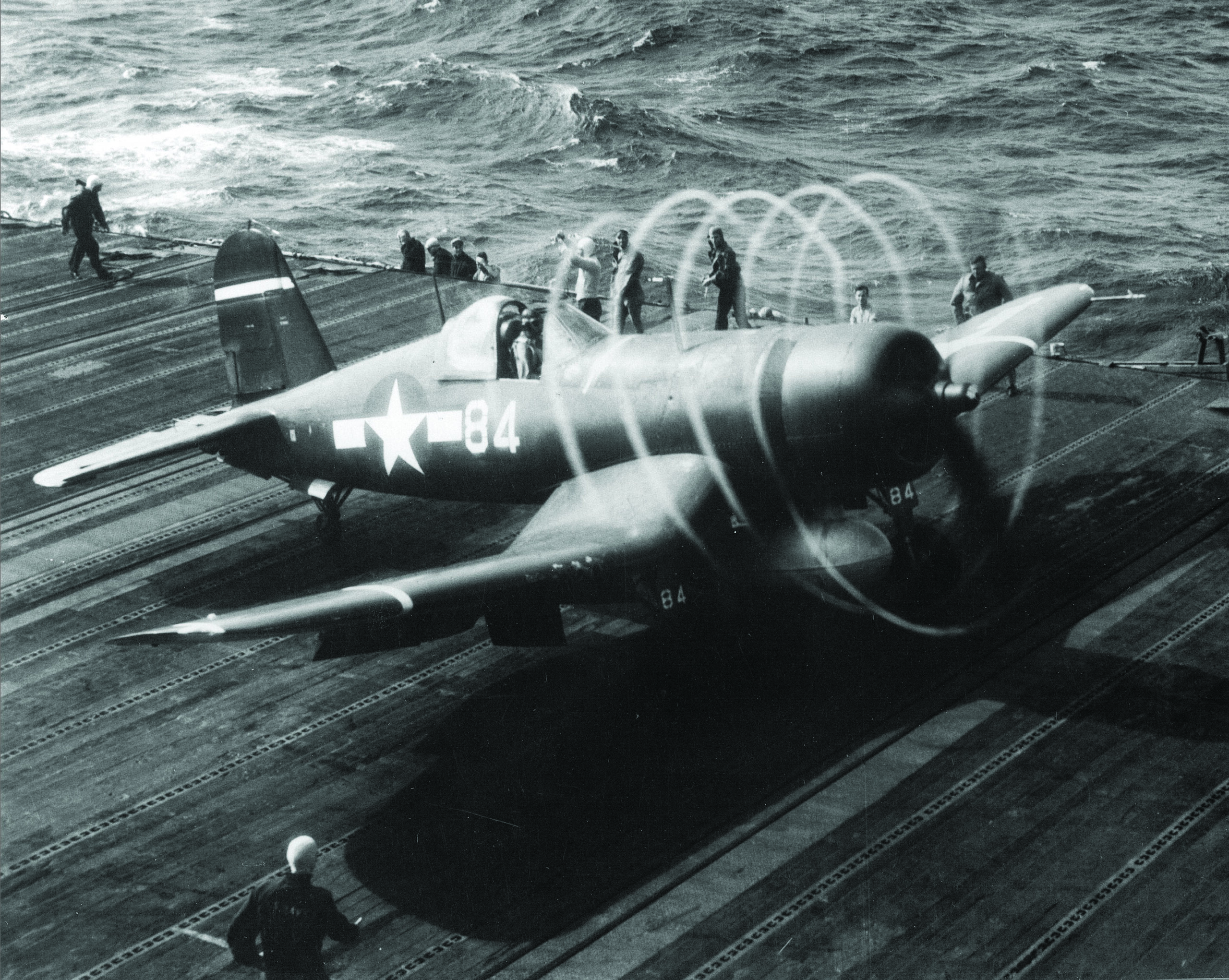
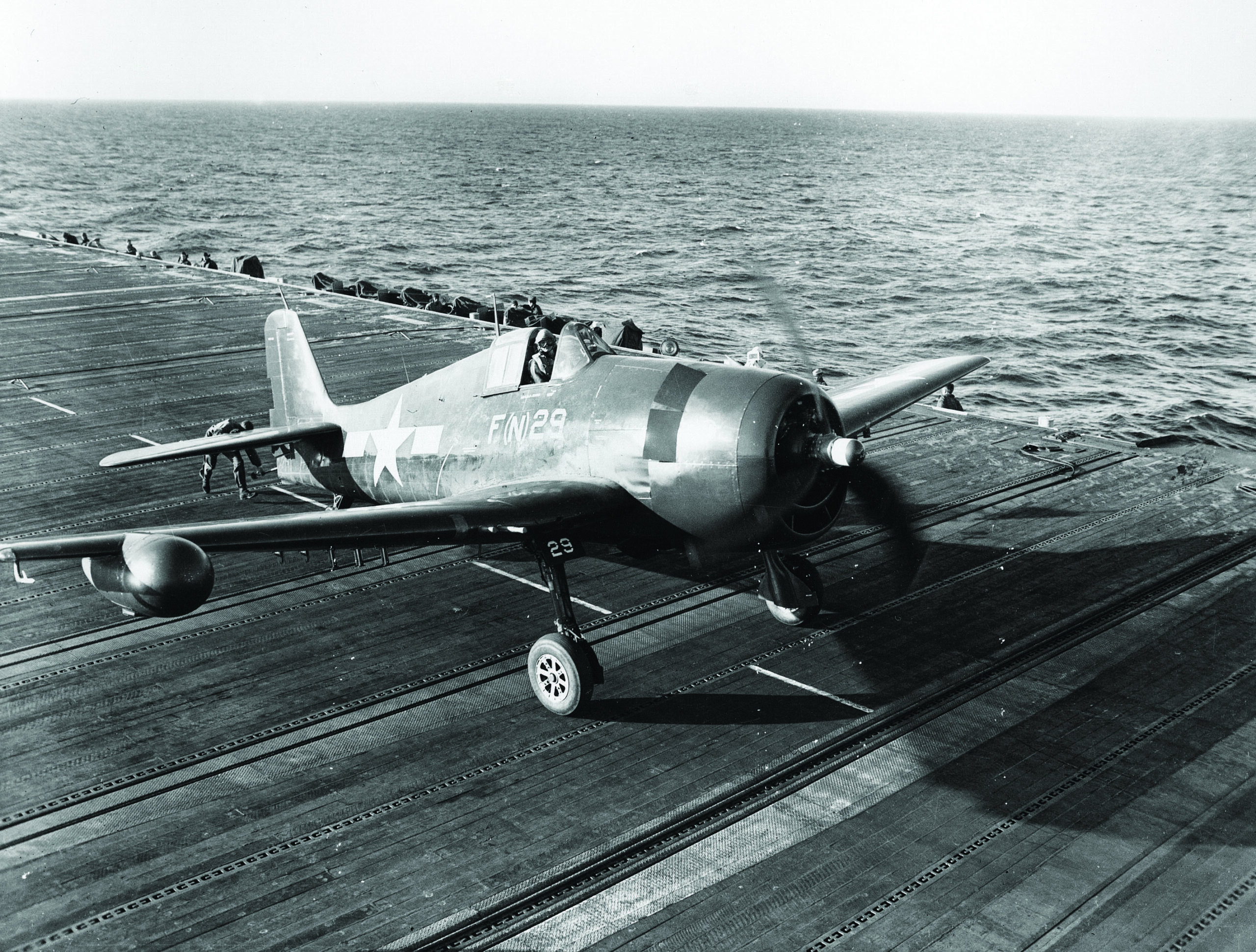
A VMF-124 Corsair launches from USS Essex. In December 1944, these were the first Marine fighter pilots to join the Fast Carrier Task Forces. (USMC)
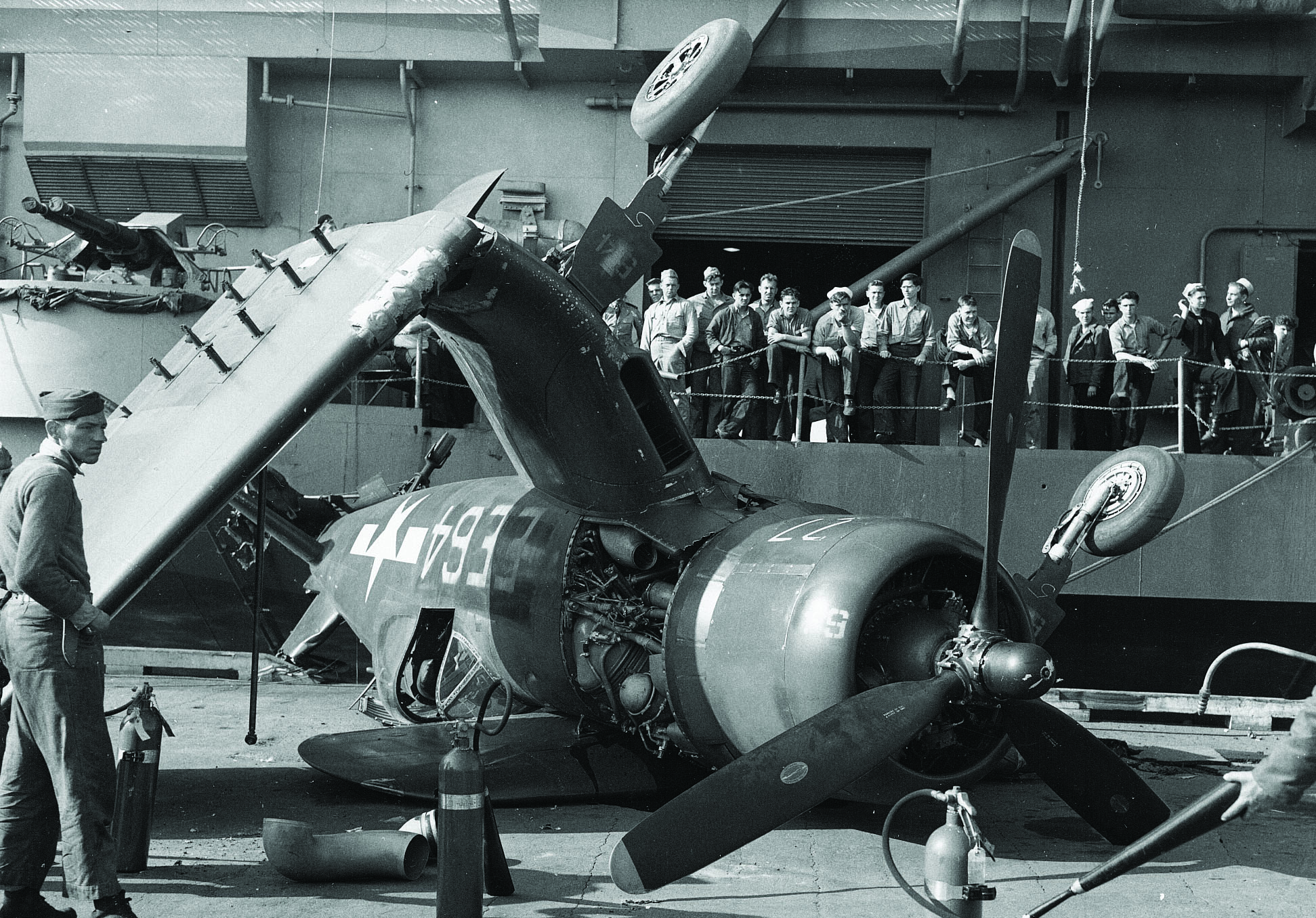
This F4U Corsair from VMF-512 crashed during landing on USS Gilbert Islands (CVE-107) in early spring of 1945. (Courtesy of Barrett Tillman)

Bennington remained on the line until June 8, spending nearly four months in almost continuous operations. VMF-112 and 123 recorded 82 shootdowns plus 149 planes claimed on the ground, but losses were high. Eighteen pilots were killed in action, one in three. Forty-eight F4Us were lost (31 in combat), and another 41 were transferred out with damage.

While the Corsair squadrons formed the bulk of Marine aviation’s contribution to carrier aviation in the war, a smaller group also logged flattop service. At least 13 Marines flew with Navy squadrons, including eight with Air Group 10 on USS Intrepid (CV-11). Their appearance was accidental—a personnel office thought that “Evil I” needed replacement Marines when in fact none were aboard. But Carrier Air Group 10 Commander John Hyland had no prejudice—perhaps he was looking for “a few good men.” In their brief time aboard, the eight Marines shot down 10 bandits and helped sink the 64,000-ton battleship Yamato on April 7. One pilot was killed before the detachment left Intrepid.

Five other wandering leathernecks flew with Air Group 85 on USS Shangri-La (CV-38) for about two weeks, mainly flying against kamikaze bases. Originally assigned as escort carrier pilots, they rejoined their friends in VMF-512 on USS Gilbert Islands (CVE-107) at Leyte in June.
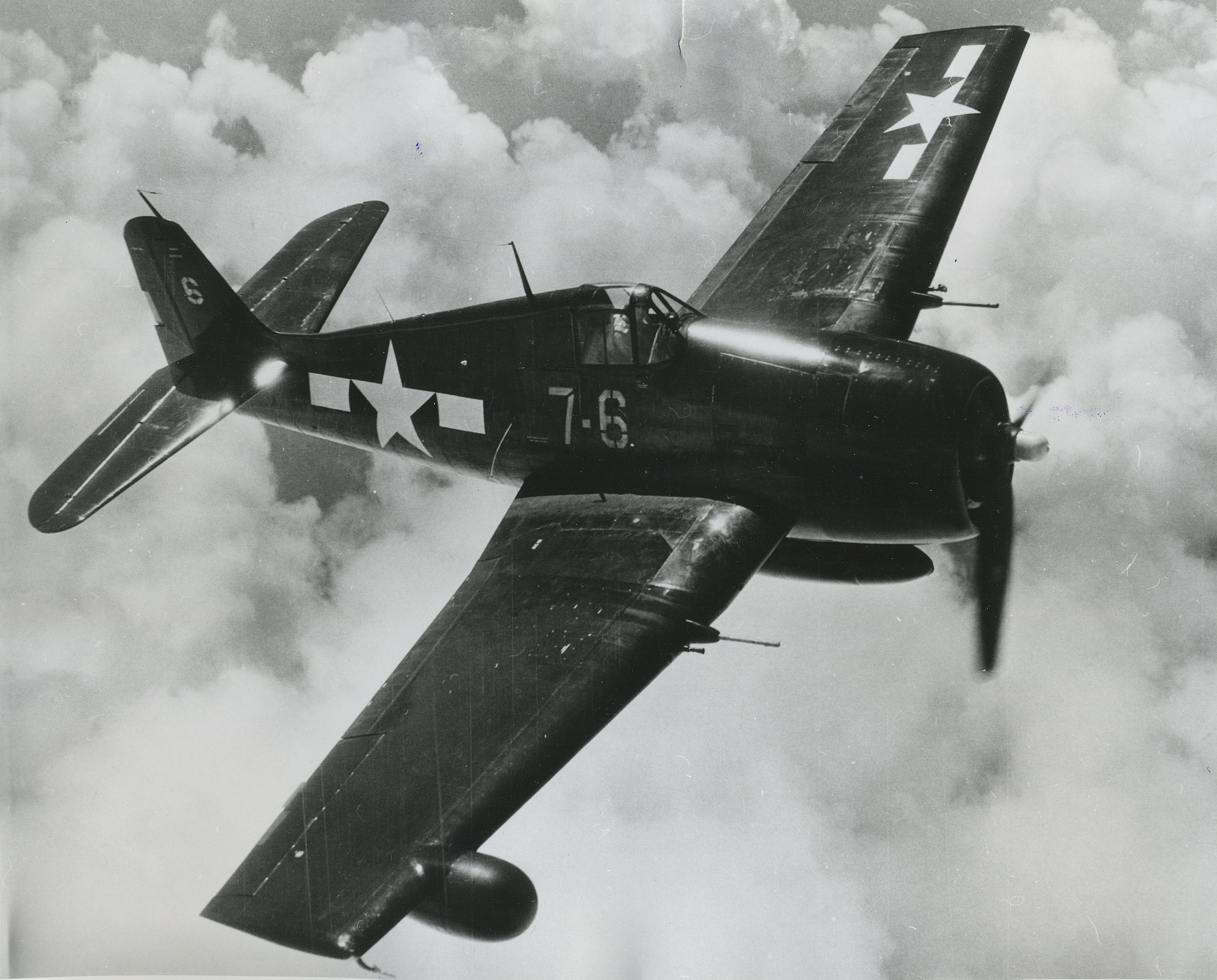
A Grumman F6F-5N Hellcat night fighter in flight. (USMC)
Baby Flattops

The final chapter of the Marine carrier experience in World War II was the escort carrier (CVE) program under Colonel Albert D. Cooley. When the first F4U squadrons joined the fast carriers, the project was already underway, as noted in the Chief of Naval Operations’ dispatch to Pacific Fleet Commander Chester Nimitz. It said in part, “You are further authorized to proceed with training Marine fighter squadrons for deployment in assault CVEs to relieve Navy pilots and personnel required for fast carrier groups. Keep me informed of number of Marine squadrons to be assigned fast carriers and make recommendations for substituting Marine squadrons in combat CVEs.”

On Oct. 21, 1944, Marine Carrier Groups, Fleet Marine Force, Pacific, was established at MCAS Santa Barbara, Calif. The command was comprised of two groups at Santa Barbara and Mojave. Two weeks later, they were designated Marine Air Support Groups 48 and 51. Each group was to be composed of four carrier air groups (MCVGs), each with an 18-plane fighter squadron and a 12-plane torpedo bomber squadron. The units were to be deployed in four escort carriers with an additional two CVEs of Navy squadrons to form an escort carrier division. The all-Navy ships’ task was antisubmarine and CAPs, while the Marine units provided air support for amphibious forces. All ground crews were organized into carrier aircraft service detachments as part of each MCVG.

The goal of the Marine CVE program was to provide 16 air groups simultaneously, plus spares. A full complement would be 540 fighters and 360 TBM Avengers for the deploying and backup or spare Marine air groups. 

By early 1945, the first “all Marine” carrier was ready: USS Block Island (CVE-106), embarking VMF-511 and Marine Torpedo Bombing Squadron 233 in MCVG-1. The other three MCVGs were assigned at one-month intervals: MCVG-2 on Gilbert Islands, MCVG-3 on USS Vella Gulf (CVE-111) and MCVG-4 on USS Cape Gloucester (CVE-109). They merged with the Navy units aboard Kula Gulf (CVE-108) and Siboney (CVE-112) in May 1945.

As always, maintenance loomed large. Some of the “downstream” fighter squadrons were slated to receive F6F Hellcats or even F8F Bearcats. Experience had shown that sustained operations taxed F4U squadrons because of the Corsair’s complex oil and hydraulic systems. Deferred maintenance often was not possible, resulting in fewer sorties per aircraft compared to F6Fs. The operational CVE air groups deployed with F4U fighter-bombers plus F6F photo aircraft and night fighters.

Among the pilots in MCVG-1 was Major R. Bruce Porter, the commanding officer of VMF-511, which was expected to conduct night-fighter missions from Block Island. After a Solomons tour, the 24-year-old Californian anticipated his greatest challenge yet—flying fighters from small-deck carriers at night.

The squadron began night “car quals” in Hawaii early in 1945, and Porter recalled the evolution beginning with his F6F-5N hitched to USS Tripoli’s(CVE-64) hydraulic catapult:
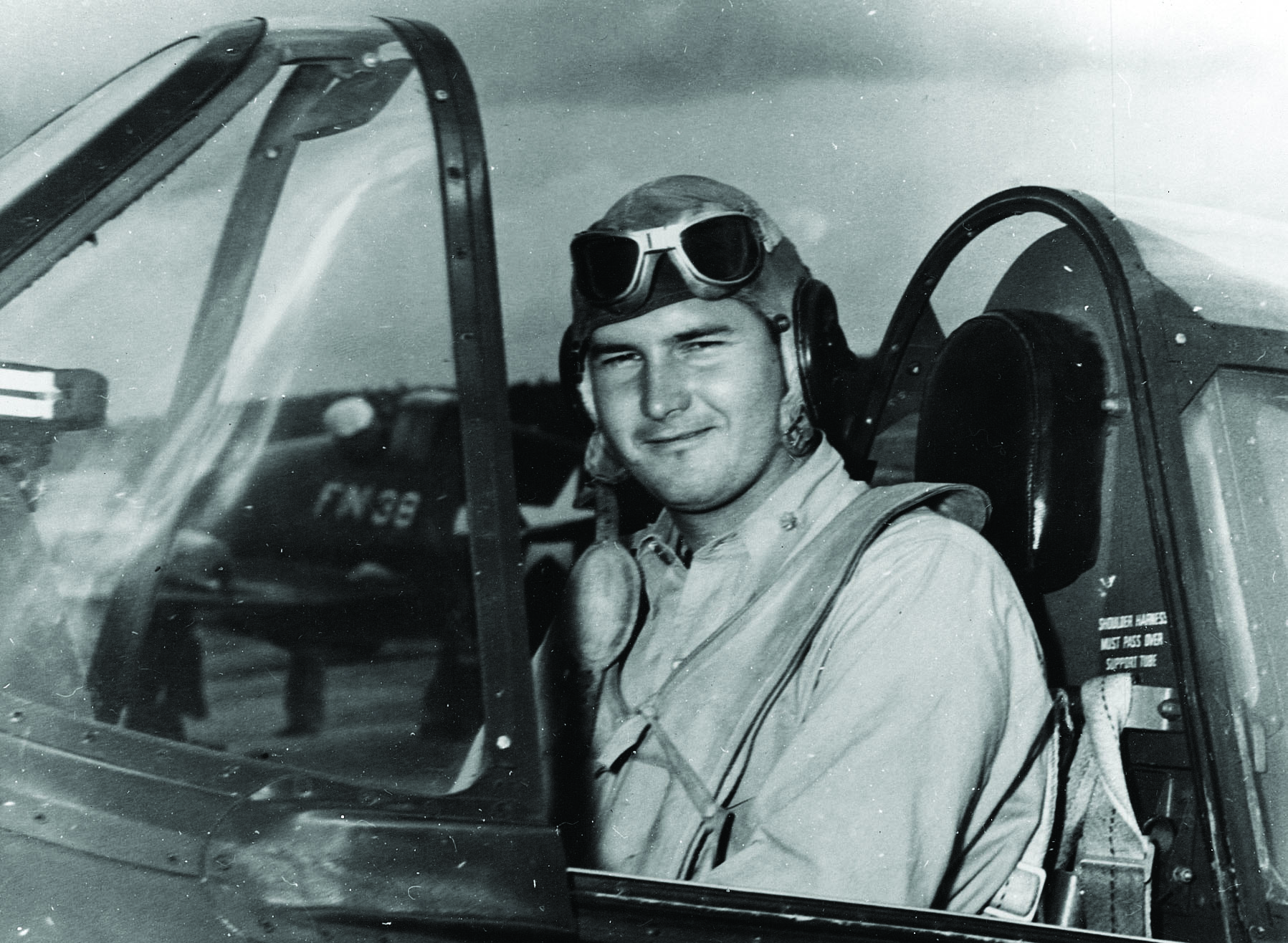
Maj Bruce Porter in the cockpit of his F6F-5N Hellcat night fighter. He mas­tered the high-stakes night carrier ope­r­ations that would intercept kamikazes and strike targets in total darkness dur­ing the final months of the Pacific War. (USMC)

“I looked to my left and saluted. Ready! In response, a dimly perceived deck hand standing over the catapult crew’s catwalk whirled a flashlight. Go! I turned my eyes front, loosened my grip on the stick, set my jaw and leaned back into my seat. “WHAM! “My conscious mind was eons behind my senses. … I had a very busy couple of seconds as I kicked the right rudder pedal and yanked the stick into the pit of my stomach. I had no time to dwell on how dark it was out there.

“All my training and experience saw me through a climb to 3,000 feet. While my mind reeled off a thousand facts about my flying, my voice talked to the ship in calm tones, reporting on routine matters. … I was neither here nor there.

“After assuring myself that I was flying on a heading opposite of that of the ship, I flew down the carrier’s port side and approached the plane guard destroyer, keeping it just off my port wing. I could not help ruminating about how useless a night search for a bilged aviator must be.

“Next, I flicked on my radio altimeter, a brand-new instrument that had been installed just before we left San Diego. I set it for 150 feet. If I flew above that altitude, I’d get a white signal light. If I flew below, I’d get a red—danger! If I was flying right at 150, I’d get a comforting green light. It was green when I turned the altimeter on.

“I flew upwind the length of the tiny destroyer and sighted her deck lights. This was the only concession to a pilot’s natural aptitude for becoming disoriented across even the briefest interval of night space.

“At what I judged to be the best moment, I turned 90 degrees port, dropped wheels and flaps, enriched the fuel mixture, partly opened the cowl flaps, put the prop in low pitch and turned another 90 degrees to arrive downwind dead astern of the carrier.

“Then I was committed to the approach; all my attention was aimed at visually acquiring the LSO’s luminous paddles.

“I momentarily panicked and said, ‘Where the hell are you?’

“First, I sensed the colored paddles, then I knew I saw them. The LSO’s arms were both out straight. Roger! My ragged confidence was restored, though I remained a good deal less than cocky. I checked my airspeed, down to the required 90 knots. Before I knew it, I saw the ‘cut’ signal. Then, WHAM! The tailhook caught a wire and I was stopped on a dime.

 “I taxied past the barrier, came to rest beside the island and cut the engine. As had been the case after my first live combat mission, my flight suit was reeking of sweat.”

By the time the Marine CVEs became operational, the war was winding down. Despite initial intent, Block Island and Gilbert Islands, which arrived off Okinawa in May with Marine squadrons and a primary mission of close air support, logged more sorties striking targets in Sakishima Gunto than working with infantry ashore. 
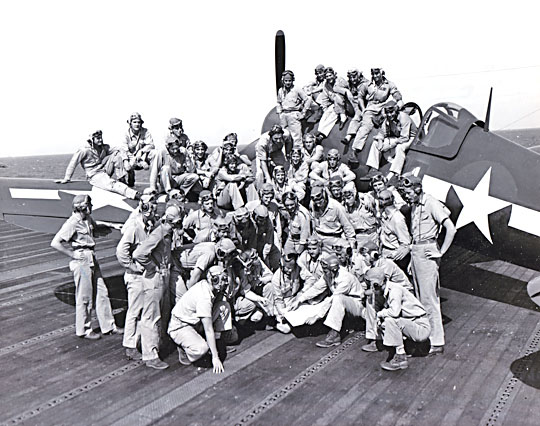
The Marines of VMF-124 and VMF-213 served as pioneers of Marine carrier aviation. Their transition from land bases to USS Essex proved the versatility of Marine air power. (USMC)

Rear Admiral Calvin C. Durgin, commanding the escort carrier force at Okinawa, noted that Navy CVE squadrons were well trained in close air support. He added, “The advent of Marine Air Groups in CVEs should not be permitted to complicate the support carrier picture any more than is necessary. … Marine air groups should be and probably are as flexible as navy squadrons and groups, and should remain so, and should expect no preferential treatment. To assign all Marine squadrons to direct support work would probably work to the detriment of morale of the Navy groups … and this command sees … no reason for such assignments and has no intention of allowing it to occur.”

“Jeep carriers” also supported the Balikpapan, Borneo, occupation. In July and August, Cape Gloucester aircrews contributed to an operation off the China coast. VMF-351 downed five aircraft, two of which fell to Lieutenant Colonel Don Yost, who on Aug. 5 became the last Marine ace of the war, having started his career with VMF-121 at Guadalcanal. Meanwhile, Vella Gulf arrived at Okinawa as the war ended. Block Island and Gilbert Islands supported the Allied occupation of Formosa and the evacuation of former POWs.

Ultimately, 14 of the planned 16 MCVGs were established or directed to form. In the rapid demobilization following the war, however, the Marine CVE program was drastically reduced, providing only three air groups for the Pacific Fleet and two for the Atlantic. 

Featured Photo (Top): Marines of VMF-124 and VMF-213 aboard USS Essex, led by LtCol William A. Millington, the first Marine to com­mand a Navy air group. (USMC)


About the Author

Barrett Tillman is a professional author with more than 40 non-fiction volumes and novels plus more than 800 articles published worldwide. He is best known as an award-winning historian for his histories of naval aircraft and carrier operations. He learned to fly as a teenager and has flown hundreds of hours in historic aircraft. A competitive marksman, he has led a national championship shooting team.


Enjoy this article?

Check out these similar Leatherneck and Scuttlebutt features:
The National Naval Aviation Museum: A Flight Through History

Leatherneck
October 2010
By: Sara Bock

Warbird Review: A List Of Legendary Marine Aircraft

Leatherneck
May 2025
By: Barrett Tillman

Alfred A. Cunningham: Father Of Marine Corps Aviation

Leatherneck
May 2025
By: Dr. Laurence M. Burke II
Behind the Scenes: The Process of Bringing Marine Aviation to Life

Behind the scenes of every piece of equipment fielded by the Marine Corps lies a complex acquisition system. The intricate process ensures the right product ends up in the hands of the warfighter. Evolved through a methodical, layered structure of requirements and testing, anything a Marine might carry, wear, shoot, drive or fly begins with the most generic form of a requirement.

(Photo from USN)

If Marines across the Corps were thirsty every time they went to the field, the basic need for a water bottle might bubble up to the top. From the highest level, the Corps tasks an acquisition officer in charge of the appropriate program office with the fundamental requirement: We need a way for Marines to carry water in the field. Along with the requirement comes specifications. The vessel must be small enough for an individual to carry, but large enough to keep a Marine hydrated for six hours. It must close and be leakproof. The drinking orifice must fit the average size mouth. It must withstand being run over by a 7-ton truck, or maybe a direct hit from a 500-pound bomb. Etc.

Marines and civilians within the program office get to work. Some partner closely with civilian industry looking for companies to enter competing bids with prototypes that meet the specifications. Others generate the lifecycle documenta-tion required for sustaining the project. They estimate the cost per unit, research and development and timetable required. They request funding for engineering, development, initial manufacturing and fielding, testing, revision and mass adoption of the finalized product. With funding approved, the program office is now responsible for keeping the cost, schedule and performance of each product to the original spec and delivering it to Marines in the fleet.

Getting the product into Marines’ hands, a monumental effort in itself, is only step one. Perhaps the lid designed for the water bottle breaks too easily or unscrews itself under certain conditions that only occur in the field. The program office drafts engineering change propos-als to correct the problem, implements the changes into manufacturing, then delivers the newly designed lid to each bottle coming off the production line and to every bottle already in the field. Mean-while, data shows that fully two-thirds of fleet Marines are losing or otherwise demolishing their new water bottles at the rate of one every six months. Now, the program office must create a sustain-ment plan for the dictated life cycle of the water bottle; for the next 20 years, we have to order how many hundred thou-sand water bottles, at what cost, coming from what pot of money, in order to keep the fleet supplied?

It’s easy for even the most ignorant of us outside the acquisition field to imagine the intensive workload, mental pressure and herculean effort required of these Marines. They operate within an unsung and largely thankless subsection of the Marine Corps, working more often with government civilians and contractors to create and deliver products than with their fellow Marines who use them. The simplest, smallest piece of equipment en-dures the same fundamental acquisition process as the most complex.

Marine aviation employs some of the most technologically advanced and expensive equipment the Corps has to offer. While the fundamental acquisition process is the same, every lever, door and wire within an aircraft endures the same testing, fielding and revising as the water bottle. Acquiring and sustaining these technologies requires not only an array of dedicated program offices, but also a host of fleet-experienced subject matter experts and certified Marine test pilots to fly each aircraft and safely trial every upgrade or new technology. Like the Marine Corps as a whole, all of these Marines and program offices fall within a larger U.S. Navy command.

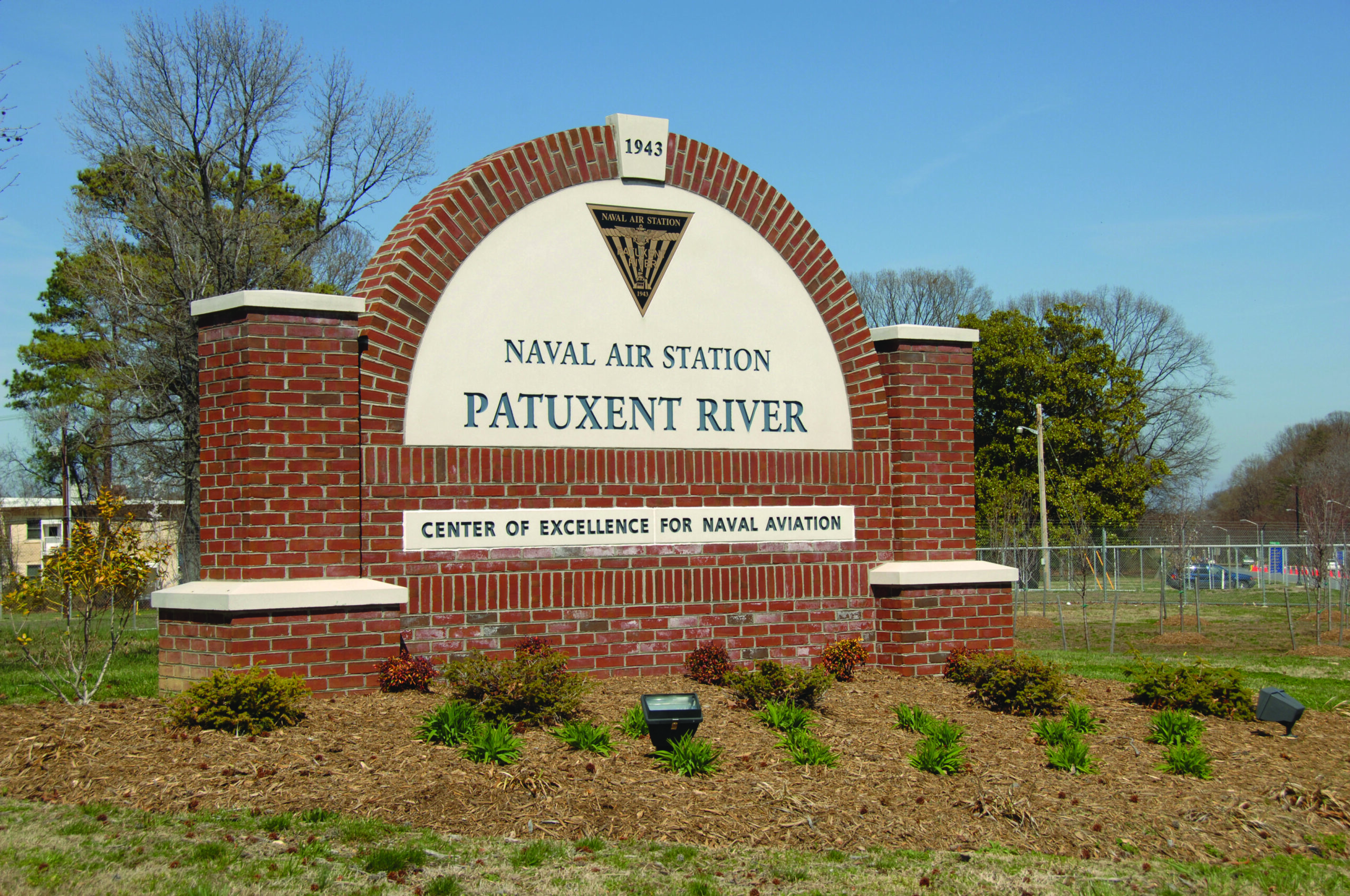
Naval Air Systems Command (NAVAIR) is headquartered at Naval Air Station Patuxent River, Md. Dominating the southern mouth of the Patuxent at the Chesapeake Bay, the base is home to numerous test flight squadrons, program offices, engineering offices and civilian contractor spaces. In the heart of the air station, occupying an old firehouse directly on the flight line, lies the Marine Aviation Detachment (MAD). The MAD holds administrative responsibility over all Marines assigned to program offices and test flight squadrons within NAVAIR, providing the crucial talent management needed to keep the right Marines in the right seats at all times to move aviation acquisitions forward.

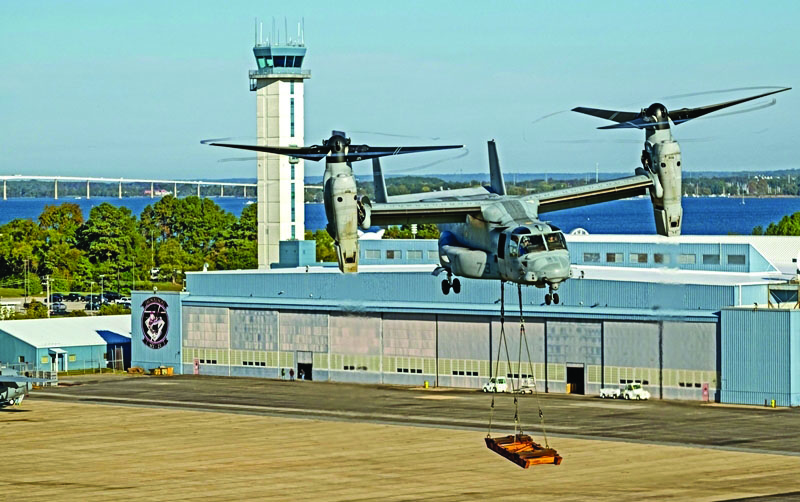
A V-22 Osprey conducts a test flight over the HX-21 squadron area at NAS Patuxent River, Md. (Courtesy of HX-21)

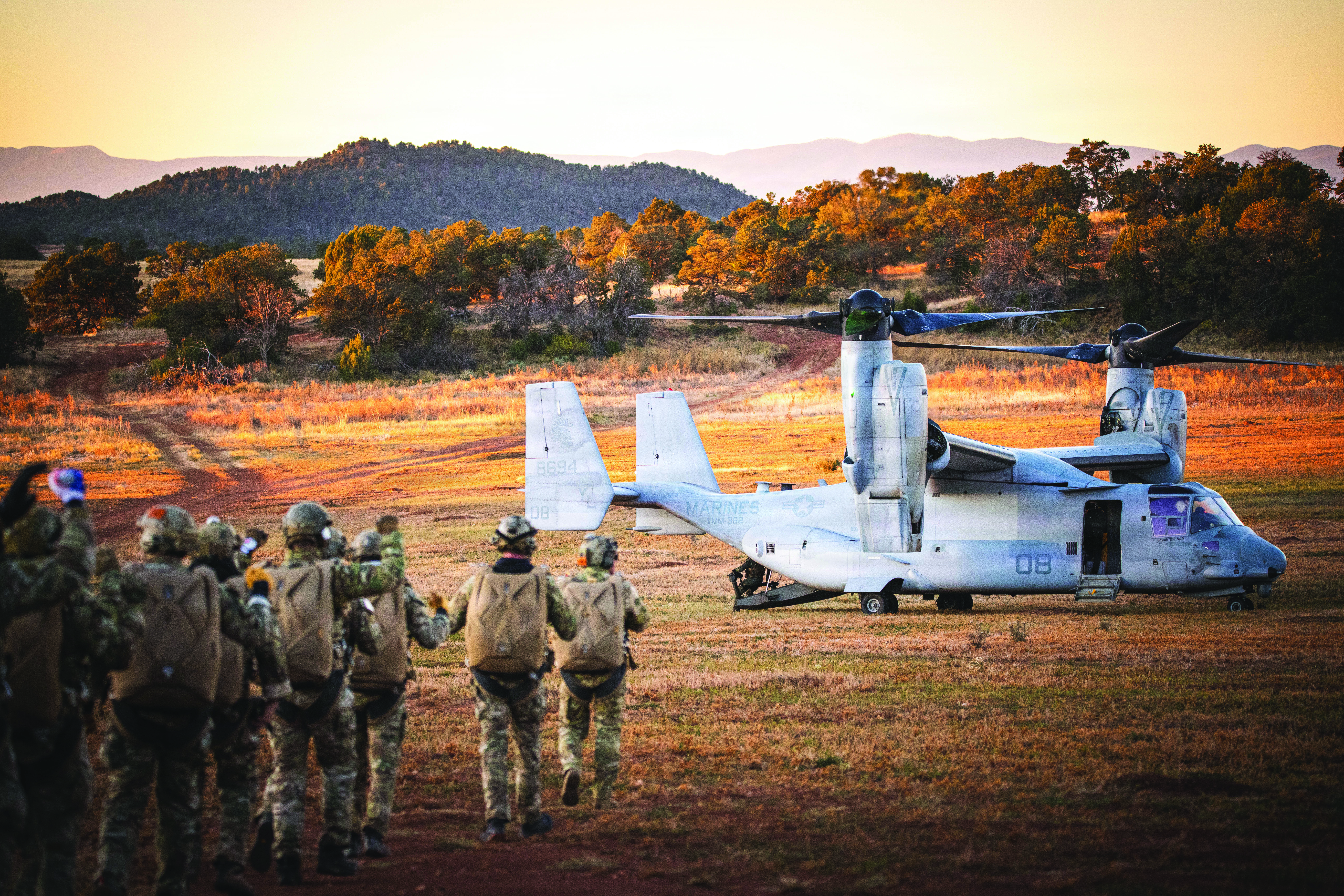
Army Green Berets with the 10th Special Forces Group (Airborne) walk to a Marine Corps V-22 Osprey on Fort Carson, Colo., Oct. 21, 2025. Green Berets with the 10th SFG(A) conducted multiple high-altitude free-fall jumps from a V-22 Osprey, honing precision and proficiency. (Sgt Rhianna Ballenger, USA)

At 185 Marines strong, only a few call the former fire station home. Most are spread from coast to coast working on aviation projects as varied as the Marines assigned to them.

“We are a very top-heavy organization with an incredibly wide range of exper­tise,” said Lieutenant Colonel Michael Shull, the MAD executive officer (XO). “The Marines are all operationally dispersed. You may have a lone Marine in a program office. You may have another with six to eight Marines, depending on the size of the portfolio or the attention it’s getting from Headquarters Marine Corps. It’s important for us to keep a bead on those upper-level documents that trickle down to how we manage manpower to ensure the right people are in the right spot. They’re all hand-selected billets with people out of the fleet selected for their expertise.”

Despite the “behind the scenes” nature of their work, the results these Marines produce reach the highest levels of visibil­ity. There are roughly 60 Marine officers qualified as 8059 acquisition officers specializing in aviation. These men and women work in close conjunction with civilian industry partners operating with a staggering budget to bring ideas to life. In the three-year period from April 2022 to April 2025, Marines within the MAD executed the funding of $65 billion across research, development, testing and evaluation. The funding derived from Ma­rine Corps projects as well as Navy and joint program offices, meaning not all were specifically Marine Corps dollars, but Marines were still responsible for managing those dollars. At a time when the annual service budget for the entire Marine Corps totals roughly $50 billion, the responsibility these Marines shoulder proves no trivial task.

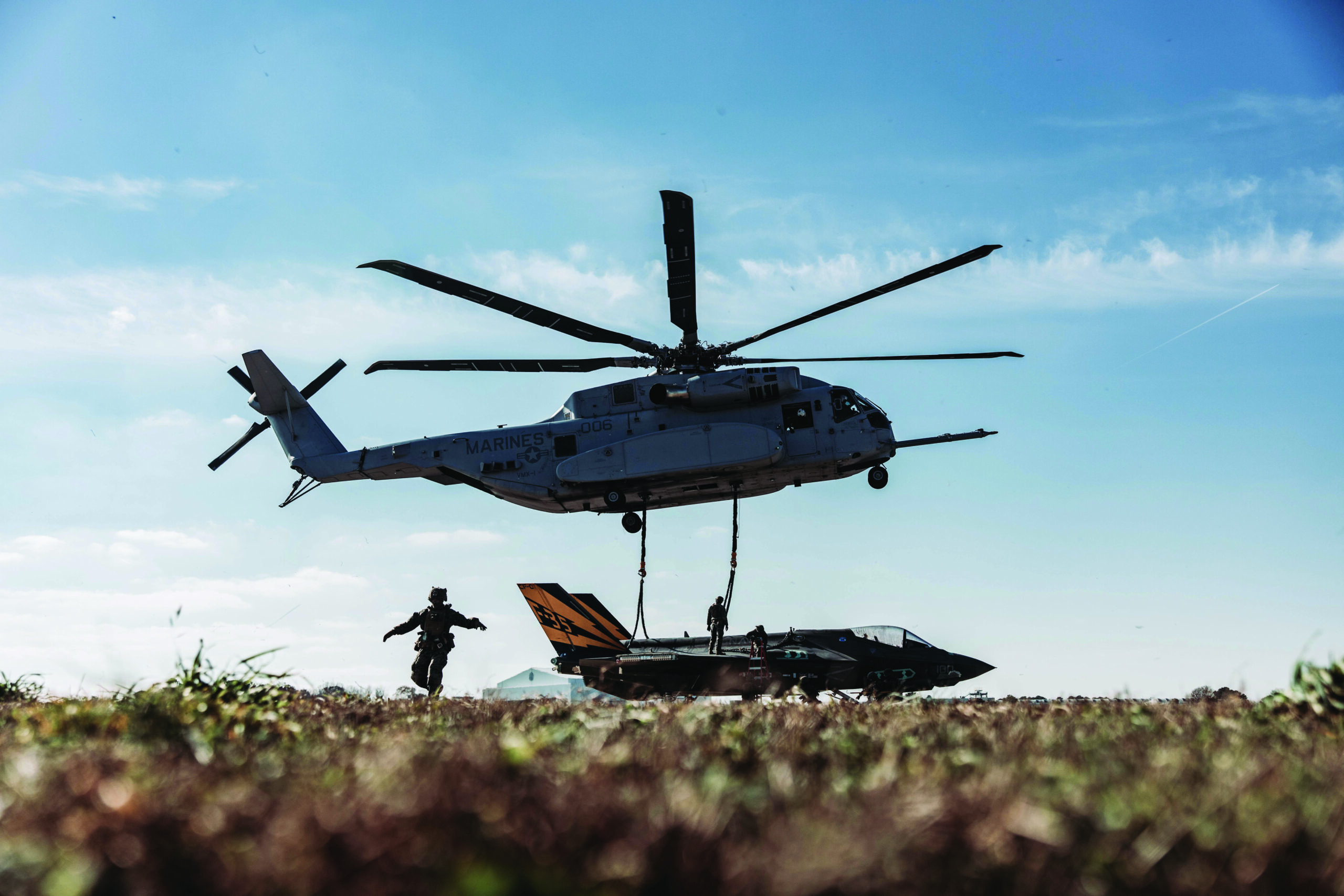
Marines with CLB-24, CLR-2, 2nd MLG, hook an F-35C Lightning II to a CH-53K King Stallion for helicopter support team operations at NAS Patuxent River, Md., on Dec. 13, 2022. CLB-24 conducted external lift operations with a helicopter support team to develop the proper tactics, techniques and procedures when flying a CH-53K King Stallion. (Cpl Meshaq Hylton, USMC)

Additional pilots and enlisted Marines fill out the MAD as subject matter experts supporting each program office. They help design engineers understand all the ways their product will be used by Marines around the world and the creative ways Marines will find to break it. They make suggestions for design changes that will ultimately result in the most user-friendly version winding up in the hands of warfighters. Some senior enlisted work as fleet liaisons, remaining close to operational squadrons around the world. Once a new widget of any kind trickles down to the end user, fleet liaisons travel from unit to unit introducing Marines to the new equipment, gathering their feed-back, and relaying information and suggestions back to the program office.

Program Manager Air (PMA) offices cover every facet of Marine aviation and supporting systems. The life-cycle stages of each office range from new acquisition to sustainment of current technologies.

“Every year we receive an aviation plan from the deputy commandant for aviation based on force design, projections, budget and other factors from the three-star level,” said Colonel James Reynolds, the MAD commanding officer. “That determines the needs and requirements for the future. Acquisition officers take requirements and money, merge the two and deliver a product. It’s an important mindset to frame your thoughts around—the idea that when you purchase a drill, you’re not buying a drill, you’re buying holes. There are many ways you can get those holes, you can’t just fixate on needing a drill. If the Marine Corps needs a ship-to-shore connector, that could be an AAV, a helicopter, a flat bottom ship; there are so many ways to crack that problem. If you fixate on a helicopter, then that’s how everything becomes a helicopter.”

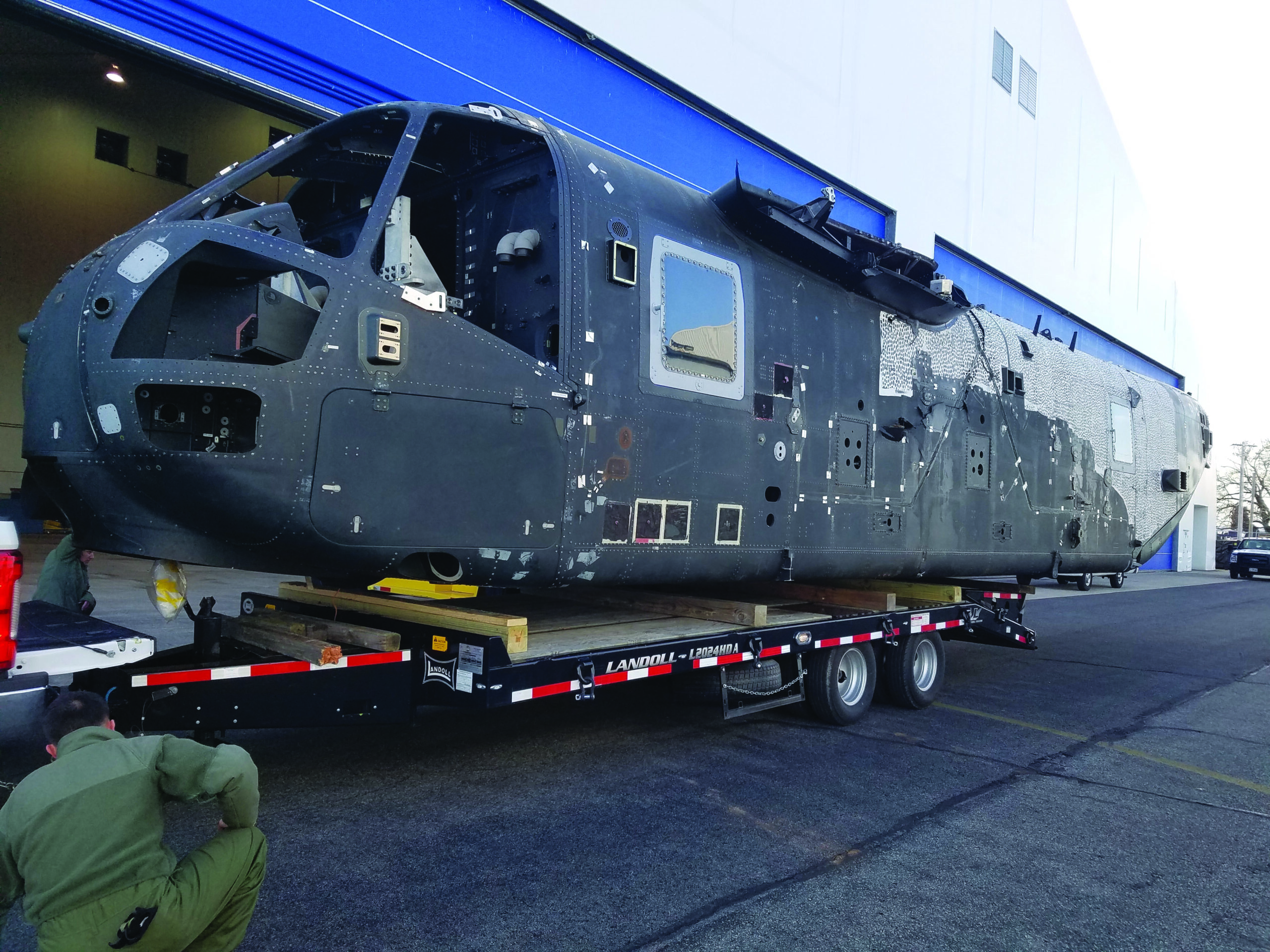
The cargo/special operations team at Naval Air Warfare Center Aircraft Division, NAS Patuxent River, Md., obtained this CH-53K King Stallion shell in 2020 for use by the NAVAIR Heavy Lift Helicopter Program Office, PMA-261. The aircraft was used for certification and qualification of cargo and to provide the program office and the Marine Corps with opportunities for time and cost savings. (Photo by Victoria Falcon, NAS Patuxent River)

PMA-275 operates one of the largest program offices across the force. This joint office between the Marine Corps, Navy and U.S. Air Force is responsible for the procurement, development, support, fielding and disposal of the U.S. military’s tiltrotor program: the V-22 Osprey. MAD Marines work alongside roughly 350 other servicemembers and civilians in the program office at Pax River, including Marine Col Robert Hurst, the program manager for the entire V-22 Joint Program.

“The work we do here is critical,” Col Hurst said. “For my office, it’s critical to the lance corporal, the Sailor and the airman. They count on us to get things done. The criticality of having a Marine voice inside the acquisitions system cannot be overstated, having our focus on the warfighter, problem solving and leadership. Being an acquisition officer is as much about leadership as it is about knowing acquisition.”

An additional 300 PMA-275 personnel work out of Marine Corps Air Station Cherry Point, N.C., as the program’s Fleet Support Team. These civilians and servicemembers deploy all over the world, wherever American V-22s are in use, to provide subject matter expert support. A program more than 20 years in the making, as of this year, PMA-275 decommissioned its active production line for Marine Corps Ospreys, transitioning from new production to sustainment of the current fleet.

PMA-261, responsible for the CH-53 heavy lift helicopter, underwent the reverse transition over the last several years. For more than four decades the CH-53E model served as the Marine Corps’ workhorse. By the mid-2010s, the Pax River-based PMA determined sustainment was no longer pragmatic.

Marines with CLB-24, CLR-2, 2nd MLG, hook an F-35C Lightning II to a CH-53K King Stallion for helicopter support team operations at NAS Patuxent River, Md., on Dec. 13, 2022. CLB-24 conducted external lift operations with a helicopter support team to develop the proper tactics, techniques and procedures when flying a CH-53K King Stallion. (Cpl Meshaq Hylton, USMC)

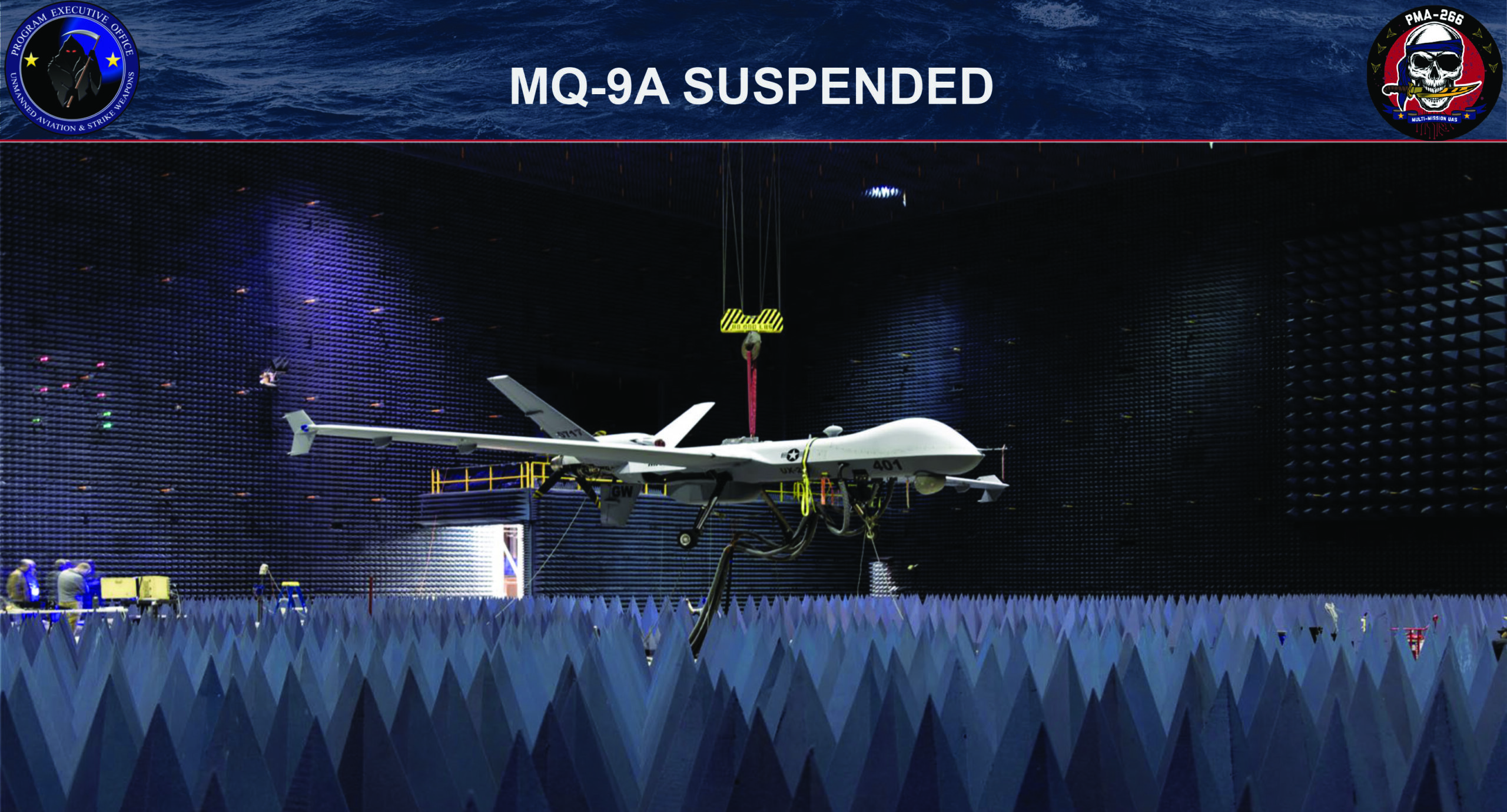
A UX-24 MQ-9A is suspended in a specialized chamber for absorbing sound and electromagnetic waves at the Advanced Systems Integration Laboratory, Patuxent River, Md., on Feb 27, 2025. PMA-266 is NAVAIR’s program office for multi-mission tactical unmanned aircraft systems. (Theresa Thomas, DAiTA and Missions Systems Group)

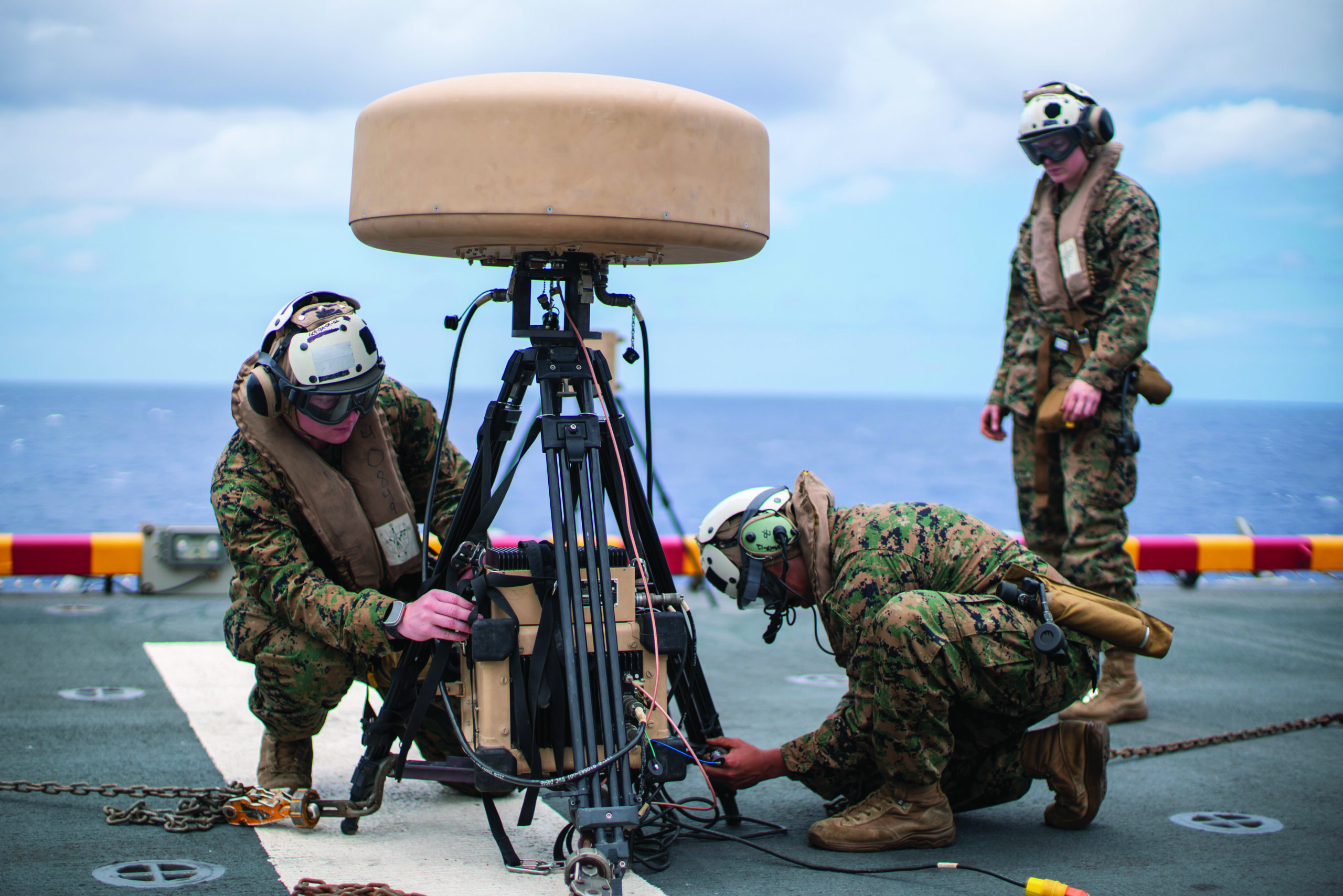
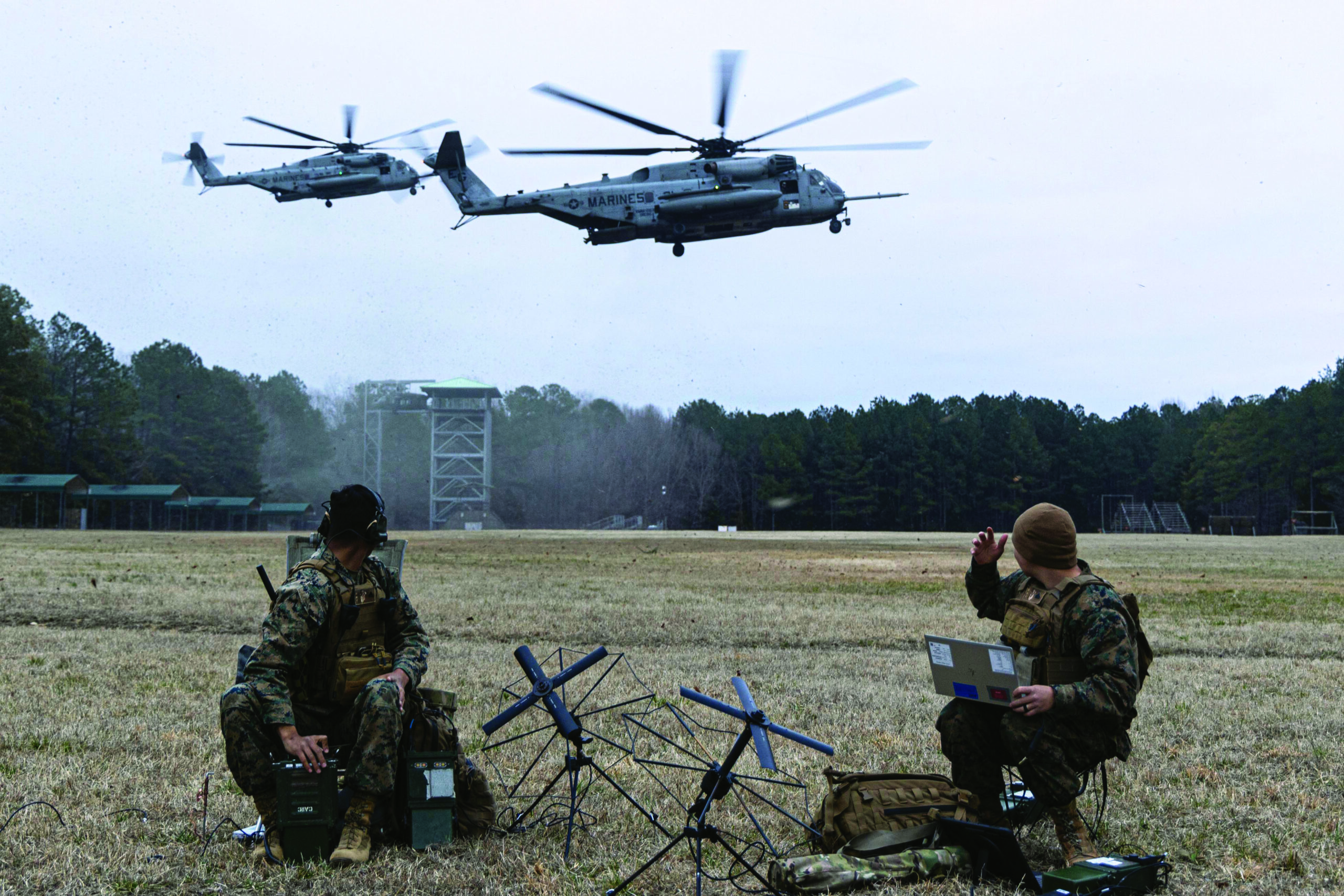
Air traffic control technicians with VMM-263 (Rein), 22nd MEU, calibrate communications systems with CH-53E Super Stallion helicopters in preparation for a simulated night raid as part of Realistic Urban Training Exercise at Fort Barfoot, Va., on March 14, 2025. (Photo by Cpl Emily Hazelbaker, USMC)

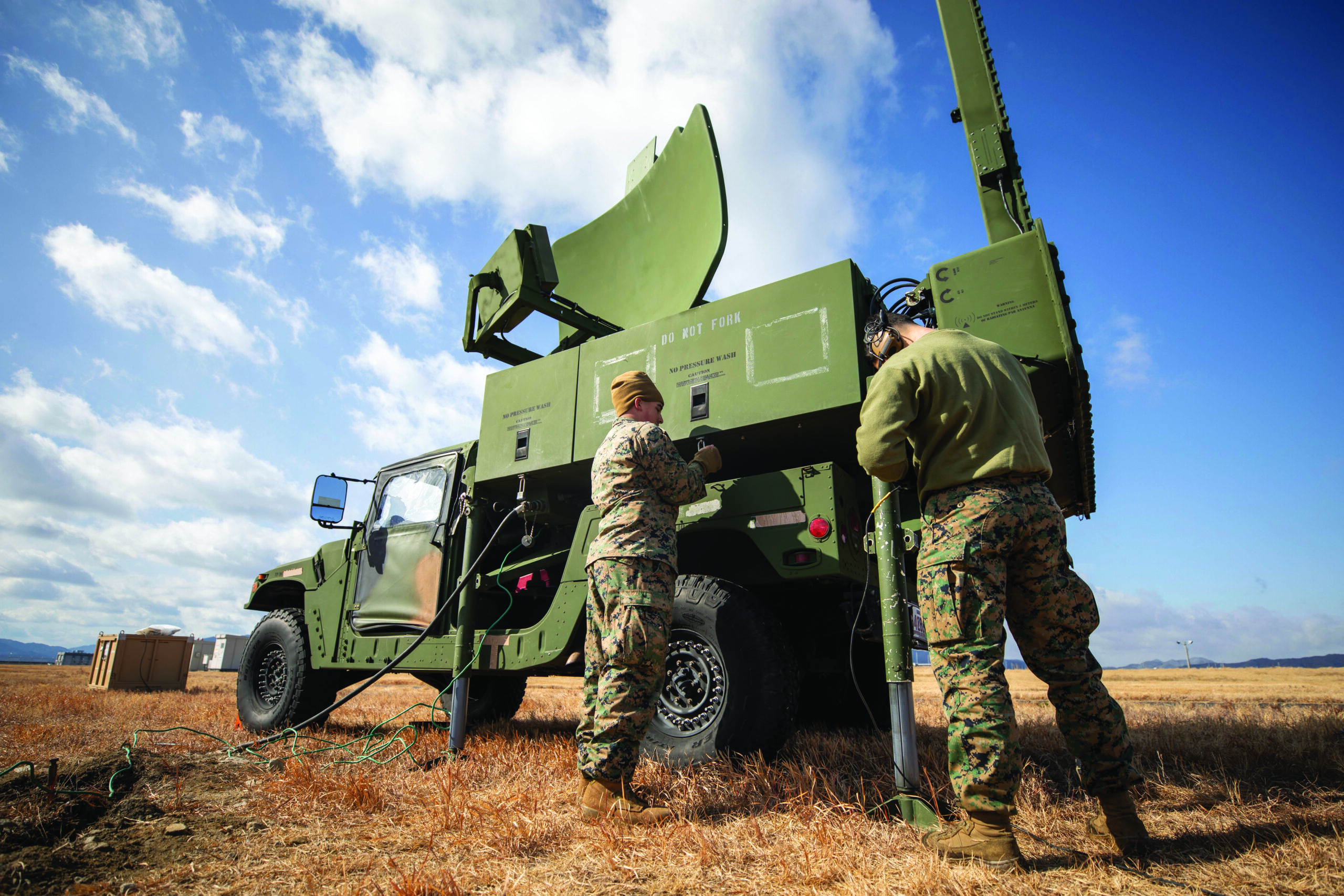
LCpl Wyatt Hahn, left, and LCpl Harrison Vallery, both air traffic control radar technicians with MACS-4, MACG-18, 1st MAW, check the panels on an air traffic navigation, integration and coordination system (ATNAVICS) at MCAS Iwakuni, Japan, on Feb. 6, 2025. ATNAVICS is a mobile radar system used to provide air traffic control to pilots within a wide range of weather conditions. (Cpl Samantha Rodriguez, USMC)

“For a long time, the goal in that office was to keep the helicopter flying and relevant,” said LtCol Shull. Prior to his service as the MAD XO, Shull piloted CH-53s in the fleet and served as an acquisition officer assigned to PMA-261. “The acquisition mindset was improvements and upgrades, maybe a new weapons system, new instrumentation or safety measures. At some point, it becomes more expensive to sustain than to replace. Either the threat has surpassed it or just the lifespan of the aircraft can no longer be extended, like an old car that eventual-ly needs to be replaced. So, the office be-gan the standard ‘new capability’ ac-quisition process, identifying the best product to meet the heavy-lift require-ments. Eventually, it transitioned into the development and fielding of the CH-53K.”

Beyond the development and acquisi-tion phases, testing each new product re-quires a special breed of Marine avi-ators. Roughly one third of the Marines selected and placed by the MAD are pilots assigned to one of the Air Test and Evaluation squadrons covering every type, model and series of aircraft. Unlike any other squadrons in the fleet, pilots joining a developmental test squadron must undergo the U.S. Navy’s Test Pilot School (TPS). Here, Marine aviators de-velop a unique skill set. Students endure a rigorous academic and flight schedule over the course of 11 months, including the ability to graduate with a Master of Science in aviation and aerospace manage-ment from Purdue University.

“TPS, most plainly stated, teaches two things: how to evaluate systems and how to manage risk,” said Major Nicholas Mantz, a UH-1 pilot assigned to Air Test and Evaluation Squadron (HX) 21 at Pax River. “The real difference is that, as a test pilot, you’re doing things that no one has ever done before.”

School-trained test pilots assigned to HX-21 are responsible for operational testing of every type, model and series of rotary-wing and tiltrotor aircraft utilized by the Marine Corps. (Photo courtesy of HX-21)

“It gives you the ability to combine an aviator’s opinion with an engineering mindset,” added LtCol Aaron Okun, the commanding officer of HX-21. “We are the bridge between the fleet and the engineers. Fundamentally what we do is we test something, we evaluate it and we communicate back to the engineers what that evaluation was.”

HX-21 employs Marine test pilots to fly and evaluate all rotary wing and tiltrotor aircraft employed by the USMC. Just like the acquisition process, the test process covers every single component within each airframe.

“When we talk about acquisitions, we think about aircraft from the cradle to the grave; from the inception of the idea all the way until we sunset it,” Okun said. “We also have to do that with every product that gets implemented into the aircraft. A new engine, a new display, any new widget, whatever it is, somebody had to design that, somebody had to install it and test it and vet all the procedures. The whole process gets boiled down for the smallest little thing.”

Okun, like all test squadron commanders, is a TPS graduate and an 8059 acquisition officer. A chief test pilot and chief engineer join the CO as the most senior and experienced veterans. Every test pilot in the squadron possesses at least four years of flying experience in the fleet, and a hearty recommendation from their previous commands, prior to enrollment at TPS and commencing a three-year stint with the test squadron. Though the squadron employs hundreds of people to test, evaluate and maintain the aircraft, only about 75 are active servicemembers. For test pilots, managing projects with civilian maintainers and engineers requires leadership skills and an approach not necessarily taught at The Basic School.

For every new or upgraded product, the PMA submits a request for testing to the squadron. A test pilot is assigned as the project officer, along with a project engineer, to spearhead the task together. The project team scales up or down depending on the complexity of each task and the level of risk associated with it.

“The team designs a set of test procedures to answer all the requirements of the aircraft or product,” Mantz explained. “Once we have that shell of what the test needs to look like, we will start going through the risk management process, identifying the hazards and precautionary measures we can take to mitigate the risks.”

Marines with 1st Bn, 7th Marines, 1stMarDiv, board a CH-53K King Stallion helicopter during Marine Air-Ground Task Force Distributed Maneuver Exercise 1-25 at Camp Wilson, Marine Corps Air Ground Combat Center, Twentynine Palms, Calif., on Feb. 11, 2025. (SSgt Armando Elizalde, USMC)

The specialized training test pilots receive enable them to venture into unknown territory as safely as possible. A host of sensors and monitoring devices specific to the test squadron accompany them on each journey.

“If you go out to one of our aircraft, you’ll see a ton of orange wires and devices everywhere,” said Gunnery Sergeant Jonothon Stutesman, a CH-53 crew chief assigned to HX-21. “They are all kinds of things—sensors measuring temperature, strain, pressure, you name it. This kind of telemetry is something you’re not going to find on a fleet aircraft. I don’t think a lot of people realize how much capability we have with that here. We can have a team of engineers in another room watching a live feed of all that data and advising if the flight is starting to progress in a way that may not be safe.”

The acquisition process calls for two types of testing: developmental testing (DT) and operational testing (OT).

“The easiest way to say it is that DT answers whether or not we built the thing right, OT answers whether or not we built the right thing for the mission it was intended,” Okun explained.

Developmental testers, such as HX-21 pilots, verify each specific function of the aircraft or system. If, for example, requirements call for a helicopter to lift a 10,000-pound load and carry it 300 miles, an HX-21 pilot will verify it can perform this task at a required speed and altitude. The goal of DT is to ensure the aircraft is safe, functional and technically capable of meeting every requirement. For an entirely new aircraft, like the CH-53K, dozens of test plans will be open simultaneously. The “Kilo” model remained in DT for nearly a decade.

Operational testers with Marine Operational Test and Evaluation Squadron (VMX) 1 out of Yuma, Ariz., place the new airframe or system in real-world situations, testing metrics such as reliability, maintainability and availability. These aviators come from the fleet and do not attend TPS prior to assignment with the squadron. Though not administratively managed by the MAD, the Marines at VMX-1 play a vital role in the testing process, providing data to PMAs and working in conjunction with DT squadrons.

After each test event is completed, the test squadrons return their evaluations to the PMAs, who retain ultimate responsibility for the decision to field a new product or go back to the design board. The process for even the simplest items might take at least a year from inception to fielding. As a result, often the Marines who spend a period of several years at a PMA working to bring an idea to life will not be present to witness their work come to fruition. For them, the satisfaction comes much later, seeing the aircraft or system they worked on flying across social media or in the news as Marines around the world put it to use.

The unique work Marines do in pro-gram offices around the nation delivers each capability the Corps brings to the fight. Just as any big-box store employs a dedicated team to engage suppliers and sellers to fill their shelves, Marine Corps PMAs fill the gap with civilian industry.

“The interaction we have with our commercial business partners is certainly something that makes us quite a bit different than a lot of the Marine Corps,” Shull reflected. “We interface daily with stakeholders out of uniform, the key military industrial base. This is the corporate, business side of the Marine Corps.”

PMAs remain constantly future-oriented, sustaining the equipment in use today and procuring the “state of the possible” for tomorrow. The MAD at Patuxent River operates equally future-focused, making sure all the right players are in place to acquire, test and field new technology. The critical work they perform is the first step in bringing about the vision for Marine Corps aviation to life.

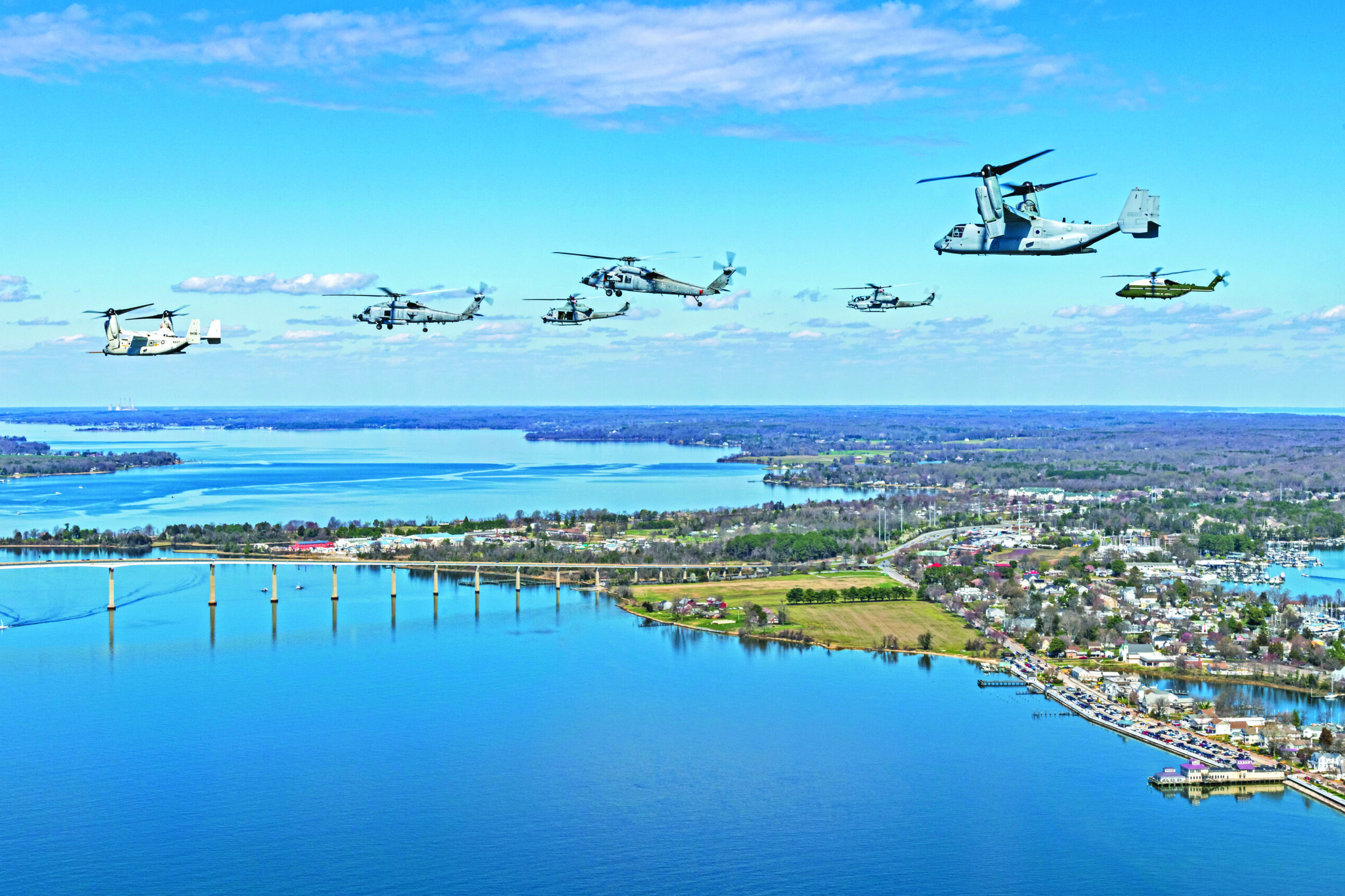
Featured Photo (Top): Air Test and Evaluation Squadron (HX) 21 executes a squadron-wide formation flight on March 25, 2022, highlighting the variety of rotary-wing and tiltrotor aircraft flown and tested by HX-21 test pilots and flight test engineers. (Photo by LT Ben Putbrese, USN)


About the Author

Kyle Watts is the staff writer for Leatherneck. He served on active duty in the Marine Corps as a communications officer from 2009-13. He is the 2019 winner of the Colonel Robert Debs Heinl Jr. Award for Marine Corps History. He lives in Richmond, Va., with his wife and three children. 


Enjoy this article?

Force Multiplier in the Sky: KC130J Harvest HAWK is Here to Stay

Leatherneck
July 2015
By: Sara Bock

Safeguarding The Airspace: Marine Air Traffic Controllers’ Critical Role In Marine Aviation

Leatherneck
May 2024
By: Kyle Watts

Value of Aviation to the Marine Corps

Leatherneck
Org. September 1920
By: MAJ Alfred Cunningham