Someone to Light the Path

Morals, ethics, and self-assessment

Whom Shall I Send?
“All around our society, you see immoral behavior … lying, cheating, stealing, drug and alcohol abuse, prejudice, and a lack of respect for human dignity and the law. In the not-too distant future, each of you is going to be confronted with situations where you will have to deal straight-up with issues such as these. The question is, what will you do when you are? What action will you take? You will know what to do—the challenge is, will you do what you know is right? It takes moral courage to hold your ideals above yourself. It is the defining aspect. When the test of your character and moral courage comes, regardless of the noise and confusion around you, there will be a moment of inner silence in which you must decide what to do. Your character will be defined by your decision, and it is yours and yours alone to make. I am confident you will each make the right one.”

—Remarks for Pepperdine University Convocation Series, Gen Charles C. Krulak, Commandant of the Marine Corps, 14 October 1998

There is No Superman
Imagine yourself as a unit leader locked in kinetic engagement with a peer enemy force. Your support is too far away and too heavily engaged to provide adequate assistance at this time. Enemy artillery is creeping closer and closer to your position as their troops close in behind it.  It seems that the entire world is beginning to crash down around you. The shockwaves and blast overpressure are rolling over you and taking your breath away. The small-arms fire and machineguns shooting at your position make loud snaps as the bullets pass by you and overhead (it sounds just like when you were pulling pits at the rifle range), and you can hear them ricocheting off metal objects, walls, and other things around you. The entire time, you are being pelted with pieces of dirt, debris, and bullet fragments. The day-to-day cares of normal life—paying bills, eating right, working out, getting to work on time, saving up for retirement—all of these things seem trivial and meaningless in the din of this moment. The thin veneer of civilization is stripped away, and your worries and cares have been reduced to a single primal instinct: to survive. The lives of you and your Marines are teetering on the precipice. You realize that existence beyond this moment is not guaranteed. It is time to make a decision and give your orders.

What kind of leader have you been up to this point, now that your own life and the lives of your Marines are at stake? Have you been a leader who has been hands off in the development of your unit, allowing the lower leadership to make all the decisions on training objectives and readiness, trusting that all will pan out well in the end? Have you been a leader who sought acceptance and popularity by catering to your Marines’ creature comforts, drinking alcohol with them during downtime and being cool, allowing training rosters to be pen-whipped, fitness tests to be inflated, and readiness requirements to be falsified—and now you and your Marines find yourselves significantly unprepared for the situation at hand? Rather, have you been a leader who has continuously led from the front with a strong work ethic, shared the common burden, and relentlessly enforced and adhered to our training standards? Have you held yourself and your Marines to the moral and ethical standards that we have sworn ourselves to, setting the example both on and off duty? Have you done your best to adhere to our code of Honor, Courage, and Commitment? Given the current situation, do you believe in yourself to make a recognition-primed, correct decision? Do you believe in your Marines’ ability to fight out of this situation? Do your Marines believe in you? What sort of leadership is more reliable and trustworthy when the time comes to put ourselves to the test in actual combat? Are you currently empowering those Marines who constantly strive to keep the standards of honor, courage, and commitment, or are you hindering them? Are the voices of reason being drowned out by those voices who prefer the easy road and do not take training seriously? What kind of leader should be calling the shots when everything is at stake? Is it someone like your current leader? More importantly, is it someone like you, or is this a job for Superman?

The central purpose of this article is to provoke the drive for self-assessment and recall the line of thinking that spurred us to join the Service. We should recall the frame of mind that originally put us on this path and, if we have found ourselves straying too far from that original line of thinking, that this piece will prod you to self-correct, readjust, or, if you need to, hit the reset button and start over. I would like us to contemplate the values that prompted us to join, the moral and ethical obligations that our country demands of us, and enforce those same obligations to which each of us has sworn a sacred oath to honor and uphold both within ourselves as well as within our ranks. My aim is to fortify our trust and confidence in each other and to empower and strengthen the dedication, resolve, and bias for action of those voices among us whose honor and character have withstood the furnace, the hammering, and the quenching of the forging process to become the true bearers of our battle standards and the uncompromising stalwarts of Semper Fidelis.

The Ovation from the Depths of Hell Itself
From the time when I was young, I have always felt like I was meant to do something great, like I had a higher purpose in life. I grew up extremely poor. My brother and I made do with a few worn-out toys and three sets of clothes each that we had to wear to school two days in a row every week. That was all we had. My family saw to it that we were educated and had a solid moral foundation, but I never felt as though I had the means to be something more. After high school, I went to college and worked a couple of jobs. I even owned a small construction business, but nothing seemed to satisfy my desire to do something that would truly make a difference in this world. Then 9/11 happened. At the time, I was working for the State of Alabama’s Department of Human Resources, going with our social workers as contracted security doing in-home investigations and mentoring ill-behaved state-custody kids who were attending public school. It was meaningful work, and we made huge differences in the lives of the children we helped—but it was also extremely disturbing at times because of what I found that parents were capable of subjecting their own children to. One day, while sitting in a high school with one of our state-custody kids, the teacher suddenly stopped the class and turned on the TV. We all saw the first tower burning as the second plane hit live on the air. The film crews on scene were shooting live footage of people jumping to their deaths. The high-pitched clapping sounds of average American citizens hitting the pavement at terminal velocity still haunt me to this day. When the President came on television and told us that our Nation had been attacked and that we were going to war, I knew deep down that I had to do something. That day, I quit my job at the Department of Human Resources and found a job at a local gym so I could get myself in shape for military service.

Through this Portal
I am, and have always been, what some would call a true believer. When I joined the Marines, I believed in everything that I read in the pamphlets and saw in the commercials on TV. I believed in everything that my drill instructors shouted at me about integrity, discipline, and the pride that is inherent in being the world’s most elite fighting force. I was grateful for the opportunity to endure the forge that would shape me into a Marine. Then, finally, one hot summer morning after an intense and grueling three months at Parris Island, an Eagle, Globe, and Anchor was placed in my hand. With tears rolling down my face, I was honored to be joining this battle-hardened organization that holds our rich and storied history in high regard and, above all else, holds in high regard the moral and ethical standards that, throughout my entire life, have been imprinted upon my soul. There was no work that I could put my hands to that could ever honor myself and my family more than serving as a Marine. I was hooked for life.

The Horns of a Dilemma
All of us, at one time or another, have been faced with some sort of moral or ethical dilemma while wearing the uniform. To level the playing field and be honest with ourselves, we must ALL acknowledge that none of us is beyond reproach in these matters. Nevertheless, in order to fight entropy, keep good order and discipline within our ranks, and to protect our most precious commodity—special trust and confidence—we must relentlessly strive to uphold and enforce the moral and ethical principles that sustain that trust and confidence. Both up and down the chain of command, mutual trust and confidence are the currency that enables us to execute our missions. Without mutual trust and confidence, we assume enormous amounts of risk and gamble the welfare of our Marines, the accomplishment of the mission, and—most importantlythe love for each other that holds it all together.

Omnia ergo quaecumque vultis ut faciant vobis homines, et vos facite illis.

“Do unto others as you would have them do unto you.”

—The Golden Rule

This well-known adage has been restated in multiple ways, such as treating others the same as you would like to be treated, not treating others in a way that you would not want to be treated, or providing to others the same dignity, honor, and respect that you expect in return. No matter how you interpret it, all these variations have the same result: reciprocity in how we deal with each other. We all want to be surrounded by people that we can trust, but this trust and confidence is not, and should never be, a one-way transaction. That being said, I am not suggesting that we should ever lie, cheat, or steal from those who do these things to us (as can sometimes be misinterpreted from the Latin translation), but that we stay on the positive end of the spectrum with our morals and ethics and correct, as efficiently and effectively as possible those who treat us and others unjustly. This will preserve our honor and dignity both as individuals and as a force. We must relentlessly seek justice and ensure that the standards that we create and enforce among ourselves apply to everyone equally, regardless of rank or station, even when it means that those who are expected to enforce the standards are the very ones who require correction. There should be no double standards. Everyone should be held equally accountable to the same set of principles. By living by this maxim, we create and sustain an environment where mutual trust and confidence can thrive, we preserve the honor of our Service, and we have the opportunity to guide, mentor, and preserve those certain voices among us from destroying themselves as well as our organization.

Trust and Confidence
Mutual trust and confidence come at a very reasonable price—that you put forward your best effort and treat those around you with the same honor, fairness, and dignity that you expect in return. Lying, cheating, and stealing are all unjust actions that no one wants to have done to them; therefore, you should hold yourself to this basic standard: that you do not impose the injustices upon others that you would not want imposed upon yourself. As Marines, I would venture to say that we should not only use these axioms to guide ourselves individually but that we have all been bound in oath together to enforce these axioms amongst ourselves, and as expeditionary forces in readiness, that we are meant to enforce these axioms against any unjustified and tyrannical entity that has born itself into existence, in whatever clime and place that our attention has been directed.

“Trust is an essential trait among leaders—trust by seniors in the abilities of their subordinates and by juniors in the competence and support of their seniors. Trust must be earned, and actions which undermine trust must meet with strict censure. Trust is a product of confidence and familiarity. Confidence among comrades results from demonstrated professional skill. Familiarity results from shared experience and a common professional philosophy.”

—MCDP 1, Warfighting

“A great man doesn’t seek to lead. He’s called to it, and he answers.”

Dune, Warner Bros. Entertainment, 2021

Trust, and the confidence that it brings in tow, is the invisible glue that holds all our relationships together. From our brotherhood and esprit de corps to our effectiveness as fighting units, trust in each other is what ties our spirits together, and hence makes us extremely effective as a team. In keeping with this, performance on demand is the standard that must be maintained. It is our intrinsic responsibility to each other to hold the line, enforce the standards, and keep each other sharp and ready for employment at a moment’s notice.

When missions come down, commanders look at what they have available, based on the Defense Readiness Reporting System and then decide which units get tasked to do the job. The Defense Readiness Reporting System report is published by each unit and requires that the leaders within each unit report correct numbers to accurately depict their unit’s readiness to meet our Nation’s requirements. If they fail to do this accurately, units may get tasked with missions that they have not been manned, trained, or equipped to accomplish. Doing so would create unbalanced tasking, which would lead directly to the reckless risking of Marines’ lives, potentially for nothing more than unit leaders selfishly wanting to look good in readiness briefs. It is not fair to the other units that are doing business honestly, nor is it fair to the Marines who are being held to a higher mission standard than what they have been trained to accomplish. Readiness is what commanders assess when war comes, so it must be done accurately and honestly for the sake of the mission and the Marines.

Mission Accomplishment and Troop Welfare
Mission accomplishment and troop welfare are the two principles that guide every unit in the Marine Corps. These two ideals of mutual expectations between leaders and led are built on the foundations of mutual trust and confidence. Without mutual trust and confidence between leaders and the led, neither mission accomplishment nor troop welfare can survive. Leaders must be able to trust that their Marines will pursue mission accomplishment in the most efficient, effective, and honorable way possible, while their Marines must in turn be able to unquestionably trust that their leaders have employed all options available to ensure their safety and troop welfare.

This trust is built over time by the repeated meeting of expectations by both leaders and led. If we want our leaders to trust us, we must prove to them that their priorities are our priorities and line up our objectives, whether in training or combat, to best address them. We must prove time and time again that we are highly capable and can be trusted both on mission and on liberty. We must be frank and honest and find out what concerns them. Then we take action to address and quell those concerns. The end state is a leader who has the utmost trust and confidence in their unit and the peace of mind necessary to employ their Marines with mission-type orders. This focus on the concerns of the leadership should be the ultimate goal of the led.

As leaders, if we want our Marines to trust us, it is simple—we love and care for them as we would our own children. We reward them when they do well, always reinforce their positive behavior, and provide fair and reasonable correction when necessary. We must train and mentor them as a teacher would their students. Above all else, we must share their burdens and never task them to do anything that we are not willing to do ourselves. We must prove to them that we are willing to sacrifice for them as they are for us—that we love them as we love ourselves. This can be proven via the sacrifice of your time, blood, and sweat to endure the same burdens alongside them. Make time to know them. Make time to suffer alongside them. This self-sacrifice shows that you genuinely care about them, proves that you have their troop welfare at heart, and builds unquestionable trust from your Marines. This relationship between leaders and led—mission accomplishment and troop welfare—is the unspoken trade-off that lives within every hierarchy in the Marine Corps. This relationship should be well-maintained and be the ultimate goal of the leaders on behalf of the led. When this relationship is properly cared for, trust flourishes, and the unit performs tremendously. When this relationship is not maintained with mutual trust, confidence, respect, and dignity, the seeds of destruction have been sown.

“Destroy the seed of evil, or it will grow up to your ruin.”

—Aesop

Seeds of Destruction
Every ordered system undergoes entropy. It is a natural part of existence. Things break down when left unmaintained, and, at times, maintenance may not be enough to restore their proper functioning. It may be necessary at times to rebuild the entire system to adequately address new requirements in line with what it was ultimately designed to do. For us as Marines, the functions of our Service and the relationships that control them are that system. For this article, I will avoid discussing big-picture Force Design and attack from the little end—the day-to-day functioning of small units and the individual Marines within them. The bottom line is this: if we do the small things right, the big things will take care of themselves. These small things are simply the basics that you were taught at boot camp and Officer Candidate School. Treat your fellow Marines with respect and dignity. Always be honest. Moral courage and integrity are virtues to be sought after and respected. Calibrate and follow your moral compass. Hone your honor. Muster your courage. Uphold your commitment to stand up for what you know is right.
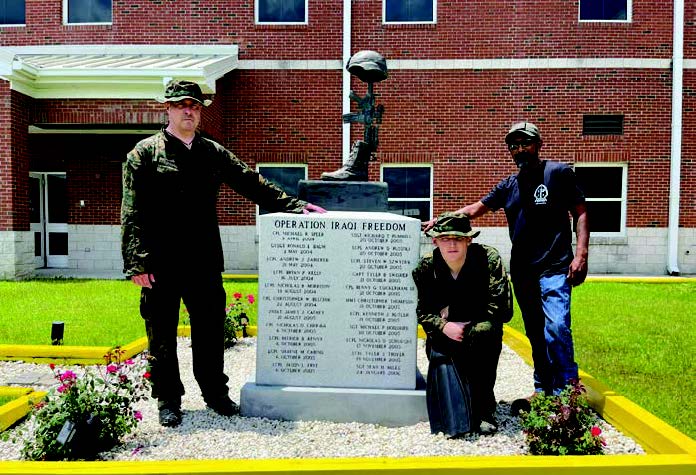
The author (left), Naim Mohammad (right), and James “Jim” Cathey Jr. (center). Jim’s father was a mentor to the author and was killed by an IED during their 2005 combat deployment to Iraq. (Photo by author.)

So, what causes entropy within our Service? It starts small. It is the everyday things that we let slide when we know they should be done correctly. Maybe we slack on pushups when the squad leader is not looking. Maybe we let someone else do our annual training. Maybe we lie about why we showed up to work late. Maybe my team leader lies for me, so I do not get in trouble. Maybe I inflate my numbers on the crunches during the PFT. Maybe my team leader inflates everyone’s numbers. As entropy goes unchecked, we may begin submitting morning reports without accountability of the Marines, pen whipping training rosters, plagiarizing or stealing credit for someone else’s work, stealing gear and supplies, stealing issued gear from another Marine, stealing ammunition from the range, falsifying unit readiness reports, cheating on your spouse, committing adultery with someone else’s spouse, using your position to get sexual benefits, sexually harassing or assaulting another Marine—the list could go on. The bottom line is that we all have the responsibility to engage and destroy these seeds of destruction as soon as they present themselves, before they grow out of control. It is on each of us to be the sentries of good order and discipline. Never ignore your inner voice. Never accept that standing up for what is right is an obstacle that cannot be overcome.

The Obstacle Is the Way
Think back to when you graduated boot camp or got commissioned. Remember how proud you felt. Remember how proud your family, friends, and loved ones were of you. Imagine them seeing you now and knowing what you know about what kind of Marine you have become. Would they still be proud of you? Compare your mindset then to who you are now. After all this time, are you still proud of yourself? If not, it is time for self-assessment and self-correction. When you fail to do it yourself, it is on us as your fellow Marines to help you assess and correct. By wearing the uniform, you represent us all. You have sworn an oath to our ethical principles, and we have in turn sworn an oath to help keep you sharp and on the path.

You do not have to be a Marine of higher rank to be a moral and ethical leader. All of us are equally capable of guiding our fellow Marines, no matter what their rank or station. All it takes is moral courage. Hold honor and integrity higher than your comfort. Fight all these fights and do your best to win each one. These short-term victories will support long-term resilience and will be realized in the indomitable strength you will gain from overcoming countless obstacles and hardships. Strength is gained by opposing a force. Confidence is gained by overcoming these obstacles. Some might say that the obstacles in your life are exactly what you must seek out. The obstacles are where you find opportunity. That the obstacles are, in fact, the way.

Beyond Corruption
The ultimate point is that we all must first be loyal to the same common standard—something fair and just and beyond corruption. People are human and fallible. They are imperfect. They have lapses in judgment and make mistakes. Loyalty to people will always have the chance of failing or backfiring on you. However, loyalty to a common set of principles will always be incorruptible given that the members of the organization see to it that its commonly agreed upon principles are always kept. Some of us will be strong when others are not and vice versa. Some of us will see the path while others do not and vice versa. Some of us will have the moral courage to stand up for what is right when others do not—and vice versa. We hold each other accountable, and by doing so, we build trust and confidence among us and ensure both mission accomplishment and troop welfare.

Conclusion
My grandfather, having served as an infantry platoon commander and company commander during World War II, taught me that leadership is built on mutual respect and dignity. My father, echoing my grandfather’s teachings, taught me that hard work is good for the soul and that honesty is always the best way forward, even if it seems to be personally harmful in the moment. Above all else, the Golden Rule is the essence of an honorable way of life. Treat others how you want to be treated. Be honest. Work hard. Recognize and honor those who do the same while having the strength and moral courage to hold accountable those who do not. Never be too proud or arrogant to allow yourself to be corrected, sharpened, and guided back to the path. Take the improvement in stride and appreciate your chance to become a stronger Marine—and a better human being—than you were before. Be appreciative and allow the detrimental parts of yourself to be identified and cut away. We all need pruning from time to time.

It is my deep and sincere wish that this article helps us all to identify the areas in which we need to improve ourselves both morally and ethically as Marines. I hope that we can make ourselves better and more honorable human beings than before—to become guides to our leaders, peers, and subordinates. To be flares who light the path of honor, courage, and commitment. This path embodies the principles and promises of all our pamphlets, commercials, and publications. This path ensures that we maintain the tremendous reputation of those who have gone before us and puts us all on the best possible trajectory to being the greatest versions of ourselves and, therefore, the finest Marine Corps that we can possibly be. Instill trust. Radiate confidence. Be loyal to our common ethical principles. Enforce our core values. Hold the line. Do not allow the seeds of destruction to take root. Do not contribute to the darkness. Each and every one of us who holds our common values near and dear—and defends them—is a light to those Marines around us. Do not let them wander in the darkness. Correct them, sharpen them, and most importantly, love them. Be someone to light the path.

>Maj Fountain enlisted in the Marine Corps in 2003 and served three combat tours to Iraq, a MEU to CENTCOM, and two deployments to the Black Sea Rotational Force. At the time that this article was written, he was deployed and serving as the Combined Task Force 61/2 Space and Special Access Programs Operations Officer in support of U.S. Sixth Fleet objectives in EUCOM. He is currently at II EOTG and retiring from the Marine Corps.

Machine Learning to Enhance Force Preservation

AI supporting leadership

>Capt Borinstein is an Intelligence Officer currently assigned to Company B, Marine Cryptologic Support Battalion at Fort Meade, MD. He holds a Master of Science in Data Analytics from the Georgia Institute of Technology.


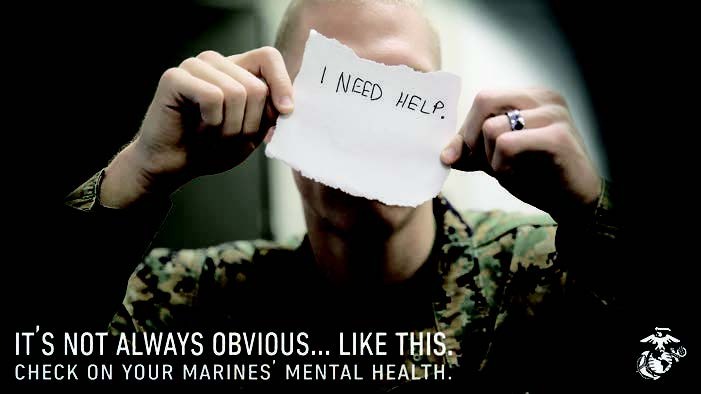
Although generally not top of mind when considering the Marine Corps’ most pressing future warfighting challenges, mental fitness, and suicide prevention unquestionably remain a chief priority across the DOD. Today, suicide rates among service members are among the highest levels in their recorded history.1

In response to increasing suicide rates, the Marine Corps has resorted to requiring commanders to become more involved in Marines’ lives and applying the risk management process to those subjectively deemed at-risk through the Force Preservation Council (FPC) program. The FPC order directs commanders to “use engaged leadership and risk management guidance … to recognize and intervene early when stressors and potentially risky behaviors first develop in Service members in order to interrupt the chain of events that can lead to an adverse outcome.”2 Unfortunately, the Defense Suicide Prevention Office’s 2020 Annual Suicide Report shows that the Marine Corps’ suicide rate has increased on average since at least 2014, with suicide rates in 2020 being the highest ever recorded in the wake of the Coronavirus Disease 2019 Pandemic.3 This trend suggests that the Marine Corps will continue to battle with and for the mental health of its Marines well into the future, which poses significant challenges to the future force’s ability to remain ready to respond to our Nation’s calling.

Despite the Marine Corps’ good intentions, the FPC program in its initial form was riddled with flaws. One of its primary problems occurred when losing and gaining commands often failed to exchange information on Marines’ past and potential struggles. When they did exchange this information, it was often through informal, non-secure means. Although the Marine Corps FPC Order (MCO 1500.60) required losing commands to “ensure the gaining command is provided the necessary and relevant force preservation information,” there were no mechanisms by which to hold units accountable for failing to comply with policy.4 Such a lack of standardization and security meant that commanders rarely received all the information needed to contextualize Marines’ behaviors and issues and that Marines’ personal data was often put at risk through the unnecessary use of PowerPoints and other informal dissemination mechanisms.

In August 2020, the Marine Corps sought to resolve these issues by adopting the Command Individual Risk and Resiliency Assessment System (CIRRAS), which is essentially a standardized database for FPC data.5 Although certainly an improvement upon the legacy FPC process, CIRRAS will sell the Marine Corps short if it remains only a tool for data storage. Indeed, CIRRAS presents a unique opportunity for the Marine Corps to experiment with using artificial intelligence—and more specifically machine learning—to combat the threat of suicide within its ranks. The Marine Corps should examine the efficacy of using the CIRRAS database in conjunction with supervised classification machine-learning algorithms to help commanders better identify Marines who are most at risk for self-harm.

What is CIRRAS?
CIRRAS is a secure application developed by Marine Corps Systems Command that standardizes the FPC program across the Marine Corps, giving commanders the ability to monitor their Marines’ holistic health and combat readiness.6 It allows commanders and their representatives to input and track the various stressors that Marines regularly experience, including information regarding mental health, relationship disputes, alcohol- and drug-related offenses, and other significant issues that could impact operational readiness.7 Though it offers a new, more secure way of storing and transferring sensitive data about Marines, CIRRAS does not make any fundamental changes to the FPC program.

Although CIRRAS offers the means to standardize and secure Marines’ holistic health information, it does not seem to offer any additional analytical advantage to commanders. In other words, CIRRAS improves commanders’ abilities to securely communicate raw data, but it does not use that data to provide valuable insights to make better decisions.

The primary purpose of collecting standardized data in any capacity is to detect trends and patterns to better inform decision making. Human minds are very good at detecting simple, linear trends in two or three dimensions, but are very limited in their capacity to detect complex, non-linear trends, which can be common in multidimensional datasets such as those involving personal health information.

Machine Learning
Machine-learning algorithms happen to be especially adept at identifying complex, non-linear trends in vast amounts of data. They can take datasets on the scale of thousands of dimensions, identify their most important factors, and detect patterns that no human brain could hope to understand or recognize. These algorithms are regularly used in the private sector to determine which Netflix shows would best suit you, which songs you will most likely enjoy on Spotify, and which products you should next consider purchasing on Amazon.

At its most basic level, machine learning is using past data and consequent outcomes to identify complex patterns, generate models from those patterns, and then combine those models with future input data to quickly deliver predictions of future outputs. The machine-learning algorithms used by tech companies take the data you and others give them, such as browsing activity and personal information, to detect patterns and build statistical models that can quickly calculate high-probability outcomes.

By centralizing and standardizing FPC data in a single database, the Marine Corps has created a venue through which it could use machine-learning algorithms to identify under-the-surface trends common among Marines who have expressed suicidal or other life-threatening tendencies. If provided with the right types of data, these algorithms could prove useful in providing commanders indications of Marines who are more likely to engage in self-threatening behavior.

Among the many different types of machine-learning algorithms, the most useful for the purposes of predicting future behavior are classification prediction algorithms. These types of algorithms are trained to predict specific categorical outcomes (green/yellow/red), and not numerical ones (1, 2, 3). Among the most popular types of classification prediction algorithms are decision trees, random forests, k-nearest neighbor classifiers, logistic regression, and support vector machines. The Marine Corps should experiment with these types of algorithms to determine whether any of them can effectively predict Marine behavior.

Issues and Requirements
Using machine learning to make impactful decisions in Marines’ lives obviously presents several potential problems. The data science and tech worlds are alight with debate over the moral and ethical use of machine-learning algorithms with others’ personal information. Moreover, no model or algorithm is perfect and, if not properly understood, can result in unfounded dependence on “the numbers” and remove commanders’ responsibility to use their judgment.

First, one should note that no model is infallible. Models are abstract representations of reality and are optimized to represent historical data. They are susceptible to developing a narrow focus and will always produce some measure of error. No model or algorithm can perfectly describe previous forms of reality nor perfectly predict future ones.

Because of this, commanders using mathematical models to make decisions must remember that such models are tools designed to supplement decision making and should never replace well-informed human leadership and judgment. It seems too often that we settle for reducing complicated situations into PowerPoint slides with boxes colored green, yellow, or red. No Marine’s personal situation can be adequately captured by a simple color, and we should be wary of similar behavior when using other models to predict which Marines are most susceptible to suicidal behavior. Instead, commanders should use such tools to identify who they should be spending more time observing.

All prediction algorithms produce false positives and false negatives. The Marine Corps must avoid a zero-tolerance approach when it comes to using machine learning and artificial intelligence of all types. Tools that use such technologies are designed to inform better and faster decisions but are never intended to generate decisions in lieu of humans.

Garbage in, garbage out is a common saying among data scientists. Because machine-learning algorithms live on the data that they are given, poor data quality can easily result in models which fail to adequately reflect reality. Leaders responsible for inputting data into CIRRAS must do so properly. The notion of no data in is also worthy of consideration. Given that prediction of at-risk Marines is the ultimate goal, a lack of data on risk factors means some Marines could slip through the cracks.

Data used in machine learning must also be computable, meaning that it should be standard throughout the dataset (think multiple choice responses or numerical data with common formatting). Supervised classification learning algorithms work by identifying which characteristics were most prevalent among Marines who expressed self-harming inclinations, generating a model by appropriately weighing each of those characteristics based on their correlation with the outcome, and then applying that model to other Marines as needed. To make this work, however, these algorithms require standard data values, especially for the metric in question, which in this instance is whether a Marine has demonstrated a predisposition for self-harm. Machine-learning algorithms cannot easily interpret free-response data without additional processing, which often involves manual interaction. CIRRAS must provide standard datasets to generate effective models.

Not all models work well and there is no guarantee that these models will provide any value at all. It is very possible that none of the models listed would be able to accurately predict which Marines are most susceptible to self-harm, and in doing so could add unnecessary noise to an already-complicated FPC system. If, however, these models can generate correct predictions even as low as 50 percent of the time, they could prove very valuable to commanders.

Conclusion
In recent years, Marine Corps dialogue has become consumed with some of the Nation’s favorite tech buzzwords: artificial intelligence, machine learning, big data, and the like. Nevertheless, we have yet to find ways to implement these at scale in the same way multi-billion-dollar corporations have been doing for years. There is little question that we should be researching and experimenting with means to harness the power of these technological advancements. In reality, however, reluctance to adapt quickly and try new things at middle and lower echelons demonstrates that research in these fields may not truly be a top priority.

Exploring the use of machine learning in conjunction with CIRRAS’ database offers an easy opportunity for the Marine Corps to showcase its long-held reputation as the Nation’s most innovative force. Further research on this topic may prompt widespread use of this technology and could prove valuable to commanders by quickly providing automated actionable data in one of the Pentagon’s top challenges: service member mental health. If our people are truly our greatest strength, then we should leverage every advantage, technological or otherwise, to their benefit and that of the Naval Service.


Notes

1. U.S. Department of Veteran’s Affairs, 2020 Veteran Suicide Prevention Annual Report (Washington, DC: 2020).

2. Headquarters Marine Corps, MCO 1500.60 Force Preservation Council (Washington, DC: August 2016).

3. Under Secretary of Defense for Personnel and Readiness, U.S. Department of Defense, Calendar Year 2020 Annual Suicide Report (Washington, DC: 2020).

4. Stephen Losey, “Military Deaths by Suicide Jumped 25% at End of 2020,” Military.com, https://www.military.com/daily-news/2021/04/05/military-deaths-suicide-jumped-25-end-of-2020.html; and MCO 1500.60 Force Preservation Council.

5. Headquarters Marine Corps, “Announcement and Implementation of the Command Individual Risk and Resiliency Assessment System (CIRRAS),” Marines, August 12, 2020, https://www.marines.mil/News/Messages/Messages-Display/Article/2310545/announcement-and-implementation-of-the-command-individual-risk-and-resiliency-a.

6. Marine Corps Systems Command, “Marine Corps Develops Secure App to Monitor Holistic Health and Combat Readiness of Marines,” Marines, February 11, 2021, https://www.marines.mil/News/News-Display/Article/2500948/marine-corps-develops-secure-app-to-monitor-holistic-health-and-combat-readiness.

7. Ibid.

Dissent

A lecture to the Marine Corps Command and Staff College

Image
Dr. Kohn is the co-editor with Peter D. Feaver of Soldiers and Civilians: The Civil-Military Gap and American National Security (BCSIA Studies in International Security) 2d Edition, Cambridge: MIT Press, 2001. ISBN 978-0262561426.
>Dr. Kohn is a Professor Emeritus of History and Peace, War, and Defense at the University of North Carolina at Chapel Hill. He was Chief of Air Force History for the Air Force at the Pentagon, 1981–199l. This article is a revised and updated version of a lecture to the Marine Corps Command and Staff College in May 2022.

Thanks, LtCol Anthony, for that kind introduction. It’s a pleasure and an honor to speak to the College class, and my thanks for this opportunity. I must note special appreciation to your Dean, Dr. Jonathan Phillips, whom I have known and appreciated for nearly 30 years, from his time in the UNC PhD program in history: one of the finest teachers and most honest, careful, and insightful scholars in my experience. And a personal friend whose advice, on professional issues as well as on what sailboat and bicycles to buy—two items of his special expertise.

In discussing dissent, we are not talking about simply disagreeing; we all disagree about many things, and frequently.1 After all, we are Americans, at least most of you in this audience. Nor is dissent insubordination or disobeying orders, although dissent can lead to such. Dissent is not about defying or disobeying lawful orders.

Where dissent differs from simple disagreement is that dissent implies disagreement with the majority opinion or judgment, with a consensus, or with established authority, or with traditional and commonly accepted institutional norms, or even orders. Fundamentally, dissent is simply thought. Sometimes, with certain people, it can be an attitude. But in your readings and in the common parlance today in civilian society and within the military, both in general and in the Marine Corps in particular, where it has something of a long tradition all the way back to Smedley Butler and Evans Carlson in the 1920s and 1930s, and after, it is accompanied by the voicing of disagreement in private or even publicly—in other words, expressing a contrary opinion. Not remaining silent. And another part of the definition is that dissent implies acting at the risk of self-interest, personal or professional, or both, and thus that it requires some courage. Risking the personal self-interest of a relationship with a boss, or peers or simply professional self-interest in promotion or reputation. As officers, you know and possess physical courage; dissent is something different, something we might call moral courage. We all know, and are educated to, or to be capable of understanding, right from wrong, and have the training, experience, education, or ability in any given situation to figure out what is a proper course of action, or ought to be, even if one is not aware of all the facts, have all the necessary information, the wider perspectives, and necessities that people at higher levels might have.

Every profession or trade expects dissent. Lawyers, doctors, professors, clergy, business executives, supervisors in factories, carpenters, electricians, social workers, nurses, and the like face, on a regular basis, problems that involve discussion with peers, supervisors, subordinates as to how to accomplish a task or solve a problem. We are a practical, pragmatic, problem-solving people and our culture thrives on differing perspectives and ideas. It is built into our culture. Our politics is infused with dissent. One of our norms—respect for alternative viewpoints—is indispensable, although it seems, unfortunately, to have declined. The country was founded on dissent from British policy, laws, and institutions; our religious traditions from earliest times involved dissenting—splits in established churches and even migration, from Roger Williams leaving Puritan Massachusetts to the Mormons leaving upstate New York and Illinois and settling in the Mountain West—and many of you know that earliest Mormon settlements had their own dissenters and breakaway groups.

Think of countries that do not permit, or do not value, dissent that arises from freedom of thought and expression. Their governments are autocracies, arbitrary, capable of terrible mistakes—such as Russia has committed in invading Ukraine—and the militaries of such governments are less flexible, more corrupt. Businesses across the world, in all societies, that are top-down and do not encourage independent thinking and open discussion often waste money, choose wrongly, misjudge the market or the popularity or appropriateness of their products, and flounder.

In the armed forces, where lives can be on the line and the country’s security or even existence can be at stake, dissent seems to me as important as in any walk of life, simply because of the stakes in military service. It seems to me that dissent is not only a moral and ethical imperative, but an obligation. Think of it at the personal level. If you witness a mistake about to be made, a decision that will lead in your judgment to unnecessary death and destruction, to counterproductive results, to self-defeating consequences, do you not have the obligation to raise questions? To stand by without asking for explanation or clarification, or further discussion, can be something of a dereliction … not serving the mission, your superior, or the people for whom you are responsible, very well or even perhaps adequately.

On the other side, in command of others, would you not want your people to express their views, give you the benefit of their experience, knowledge, and judgment in the process of deciding a course of action—if not whether to act, how to act, what are the alternatives and the risks. It seems to me that every supervisor needs to encourage subordinates to make their views known in some way or in some venue, to know that they are heard and considered, that the boss is open to ideas and thoughts that might be out of the box or unpopular. That there will be no penalty for disagreeing with the boss. You must be careful not to intimidate your people into silence. At the beginning of his tenure, as the legendary Army Chief of Staff during World War II, George C. Marshall, reputably told his immediate staff that they were not doing their job. The staff was surprised, some even shocked, and they asked for an explanation. Marshall told them that they had been working with him for a week and not one of them had disagreed with him.2

At least this is the theory of dissent and leadership. I have made it sound simple, cut and dried, no problem. But we all know that the devil is in the details. The realities, as many of you know and probably have experienced, is that dissent is always situational. That is, it depends on a number of factors, and on the circumstances.

First, the situation, the context. Is it at the tactical level, as a junior officer, or higher, at the operational level, or even higher in a geographic combatant command or in Washington or the strategic level? Is it in the field, in combat, in a unit engaged, or at a command post or headquarters, or on a staff, at home or abroad? Is there time to dissent, to discuss? Does it involve allied forces or is it all Americans? If the latter, are other Services involved, or civilians, or local populations and civilians, local leaders or institutions or partners? Is it about a policy or its implementation, say the rules of engagement, established recently or further in the past, by your command, at a close level above you or in Washington far away? Does the dilemma involve a decision or its execution? Is there time to discuss or debate the policy, decision, order, or action? Are lives at stake? Is accomplishing the mission at stake?

In other words, how important is the issue? How consequential, and is the officer in a position, because of experience, knowledge, information, and the like, to make that determination accurately? All of this requires judgment and sensitivity, acute observation, and considerable thought.

Additionally, the people involved in a situation are a crucial consideration. One has to gauge the situation, and how often to dissent. With your peers, it seems easier to dissent. To your superiors, more difficult.

And then there is the problem of how to express dissent. Speaking up, in private or within an organization or up the chain of command, but not out to the public or people who will make your views public seems to me more problematic. That is, you can speak privately one on one, or in a small group with people you know and where there has already, through personal knowledge or time together, a bond of respect and trust. Perhaps a contrary view is best offered in private, with carefully crafted language. One has to read not only the boss, but the context, and one has to make clear, always, that you are subordinate, not just in words but also in tone, body language, and understanding of the issue and the person in charge.

When I worked in the Pentagon in the 1980s, there was a saying, “that it is better to ask forgiveness than permission.” Think about that. Like all aphorisms, it can be untrue or even dangerous. My father, a canny Illinois lawyer with a likeness of Abraham Lincoln on his office wall, loved aphorisms. One he often expressed was in my judgment wrong: “You’re never sorry for what you don’t say.” Well, I disagree with that, particularly on the subject of dissent, as I will explain in a moment. On another aphorism, he was dead right: “Don’t be so open-minded that your brains fall out.” The points are these: what counts are the situation, the circumstances, the importance of the problem, the people one is trying to reach, to engage, to influence, and more.

But if dissent is a moral and a professional obligation, one with personal and professional risks, in a discussion with important consequences, and an officer who disagrees and remains silent: has he or she fulfilled the duty to his or her subordinates and the loyalty to superiors? It is a ticklish question, an important question, but also one that should not be paralyzing either in the abstract, as a matter of theory, or particularly troubling in the everyday carrying out of your duties. It is simply a part of your profession, as it is with all of the professions, with life in general. When to speak up, when to remain silent. Do not make a big deal of it, or think about it all the time, making it a defining element of your officer-ship and relationships with your contemporaries and superiors. It is just a natural part of officer-ship in a professional military service. As one retired four-star admiral said to me recently, “All of us carry out orders we disagree with, occasionally and sometimes often.”3

George C. Marshall was particularly candid about the necessity for choice. He established an independent and candid relationship with Franklin Roosevelt when, newly promoted and appointed Assistant Chief of Staff of the Army in the late 1930s, in a meeting the President made his own views clear and went around the room asking those present if they agreed. All did until Marshall, who told Roosevelt that he most definitely did not agree and why. People there told Marshall his career was over, but Roosevelt respected Marshall’s bravery and honesty, and in 1939 appointed him Chief of Staff over several other higher-ranking people. And for the next six years, when dealing with Roosevelt and with Congress, the general admitted after the war that he always saved voicing his dissents for the most meaningful, important, consequential problems or issues, and let the unimportant pass without offering contrary views, lest he forfeit his credibility or influence with these politicians on matters he considered crucial. “I never haggled with the President,” Marshall remembered. “I swallowed the little things so that I could go to bat on the big ones. I never handled a matter apologetically and I was never contentious.”4

A good example of the necessity for silence occurred at an Army Air Forces base in North Africa in 1943. Years ago in discussion with two retired generals, both four stars, the mission to take out the Axis oil refineries at Ploesti in Rumania came up. Then Col Jacob Smart, a member of the chief of Army Air Forces colonels group at Headquarters in the Pentagon, said he thought up the idea of a low-level bombing mission to avoid the fighters and flak. Hap Arnold, the Army Air Forces chief, accepted the risk and told Smart that since he came up with the idea, he should go over to North Africa and sell it to the crews that would have to fly it. Leon Johnson, the other general, then a colonel and group commander, told Smart and me that he knew the attackers would be shot to pieces and the mission likely would fail—and it did—and Johnson won the Medal of Honor for his bravery and leadership. I asked him why, if he thought it would fail, why did he not refuse to fly the mission or object to it? He was dumbfounded. In the middle of World War II, against a murderous enemy in an existential world war, it never occurred to him to refuse the mission. As far as I know, he did not dissent; to do so, in retrospect, might have unhinged his unit.

I would be particularly careful not to confuse dissent with disobedience and even insubordination, at the various levels of combat and command, as in the reading by Andrew Milburn. He cites personal instances when he disobeyed or violated orders. But every example is from the tactical or operational level, the example of the Prussian officer and king. Milburn avoids the strategic level and above, as when, in an essay over a decade ago, he cited Douglas MacArthur in Korea as an example to be followed.This was and is nonsense; MacArthur was guilty of insubordination and disobedience at the policy, strategy, and presidential levels. The necessity for civilian control of the military, so pervasive in the U.S. Constitution and so foundational to the American government, admits of no disobedience. Officers can dissent in discussions with civilian superiors, but in private, speaking up but not out (i.e. to the press or the public), and even in testimony to Congress, senior officers must be extraordinarily careful in discussing their advice to the most senior civilian officials.

As the field officer, and throughout the military in many and perhaps most situations at the tactical and operational level of war, there is the expectation that officers have the discretion to adjust their orders and their decisions, if necessary, to implement the commander’s intent. The Armed Services seem in the last generation to try to locate decisions at the lowest level where commanders on the ground are likely to have the best knowledge to judge what needs to be done to accomplish that intent. Officers must navigate uncertainty and risk, not just in battle, staff work, or in deciding when it is imperative to dissent, to speak up. When it comes down to it, moral courage and physical courage come out of the same wellspring of character and judgment.

One other example. There may be times when orders can be disobeyed and perhaps should be. On a trip to Vietnam some ten years ago, the group I was with visited tunnels used by the Viet Cong near a town northeast of Saigon. One member of our group told us that, as an Air Force major near the end of the war, he had been a forward air controller marking enemy targets on the ground. When an order came through to vector an attack on a certain village because a South Vietnamese brigade was taking fire from it, he refused—twice. He told his superiors that he had flown over it many times, never taking fire, that if the South Vietnamese brigade was being fired upon, it should assault and take the town, not level it and kill all its innocent civilians. The major was accused of insubordination, taken off flying duty, and hauled before the four-star commander of U.S. air forces in Vietnam. His superiors presented the situation to the four-star. Legal orders; clear situation; twice ordered, threatened, consequences made clear. At the hearing, the major explained why he refused the orders to mark the town for destruction. Gen John Vogt, the commander—a distinguished officer, a fighter ace from World War II—then cleared the room and asked the major again, what happened and why. Same story. Vogt pondered, then told the major to return to his unit, that he would be put back on flying duty, and the incident was closed.

Now another commander might have thrown the book at the major. The man had made a moral and professional decision not to kill in his mind innocent people because the South Vietnamese brigade commander did not want to risk his own casualties in a ground assault. You make up your own minds. Was this moral courage? The right choice?

Command at any level is not a popularity contest, even if officer evaluations are being done with 360-degree inputs. Situations are often unclear, information lacking, choices difficult. Just as command is filled with uncertainty, so too is the need and appropriateness for dissent. Officers are often forced to “lead from the middle,” that is to help their superiors get through ambivalent choices, advocate and argue for a course of action that runs against the thinking of a group. Or, as is more often the case, take a decision or order that is disagreeable or that even appears wrong to one’s subordinates, and make the best of it. As one former Marine officer said a few years ago, when at a conference on wars of choice, when asked how one leads people in battle when they think the war is wrong and they oppose it: he answered that he always did everything in his power to accomplish his mission with the least harm to the people under his command and to the Iraqis involved in the action.

There are times when one has to speak truth to power, but as Marshall understood, you cannot do it all the time or you become a nag and a problem. As you rise in rank and responsibility, you will learn the instinct to assess the audience and the situation. Do not take counsel of your fears any more than you do in combat situations. One Chairman of the Joint Chiefs of Staff who had to deal with a most difficult, frequently abusive, dismissive, and yet indecisive Secretary of Defense, told me that he always wanted the Secretary to be glad when he, the chairman, came into the room, knowing that he needed to be listened to. That it was essential to tell the Secretary what he needed to know even if he did not want to hear it. Marshall said essentially the same, in dealing with FDR: pick spots, save dissent, or unpleasant truth for what really mattered.

Let me close with one more thought. The Marine Corps is going through a set of dramatic changes as we speak. The law of averages tells me that some of them, hopefully, a tiny, tiny few, may be wrong or need adjustment or modification or whatever. This means that Marines at every level must be even more willing to dissent than in “normal” times, lest a mistake from the top—or near it—cause difficulties, even inefficiencies or deaths, that otherwise could be avoided. You who are not Marines in this audience should also take notice, and be prepared to dissent equally. I know the other Services face great challenges brought on by technology—to name only a few, cyber and drones, artificial intelligence, uninhabited ships and planes and vehicles—and a rapidly changing, and threatening, international situation. Not to speak of funding limitations, of changes in our alliances, and in leadership, all of which reverberate downrange. Be prepared for such; be attuned to the contributions you can make not by going along to get along, but by contributing your experience and expertise, reading widely and thinking critically, and dissenting when it is called for, and it can be helpful. Your Service and the country will be the better for it.


Notes

1. As a verb, the Oxford English Dictionary defines “dissent” as “to differ in sentiment … To withhold assent or consent from a proposal, etc.; not to assent; to disagree with or object to an action … To think differently.” The Compact Edition of the Oxford English Dictionary, s.v. “Dissent.”

2. Marshall and his staff at the beginning of his tenure.

3. Conversation in 2021, repeated in the fall of 2022 in Durham, NC. The Admiral had been a COCOM commander and after retirement, a senior civilian reporting directly to the President.

4. Quoted in Forrest C. Pogue, George C. Marshall: Ordeal and Hope, 1939–1942 (New York: The Viking Press, 1965); and Forrest C. Pogue, George C. Marshall: Education of a General (New York: The Viking Press, 1963).

5. Andrew Milburn, “When Not to Obey Orders,” War on the Rocks, July 8, 2019, https://warontherocks.com/2019/07/when-not-to-obey-orders; Thomas E. Ricks, “Richard Kohn Fires a Warning Flare about a Joint Forces Quarterly Article,” FP, September 29, 2010, https://foreignpolicy.com/2010/09/29/richard-kohn-fires-a-warning-flare-about-a-joint-force-quarterly-article; Andrew R. Milburn, “Breaking Ranks: Dissent and the Military Professional,” Joint Force Quarterly 59 (4th Quarter 2010).

Adapt or Die

The maneuver warfare imperative MCDP 1 ignores

>Maj Jessup did not provide a bio.

Philosophy, not prophecy; innovative, not inviolate—MCDP 1, Warfighting, is a living document long past due for revision. MCDP 1 was not written as a stone epitaph; yet, for a quarter century, that is how the Marine Corps has treated it—an exegesis to be exalted, rather than a paradigm to be parsed. The prohibition on this lapse could not be starker than the injunction in the foreword to the 1997 revision: “Warfighting can and should be improved. Military doctrine cannot be allowed to stagnate, especially an adaptive doctrine like maneuver warfare.”1 Improvements are warranted and overdue.

First, MCDP 1 needs a bold disclaimer: the publication is only a starting point for professional competence in maneuver warfare. Second, it needs a refined focus—warfighting—with expanded horizons; maneuver warfare does not apply to everything, but it applies to much more than the physical battlefield. Third, it needs a deeper appreciation of time and adaptation; time is the constant feature of all systems competition, and adaptation is the engine that underwrites successful competition.

 MCDP 1 needs a bold disclaimer. Maneuver warfare is a complex and nuanced paradigm in which MCDP 1 is neither alpha nor omega. Rather, MCDP 1 is a foundational summary, written for simplicity and broad accessibility. This fact needs to be formalized in the publication itself as a catapult to compel centrifugal, rather than centripetal, study.2 Put differently, MCDP 1 is not a self-licking ice cream cone; the study of maneuver warfare might begin with MCDP 1, but to conclude there is a severe and reckless disregard for professional intellect. If maneuver warfare is truly the Marine Corps’ philosophy for winning America’s battles, then Marines ought to have a depth of professional familiarity exceeding a 45-minute read. The gravity of its subject—a warfighting philosophy—makes this imperative intransigent.

MCDP 1 also needs a refined focus. The present edition bizarrely suggests maneuver warfare applies to everything the Marine Corps does: “[w]hether the mission is training, procuring equipment, administration, or police call, this philosophy should apply.”3 This is wrong. Systems competition between two hostile and irreconcilable wills furiously operating complex decision-making models where proper orientation paired with superior adaptation and its component parts of variety, rapidity, harmony, and initiative (VRHI) can induce the adversary system to collapse is not a philosophy suited to everything.4 This is an incoherent paradigm to conduct a court-martial, manage a maintenance cycle, balance a budget, pilot a promotion board, and a myriad of other military matters. If maneuver warfare applies to everything, then it applies to nothing and no one cares about it. MCDP 1’s institutional relevance should accord with the implacable gravity of its subject—a warfighting philosophy sufficient to “secure or protect national policy objectives by military force when peaceful means alone cannot.”The Marine Corps undermines the institutional relevance of maneuver warfare by rendering it a ridiculous panacea for all ills.

While MCDP 1 needs a refined focus, it also requires a more holistic scope. The current publication retains an unhealthy gaze on the physical battlefield.The overplayed and dubious dichotomy MCDP 1 cultivates between attrition warfare and maneuver warfare7 is a prime example that draws the reader into a universe of Materialschlacht,8 obfuscating maneuver warfare as a “moral-mental-physical”9 defeat mechanism.10

MCDP 1 describes attrition warfare in purely physical terms.11 Maneuver warfare is presented as its opposite, but the emphasis on the physical battlefield remains: “[f]irepower and attrition are essential elements of warfare by maneuver … [maneuver warfare] may involve outright annihilation of enemy elements.”12 The emphasis on the physical battlefield even carries through to the maneuver warfare examples MCDP 1 highlights: the German invasion of France in 1940, the failure at Anzio in 1944, the breakout from Normandy in 1944, Inchon in 1950, etc.13 Emphasis on the physical battlefield is also prominent in Chapter 4 (“The Conduct of War”): firepower and speed are discussed in the context of the physical battlefield, shaping actions “render the enemy vulnerable to attack, facilitate the maneuver of friendly forces, and dictate the time and place for decisive battle,”14 combined arms embraces mobility and firepower in a terrestrial melee.15 None of this is wrong; maneuver warfare is entirely applicable to the physical battlefield, but its application vastly exceeds this limited arena.

This emphasis on the physical battlefield is a particularly glaring difference between John Boyd’s nuanced conception of maneuver warfare and MCDP 1’s blunted summary.16 Boyd believed the most efficient and effective warfighting systems will synthesize attrition warfare (exploiting kinetic means in the physical domain),17 maneuver warfare (exploiting an information differential),18 and moral warfare (severing an adversary’s internal cohesion)19 into a unified whole that will “[d]estroy [the] adversary’s moral-mental-physical harmony, produce paralysis, and collapse his will to resist.”20 This holistic concept includes, but far exceeds, the physical battlefield—the opponent is not merely pitting strength against weakness on the field of battle but rather destroying the adversary’s systemic moral, mental, and physical harmony.21 Put differently, Boyd expects successful warfighting systems to utilize a combination of destructive force (attrition), an escalating information differential (maneuver), and friction aimed at inciting internal alienation (moral) to “produce paralysis and collapse [the adversary system’s] will to resist.”22 While MCDP 1 does not entirely blunder past this theme,23 its plane of engagement is usually couched in the physical battlefield and this presents a stunted view of maneuver warfare.24

Third, MCDP 1 needs a deeper appreciation of time and adaptation. Maneuver warfare is incoherent apart from time. Time is implacably pervasive and domineering in every aspect of conflict (and even the peaceful preparation for the contingency of conflict). It “defines the limits of political and military power. It defines the possible and impossible. In short, there is no understanding warfare apart from time.”25 Accordingly, time is a uniquely uniform feature of all systems competition. Yet, MCDP 1 offers a severely undersized and elementary appreciation of time; it recognizes only one aspect of time—frequency—and demands only one application: be faster relative to the adversary.26 This approach disregards the other characteristics of time—duration (the temporal span of a conflict), opportunity (“time-sensitive decision point[s]”27), and sequence (“the order of events”28)—and only accords advantage to a unidirectional view of frequency.29 For brevity, consider just one illustration of how limited a unidirectional view of frequency is: in his book, Fighting by Minutes, Robert Leonhard acknowledges the advantage of high frequency (MCDP 1’s traditional view of tempo); however, he also persuasively illustrates how low frequency can be similarly exploited with decisive effect. Essentially, operating at a tempo beneath an adversary’s expectation precludes the adversary’s effective orientation (mirroring the impact—impaired orientation—of high frequency, only with a vastly different kind of tempo and associated systemic economy).30 Leonhard cites a variety of examples in the context of small wars to illustrate this point and concludes that the United States has normalized a frequency of conflict and has difficulty responding to adversary operations beneath this frequency.31 Leonhard’s studious examination of time generates dazzling illumination that adds significant depth of insight to the philosophy of maneuver warfare.

MCDP 1 also needs an explicit discussion of adaptation as the engine of systems competition and its component parts of VRHI. These components are fundamental to John Boyd’s conception of superior adaptation;32 however, their treatment in MCDP 1 is oblique and glancing at best.33 Nonetheless, these concepts underwrite much of what i does explain; for example, mission tactics generate superior adaptation because they incorporate harmony (a commander’s intent) without jeopardizing variety, rapidity, or initiative.34 While MCDP 1’s discussion of mission tactics and commander’s intent is excellent, it would be materially improved by direct association with the fundamentals of systems competition: adaptation and VRHI.

The success of the Marine Corps demands a warfighting philosophy characterized by reasoned adjustment, not regimented adulation. MCDP 1 is concise, not complete. Maneuver warfare is a complex subject and MCDP 1 must regard itself as a starting point on the path to professional competence. Further, unless the gravity of its subject is cut loose from universal applicability, its institutional relevance will remain flagging and professional study suppressed. A philosophy suitable for everything is suitable for nothing. MCDP 1 expresses a warfighting philosophy, and it should be so constrained; however, it must also embrace a more holistic vision of this subject. MCDP 1s undue emphasis on the physical battlefield obscures the mental-moral-physical defeat mechanism that maneuver warfare champions. Finally, proper handling of this holistic outlook cannot be sundered from a deep appreciation of time and adaptation. Time accords to maneuver warfare as gravity to physics—it is incomprehensible without it. Similarly, adaptation and its component parts of VRHI underwrite the application of maneuver warfare and must be made prominent.

MCDP 1 is a living document; thus, these changes will not finish it, only improve it and that is precisely what MCDP 1 demands. “Warfighting can and should be improved. Military doctrine cannot be allowed to stagnate, especially an adaptive doctrine like maneuver warfare.”35 Put simply: perfection is a myth; all systems adapt or die; MCDP 1 draws no exception.


Notes1. Headquarters Marine Corps, MCDP 1, Warfighting, (Washington, DC: 1997), Foreword.

2. While MCDP 1 does plainly command individual study of the profession of arms, it does so on general terms. See Ibid. Further, it does not identify its substance as a summary or mere starting point for professional competence with maneuver warfare; to the contrary, it regards its content as the warfighting philosophy of the Marine Corps, without caveat or disclaimer, and ordains internal study of the publication itself, not external exploration to obtain maneuver warfare mastery. The Foreword and Preface are particularly striking examples of this feature.

3. Ibid.

4. Opting for MCDP 1’s summary description of maneuver warfare does not improve this prognosis; consider: “[m]aneuver warfare is a warfighting philosophy that seeks to shatter the enemy’s cohesion through a variety of rapid, focused, and unexpected actions which create a turbulent and rapidly deteriorating situation with which the enemy cannot cope.” Ibid.

5. Ibid.

6. See Scott H. Helminski, “No Room for Maneuver: The Reduction of Maneuver Warfare from Cognitive Approach to Physical Concept in Marine Corps Doctrine, Discourse, and Education,” (paper, U.S. Marine Corps Command and Staff College, 2017).

7. See William F. Owen, “The Manoeuvre Warfare Fraud,” Small Wars Journal, September 5, 2008, https://smallwarsjournal.com/jrnl/art/the-manoeuvre-warfare fraud#:~:text=The%20concept%20of%20Manoeuvre%20Warfare,and%20generic%20concept%20of%20operation; B.A. Friedman, “Maneuver Warfare: A Defense,” Marine Corps Gazette, December 1, 2014, https://www.mca-marines.org/blog/gazette/maneuver-warfare-a-defens (“The biggest problem for maneuver warfare proponents is the simplistic maneuver versus attrition warfare dichotomy that occupies a central place in the document. There is really no such thing as attrition warfare: there has never been an attrition warfare theorist or book that proposed that attrition warfare should be utilized. Rather, attrition warfare serves as a straw man against which to compare maneuver warfare.”).

8. A German word roughly translated “material battle;” an important inclusion here since no essay on maneuver warfare is complete without some talismanic incantation of at least one German military phrase.

9. John R. Boyd, Patterns of Conflict (unpublished manuscript, 1987).

10. See “No Room for Maneuver,”; See “Maneuver Warfare: A Defense.”

11. “Warfare by attrition pursues victory through the cumulative destruction of the enemy’s material assets … An enemy is seen as a collection of targets to be engaged and destroyed … the logical conclusion of attrition warfare is the eventual destruction of the enemy’s entire arsenal … The attritionist tends to gauge progress in quantitative terms: battle damage assessments, ‘body counts,’ and terrain captured …” etc. MCDP 1.

12. Ibid.

13. Ibid.

14. Ibid.

15. Ibid.

16. See “No Room for Maneuver.”

17. Patterns of Conflict.

18. Ibid.

19. Ibid.

20. Ibid.; See Frans Osinga, “‘Getting’ A Discourse on Winning and Losing: A Primer on Boyd’s ‘Theory of Intellectual Evolution,’” Contemporary Security Policy 34, no 3, (2013).

21. Patterns of Conflict, 136; “No Room for Maneuver.”

22. Patterns of Conflict.

23. MCDP 1.

24. “No Room for Maneuver.”

25. Robert R. Leonhard, Fighting by Minutes: Time and the Art of War, (Santa Barbara: Praeger, 1994).

26. Ibid., (defining frequency as: the “pace at which things happen … the tempo of events.”); MCDP 1, (“speed over time is tempo—the consistent ability to operate quickly.”).

27. Fighting by Minutes.

28. Ibid.

29. Ibid.; and MCDP 1.

30. I.E., disrupting an adversary’s orientation by operating at an incoherently low (as opposed to high) frequency, is often a more economic and efficient use of resources in comparison to high frequency which naturally is more resource intensive.

31. Fighting by Minutes. While Leonhard published in 1994, his conception of frequency presciently describes America’s contemporary struggle to challenge the various gray-zone activities of peer adversaries—operations exceeding international customs and the liberal order but ostensibly lingering beneath the so-called threshold of war.

32. Patterns of Conflict; “‘Getting’ A Discourse on Winning and Losing.”

33. For example, MCDP 1’s handling of mission tactics, commander’s intent, and implicit communication approximately grasps at harmony. See MCDP 1. Nonetheless, these touchpoints are largely centered on overcoming friction and uncertainty; they do not incorporate the associated components of variety, rapidity, or initiative or contemplate the VRHI quartet as collective enablers of superior adaptation. Like analysis obtains for the other components individually—variety, rapidity, and initiative receive glancing and solitary handling. At no point does MCDP 1 explicitly tie these components together or describe their critical interplay in enabling superior adaptation.

34. See MCDP 1.

35. Ibid.