SIF HMLA: Why The Marine Corps Needs to rethink H-1s

The Commandant’s Rapid Response Essay Contest: Second Place


The Marine Light Attack Helicopter Squadron (HMLA) has long served as the Marine Corps’ rotary-wing utility and attack aviation workhorse. Centered around the UH-1Y Venom and the AH-1Z Viper, the HMLA structure was born of Cold War legacy platforms updated to meet post-9/11 operational demands. While the H-1 upgrade program succeeded in modernizing those platforms with improved powerplants, rotor systems, and avionics, the strategic environment has since changed. As the Marine Corps pivots to great-power competition, the legacy of the H-1 plat-form must be re-evaluated.

The 1990s decision to continue with the Bell H-1 Upgrade Program instead of shifting to the Sikorsky H-60 series was appropriate for its time. It allowed for parts commonality, reduced acquisition costs, and leveraged existing maintenance infrastructure. However, the assumption underpinning that decision—that the HMLA structure could meet future expeditionary and distributed warfare needs—no longer holds.

Background: Proven Performance in a Changing World

The H-1 aircraft have served admirably across decades of conflict. The UH-1Y offered a major step up in survivability, digital cockpit integration, and mission flexibility, especially when paired with the AH-1Z. The platforms boast 85 percent parts commonality, a critical enabler in logistics efficiency during Operation ENDURING FREEDOM and MEU deployments.

However, those successes were rooted in a context of low-intensity conflict, permissive airspace, and robust forward operating bases. Today’s reality is defined by dispersed operations, denied logistics chains, anti-access/area-denial environments, and contested maritime domains.

In parallel, the Marine Corps has introduced the Stand-In Forces (SIF) concept—a doctrinal shift focused on persistent, forward-deployed units operating inside an adversary’s weapons engagement zone. These forces must be agile, survivable, and interoperable with joint and partner forces.

The Role of Rotary-Wing Close Air Support in the Future Fight

The Marine Corps possesses a deeply rooted close air support (CAS) culture, forged through decades of joint operations and integrated fires. This institutional knowledge enables Marine aviators to work seamlessly with ground forces and Joint Terminal Attack Controllers, making the Marine Corps the go-to Service for CAS in the Joint Force. The enduring emphasis on combined-arms operations reinforces the value of rotary-wing CAS as an essential tool in contested and austere environments.

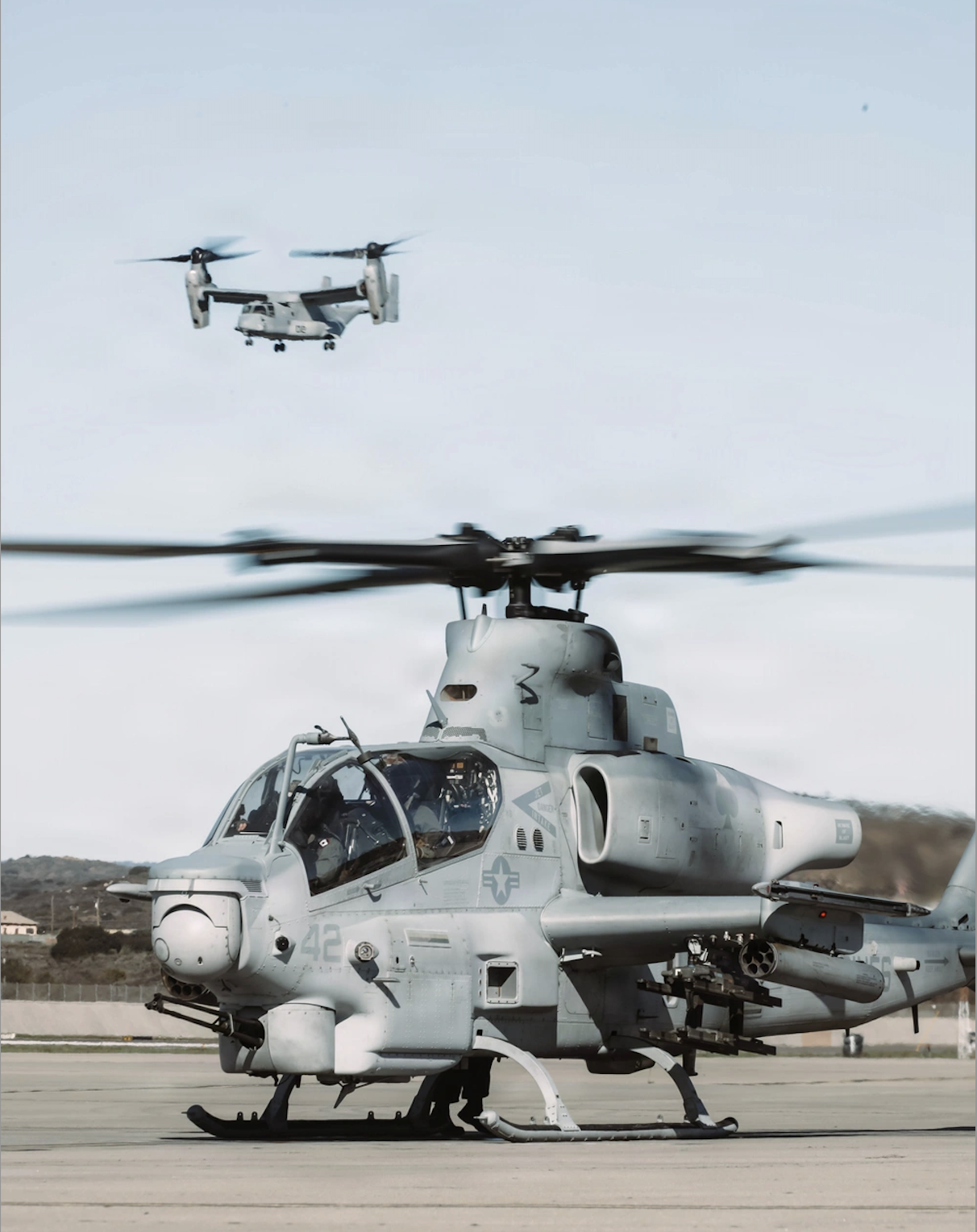
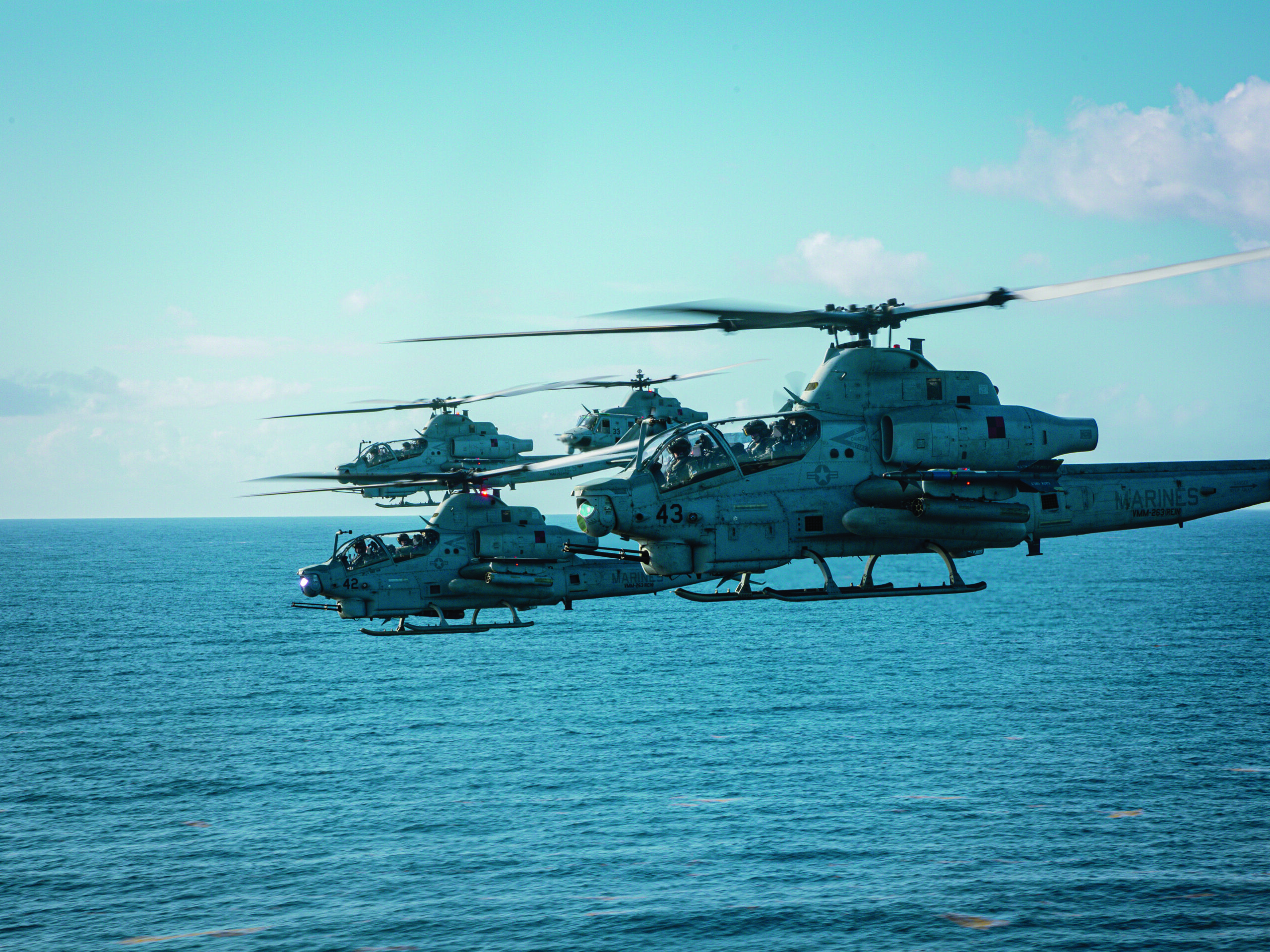
Marine AH-1Z Viper and UH-1Y Venom helicopters with Marine Medium Tiltrotor Squadron (VMM) 263 (Reinforced), 22nd MEU (Special Operations Capable), fly in a formation during operations underway in the Caribbean Sea in September 2025. (Photo by Sgt Tanner Bernat.)

As unmanned aerial systems proliferate and prove effective in conflicts such as the Russo-Ukrainian War, questions have emerged regarding the enduring relevance of rotary-wing CAS. While drones offer low-risk, long-endurance surveillance and precision strike capabilities, they cannot fully replace the flexibility and responsiveness of manned rotary platforms.

Rotary-wing CAS provides commanders with realtime decision making, coordinated fires, and the ability to adapt to dynamic ground combat conditions. Helicopters are not only weapons delivery platforms; they are versatile airframes that can deploy and support drone operations, serve as airborne command and control nodes, and offer casualty evacuation or resupply under fire.

Moreover, CAS conducted from helicopters fosters joint terminal attack controller integration and enhances combined arms effectiveness. This layered approach ensures redundancy and resilience on the battlefield—qualities that are critical in peer or near-peer engagements. A hybrid model that combines rotary-wing CAS with drone capabilities will likely dominate future battlefields.

The MH-60S platform, especially with the armament kit making it an Armed Black Hawk (ABH), supports this hybrid future. It can deliver suppressive fire, coordinate strikes, or act as a launch and relay platform for unmanned aerial systems. Its ability to integrate into naval operations and expeditionary bases makes it a critical enabler of persistent close air support in contested environments.

The Case for the MH-60S/ABH: Flexibility, Interoperability, and Logistics

In addition to its combat utility, the MH-60S enhances the Marine Corps’ ability to contribute to joint operations in other mission areas. When embarked aboard amphibious shipping, Marine-operated MH-60s can augment search and rescue capabilities, providing rapid response and recovery for personnel in distress. This dual-purpose role strengthens naval force protection and humanitarian assistance during expeditionary missions.

MH-60S Sea Hawk on the fl ight deck of the world’s largest aircraft carrier, USS Gerald R. Ford (CVN 78). (Photo by Mass Communication Specialist Seaman Brianna Barnett.)

The MH-60S with the ABH kit offers substantial operational and logistical benefits over the current HMLA construct:

  • Multi-role Capability: The platform performs armed reconnaissance, vertical assault, medevac, ISR, armed escort, and anti-armor missions when equipped with the ABH kit.
  • Naval Integration: Designed for shipboard use, the MH-60S seamlessly operates from amphibious ships (LHDs, LPDs) and other amphibious platforms.
  • Logistics Commonality: Shared components with the MH-60R/S enable integration into the Navy’s global sustainment architecture.
  • Interoperability: Already fielded by partner nations, the platform enhances joint and coalition mission execution.
  • Growth Potential: Capable of incorporating mine detection systems, extended range tanks, and directed energy weapons in the future.

Since logistics often relies on commercial services and contracted sustainment pathways, the Marine Corps would benefit from the MH-60’s alignment with allied logistics infrastructure. The widespread use of H-60 variants across more than 30 countries enables the Marine Corps to tap into allied nations’ parts programs, boosting availability and mitigating domestic logistical shortfalls in a contested or resource-constrained environment. Logistics operations could also hide in plain sight by leveraging the parts commonality with host-nation inventories, allowing Marine Corps supply and maintenance activities to blend with existing allied infrastructure, reducing the visibility and vulnerability of logistical nodes in contested environments. The Marine Corps could also further increase resilience by prepositioning key supplies with allied forces who operate the same platform, ensuring rapid access to critical components in theater and enabling quicker recovery from attrition or supply chain disruption. This global adoption also enables greater coalition interoperability and access to multinational sustainment hubs during joint operations.

Furthermore, the H-60’s operational pedigree is unmatched among rotary-wing platforms. The platform’s modularity has allowed for adaptations across mission sets—from humanitarian assistance to special operations. Most notably, a stealth-modified version of the Black Hawk was used in Operation NEPTUNE SPEAR—the mission that resulted in the killing of Osama bin Laden. This high-risk, high-precision operation demonstrated the H-60’s adaptability, stealth modification potential, and elite mission success under extreme conditions.

Another distinct advantage of the H-60 platform is its ability to conduct aerial refueling, reducing the reliance on aviation-delivered ground refueling. In distributed maritime and expeditionary environments where forward arming and refueling points may be limited or compromised, this capability allows for greater operational endurance and tactical flexibility. Aerial refueling extends mission range and dwell time for rotary-wing platforms, enabling deeper penetration into contested areas without the logistical risk associated with groundbased refueling operations.

The Marine Corps already has VH-60N pilots stationed at HMX-1. These pilots could act as the instructor cadres during the transition. These seasoned pilots possess institutional knowledge of the H-60 platform and could assist in converting both the training pipeline and the fleet, ensuring a smoother and faster implementation of the MH-60 transition.

Organizational Implications: From HMLA to HMMA

Adopting the MH-60S would require structural changes to the HMLA designation and table of organization and equipment. The HMLA designation would need to shift to Marine Medium Attack Helicopter (HMMA) Squadron, reflecting the new platform’s capabilities and dual-role nature. The Marine Corps would require table of organization and equipment changes, as well as updates to training pipelines and maintenance protocols. Since the MH-60 variant can perform both utility and attack missions, the total number of aircraft fielded may be reduced allowing for streamlined fleet management.

Additionally, the reorganization of personnel will be necessary. Fewer aircraft could lead to a surplus of qualified aircrew and maintainers. Rather than reduce manpower, the Marine Corps should repurpose this talent to establish an aviation liaison company modeled after air naval gunfire liaison companies. Instead of coordinating fires, this unit would consist of experienced pilots and maintainers focused on building aviation capacity with allied and partner nations. These teams could deploy to enhance coalition air interoperability, provide training, and strengthen forward aviation operations in alignment with SIF objectives.

This transformation is not without cost, but the benefits are profound. In an era of constrained logistics, dispersed operations, and joint warfighting, the Marine Corps cannot afford to field legacy systems that fail to meet the threat.

Recommendations

  1. Initiate a phased replacement of H-1 aircraft with MH-60S variants equipped with ABH kits.
  2. Redesignate HMLA squadrons as HMMA and revise the table of organization and equipment accordingly.
  3. Integrate training and maintenance pipelines with Navy MH-60R/S programs.
  4. Enhance forward-deployed logistics nodes to support MH-60 operations under SIF doctrine.
  5. Partner with allied forces operating MH-60 variants to standardize coalition interoperability.
  6. Stand up an aviation liaison company to expand partner capacity and joint mission support.

A New Acquisition Opportunity: Capitalizing on Army Transition

The Army is transitioning from the H-60 platform to the Bell V-280 Valor tiltrotor, a move that will phase out thousands of existing Black Hawk helicopters. The Marine Corps could take advantage of this transition by acquiring surplus Army H-60s at a reduced cost and converting them to the MH-60S variant. This would accelerate modernization while avoiding the cost of new airframe production.

Additionally, the Marine Corps could mothball the legacy HMLA fleet. By placing H-1 airframes in long-term preservation, the Service would retain surge capacity for major conflicts while focusing current efforts on building a more integrated and survivable rotary force aligned with SIF doctrine.

The Bell V-280 Valor. (Photo: Courtesy of Bell/U.S. Army Acquisition Support Center.)

Conclusion

The H-1 program has served the Marine Corps with distinction, yet the emerging operational environment demands more. The MH-60S variant—with its modularity, interoperability, and logistical advantages—provides a pathway to modernize Marine aviation. Combined with doctrinal shifts like SIF, adopting the H-60 strengthens the Corps’ ability to operate forward, fight distributed, and support allies and partners across the globe.

Modernizing to the MH-60S not only responds to current operational needs but also prepares the Marine Corps for future contingencies by leveraging the broader DOD ecosystem. If the Marine Corps acquires surplus H-60s from the Army, then it allows for cost-effective transition and rapid fielding. With the excess aircrew and maintainers, the Marine Corps has the capacity to establish liaison elements modeled after air naval gunfire liaison companies and enhance strategic partnerships while preserving legacy platforms for potential large-scale conflict and providing depth in the force.

This transition supports the Marine Corps’ enduring role as a premier crisis response force, ensuring aviation remains a lethal, flexible, and forward-postured capability. Rotary-wing CAS—when aligned with SIF principles and integrated across the naval and Joint Force—remains indispensable. Rethinking HMLA is not merely about replacing platforms but evolving the Corps’ posture to prevail in the contested, distributed fight of the future.


> Maj Healy is a Faculty Advisor at Expeditionary Warfare School.

2025 Aviation Plan Executive Summary

Balancing crisis response and modernization

The Deputy Commandant for Aviation’s (DC A) 2025 Aviation Plan (AVPLAN) was signed and released this past January. The AVPLAN intends to communicate to the FMFs, our industry partners, and Congress, the DC A’s priorities and direction over the next five years, guided by the 39th Commandant’s Planning Guidance and his priorities. Notably, the Commandant’s priority of “Balancing Crisis Response and Modernization” lies at the forefront of this AVPLAN and has guided Marine Aviation’s strategy to maintain a ready and lethal force.

Project EAGLE outlines DC A’s strategy to modernize Marine Aviation across multiple future year defense programs. The Project EAGLE initiative focuses on expanding interoperability with the Joint Force and allies, evolving the Marine Air Command and Control Systems, and incorporating new functional concepts such as Distributed Aviation Operations and Decision-Centric Aviation Operations. We will transform Marine Aviation to meet future operational needs by focusing on unmanned platforms, logistics, digital interoperability, and manned-unmanned teaming, ensuring a competitive advantage in future conflicts and supporting both the naval and Joint Forces across all domains.

To accomplish this, Marine Aviation must be ready. Therefore, operational readiness is the DC A’s number one priority. The challenge is to maintain a high level of readiness and remain lethal to respond to crises while also modernizing aviation capabilities. As we maintain this balance between crisis response and modernization, the DC A will ensure Marine Aviation remains lethal, naval at its core, and ready to respond to crises with the warfighting edge necessary to support our Marines, sailors, and the Joint Force.

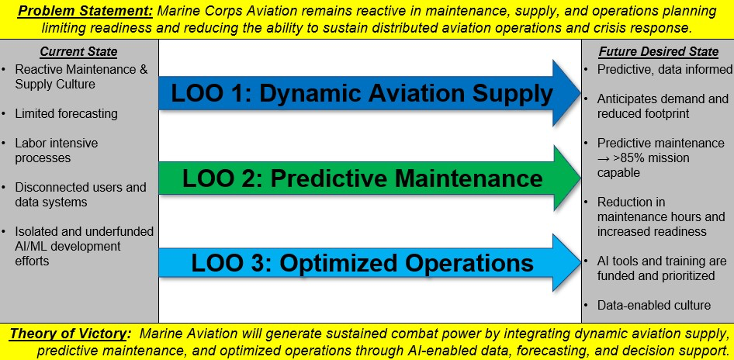
Marine Aviation will also pursue a demand-based sustainment strategy, improving fleet readiness through better collaboration and efficient resource delivery. Efforts are being made to reduce variability in aircraft readiness through optimized maintenance, tooling, and logistics. Sustainment solutions will focus on three lines of effort: improving fleet readiness, enhancing sustainment for distributed aviation operations, and reducing equipment variability. This includes modernizing aviation supply packages, enhancing logistics information systems, and developing a replacement for aging aviation logistics vessels. This comprehensive approach ensures Marine Aviation can effectively support the MAGTF throughout the full range of military operations.

Qualified Marines also remain the key to our ability to meet operational requirements. While each type, model, and series of aircraft is in a different phase of lifecycle and inventory management, Marine Aviation will remain focused on managing aircrew and maintainer inventories by building properly-sized populations in grade, qualifications, and experience levels. To realize these goals, Marine Aviation will first reestablish a manpower management branch within Marine Aviation.

Marine Aviation Capabilities and Commodities
Marine Aviation aims to maintain a powerful and responsive air combat element for the MAGTF. This includes transitioning to an all-5th generation tactical air (TACAIR) fleet and modernizing the air combat element to be ready for combat today and tomorrow. The DC A’s intent is to maintain the current F-35 and CH-53K transition plans while also ensuring each community employs the most ready, safe, and lethal aircraft. 

First, the F-35 B/C provides advanced sensors, air-to-air missiles, and air-to-surface strike weapons, which are crucial for the MAGTF and Joint Force mission globally. By 2025, the Marine Corps will have received 183 F-35B and 52 F-35C aircraft. The F-35 program aims to support 12 F-35B squadrons and 8 F-35C squadrons, with a total of 420 F-35 aircraft. Fleet squadrons will be increased to 12 primary aircraft authorization by fiscal year (FY) 2030. The F-35B/C modernization includes Technical Refresh-3 upgrades, APG-85 radar upgrades, advanced countermeasures, and electronic warfare improvements. The program is focused on Block 4 capabilities, weapons integration, and site activations.

The F/A-18 Hornet provides vital maritime strike and air interdiction capabilities, with ongoing modernization ensuring its effectiveness in the Marine Corps’ TACAIR Transition Plan and global operations. The Marine Corps operates 161 F/A-18 aircraft, transitioning squadrons annually until FY29, with aircrew training now conducted by the Fleet Replacement Detachment at VMFA-323. The Hornet’s increased lethality with the AN/APG-79(v)4 radar and AESA technology, alongside upgrades in electronic warfare, extended-range weapons, and communications. Funding priorities focus on integrating advanced weapons, improving beyond-line-of-sight capabilities, enhancing electronic warfare systems, and supporting precision approach capabilities.

The AV-8B Harrier provides critical Vertical/Short Take-Off and Landing capabilities for the MAGTF, offering precision strike, escort, and rapid deployment for MEUs with advanced targeting and missile systems. The Marine Corps operates 39 AV-8B aircraft across two VMAs, with plans for VMA-231 and VMA-223 to transition to F-35B. The AV-8B will continue supporting training and combat operations for forward air controllers and joint tactical air controllers, providing flexible deterrence and combat capabilities to combatant commanders. Funding will focus on T402 engine readiness, full LINK-16 integration, fleet replacement squadron support, and weapons upgrades.

The KC-130J is a vital enabler for MAGTF success, providing global mobility, logistical support, and aerial refueling across multiple regions with increased capacity in the Indo-Pacific. Four Marine aerial refueler transport squadrons operate 75 KC-130J aircraft with the full transition expected by 2027, which includes a program of record of 95 aircraft. The aerial refueler transport team is working to integrate more effectively with the MAGTF and joint forces by enhancing capabilities like realtime data transmission and adjusting training devices to support expanded training needs. Funding will focus on hardware and software upgrades, integrating MAGTF Agile Network Gateway Link, procuring infrared countermeasure kits, and expanding backup aircraft inventory to maintain operational capacity.

The MV-22 Osprey provides critical medium-lift assault support with unmatched speed, range, and payload, ensuring rapid response for global crisis and humanitarian missions. The Marine Corps has a program of record for 360 MV-22Bs, organized across 16 active squadrons, 2 reserve squadrons, and several test and executive transport detachments, with VMM-264 reactivating in FY26. Ongoing efforts focus on improving configuration management, increasing fleet sustainability, modernizing flight control systems for degraded visual environments, and enhancing interoperability with the MAGTF Agile Network. Funding focuses on safety instrumentation for predictive maintenance, technology replacements to mitigate obsolescence, improved nacelle reliability, and new flight control systems to increase aircraft capability and safety.

The CH-53K King Stallion offers three times the range and payload capacity of the CH-53E Super Stallion. It can transport heavy equipment, troops, and supplies over long distances, ensuring forces remain agile and supported. Operating from both land and sea bases, including austere sites and amphibious shipping, it provides essential flexibility to the MAGTF. The Marine Corps plans to procure 200 CH-53Ks, equipping six active squadrons, one reserve squadron, and various test and fleet replacement detachments, with the full transition expected to be completed by FY32. Key efforts for the CH-53K include focusing on aircraft inventory, sustainment, and capability, with the first MEU detachment expected to deploy by FY27. Funding priorities for the CH-53E include sustainment, safety, and interoperability upgrades, while the CH-53K focuses on supply chain capacity, testing, sustainment, and warfighting capability expansion.

The H-1s are essential to the MAGTF, providing multi-role attack and utility capabilities that enhance lethal and non-lethal options, bridging gaps in low-altitude attack and strike operations. The H-1 Program consists of 349 aircraft, with a total active inventory of 301 aircraft across five squadrons and a planned increase to 314 by FY31. The H-1 modernization plan focuses on improving digital interoperability, survivability, lethality, and electrical power capacity, ensuring the fleet remains versatile and capable of future conflicts. The program’s key funding priorities include digital interoperability, power upgrades, survivability, sensor optimization, and aircrew systems enhancements.

The Marine Unmanned Expeditionary Medium Altitude Long Endurance unmanned aerial systems provide critical capabilities such as airborne early warning, maritime domain awareness, and electronic warfare support. The Marine Corps currently operates 10 MQ-9A Block 5-20 aircraft and plans to field a total of 20 Block 5-25 aircraft with ongoing efforts to establish additional unmanned aircraft squadrons. The MQ-9A program focuses on sustaining operations through contract logistics support and the activation of Unmanned Aerial System Maintenance Squadron 1 (UASMS-1) by FY26 to manage maintenance and sustainment for MQ-9A Reapers. Key funding priorities include Marine Unmanned Expeditionary Medium Altitude Long Endurance unmanned aerial systems procurement, capability spirals, UASMS-1 establishment, and improvements in lethality, survivability, and expeditionary deployability.

The F-5 N/F provides essential adversary training for TACAIR, assault support, groundbased air defenses, and Marine air control squadrons, enhancing combat readiness for Marine aviation and ground units. The Marine Corps currently operates F-5s assigned to Marine Fighter/Attack Training Squadron 401 at Marine Corps Air Station Yuma and Marine Fighter/Attack Training Squadron 402 at Marine Corps Air Station Beaufort, with plans to acquire eleven more aircraft over the next four years to meet growing adversary training requirements. The F-5 fleet is undergoing upgrades, including glass cockpits and Red Net integration, while exploring new solutions like LVC capability and commercial air services to address adversary training gaps.

Marine Corps Operations Support Airwing provides critical air transport for high-priority passengers and cargo, ensuring timely logistical support for forward-deployed MAGTFs. The Marine Corps Reserve Operations Support Airwing squadrons, including Marine Transport Squadron 1, Marine Transport Squadron Belle Chasse, and Marine Transport Squadron Andrews, support active-duty Operations Support Airwing operations and lead the management of UC-12W, UC-35D, and C-40A aircraft. The top priority is the recapitalization of non-deployable UC-12F/M and UC-35D aircraft, with plans to procure additional UC-12W aircraft to meet the program of record. The funding priorities include procuring nine UC-12W aircraft and modernizing UC-12W with digital interoperability capabilities.

The HMX-1’s mission includes worldwide transportation for the President and key officials, supporting high-level travel and operational test evaluations for presidential lift aircraft. The HMX-1 began transitioning to the VH-92A in 2022, with the Marine Corps declaring its initial operational capability in December 2021 and having since integrated the aircraft into operational missions. With a total of 23 aircraft in the program of record, the VH-92A is set to fully replace the VH-3D and the VH-60N, with ongoing improvements in performance for high/hot environments and expanded communication capabilities.

Marine Aviation is advancing new weapon systems to address evolving threats, integrating capabilities that enhance fighter and attack aircraft for global operations. The focus is on munitions with greater range, speed, and lethality to dominate both air and surface domains. Recent efforts have concentrated on integrating net-enabled weapons into the F-35B/C and improving long-range maritime strike capabilities. Key developments include the Advanced Anti-Radiation Guided Missile-Extended Range entry into low-rate production, safe separation testing for the GBU-53 SDB II, and the addition of the Long-Range and Maritime Strike to the F-35B/C roadmap.

The AGM-158C Long-Range and Maritime Strike is a long-range, precision-guided anti-ship missile designed for semi-autonomous engagement of maritime targets. Its integration with the F-35B/C enhances Marine Aviation’s strategic maritime capabilities.

The Joint Air-to-Ground Missile program is undergoing operational testing on the AH-1Z. Its dual-mode seeker and multi-purpose warhead provide enhanced strike precision while its countermeasure resistance and fire-and-forget capability improve survivability in diverse conditions.

Advanced Precision Kill Weapon System II, integrated across platforms carrying 2.75” rockets, offers significant improvements over unguided rockets, particularly in precision targeting. The Single Software Variant, fielded in FY22, provides increased range and accuracy, enabling common use across fixed and rotary-wing platforms.

The AIM-9X Block II Sidewinder introduces lock-on-after-launch with data-link for 360-degree engagements, and its Block II+ variant will support F-35B/C in FY19. The AIM-120 Advanced Medium-Range Air-to-Air Missile, with its ability to engage multiple targets simultaneously, is further enhanced by the AIM-120D variant, featuring GPS, improved data link, software, range, and speed.

The evolving electromagnetic environment necessitates advanced electromagnetic spectrum operations capabilities to ensure the MAGTF maintains superiority and can effectively deny the enemy’s electromagnetic spectrum use while protecting its own. Marine Aviation is integrating the electronic warfare family of systems with a focus on platforms like the UH-1Y, MV-22, and KC-130 while developing capabilities for unmanned systems through collaboration with the Marine Corps Spectrum Integration Lab.

The goal of MAGTF Digital Interoperability/MAGTF Agile Network Gateway Link (DI/MANGL) is to deliver timely, efficient, and secure information across diverse systems to enhance situational awareness, accelerate the kill chain, and improve survivability. The DI/MANGL program is modernizing to align with Combined Joint All-Domain Command and Control standards, advanced tactical data links, and zero-trust architecture, with funding efforts planned for FY26. The DI/MANGL integrates sensors, processors, interfaces, and radios to improve interoperability and situational awareness across the MAGTF, joint, and coalition forces while ongoing efforts expand tactical relevance and mobility.

The goal of aircraft survivability equipment (ASE) is to equip all aircraft with advanced systems that enhance survivability and situational awareness to detect, identify, and defeat anti-aircraft threats while integrating into the MAGTF C2 ecosystem. Current ASE systems include various missile warning systems, radar warning receivers, and countermeasure systems, all aimed at improving threat detection, situational awareness, and survivability across multiple aircraft platforms. Future efforts will focus on integrating multi-spectral sensors and evolving. 

The ASE systems, such as the Next Generation Pointer/Tracker, meet emerging threats and enable interoperability with future platforms. Continued science and technology investments will drive the development of ASE capabilities, ensuring seamless integration into digitally connected networks like the MANGL.

Marine Aviation Enablers
The Marine Air Command and Control System is undergoing significant modernization with new equipment like TPS-80 Ground/Air Task-Oriented Radar, Common Aviation Command and Control System (CAC2S), and Marine Air Defense Integrated System to enhance air battle management, integrated air and missile defense, and multi-domain C2 capabilities. The CAC2S processes and integrates data from sensors and aircraft to support Marine, Naval, and joint aviation operations, while the CAC2S Small Form Factor variant and the Theater Battle Management Core System provide scalable, modern capabilities for distributed command and control.

The Marine Corps is expanding its groundbased air defense capabilities through systems like MADIS, Light-MADIS, and the Medium Range Intercept Capability to defend against a range of aerial threats, supported by the growth of the low altitude air defense community and future participation in the Army’s interceptor development efforts.

Aviation ground support ensures Marine Aviation’s expeditionary capability, providing essential services like airfield construction, aircraft recovery, and refueling at austere locations, supporting advanced base operations and distributed aviation.

The AC2GS funding priorities focus on improving air traffic control and aircraft launch and recovery capabilities, including precision landing systems, inter-facility communications, and airfield lighting. Additionally, funding is directed toward sustaining and enhancing green-dollar air C2, air defense programs, and aircraft rescue and firefighting equipment to ensure readiness and interoperability across joint and naval operations.

4th Marine Aircraft Wing
The 4th MAW plays a vital role in enhancing the MAGTF’s global readiness and flexibility by providing a reserve aviation force capable of responding to emerging threats. This force ensures that the Marine Corps maintains operational depth, which is critical for addressing the evolving demands of modern warfare.

The 4th MAW works closely with active components, strengthening aviation readiness through ongoing support and collaboration with 1st, 2nd, and 3rd MAW units. By transitioning to advanced platforms like the F-35C, KC-130J and tiltrotor aircraft, and integrating rotary, unmanned, and expeditionary aviation enablers, the wing ensures a unified and adaptable force structure ready for global missions.

Expeditionary & Maritime Aviation-Advanced Development Team (XMA-ADT)
The XMA-ADT, established in August 2023, accelerates the acquisition of technologies for Force Design by coordinating with stakeholders and employing operational prototypes to address critical capability gaps in Marine Aviation. In 2024, XMA-ADT focused on enhancing capabilities for Marine Aviation, including MUX TACAIR, Airborne Logistics Connector, Precision Attack Strike Missile, and H-1 Next, with key milestones such as UAS Manned-Unmanned Teaming and successful flight demonstrations for each project. In 2025, XMA-ADT will refine capabilities for MUX TACAIR, continue Airborne Logistics Connector demonstrations with plans for Weapons and Tactics Instructor Course 1-26, and further develop the Long-Range Attack Missile toward achieving a maximum range live-fire shot by the end of the year.

In summary, Marine Aviation continues to be forward deployed and operate from expeditionary sites, joint locations, Navy ships, and strategic main operating bases. As we actively campaign, our focus on balancing today’s readiness with tomorrow’s modernization is critical as we continue to compete, assure our allies and partners, and deter our adversaries. This balance cannot be achieved without direct investment in our Marines, sailors, and aircrew. Their training must be relevant, realistic, and accomplished in the best aircraft and equipment available. Marine Aviation stands ready to fight and win today and into the future.
Project EAGLE

Reorienting Marine Aviation’s Lift Vector toward 2040

Societal divisions, state tensions, and contested international norms are setting conditions for a volatile and potentially dangerous future. Although these conditions are not new to history, the addition of rapidly evolving demographic, environmental, economic, and technological developments present both tremendous opportunity and significant challenges to the Marine Corps.Given these conditions and developments, the Marine Corps seeks to continually refine its understanding of the future operating environment and refine relevant operating concepts to compete beyond 2030.

Most importantly, Marine Aviation must be able to deliver the lethality coefficient to the MAGTF, Joint Force maritime component command, and the broader Joint Force when called upon. To deliver the necessary lethality, Marine Aviation endeavors to lead-turn the acquisition of capabilities and advanced technologies through a Three-Future Years Defense Program (FYDP) plan, starting in fiscal year 2026. We will use Force Design 2030 and force modernization guidance as the strategic waypoint to address current challenges while setting conditions to compete in the next decade. In collaboration and coordination with the Commandant of the Marine Corps’ Office of Net Assessment and the Marine Corps Warfighting Lab’s Futures branch, Marine Aviation will continue to contribute to the strategic design effort by forecasting challenges out to 2040 and establishing a plan that allows Marine Aviation to outpace our adversaries.

Marine Aviation’s Project EAGLE is that plan. Project EAGLE’s embedded three-FYDP plan is the strategic lift vector of Marine Aviation to 2040. The objective is to achieve a framework that enables the Marine Corps to adjust the current Planning, Programming, Budgeting, and Execution Assessments process to meet the correct future operational requirements. The approach seeks capabilities and technological innovations that exceed a single FYDP to provide informed predictability and flexibility. The unconstrained planning of future FYDPs provides opportunities to invest in the current FYDP in the procurement of future technology to match the changing environment and ensure Marine Aviation remains an integral member of the Joint Force.

Fundamentally, war is both timeless and ever-changing. As Marine Aviation adapts and evolves to the changing character of conflict, we shall remain true to our identity and honor all the hard aviation lessons learned over the years. Therefore, Project EAGLE is guided by the following priorities:

  • Support the MAGTF in force modernization efforts via the functions of Marine Aviation.
  • Ensure detailed collaboration and interoperability with the Joint Force maritime component command.
  • Support broader joint and coalition force efforts of interoperability and interchangeability.

Project EAGLE has three phases. These phases are specifically designed to support CMC 38’s initial force design guidance and CMC 39’s force modernization vision. In addition, Project EAGLE phases are intended to provide more analytical rigor to the Marine Corps’ budget planning and programming. These phases also provide an opportunity to communicate a clear and steadfast vision of Marine Aviation to the Department of Navy, Office of the Secretary of Defense, Congress, and industry.

Phase I: Framework Development
This phase began in the summer of 2022 and will continue to be refined throughout all phases. The following were areas of focus during Phase I:

  • Initial research and orientation of historical demographic, environmental, economic, and technological developments, and the impacts of these variables on the current environment.
  • Understanding the future operating environment and emerging trends.
  • Development and research of potential concepts and functions.
  • Initial development of lines of effort (LOEs), roadmaps, and key milestones out to 2040.

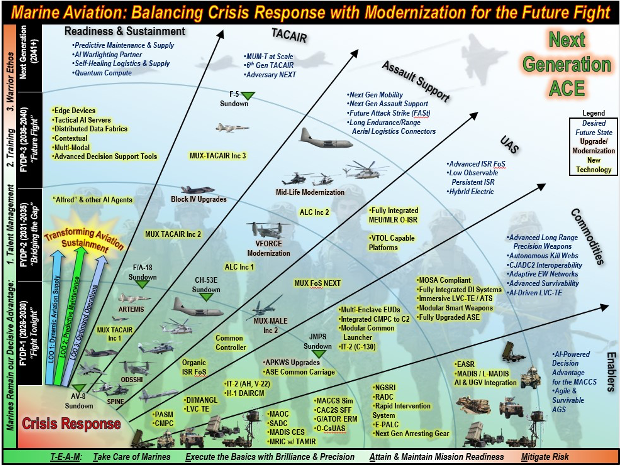
Project EAGLE placemat. (Image provided by author.)

Phase II: New CMC 39 Guidance
This phase began in the fall of 2023 and will continue to be refined throughout Phase III. The objective of this phase is to refine the vision and LOEs developed during Phase I and implement appropriate CMC 39 guidance at the beginning of fiscal year 2024. This phase will also include the publishing of the Aviation Plan (AVPLAN) in December of 2024. The AVPLAN has been a vital tool to communicate the Deputy Commandant for Aviation’s vision and direction to multiple audiences. This annual message will again transmit DC Aviation’s rudder steers and altitude changes to maintain alignment and focus on Marine Aviation’s core responsibility of supporting the MAGTF.

Phase III: Execution
This phase will begin in the summer of 2025 and will continue through 2040. Phase III will incorporate actions from Phase I and II and will introduce FYDP 41–45’s vision for planning.

Project EAGLE Has Five Lines of Effort (LOE)
LOE 1: Concepts
Marine Aviation is looking at the viability of two new concepts: distributed aviation operations (DAO) and decision-centric aviation operations (DCAO) 2040. These concepts are nested with and support expeditionary advanced base operations (EABO), Stand-in Forces, and broader Joint Force operating concepts. These aviation concepts, which will be tested and developed via the Marine Corps’ Concept Generation and Development Process, will drive aviation strategy, doctrine, and acquisition planning.

  • DAO. As part of Force Design 2030 and force modernization, Marine Aviation must further its capabilities for operating in austere and distributed littoral environments as an essential element of the Stand-in Force, and in support of EABO. Included in this functional concept is the need to review the traditional functions of Marine Aviation.
  • DCAO 2040. The central idea of DCAO is to accelerate the decision cycle of the ACE to machine-level speeds using cutting-edge and emerging technologies. The intent is to enable the rapid composition and decomposition of a more distributed force achieving the benefits of mass while minimizing the risks associated with concentration. Current studies are underway to assess the full requirements and efficacy of DCAO 2040. However, DAO is the first step towards DCAO 2040.

LOE 2: Functions of Marine Aviation
Marine Corps Warfighting Publication 3-20, Aviation Operations, directs planners to consider aviation functions when conducting aviation planning and not the means available (i.e., weapons systems or platforms). The role of the Marine Aviation functions is to provide a framework for planners in planning aviation operations, but this requires having relevant aviation functions.

The existing six functions of Marine Aviation (offensive air support, anti-air warfare, assault support, aerial reconnaissance, electronic warfare, and control of aircraft and missiles) were critical to the Marine Corps’ success in conducting expeditionary land and amphibious operations. However, based on the changing global environment and technological developments, a modernized Marine Aviation functional framework is necessary for planners to approach today and tomorrow’s maritime campaigns. Current studies are underway to assess the efficacy of expanding the functions of Marine Aviation to better support joint and coalition forces in a maritime campaign.

LOE 3: Digital Data-Centric Culture
To maintain a competitive advantage in future conflicts and meet the current mission requirements, Marine Aviation will embrace a digital data-centric culture, equip the ACE with cutting-edge artificial intelligence (AI) tools and knowledge, and enhance the Marine Corps’ asymmetric warfighting capability leveraging AI and other emerging technologies. Marine Aviation is dedicated to creating a digital data-centric culture where AI agents serve as a force multiplier and a teammate in the ready room, on the flight line, in the field with our enablers, and in the cockpit. When fully integrated into aviation operations, AI agents will enable the seamless and rapid move from in, on, and out of the loop against our adversaries.

Becoming a data-centric and data-enabled organization will enhance Marine Aviation’s culture, risk management, efficiency, effectiveness, and decision making. Such a change requires leadership at all levels, trust in data, and investment in infrastructure, personnel, and training. Developing a digital data-centric culture within Marine Aviation will be challenging at first, but it is a key component to supporting force modernization efforts, DAO, and DCAO 2040 concepts.

LOE 4: Three-Future Years Defense Program
LOE 4 will address the specific priorities and allocation of resources and funding across the next three FYDPs to support the future vision of Marine Aviation encapsulated in Project EAGLE.

LOE 5: Roadmaps
The following proposed roadmaps for Project EAGLE involve multiple key stakeholders within HQMC and will require detailed collaboration and coordination across the enterprise for implementation.

  • Vertical Takeoff and Landing Development Portfolio.
  • MAGTF Unmanned Expeditionary Development Portfolio.
  • Aviation Command and Control and Ground Support.
  • Aviation Sustainment 2040.
  • Infrastructure Roadmap 2040.
  • Ranges Roadmap 2040.
  • Live/Virtual/Constructive Roadmap 2040.
  • Aircrew Recruitment and Retention Roadmap.

Image
Structural forces, emerging dynamics, and advanced threats require a new and evolving Marine Corps operating concepts out to 2040. (Photo provided by author.)

Bottom Line
Structural force changes, emerging technologies, and advanced threats require new and evolving Marine Aviation operating concepts to deliver the lethality coefficient when required. First, DAO, DCAO 2040, and decision-centric concepts provide pathways into fighting in future operating environments. Second, the review of the six functions of Marine Aviation is essential to supporting EABO, joint operating concepts, and Force Design 2030. Third, transformational capabilities such as AI, ML, and the cultivation of a digital data-centric culture will equip Marines with digital tools and knowledge to enhance their warfighting capabilities within the ready room, on the flight line, in the field with our enablers, and in the cockpit. Project EAGLE reorients Marine Aviation’s lift vector and is the next waypoint in the Commandant’s vision for force modernization to ensure the Nation’s 911 force remains agile, dynamic, and ready.

>LtCol Robillard is currently assigned as the Lead Aviation Strategy and Plans Officer for Headquarters, Marine Corps Department of Aviation.

Notes

1. Office of the Director of National Intelligence, Global Trends 2040–A More Contested World, (Washington, DC: 2021).