
MCRD San Diego Marks its Centennial

West Coast Base Blends Historic Architecture With the Corps’ Modern Mission

By Barbara McCurtis
Image

One of the first platoons to graduate from the new West Coast Recruit Depot in San Diego, Calif., was 4th Plt, Co C, on Sept. 28, 1923.

Marine Corps Recruit Depot San Diego is celebrating its 100th birth­­day and its beginnings are quite interesting. Following World War I, San Diego, Calif., was a sleepy border town struggling to establish a stable economic base that would attract new residents and generate prosperity. The main thing the area had going for it was perfect climate.

The city’s chamber of commerce, led by a powerful group of local citizens, began courting the Department of the Navy to select San Diego as its southern Pacific port. Initial efforts were rejected as the Navy did not want to invest in an undeveloped location. The group then began lobbying President Theodore Roosevelt. In 1908, the fleet was passing San Diego on its world tour and the committee made a bold move. They raised more than $20,000 and chartered a fishing boat to take the mayor and a group of directors 600 miles south to intercept the fleet off the coast of Mexico. They pleaded their case on the foredeck of a battleship, and the admirals agreed to stop outside the bay of San Diego as the harbor was too shallow, narrow and dangerous.

When the fleet landed on April 15, 1908, they were greeted with parades, cere­monies, balls, guided tours, dinners and other functions in the homes of prom­inent San Diegans. The visit was such a success the group began to pursue oppor­tunities to improve the harbor. Meanwhile, a rev­olution in Mexico brought the Ma­rines to the area. The United States activated the 4th Marine Regiment to support the existing regime in Mexico. At that time, limited operations had been conducted in many parts of the globe in support of national interests.
Image

Marines aboard MCRD San Diego, Calif., run along Hochmuth Ave., during a 3-mile run to celebrate the Marine Corps Birthday on Nov. 5, 2015.

In March 1911, the 4th Provisional Brigade, under Colonel Charles A. Doyen, sailed from San Francisco to San Diego where they waited on Navy ships for orders south. After a week of waiting, Doyen and his Marines disembarked on March 20 and set up a temporary camp on North Island they called Camp Thomas, in honor of Rear Admiral Chauncey Thomas, Commander of the Pacific Fleet. North Island was one of two islands that transformed San Diego Harbor from a broad bay, wide open to the Pacific Ocean, into a landlocked harbor on the Pacific Coast. A flat spot of sand and scrub growth, the camp allowed the Marines to conduct physical exercises, close order drill and marches under full packs. Marksmanship training was carried out on a range that had been constructed by First Lieutenant Holland M. Smith.

By the end of May the revolution was over, and the 4th Provisional Regiment was disbanded. In 1912, William Kettner, Director of the San Diego Chamber of Commerce, was elected to Congress. Kettner used his new position to find federal funding and eventually persuaded Congress to appropriate $238,000 to dredge San Diego Harbor. This was an important first step in making San Diego a Navy town.

Trouble with Mexico occurred again in 1914, and the 4th Regiment was in camp on North Island under the command of Colonel Joseph H. Pendleton. Col Pendleton saw San Diego as a strategic point for the Marines to train and embark quickly for expeditionary duty. He was not alone in this idea; Marine officers had been recommending a permanent advance base regiment since 1911.

Image

Tents that serve as quarters for leathernecks from 4th Marine Regiment line the beach on North Island, Calif., in 1914.

In camp on North Island, Col Pendleton took every opportunity to generate sup­port for the Marine Corps. Interested in local affairs, he rarely turned down an invitation to attend civic functions. He held an open house every Tuesday and Thursday and hosted the regiment parade for public viewing.

Pendleton’s presence in the city is well-documented in the photographs of the Panama California International Exposition as well as more than 15 articles written on him in the local newspapers. He was sought after as a speaker for civic engagements and soon became a close associate of local leaders to include Congressman Kettner, who became a strong advocate for a permanent Marine Corps installation in San Diego. Before and during the exposition, Kettner pre­pared the city for new military installations when he deepened the harbor and added a coal wharf and fuel oil station and a Navy radio station in Point Loma.

Franklin D. Roosevelt, the Assistant Secretary of the Navy, inspected the area in April 1914 and recommended San Diego as the site for an advanced base. His proposal was approved and the 4th Regiment, ordered ashore at San Diego for an indefinite stay, became the nucleus of the West Coast advance base force. The Marines remained in Balboa Park after the Panama-California Exposition ended, and leased buildings that were part of the exposition and used them for barracks, work spaces and offices.

The 1916 Naval Appropriation Act ap­proved $250,000 to purchase 232 acres of tidal land abutting Dutch Flats, where the San Diego River frequently emptied into San Diego Bay. Dutch Flats was a low-lying marsh near downtown that was covered with water at high tide. Con­gressman Kettner had a home that overlooked the eyesore that was Dutch Flats, and he convinced Pendleton that Dutch Flats was the perfect spot for the Marine base. The San Diego airport was also in Dutch Flats. The airport would be dedicated in 1928, but by 1934 it was crowded with two flying schools; United, American and Western Airlines; Ryan Aircraft and the Marines. Located in the center of the city, the airport’s proximity to downtown gives it little room to ex­pand due to lack of land space and the environmental impact of neighboring communities.

May 15, 1917, reported that Congress had appropriated $250,000 to pay for the land for the Marine base. On Dec. 1, 1921, Col Pendleton raised the flag and the base officially opened. The new San Diego base was the Marine Corps’ first purpose-built installation. Prior to this, Marines were tenants in Navy Yards or occupied former Army or Navy installations and either expanded or remodeled them for their own purposes. The architect for the new base was Bertram Goodhue, the principal designer for the Panama-California Ex­position buildings in Balboa Park.

The original land parcel that abutted Dutch Flats was 232 acres. Eleven dif­ferent land acquisitions from 1916 to 1942 state the base acquired 890 acres. In 1948 the Marines relinquished 245 acres to the airport for construction of a new terminal. The proximity to the airport has created what one commanding general referred to as the San Diego Pause; that interval of time when multiple planes are taking off and individuals speaking outdoors must stop speaking.

Goodhue’s original plan for the base used the Spanish Colonial Revival style architecture featured in the exposition and called for 46 buildings according to a Los Angeles Times report in 1919. The barracks would be linked by a great arcade facing the parade ground; secondary structures would form a long axis behind the arcade creating a series of courtyards. Six major support buildings and small utility structures were completed from 1922 to 1923. During the 1920s and 1930s, the primary function of the base was supporting Marine Corps expeditionary operations. In August of 1923 that changed when the Marine Corps Recruit Training Depot for the West Coast relocated from Marine Barracks, Navy Yard on Mare Island.

The first group of recruits arrived in San Diego on USS Sirius (AK-18). Major E.P. Moses was the officer in charge of recruit training. At that time, the recruit depot had three departments: the recruit detachment, which consisted of all the recruits in training; the personnel section; and the recruit depot detachment which was made up of the depot’s permanent personnel and Sea School. The 4th Reg­iment, nicknamed “San Diego’s Own,” was serving on expeditionary duty and did not return to San Diego until 1924.

In 1924, the base was redesignated Ma­rine Corps Base, Naval Operating Base, San Diego and served as the headquarters for Observation Squadron One, the oldest organized air unit in the Marine Corps. Aircraft were stationed across the bay at North Island Naval Air Station at Coronado, Calif. An emergency expansion of the base began in September 1939 with construction of 27 new storehouses, a defense battalion barracks, mess facilities, hundreds of 16-man prefabricated metal huts for the recruit depot, post exchange, recruit parade ground, neuro-psychiatric building, dental and dispensary quarters, new roads, and a railroad. When the De­partment of the Navy authorized the Ma­rine Corps Women’s Reserve in 1942, several buildings were constructed to house and support female Marines. The first Woman Reserve (WR) officer as­sumed her duties the week of Sept. 25 and by the end of 1943, 187 WRs were sta­tioned on base. When World War II ended, the base focused on demobilization for thousands of Marines returning from the Pacific. WW II had a significant impact on the area; by 1942 San Diego’s popula­tion swelled so much in a single year that it surpassed the projected pop­ulation growth for the next two decades. A large portion of the new arrivals were military personnel and their families.

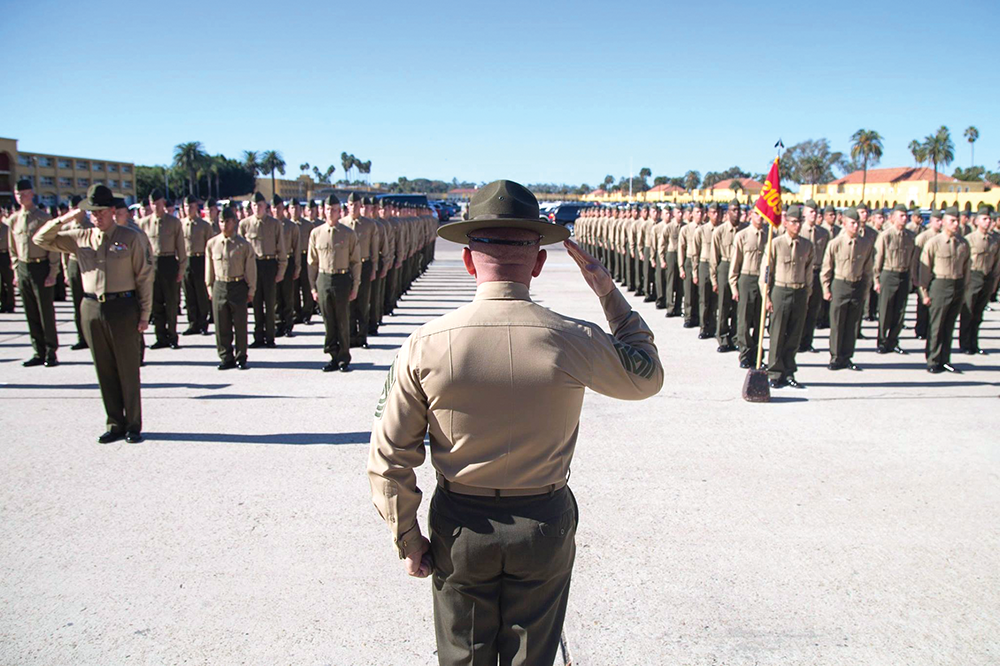
Image

Marines of “Fox” Co, 2nd Recruit Training Bn, stand in formation during a graduation ceremony at MCRD San Diego, Jan. 15, 2021.

In 1948 recruit training became the principal tenant, and the base was re­designated Marine Corps Recruit Depot San Diego. The Korean War in the 1950s resulted in a need for housing for returning reserve Marines and new recruits. Tents were assembled on the parade deck for billeting, and the base also built hundreds of Quonset huts. The 270 corrugated galvanized steel huts were in the western area of the base with 180 additional huts located adjacent to the parade deck. Each hut housed 24 recruits.

The depot also served as a staging area for reserve Marines recalled to active duty for the Korean War. The Marines were quickly processed through medical, legal and administrative procedures on and then transported to Camp Pendleton to join new units. The units would eventually be shipped out from San Diego’s Broadway pier as they had during WW II. Col Pendleton’s foresight for the base to be quickly able to support expeditionary needs had proved true.

President John F. Kennedy visited the base on June 6, 1963. A pair of brass foot­prints were created on the site where he stood, with his feet at a 45-degree angle, just as Marine recruits stand on the yellow footprints at the start of recruit training. Dating back to at least June of 1963, gen­­erations of recruits have started their Marine Corps training by standing on the yellow footprints painted outside the receiving building at the Recruit Training Regiment.

The rapid construction of facilities for recruits occurred on the depot during WW II, Korea and Vietnam. In 1967, con­struction began on the first two of five new per­manent “H-style” barracks. Each barrack was three stories high and was designed to house 900 recruits. The depot used the Quonset huts and tents to house the large number of men reporting due to the draft before the barracks were completed.

The end of the Vietnam War and sub­sequent fewer recruits in training meant changes on the depot. In 1972, the final H-style barracks were completed, and 242 Quonset Huts were demolished two years later. In 1976 the correctional facility was demolished, and Recruit Training Reg­iment moved into offices on the arcade vacated after Communication and Elec­tronic School moved to Twentynine Palms in 1975.

The depot has had as many as five Ma­rine Corps schools as tenants over the years. Sea School was a tenant from 1921 until its closure in December 1987. In 1965, Field Music School consolidated with a like unit at Parris Island. Recruiters School was established on Parris Island in 1947 and San Diego opened its school in 1971. The two schools eventually were consolidated in San Diego in 1972. Both depots have had their own drill instructor schools since WW II.

The needs of the Marine Corps have always ruled the demolition and con­struction of buildings and tenant com­mands on the depot. In 1976 the depot was redesignated Marine Corps Recruit Depot and Western Recruiting Region after the addition of the recruiting head­quarters. Women were no longer in sep­arate companies and the new enlisted barracks model of two person rooms was developed. By 1985, the Women Ma­rine and Staff Noncommissioned officer barracks were demolished.

In 1987, Headquarters Marine Corps directives increased recruit training in support of basic warrior training. General Alfred M. Gray, the 29th Commandant, was looking for more meaningful physical exercises such as forced marches and confidence courses.
In 1988 the base opened a Command Museum and to this day, the recruits receive history classes taught by docents, most of whom are retired Marines. The docents use the displays in the museum to reinforce Ma­rine Corps history lessons. New Marines escort their families through the museum retelling the history they have learned from the docents on every Family Day.

In 1991, 25 buildings aboard the base were added to the National Register of Historic Places. In addition to the build­ings, 110 acres of land including the parade grounds, was delineated the Historic District. The depot was nominated for the register because of the significant archi­tecture and the arcade, a covered walkway north of the parade ground, more than 1 mile long that contains nearly half of the buildings. Other historic places include the commanding general’s residence and garage, four married officer’s quarters and garages, the depot disbursing office, Headquarters and Service Battalion head­quarters, the Command Museum, and the Recruit Training Regiment headquarters.

In 1996, the 31st Commandant of the Marine Corps, General Charles C. Krulak, established “The Crucible.” Gen Krulak called the Crucible “the defining moment in a young Marine’s life.” It is a grueling test every recruit must pass to earn the title “Marine.” The Crucible and rifle range training for recruits are conducted at Weapons Field Training Bat­talion which is part of the Recruit Training Regiment but located on Camp Pendleton.

Rifle range training for recruits had been conducted on Marine Corps Base San Diego which was about 13 miles north of San Diego and built by the Marines in 1916. In 1942 the Secretary of the Navy redesignated it as Camp Calvin B. Matthews. Progressive and continuing growth of the city of San Diego in the vicinity created hazardous conditions and in August 1964 the property was trans­ferred to the Regents of the University of California. Rifle range training was re­located to Weapons Training Battalion at Marine Corps Base Camp Pendleton and formally dedicated as the Edson Range Area Sept. 21, 1965.

Recruits are bused to Weapons Field Training Battalion in their second phase of training for rifle qualification. They live on the base for two weeks and return to San Diego to start the next phase of training. In the last phase of recruit train­ing, recruits are again transported to Weapons Field Training for the Crucible. One distinctive aspect of the MCRD San Diego Crucible is “The Reaper,” the grueling steep ridge of rugged terrain that recruits hike carrying 55-pound packs to conclude the event.

New facilities constructed in the early 2000s have energy efficient designs that save money. Physical training fields feature artificial turf cutting down on water use. In September 2007 a new 47,360 square foot Recruit Clothing Issue facility consolidated five facilities in one location. The building has four uniform alteration bays, phase lines for clothing issue, administrative offices for staff, a high-bay warehouse, and a DI lounge.

In 2009 construction of two new bar­racks, a recruit rehabilitation facility, and several independent restrooms were planned as part of the Grow the Force Initiative. The project was part of $175 million awarded to MCRD to upgrade facilities. The upgrades allow the Depart­ment of Defense to utilize the base in the case of a large war or natural disaster. The new barracks were designed with “Black/Grey” water recycling, energy saving elec­tronic monitoring systems, separate laundry facilities and a local area network.

Major changes also have affected the training schedule with the start of inte­grated training in 2020. Three female Marines completed DI school at MCRD San Diego for the first time in December, 2020. In February 2021 the first female recruits reported for training and grad­uated in May. The second in­tegrated class started training Oct. 29, 2021 and is scheduled to graduate Jan. 21, 2022.

Integrated training and new efficient facilities are signs of the future. That they take place on this space created 100 years ago is a blend of old and new. The San Diego Chamber of Commerce was seeking a new path for the city in 1911 when it pursued the Navy. When the exposition broke ground in 1911, San Diego was an optimistic, progressive metropolis of almost 40,000 people.

The chamber of com­merce directors were correct: military bases produce pos­itive economic impact. Military-re­lated spending in San Diego County grew by 5.4 percent in 2021. An annual report released by the San Diego Mil­itary Advisory Council reported that government spending associated with the defense industry in San Diego amounts to 25 percent of the local economy. That same report claimed almost 350,000 jobs can be attributed to the defense industry. About 23 percent of the total labor force in the region works, directly or indirectly, in service of the military.

The relationship between MCRD San Diego and the surrounding community has changed over the years. Urban en­croachment has been held at bay yet remains in the background. Friday parades are still popular with visitors. Training methods may change, but the mission of making Marines remains. The iconic architecture of Marine Corps Recruit Depot San Diego is a historic place, one that echoes with the memories of 100 years of marching feet and cadence calls.Author’s bio: Barbara McCurtis served in the Marine Corps from 1976-1998, retiring as a first sergeant. She earned a bachelor’s degree in journalism and worked for a weekly paper. After earning a master’s degree in public history, she was a curator for the San Diego Hall of Champions Sports Museum and served as the director of the Marine Corps Recruit Depot Command Museum. Prior to retirement in 2018, she was the MCRD Historian and the History In­spector for the Commanding Generals Inspection Program.

One Marine’s Return to Adak island, Alaska

By Dr. Barry Erdman

Image
Looking east from the Marine barracks in Adak with the Great Sitkin volcano visible in the distance during the winter of 1980.

Background


The island of Adak, Alaska, is about 1,250 miles west of Anchorage, and sits in the middle of the Aleutian chain of islands in the Bering Sea. Adak is about 32 miles long and 22 miles wide, and the tallest peak is Mount Moffet at 3,924 feet. Adak’s northern portion was formerly a military installation but is now owned and managed by the Aleut Corporation, and the southern portion is managed by the U.S. Fish and Wildlife Service as a refuge and preserve.


Adak’s climate is austere, harsh and demanding for its inhabitants. Due to the extremely remote location, it was considered a hardship duty station for servicemembers assigned there. Many Navy personnel called it, “The Rock,” given the volcanic nature, and it was also well known as “The Birthplace of the Winds.”

Due to the island’s strategic location, it is replete with American military his­tory. On Aug. 30, 1942, the U.S. Army came ashore at Kuluk Bay on Adak. The Japanese occupied the nearby islands of Attu and Kiska in the Aleutians in their advancement in the Pacific. To prevent further advancement, Adak was chosen by the United States as a base of operations to launch attacks on adjacent Japanese occupied islands.


Ultimately, a base was set up on Adak that held more than 100,000 American mil­itary personnel during World War II. Two separate airfields were constructed along with a seaplane base. American sub­marines fighting in the Pacific could seek refuge there for resupply and refueling.


After WW II ended, Adak’s strategic importance was diminished, and the base was turned over to the U.S. Navy, be­coming Naval Air Station Adak. During the Cold War, Adak once again became a major strategic location, since the Kamchutka Peninsula, a part of the Soviet Union, was only about 450 miles away.


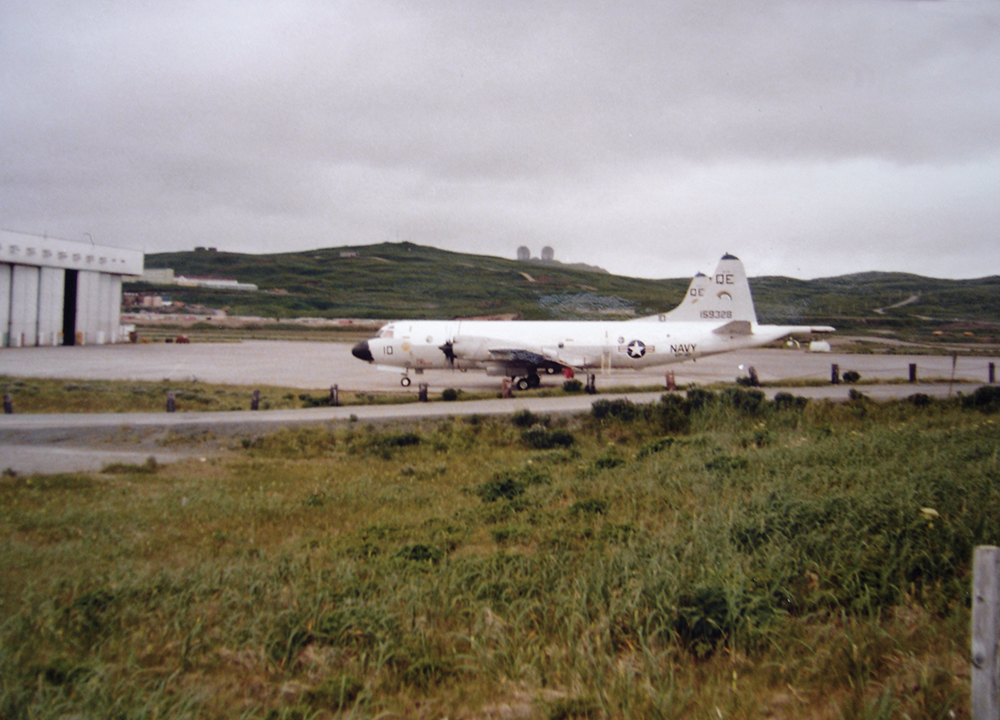
In the 1950s, Adak became a location for fleet communications, listening posts, an underwater sonographic post, and a support base for Navy ships as well as the P-3 Orion, the Navy’s anti-submarine patrol aircraft. As the Cold War intensified, so did the need for the strategic placement of weapons of mass destruction, and Adak became a weapons storage facility.


The Marine Corps established a pres­ence on Adak in the 1950s due to the need for base security. The weapons storage facility on Adak was known as the Ma­rine Airborne Underwater Weapons Com­pound, or to Marines there, “The Pound.”

The end of the Cold War and subsequent reduction in the U.S military and its bases resulted in the closure of NAS Adak in 1997. During the Cold War, there were approximately 6,100 military and civilian personnel on the base. That dwindled to 300 residents pre-COVID-19, with about 62 residents remaining today.


Image


Foreground: A view of base housing and hangars with three parked P-3C Orion aircraft. Great Sitkin Island, a semi-active volcano, is visible in the background.

The Marines on Adak Island

The Marines’ mission on Adak during the Cold War was to provide security at the weapons storage compound and other then-classified military installations on the island, such as Naval Security Group Activity and Naval Facility, both listening posts. The Marines also provided backup security for the island’s naval police force as needed.


There were usually 150-160 Marines stationed on Adak who were organized into three platoons—an admin platoon and two guard platoons, called the 1st and 2nd guard platoons respectively.


I was with the 1st Guard Platoon. The commanding officer was a major with a captain as his executive officer and one lieutenant serving as a platoon commander.


The Marine barracks were located on Bering Hill and overlooked Adak City. The top decks housed berthing for the single Marines with administrative officers on the first deck. They housed some noncommissioned officers and junior Marines, while base housing housed the officers and married and some single NCOs.


In the mornings when the clouds lifted, I had beautiful views of the Alaskan scenery, the rolling bright green tundra hills and snow-covered mountains. The climate was temperate with average 50-degree summers and 30-40 degree average winters, but high winds drove the temperature down. Precipitation was almost daily throughout the year with rain in the fall, spring and summer, and plenty of snow in the winter. On average, there were about five or six days or so of all-day sun in the summer, and when that hap­pened, schools on the island were closed so the students could enjoy the day.


Snowstorms were frequent and came and went when least expected in the winter. The severe storms were called “Williwaws” by the indigenous Aleuts as the snow would come down horizontally due to wind blasts. These storms were abrupt, without warning, and came and went in an instant. “White-outs” were defined as when you held your arm outstretched and you could not see your hand. These were also frequent in the winter on Adak.


Behind the Marine barracks was the Marines’ enlisted club called Tundra Tavern. The Marine Corps Ball and mess night were always held there. At Tundra Tavern, Marines could unwind when off duty with beer on tap, billiards and pinball machines. The open garages that housed bus, patrol and armored vehicles and search and rescue tracked vehicles, as well as a small enclosed and well-protected ammo bunker, were also located behind the barracks.


All buildings on Bering Hill could be traversed via a combination of above-ground and underground tunnels which enabled the Marines to reach recreational facilities including the gym, indoor pools, bowling alley and theater in poor weather. Elsewhere in Adak City, below and south­east of the Marine barracks, were multiple specialty hobby buildings.


The weapons compound where we worked was a short distance from the Ma­rine barracks. The guard platoon would be bused to the compound for a one week stay. The compound itself was shrouded in mystery. None of us young, enlisted Marines actually saw or even knew what we were guarding at the time as it was shrouded in secrecy. I later learned that we were guarding up to 70 M57 nuclear depth charges which had up to a 10-kiloton capacity each.


The Kamchutka Peninsula of the Soviet Union contained Soviet nuclear ballistic missile submarine bases, and its sub­marines roamed the Pacific Ocean. The M57 was destined for those submarines in the event of war. The M57 weapon would be released from a P-3 Orion sub­marine patrol aircraft and set to go off at a cer­tain depth to cause any submarine in a targeted area to implode. Apparently, there was always a Soviet Foxtrot class diesel-electric attack submarine within 5 miles in waters off Adak Island during the Cold War. The P-3 Orion aircraft had a magnetometer probe on its tail to detect the presence of underwater metal anom­alies, as well as drop sonobouys that would float for several days and send signals to the P-3 Orion aircraft to determine sono­graphically what was lurking below in conjunction with the land-based listening posts on Adak Island.


The weapons compound and adjacent areas on Adak were an exclusion zone where the use of deadly force was au­th­orized. From afar, the compound looked like a well-secured federal prison. The compound had an entrance gate with an adjacent two-story guard tower, an inter­nal as well as external barbed-wire fence enshrouded in layers of razor tape, and an internal “no man’s land” in between. Within the compound, there were three primary structures—the weapons mainte­nance building, the heavily fortified Marine “mini-barracks” that housed the Marine guard unit, and the weapons ordnance bunkers that contained seven bomb-blast protected doors. The first two bomb bunker blast doors housed the nuclear warheads, and they were ready access in the event of war as a short dis­tance away from the weapons compound. The other five bunkers contained con­ventional ordnance and ammo and explosives.


The compound was heavily guarded all days and times of the year. There were always two armed sentries on foot patrol around the immediate inside perimeter of the compound, each armed with an M16A1 machine gun and 200 rounds of ammo, a flak vest, a radio and a pair of binoculars.


The Marine barracks within the com­pound, where Marine guards would stay for a week at a time, had its own galley, mini-gym and berthing quarters as well as an armory and ammo bunker. It was completely self-contained. There were enough Marines there within the com­pound to serve as a quick reaction force until reinforcements from the main barracks arrived if needed.


As a Marine Security Unit, we were trained and equipped to ward off a land-based Soviet attack on the compound. More than likely, in the event of a nuclear war, Adak would have been dealt a pre-emptive first strike itself with a Soviet nuclear weapon, given its strategic lo­cation and what was on the island at the time.


Other facilities for which Marines pro­vided security were the National Security Group Activity Complex and Naval Facili­ties building at the northern parts of the island near Clam Lagoon. These were highly classified listening posts at the time with underwater sonographic facilities and extensive computer networks.


We had regular react drills but a Ma­rine never knew a drill from the real thing when a react was called. When a react was called, an off-duty Marine on Adak dropped everything and reported im­mediate­ly to the barracks, ready to do battle in defense of the weapons com­pound. During a react, Marines at the primary barracks were assigned to certain check and operational points on the island in full battle rattle. The Marines at the Weapons Compound had their own mission in defense of the complex and the immediate surrounding area.


Training outside the barracks entailed a variety of activities, including rappelling at Checkpoint Two and squad close quar­ters combat training using old WW II Quonset huts and old cabins in the hills of Adak. Combat training with advance­ments stomping through tundra grass-laden hills was always a work-out, carry­ing a rifle or heavy machine gun, with full combat gear through tundra grass that can be ankle, then knee, then waist deep.


Range day happened three to four days per year. All weapons were fired at targets positioned in the tundra. When you fire a .50-caliber in the tundra, we called that “toupee shooting,” as when a .50-cal. round impacts tundra grass, a chunk of dirt and tundra grass flies at least 20 feet in the air, straight-up. It looks like a toupee has been blown off of someone’s head. Since the tundra is so thick and the underlying permafrost is soft, mortar rounds did not always go off. Efforts to remove unexploded ordnance are still ongoing.


Adak was a two-year duty station for Marine officers and staff NCOs; however, for the young Marines on Adak, it was a one-year duty station. Many Marines took up bodybuilding or a regular exercise program, became music addicts with elaborate stereo systems procured at the PX, ventured out hiking and enjoyed the Alaskan landscape, or pursued either a new or existing hobby such as photography at one of many individual hobby facilities that were available on station. Some Ma­rines pursued education opportunities.


When off-duty, a Marine could spend a weekend hunting caribou, fishing for salmon, or spending time at an old cabin or Quonset hut that had been repurposed for leisure. Other options included “tundra-stomping,” which meant hiking the island to various WW II historic sites.


Image

On a recent return visit to Adak, Alaska, Dr. Barry Erdman looks down at the rack he slept on 41 years ago at the Modified Advanced Airborne Underwater Weapons Complex/Compound barracks.

My Story, Then and Now—Adak as it now exists in 2021

I landed on Adak Island in 1979 when I was 17 years old. It was my first duty station in the Corps. I recently returned, over 41 years later, for a five-day visit in August of 2021.


Through the years, I would occasionally think of Adak and wonder what it was like now and how I would react if I returned. The last 10 years or so, I searched many YouTube videos on Adak to try and satisfy my curiosity.


In 2019, I caught up with a childhood friend of mine, Alaska Airlines 737 pilot Fred Ripp. Fred has flown in and out of Adak many times through the years, and we decided to make the journey together.


Armed with far more wisdom and much more educated, older, well-traveled and experienced in life, I came in with a much different and very positive perspective.

The Aleut Corporation gave Fred and me an unrestricted permit to explore all sites and abandoned buildings and structures that are not privately owned on Adak. We stayed at the Aleut Inn which is repurposed base housing for civilian use. We secured a pick-up truck for the duration there as well. We had to fly in our own food as food is extremely expensive on Adak, and the local store is open only a limited time.


The flight to Adak is nothing like it was when I was 17. Back then, Marines flew in on a Lockheed-Electra turboprop airplane. Now, it’s an Alaska Airlines 737 with all modern conveniences. Passengers on flights to Adak include commercial fisherman crews, caribou hunters, salmon and halibut fisherman, bird watchers and to a lesser extent, civilian contractor workers.


Boarding the flight to Adak from Anchorage, I felt I was taken back in time. The many thoughts and feelings that raced through my mind, coupled with that melancholy feeling, were incredible. The three-hour flight from Anchorage gave me plenty of time to gather my many thoughts.


When preparing to land, we circled the island, and I saw bays and outer islands I did not see so long ago. Adak was en­shrouded in clouds and a light mist just as it was when I left. Mount Moffit was to the left. I had looked at that beautiful mountain from my window at the barracks every morning I woke up when stationed there, and I marveled looking out at it. The Marine barracks was to the right. From the air, the barracks still looked intact as I remembered. It felt good to see it.


As we landed, the abandonment of the base elements of Adak City became readily apparent. Many Cold War military buildings had been left to the elements. It had an eerie apocalyptic appearance as if the folks here had just gotten up and left.


Fred and I ventured out to the immediate surrounding areas in downtown Adak City. The downtown area was a shell of its former self. Efforts are underway to clear the island of unwanted debris, dangerous structures and contaminated areas that resulted from the military presence, primarily during the Cold War. WW II structures are pretty much long gone. Those that remain have been repurposed for liberty enjoyment, and even those are in marked deterioration and hazardous.


The next morning, we began at Kuluk Bay, the site of the 1942 U.S. Army land­ings, the beach that we Marines hiked on when I was stationed there, which seems to be unchanged.


The Marine barracks was next on Bering Hill. Bering Hill was eerily quiet but pulling up to the Marine barracks was an altogether different story. The flagpole was still there but flew no flag. The two-wheeled cannons on each side of the flag are long gone, and missing is the brass plaque on the concrete block pedestal before the flag that said, “Marine Barracks Adak Alaska.” The yellow, painted dec­orative chain fence that surrounded the sidewalk at the front of the barracks by the road is gone. The barracks’ cement super­structure is intact, but vandalized, with broken windows and doors ajar.


I ventured through all the floors in the barracks and then the basement. In the basement, the armory and brig had been moved after I left the island, as well as the rooms and offices on that level that once housed the sergeant of the guard, the lieutenant’s office and small gym. The laundry and its machines were still there from later guard platoons.


The barracks as it exists now is just a shell of its former self. The wax polished floors and polished metalwork are all long gone, and the rooms are dilapidated and in disarray, now deteriorated and vandalized throughout with broken glass and graffiti.

The ammo bunker at the rear of the barracks is still present but void of con­certina wire, and the rear garages and buildings are in various states of deteriora­tion. We proceeded up Bering Hill to the recreation center and galley/chow hall, which were also all abandoned and in various states of deterioration as well.


The various weapons bunkers in the Adak countryside remain in fairly good condition and we explored several of those as well as the various cabins and Quonset huts where we spent weekends when off-duty. Many are quite deteriorated and hazardous to venture into today.


We explored the Marine Weapons Compound that day and most of the next day. The building once had so much security and mystery that I could not believe we were actually in every nook and cranny without any restrictions. It was unheard of back in the day to even be near there if one was not with the Marine Guard or a Navy Weapons Specialist as­signed to it. The mystery behind it now exposed and abandoned for all to see and walk into unrestricted.


As I entered the compound, the faces and names started coming back to me. I was one of the Marine flankers on patrol who once walked this facility in all weather conditions with a machine gun and 200 rounds with deadly force authorized, 41 plus years ago. I could not believe that back in the day, I was sleeping each night, about 150-200 feet away from about 70 nuclear warheads.


We explored the entire compound, actually walking into the bunkers that once housed the nuclear weapons, as well into the weapons maintenance building, both floors of the guard tower, and the entire Marine Compound Barracks. I even found the rack I once slept in. I paused for a while to take that in. I retraced my patrol course around the entire compound. The sensors on the fence and ground are long gone, along with the multiple layers of concertina wire and razor tape that were once present.


We ventured out over the next days exploring other Marine Guard facilities. All were accessible, but abandoned, and in various states of deterioration, often stripped of valuable metals as well. The “elephant” or “dinosaur” cage (antenna array) is long gone, though their pylons/pedestals remain, which were part of the NSGA complex.


The center of where the “dinosaur” cage once stood, incidentally, was the crossroads of the two major runways of the WW II Mitchell Field where B-17, B-24 Liberator, B-25 and P-38s once took off to targets at Japanese held islands in WW II. You can only see the outlines of these airstrips by satellite as the Marsden Mats, once the runway floor, have long been removed and salvaged, the landscape taken over by mother nature and time.


Fred and I then explored places that we Marines frequented when we had time off. We visited Horseshoe Bay, and I did the arduous hike up and down with rope assistance, which was spectacular. I also visited the abandoned LORAN [long range navigation] station near there.


As we drove the island, we visited var­ious checkpoints that the sergeant of the guard would see daily. The most famous is Checkpoint Two or “Charlie Papa Two,” which was a tall hill on the mid-portion to the north of the east/west runway. It had many antennae and small buildings on it, but has since been bulldozed flat, and is now just a hill with a slanted rocky down fall. Marines once rappelled down the face of those rocks.


We visited Finger Bay to see the old WW II foundations and the anti-submarine nets that were placed underwater at the entrance to this bay to prevent Japanese mini-subs from entering. The metal mesh net is actually in pretty good condition.


What I also learned about present-day Adak, in an ever-changing world, is that the military may be back on Adak in some shape or form, sooner than later. As the political climate changes, this presents recurring military opportunities, given its strategic location. As well, with the melting polar ice caps, the sea has risen. Thus, shipping has increased in the region, and Adak serves as a port of opportunity. If the U.S. Navy is involved, the Marines may very well return to Adak in defense and support of that in the future.


While exploring Adak on this trip, one great story had led to another. This trip indeed went from a journey to an expedition that evolved into a personal odyssey that I will never forget. It was somewhat cathartic as well for me. I have done much to give back to the Marine Corps through the years, thankful for what the Marine experience did for me as a person, that shaped my future.


Thus, being at the place where the foundation of it all for me was started, on Adak, I felt returning here, I could in a way, show that it was all worth it.


When I look back at my life, I am so appreciative. I am proud and feel very lucky as the American dream worked out for me. The Marines were a good part of that, and I have so much to be grateful for.


Flying out of Adak, as we rolled down the runway on take-off, I felt teary-eyed, but good inside. I felt a sense of reconciliation and was ready to move on to my next chapter in life. This trip was so worth it, beyond words.


Image

Author’s bio: Dr. Barry E. Erdman is a retired foot and ankle surgeon who enlisted in 1979 and served in the Marine Corps until 1982. He is a freelance writer and explorer and supports the Marine Corps from time to time whenever called upon.

The 41st Modern Day Marine MILITARY EXPOSITION

UPDATE: Unfortunately, due to the increasing COVID cases in the national Capitol Region, the 41st Modern Day Marine Exposition was cancelled.

At the Crossroads of Force Design

By LtCol Alexander G. Hetherington, USMC (Ret)
The 2021 show theme, “Today’s Innovation, Tomorrow’s Battles Won” signals Modern Day Marine’s position at the nexus of the “theory and practice” of force design—the “theory” inherent in the technological possibilities pioneered by industry and the “practice” embodied by the lived operational experience of serving Marines. As the event enters its fifth decade, its function for zeroing in on what is both possible and needed for an expeditionary force in an age of digital disruption is more vital than ever to ensuring the Marine Corps retains its ability to be a worldwide overnight success in securing national security objectives in 2030 and beyond. As Major General Michael “Mike” Regner, USMC (Ret), National Chairman of the Marine Military Expositions Committee, pointed out, “the ability to shoot, move and communicate are the immutable principles of a credible expeditionary force, but the means and ends of maneuver warfare in the 21st century are challenged by the exponential characteristics of technological acceleration and increasing operational ambiguity, to which has been added a fifth domain imperative to neutralize adversary networks while defending our own. The United States Marine Corps’ ability to deter destabilizing activities is a function of generating the tempo, timing, and situational awareness to reach opportune locations with lethally superior systems that cause our competitors to reevaluate their priorities for challenging international norms and standards.”
WHERE WE HAVE BEEN: Providing Industry with a Venue to Reach Top Marine Corps Decision-Makers and Primary Users

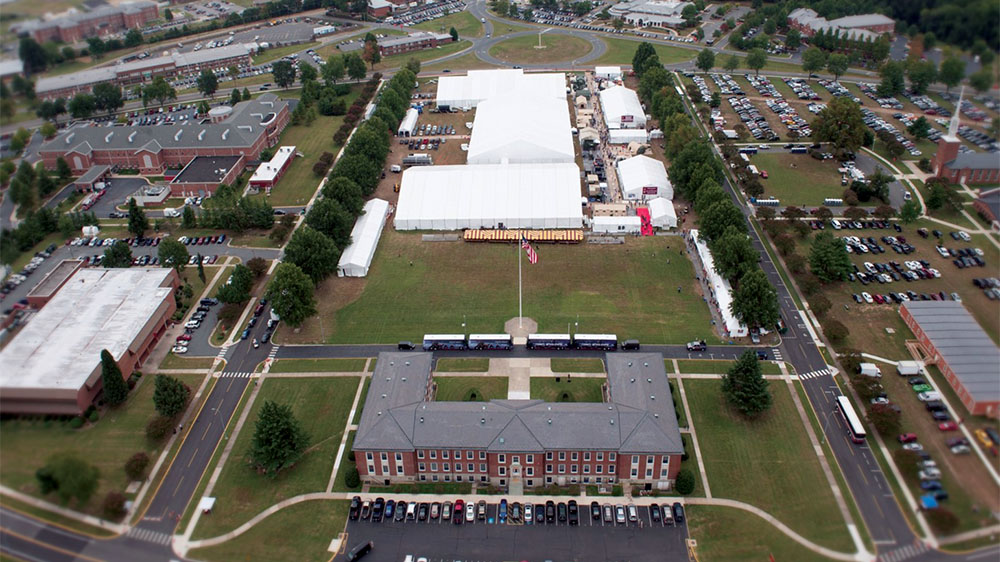
For the past 40 years, the Modern Day Marine Military Exposition (MDMME) has been an industry forum providing Marine Corps leadership, requirements and procurement personnel, and prospective users—occupationally proficient Marines of every rank and qualification—with a preview of future possibilities for training and equipping the Fleet Marine Force. The first show in 1981, billed as the Modern Day Marine “Force In Readiness Exhibit,” took place at an auxiliary airstrip near Yuma, Ariz., with two dozen companies congregated in the open air to “discuss their products, programs and proposals with prominent decision makers who plan and carry out amphibious operations in our nation’s defense.” In 1982, the MDMME migrated across the country and was staged in various commercial facilities in and around Washington, D.C., before finding a long-term home aboard Marine Corps Base Quantico in 1991.During its first 14 years on base, the show took place at the now-demolished structure of Larson’s Gymnasium, which originally was an aircraft hangar built in the 1930s, located between what is now the modern Quantico Air Facility and the Marine Corps’ original aerodrome, Brown Field, the current location of Marine Corps Officer Candidates School. In 2005, the MDMME made the 1.5-mile move to its current more expansive and centralized location on Lejeune Field, a grass quadrangle and parade ground bracketed by Marine Memorial Chapel, Dunlap traffic circle and the iconic base headquarters building, Lejeune Hall. By 2019, the most recent staging of the live event, it had grown to 76,000 square feet of exhibit space housed in a $1.3 million “Expeditionary Convention Center” that is “deployed and redeployed” annually over a five-week period between late August and early October.

As the indispensable intersection for service-level guidance and industry solutions within the Marine Corps community of interest, Modern Day Marine expects to welcome approximately 350 exhibiting organizations and more than 10,000 attendees, 55 percent of whom will be active-duty servicemembers representing every Marine Corps occupational community, to the 41st MDMME, scheduled to take place over its traditional three-day period between Tuesday, Sept. 21 and Thursday, Sept. 23, 2021. Current exhibitor categories have expanded beyond industry manufacturers and service providers to include Marine Corps research, experimentation, requirements, acquisitions, training and education component commands, government logistics activities, academic research and technology organizations, state and local business development activities and chambers of commerce, and a diverse collection of nonprofit organizations which support the personal and professional needs of active-duty and veteran servicemembers, as well as their families, including the Marine Corps Association.

Image
LtGen Mark Faulkner, USMC (Ret), former President and CEO of the Marine Corps Association, presides over one of the many professional development events organized by MCA throughout the calendar year.

WHERE WE ARE GOING: Providing a Forum to Communicate Service-Level Messages and Institutional Priorities to Key Publics and Stakeholders That Will Support Future Force Design EffortsWhile bringing the show to the Marines has been a MDMME tradition for 30 years, during the winter and early spring of 2020, General David H. Berger, the Commandant of the Marine Corps, chartered an Operational Planning Team to evaluate the increasingly vital role of the event as a key enabler for Force Design 2030, the Marine Corps’ 10-year plan to optimize its structure and capabilities for modern operations. The most significant outcome of this Headquarters Marine Corps evaluation was the decision to move the 42nd MDMME to the Walter E. Washington Convention Center in Washington, D.C., where it will take place from May 10-12, 2022.

Lieutenant General Mark Faulkner, USMC (Ret), former President and Chief Executive Officer of the Marine Corps Association, said the move is necessary. “While Quantico is the crossroads of the Corps, Modern Day Marine is at the crossroads of the whole of government process to plan, program, develop and deploy the layered and integrated capabilities which underpin our national security strategy and the Marine Corps’ role within it as the nation’s premier expeditionary force.”

In addition to sustaining dialogue with industry on capabilities that will catapult the Corps into the future, including long-range precision fires, advanced reconnaissance capabilities, unmanned systems, and the resilient networks which encapsulate the Marine Corps’ Expeditionary Advanced Base Operations (EABO) concept, the MDMME will become a premium venue for demonstrating to Congress and the wider Department of Defense community that major change in existing force structure and ways of doing business are needed in this era of renewed Great Power Competition. Through an enhanced and diversified lineup of presentations, structured networking activities and technology demonstrations, the event will demonstrate the advantage of persistent, survivable units that operate as a component of the Joint Force, as well as by, with, and through our allies and partners, to provide the fleet and joint force commander with a stand-in component possessing the organic mobility and dispersion to compete and deter in a future operating environment characterized by a maturing and proliferating precision strike regime.

Image
MajGen Mike Regner, USMC (Ret), serving as the master of ceremonies at the 2019 Modern Day Marine Grand Banquet.

WHERE WE ARE GOING: Providing a Forum to Communicate Service-Level Messages and Institutional Priorities to Key Publics and Stakeholders That Will Support Future Force Design EffortsWhile bringing the show to the Marines has been a MDMME tradition for 30 years, during the winter and early spring of 2020, General David H. Berger, the Commandant of the Marine Corps, chartered an Operational Planning Team to evaluate the increasingly vital role of the event as a key enabler for Force Design 2030, the Marine Corps’ 10-year plan to optimize its structure and capabilities for modern operations. The most significant outcome of this Headquarters Marine Corps evaluation was the decision to move the 42nd MDMME to the Walter E. Washington Convention Center in Washington, D.C., where it will take place from May 10-12, 2022.

Lieutenant General Mark Faulkner, USMC (Ret), former President and Chief Executive Officer of the Marine Corps Association, said the move is necessary. “While Quantico is the crossroads of the Corps, Modern Day Marine is at the crossroads of the whole of government process to plan, program, develop and deploy the layered and integrated capabilities which underpin our national security strategy and the Marine Corps’ role within it as the nation’s premier expeditionary force.”

In addition to sustaining dialogue with industry on capabilities that will catapult the Corps into the future, including long-range precision fires, advanced reconnaissance capabilities, unmanned systems, and the resilient networks which encapsulate the Marine Corps’ Expeditionary Advanced Base Operations (EABO) concept, the MDMME will become a premium venue for demonstrating to Congress and the wider Department of Defense community that major change in existing force structure and ways of doing business are needed in this era of renewed Great Power Competition. Through an enhanced and diversified lineup of presentations, structured networking activities and technology demonstrations, the event will demonstrate the advantage of persistent, survivable units that operate as a component of the Joint Force, as well as by, with, and through our allies and partners, to provide the fleet and joint force commander with a stand-in component possessing the organic mobility and dispersion to compete and deter in a future operating environment characterized by a maturing and proliferating precision strike regime.

Image
SgtMaj Johnny Baker, USMC (Ret), 64th National Commandant and CEO of the Marine Corps League, right, reconnects with the 12th Sergeant Major of the Marine Corps, Gene Overstreet, USMC (Ret), at the 2019 Modern Day Marine Grand Banquet.

THE MDMME SPONSORS: The Marine Corps League and the Marine Corps Association—A Stable Foundation for the EnterpriseThe MDMME is the most significant annual undertaking in fulfilment of the complementary chartered missions of the Marine Corps League and Marine Corps Association, two organizations single-mindedly dedicated to the professional development, advocacy and outreach activities which support our Corps, its Marines, and the veteran community, as intended by their common founder, the 13th Commandant of the Marine Corps, LtGen John A. Lejeune, the visionary leader who is celebrated to this day as a principal architect of the expeditionary character and ethos of the Corps as we know it.

The Marine Corps League is a national organization of more than 60,000 members and more than 1,000 community-based detachments in its 96th year as the federally chartered nonprofit advocate and veterans’ service organization for the United States Marine Corps. As SgtMaj Johnny Baker, USMC (Ret), the 64th National Commandant and CEO of the Marine Corps League, said, “We are a body of citizens transformed by service to Corps and country who provide daily community examples of the values that will inspire the next generation to earn the title and cultivate the resilience imperative to the proposition of an inside force.”

In 2020, the Marine Corps Association formally joined with the MCL as co-sponsors of the MDMME. In doing so, the MCA brought its 107-year pedigree as the professional association of the Marine Corps, dedicated to leader development and recognition of professional excellence, front and center by initiating closer cooperation with Marine Corps leadership to sharpen the focus of the conceptual design, as well as the scope and quality of presentation content for the event.

“The Marine Corps Association sees the MDMME as a natural extension of its mission to support the Marine Corps in the development of collaborative, cross disciplinary Marine leaders who prioritize learning. By cultivating a desire to know, a bias for identifying gaps in conceptual knowledge, and the intellectual tools to design questions which deliver understanding, we will continue to place the future of the force in capable hands,” said Colonel Chris Woodbridge, USMC (Ret), Editor and Publisher of Marine Corps Gazette, the professional journal of the United States Marine Corps.
Editor’s note: The presentations and panel discus­sions of the 2021 MDMME will be available to view on demand through the MCA website: www.mca-marines.org. Photos courtesy of LtCol Alex Hetherington, USMC (Ret).

Author’s bio: LtCol Alex Hetherington is a retired Marine aviator, primarily serving with the squadrons of MAG-39 flying the AH-1W heli­copter. He is the show director of the Marine Military Expos, sponsored by the Marine Corps League and the Marine Corps Association.

The Marine Corps Association 100 YEARS OF SERVICE

“Scarlet and gold” oozes out of every nook and cranny of Bart­lett Hall. Sporting a cherished post office box of “1775,” most of the 108 full- and part-timers at the Marine Corps Association’s quaint headquarters at Quan­tico, Va., aren’t Marines. Yet, they are as much Marine as anyone who has stood on the “yellow footprints” at boot camp or completed The Basic School.

“I love my work here,” said Sherry Lin­hares, a six-year MCA civilian marketing coordinator and a perky “can do” member of the team. “I love Marines. They are part of my life.”

The Marine Corps will celebrate nu­merous 100-year anniversaries of its units, installations and battles in the 21st cen­tury.
Commemorating its 100 years of service this month, the MCA has been around longer than most service organi­zations. It has more service stripes than every major Marine base, including Quan­tico, and all of the Corps’ air and ground combat units.


“We have a great gang here who work hard to help Marines,” said retired Marine Major General Ed­ward G. Usher III, current MCA president and CEO. “Many of our key people double-hat in crucial jobs. We have strong players, but no bench.”

Marines formed the MCA in 1913 before the Corps had recruit depots, tin hats, tanks and dive bombers. The nation had barely 10,000 Ma­rines. It was a time when field-hatted Marines sailed in large Navy ships, shot well, marched often and landed in small boats to skirmish in strange places. Back then, who could have imagined 182,200 Marines or fights like Belleau Wood, Wake Island, Iwo Jima, Chosin, Con Thien and Fallujah?


While a lieutenant colonel, LtGen John A. Lejeune, the13th Commandant of theMarine Corps, was a member of the executive committee forming the Marine Corps Association in 1913 and drafting its constitution and bylaws, which remain the cornerstone for MCA&F operations.


MajGen Usher’s grandfather was an infantry Marine during the early 1900s. As a wandering youth in Cleveland, Pri­vate Edward G. Usher enlisted in 1902, trained at Marine Barracks Wash­ington, D.C., fought in the Philippine Insurrec­tion, sailed in the battleship Ken­tucky, par­tici­pated in campaigns in China and was discharged in 1906. Buried at Rosecrans Na­tional Ceme­tery in San Diego, the busi­nessman requested that his tomb­stone simply read: “Edward G. Usher, U.S. Marine.”

“Both my grandfather and father [a career Marine] loved the Marine Corps and were life mem­bers of the MCA,” said MajGen Usher. “The Association meant a lot to them, and here I am, running this orga­niza­tion, and we’ve added a Founda­tion to allow us to do even more to support Marines.”

Since 1913, the Marine Corps and its Association have grown up together. In fact, the Corps controlled and staffed the MCA for 60 years before the Pentagon required that MCA become a private entity in the 1970s. Governing board meetings were held in the Marine Commandant’s office for years, and he was the senior member. Some Commandants even wanted the names of nonmember officers and those delinquent in their membership dues. Those days are long gone.

“For a century now, the MCA has stayed true to Lieutenant General John A. Le­jeune’s [13th Commandant’s] vision of providing a forum for Marines of every rank to exchange ideas, preserve our heri­tage and develop professionally,” said General James F. Amos, the 35th and current Commandant. “The hard work of the MCA staff materially contributes to our mission and the advancement of the Corps’ objectives.”

When Lieutenant Colonel Lejeune com­manded the Marine Barracks in Brooklyn, N.Y., from 1911 to 1914, he left his family to make expeditions to Panama, Veracruz, Mexico and Cuba. On Feb. 20, 1913, he sailed with the 2d Provisional Marine Brigade for Guantanamo Bay (Gitmo), a frequent jumping-off spot for Caribbean hot spots.

Two years before, the officers of a similar Marine brigade at Gitmo voted and contributed $5,000 to form the Marine Corps Association, but the action was not formalized.

On April 25, 1913, Lejeune was named head of a three-man executive committee, and the MCA was born. The goal was the professional advancement of Marines and the preservation of the Corps’ history and traditions. Those simple but vital goals remain to this day.

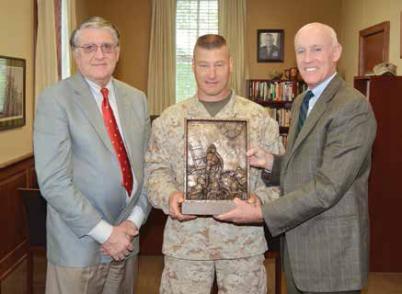
MajGen Edward G. Usher III, MCA&F president and CEO, far right, along with sculptor and artist, Marine veteran Mark Austin Byrd, presents the newly established MCA&F sponsored 1stLt Baldomero Lopez Honor Graduate Award for TBS honor graduates to the TBS commander, Col Dale Alford, in 2012.
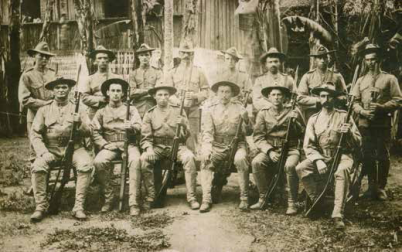
MajGen Usher, a third-generation Marine, traces his Marine Corps roots to his grandfather, Edward G. Usher (left), fourth from the right, back row, in this photograph of leathernecks in Co E, 2d Bn, 1st Marine Brigade in Zambales, Philippines, circa 1902. (Photo courtesy of the Edward G. Usher Collection, MCA.)

Despite mostly imagined threats to the Marine Corps’ existence in 1913, the MCA’s founders gave it an internal mis­sion of developing Marines. Unlike many service associations, the MCA does not have a political role and never has lobbied Congress.

“It’s my role, with the support of our fine Marines at the Office of Legislative Affairs, to keep Congress informed of our activities, achievements and challenges. I think we have a great relationship with the folks on the Hill,” said Gen Amos. “I see the MCA’s role as supporting the professional development of our Corps through the Gazette and Leatherneck, professional military education (PME), the reading program and other such activities.”

Bartlett Hall is slightly more than three miles from Quantico’s main gate. Nestled barely inside the base, the three-story red-brick building sits next to Quantico town, within easy walking distance of Little Hall, the Marine Corps University and other familiar landmarks.

“If General Lejeune could see today’s operation, he’d be amazed,” said retired MajGen Harry W. Jenkins, who heads the MCA’s Board of Governors. “We are taking care of the troops, and since we added the Foundation in 2009, we can do even more to help the troops.”

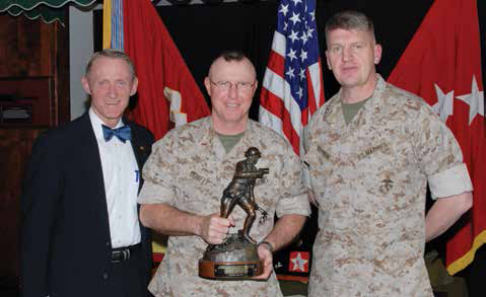
The Hulbert Award for the Marine Gunner of the Year, named after the first Marine Gunner, Henry L. Hulbert, was crafted by former Leatherneck artist and veteran Marine John Chalk. The initial trophy, presented to TBS in 2008 for display by the MCA&F CEO, MajGen Les Palm, USMC (Ret), left, is held by CWO-5 David R. Dunfee, who coordinated the development of the award for the Deputy Commandant, Plans, Policies and Operations, LtGen Richard F. Natonski, right.

LeeAnn Mitchell is the Foundation’s events planner. She coordinates 14 major events a year; many are awards dinners. The MCA&F brings in and hosts Marine honorees and their families at the awards dinners. They are popular, well-attended and growing. More than 400 people attend each dinner, and Gen and Mrs. Amos are frequent guests. Active-duty Marines attend free. Mitchell also recruits and courts the Marine-friendly corporate spon­sors who help foot the bill. MCA&F staffers cheerfully do the grunt work.

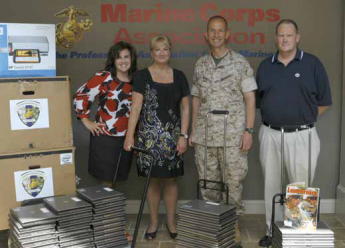
Hewlett Packard laptops are ready for delivery to wounded Marines in 2011. From left: Barbara Lewandrowski, Wounded Warrior Regiment; LeeAnn Mitchell, Director, Events and Corporate Sponsorships, MCA&F, who coordinated the laptop donation; Col John L. Mayer, Commanding Officer, WWR; and Greg Lockett, Hewlett Packard.

“These dinners are the Marine Corps’ dinners, not ours. LeeAnn is their un­compensated event planner,” said Tom Esslinger, the MCA chief operating of­fi­cer. A successful career lawyer, Esslinger served in Vietnam as a Marine infantry officer and joined the staff in 2008. “One general officer told me, ‘If it wasn’t for you guys paying for these dinners, we’d hand these awards out at lunchtime in the mess hall.’ ”

Shouldn’t the Marine Corps do these things? Yes, it probably should, but laws prohibit the use of appropriated money for certain things. The MCA and its Founda­tion fills this important gap. It always has been that way.

For example, in 1915, the Corps’ inspec­tor general recommended that the MCA purchase flowers for Marines buried at Arlington National Cemetery. In 1918, the Association bought bronze plaques to place on Navy destroyers named after Marines.

The MCA Foundation was in its infancy when MajGen Usher took over in 2010. It now sponsors programs that help active-duty Marines and attracts the funds to pay for them. In 2012, the Foundation provided 300 unit libraries (mostly books from the Commandant’s Professional Reading List)and more than 8,000 awards to Marines in its significantly expanded Marine Excel­lence Awards Program.

“The money we take in goes into our programs to support Marines. If a Marine commander comes to me, and I start say­ing no, we’ve got a problem,” said MajGen Usher.

“We’re also not competing with other Marine organizations. I don’t want to take money away from the Scholarship Foun­da­tion or our world-class museum,” said MajGen Usher. “We’re all dedicated to support an institution that we love.

“Nonprofit doesn’t mean we can operate in a deficit. We have to make pay­roll, re­cover our costs and provide money for our programs,” said MajGen Usher. “In addition to being the Corps’ pro­fessional associ­ation, we conduct a successful retail operation. It helps us generate revenue to meet our program needs.”

MCA membership today is about 77,000, mostly active, retired and vet­eran Marines but with some mem­bers from other U.S. Armed Forces. The Association’s charter rules out some individuals who would join to support the Corps. With the creation of the Foundation, nonveteran Marine parents and “friends” of the Marine Corps now can get on board as members of the Foundation, helping ensure a strong MCA&F.

The policy is paying off. The Corps’ “friends” are joining and becoming leading customers in the MCA’s e-commerce trade via the Internet. People place orders with the MCA’s online store and call cen­ter in Bartlett Hall. When MajGen Usher completes a planned website improvement effort, it will be even easier to make a purchase, join the Association and Foundation and access Marine-related content.

“In retail, we’ll have a mini-Amazon.com,” predicted MajGen Jenkins. “We’re positioning our­selves to better help the troops for the rest of this century.”

The MCA&F presently has a successful Group Benefits (insurance) program and offers financial planning, banking services and other insurance products through an affinity partnership with USAA. These offerings are a steady source of assurance for Marines who want to ensure their families’ well-being should something happen.

When the well-known source of Marine uniforms and equipment, The MARINE Shop, became available after the death of its founder, retired Major Harry Elms, the MCA, led by its CEO, MajGen Les Palm, stepped in and purchased it in 2007. The popular retail uniform store on the corner of Broadway and Potomac in Quantico town was renovated and now makes it even easier for Marines to wear the best-fitted uniforms.

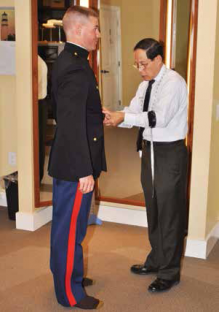
Master tailor Nhean Keo is one of many world-class tailors who assist Marines at the MCA&F’s The MARINE Shop in downtown Quantico, Va.

The MCA also opened a very popular retail store at MCB Camp Lejeune, N.C., built a new annex to its headquarters in Quantico and initiated a series of professional dinners, including awards dinners, and launched the Marine Corps Association Foundation during MajGen Palm’s tenure as CEO.

The MARINE Shop appeals to all grades, and with The Basic School located at Quantico, many Marine second lieutenants become career-long customers. The MARINE Shop’s expert tailors visit the U.S. Naval Academy, Officer Candidates School and several Naval Reserve Officers’ Training Corps units. In 1972, when the Department of Defense closed out the option of assigning active-duty personnel to military-related associations, the Marine Corps Association shifted from an organization staffed large­ly by active-duty Marines to a civil­ian work force, but the focus on supporting Marines continued to gain momentum.

Gen Louis H. Wilson, the future 26th Commandant, was the MCA’s last active-duty leader. He ordered a management study, and retired Marine Colonel Bevan G. Cass be­came the MCA’s first executive director. The tireless, square-jawed, crew-cut executive had to make the Association profitable in order to continue needed programs supporting the Corps.

“No longer subsidized, the MCA be­came a pay-as-you-go operation,” recalled retired Marine LtCol Robert W. Smith, the Gazette editor in the late 1970s. “The MCA focused on the business side, and ‘Bev’ Cass was the initial driver.”

Cass improved the MCA Bookstore, pro­cured a printing press and shipped Ma­rine Birthday Ball supplies to Marine units. Operating from an old temporary building near Quantico’s Butler Stadium, he set the business tone for his successors.

“Many people believed that the cost of running the MCA with ci­v­il­ians would be so high that we couldn’t survive. I didn’t believe it then, and I’ve been proven right,” said Gen Wilson when he retired in 1979. “The Association was worth saving to continue its work.”

The Association and the Marine Corps Gazette have been almost synonymous since the Association’s founding. Leather­neck magazine took another course to today. In 1917, two enlisted Marines re­ceived per­mission from Brigadier General Le­jeune, the Quantico commander, to publish a paper for Marines. In time, it became Leatherneck magazine.

“While the Gazette is our profes­sional journal, General Lejeune wanted Leather­neck to tell the Ma­rine Corps’ story,” said retired Ma­rine Col Walt Ford, current MCA publisher and editor of Leatherneck since 1999. “General Lejeune placed Leatherneck under the Marine Corps Institute, and both moved to Wash­ing­ton after he became Commandant.”

Leatherneck grew to a colorful 64-page monthly in 1926 with photos, jokes, cartoons, poetry and reports from the field. Its popularity con­tinues to this day. In World War II, the magazine’s notoriety elevated it to a monthly circulation of 300,000. The Leather­neck Association was incorporated in 1943 when it added the professionally enriching, red-covered “Guidebook for Marines” to its offerings.

During the Vietnam War, circulation was at 200,000 monthly. The Leather­neck staff, numbering more than 100 in Washington, received a Meritorious Unit Commendation for its service during the period. The Leatherneck Association moved its offices from Henderson Hall, Arlington, Va., to Quantico in 1975, but, with the loss of its Marine active-duty staff, more dramatic change was needed.

“General Wilson appointed me to study the possibility of merging both associa­tions in 1975 when I was a young brigadier heading the Development Center at Quan­tico,” recalled retired Gen Paul X. Kelley, 28th Commandant. “It was like being in the middle of two armed camps.”

The Kelley committee discovered that both associations had their own book service, magazine, insurance plan and awards program. Although more people read Leatherneck and the “Guidebook for Marines,” and its insurance program was popular, the Leatherneck Association, by merging with the Marine Corps Associa­tion, could obviously support the Corps more effectively.

The current home of the MCA&F, Bartlett Hall, aboard MCB Quantico, Va., was named for former Executive Director BGen George Bartlett and dedicated on Nov. 10, 1986.

We recommended the Leatherneck Association be merged into the MCA in 1976,” said Gen Kelley. “We did the right thing. I’m truly pleased with what our Association is doing today.” When retired BGen George L. Bartlett took over in 1979, the MCA headquarters was located in what is now Butler Hall (Building 1019), not far from Quantico’s railroad station. But this headquarters couldn’t house all of the MCA’s activities.

“Our insurance people worked out of the [top floor of the] Quantico bank, and we had six to eight storage areas scattered around,” recalled BGen Bartlett, still a go-getter at 89. “We had almost nothing in the bank, nothing in our checking ac­count and we couldn’t afford to pay rent even if we had to.”

Operating from his hip pocket, he made things happen. He opened communications with the State Department, shipping Birth­­day Ball supplies to Marine embassy de­tachments around the world. The MCA stepped in to run the Marine Corps Mara­thon for eight years. Then a series of mail campaigns were launched to promote the MCA and its professional magazines to active-duty and other Marine communi­ties. The MCA’s printing press located in Quantico town seldom stopped rolling.

With operations taking off, it was time to consolidate operations under one roof—it was time to build a permanent home.

The Kelley committee recommended that the MCA headquarters be constructed at Quantico. BGen Bartlett handled the detailed negotiations and closely super­vised the building project. The building, appro­priate­ly named Bartlett Hall, was dedi­cated in 1986 on the Corps’ 211th Birthday.

“I’m personally thrilled, but halls should be named after heroes,” BGen Bartlett said. “We signed a 25-year lease. It was a good deal for the Corps and the Association.”

The MCA staff, now able to easily conduct staff coordination, became an even more effective team. Initially, the merger was not popular with the Leatherneck staff. Things improved immediately when BGen Bartlett’s talented MCA deputy, retired Marine Col William V. H. White, became Leatherneck’s editor.

“I did more for the Marine Corps in that Association than I ever did as a general officer on active duty. I’m proud to be a part of it,” BGen Bartlett said.

LtGen Anthony “Tony” Lukeman took over in 1989. (His son, BGen James W. Lukeman, currently commands the Sec­ond Marine Division at Camp Lejeune.) LtGen Lukeman computerized the MCA and kept the business side going, but he took pride in reading every word before both magazines were published.

“I was thrilled to be in the company of writers. There is nothing more important than informing Marines,” said the soft-spoken retired Marine.

When he departed in 1998, the Gazette staff presented LtGen Lukeman with a bronze plaque of his final Gazette edi­torial. “In appreciation for the 115 issues that you so diligently proofread. We thought it only appropriate to return the favor—we could find no errors in this editorial.”

“The two magazines were the most im­portant part of my job,” LtGen Lukeman recalled. “You could be 22 or 90 years old, they bound the generations of Marines. That’s what makes us a special breed.”

Today, Leatherneck and the Marine Corps Gazette are still the most popular MCA member benefit. “Probably the majority of our members join to get the magazine[s],” said Esslinger, “but they join for other reasons as well.”

The Marine Corps Gazette has been the professional journal of Marines since 1916. Col Lejeune wrote the first article. Starting as a quarterly and becoming a permanent monthly in the mid-1940s, Marines have exchanged ideas in Gazette before every major Marine Corps ad­vance­ment—amphibious operations, helicopters, maritime prepositioning, etc.

“We have an ethos of innovation, and the Marine Corps actively seeks input from Marines,” said retired Marine Col John Keenan, the professional journal’s editor.

Shortly after Gen James T. Conway became the 34th Commandant, he visited Keenan’s office. After emphasizing Gaz­ette’s importance, Gen Conway left Keenan with this thought, “If I agree with one-half of the articles and disagree with the other half, you have it exactly right.”

Keenan reads all submissions and per­sonally accepts or rejects most articles. When in doubt, he sends articles to the Gazette editorial board member with subject-matter expertise. The full 14-person board votes on sensitive items and all writing contest submissions.

“The Foundation is elevating our writ­ing awards program to encourage Marines to write,” said MajGen Usher. “We’re dusting off some of the older awards and adding new ones. Winners will now re­ceive cash and a special plaque. Some of those majors, captains and staff NCOs are on to something. We want to get some dialogue going and recognize their efforts.”

Keenan is trying to debunk the myth that Gazette is an officers’ magazine. The Gazette’s diverse active-duty audience begins at the lowest enlisted grade, grows at the NCO level and goes up to the Com­mandant. Enlisted Marines won several writing contests in recent years, and many had their articles published.

“We can do better this year! I challenge all Marines to ‘stretch their brains’ and submit professional articles for publica­tion,” said Sergeant Major Micheal P. Barrett, 17th Sergeant Major of the Marine Corps and a Gazette subscriber for three decades. “The articles are relevant, cur­rent and enhance cognitive fitness. Ma­rines need to exercise their brains constantly. The Gazette helps me stretch mine, and it’s part of my monthly PME.”

One new MCA&F award is the Sergeant Major of the Marine Corps Writing Award that honors the top Gazette article written by an enlisted Marine. SgtMaj Barrett said that with each promotion, Marines spend more time writing, and they must learn to write clearly and persuasively.

“Our Marines need to practice and de­velop writing skills through daily use. This award recognizes enlisted Marines for that commitment,” he said.

Only a few young Marines read printed newspapers, and most receive their news from smartphones or tablets. The MCA is preparing for this evolution in reader­ship. Digital editions of both Gazette and Leather­neck are available monthly for online readers, and plans are underway to make the digital content even more user-friendly for smartphone and tablet users. The focus will be on providing content attractive to members and other readers and in the format preferred.

“Our younger readers want to read online. Other readers prefer the current paper version, and some will do both. Our challenge is to accommodate everyone,” said Keenan.

Right now, about 14,000 members elected to forego the print editions, reading the digital editions online. The online-only readership will grow in the years ahead, and the magazines are making preparations to meet changing preferences.

“We’re committed to print these maga­zines monthly. Each will continue to have quality content and the feel of a first-class magazine,” said MajGen Usher. “At some point, there probably will be a shift from predominantly paper to digital. It will be driven by what our readers want.”

The Marine Corps and its professional Association were joined at the hip for the past 100 years. Since the MCA went private, the two have marched side by side, each having the other’s back. That journey should never end. With a recent 17-year lease, the MCA headquarters will remain at Quantico at least through mid-2026. The MCA has the freedom to support Marines in many ways today, and its new Foundation gives it potential to do even more.

What a century! But, the best is yet to come.

“The MCA supports us in many ways each year, and I’m very grateful for every­thing they do to make our Corps a better warfighting organization,” said Gen Amos. “The staff at MCA should feel pretty good about themselves as they reflect on their 100th anniversary.”