Precision Weapons Section

Keeping the Marine Corps Competitive On the Range and On the Battlefield

Since 1775, the U.S. Marine Corps has prided itself on the martial skill of its members. The Marine has long been revered as an expert marksman, capable of precision on the battlefield surpassing that of any foe. Just as important, however, is the long arm itself. No amount of training and skill can fully compensate for a substandard weapon. For the Marine Corps’ renowned snipers and competitive shooters, nothing less than the finest equipment will suffice. Located on Marine Corps Base Quantico, Va., the Precision Weapons Section (PWS) is tasked with building and maintaining a fleet of such arms for the Marine Corps’ most elite.

PWS is a versatile organization that ably fulfills a wide range of responsibilities related to small arms. It is a one-of-a-kind unit whose accordingly unique mission requires a select team of specially trained technicians, true experts with skills far in excess of what would be expected from any 2111 (small arms repairer) in the fleet. The Marines of PWS hold the military occupational specialty of 2112 (precision weapons repairer), equivalent in the civilian world to a master machinist specializing in gunsmithing.

To fill its own ranks, PWS runs four overlapping six-month sessions per year called the Precision Weapons Repair Course (PWRC) to train existing 2111s in the technical skills needed to build and maintain the Marine Corps’ finest small arms. Marines are recruited annually for the course; to apply, a 2111 holding the rank of corporal or sergeant must have just reenlisted and must be eligible for a permanent change of station to MCB Quantico. Applicants are screened for knowledge and aptitude; prior civilian experience as a machinist is not required. The most difficult part of the recruiting process, according to CWO5 Joseph Bering, former officer in charge (OIC) of PWS, is to find applicants with the proper qualifications. Many units find that Marines with the requisite knowledge are too valuable to give up.

New students in the PWRC begin by using older, manually operated machines such as lathes, mills and drill presses to manufacture their own tools to use throughout the course. Not just a cost-saving measure, this process teaches students how to perform basic machining operations without the aid of computer control. 

“The main value in manual machining is a thorough understanding of the process and the capability to do it,” explained Master Gunnery Sergeant Joseph Kennedy, the current staff noncommissioned OIC at PWS. Even in the age of computer numerical control (CNC) manufacturing, those skills are still essential. “A CNC can, and in some cases does, do the lion’s share of the work,” Kennedy said, “but when you are taking components from various manufacturers, all with their own tolerances, and trying to get the best product out of it, sometimes the best way is by hand.”

After mastering manual machining, students learn to program and operate the mammoth 5-axis CNC mill, the wire electrical discharge machining (EDM) machine, anodizing baths and other sophisticated equipment. Students use computer-aided design software to digitally model an object, then run it through a second piece of software called a slicer to convert the virtual object into G-code, a set of instructions that tell the machine how to turn a raw block of metal into a complete part.

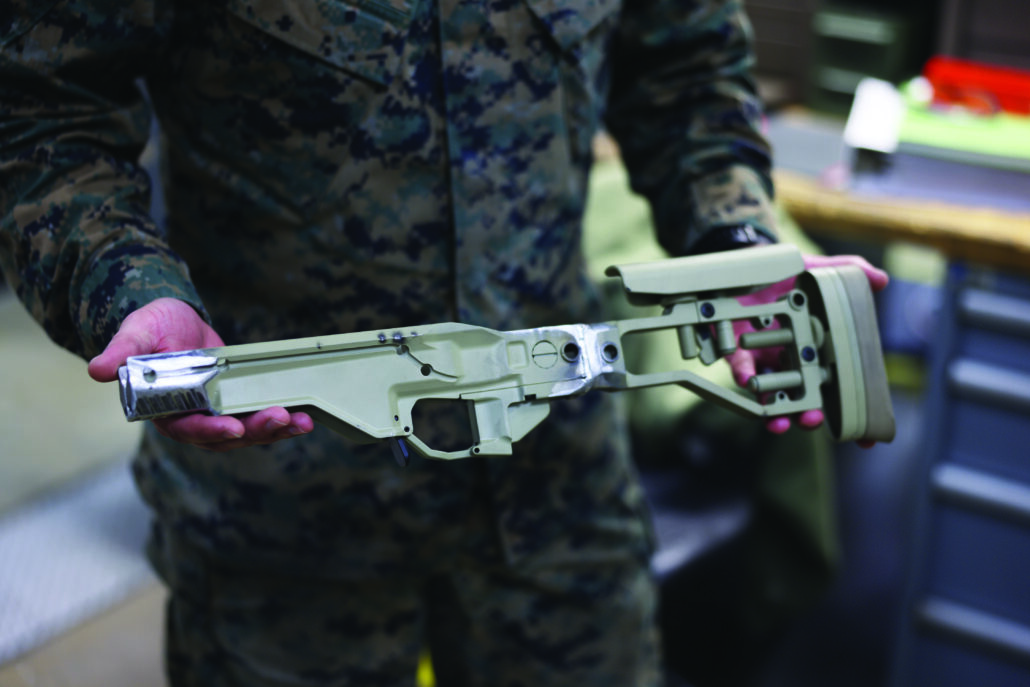
Upon successfully completing the PWRC, a newly minted 2112 will work at PWS for the remainder of his or her three-year assignment before being sent back out to the fleet to manage a battalion arms room at any large base around the world. While at PWS, though, 2112s work on a variety of manufacturing projects which make full use of their extensive training: A Marine might spend one day at a lathe recycling scrap barrels into muzzle devices for competition rifles and the next day at a computer designing unmanned aircraft system (UAS) parts for 3D printing.

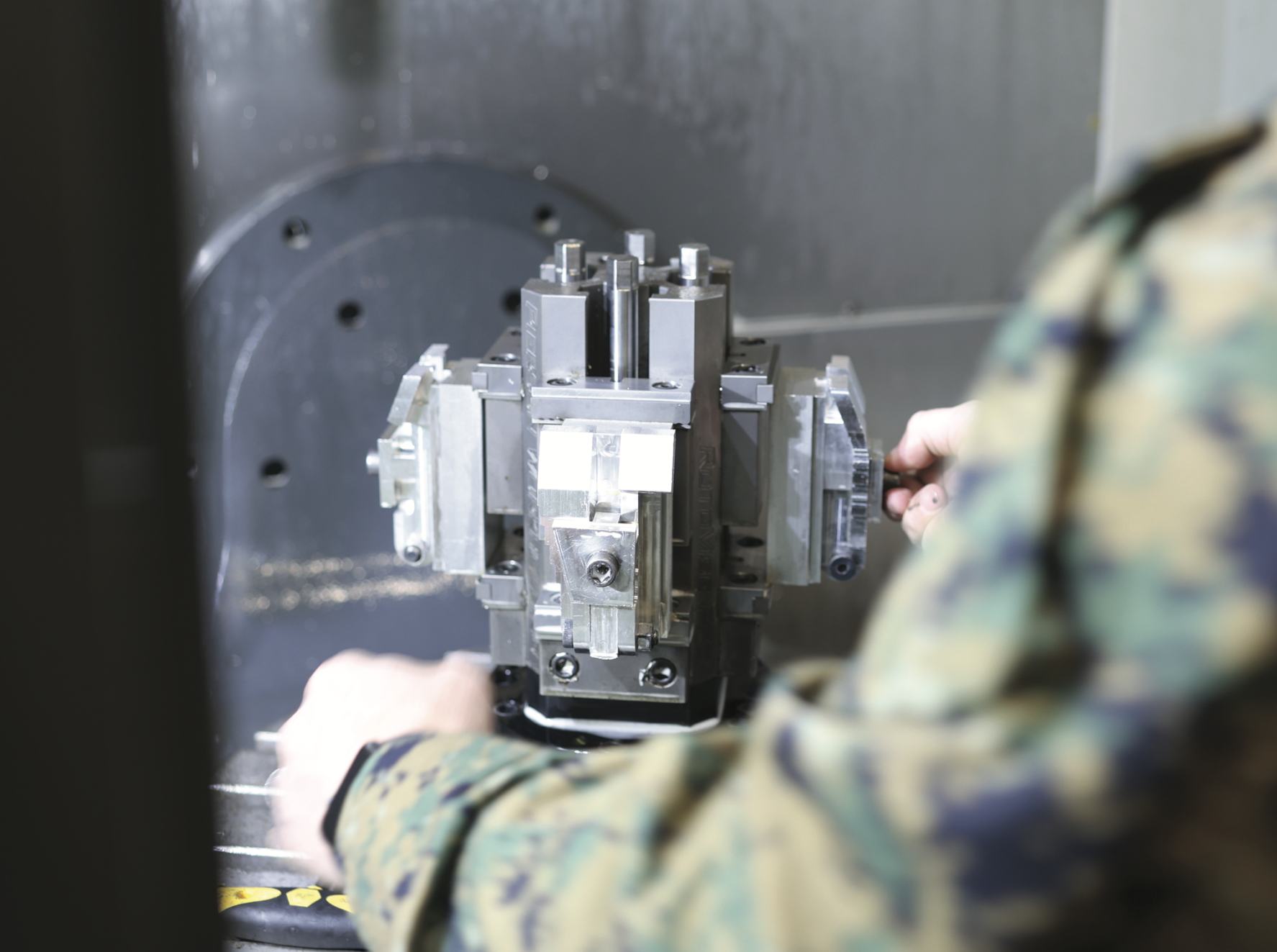
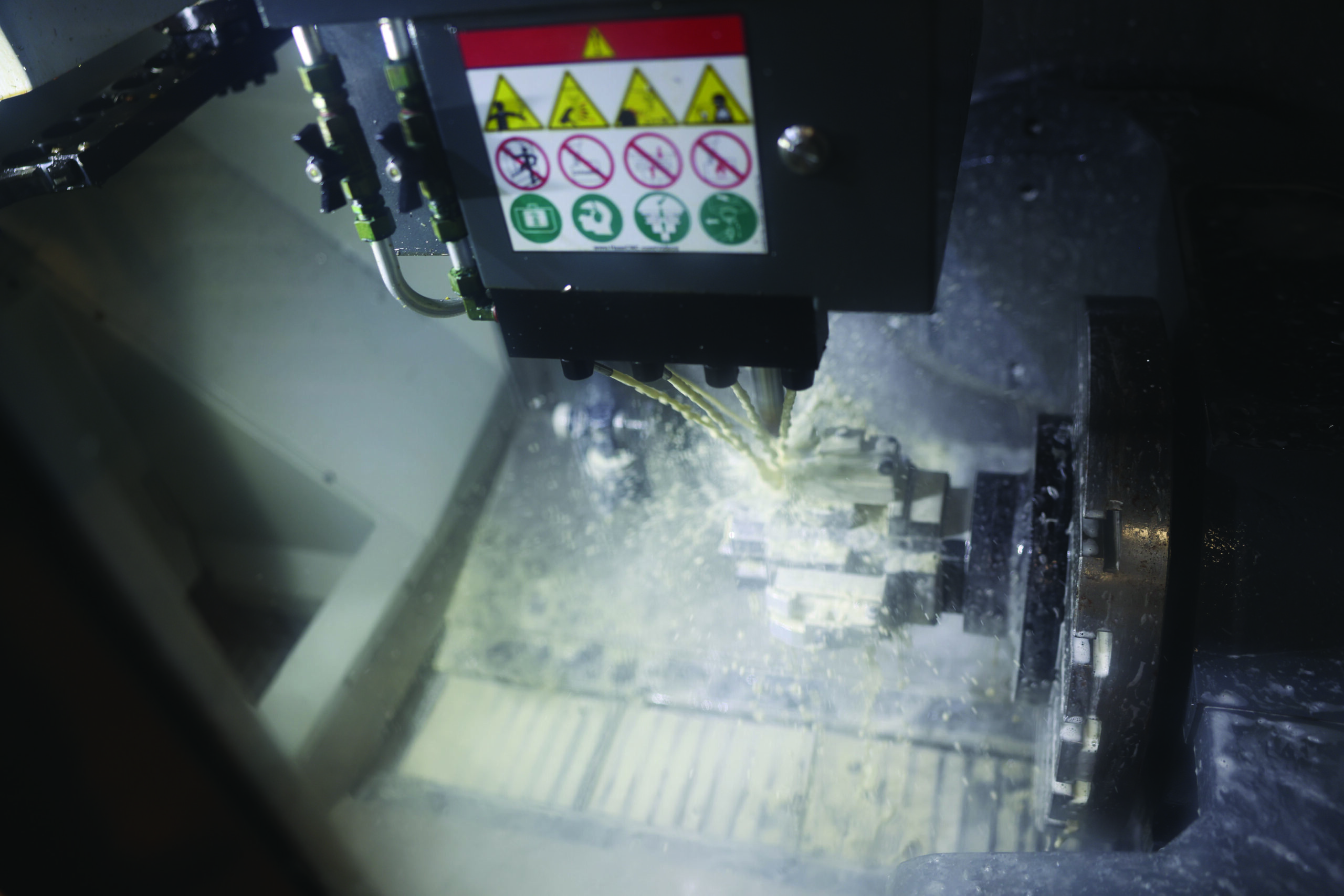
In the Precision Weapons Repair Course, Marines hone their skills on manual machines (above left) before learning to program complex toolpaths on the 5-axis CNC mill (above right). The CNC mill’s tool head sprays water on the workpiece to cool it from the intense friction of machining and wash away metal chips. (Photos by LCpl David Brandes, USMC)

Inside the Job of a 2112

Harlee Hall, PWS’ headquarters on MCB Quantico, is a veritable gunsmith’s playground: In addition to arms rooms like one might find at any Marine Corps base, it contains a fully equipped machine shop with the capability to assemble, maintain and manufacture parts for all the small arms in the Marine Corps’ arsenal. There, 2112s can transform a solid block of material into a finished product ready for the field. In addition to the equip-ment taught at the PWRC, the machine shop holds a high-pressure water jet that can quickly and precisely cut complex shapes for flat parts. Soon, PWS expects to begin 3D printing in metal via wire arc additive manufacturing as well. 

Such advanced manufacturing capabilities, though, would be useless without the ability to test the firearms. To evaluate the weapons built and modified there, PWS also operates a highly sophisticated shooting range which in some ways functions like a laboratory. Operators use a recoiling test sled to stabilize a weapon and eliminate human error, then fire out into a field next to the building. This range uses no physical targets; instead, as each bullet passes through a rectangular window downrange, an array of microphones detects and records the shot’s “impact” on a virtual grid. To perform reliability testing and collect ballistic data in a wide range of environmental conditions, the facility also includes a freezer and an oven.

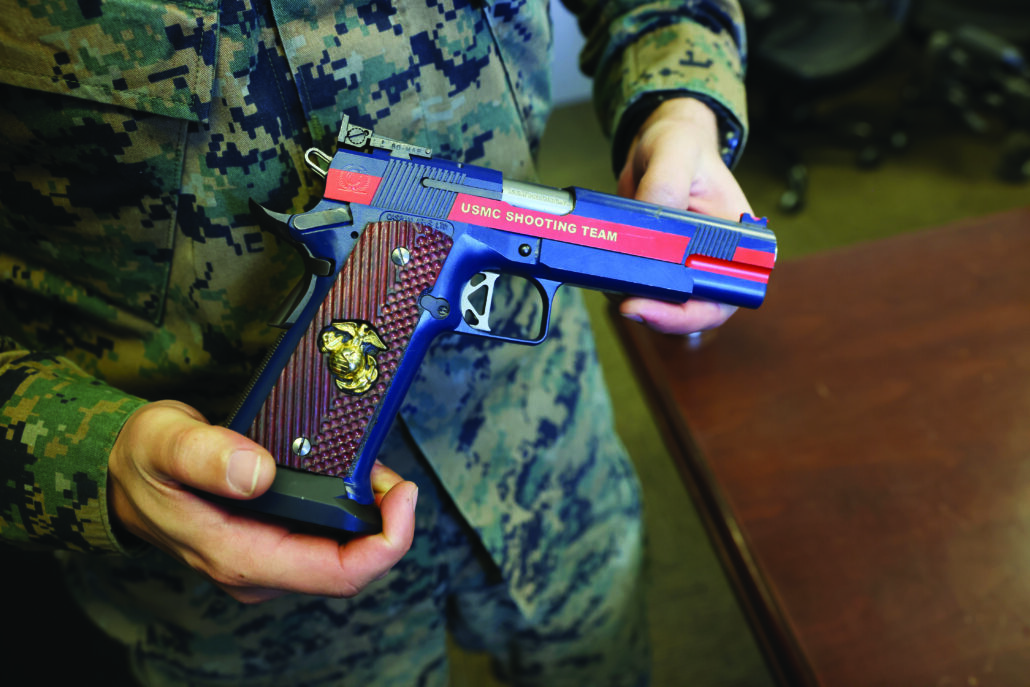
All this complex testing equipment is necessary in part because PWS is responsible for building and maintaining the Marine Corps shooting teams’ arsenals. Supporting just one military shooting team would be a full-time job, but PWS rebuilds pistols, rifles and shotguns for the shooting teams at every Marine Corps installation around the world. Competitive marksmanship arose out of a desire to hone military riflemen’s skills with their service weapons, but mass-produced rifles and ammunition are simply not up to the task. While sufficiently accurate for combat use, the M16A4 must be significantly reworked to enhance its accuracy and add the features necessary to turn it into a viable competition rifle.

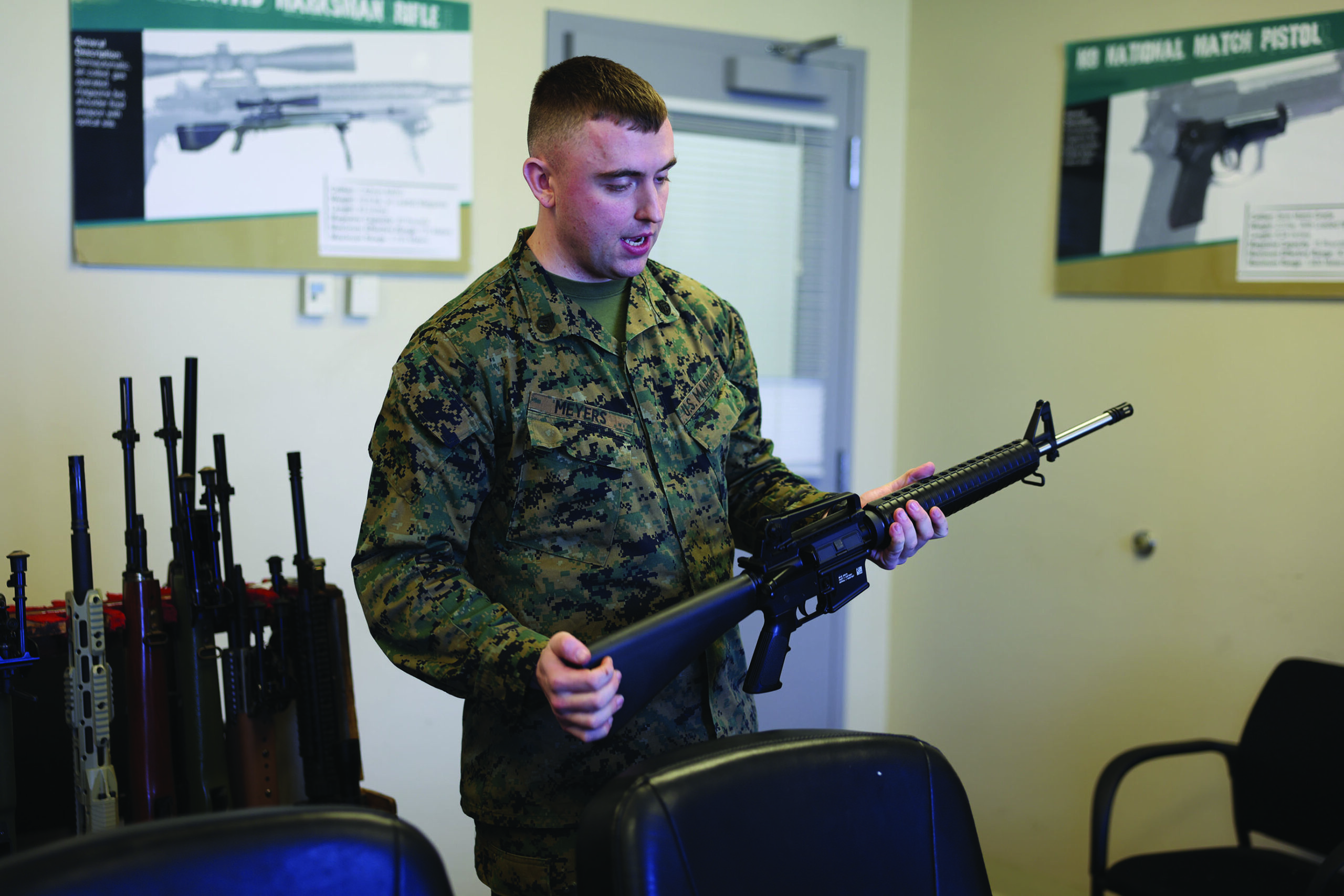
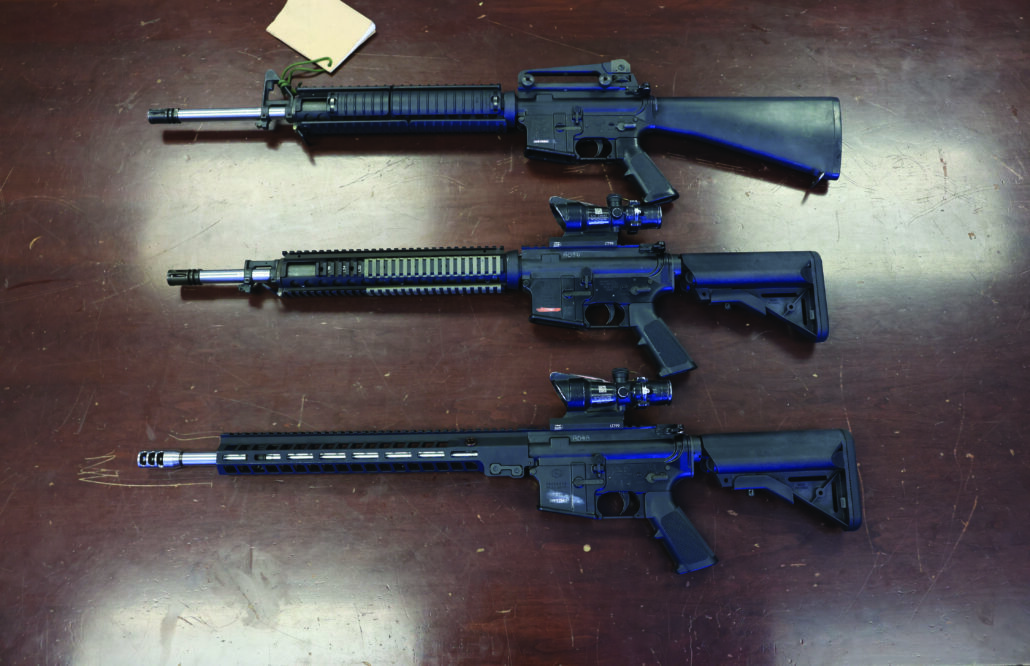
Marine Corps shooting teams have historically used the National Match M16A4, a standard service rifle rebuilt for competition at PWS. Lead weights are added to the fixed stock and rail system, the mil-spec trigger is exchanged for a match-grade replacement made by Geissele, and the typical chrome-lined carbon steel barrel is replaced by a heavy stainless match barrel of the same length. PWS armorers machine each barrel individually from a rifled blank—they cut the chamber, turn down the profile, crown and thread the muzzle and mount and headspace a barrel extension for the bolt to lock into. The end result of this Cinderella-like transformation is a weapon that outwardly appears nearly indistinguishable from any other M16A4 but weighs twice as much and is capable of far superior accuracy. The National Match M16A4’s 17-pound bulk helps keep the weapon steady when it is fired from a fixed position, as is required for the Highpower Rifle shooting sport.

PWS rebuilds many competition rifles, like this National Match M16A4, from worn-out service rifles. (LCpl David Brandes, USMC)
At PWS, nothing ever goes to waste. PWRC students will machine these scraps of shot-out sniper rifle barrels into muzzle devices for competition rifles, practicing their manual machining skills as well as reusing the steel. (LCpl David Brandes, USMC)

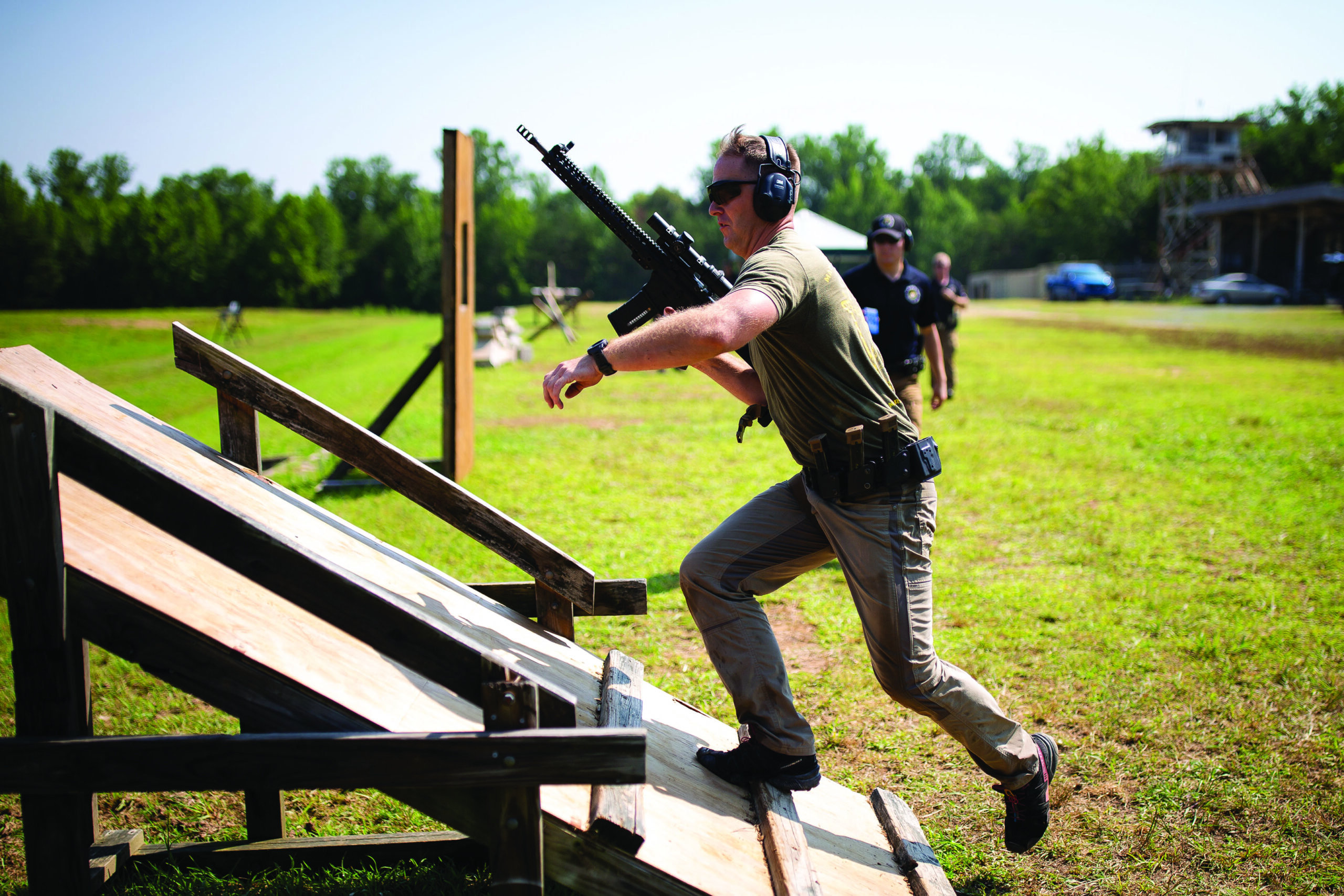
Since its inception, competitive rifle shooting has had a very slow, deliberate pace, with a strong emphasis toward long-range accuracy on bull’s-eye targets. A typical stage might give the shooter 10 minutes to fire just 10 rounds at a circular target hundreds of yards away. This type of shooting hones the fundamentals of marksmanship and allows the shooter to make the most of his or her rifle, but it has not been representative of typical combat engagements since at least the 19th century. Beginning in about the 1950s, the world of competitive shooting began to embrace “practical shooting”—faster-paced matches taking place at much shorter distances. Informed by military and law enforcement experience, practical shooting, also known as action shooting, emphasizes speed and agility in addition to accuracy. PWS has developed an upgrade package to allow Marine Corps shooting teams to remain competitive, exclusively using parts already in the military logistics system so that armorers can upgrade National Match M16s in inventory to the new Combat Match M16 standard.

Taking cues from the civilian competition circuit, the Combat Match M16 is significantly lighter and more compact than both its predecessor and the standard M16A4 from which both are derived. The 20-inch heavy-profile barrel is cut down to 18 inches and reprofiled to reduce weight, the fixed stock is replaced with an ergonomic adjustable one, and the A-frame front sight tower is milled down to provide a clear line of sight when using magnified optics. All in all, the Combat Match M16 measures 34 inches long with the stock fully collapsed, and it tips the scales at just 7.7 pounds—less than half the weight of the National Match rifle. Despite all the weight reduction, accuracy isn’t substantially impaired; the new rifle can still shoot better than 1.5 minutes of arc even with service ammunition. The Combat Match M16’s resemblance to the M27 infantry automatic rifle is intentional—competitive shooters in the fleet now have a match rifle with similar performance and handling characteristics to their service weapons.

Competitive shooting helps to advertise for the Marine Corps and can serve as a training aid. PWS and Weapons Training Battalion have made efforts to apply lessons learned from dynamic competitive shooting to the way Marines train, enhancing their performance in combat. PWS pays close attention to trends in the competition world to inform its work; for example, a stage that forces the shooter to move around and engage targets at various unknown distances on a timer is the best way to simulate the physiological and psychological stress of combat without placing anyone in actual danger. That environment can therefore be used as an impromptu testing ground for new ideas. Although competitive shooting formats have changed over the years, the relation-ship between the competition world and the operational Marine Corps via PWS is an old one.

1stLt Scott Ambridge, a mem­ber of the Marine Corps Shoot­ing Team, trains at MCB Quantico, July 27, 2021. As PWS adapts to the modern battle­field, it has transitioned from traditional bull’s-eye targets to practi­cal shooting formats that emphasize speed and agility. (Photo by Tia Dufour)

The History of PWS

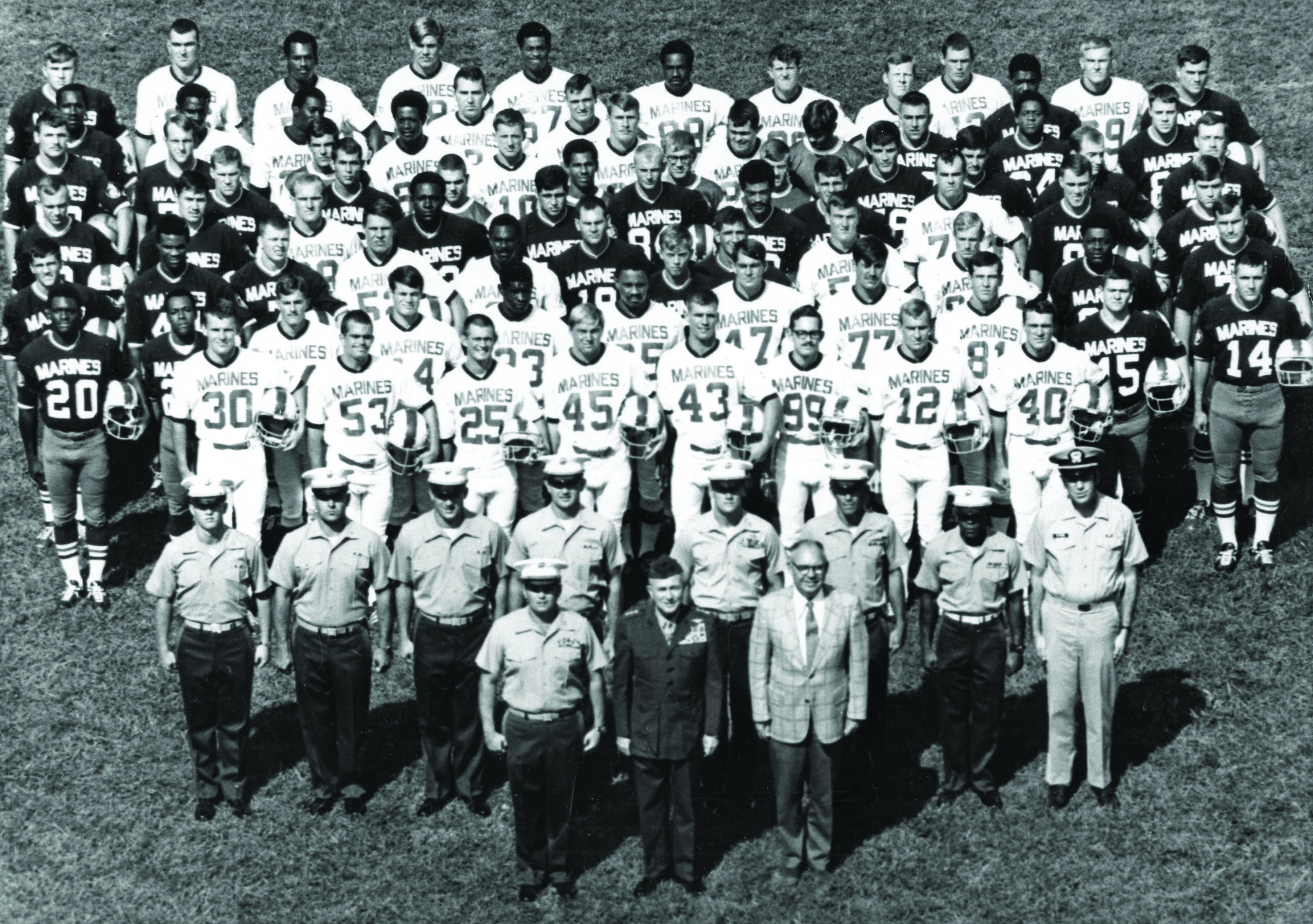
PWS traces its lineage back to 1966 with the foundation of the Rifle Team Equipment Section, which, as the name suggests, existed to support the Marine Corps shooting teams. They also provided some advanced gunsmithing training, but not through a formalized course of instruction like the modern-day PWRC.

The Rifle Team Equipment Section began providing equipment to the op-erational side of the Marine Corps in the early 1970s, prompted by problems experienced with the M40 in Vietnam. The original M40 was the first sniper rifle not based on an existing service weapon, instead starting life as a com-mercially produced Remington Model 40-X. Like the M14, the M40’s walnut stock tended to swell and warp in the humid jungle climate of southeast Asia, interfering with barrel harmonics and diminishing accuracy. In response, the Rifle Team Equipment Section began upgrading M40s to the M40A1 standard, using fiberglass stocks molded individually in the garage of one Gale McMillan, whose company is now one of the industry leaders in fiberglass rifle stock manufacturing. In 2003, the M40 platform was further upgraded with the M40A3, built on all new receivers and barrels, and equipped with improved McMillan stocks with adjustable cheek risers. Combat experience in Iraq and Afghanistan led later M40A3s to be equipped with Schmidt & Bender 3-12x illuminated scopes, superior to the old 3-9x Redfield models, and rails for clip-on night vision devices. The M40A5, introduced in 2009, had the addition of a muzzle brake with a quick-attach mount for a sound suppressor. And 2013 saw the M40A6, equipped with a barrel five inches shorter, mounted in a Remington Accessory Chassis System with a folding stock. These changes made for a much more compact rifle, allowing Marines to ruck with it in their packs. Every M40 from the M40A1 in 1977 until the platform’s replacement with the MK 22 Advanced Sniper Rifle  in 2024 was hand-built and tuned by the 2112s at PWS.

The section also has a long history of upgrading M14s into precision rifles. While the M14 looks on paper like an appealing base for a highly capable semi-automatic precision rifle, the platform suffers from inherent accuracy problems which require extensive modification to address. Starting with the National Match M14’s double-lug receiver, which improves the consistency of the bedding between itself and the stock, PWS developed the M14 Designated Marksman’s Rifle (DMR) with a McMillan stock and a fixed 10x. It entered the service in 1998 and was later replaced by the Enhanced Marksman’s Rifle, with a modular aluminum chassis and the same Schmidt & Bender scope as contemporary M40A3s. During the global war on terrorism, the enhanced M14s were eventually phased out in favor of the M110 and SAM-R, the latter of which was the last model of firearm that PWS produced for the operational side of the Marine Corps.

With the scout sniper program defunct and the M36 filling the DMR role, one might imagine that PWS is now redundant, but nothing could be further from the truth. As the Marine Corps’ clearinghouse for precision machining expertise and a unit with a knack for doing more with less, PWS has expanded its mission to offer more support of Marine Corps Systems Command’s (SYSCOM’s) efforts. When SYSCOM identifies a need, instead of going through the arduous process of wrangling the private sector to solve it, they can draw from the well of problem-solving talent at PWS. The section aims to “give the Program Office other avenues to get their equipment up and running” instead of waiting months or years for a defense contractor to develop a solution, said MGySgt Kennedy. In recent years, that rapid innovation capability has allowed PWS to help the Marine Corps adapt to new battlefield technologies, learning how to work with and against them before the shooting starts.

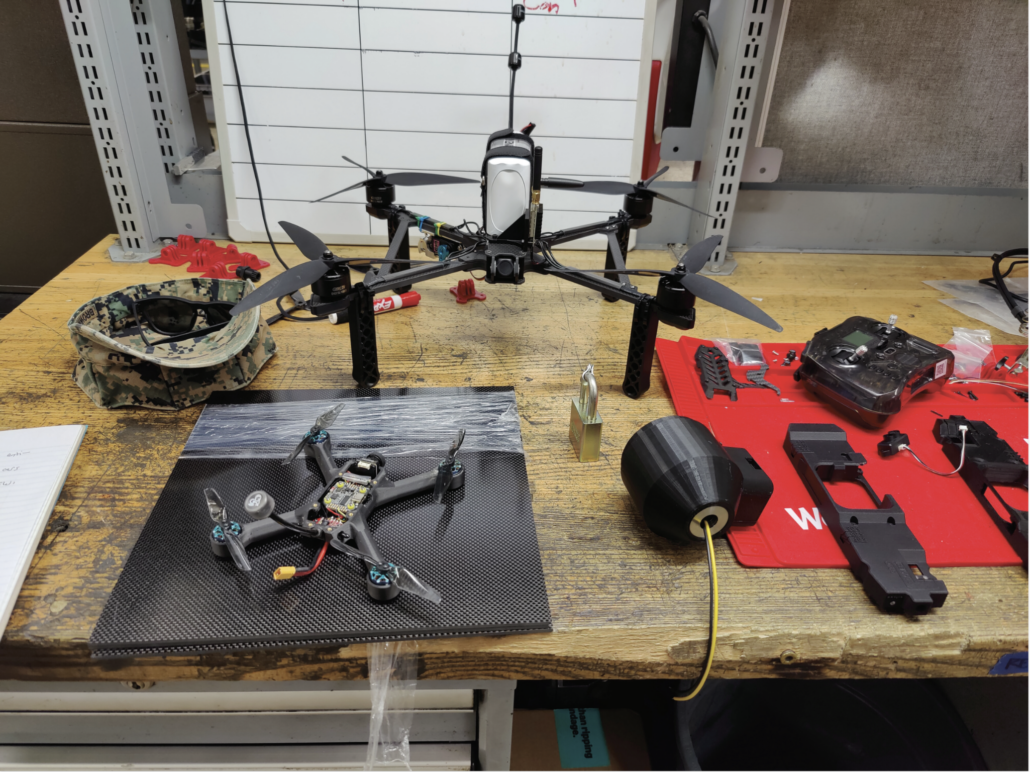
As the war in Ukraine has shown, small UASs and rapid prototyping technologies to produce them more rapidly have radically changed the face of peer/near-peer warfare. To that end, PWS is making great strides in validating those technologies for the Marine Corps. Gunnery Sergeant Gregory Brown has been working with the Marine Corps Attack Drone Team for more than a year now, designing and building small UASs to demonstrate the technology and help the Marine Corps learn more about their employment. Brown builds UASs using carbon fiber laminate, 3D-printed parts and commonly used electronics, allowing for greater flexibility in the designs and a much lower unit cost. Whereas a Neros Archer first-person view drone might cost $2,000 plus another $1,300 for the electronic safe and arming device that allows it to deploy explosives, Brown can build a somewhat less-capable but similar unit for training for approximately $400. While not authorized to carry weapons due to its use of foreign electronics, the latter allows Marines to study small UASs and learn how to integrate them into small unit tactics.

3D printing allows Marines on deployment to do onsite manufacturing of replacement parts and new equipment according to immediate needs. Instead of waiting weeks or months for a part to be delivered thousands of miles, a Marine with an expeditionary fabrication manufacturing kit and a few spools of plastic filament can produce almost any physical object on demand in just a few hours, or, for small parts, less than an hour. Part of PWS’ work is to redesign essential hard-ware for 3D printing and validate those designs so a Marine in the field can print them at the press of a button, without needing to perform calibration or iterative design work. The unit has an eclectic collection of 3D printers from a variety of brands, so they can validate each design on hardware used by the Marine Corps. Whereas Chinese brands Creality and Bambu Lab are the most popular for hobbyists, hardware security and reliability concerns mean the Marine Corps relies on machines from Markforged, LulzBot and Prusa

On the modern battlefield, the integration of small UASs and additive manufacturing in expeditionary environments are no longer advantages, they are necessities. As PWS builds its knowledge base in those areas, it sends personnel out to share that knowledge with Marines in the fleet. 

“Any corporal, any sergeant can do what I can do in just a few days’ training,” GySgt Brown said of his work building attack drones. “Any NCO can learn to build, automate and fly drones in just a few days.” 

To that end, the true value of PWS is not in its ability to produce sniper rifles that are accurate beyond 1,000 meters, tune service weapons to win national matches or inexpensively produce replacement parts for essential equipment. Its true value is its ability to creatively solve the Marine Corps’ most pressing problems. PWS takes Marines with innate talent for figuring out new and better ways to do things, puts them in front of all the tools they need to make their ideas a reality and instills in them the technical know-how to connect the two. It’s been a long time since the unit’s job was to put accurized Remington 700s into fiberglass stocks, but PWS continues to expand its capabilities to keep the Marine Corps at the cutting edge. As new technology continues to change the way Marines fight, PWS will still be hard at work solving tomorrow’s problems today, as MGySgt Kennedy says, “just using good old NCO creativity.”

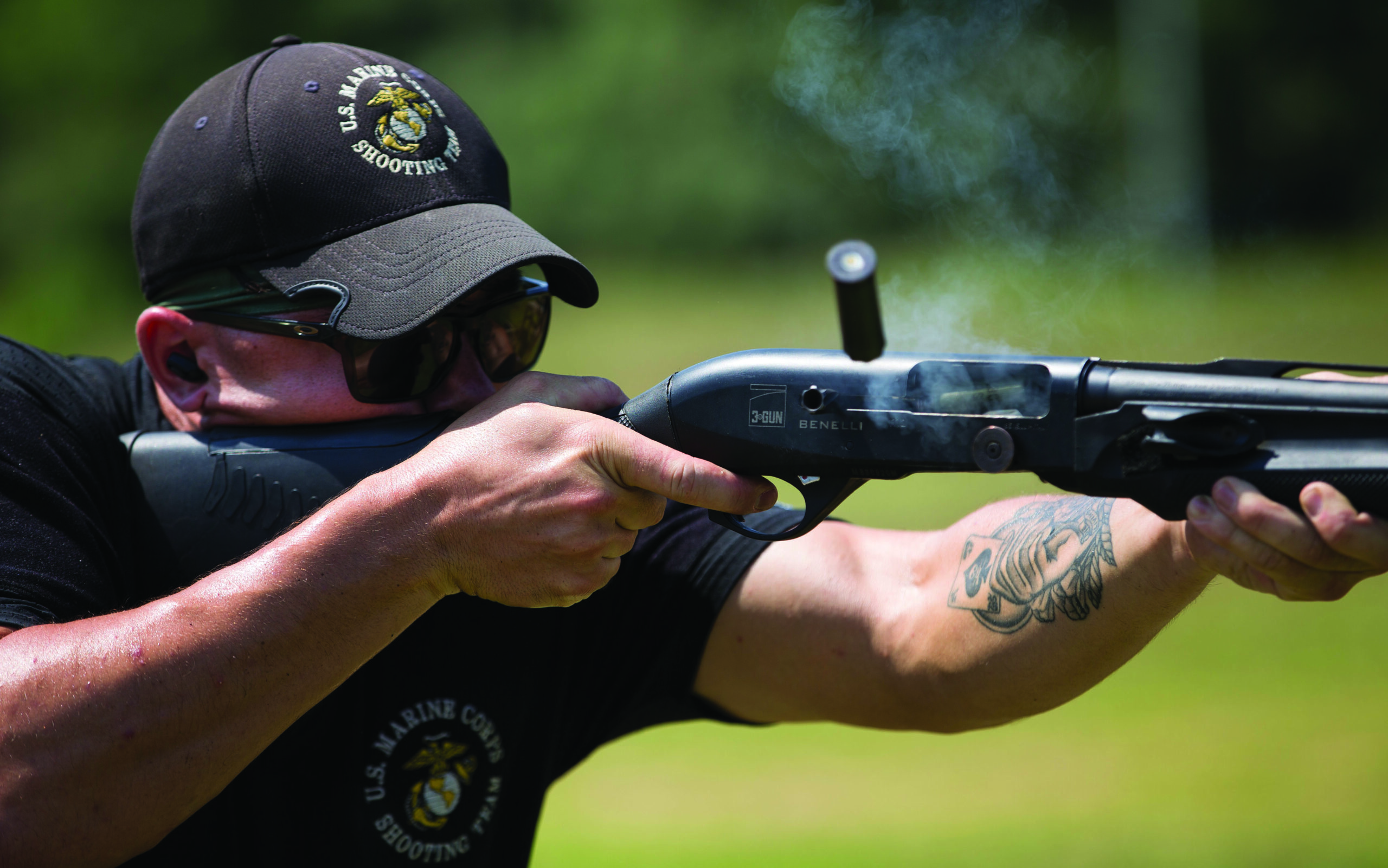
Featured Photo (Top): Using its state-of-the-art machine shop, PWS customizes all types of firearms for use by the Marine Corps’ top competitive marksmen. According to user preference, semiautomatic shotguns have their loading ports enlarged, magazine tubes extended and factory grip checkering replaced with silicon carbide (the “sand” in sandpaper), all to help shooters achieve high scores. (Cpl Sean Potter, USMC)


About the Author

Sam Lichtman is a freelance writer and editor who specializes in small arms technology and military history. He has a weekly segment on Gun Owners Radio. He is a licensed pilot who lives in Virginia.


Enjoy this article?

Check out similar member exclusive articles on the MCA Archives:
Office Of Naval Research: Preparing The Marine Corps For Battlefields Of The Future

Leatherneck
July 2023
By: Sam Lichtman

Modern Day Marine
Modern Day Marine

Leatherneck
September 2022
By: Sam Lichtman

The Life Of Lauchheimer: The Man Behind The Corps’ Top Shooting Trophy

Leatherneck
April 2025
By: Col Dwight H. Sullivan

Muster Up, Women Marines!

Women Marines:
It’s your history—preserve it.
They’re your stories—hear them.
They’re your sisters—join them.

The Women Marines Association (WMA) is the only organization that exists for female Marines, and it needs help from her sisters in arms. All over the United States, local chapters have been struggling to recruit new members, with 12 of its 64 chapters at risk of closing due to aging membership and the inability to meet regularly. With each chapter closure, the photographs, stories and, most importantly, opportunities for mentorship are lost.

You might think that the WMA is your grandma’s garden club, a bunch of old ladies drinking and spilling the tea, but it is so much more than a social gathering.

Female Marines, like all Marines, long for a mission-purposed life. Become active in your local WMA chapter and shape it into the mission that calls to you. Do you feel called to mentor new recruits? To provide guidance in the transition from active duty to retired? To volunteer for projects? To curate photos, memorabilia and stories? To spread the word on social media? All these roles need to be filled. Whatever your mission, you will have a club of tough, resilient and like-minded women to work with.

“I joined WMA because I needed a community, one that I could lead again. I think part of the Marine Corps tradition is leaving something better than you found it. So, when I said I wanted to be a part of this, that’s my commitment,” explained 29-year-old Sergeant Nadia Urbina-De La O, who serves as the vice president of WMA CA-2 San Diego County.

Mission Statement of the WMA

Founded in Denver, Colo., 1960, the WMA is committed to preserving and sharing the proud heritage of women who have served in the U.S. Marine Corps—from World War I to the present day. We educate current and future generations about our enduring legacy and provide un-wavering support to all women Marines through every stage of their life and service.

Mentorship Opportunities with Active-Duty Women Marines

“I joined the Marine Corps at 19. I joined, but I didn’t know what I was getting myself into. Honestly, I don’t think any of us did,” recalls Urbina-De La O. Remember that feeling? The WMA is a resource to support women and get them connected to others who have marched down the same road.

Retired Master Sergeant Jeannine Marie Franz, the WMA National History and Archives Chair, joined the organization when she was a 30-year-old staff sergeant stationed in Camp Fallujah, Iraq, and became that chapter’s president. “Once I joined, I learned that accessibility to senior female leadership was readily available. They would go to our luncheons and events, so there was a good chance you could just sit down and ask questions. They weren’t necessarily in your chain of command, but it’s an environment where you can ask for advice and guidance from an experienced woman.”

Often, women Marines are placed in a unit where there are no other women. These Marines need someone to turn to for advice on uniquely feminine problems such as juggling expectations to be a perfect mom and a perfect Marine or finding strategies that will help them get promoted in the male-dominated Corps.

“It’s important to have a woman’s perspective—that’s why WMA is so important,” explained Marta Sullivan, a retired lieutenant colonel and current vice president of Marine and Spouse Programs for the Marine Corps Association. Sullivan recalled that four months after having her first child, she was back to work in the field but still nursing her baby. She needed other women to explain to her how they had dealt with the same situation.

Older female Marines can provide a vital connection with younger women who share the same cultural references.In turn, those Marines can receive mentorship from older women who have transitioned out of their military careers and into new ones.

Sharing Stories with Future Women Marines

Maybe your WMA mission is to coach young women who dream of standing on the yellow footprints. Aimee Gonzales, a 21-year-old lance corporal, grew up attending WMA events in the OR-1 Portland, Ore., chapter with her mother, who is also a Marine.

Older female Marines can provide a vital connection with younger women who share the same cultural references. In turn, those Marines can receive mentorship from older women who have transitioned out of their military careers and into new ones.

“There were a couple of ladies—Patty and Golda—who were World War II veterans, and there were other Korea and Vietnam era women Marines. It was so enjoyable to talk to them. They really loved their time,” said Gonzales. Having these WMA experiences helped when she decided to enlist in the Corps. “[The WMA members] told me what to expect and prepare for,” she explained. “It was a lot easier for me to notice things that were not quite right because of their experiences. It was a little bit more eye opening. A lot of women don’t have that same advantage of talking to a female Marine.”

Mentorship Opportunities with Women Veterans

The WMA also provides an opportunity to network with women who have established post-military careers.

“I am more of a Marine today than I was when I was in uniform. And I say that because of the principles that we were taught, you know, operating in integrity, excellence, decency, order and honoring leadership—even if you don’t like the people, right? I pull from those principles, and I stand strong,” said Laurie Sayles, Marine veteran and current CEO of Civility Management Solutions. “You’ve got to maintain those principles that you learned from the Marine Corps, and that’s your differentiator.”

Job hunting is challenging for everyone, and for Marines, there is the added stress of transitioning from military to civilian life. WMA provides support and strategies. 

“Joining WMA gives you contacts all over the place because you meet so many people within that organization, especially when you go to the conventions every other year. There’s such a wealth of knowledge in the room,” said MSgt Franz. 

Public Service Projects

One of the purposes of the WMA, as stated in their bylaws, is to provide care and assistance to hospitalized veterans and members of the Armed Forces of the United States. Many chapters volunteer in veterans’ hospitals and veterans’ retirement homes. Likewise, many WMA chapters participate in stand downs, free events that provide veterans with onsite medical and dental attention plus information on navigating benefits and support services.

“WMA OR-1 has been a pillar of the Salem Stand Down, consistently volunteering their time, tirelessly collecting items, and adding a touch of warmth by baking sweets for attendees,” said Sergeant Rosy Macias, the vice president of OR-1.

WMA MI-2 Motor City actively supported troops from 2002 to 2022. Their project Operation Caring Friends sent letters and care packages to service-members who received little or no support from home. Commands and chaplains reached out to the group, and the program grew.

“We are finally on our last month of deployment, and it warms my heart each time my team gets a care package from those of you who support their troops…. It might not be that big of a deal to you, but it means the world to us,” wrote one recipient.

Many WMA chapters also participate in Wreaths Across America and join in local events with other military organizations.In San Diego, De La O participated in the Coronado 4th of July Parade. She walked beside the car that carried 103-year-old Marine Corps veteran Sgt Roberta “Randy” Tidmore. Tidmore has been a long-time member of the WMA CA-2 chapter, as well as other service organizations such as Honor Flight.

One of the purposes of the WMA, as stated in their bylaws, is to provide care and assistance to hospitalized veterans and members of the Armed Forces of the United States

National WMA Activities

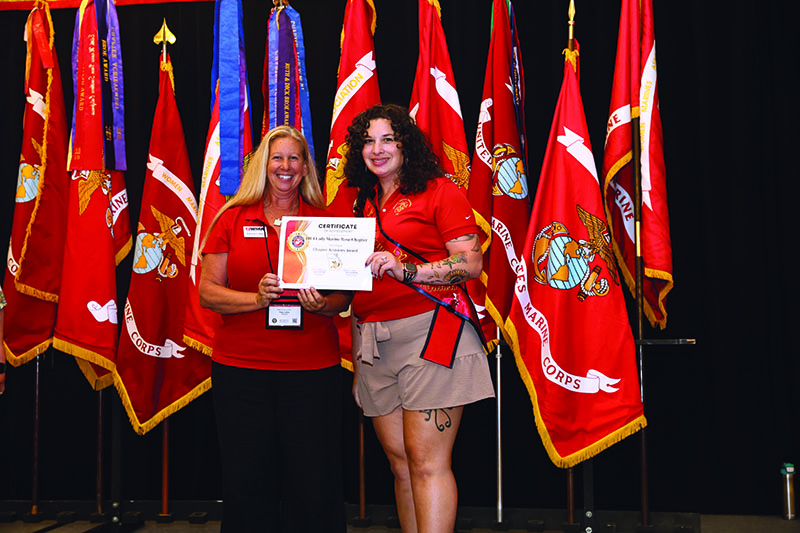
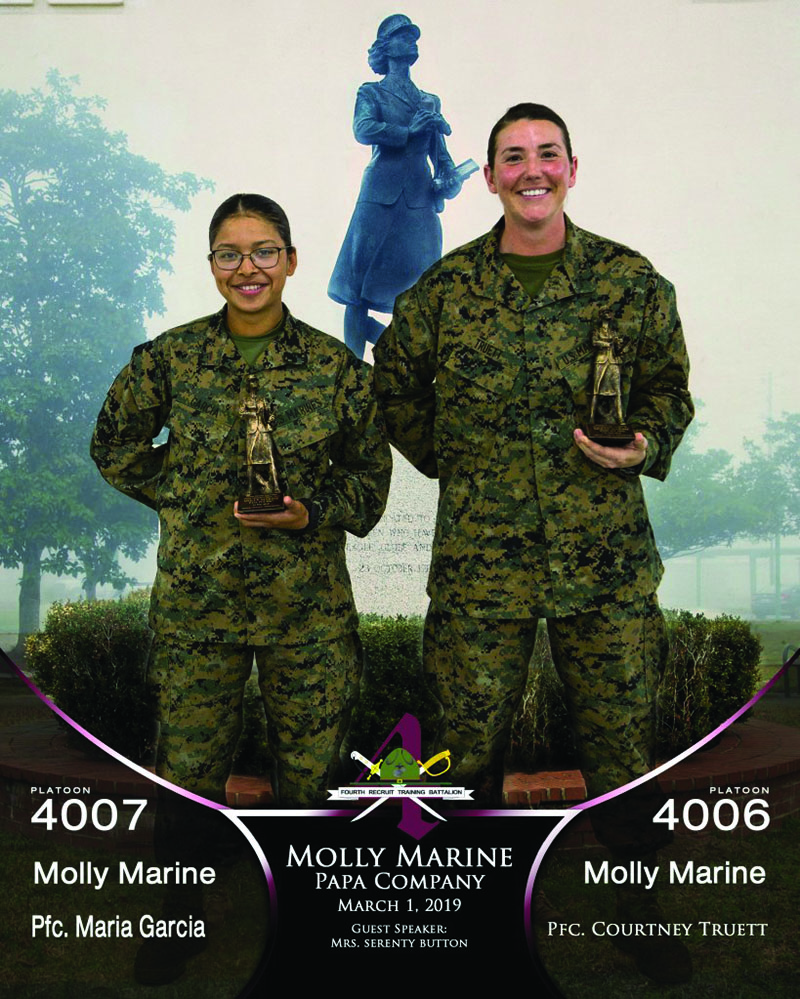
To support excellence among female Marines, the WMA provides awards and scholarships. The organization began the Molly Marine Awards in 1969, which go to one recruit in each graduating platoon at boot camp, selected by her peers for demonstrating the qualities of an exemplary Marine. The WMA also provides annual memorial scholarships up to $5,000 and assistance grants to members undergoing financial difficulties.

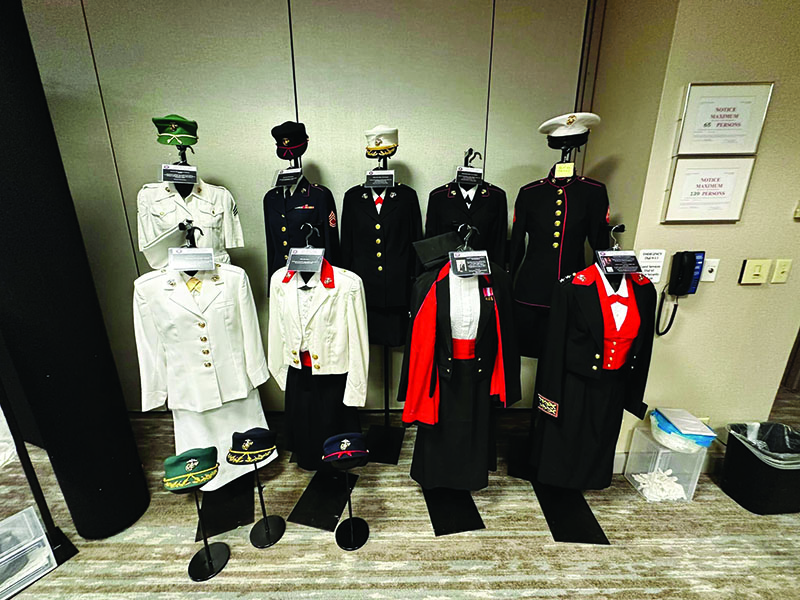
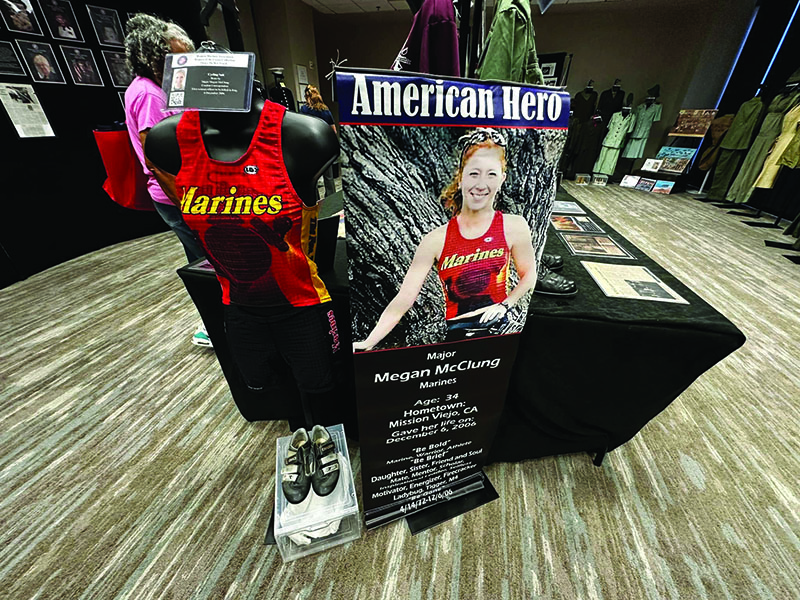
As part of their mission to preserve and promote the history of female Marines, the WMA maintains a historic collection of uniforms and artifacts. The Women of the Corps Collection began as a history project by the WMA Colorado Columbine chapter (CO-1) in 2004. It grew into a unique and definitive collection of every uniform used by women Marines since WW I. The WMA presented the full collection at the last convention, and a partial collection of the uniforms is available for display at museums. If interested, contact the WMA’s National History and Archives Committee at [email protected].

The History of Women Marines

Women Marines need to hear the stories of those who have gone before, appreciate their fights for equality and learn from them. By hearing their stories, you will know that change is possible.

Most WMA chapters hold an event in February honoring the establishment of the Marine Corps Women’s Reserve under the “Free a Man to Fight” campaign. During WW I, the Marine Corps admitted women for clerical services in order to send more men into combat. Opha May Johnson became the first female Marine reservist in 1918. However, in 1919, all women Marines were returned to inactive status.

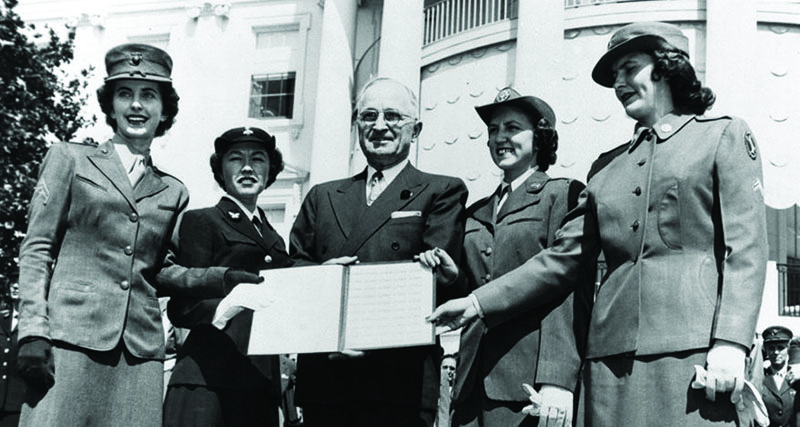
During WW II, the Marine Corps Women’s Reserve was established in February 1943. Females were only assigned to 30 occupations, consisting mostly of administrative work. But as the war continued, women were assigned as mechanics, drivers, welders and air traffic controllers. At the end of the war, women’s roles were again demobilized. But, in 1948, President Harry S. Truman signed the Women’s Armed Services Integration Act, providing a separate women’s corps within each branch of the military.

Female recruits began training at Parris Island, S.C., in 1949. In the following years, the manpower demand from the Korean War increased recruitment goals for women. Schools such as Naval Amphibious School and Command and Staff College opened to women officers.

In the ’60s and ’70s, the Vietnam War and anti-military attitudes caused manpower shortages across all branches. The 1967 Marshall Commission removed the policy that limited women to only 2% of the military and lifted restrictions on promotions, and in 1976, the first female drill instructors graduated from Drill Instructor School. This allowed women to independently supervise and train female recruits at Parris Island and opened more leadership and promotional opportunities for women Marines.

In 2015, Secretary of Defense Ash Carter ordered all military occupations and positions opened to women. In 2020, the National Defense Authorization Act mandated the Marine Corps to integrate all training for males and females at both Parris Island and Marine Corps Recruit Depot San Diego, Calif. By 2023, all training companies were integrated.

The Closure of the 4th Battalion

In 2023, the Marine Corps deactivated the 4th Recruit Training Battalion at Parris Island. From 1986 until just recently, all enlisted women trained in this battalion before earning the title of United States Marine. 

“It means closure, but it also means progress because this is something that has been needed for a long time. For women Marines to be validated more, I think the integration was necessary,” said Sgt Kay Ross in a 2023 interview with WTOC.

On June 15, 2023, Marines gathered at MCRD Parris Island, S.C., for the deacti­va­tion of the 4th Recruit Training Bat­tal­ion, an end of an era for the unit that trained generations of enlisted women, transitioning the Corps toward a fully integrated and standardized training structure for all recruits.

But the moment was also bittersweet because it ended a chapter of women’s history.

“The guys had their bragging rights with their battalions—we had ours. To say I went to boot camp with the 4th Battalion makes me proud to this day,” said SSgt Melissa M. Roy.

Some wondered, with the full integration of the Marine Corps, whether there was still a place where women Marines could experience camaraderie. Would the unique history of women in the Corps be buried?

“The Women Marines Association will retain your identity for the rest of your lives…. This is your safe haven,” promised Ann L. Crittenden, WMA National President.

Sign Me Up!

You can head over to www.womenmarines.org to join the WMA as a term or life member. Then search their map for the local chapter nearest you and join them. Most local chapters have active Facebook groups that post their events, so be sure and check those out. If you’re not interested in joining a local chapter, you can be a member at large. You can still be active within the WMA and volunteer your time and services. 

Additionally, the WMA holds conventions biennially, on even years. The location varies throughout the United States. The next WMA convention will be hosted by the MI-2 chapter in Frankenmuth, Mich., Sept. 22-25. 

SSgt Sayles shared about one convention, “After I started sharing my experience, one lady said, ‘So we’re standing on your shoulders.’ And I tell you—it touched me. It was just a wonderful experience to have at the WMA that you can’t get anywhere else. There’s nowhere else I could have gone and been in a room full of women Marines.”

No club in your area? Consider starting a chapter. Article 10 of the WMA bylaws states that “five or more active members of WMA who reside in a defined geographic area … or share a common USMC special interest/experience (e.g., music, aviation, drill instructor, deployed, etc.) may apply for a chapter charter.”

The Women Marines Association represents the fewer and the prouder. Your enlistment in the U.S. Marine Corps was one of the defining moments of your life. Show your colors by joining the WMA today.

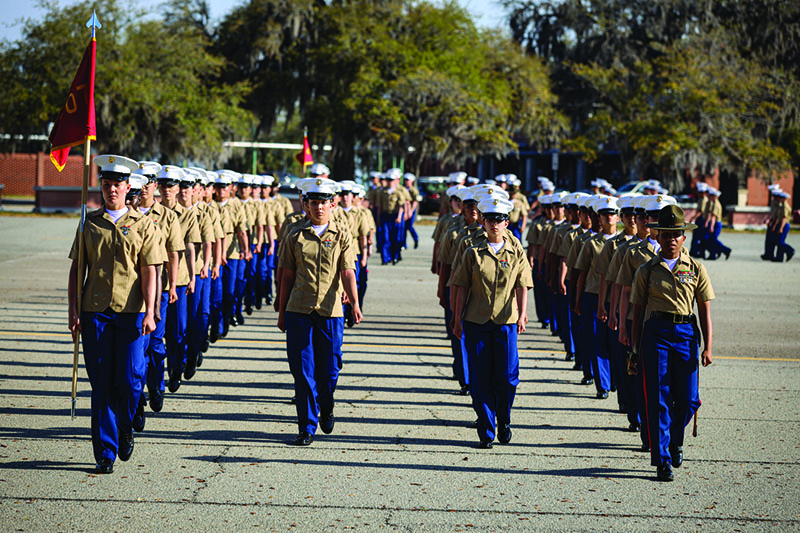
Featured Image (Top): Women Marines with “Papa” Company, 4th Recruit Training Battalion, graduate from boot camp MCRD Parris Island, S.C., March 26, 2021. While the historic 4th Battalion that trained all enlisted women was deactivated in 2023 with gender-integrated training initiatives, the Women Marines Association (WMA) continues to ensure that the stories, mentorship and camaraderie of the women who trained here are never lost.


About the Author

Kimberly Ussery grew up as a Navy Brat and has her MFA in Creative Writing from U.C. Riverside. A retired science teacher, she currently writes book reviews for the Journal of San Diego History and blogs on kimberlyus.com.


Enjoy this article?

Check out similar member exclusive articles on the MCA Archives:
Women Marines Celebrate 60 Years of Honor, Courage and Commitment

Leatherneck
June 2003
By: Col. W Ford

Women Marines March On!

Leatherneck
February 2006
By: Mary Karcher

Women Marines Association: Runs "Race  of the Decade" at Convention
Women Marines Association: Runs “Race of the Decade” at Convention

Leatherneck
January 2007
By: Mary Karcher

Marine Corps Body Bearers: Upholding a Sacred Duty

A hallmark trait of Marine veterans is the immense pride we take in having earned the right to wear the uniform and serve alongside our fellow warriors. Within the active-duty force, numerous entities push this a step further, separating themselves based on military occupational specialty, duty station or unit affiliation. Some of the fiercest and proudest Marines stem from the smallest and most specialized groups. One of these may also be the least recognized yet proudest section stationed at “8th & I.”

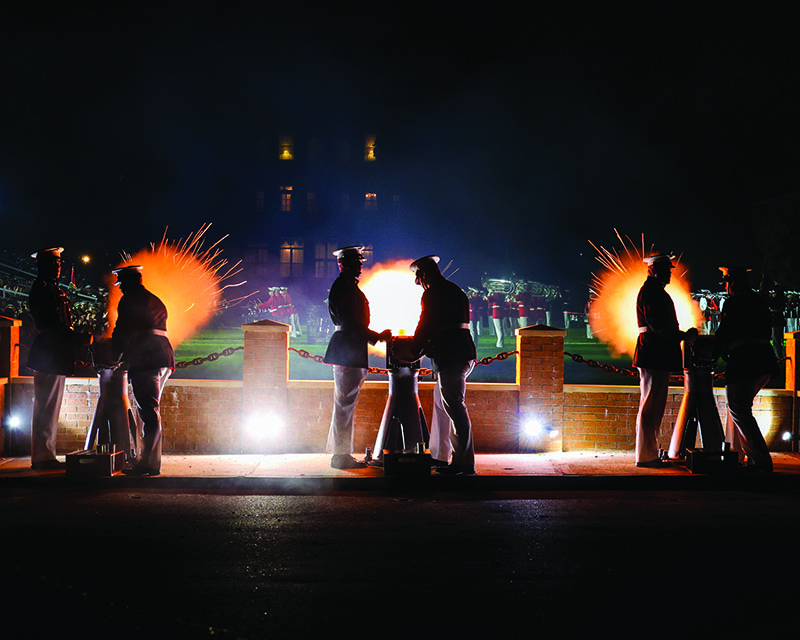
Marine Barracks Washington, D.C., houses no shortage of special units with high-visibility duties. Visitors attending any Sunset or Evening Parade may witness the immaculate marching platoons, the brilliant Silent Drill Platoon, the elite Commandant’s Four Color Guard, or flawless elements of “The President’s Own” U.S. Marine Band or “The Commandant’s Own” U.S. Marine Drum and Bugle Corps. Each Friday night throughout the parade season, while other barracks Marines wow the crowd beneath the spotlights, one small group stands silent in the dark at the end of the field, patiently awaiting their part in the performance. Without introduction or verbal cue, the Marine Corps Body Bearers fire three cannons at the appointed times, casting a smoky haze across the parade deck. For the casual viewer, the true identity of these shadowed figures may feel of less importance, their role in the show less consequential than the Marines flipping rifles, clashing cymbals or saluting a star-spangled general beneath the flagpole. For a Body Bearer, however, this perception fits perfectly in line with their occupational goal; never be in the spotlight, never draw attention to yourself and never distract from the purpose of the ceremony.

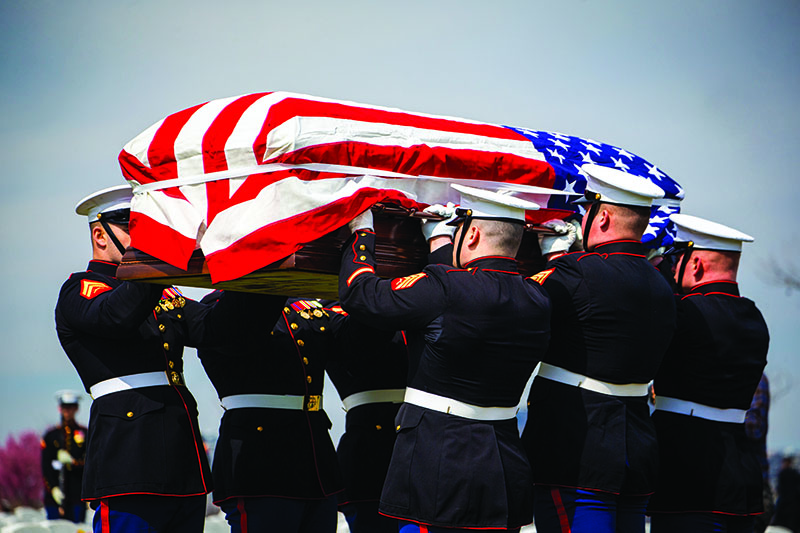
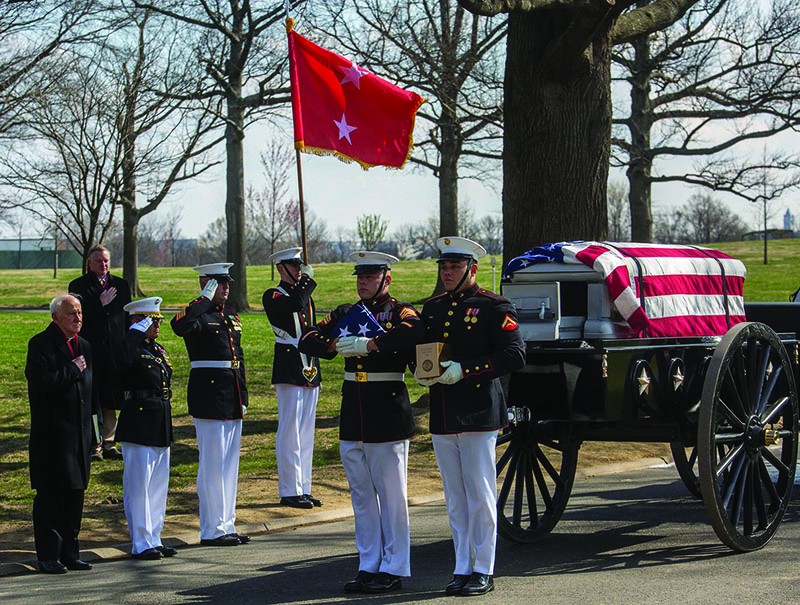
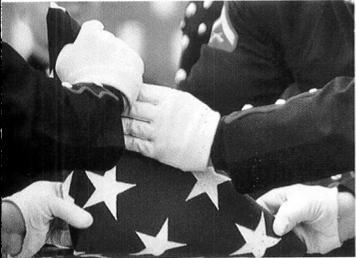
U.S. Marine Corps Body Bearers with Marine Barracks Washington, D.C., conduct the “final raise” at the funeral of Cpl Thomas H. Cooper, a World War II Marine killed in action on Tarawa. Cooper was not repatriated until many years later, at Arlington National Cemetery, Arlington, Va., on March 10, 2022. The final raise serves as a last salute to the fallen Marine.

The true function of these Marines is showcased outside the barracks at Arlington National Cemetery where the section performs funerals for Marines and Marine dependents. The Body Bearers’ precision at each funeral reveals the daily training they endure to perfect their craft. Relentless attention to detail in every movement intentionally keeps the focus off of the Body Bearers and directed toward the Marine being laid to rest.

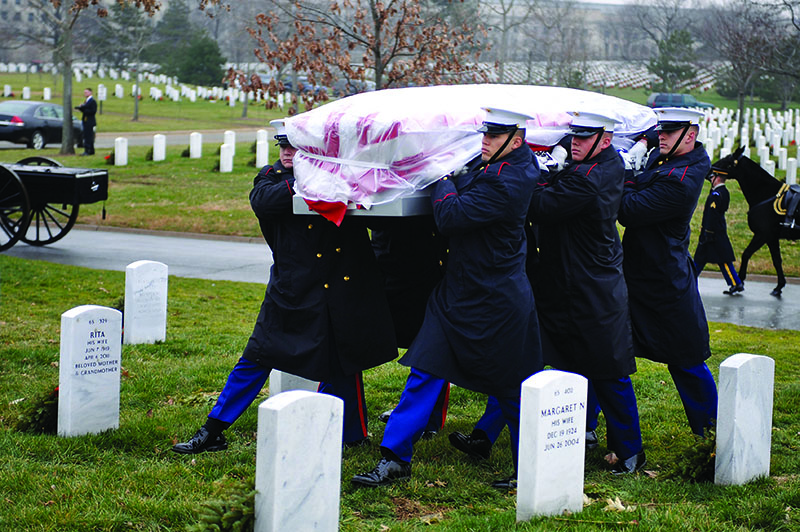
Other branches of service, such as the U.S. Navy and Air Force, maintain similarly dedicated units, highlighting the vital importance of their mission. Though similar in task, the Marine Corps scripts its funerals differently to ensure the fallen Marine and their family remain at the center of attention. While the other branches utilize eight pallbearers, the Marines operate with six, two fewer bodies blocking the family’s view of the casket being transported to the gravesite. Each branch of service trains to carry the casket at waist height, a uniform method adopted during joint funerals. At Marine funerals, though, Body Bearers hoist each casket up to their shoulders from the hearse or caisson all the way to the gravesite. In so doing, family members in attendance witness their loved one in their final journey to his or her resting place, rather than losing sight of the casket amidst a surrounding crowd of splendidly uniformed service members.

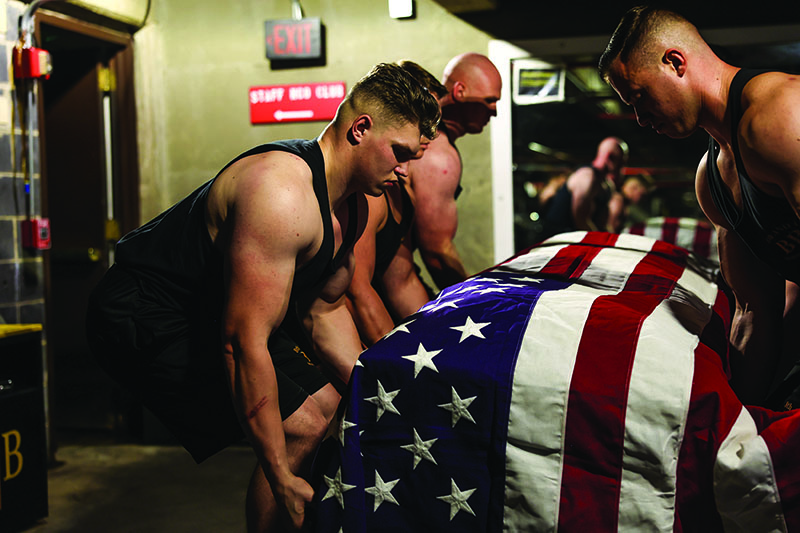
Through rain or snow, over ice, gravel or grass, in freezing or scorching temperatures, the Body Bearers execute their duties. Some caskets may weigh upwards of 600 pounds. Some gravesites may lie hundreds of feet away. Regardless, six Marines with stoic faces level the flag-draped casket at their shoulders and march in unison to the appointed place. At the gravesite, in one final and uniquely Marine salute, the Body Bearers face the casket, raise it up above their heads and freeze there for 10 seconds before lowering the casket down to the ground and folding the flag. After a funeral is complete, the Body Bearers prepare to do it all over again in a different section of Arlington, sometimes performing up to three funerals per day.

Accomplishing every funeral to the Corps’ standard of perfection requires each Marine to rigidly maintain his bearing. Any visitor to any gym in the nation will likely roll their eyes at some point watching another nearby patron grunting and hissing and sucking down air as they throw up a bar full of weight, a performance likely captured on a phone for instant upload to social media. This brand of self-serving distraction would clearly be unacceptable for Marines raising a 600-pound casket overhead in a final dignified salute. For Body Bearers, proper bearing is achieved through physical strength—astounding and extraordinary levels of endurance found few other places across the Corps.

“The distance we carry a casket can vary significantly. It can be a little as 20 feet off the road to one we did where it was probably two and a half football fields,” said Corporal Glen Hafemeister, a former Marine Body Bearer who served with the section from January 2023 to August 2025.

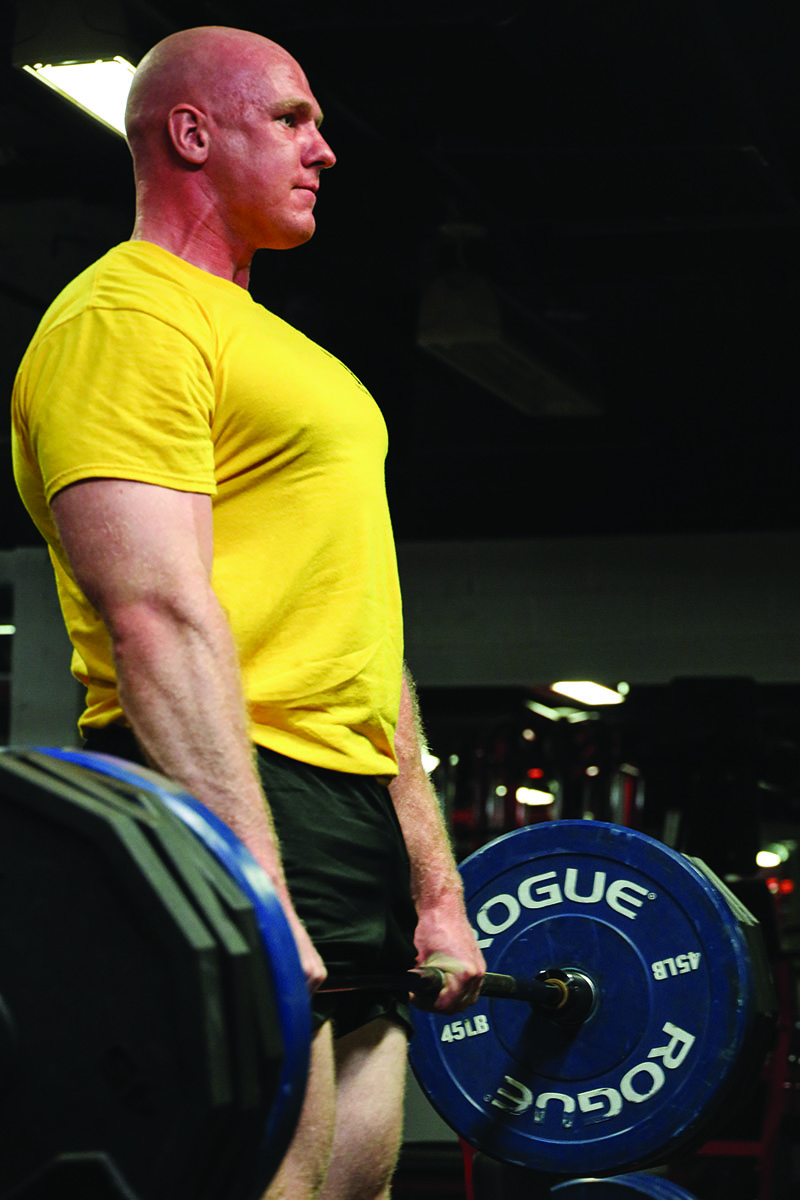
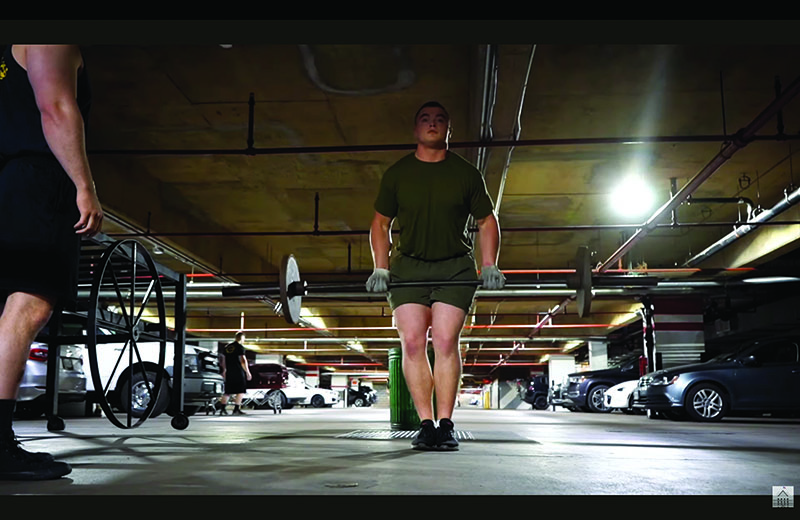
Cpl Jacob Dorton performs deadlifts dur­ing a workout at Marine Barracks Washington, D.C., on Aug. 1, 2025. The workout session, conducted with Muscle & Fitness magazine, gave insight into the Body Bearers’  rigorous training regimen and functional fitness.

 “For the majority of funerals we conduct, you might not need to have the strength that we require, however, there are always going to be a few every month where that strength is absolutely necessary, and we never know if the next funeral is going to be like that.”

Some of the most memorable moments from the history of other elite ceremonial units at 8th & I originated with mistakes made and worked through. Even the Silent Drill Platoon, renowned for precision and perfection, celebrates members who maintained their bearing and finished the performance through mishaps such as a rifle butt slashing open a Marine’s face or a bayonet stabbing into a Marine’s thigh. The Body Bearers’ training, however, mandates that no mistakes are made; perfection at every funeral, every day.

“Every Marine deserves our best, and we’re going to give our all for him,” said Cpl Jacob Dorton, a three-year member of the section. “He is our brother. He earned the title and served honorably. We’re going to give everything we have to give him a flawless funeral. We have a no-fail mission. We can’t have extra Body Bearers following along behind in case one of us falls out.”

“We’re also less than 5 feet away from the family,” added Hafemeister. “We don’t fall out.”

For many prospective Body Bearers, the enormous physical challenge embodies their initial interest and hook. Marines with the section deploy twice a year to both coasts on recruiting tours. They visit graduating classes from the Schools of Infantry at Camp Lejeune, N.C., and Camp Pendleton, Calif., in search of candidates. While on base, they pin up recruiting posters at the local gyms challenging corporals and below already in the fleet to try out and see if they have what it takes. With fewer than 15 slots available, trials are extremely competitive.
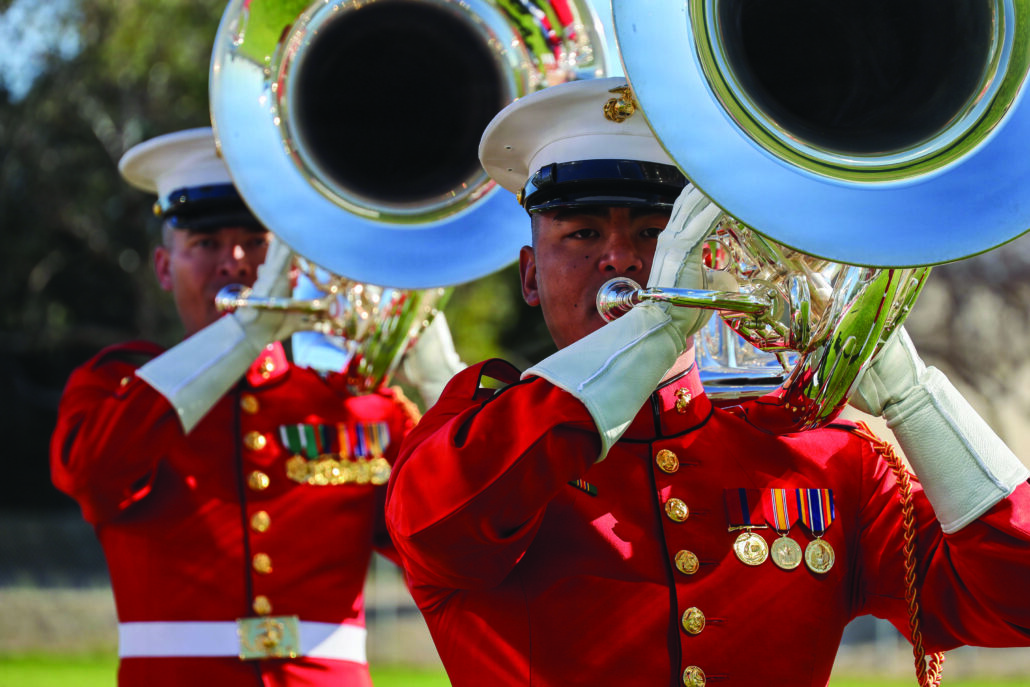
Any Marine hoping to join must first score a first-class physical fitness test and combat fitness test. This serves primarily to weed out the candidates who stand little chance of completing phase two: the Body Bearers’ uniquely crafted initial strength test. This minimum requirement consists of 10 repetitions of each exercise, including a 225-pound bench press, 135-pound overhead press, 115-pound bicep curl, and 315-pound squat. Each rep on each exercise must be completed with good form and bearing. The section chooses new candidates from the pool of Marines who complete the initial requirements and demonstrate exemplary character, then cuts them orders to 8th & I. Here, the most grueling phase of training begins.

LCpl Phillip Meckna, left, a Body Bearer with Bravo Company, Marine Bar­racks Washington, conducts morning drill practice with the section at 8th & I, on Sept. 17, 2025. The Body Bearers train daily to uphold the highest standards of pre­cision and discipline while carrying out one of the Corps’  most solemn mis­sions, honoring fallen service members and their families. (Photo from LCpl Brynn L. Bouchard, USMC)

Every Marine arriving in D.C. begins their tour with Ceremonial Drill School (CDS). While most barracks new joins practice marching, rifle drill, and other disciplines with the marching platoons on the parade deck, prospective Body Bearers spend the duration of CDS out of sight, training in the parking garage. Candidates arrive in small groups throughout the year. To accommodate them, Body Bearer CDS operates as a continuous, self-paced evaluation placing new joins alongside experienced Marines in daily training and exercise. Cpl Dorton currently serves as the senior instructor for Body Bearer CDS.

“We train down there to be out of sight,” he said. “We don’t like a lot of attention towards us and the job we do. We want the attention to be on that Marine and his family. That’s why we work towards flawless bearing, so that the family can focus on their Marine, his service and life. We are just there to carry the casket, fold the flag, and walk away so they can have their moment.”

Candidates take six to 12 months to perfect each movement under the intense scrutiny of their peers. A candidate must flawlessly perform every ceremonial movement in coordination with the rest of the team. They must demonstrate perfect bearing under extraordinary physical strain in order to successfully graduate.

A Body Bearer candidate exercises below ground in the parking garage at Marine Barracks Washington, D.C., during Ceremonial Drill School. New candidates train in the Corps’ standard green-on-green until they complete CDS, at which point they earn the section’s coveted black and gold uniform.

As one metric to gauge their bearing, each candidate must pass the final strength test, consisting of the same exercises and weights used in the initial strength test, but with double the repetitions. During CDS, candidates train wearing the Corps’ standard green-on-green. When they graduate, they receive the coveted black and gold tank top displaying the section’s logo and motto, “The Last to Let You Down,” officially signifying the Marine holds a spot within the section and has earned the right to perform the sacred duty at Arlington.

Sergeant Joshua Williams, the Body Bearers’ platoon sergeant, coordinates with the cemetery several weeks in advance. He determines which Marines perform funerals each day and which will remain at the barracks for training or other duties. The amount of support required at the cemetery depends on the type of funeral being conducted, whether a dependent funeral, standard honors for any Marine or full honors for higher ranking enlisted or officers, Medal of Honor recipients, or Marines killed in action or held as prisoners of war. The funeral may have a casket or an urn. The family may request other specifics, such as a horse-drawn caisson. Variations in weather create friction but will not be a reason for delay or cancellation. Ultimately, the Body Bearers will not know exactly what is required of them until they arrive on site.

“I had an experience one day where there was a funeral we didn’t know about that was not on our schedule,” Williams remembered. “We had to get everybody ready with everything they needed and in place in less than two hours. We had another instance where we set up to perform a funeral, and it turned out to be two caskets. In that case, the Marine and his dependent were being buried at the same time, so we had to carry the dependent first, then the Marine.”

Other unique experiences or special circumstances stand out from the hundreds of funerals each Marine completes during the course of their tour. Joint funerals performed with other service branches often prove most memorable. In January 2025, several Marines took part in the funeral services for President Jimmy Carter. Dorton served as a pallbearer, transporting the casket to and from the U.S. Capitol building where President Carter lay in state. Two days later, Hafemeister helped move Carter into Washington National Cathedral for his state funeral.

“We do quarterly sustainment training with the other services to make sure we are always ready to perform a joint funeral,” Hafemeister stated. “That way when we show up, there might be a different team of individuals and each branch has a different drill, but we all have a baseline that we can work off of pretty easily.”

Many Body Bearers hold similar impactful memories from the opposite end of the public visibility spectrum: funerals conducted with a single person, or sometimes even no one else, in attendance.

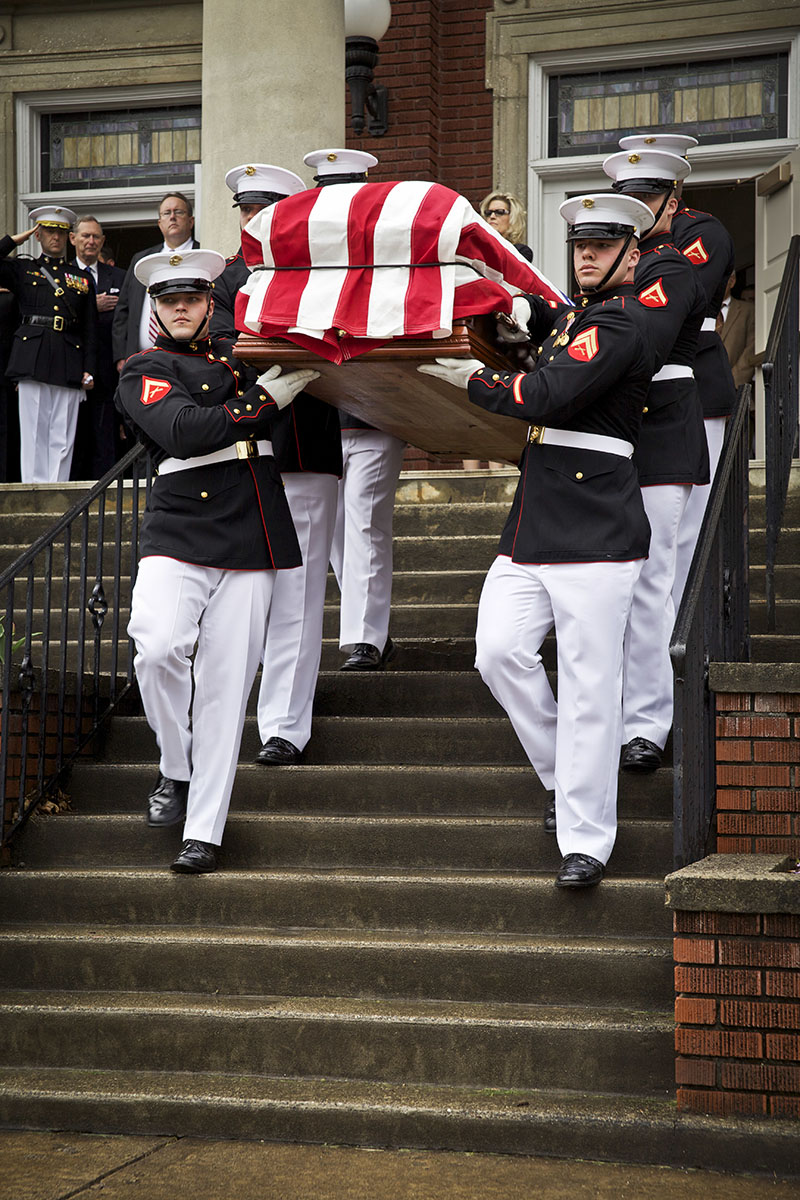
Body Bearers carry the casket of the 30th Commandant of the Marine Corps, Gen Carl E. Mundy, Jr., USMC (Ret), during a funeral service at the First Methodist Church in Waynesville, N.C., on April 19, 2014. (Photo from Sgt Mallory S. VanderSchans, USMC)
Body Bearers prepare to march with the remains of MajGen John A. Studds, USMC (Ret), during a full honors funeral at Arlington National Cemetery, Arlington, Va., on April 10, 2018. (Photo from Sgt Robert Knapp, USMC)
Cpl Jacob Dorton, center,
 LCpl Ethan Barlow, left, and Sgt Joshua Williams, Body Bearers assigned to Marine Barracks Washington, D.C., take part in caisson refamiliarization training at Joint Base Myer-Henderson Hall, Va., on May 13, 2025. (Photo from LCpl Kiara Rawls, USMC)

“No matter how many people are there, it doesn’t matter if it is a private first class or the President of the United States, the whole country watching or nobody watching, the training and attention to detail that will go into that funeral are identical,” Hafemeister added.

Regardless of the experiences that may come after, many of these Marines cherish most the memory of their first funeral.

“That one will always stand out to me,” said Dorton. “Just the nerves I had beforehand going into it and then, during and after, being able to see the impact that I had on that family really meant a lot to me. It kind of cemented in my mind why I wanted to do this job.”

“Being on my first casket was an honor,” Williams reflected. “I could feel the presence of that Marine, even though they were deceased. At the end, a family member whispered, ‘Thank you for all that you do.’ For me, that reinforced the reason why we do what we do. The reason why I love what I do is the impact and comfort we give the families. You never forget that feeling.”

A Marine’s time with the section varies greatly. Some, especially those joining from duty stations already in the fleet, might spend as little as two years with the Body Bearers. Others, particularly those joining straight out of School of Infantry, could potentially spend their entire four-year enlistment there. Hafemeister began his enlistment as a 0331 machine gunner with 1st Battalion, 6th Marines, at Camp Lejeune. After more than two and a half years and 250 funerals completed with the Body Bearers, he left active duty. Williams is one of the less typical members who joined from the fleet, will remain with the section for four years, and intends to reenlist. He began his career as an automotive mechanic with 1st Battalion, 12th Marines, in Hawaii, before finding the Body Bearers’ recruiting poster at the gym. Now, with less than a year left in his tour at 8th & I, Williams is preparing to return to the fleet as a senior sergeant. His time with the Body Bearers has prepared him for the future in multiple unique ways.

“Going through CDS was very, very challenging,” he stated. “Going through anything else in the Marine Corps after that will seem fairly easy.”

Whether a Body Bearer, a marching platoon member, a machine gunner or a mechanic, every Marine possesses the drive to be the best, and believes they are. Relentless perfectionism and unwavering dedication to honoring our heritage are foundational to wearing our cloth. The Marine Corps Body Bearers demonstrate this daily, both on display at Arlington and in the privacy of the barracks parking deck. Their professionalism serves as an understated, little recognized, yet hard-to-match example of commitment to these core values.

Body Bearers conduct ceremonial cannon fire during the conclusion of a Friday Evening Parade at Marine Barracks Washington, D.C., on May 16, 2025. The final cannon salute signifies the end of the parade, honoring the Marine Corps’ traditions of precision, professionalism and ceremonial excellence. (Photo from LCpl Brynn L. Bouchard, USMC)

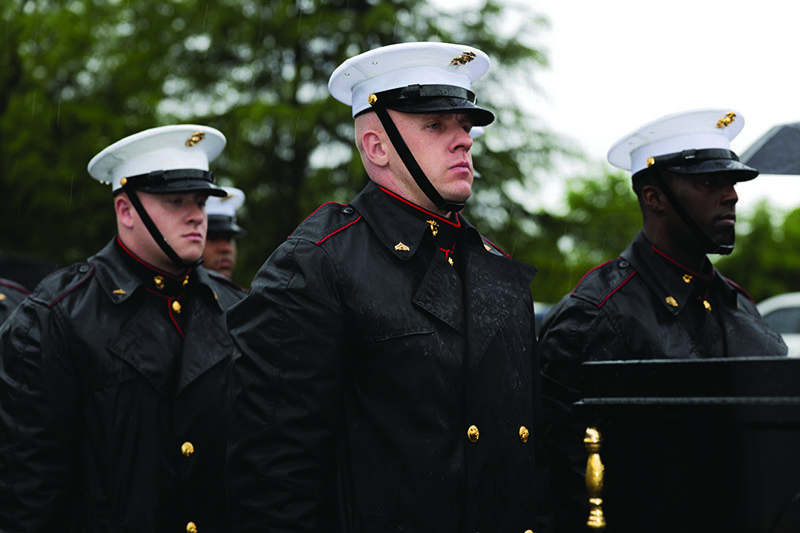
Featured Photo (Top): Body Bearers carry the casket of Gen Samuel Jaskilka, USMC (Ret), the 16th Assistant Commandant of the Marine Corps, to its final resting place at Arlington National Cemetery, Arlington, Va., on Jan. 26, 2012. With only six Body Bearers around the casket, and the casket carried at shoulder-height, the Marines make every effort to keep the focus of the ceremony on the fallen Marine.


Author’s bio:

Kyle Watts is the staff writer for Leatherneck. He served on active duty in the Marine Corps as a communications officer from 2009-2013. He is the 2019 winner of the Colonel Robert Debs Heinl Jr. Award for Marine Corps History.


Enjoy this article?

Check out similar member exclusive articles on the MCA Archives:
The Final Escort
The Final Escort

Leatherneck
April 2004
By: Mary Karcher

Uncovering the Origins of Marine Corps Birthday Celebrations

On Nov. 10 across the globe each year, Marines in every clime and place don dress blues with freshly mounted medals and slip on high-gloss Oxford shoes, or the spit-shined “Hershey’s,” to celebrate the Marine Corps Birthday. We listen intently to Major General John A. Lejeune’s message read aloud, feeling goosebumps as we listen to “The Marines’ Hymn.” We envision ourselves in a grand formation spanning the ages, surrounded by the historic pageantry of brother and sister Marines across 10 generations. This year, we celebrate a special milestone, the “Sestercentennial,” celebrating 250 years as the finest all-domain fighting force the planet has ever known. 

To understand the context behind how we celebrate our birthday, Leatherneck recently explored the National Archives, Marine Corps History Division, the Library of Congress and other online repositories. Along the way, we discovered a cast of unsung trailblazers who tirelessly supported the Marine Corps’ most storied leaders in codifying what is today’s most coveted and time-honored tradition. Their contributions, preserved yet faded by time, shaped today’s celebrations through art, writings and recommendations. From the crimped and brittle materials emerged a passion for tradition still vibrant today. Their teamwork may have also proved crucial in helping leaders secure the Marine Corps’ existence. 

Our modern celebrations were born out of uncertain times. One hundred years ago, as the Marine Corps approached its 150th birthday, postwar sentiments might have derailed the Corps from reaching that date. To reinstill public confidence, preserve our legacy and galvanize our place as America’s premier “force in readiness,” the Marine Corps had some work to do to avoid extinction. 

Following the Great War, the “postwar disarmament period” found the Marine Corps struggling for existence. Downsizing shrank the Corps from a 75,101 peak end strength in 1918 to 27,400 by 1920, a nearly two-thirds diminishment in manpower. America wanted time to recover and to prosper in hard-won peace, having made the world safe for democracy.

An isolationist fervor emerged and dominated the political climate. In a speech, U.S. Senator Warren G. Harding asserted, “America’s present need is not heroics but healing; not nostrums but normalcy; not revolution but restoration; … not surgery but serenity.” His comments reflected common sentiments to leave international problems overseas for a return to domestic “normalcy.” Harding’s views would elevate him to such prominence that he secured his inauguration as President of the United States on March 4, 1921. Calls to broaden U.S. Navy downsizing added to the sentiment. On Nov. 12, 1921, Secretary of State Charles E. Hughes declared in front of an international audience in Washington, D.C., that the United States needed to limit naval capabilities, as should the other major world powers, including Great Britain and Japan. He proposed a 10-year shipbuilding holiday and 66 ships to be scrapped. Reports indicated that the attending audience responded with “wild applause,” indicating popular support for what represented large-scale disarmament. This led to deep budget cuts, military downsizing and a bureaucratic reset, echoing the challenges of our modern interwar period. Marine Corps senior leaders had a legitimate cause for concern.

Commandant Lejeune remained focused, driving what later became the Marine Corps’ “first enlightenment,” emphasizing unique expeditionary and amphibious capabilities. He knew that, to remain relevant, our Corps needed to change. He reorganized the headquarters, developed schools, instituted Advanced Base Force training, modernized equipment and built rapid-deployment amphibious capabilities. The Marine Corps already had a suitable place to train, educate, experiment and deploy expeditionary might, well proven during World War I. The Marine Barracks Quantico, Va., had emerged as a powerhouse for expeditionary deployment that MajGen Lejeune himself developed while serving as one of the first commanding generals.
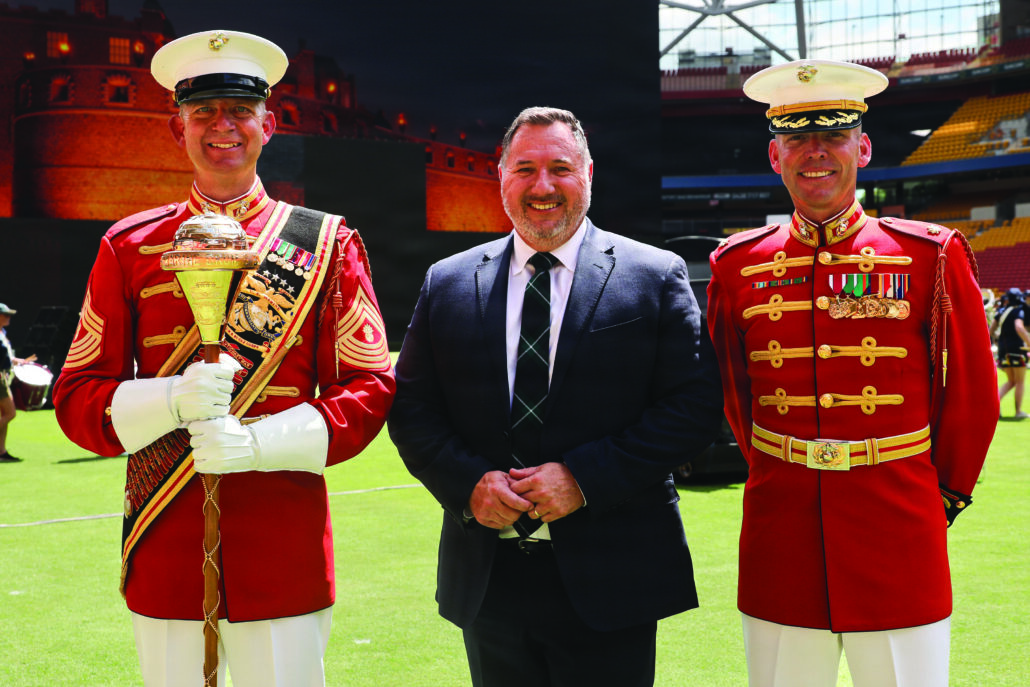

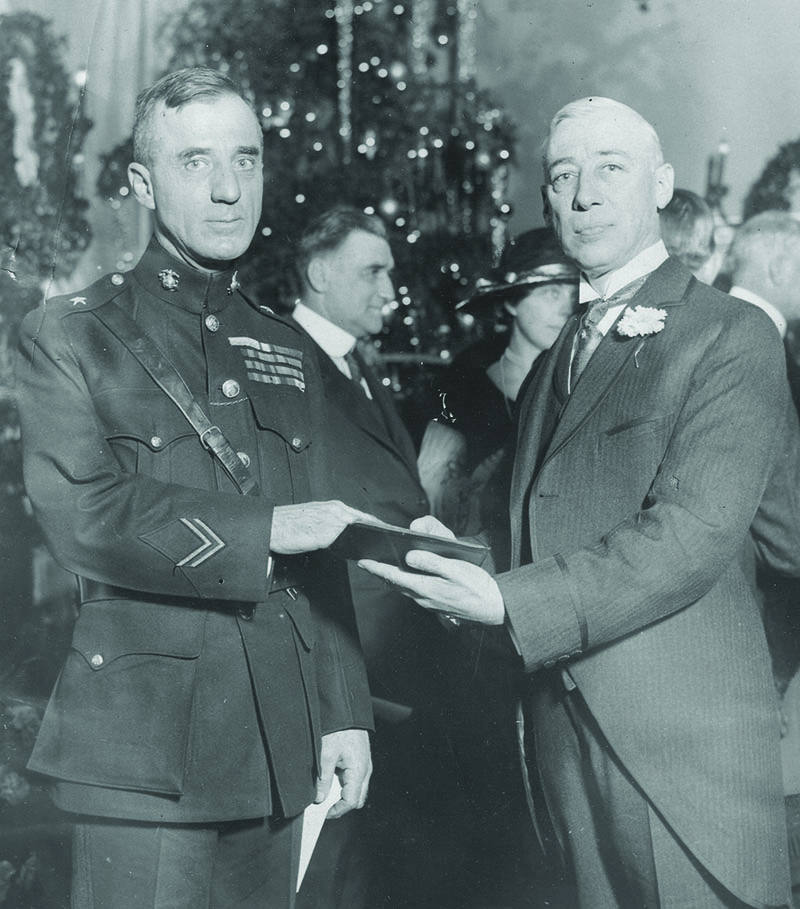
BGen Smedley D. Butler takes the oath of office as the Director of Public Safety for Philadelphia, January 1924.

Quantico’s real estate boasted capabilities for all warfighting domains, representative of the Marine Air-Ground Task Force. The base offered ample space to quarter troops, conduct artillery and infantry maneuvers and sustain troop transport by water and rail. Brown Field, now Officer Candidates School, teamed with biplane aircraft, undoubtedly frequented by the Corps’ first Marine aviator, Alfred A. Cunningham, the base assistant adjutant and inspector. The Quantico pier regularly docked Navy steam-powered ships for swift embarkation. 

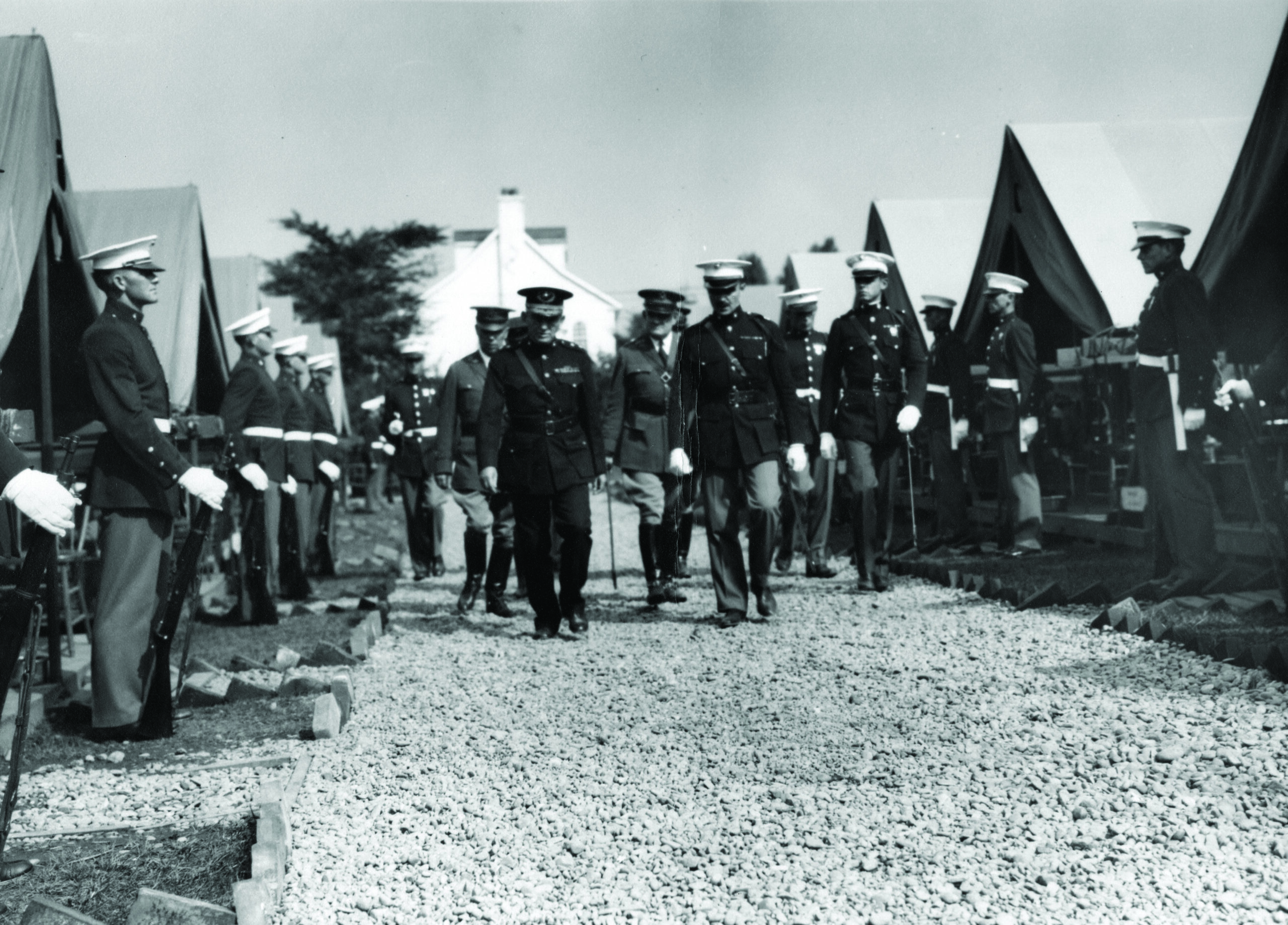
When MajGen Lejeune had been selected for his two-star grade and Commandant on July 1, 1920, he appointed his right-hand man, Brigadier General Smedley Butler, to succeed him. The insightful two-time Medal of Honor recipient continued the Commandant’s intent by further developing the base, expanding schools, training for Advanced Base Force operations and showcasing Marine expeditionary capabilities to the public. The base hosted a variety of public events, including football games at the new stadium (now Butler Stadium) to rally public support. Most visible to the public, Butler and his Marines conducted a series of marches to reenact battles at the Wilderness and Gettysburg, showcasing modern equipment and tactics. He and the Commandant hosted influential political leaders, including President Warren G. Harding and former Secretary of the Navy Josephus Daniels.

MajGen John A. Lejeune (back to photographer) orients President Warren G. Harding and former Secretary of the Navy Josephus Daniels during a Marine Corps Civil War re­enactment at the Wilderness Battlefield just outside of Fredericksburg, Va., 1921.

However, MajGen Lejeune needed to continue to develop ways to appeal to the public, while at the same time inculcating the shared pride that esprit de corps delivers. Documents show that Lejeune was keenly aware of the importance of public awareness through the media. Not only did celebrating the Marine Corps build a sense of institutional pride, esprit de corps and unity within, but the occasion could serve to garner public support as well. But there was a problem. Until 1921, the Marine Corps’ founding date was believed to be July 11, 1798, due to a law signed by President John Adams establishing the Marine Corps as an independent branch of military service. 

Major Edwin North McClellan, a studious, prolific writer assigned to lead the Historical Section of Headquarters Marine Corps (HQMC), played a key role in the establishment of Nov. 10, 1775, as the Marine Corps’ birthdate. 

Reviewing McClellan’s many writings showed variances in the Marine Corps’ exact origins, complicated by 11 state navies, including all but two of the original colonies, New Jersey and Delaware. He grappled with questions on when to draw the line on what constituted the original Marines. Evidence supported going as far back as the first British Royal Marines on American soil, state-appointed Marines or Marines who served on the first American warships to fight in the Revolutionary War aboard the sloop Liberty and the schooner Enterprise. He had to parse through a confusing start where the 1775 resolution created the Continental Marines, but they were disbanded after the Revolutionary War. The 1798 Act later reestablished the Marine Corps under the new U.S. Constitution, which led some to view that date as a new “founding” moment, until historical research prioritized the earlier date. McClellan settled on what came from the American people via the Second Continental Congress resolution signed on Nov. 10, 1775, in Philadelphia, Pa. Accordingly, he delivered his recommendations to the Commandant on Oct. 21, 1921, on what celebrations he thought most appropriate to mark the occasion each year. Maj McClellan’s work formed the genesis behind Marine Corps Order No. 47, Series 1921, read aloud today, signed by MajGen Lejeune on Nov. 1, 1921.  

Despite all these efforts, critics continued to argue about the Marine Corps’ disbandment. One of these critics, Brockholst Livingston, a wealthy, influential New York resident, wrote a letter to the Secretary of the Navy on June 13, 1923, asserting that “a plan should be outlined in which the Marine Corps would be joined with the Line [Navy], doing away with Marines entirely.” He argued that retaining the Corps would be purely sentimental and less a matter of economy. Livingston proposed that most duties performed by Marines could be assumed by the Navy and that camps at Quantico and Parris Island, S.C., should be abandoned. He asserted that other capabilities could be absorbed by the Army, such as overseas garrisons in Peking, Haiti and Santo Domingo. He likened these changes to replacing horses with motor power, or sailing ships with electric drives, by “replacing obsolete organizations with modern ones.” 

MajGen Lejeune, ever the consummate professional, replied to Livingston’s letter within six days, thanking him for furnishing him a copy and stating that his concerns would “receive due consideration.” He then drafted and delivered a memo to the Secretary of the Navy, pulling no punches between professionals. He posited that Livingston’s arguments were a “fallacy,” arguing that Marines had been employed aboard naval vessels since the earliest times. Commandant Lejeune went on to argue they should be retained, that the Navy did not train Sailors to operate ashore and that the Army did not have “sufficient numbers in times of emergency” nor the proper training or organization to operate promptly and in harmony with Naval forces. In his final argument, Lejeune declared that Marines “are abreast of the times in the use of modern methods which they employ in their operations,” and that “they are as modern and up to date as any troops or any body of armed men in any country in the world.”   

As the Marine Corps continued the fight to exist, the 150th anniversary rapidly approached. The Corps’ birthplace in Philadelphia, Pa., emerged as a natural choice to celebrate the occasion. However, in the early 1920s, the city was hardly a place to support parades and ceremonial events or play host to dignitaries. The crime rate had escalated. Bootlegging and police corruption ravaged the city and threatened peace and public safety. So, the city mayor, W. Freeland Kendrick, frustrated with police union influences and corruption, turned to his friend BGen Smedley Butler for help. He petitioned President Calvin Coolidge, who succeeded Harding following his death, to select Butler to take charge as the city’s director of public safety, and, in an unprecedented peacetime measure, Coolidge granted his request. In December 1923, Commandant Lejeune relieved BGen Butler of his Marine Expeditionary Forces, U.S. Fleet command. The Commandant granted him one year’s leave from the Marine Corps to assume his civilian duties, and in the process, he set the stage for a city-wide crime-fighting field day to enable preparations for Sesquicentennial events. 

Immediately following his oath in January, Butler swapped his Marine Corps uniform for a police uniform and began work in earnest, summoning police leadership, captains and lieutenants and directing them to clean up the city within 48 hours or he would replace them with Marines. He moved a cot into his headquarters, disbanded the police union and initiated what resulted in a mass exodus of criminals from Philadelphia. Adjacent cities, including New York, reportedly set up barriers to keep “the undesirables from coming within their gates.” Crime rates went down. Of the 1,200 saloons raided by Philadelphia police under Butler, 973 were closed for illegal bootlegging. Butler served two years at the post, extending his second year by request. In his final year, having set the conditions for safe celebrations, he hosted the Commandant and numerous dignitaries in what became the first major Marine Corps Birthday celebration of its kind. 

BGen Smedley D. Butler takes the oath of office as the Director of Public Safety for Philadelphia, January 1924.

As the Marine Corps Birthday Sesquicentennial approached, planning began in earnest. David D. Porter, a Brevet Medal and Medal of Honor recipient, Commanding Officer of the Marine Corps Eastern Recruiting Division Headquarters in Philadelphia, submitted recommendations to MajGen Lejeune on how to celebrate the occasion appropriately. In his Feb. 27, 1925, letter, he credited an enlisted Marine, Quartermaster Sergeant Victor H. Rogers, with the following eight recommendations, listed verbatim:  

“That a short history of the Corps be written and that same be read to all commands on that day.

That all ships be ‘dressed’ with flags, etc., on which Marines are stationed.

That a holiday be declared at all posts, etc.

That special athletic events be held.

That a dance or other suitable entertainment be held in the evening. 

That a special dinner be served, the same as on Christ-mas, etc.

That a special story be written by the Recruiting Bureau and distributed to the newspapers, together with appropriate pictures.

That the Recruiting Bureau issue an appropriate poster for display on ‘A’ signs.”

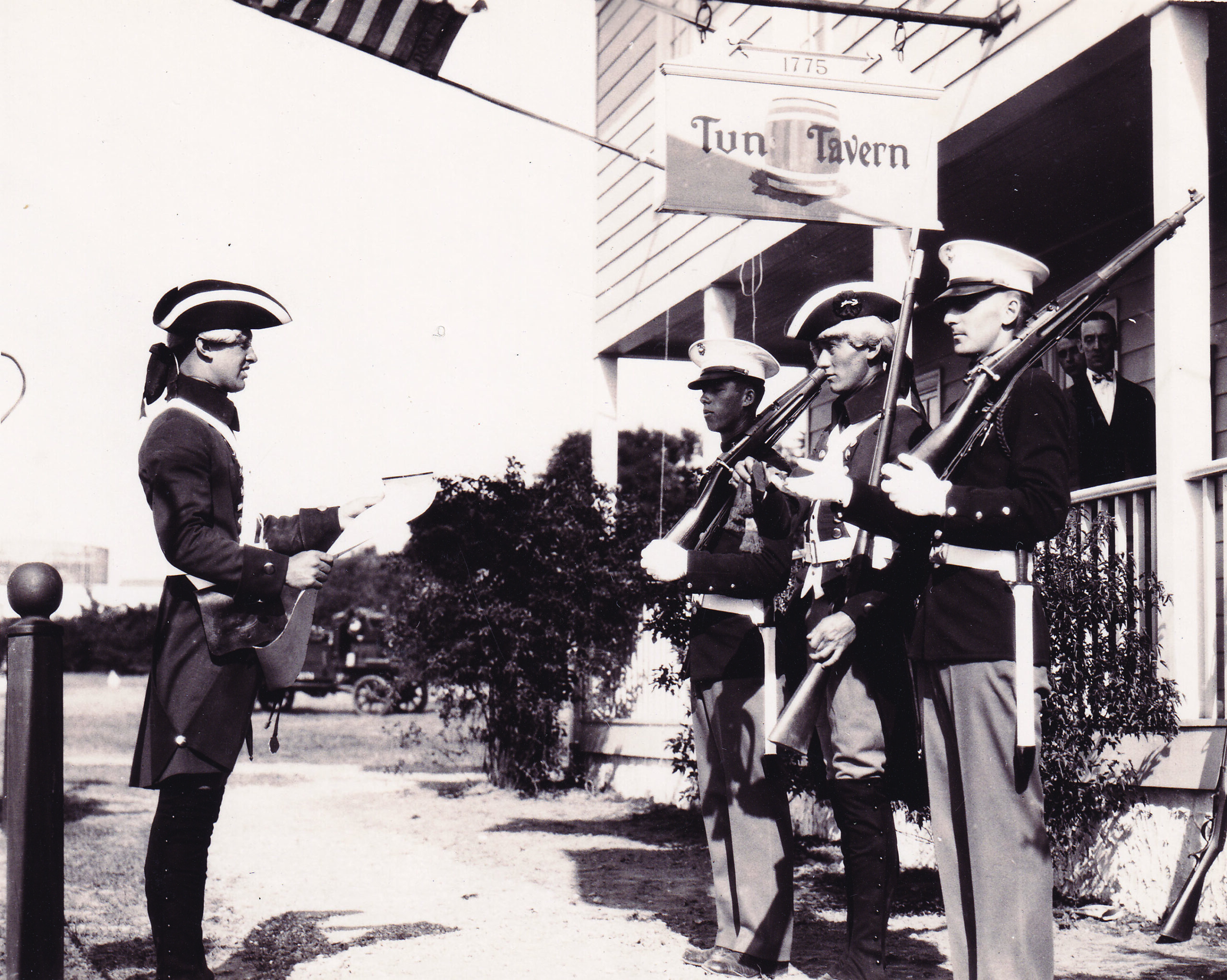
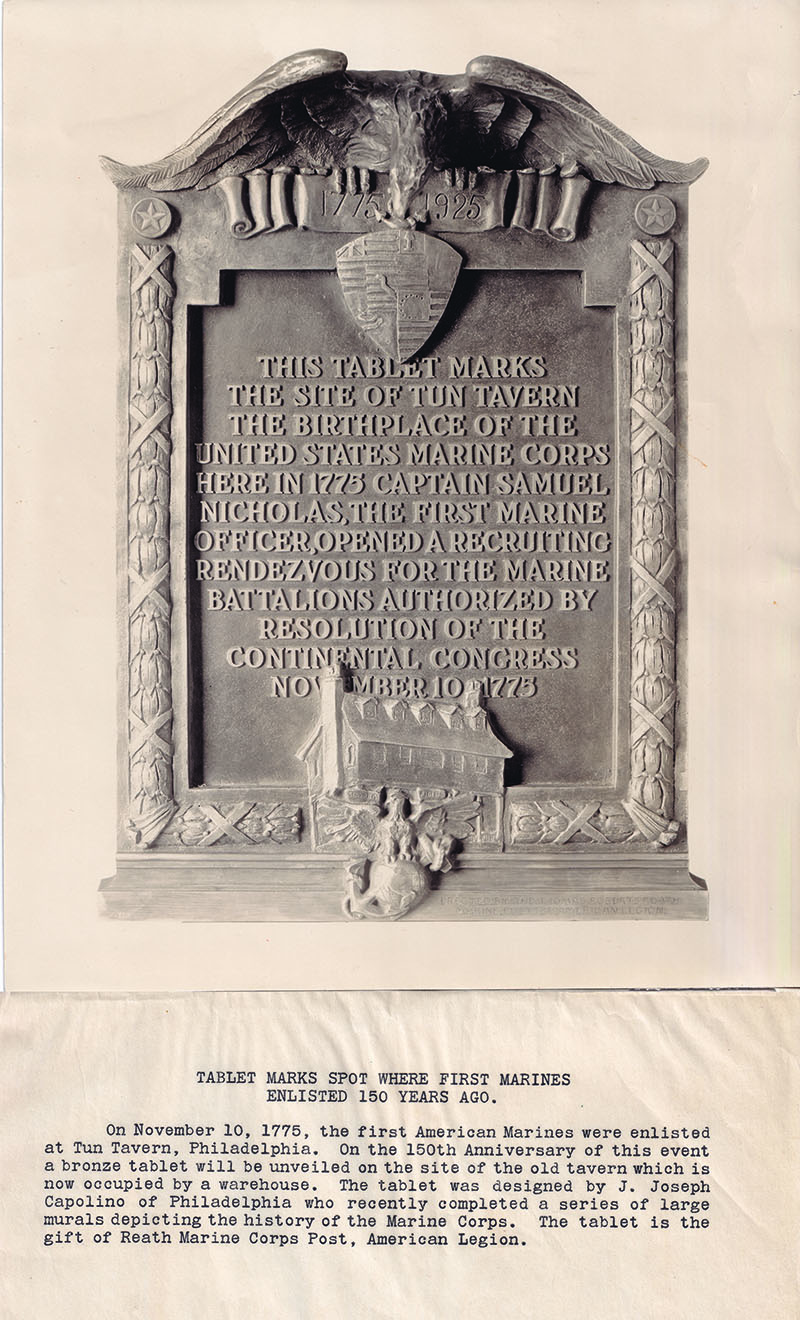
Tablet unveiling where the original Tun Tavern once stood with Navy Secretary Curtis Wilbur, Pennsylvania Governor Gifford Pinchot and MajGen John A. Lejeune in attendance.

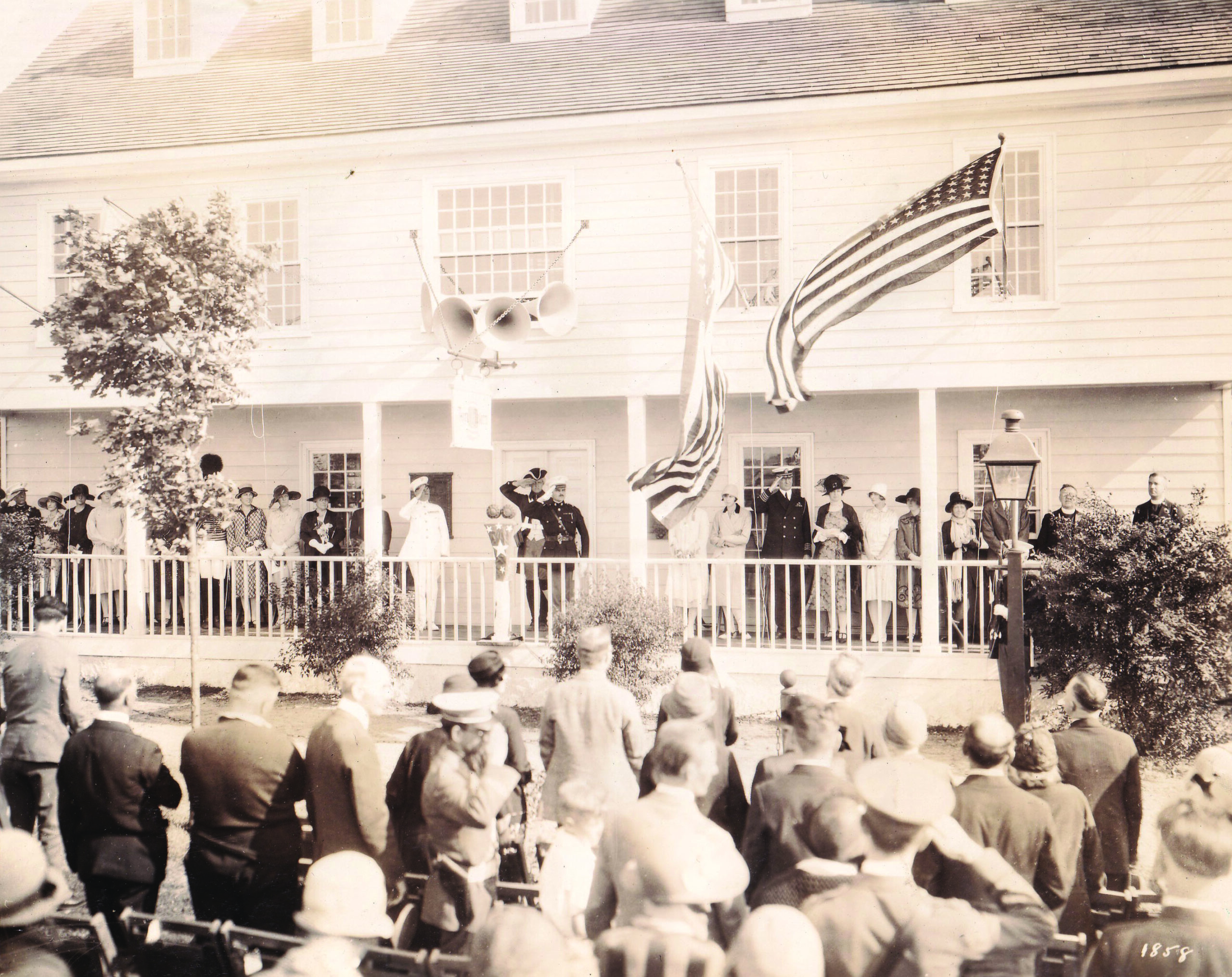
Philadelphia’s Thomas Roberts Reath Marine American Legion Post No. 186 sponsored the venue with the active co-operation of the mayor of the city of Philadelphia and the Philadelphia Chamber of Commerce. Their membership boasted the only chapter that consisted solely of Marine Corps veterans nationwide. The sequence of events would begin on Nov. 10, 1925, with a bronze tablet dedicated at Tun Tavern’s original site, followed by a parade in the afternoon, then a birthday party celebration and dinner conducted at the Ben Franklin Hotel, to be followed that evening with a separate “Military and Naval Ball” sponsored by the Marine Post at the Bellevue-Stratford Hotel. More than 1,200 people would be invited to the dinner and 2,500 to the ball that would follow. This is widely accepted today as the “first” formal Marine Corps Birthday Ball. 

The Tun Tavern tablet, sculpted by John J. Capolino, is a historic marker commemorating the birthplace of the Marine Corps.

Preparation took months leading up to the events. National Archives documents support that invitation letters went out to 56 military, civilian and local dignitaries, including 15 state governors, 16 senators and 20 representatives responsible for Naval affairs. Many written replies expressed sincere regret due to scheduling conflicts with Armistice Day celebrations the following day and other events. An HQMC memo showed pencil annotations next to the names of eleven field- and company-grade staff officers who could not attend. This initial celebration would be optional for Marine Corps attendees. However, formal tasks went out from HQMC for troop support from all East Coast Marine Corps installations, including Quantico, the Navy Yard, Philadelphia and the Eastern Recruiting Division.

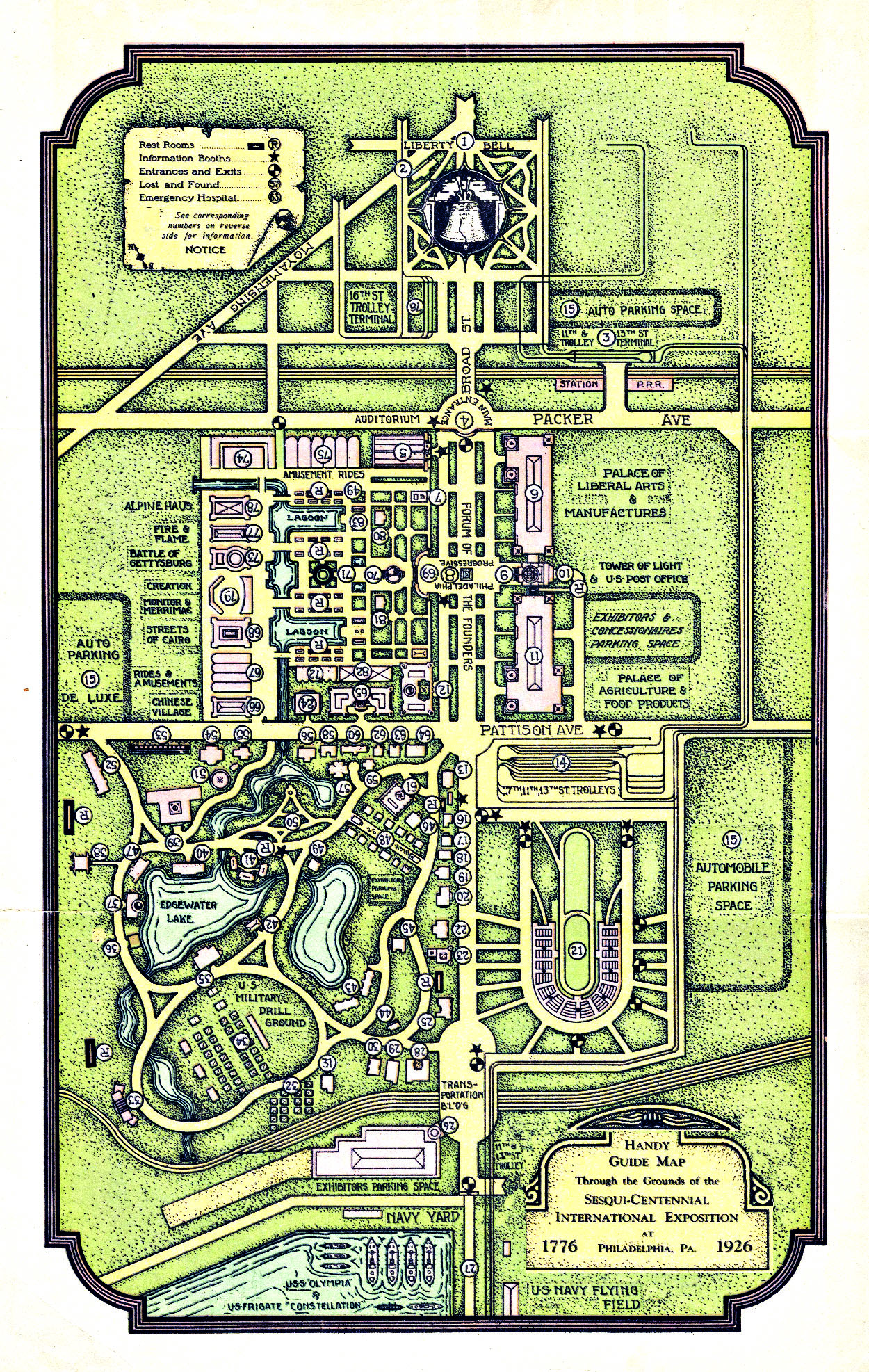
To kick off the first event, the distinguished guest entourage presented the bronze tablet at Tun Tavern’s original site. One of the first artists commissioned by the Marine Corps, John Joseph Capolino, created the token. He also is credited with producing a series of large murals depicting the Corps’ early history, hung in the first Tun Tavern replica built the following year for the Sesquicentennial Exposition of 1926. Today, copies of the prints line the third-floor walls of the U.S. Marine Corps History Division, Marine Corps University, in Warner Hall. The original tablet is no longer at the site in Philadelphia and resides today at the National Museum of the Marine Corps, though not on display. The artifact is now covered in patina and aged greenish with corrosion but still bears the legible inscription.

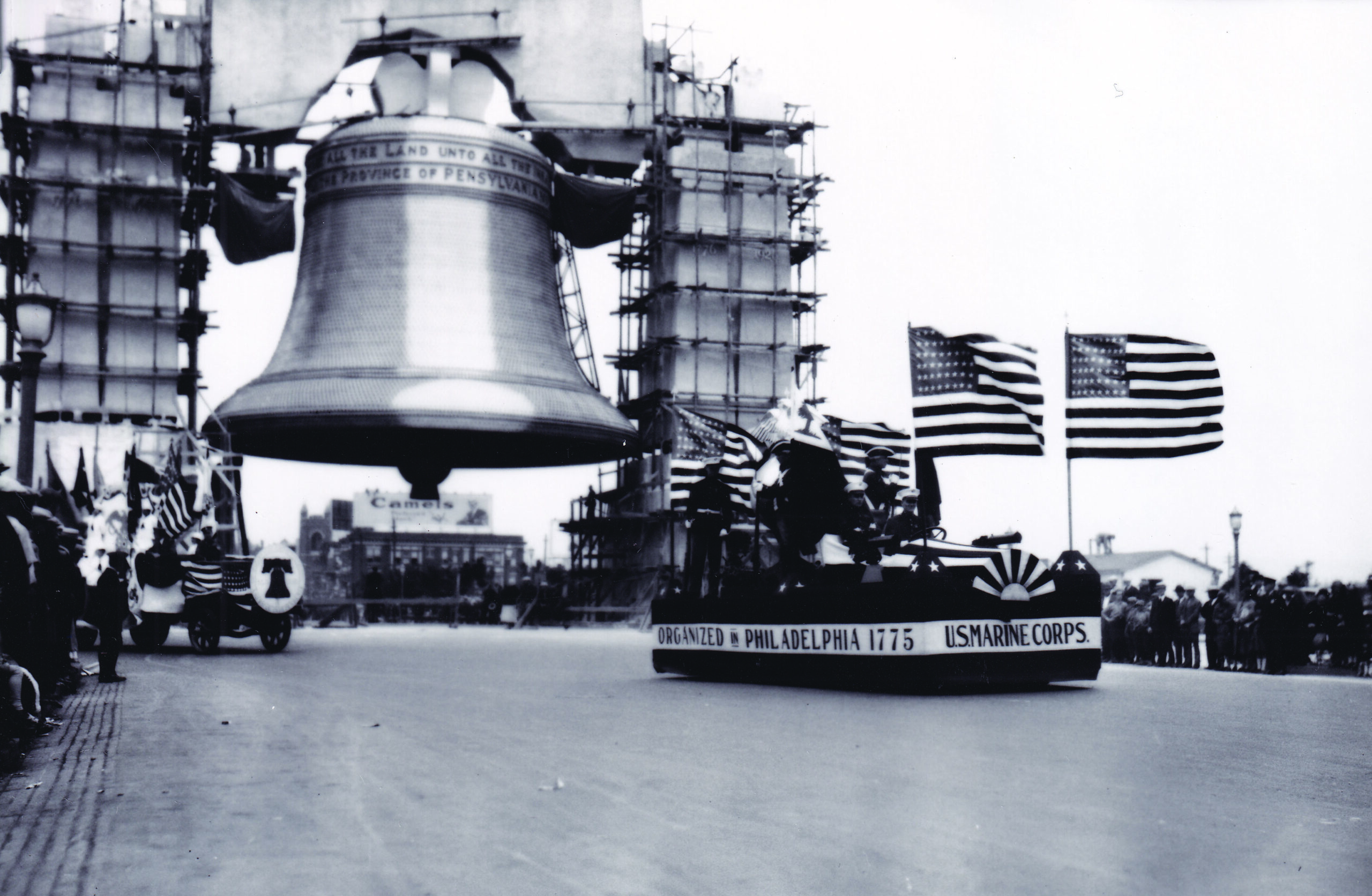
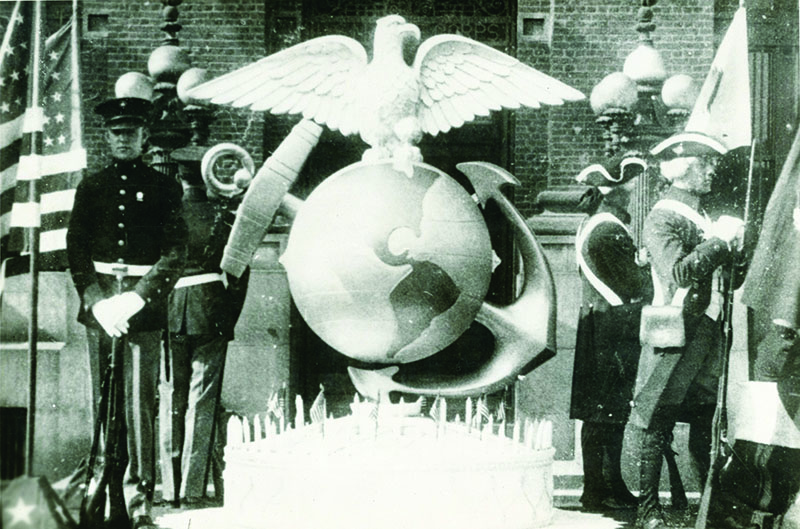
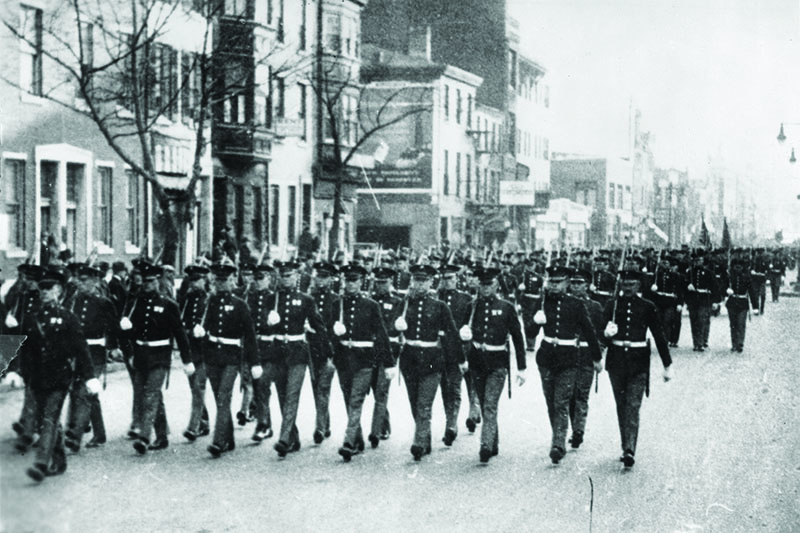
After the tablet dedication ceremony, a parade immediately followed. The parade featured a special float containing a birthday cake with 150 candles at the top, along with 13 American flags. Four Marines accompanied the cake, dressed in period and colonial uniforms. The traditional eagle, globe and anchor depicted the fouled anchor opposite in appearance today, with the anchor oriented diagonally behind the globe from left to right. 

Marines march through the streets of Philadelphia in the Marine Corps’ Sesquicentennial Parade on Nov. 10, 1925. (Photo courtesy of National Archives)

Following the parade, Marine senior leadership, dignitaries, Marines and their guests headed to the Ben Franklin Hotel for the banquet. Later that evening, the culminating event at the Bellevue-Stratford Hotel followed. Newspaper clippings out of the National Archives, Smedley Butler and John A. Lejeune collections, show that the event was broadly circulated in print and well attended. The Evening Star, a Washington, D.C., newspaper, reported that Secretary Wilbur declared during the banquet, “The accomplishments of the United States Marine Corps from the day of its foundation, November 10, 1775, to the present time have more than fully justified the wisdom of its establishment.” The event succeeded in capturing the attention, the imagination and the appreciation of a grateful nation. In essence, the entire team of Marines, active, on leave and veteran, coalesced together not only to reignite our heritage but to rekindle America’s love for her Marines. Indeed, these original celebrations not only delivered the Marine Corps’ case for preservation but ignited a torch of tradition that we bear in ceremony to this day. Standing on the shoulders of our ancestral teammates, we bear the same responsibility to preserve our storied legacy as we celebrate our 250th year. 

The words below from MajGen John A. Lejeune to President Calvin Coolidge to commemorate the 150th in 1925 ring as true today for the Sestercentennial as they did back then: 

“Marines have therefore traditions to uphold, traditions of loyalty, well exemplified not only by our motto, ‘Semper Fidelis,’ but by the heroism of our predecessors,” Lejeune wrote in the Oct. 21, 1925, memorandum. “Our country is now at peace, but we have still the obligation faithfully to carry out the duties assigned us and keep ourselves in readiness should our nation again be engaged in war, to defend her as of old.”

From left to right: Col John Muckle, Secretary of the Navy Curtis Wilbur, Assistant Secretary of the Navy Theodore D. Robinson, Assistant Secretary of War Hanford MacNider, MajGen John A. Lejeune and BGen Smedley D. Butler at the celebration of the Marine Corps’ 150th Birthday.

Featured Image (Top): A Marine Corps Birthday cake, surrounded by Marines dressed in uniforms representing leathernecks of the past, sits atop a drivable float that was used in a parade in Philadelphia, Pa., to celebrate the Marine Corps’ 150th Birthday, Nov. 10, 1925. 


Authors’ bios: LtCol Brad Anderson, USMC (Ret), is a freelance writer and researcher for Leatherneck. 

Katie Cashwell is a veteran Marine. She is a graduate of the Uni-versity of Mary Washington with a degree in historic pres-ervation. She has spent decades providing research supporting recoveries of America’s Missing in Action. She was instrumental in researching the lost graves of Tarawa. 

The Rifle, the Creed And the General: Honoring the Legacy Of Major General William H. Rupertus

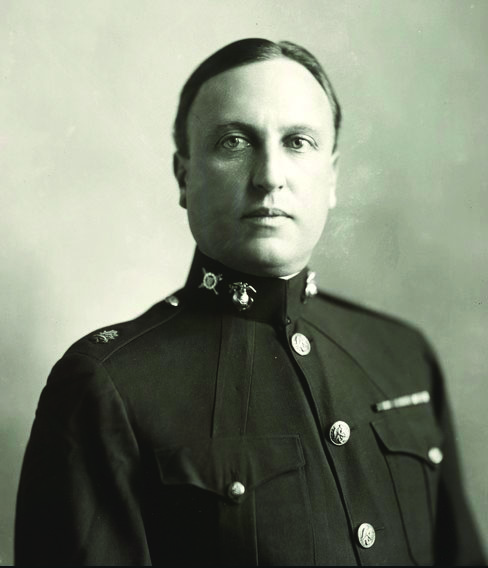
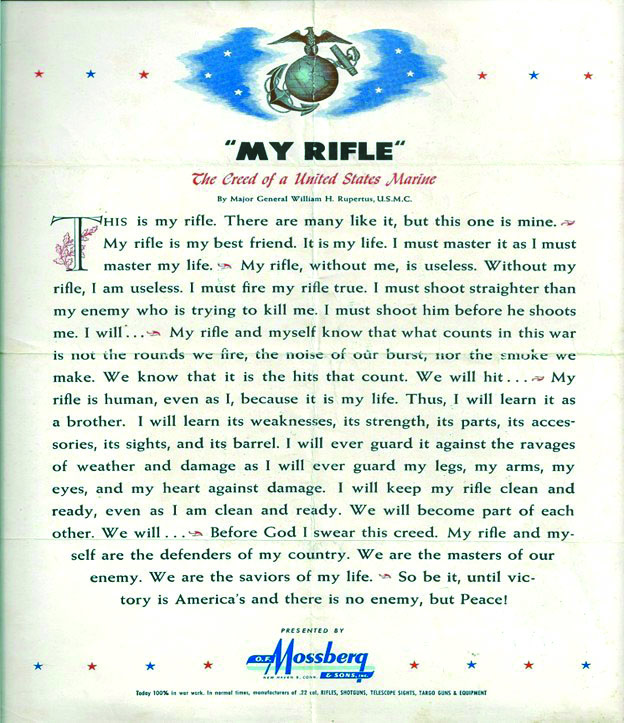
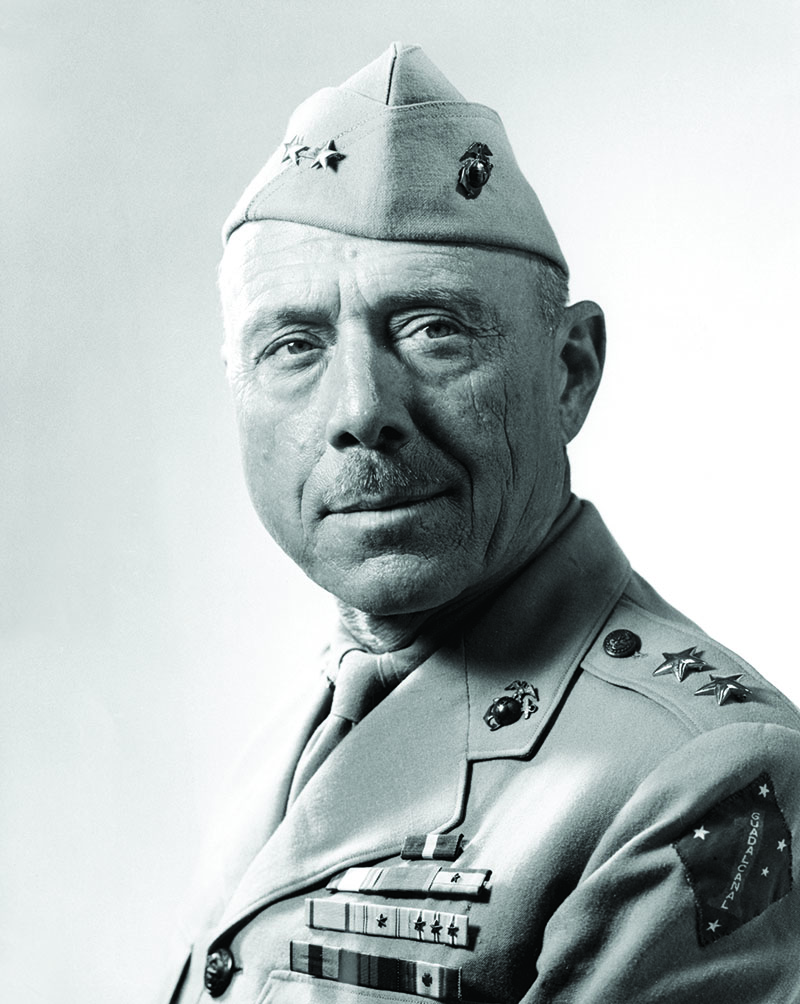
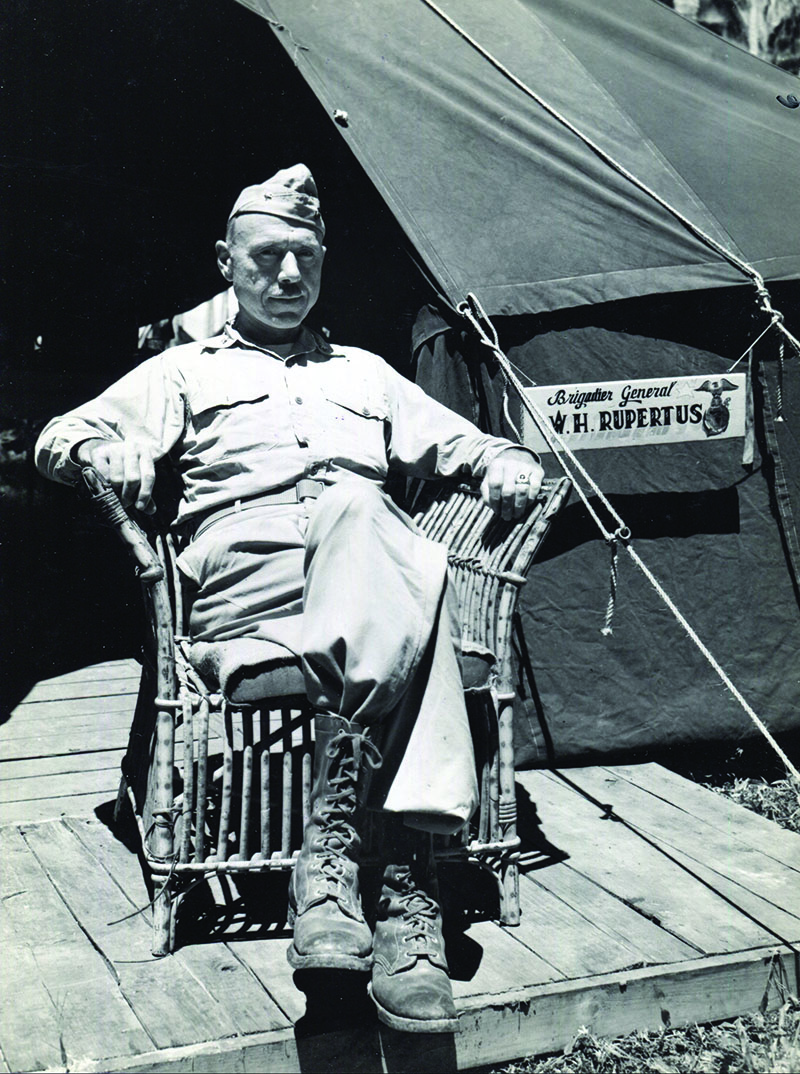
In March 1942, just months after the bombing of Pearl Harbor, the Marine Corps Chevron published a short but powerful piece titled “My Rifle: The Creed of a United States Marine.” Its author, then-Brigadier General William H. Rupertus, was serving as the commanding officer of Marine Corps Base San Diego, Calif. A career Marine and seasoned marksman, he understood better than most that a Marine’s rifle was more than a weapon—it was a lifeline.

That simple yet stirring creed, written during a time of global chaos and national mobilization, would go on to define the ethos of the United States Marine Corps for generations. As we celebrate the 250th anniversary of the Marine Corps, I want to share the story behind the rifle creed and the man who wrote it. He was my grandfather.

MajGen William H. Rupertus began his Marine Corps career as a competitive shooter and expert marksman. While commanding 1stMarDiv in the Pacific, Rupertus instilled in his Marines the same discipline and respect for the rifle that defined his own service. His legacy endures through the Rifleman’s Creed, a reflection of his belief that a Marine’s rifle is his most trusted companion in battle.

A Marksman from the Start

Rupertus joined the Marine Corps in 1913 after transferring from the U.S. Revenue Cutter Service (USRCS). He had graduated from the USRCS Academy second in his class but was denied sea duty due to his diagnosis with Bright’s Disease, which was supposed to kill him within three to five years.

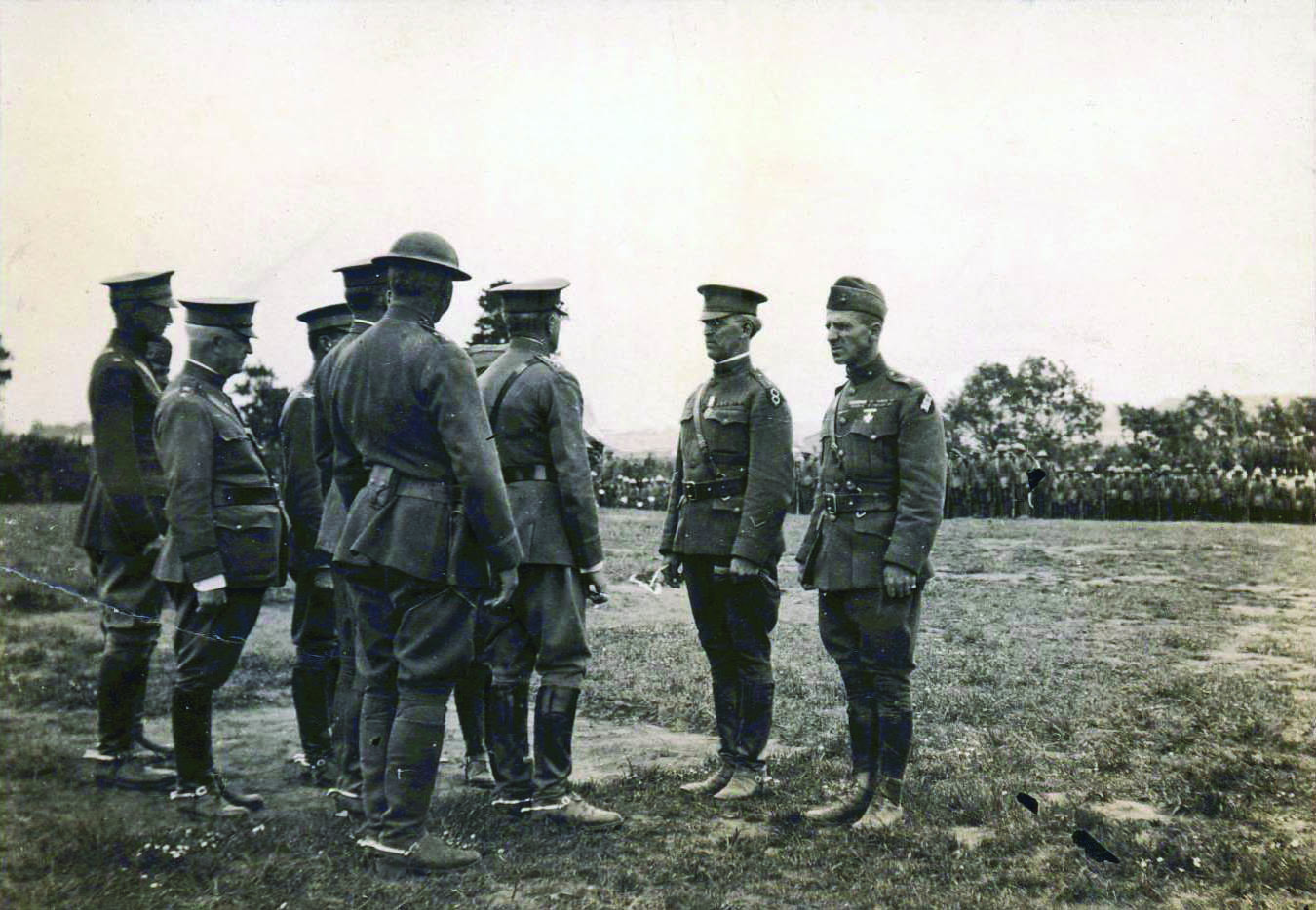
Determined, he set his sights on the Marine Corps and graduated first in his class from the Marine Officers’ School. By 1914, he had been chosen, along with several classmates,  to serve on the Marine Corps rifle team, a prestigious group that competed at the national level and symbolized the Corps’ elite marksmanship tradition. In addition to his duty on the USS Florida (BB-30), his early career centered on the rifle team and the disciplined culture it required.

Rupertus was not just a competent marksman—he was an Expert, earning several awards and the Distinguished Marksman badge.

Later, he spent time at the Marine Corps Headquarters in Washington, D.C., working closely with legendary marks-men and instructors, shaping the next generation of Marine riflemen. In an era when precision shooting was still revered and rifle qualification meant something personal, Rupertus helped instill a culture of marksmanship that remains a hallmark of the Corps to this day.

When he was stationed in China as a commanding officer with the 4th Marines, he also oversaw many rifle matches, a popular activity for these “China Marines” and competing countries.

Why He Wrote the Creed

After the Japanese attacked our fleet at Pearl Harbor on Dec. 7, 1941, catapulting us into World War II, the Marine Corps expanded rapidly, and thousands of new recruits filled training depots. In early 1942, Rupertus headed from Marine Corps Base San Diego, where he oversaw one of the nation’s largest hubs for preparing new recruits, to New River, N.C., to join General Alexander A. Vandegrift in the formation and training of the 1st Marine Division.

These young men came from all over the country, many with no military background and little experience with firearms. But they were ready to fight.

Rupertus had witnessed the brutal Japanese military tactics in China during the 1937 Battle of Shanghai while with the 4th Marines on his second duty tour in China; he and many of the officers and men there had predicted the Japanese would attack the United States.

Rupertus understood that the rifle had to become personal and sacred to each Marine if it was going to save their lives and win the ground battles in the Pacific. According to family and Marine Corps lore, Rupertus wrote the creed on a piece of paper in late February 1942 after reflecting on the importance of personal responsibility, discipline and survival in combat. He wanted every Marine, especially those new to the service, to understand that their rifle was not merely another piece of issued equipment.

And so, in quiet reflection, he wrote “My Rifle: The Creed of a United States Marine.”

“This is my rifle. There are many like it, but this one is mine. … My rifle is my life. I must master it as I master my life.”

Upon publication, the creed was immediately embraced. While the Chevron is no longer in print, Rupertus’ words have become a permanent fixture in the soul of the Corps.

A Quiet Tradition

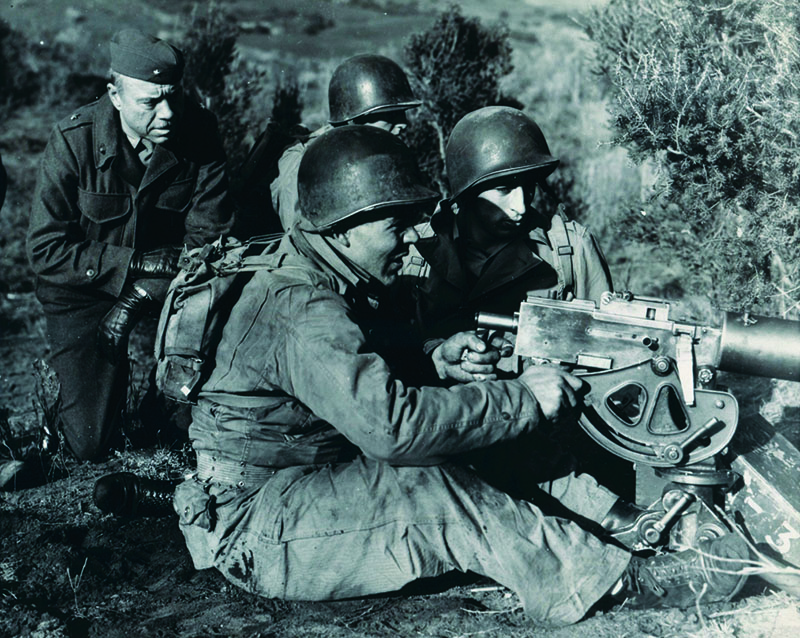
William H. Rupertus went on to command 1stMarDiv during some of the most brutal fighting of the Pacific War, including Tulagi, Guadalcanal, Cape Gloucester and Peleliu. His belief in the rifleman, forged on the rifle range and articulated in the creed, never wavered.

When you understand the background, this rifleman’s creed is poetic, brutally practical and profound, knowing what America, our allies, the Marine Corps and all of the U.S. military were facing in 1942. And what we face today.

Since the creed was first published, it has been memorized by generations of Marines and other branches of our military. It’s been recited in the movies “Full Metal Jacket” and “Jarhead” as well as the popular video game “Call of Duty: Modern Warfare.” Though modern boot camp training no longer has recruits reciting it aloud daily, its words still echo in the ethos of every rifle range and combat zone where Marines serve.

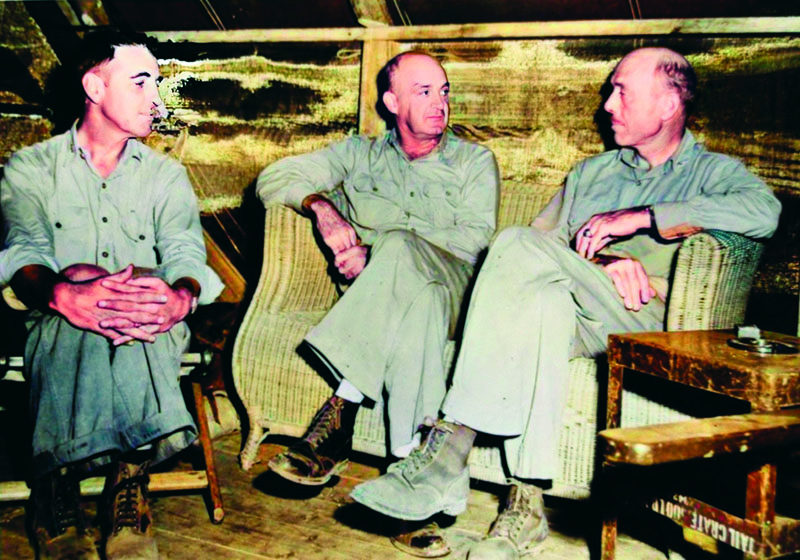
Rupertus, right, meets with Col Jerry Thomas, left, and Gen A.A. Vandegrift, on Guadalcanal.

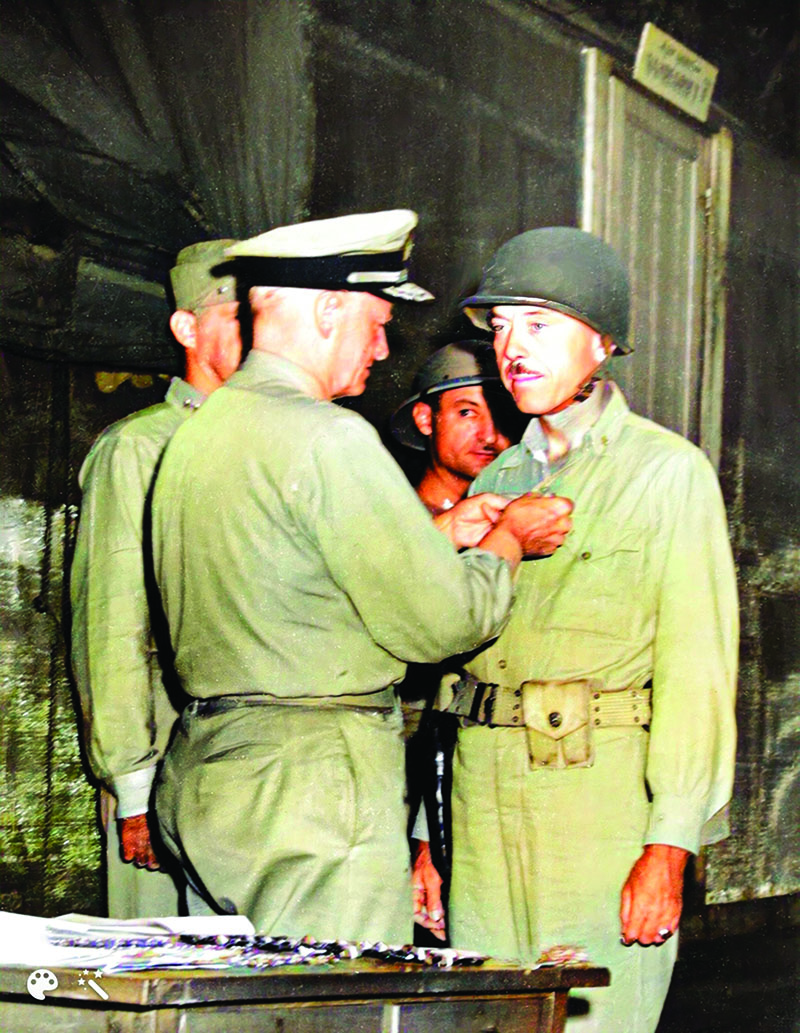
ADM Chester Nimitz presents Rupertus with the Navy Cross on Oct. 1, 1942, on Guadalcanal.

A Legacy Carried Forward

Though he fought hard, Rupertus did not see the end of the war. He died of a heart attack in March 1945 at the Marine Corps Barracks Washington, during a party with fellow veterans of 1stMarDiv.

In recent years, while researching his military background, I learned to recite the rifle creed myself. It’s more than military prose. It’s a reflection of who my grandfather was: precise, principled and utterly dedicated to the mission and the Marine. Above all, understanding that in the fog of war, a Marine must rely on what he knows best: his rifle, his training and his brothers and sisters in arms.

Over 80 years later, the rifle creed still speaks not only to the Marine Corps but to anyone who understands what it means to take responsibility, to train with purpose and to treat their tools—and their mission—with respect.

As we honor 250 years of the Marine Corps in 2025—and reflect on the nation it has served for two and a half centuries—I offer this story in remembrance of a man who knew that the heart of the Corps beats in the chest of every rifleman and riflewoman. Because before the battles, before the medals and before the victories—there was a Marine and his rifle.

Semper Fidelis.

Then-BGen William H. Rupertus outside of his com­mand post on Guadalcanal, November 1942.

Author’s bio: Amy Rupertus Peacock is a daughter and granddaughter of U.S. Marines and co-author of the book “Old Breed General.”

A Small Piece of Cloth: The History of the Marine Corps’ Shoulder Sleeve Insignia

Editor’s Note: Leatherneck contributor Chase McGrorty-Hunter took home the Master Sergeant Tom Bartlett Award at the Marine Corps Heritage Foundation annual awards program this spring with this 2024 article titled “A Small Piece of Cloth: The History of the Marine Corps’ Shoulder Sleeve Insignia.” The award, which is named for the late managing editor of Leatherneck magazine and leading Marine photojournalist, is given to an active-duty enlisted Marine for the best article pertinent to Marine Corps history published in a newspaper, magazine, journal or other periodical.


“Each night during the north­ward trip I had noticed the beautiful Southern Cross constellation slipping lower and lower on the starlit horizon. Finally, it disappeared. It was the only thing about the South and Central Pacific I would miss. The Southern Cross formed a part of our 1st Marine Division shoulder patch and was, therefore, especially symbolic.

We had intense pride in the identifica­tion with our units and drew considerable strength from the symbolism attached to them. As we drew closer to Okinawa, the knowledge that I was a member of Com­pany K, 3d Battalion, 5th Marine Reg­iment, 1st Marine Division helped me prepare myself for what I knew was coming.”
—Eugene Sledge, “With the Old Breed: At Peleliu and Okinawa”

This pride that Eugene Sledge de­scribed while en route to the bloody battle of Okinawa is a feeling that generations of Marines have found in their unit insignia. These symbols serve as beacons of motivation that act as a connecting thread from one generation of Marines to the next. Many of the logos that represent Marine Corps units today stem from two very distinct eras in the Corps’ history—times when Marines wore the insignia proudly affixed to their shoulders.

One of the most iconic images of Ma­rines in World War II, outside of combat, is that of young Marines on liberty in their service uniforms with their unit patches on their sleeves. Although the use of shoulder sleeve insignia (SSI) was at its peak in this period, it was not the first time Marines represented the units they served with on their uniforms.

The history of the SSI predates the founding of the nation and likely finds its origins in the heraldry displayed by the knights, who would often paint their symbol onto their armor and shields. British officers adopted patches as a form to identify ranks many years later. In the United States, instances of SSI date back to the War of 1812, the Mexican-American War, and, most prominently, the Civil War, when some states sewed insignia on their uniforms to distinguish separate outfits. However, because these patches were made by hand, they were often crude, never distributed in abundance, and impossible to standardize. Although SSI was used during these time frames, this is not the historical beginning that the modern-day military would recognize for the insignia as they are thought of today.

All variations of unit insignias of 2ndMarDiv during World War I. (Courtesy of the National Museum of the Marine Corps)

It was not until WW I, a war in which the character of fighting was dramatically transformed by the effects of the Indus­trial Revolution, that the SSI became the official tradition to the U.S. military that is known as today. Upon their deployment to France in 1918, the 81st Division of the U.S. Army became the first unit to adopt an insignia that would be worn. A black wildcat was authorized as their SSI by the General Headquarters American Expeditionary Forces (AEF), which “rec­og­nized the value of this means of build­ing morale and helping troops to re­assem­ble under their own officers after an of­fen­sive.” As a result, on Oct. 19, 1918, all units that fell under the AEF were tasked with submitting their own pro­posals for SSI.

For the Marines who fell under the command of the Army in this theater, developing a unit branding to be worn on their shoulders filled a different role as well. It would help further distinguish them from their Army counterparts. Be­cause of the shortage of uniforms to sup­ply the surge of troops sent over quickly to the western front, and to simplify sup­ply and distribution procedures, General Pershing, Supreme Allied Commander, AEF, ordered all units to don the U.S. Army olive-drab uniform. Almost im­mediately Marines began looking for ways to differentiate themselves, and thus began the tradition of affixing the eagle, globe and anchor to their neck tabs and helmets.

Earlier in the year, the 2nd Division, an Army unit commanded by Marine Major General John A. Lejeune and housing all of the 5th and 6th Marine regiments as well as Army units, had hosted a competition for a logo which was to be painted on all vehicles to help with identification. The final logo was a combination of the first- and second-place entries, an Indian head and a white star, respectively. Because this logo had al­ready been adopted by the division and was being used widely to mark gear, MajGen Lejeune submitted his response to the AEF headquarters in a memo dated Oct. 21, 1918, to establish this as the di­vision’s SSI. Variations in background colors and shapes on the patches distin­guished the 5th and 6th Marine Regiments as well as their supporting components.

This new SSI would be sewn onto the uniform sleeves of the Marines in France until they returned to Quantico in the summer of 1919. At home, they exchanged their Army uniforms for their own and trans­ferred their patches over to signify their service in the Great War. Soon after their return to the States, all Marine units fell back under the Naval command, and the use of SSI insignia was discontinued. But the insignia’s design would have a life much longer still, representing the regiment and its subunits aboard Marine Corps Base Camp Lejeune, N.C., to this day.

The 5th Marine Brigade, stood up to assist these regiments in WW I, also had its own SSI approved by Headquarters Marine Corps before returning home from Europe: a crimson square with a black eagle, globe and anchor in the center and a gold “V” through its middle.
In the interwar years, the Army con­tinued the use of SSI and expanded its use to other units under its command, but it was not until the start of World War II that Marines would again dawn the organizational emblems of the units they fought for.

Then-Col Smedley Butler is decorated by GEN John Pershing in France, 1919. A unit insignia is visible on the left shoulder of his uniform. (USMC)

Many believe that the first official patch of WW II for the Marines was the 1stMarDiv’s famous blue diamond. Al­though this is the patch that started the general adoption for SSI by the Marine Corps, it was not the first time Marines were sewing SSI on their shoulders again. Even before America entered the war, the 1st Marine Brigade Provisional was activated for service in Iceland to serve alongside the British garrison to defend the land from any hostile attack.
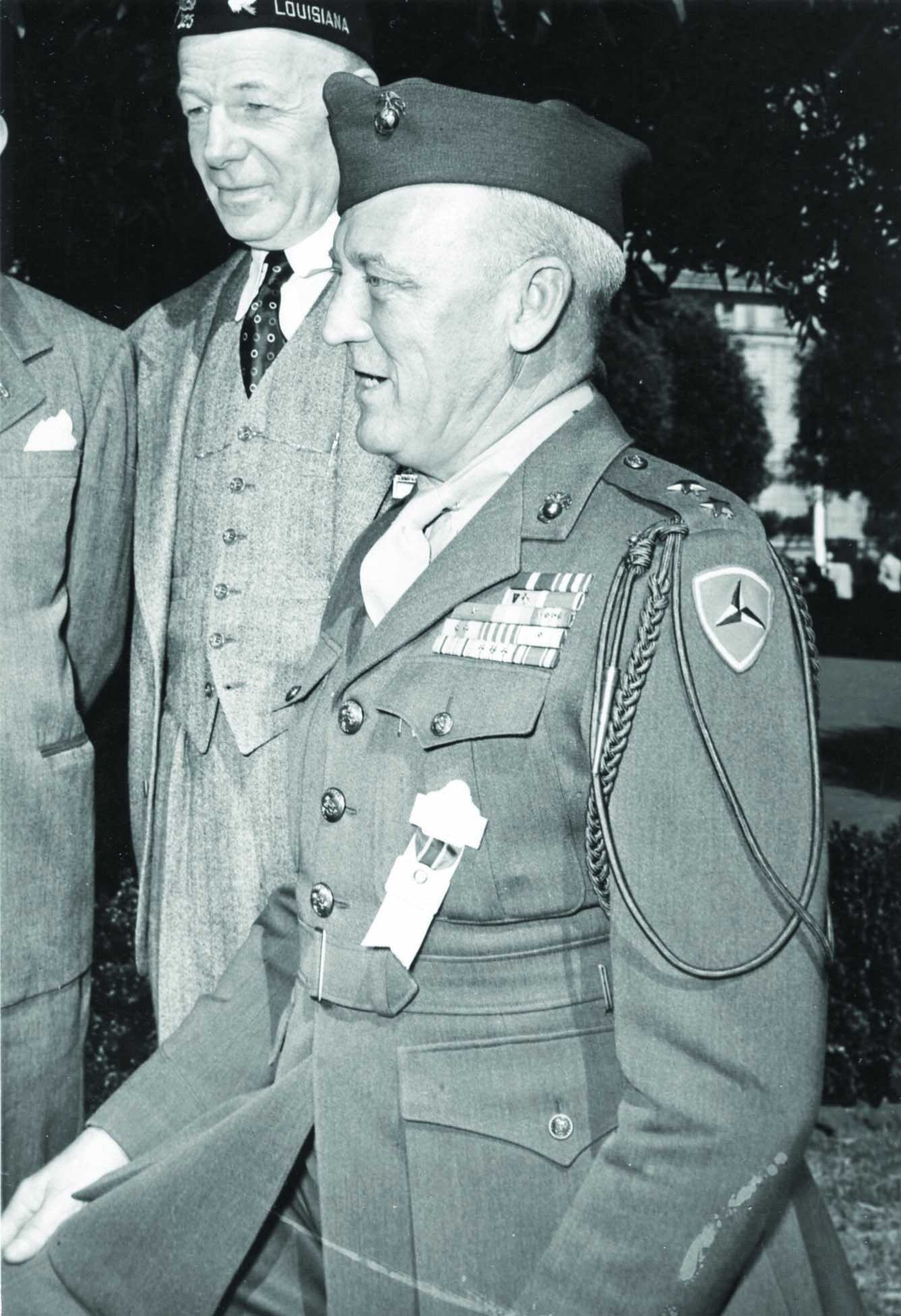
The Marines were so well received by the British troops that, on top of being pro­vided with gear and a place to live, they were honored by British Commander Gen­eral Henry O. Curtis with the priv­ilege of wearing the unit’s logo, a white polar bear, on service and dress uniforms. This request was authorized by Com­mandant of the Marine Corps Lieutenant General Thomas Holcomb under the con­dition that they be removed before re­turning stateside, thus making it a theater-only allowance.

Only a few months after the arrival of Marines in Iceland, the nation would be thrust into war, and the Marine Corps would shift its focus to becoming the primary fighting force in the Pacific theater. In August of 1942, Marines would have their chance to prove to the nation and the world the ability of a free nation to prevail on the battlefield against the tyrannical rule of an empire. And that test would come on the island of Guadal­canal. After four bloody months of com­bat, the 1stMarDiv had proven they could defeat their adversary in battle cementing themselves in the history of the nation. When the island was turned over to re­inforcements in December 1942, the divi­sion’s commanding general, future Com­mandant Major General Alexander A. Vandegrift began his departure to Australia, where the division would re­assemble for rest, liberty, and training for future battles. It was on this plane ride south that the blue diamond was birthed into Corps history. This story is best captured in “The Old Breed: A History of the First Marine Division in World War II” by George McMillan, and is as follows:

“They sat in facing bucket seats, be­tween them the litter of packs, seabags, typewriters, briefcases—the kinds of things that staff officers would necessarily bring out of battle.

“General Vandegrift had begun to be a little bored with the monotony of the long plane ride. ‘Twining,’ he said, ‘what are you doing?’

“Twining, full colonel and division operations officer, handed Vandegrift a sketch. It was on overlay paper.

“ ‘An idea I had for a shoulder patch,’ said Twining. ‘The stars are the Southern Cross.’

“Vandegrift looked at it for a moment, scribbled something on it, and handed it back to Twining who saw the word, “Approved,” with the initials, “A.A.V.”

“That had been on the ride from Guadalcanal to Brisbane. Because the first few days in Australia were hectic, Twining did nothing else about the patch until one morning he was called to Vandegrift’s quarters.

Gen Graves B. Erskine stands with other veterans, circa 1945. The 3rdMarDiv patch is visible on his shoulder. (USMC)

“ ‘Well, Twining, where’s your patch?’ Vandegrift asked, to the discomfort of Twining.

“ ‘I bought a box of watercolors,’ ” Twining says in recalling the incident, ‘and turned in with malaria. I made six sketches, each with a different color scheme. In a couple of days, I went back to the General with my finished drawings. He studied them only a minute or so and then approved the one that is now the Division patch.

“Twining knew that there was more to his mission. He placed an order for a hundred thousand.’’

Not long afterwards, the Marine Corps officially authorized the wear of SSI fleet­wide in the Letter of Instruction No. 372, dated March 1943. This letter designated that the senior officer in theater would be the approver of designs for units, that SSI would not be worn in advanced com­bat zones, and which units would be granted SSI. By the end of WW II, there would be 33 unique SSIs authorized for wear by Marines serving in the Fleet Marine Force.

During the war, there were some issues with fielding patches, most prominently with the 2ndMarDiv’s unit logo. Three variations of the patch exist as a result of this confusion. Those who replaced the 1stMarDiv for the final two months of fighting on Guadalcanal adopted the same blue diamond logo as the 1stMarDiv but had substituted the large number one in the center with a red coral snake in the shape of a number two. This logo was never officially approved but was worn for some time by Marines in the division.

The official 2ndMarDiv logo that persists to this day is the red spearhead with a white hand holding a golden torch with the number two. Surrounding the center­piece are the stars of the Southern Cross, like the 1stMarDiv logo. But even in pro­ducing these official patches, there were still issues in communication between Marines and the companies making the patches. Most notably this resulted in a large quantity of patches going into circu­lation with the shape of an upside-down heart instead of a spearhead. This patch is affectionately referred to as the kidney patch by collectors nowadays.

Courtesy of the National Museum of the Marine Corps

The legendary logos that represent the fighting units of the force today were all created during the war: the 3rdMarDiv’s trinity, 4thMarDiv’s bold four, the air­craft wing’s gold wings and Roman numerals to delineate, and Edson’s Raiders’ modern-day Jolly Rodgers skull. And along with the Marines who bore these representations on their arms, their Navy corpsmen did so proudly as well.

Following the war, a memorandum was sent to the Commandant to determine whether SSI should be discontinued. Some of the reasons presented on both sides were that in the post-war Marine Corps, almost all of the units wearing SSI would be disbanded; wearing SSI is an Army tradition; unit pride, as well as prejudice, is fostered by wearing them; the Marine emblem is distinctive enough; and finally they may have some value for use in recruiting. Some of the conclusions drawn from these points were that “the use of SSI is a custom alien to the tradition of the Marine Corps,” that because the Marine Corps would shrink back down to a small force it would be unnecessary, and that pride in the Marine Corps should be prioritized over that in units. Ultimately it was recommended that they be discontinued, with the exception that recruiters could still wear theirs. Letter of Instruction No. 1499 officially ended the use of SSI, effective Jan. 1, 1948. In 1952, Marines pushed to bring SSI back, and the plea made its way to the uniform board in study No. 2-1952. The board ruled against the readoption, restating all the same reasons verbatim from memo 1499 four years prior.

As the Marine Corps pivots back to its amphibious roots in the Pacific much like the Marines of WW II, it is unknown if Marines will wear SSI on their uniforms again and carry on the tradition that gave rise to many of its most storied units. However, the logos themselves have been carried on and found a home in the units and with the Marines they represented. And although many of the units in ex­istence during WW II were disbanded following the war, the insignia designed for all the Marine divisions, air wings and Marine Raiders are the same logos that represent those units today. Emblems born in the cauldron of fire that is combat and solidified for generations of Marines to come. For the decades following the war, and even now, it would be almost impossible to step foot on a Marine Corps base without seeing these historical logos represented all over the place. From stickers on cars to tattoos inked into Marines’ skin, the pride in unit history and lineage runs deeper than ever.
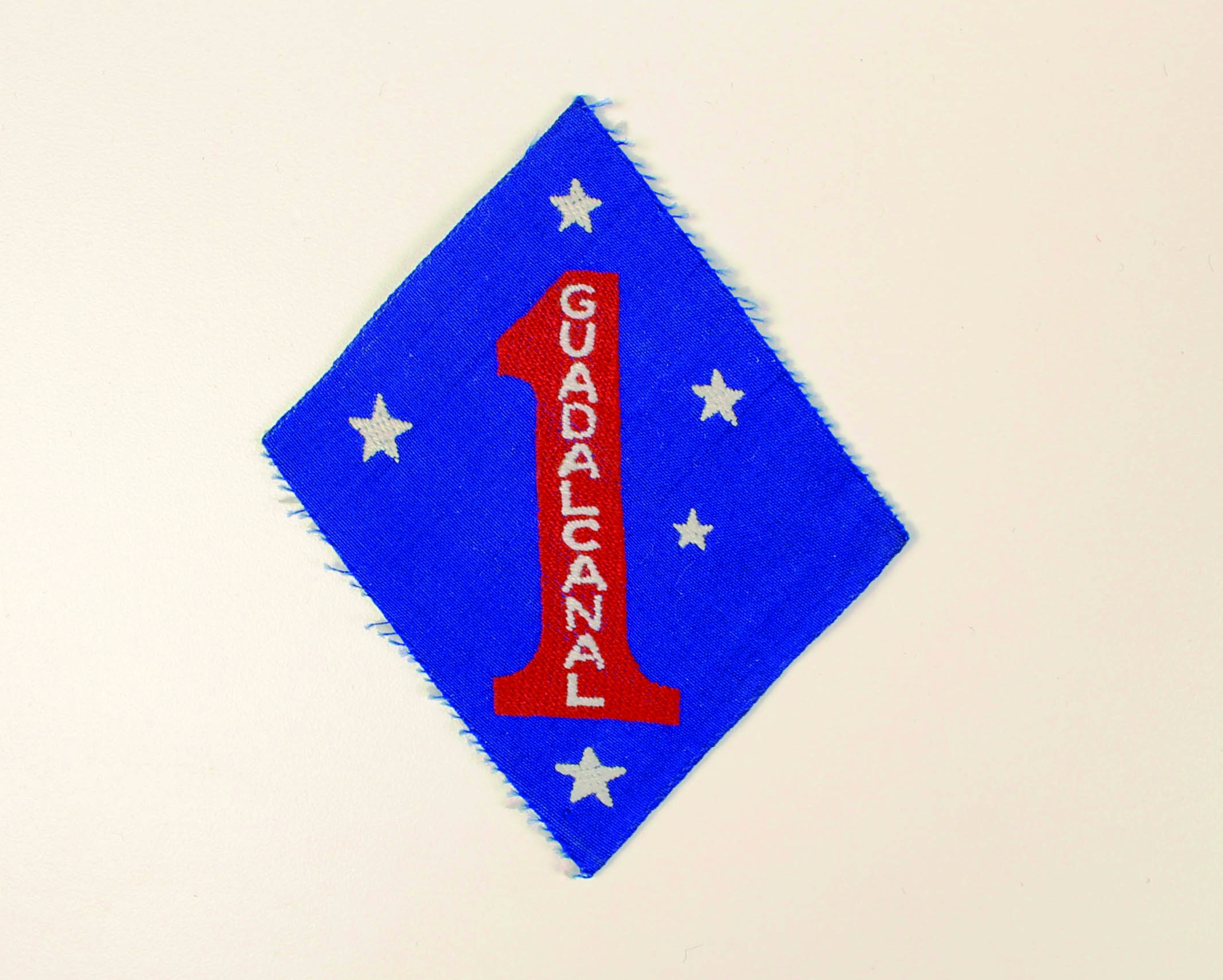
With the rise and proliferation of social media, not only unit pride but even SSI has found a new home among Marines. Even though SSI has not been officially worn for more than 80 years, the ability for Marines to gather online into communities has resulted in a common idea circulating the internet: a call to bring back tradition and reinstate the use of SSI. Tens of thousands of Marines active, reserve, and veteran—officer and enlisted, have joined in on this movement trending online. Following many of the most prominent leaders in the space today, this topic is often posted about and shared around spaces primarily in the Instagram “mil community.”

Since none of these Marines have lived long enough to experience this tradition—or in some cases even met someone who has—why there is such a strong desire to bring the SSI back? One thing is apparent, though, and that is that Marines believe that SSI is not a “custom alien to the tradition of the Marine Corps” and in fact is a custom that was built out of the very eras that defined what has become the Marine Corps.

Authors bio: GySgt Chase McGrorty-Hunter is a cyber network chief with 9th Com­munications Battalion. He is an avid writer and founder of the Bayonet War­fighting Society.