Executive Editor’s note: The following article received 1st place in the 2025 Leatherneck Magazine Writing Contest. The award is provided through an endowment by the Colonel Charles E. Michaels Foundation and is being given in memory of Colonel William E. Barber, USMC, who fought on Iwo Jima during World War II, and was the recipient of the Medal of Honor for his actions at the Battle of Chosin Reservoir during the Korean War. On Jan. 1, we will begin accepting submissions for the 2026 Leatherneck Magazine Writing Contest.
Belleau Wood, Iwo Jima and the Chosin Reservoir are the Marine Corps’ three touchstone battles—names that hit like a mortar round in the chest. They’re the gold standard: Marines charging into hell, bleeding for every scrap of ground and coming out on top when the odds say we shouldn’t. I carried those stories with me through my time at 3rd Battalion, 6th Marines, Scout Sniper Surveillance and Target Acquisition (SS STA) 3/6, Camp Lejeune, N.C., until I hung up my uniform on Jan. 25, 2004.
As the Corps turns 250, I’ve been chewing on what other fight deserves to stand with those giants. For me, it’s the Battle of Khe Sanh, Vietnam, 1968. That siege wasn’t just a battle—it was a crucible, a 77-day gut check that forged Marines into something unbreakable. It belongs up there with the big three, and here’s why.
Khe Sanh started in January 1968, when the North Vietnamese Army (NVA) clamped down on the Khe Sanh Combat Base, a speck of dirt near the DMZ and the Laotian border. About 6,000 Marines and allies—mostly the 26th Marine Regiment—found themselves surrounded by 20,000 to 40,000 NVA troops. The enemy’s plan was straight out of its playbook: besiege, bombard and bury, just like they did to the French at Dien Bien Phu. For 77 days, those Marines took a pounding—over 10,000-15,000 rounds of artillery and rockets, in addition to U.S. bombing, and more than 1,000 rounds a day at the worst of it. Hill 881 South, Hill 861, the main base—they became islands in a sea of mud and fire. Supplies ran thin, the weather was a soup of fog and rain, and the NVA kept coming. But the Marines didn’t just hold—they fought.
That’s what makes Khe Sanh a touch-stone: the sheer stubborn will it took to stay in the fight. I picture those grunts in their trenches, caked in red clay, patching bunkers after every barrage. Resupply drops came under fire, with C-130s and Hueys dodging antiaircraft guns to get ammo and chow through. It was chaos, but it was controlled chaos, the kind I saw in my own small way at Lejeune with SS STA 3/6. We weren’t in combat, but we kept the battalion’s gears turning—logistics, comms, planning. Khe Sanh was that on steroids: Every Marine, from the commanding officer to the newest private, locked in to keep the machine running. Patrols slipped out to hit NVA positions, artillery crews fired until their barrels glowed, and air support—Marine, Navy and Air Force—dropped over 100,000 tons of bombs, turning the hills into a wasteland. When Operation Pegasus rolled in with Army and Marine reinforcements in April, the NVA limped away, leaving bodies and broken plans behind.
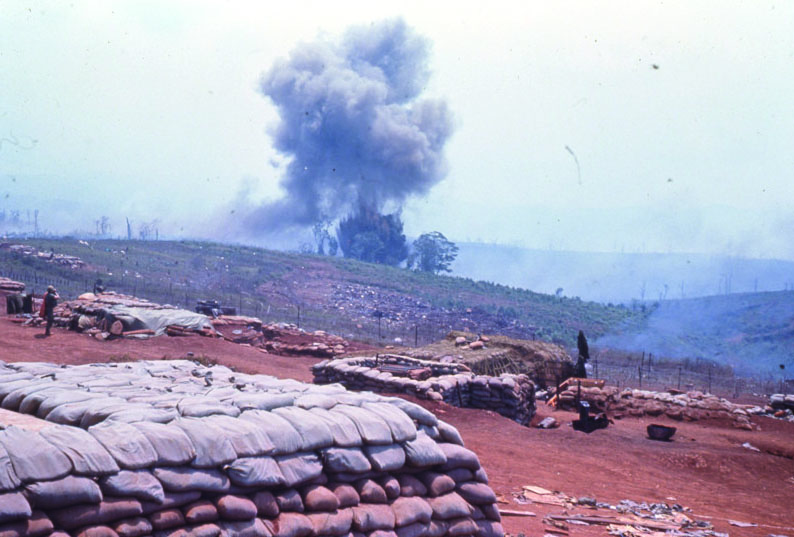
Air Force F-100s deliver close air support following an assault on ARVN Ranger positions, Khe Sanh, 1968.
Khe Sanh mirrors Belleau Wood, Iwo Jima and Chosin in ways that cut to the bone. Belleau Wood was raw guts—Marines rushing German lines, taking casualties but never stopping. Khe Sanh had that same fire, just pinned down instead of charging. Iwo Jima was about digging in, making a volcanic rock a fortress—Khe Sanh’s hills were the same, only with jungle and mud instead of ash. And Chosin? That frozen march out of a Chinese trap, outnumbered 10 to one? Khe Sanh was its echo—surrounded, outgunned but never outfought. The difference is the siege itself: 77 days of unrelenting pressure, a modern test of what Marines can endure. It wasn’t about maneuvering or grand strategy; it was about standing fast when everything said to break.
Now, some will argue Khe Sanh doesn’t fit because we pulled out after the siege. The base got torched and abandoned in July ’68, and critics say that stains the victory. Fair point: Nobody’s raising a flag over Khe Sanh today like we did on Suribachi. But touchstones aren’t about holding dirt forever; they’re about what the fight reveals. Khe Sanh was a slugfest that messed up the NVA’s Tet Offensive, tying down divisions they needed elsewhere. It cost them thousands—estimates run from 10,000 to 15,000 dead—while we lost under 500 KIA. More than that, it was a middle finger to the idea that Marines could be cracked. I’d tell those doubters victory isn’t just a map pin; it’s the message you send. Khe Sanh screamed, “You can’t take us.”
Khe Sanh was that spirit writ large—Marines doing the dirty, thankless work to hold the line. I remember a gunny who’d been at Chu Lai in ’69, not Khe Sanh, but he talked about Vietnam like it was yesterday. He’d say, “You don’t win by running—you win by staying.” That’s Khe Sanh: staying when every instinct says go. I left the military in ’04, honorable discharge in hand, but that lesson stuck.
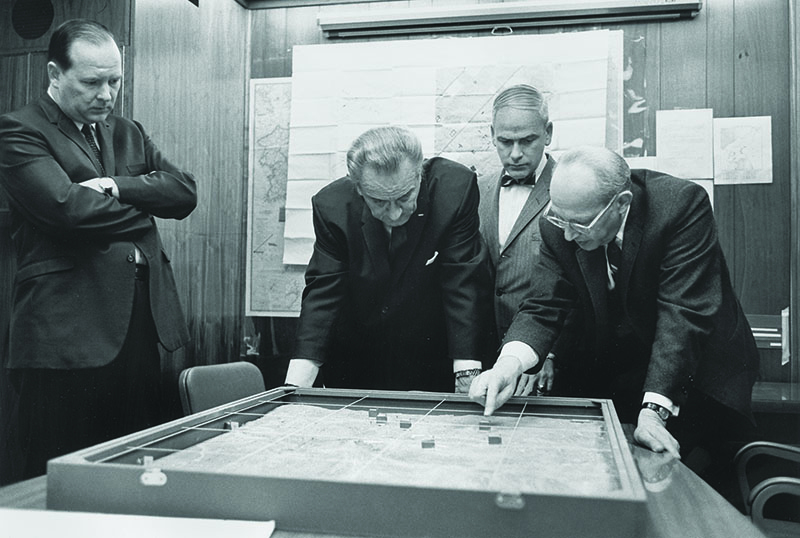
In the White House situation room, President Lyndon B. Johnson (second from left) examines a scale model of the Khe Sanh Combat Base, Feb. 15, 1968.
It’s what I’d tell the boots today: Stand your ground, because that’s what Marines do.
The battle’s legacy runs deep. It showed combined arms at its peak—air strikes syncing with arty, infantry holding the perimeter. I can see the forward air controllers on those hills, calling in Phantoms while mortars pounded the treeline. It’s a blueprint for how we fight now—integrated, relentless. Khe Sanh also cemented small-unit leadership. Lieutenants and sergeants kept their squads tight, kept them believing, even when the sky was falling. That’s the Corps I knew: NCOs running the show when it counts. And the vets? I’ve met a few—gray-haired, quiet types at VFW halls. They don’t brag, but you see Khe Sanh in their handshake, their nod. It’s the same steel you feel from Chosin survivors or Iwo vets—a brotherhood forged in the worst of it.
Khe Sanh’s place as a touchstone isn’t just about ’68; it’s about 2025 and beyond. It’s a reminder that wars change but Marines don’t. We adapt, sure—Vietnam wasn’t Belleau Wood’s trenches or Iwo’s beaches, but the core stays: Fight hard, fight smart, fight together. Khe Sanh teaches that isolation isn’t weakness; it’s a chance to prove what you’ve got. I’d tell any Marine to study it. Feel the weight of those 77 days. It’s not just history—it’s us, at our toughest, our proudest. Belleau Wood, Iwo Jima, Chosin—they’ve got a brother in Khe Sanh. On our 250th, let’s give it the honor it’s earned.
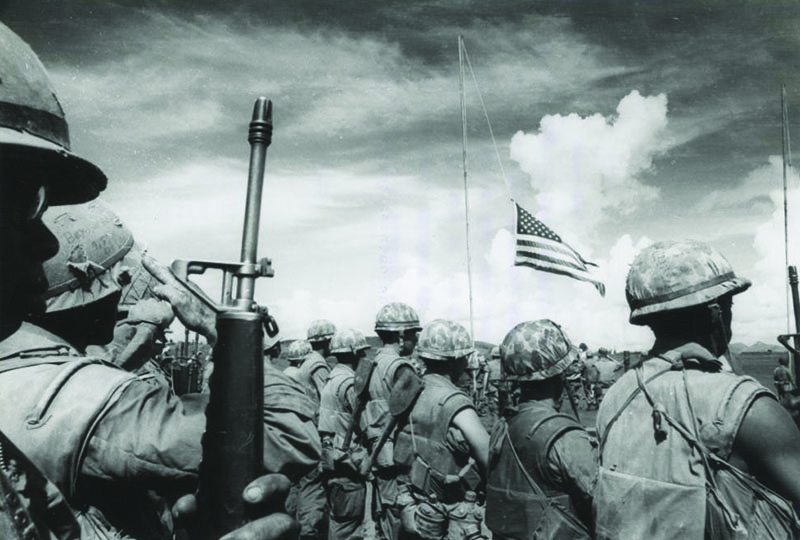
Marines of 1st Platoon, Company K, 3rd Battalion, 4th Marines, salute as the American flag is raised during a memorial service at Khe Sanh. Joined by soldiers of the Army of the Republic of Vietnam, the ceremony paid tribute to those lost during the 77-day siege. (Photo by SSgt Fred Lowe III, USMC)
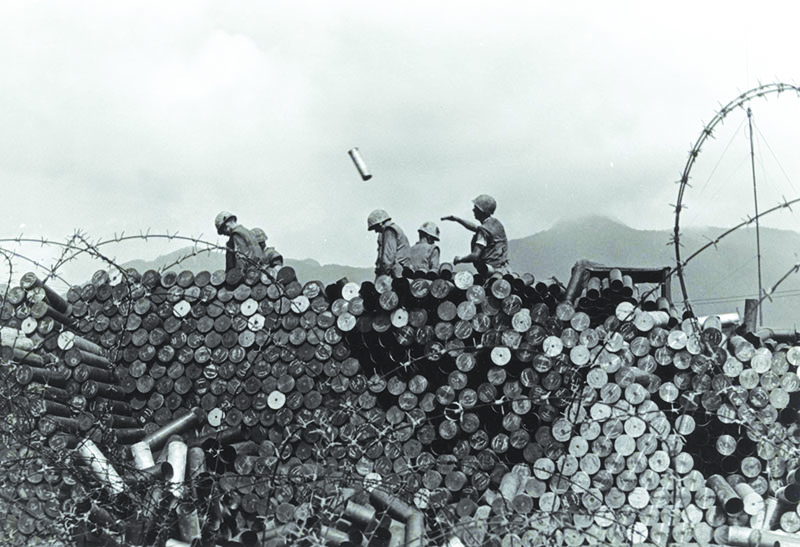
Featured Image (Top):During the 77-day siege of Khe Sanh, Marines stacked tons of expended 105 mm shell casings,a testament to the intensity of the bombardment. (Photo by Sgt T.H. Nairns, USMC)
Author’s bio:
HM3 Brian Nielson served with 3rd Battalion, 6th Marines, Scout Sniper Surveillance and Target Acquisition (SS STA) 3/6 at Camp Lejeune and was honorably discharged in 2004. Nielson served as the senior corpsman of SS STA on Camp Lejeune and is the founder and CEO of Kern + Bellows, a defense contractor specializing in re-cruitment and advertising.
On Nov. 27, 1950, the 5th and 7th Regiments of the 1st Marine Division were in Yudam-ni, a mountain hamlet on the western side of the Chosin Reservoir, positioned for a thrust west across the upper reaches of the Taebaek Mountains and a link-up with the American 8th Army. The Marine offensive would be part of the “Home by Christmas” offensive, the grand design of the U.S. Commander in Chief, Far East, General of the Army Douglas MacArthur, to end the Korean War. As proposed in his double envelopment strategy, found in Roy E. Appleman’s “South to the Naktong, North to the Yalu,” the X Corps, which included 1stMarDiv, and 8th Army would act as giant pincers, ensnaring and destroying the remnants of the North Korean People’s Army (NKPA) that were fleeing north after the breakout of the 8th Army from the Pusan Perimeter and the successful amphibious landings of 1stMarDiv at Inchon in September.
In developing this stratagem, MacArthur’s war planners seemingly disregarded reports that Chinese Communist Forces (CCF) were amassing in southern Manchuria, and that perhaps tens of thousands of them had already crossed into North Korea by the middle of October, writes Appleman.
Entrapment and Breakout
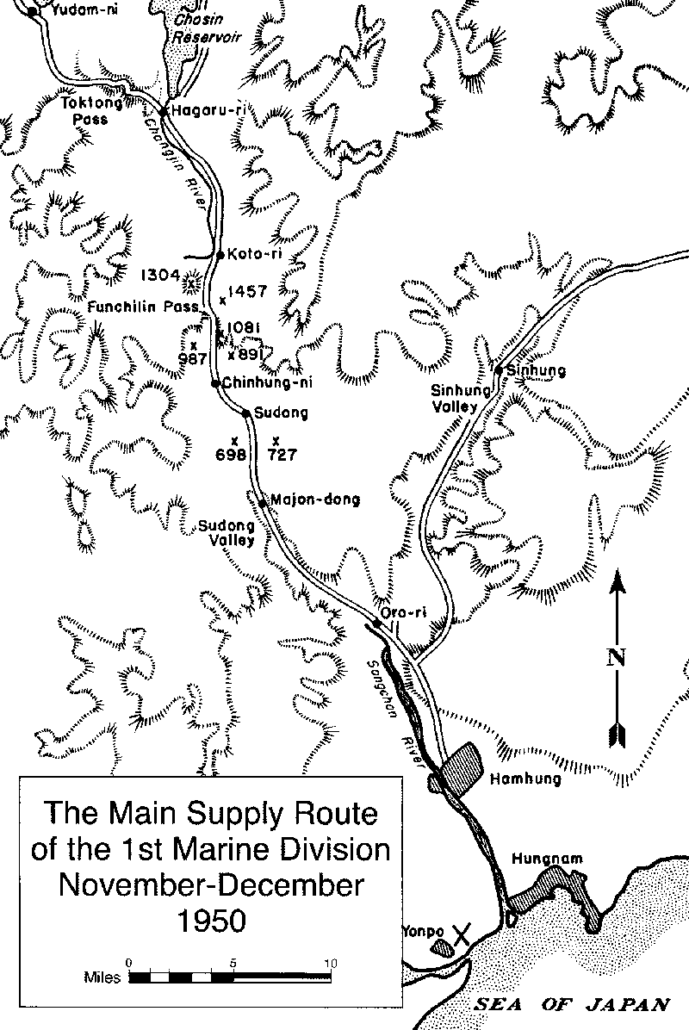
The 5th and 7th Marines began moving west and were shortly engaged, not by the disorganized units of the NKPA but by the hardened troops of the 79th and 89th Divisions of the CCF’s IX Army Group, 3rd Field Army. A third division, the 59th, struck to the rear at the Toktong Pass to interdict the main supply route (MSR). After four days of violent combat, the 5th and 7th Marines began a fighting withdrawal to Hagaru-ri, the division’s forward operating base some 14 miles south. They brought with them all their wounded and dead; and they did so during one of the coldest winters seen in northeast Korea—blustery, snowy Siberian winds dropped the temperatures into the minus 30s, causing weapons, artillery and vehicles to malfunction. Moreover, though they had been issued cold-weather gear, an alarming number of cold-weather casualties began to appear—hypothermia, chilblains, trench foot and frostbite of the face, hands and feet.
The 7th Marine Regiment at Yudam-ni prepares to depart, ready to fight its way back to Hagaru-ri and on to the sea for extraction in December 1950.
Meanwhile, more divisions of the IX Army Group struck south at Hagaru-ri, Koto-ri and Chinhung-ni and cut the MSR in several places. The hardest hit was Hagaru-ri. There, on the night of Nov. 28—“Hagaru’s Night of Fire,” according to Lynn Montross and Nicholas Canzona’s “The Chosin Reservoir Campaign”—the 58th Division attacked the southwest defensive perimeter and threatened to overrun a medical battalion hospital and the partially completed airstrip, which Lieutenant Colonel John H. Partridge’s 1st Engineer Battalion had been working on since the division arrived in Haragu-ri on Nov. 15. Fortunately, with the help of a detachment of engineers who left their heavy equipment and took up arms, the attack was thwarted.
As the fighting in the southwest wound down, another CCF division attacked East Hill, the largest of the hills surrounding Hagaru-ri. During the ensuing seesaw battle, the Chinese Communists took the hill and resisted several attempts to dislodge them. By the morning of Nov. 29, the only force preventing a CCF breakthrough at East Hill was a ragtag group of defenders—administrative and supply personnel, and bits and pieces of infantry units—bolstered by several tanks and machine-gun emplacements.
Though seriously outnumbered, the doughty defenders of Hagaru-ri had held the line, and further CCF attempts to breach the defensive perimeter would fail.
During the early morning of Dec. 1, General Oliver P. Smith met with his division surgeon, Captain Eugene R. Hering Jr., at the division command post at Hagaru-ri. Smith recorded the reason for the meeting in his aide-mémoire (war journal) entry for that day: “The casualties in his installations were piling up and he was concerned over his ability to provide suitable medical care. At that time he had about 600 casualties at Hagaru-ri awaiting evacuation.” Hering expected “400 additional casualties” to arrive from the east side of the Chosin Reservoir, where the 7th Infantry Division’s 31st Regimental Combat Team had been decimated by several CCF divisions, and many, many more from the 5th and 7th Marines, who were fighting their way back to Hagaru-ri. “The only solution to our casualty problem,” wrote Smith, “was the completion of the C-47 strip.” However, he noted that “the Engineers considered the strip to be only 40% completed”; nonetheless, “it was decided to bring in a C-47 on a trial run.”
At about the time of their meeting, General William H. Tunner, commander of the Combat Cargo Command of the U.S. Far East Air Force, received a message from Colonel Hoyt Prindle, his liaison officer with X Corps—a composite of 1stMarDiv and the 3rd and 7th Infantry Divisions, commanded by Army General Edward M. Almond. In the message, Prindle related the important details of recent staff meetings at the Corps headquarters in Hungnam, which can be found in Tunner’s book “Over the Hump”: “I am in General Almond’s outer office and waiting to get in to see him. I attended briefings both last night and this morning … The situation at and near the Chosin Reservoir is critical. We must exert every possible effort to airdrop supplies and ammunition into that area in order to get the 1st Marine Division out or we will be lost. There are already between 900 and 1,000 casualties that urgently need air evacuation now. If we don’t get them out, they won’t get out.”
Prindle also briefed Tunner on the status of the landing strip at Hagaru-ri: “A 3,200-foot strip being hacked out of the frozen earth will be ready by 4 p.m. this afternoon. It may or may not be under enemy fire. We will have to take that chance. If usable it will help the air evacuation situation and also re-supply the unit that is near the strip. The support of others must be handled by air drop.”
He further expressed the need for immediate action, stating that “roughly ten Chinese Red divisions” were “closing in” on Hagaru-ri and that waiting a “few more days” was not an option. He wrote, “The roads to this area are cut in a number of places and everyone will have to fight his way out.”
Later that same morning, Prindle again messaged Tunner: “I just came out of Almond’s office and he asked me to express to you in the strongest terms the urgency of the situation in the Chosin Reservoir area. Re-supply of those units will have priority over all other requests.” Prindle emphasized in his closing remarks that “the drop situation and the relief of the 1st Marine Division is most urgent,” and recommended a course of action: “It is a C-47 operation entirely from the way I look at it … if we are able to air land into the strip which is located one mile south of the southern end of the reservoir.” C-47s and their Marine Corps variant, the R4D, were large, multi-engine transports that could carry up to 6,000 pounds of cargo, 28 troops or walking wounded, or 18 stretcher cases—and more often than not carried far more.
Tunner, who had directed the 1948 Berlin Airlift, agreed with Prindle. After receiving the approval of his superior, Lieutenant General George E. Stratemeyer, commander of the U.S. Far East Air Force, he recalled telling Pringle, “I am going to move every C-47 I’ve got up there.” He also committed to using “two squadrons of C-119’s … to do air drops of ammunition, clothes, and anything else” the Marines needed.
According to Paul C. Fritz’s article “The Kyushu Gypsy Squadron in Korea” in Air Power History, word was soon passed to the 21st Troop Carrier Squadron (TCS)—the “Kyushu Gypsies”—at Itazuke Air Base in Japan to dispatch 11 C-47s to Yonpo Airfield, the aviation facility closest to the port city of Hungnam, the southern anchor of 1stMarDiv’s MSR.
Last Days at Hagaru-ri
The first Gypsy C-47 touched down at Hagaru-ri on the afternoon of Dec. 1, but, according to “The Chosin Reservoir Campaign,” the landing and subsequent takeoff were anything but uneventful: “It was a tense moment, at 1430 that afternoon, when the knots of parka-clad Marine spectators watched the wheels of the first FEAF C-47 hit the frozen, snow-covered strip.
The big two-motored aircraft bounced and lurched its way over the rough surface, but the landing was a success. An even more nerve-racking test ensued half an hour later when the pilot took off with 24 casualties. It seemed for a breath-snatching instant that the run wouldn’t be long enough for the machine to become airborne, but at last the tail lifted and the wings got enough ‘bite’ to clear the hills to the south.”
Several more planes of the 21st TCS flew into Hagaru-ri after that, offloaded their cargoes and left for Yonpo fully loaded with casualties. The last arrival of the day, a Marine Corps R4D heavily laden with ammunition, broke its landing gear on touchdown and crashed. A total of 211 casualties were flown out of Hagru-ri that day: 157 by C-47s and 54 by Stinson OY-1 aircraft and Sikorsky HO3S-1 helicopters of Marine Observation Squadron 6.
According to Captain Annis G. Thompson’s “The Greatest Airlift: The Story of Combat Cargo,” few planes flew in and out of Hagaru-ri without experiencing damage from harassing enemy groundfire or mishaps.
In fact, the Air Force considered the flights to be so dangerous that it prohibited flight nurses of the 801st Medical Air Evacuation Squadron based at Yonpo from participating in them; only aeromedical technicians of the squadron provided in-flight care.
When casualties from Hagaru-ri arrived at Yonpo Airfield, they were triaged by X Corps medical clearing teams to one of the three fully staffed and equipped hospitals in the Hungnam area; to the hospital ship, USS Consolation (AH-15), moored in Hungnam Harbor; or flown to a military hospital in Japan.
The evening of Dec. 1, survivors of the embattled 31st Regimental Combat Team began arriving at Hagaru-ri. About 1,050 of those making it to safety required evacuation.
On Dec. 2, “an all-out effort was made to evacuate the casualties on hand by both C-47 and liaison plane,” Smith wrote in his aide-mémoire. Nine hundred and sixty casualties were flown to Yonpo that day. According to Gail B. Shisler’s book “For Country and Corps: The Life of General Oliver P. Smith,” things were so busy at the airfield, that it reminded Smith of LaGuardia Airport.
At about this time, Fritz, the assistant squadron officer of the 21st TCS, flew into Hagaru-ri, and later wrote of the experience: “Hagaru-ri lay in a bowl formed by mountains in all directions, except on the north side, which opened to the reservoir, a long narrow lake extended northward. The hamlet and our newly hacked airstrip area were protected from excess water by a long east-west dike about twenty-five high. The airstrip was oriented north-northwest to south-southeast, with the north end pushing right up to the dike. These features dictated landings north, with a guarantee of no over-shooting, and takeoffs south.”
Fritz also noted that runway was “about 2,500 feet” and that there was a “parking area for three C-47s.” Between the hamlet and airfield to the west was a “drop zone for C-119s,” above which “Marine Corps and Navy fighter aircraft droned in lazy circles.” But what he found most memorable was what he saw in and around the makeshift terminal: “After parking, I learned that people can overcome unbelievable difficulties. To an ex-Minnesotan and ex-infantryman/officer, this was a composite of a disaster and catastrophe. Severe cold greeted us, with a horrible stench—a pungent combination of vehicle exhausts, fired gunpowder, smoke from bonfires, and men’s bloody clothing over unwashed bodies.” Those ambulatory casualties who were waiting to be evacuated were “huddled speechless in knots, their eyes vacant from witnessing untold horrors, unshaven for days, and wearing blankets draped over their shoulders.” Everyone was disabled in one way or another: “Many hobbled about with walking poles or canes fashioned from tree limbs. Some were barefoot with bright-red or gangrene-blackened feet. One man who boarded my C-47 flipped away all of his toes like rotten apples before getting aboard. Not a word was spoken—a brief flicker in their eyes was their thanks for our ‘magic-carpet’ that would whisk them away to safety and medical attention.”
Some 464 casualties were evacuated to Yonpo on Dec. 3. At dusk, when air operations ceased, most of the casualties remaining at Hagaru-ri were those unable to be transported out and those among the survivors of the 31st Regimental Combat Team trickling in.
Sometime that day, Capt Hering went to the division command post to see Gen Smith. In his oral history transcript in the Marine Corps University Archives, Smith would remember that Hering was “fit to be tied” because he realized that some men with minor wounds or mild frostbite were gaming the system. Apparently, medical malingerers “would go down to the strip and get a blanket and a stretcher and then groan a bit,” and try to talk their way onto a flight. “It was our fault probably,” Smith admitted, “because the Air Force had sent up what they called an Evacuation Officer, and the doctor [Hering] assumed that the Evacuation Officer would see that the proper people got aboard the planes, but that was not his function at all; he was just thinking in terms of planes, not on what was flown on the planes.” As a stopgap measure, Hering promptly introduced a stationed at the loading area of every outgoing plane. “Nobody after that got on any plane without a [doctor-issued] ticket that showed that he was due to get out,” said Smith.
Hering also issued strict, multilevel triaging procedures for frostbite casualties, documented in a 1stMarDiv special action report dated Oct. 8-Dec. 15, 1950: “All frostbite [cases] were screened three times, once by their own unit surgeons, again by the medical companies and finally by a team consisting of the Division and Regimental surgeons and a senior line officer from each regiment. As a working criterion, those with large blisters or large discolored areas [Grade 3 frostbite] were considered candidates for evacuation.”
Borderline cases were referred to Hering, who later explained the simple but austere standard—the “Lessenden Rule”—that he used to decide for or against evacuation in his article, “Combat Medical Practice”: “This sorting of frost-bite added greatly to our medical burden and was … almost brutally done, as we needed every man capable of bearing a rifle … I personally passed on all controversial cases, using as my criteria the feet of the 5th Regimental Surgeon [LCDR Chet Lessenden]. He refused to be evacuated although he could not walk without great pain, but insisted on riding in an ambulance with his medical section. Those worse than we evacuated, those less fought their way back.”
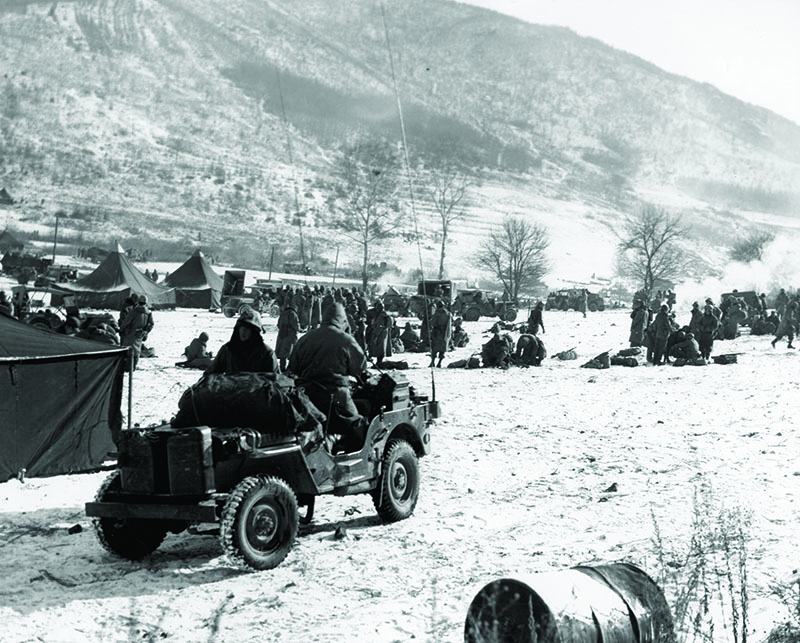
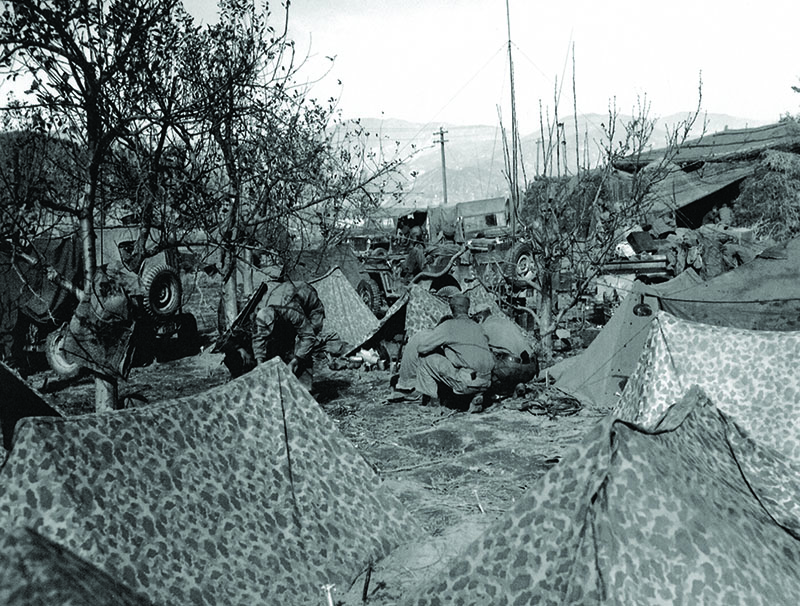
Marines of the 2nd Battalion, 5th Marines, set up a command post in the hills around Chosin Reservoir.
Just after 7 p.m. on Dec. 3, the lead element of the column from Yudam-ni entered the Hagaru-ri defensive perimeter, and about twenty hours later, the rear guard arrived. As noted in one account of the heroic withdrawal from Yudam-ni in “The Chosin Reservoir Campaign,” “The four-day operation passed into history. Some 1,500 casualties were brought to Hagaru, a third of them being in the non-battle category, chiefly frostbite cases. It had taken the head of the column about 59 hours to cover the 14 miles, and the rear units 79 hours.”
The medical needs of the arriving casualties overwhelmed the medical facilities and personnel at Hagaru-ri. Yet, as Capt Hering later recalled, “Somehow they were sorted, those in need given resuscitation and definitive care, sheltered, warmed, and fed.” The critically wounded were shunted to the two medical battalion hospitals, Charlie and Easy Med, which were near the airstrip.
The commanding officer of Easy Med, Navy Lieutenant Commander Charles K. Holloway Jr., a veteran of the Second World War and one of the most experienced surgeons in the division, vividly remembered the challenges he faced on Dec. 4, as recounted in his unpublished manuscript “Escape From Hell: A Navy Surgeon Remembers Pusan, Inchon, and Chosin”: “We had so many patients lying, sitting, and standing that we could hardly see the floor. The 300 triple-deck bunks of our expanded capacity were simple wooden frames that held the patients’ own litters. I stacked patients like sardines in the commandeered pyramidal tents, 25 casualties in a circle around the center stove.
Their own body heat and warmth from the heater kept them from freezing until we could load them on planes in the few hours of safe operation left at the airstrip. There was not much else we could do for them at the time, but it was enough to save most of them.”
Those requiring “emergency surgery, and there was surprisingly few, managed to get it.”
CAPT Eugene Hering, USN, 1st Marine Division surgeon, right, shows Secretary of the Navy Francis P. Matthews the hospital at Hamhung.
Those whose surgery could be delayed “were evacuated by air to get needed surgical treatment later at the First Marine Division Hospital in Hamhung.” Those “who had made the supreme sacrifice for their buddies” were placed in a “morgue tent” erected in front of the hospital.
Dec. 5 was 1stMarDiv’s last full day at Hagaru-ri, and the rush was on to evacuate the remaining casualties. That day, according to Air Force historian William M. Leary’s book “Anything, Anywhere, Any Time: Combat Cargo in the Korean War,” the 21st TCS “flew 44 missions into the perimeter … the 1st Marine Aircraft Wing flew 10, and a detachment of C-47s from the Royal Hellenic Air Force flew 8.” Together they “brought in 254,851 pounds of freight and 81 replacement Marines” and evacuated “1,561 casualties.” Regretfully, wrote Leary, “there was neither the time nor the space on the airplanes to bring out all the bodies of the dead.”
While the busiest day of the airlift unfolded, correspondents scrambled to file their last-minute reports from Hagaru-ri. All civilians and nonessential personnel were directed to leave by the end of the day, as Gen Smith had ordered 1stMarDiv to begin the breakout from Hagaru-ri the following morning.
Their dramatic stories, accompanied by maps, filled the front pages of the nation’s newspapers. Their common theme: The oldest and most venerated division in the Marine Corps, the finest group of fighting men in the world, was in mortal danger of being annihilated by an overwhelming force of Chinese Communists. An estimated nine divisions had taken up positions along the MSR with the avowed intent of exterminating the 1st Marine Division. When a reporter asked Gen Smith whether he was retreating or withdrawing from the Chosin Reservoir, he replied that he had done neither. There is no retreating or withdrawing when you’re surrounded, he was purported to say, you can only attack. His response was quickly transmuted by the press into perhaps the most memorable phrase of the war: “Retreat, Hell! We are just attacking in a different direction.” Smith had refused General Tunner’s earlier offer to fly out the entire division—“It just didn’t occur to us that we wouldn’t be able to fight our way out,” he later said, according to the Marine Corps University Archives transcript.
During the snowy, sub-freezing morning of Dec. 6, the 7th Marines passed through the Hagaru-ri defensive perimeter and proceeded along the MSR toward Koto-ri, some 11 miles to the south; the breakout from the Chosin Reservoir had begun. “Twenty miles of icy, winding, mountain road barred by a 6,000-foot pass with enemy spread on both sides, stand between the Marines and the open road to the ocean,” wrote war correspondent Keyes Beech that day.
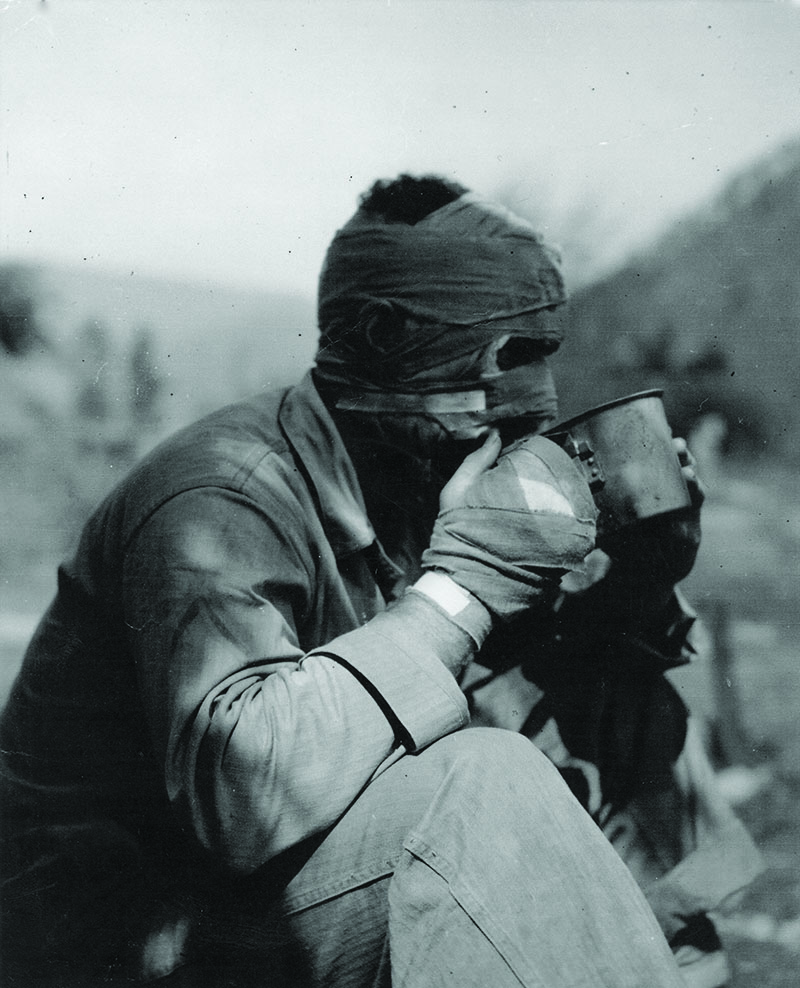
A wounded Marine sips hot coffee from a canteen cup while awaiting evacuation to a rear area hospital for treatment.
While this was unfolding, the evacuation of the remaining casualties continued. At noon, the director of operations for the Combat Cargo Command, Colonel Robert D. Forman, flew into Hagaru-ri to direct the final evacuation flights. Accompanying him was Michael James of the New York Times, who later described the final moments they spent at the airstrip: “By this time the whole area was a sea of flames. Not only were Marines burning their surplus stocks, but two slightly damaged C-47 transports, neither of which could be flown out due to lack of immediate repairs, went up in flames.
Colonel Forman who flew the last transport out … was notified by radio jeep that there was one more wounded man desperately in need of expert medical attention. For one hour Forman waited while the enemy closed in on the field. Eventually a jeep drove up with the last casualty who was taken aboard.”
As the plane lifted off through a swirling snowstorm and hail of enemy gunfire, countless Chinese Communist foot soldiers swarmed over the abandoned airfield.
An Unparalleled Aeromedical Operation
The following day, General Stratemeyer sent a redline message to the Chief of Staff of the U.S. Air Force, General Hoyt Vandenberg, reporting that 4,369 wounded Marines and soldiers had been evacuated by the Combat Cargo Command during the six-day Hagaru-ri airlift, as documented in “The Three Wars of Lt. Gen. George E Stratemeyer: His Korean War Diary.” By any standards, it was a historic achievement—a “very outstanding performance,” commented Stratemeyer in a dispatch to General Tunner. Time magazine was so impressed with the airlift that it featured Tunner on its Dec. 18 cover, calling him the “Airlifter.”
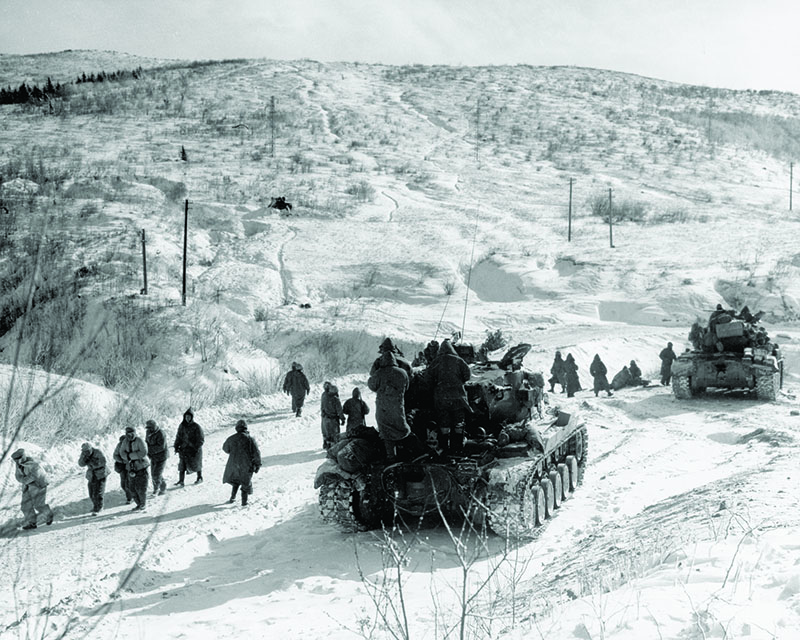
Marine tanks maneuver around a blown bridge south of Koto-ri as the allies push to break out from a Chinese Communist encirclement en route to the beachhead at Hungnam, December 1950.
Gen Smith was unsparing in his praise of the Hagaru-ri airlift. “I believe the story of this evacuation is without parallel,” he wrote in his aide-memoir. “Credit must go to the troop commanders whose determination and self-sacrifice made it possible to get the wounded out, to the medical personnel whose devotion to duty and untiring efforts saved many lives, and to the Marine and Air Force (including Greek) pilots who accomplished this difficult task without a fatal accident in spite of the hazards of the weather and the rudimentary landing strip.”
The “fabulous” airlift ushered in a new era in combat medicine, Hering said in a press conference after 1stMarDiv reached the safe environs of Hungnam, prompting one exuberant Kansas City Star reporter to label aeromedical evacuation as the “great medical weapon” of the war. Later, Hering would clarify its role in military medical operations in the article he wrote for The Military Surgeon journal: “Air evacuation is only a link in the chain of casualty care. It is a strong member of the team, but it is not the whole answer. Every other member of the team must be utilized under most conditions, from the company aid men all the way through to the evacuation hospital, the naval hospital ship, and the base hospitals in the zone of the interior. It is a wonderful adjunct, our greatest advance in the evacuation of casualties, but still an adjunct.”
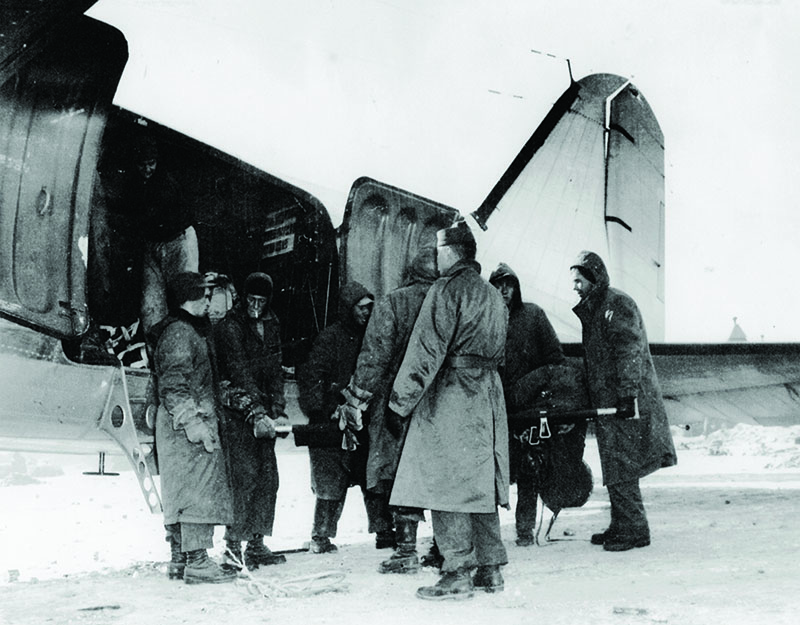
Featured Image (Top): Casualties are loaded onto a C-47 at Hagaru-ri for evacuation during the Battle of the Chosin Reservoir, December 1950. Over six days, more than 4,300 casualties were flown out under constant threat of enemy fire.
Authors:
Dr. Eugene Ginchereau is a military historian and retired Navy physician.
André B. Sobocinski serves as the historian at the U.S. Navy Bureau of Medicine and Surgery.
Patriot Led a Life of Military Service, Culminating in Medal of Honor
By Mike Miller
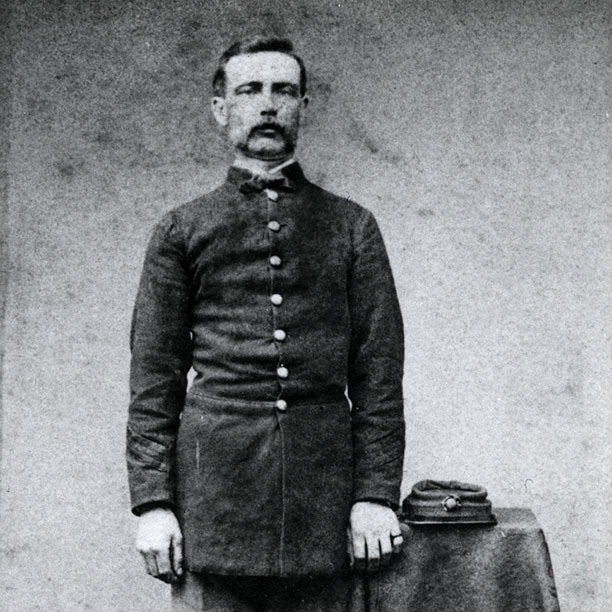
Pvt Hugh Purvis received the Medal of Honor in 1872, for his heroic actions during the Korean Expedition in 1871.
Students of Marine Corps history may know about the bravery of Hugh Purvis, who received a Medal of Honor for his actions in the 1871 Korea expedition. But what is not well-known about Purvis is that he was a veteran of the Civil War. Purvis became a Marine in 1869, the first of many years of a long and distinguished career wearing the eagle, globe and anchor. Before that, however, he was a soldier who fought in the Battle of Gettysburg.
With the outbreak of the Civil War in 1861, Hugh Purvis was struck with patriotic fervor and joined the 23rd Pennsylvania Infantry, a three-month regiment, serving in Maryland in order to secure Washington, D.C., from Confederate incursions. At the end of his enlistment, Purvis decided that military life suited him well and joined the 28th Pennsylvania Infantry for three years. After a quiet winter on the Potomac River near Harper’s Ferry, Purvis faced sustained battle for the first time at Antietam on Sept. 17, 1862. More combat awaited at Chancellorsville in 1863, which began the road to Gettysburg. The 28th Pennsylvania was fragmented, with Purvis now belonging to the newly formed 147th Pennsylvania.
On July 1, 1863, Private Hugh Purvis and the other 297 officers and men of the 147th Pennsylvania Infantry marched hurriedly toward Gettysburg, drawn by the sounds of cannons and the knowledge that they must face General Robert E. Lee’s Army of Northern Virginia on their native soil. As dawn broke on July 3, 1863, Private Purvis and the 147th Pennsylvania were ready to meet the expected Confederate advance at the base of Culp’s Hill. Across a cleared field and stone wall, the 1st Maryland Infantry (Confederate), the 3rd North Carolina and two Virginia regiments made ready to charge directly into the Union regiment’s line. Lieutenant Colonel Ario Pardee moved his men down a slight slope to the low ground to a better firing position where they would not be on the skyline. Hugh Purvis and the 147th Pennsylvania readied for battle.
The woods where the 147th Pennsylvania Infantry lay at the time of the charge of the rebels on Culp’s Hill, Gettysburg, Pa.
At 8 a.m., the Confederates charged down the slope with the “rebel yell,” led by the Maryland regimental mascot Gracie, a black Labrador retriever. Pardee allowed the Confederates to approach to 100 yards and then opened fire. The volley tore through the enemy ranks, breaking the charge into fragments that continued to attack until they could go no further. Within minutes, the surviving Confederates drew back up the hill to safety, leaving the field littered with the bodies of the dead and wounded southerners.
The sight before the 147th Pennsylvania was horrendous. One wounded Maryland soldier pulled up to load his rifle, which caused many nervous Federals to sight in on the injured man. Major John Craig ordered the men to hold fire as it was obvious that the warrior could do little damage. The intent of the wounded man soon became clear. All watched carefully as he slowly loaded his weapon, pulled the hammer back and then placed the muzzle of the rifle under his chin. As the Federals watched in horror, the soldier placed his ramrod on the trigger and fired the weapon, ending his suffering. No one who witnessed the incident could ever forget the Maryland soldier. The field at Gettysburg would forever be known as Pardee Field, after the commander of the 147th Pennsylvania.
Purvis next saw action in the Western theater in the 1863 battle of Lookout Mountain and the 1864 Atlanta Campaign at Dug Gap, Resaca, New Hope Church and Kennesaw Mountain. On Sept. 26, 1864, he returned home at the end of his enlistment. Civilian life seemed not to suit Purvis, and he joined the Veterans Volunteer Corps in 1865, serving in the defense of Washington, D.C., until the end of the war. Purvis remained in this service until July 20, 1866, when he again rejected civilian life for the duty of a soldier, enlisting for three years initially with the 26th Infantry Regiment. As the Army reduced in size, Purvis’ regiment was consolidated with other units.
Ario Pardee
Purvis made a fateful decision on Oct. 27, 1869, leaving the Army for an enlistment in the Marine Corps with his first station fittingly the Marine Barracks at the Philadelphia Navy Yard. He left the City of Brotherly Love for Boston the following month, followed by a quick assignment to the Marine detachment on USS Alaska on Dec. 29, a new wooden hulled screw sloop of war. Purvis had little time to learn the ways of the Marine Corps before going to sea. On April 8, 1870, Purvis found himself on his way to join the Asiatic Squadron commanded by Rear Admiral John Rodgers.
Private Purvis arrived on station just as tensions between the United States and Korea escalated over the 1866 disappearance of an American flagged ship, S.S. General Sherman, and the American Sailors who were supposedly shipwrecked on Korean territory. There existed no formal diplomatic relations between the two countries, so when the ship vanished, no method existed to investigate the incident. American warships visited Korea over the next two years, but no information was gained.
Rear Admiral John Rodgers was tasked to visit Korea and assist American diplomats in establishing some form of diplomatic relations. He assembled his squadron in Nagasaki, Japan, and sailed for Korea on May 16, 1871, aboard the screw frigate USS Colorado, accompanied by USS Alaska with Pvt Purvis aboard, the screw sloop of war USS Benicia, side wheel gunboat USS Monocacy and the gunboat USS Palos. The expedition reached Korean waters three days later but was immobilized by thick fog that prevented any further movement. When the weather cleared, RADM Rodgers anchored his squadron near Eugenie Island on May 23. Rodgers sent out the gunboat USS Palos with steam launches to survey the area.
This map shows the location of the forts and batteries engaged by land and water forces of the U.S. Asiatic Fleet, June 1871. (Courtesy of Naval History and Heritage Command)
At noon on June 1, USS Monocacy began the sounding mission with Commander Homer C. Blake on USS Palos steaming up the river behind three steam launches and a steam cutter performing the actual soundings. As the Americans neared the Korean forts at a bend of the river, the Sailors “observed the flags, an indication of the forts being occupied by soldiers.” As the Americans came closer, they saw the cannons in the fort were fully manned, and “the face of the hill occupied by lines of men, perhaps a thousand in number.”
The sound of a rifle shot echoed across the river, signaling the guns to open a blistering fire upon the American craft. Blake’s Sailors replied with a fusillade of cannon fire which quickly caused the gun crews to abandon their cannons. The American ships passed the fort at full speed and anchored, still firing at any sign of Korean resistance; however, USS Monocacy struck a rock and was leaking water at a rapid rate. The small boats reported little ammunition remaining from the fight. The Americans withdrew to rejoin the rest of the squadron, firing on the forts as they passed with no response from the Koreans. The Americans lost only two Sailors wounded during the engagement.
RADM Rodgers regarded the fire from the Korean forts as an insult to the American flag and informed the Korean government he would give them 10 days to make an apology before taking further action against the forts. Ambassador Low concurred with RADM Rodgers’ arrangements. The 10 days allowed him time to plan for battle and to take advantage of the neap tide, which would provide optimum conditions for a landing. There would be no more dueling with the cannon from the river. This time, RADM Rodgers planned an amphibious landing that would capture each fort as necessary. He pulled together a landing force of Sailors and Marines from Colorado, Alaska, and Benicia, totaling 759 men, including 105 Marines, commanded by Captain McLain Tilton. As each day passed, there remained no response from the Korean government.
On June 10, at 10 a.m., Rodgers ordered his landing force into motion with the mission to punish the forts which fired on the American vessels. USS Monocacy bombarded the first offending fort, identified as the “Marine Fort,” while the Palos towed 22 small boats loaded with Sailors and Marines, including Pvt Purvis and the landing party from Alaska. The Koreans returned fire but were driven from their guns by Monocacy’s cannon. Benicia made for a landing in an inlet below the fort, flanking the Korean defenders, who scattered as the boats neared shore, leaving their stronghold vacant.
USS Monocacy towing landing boats in the Han River during the Korean expedition in May-June 1871.
Each boat grounded on the beach, allowing the ready Marines and Sailors to jump ashore to an unopposed landing, at least in theory. No one performed a reconnaissance of the ground itself, which proved to be the major opponent of the day. The inlet possessed a seemingly bottomless mudflat, which grasped the Marines by their legs and refused to let go. “The men, stepping from the boats, sunk to their knees, and so tenacious was the clay,” Rodgers reported, “that in many cases they lost gaiters and shoes, and even trouser legs.” Even worse were the gun crews of the nine howitzers, which quickly disappeared in the mud up the axles of their gun carriages. Dry land was a distant quarter mile to half a mile, depending on the landing site.
The lack of Korean resistance, even with obsolete weapons, allowed the Americans to avoid a disaster as the hill above the fort completely dominated the mud flat. Time was also necessary to plow through the mud and cross cavernous tidal channels in the sludge to reach dry land. Purvis and the Marines took a direct route to the fort, pulling themselves from out of the mud into the abandoned fort; however, the landing guns took a deeper route out of the swamp, avoiding the steep banks of the hill at the fort. Each cannon was pulled out by 75 to 80 Sailors and Marines manning drag lines with raw force to overcome the morass and requiring more than two hours of labor.
Once out of the mud, the sodden Marines and Sailors immediately began the destruction of the abandoned fort, tossing the smaller cannons into the river while spiking the larger cannons to prevent any further use. Other working parties pulled down the walls of the fort while powder, uniforms, rations and anything else burnable were put to the torch, sending blank clouds of smoke into the air. The destruction went on into the later afternoon when the Americans went into camp on the heights above the smoldering fort. The Marines took position in advance of the main encampment, armed with one of the boat howitzers, placing a strong picket line to detect any counterattack by Korean forces from the additional forts upriver. A force of Korean soldiers harassed Pvt Purvis and the Marines at midnight with desultory rifle fire but was soon driven away by several howitzer shells.
Daylight of June 11 allowed complete destruction of Fort Marine, and a request was sent to Admiral Rodgers for further instructions. Rodgers signaled back, “Go ahead and take the forts.” Commander Lewis A. Kimberly ordered the landing party into motion, marching toward the principal Korean forts 3 miles upriver. Pvt Purvis and the rest of the Marines led the advance, approaching a second fort on a high ridge overlooking the river. Once again, the Korean forces evacuated their fort, allowing the Americans to destroy the large number of cannons remaining behind. When the walls were pulled down, the American column began to march the final 2 miles to the heart of the Korean defense. If there would be a battle, it would be in the final fort complex ahead, the headquarters of the Korean commanding general.
Elbow Fort, one of the defenses of the Han River, as photographed from Fort McKee shortly after its capture on June 11, 1871.
The final 2 miles to the Korea citadel proved exhausting, and Admiral Rodgers described it as “a succession of steep hills, with deep ravines between, over which foot soldiers passed with great fatigue.” Entire companies deployed on the drag ropes of the artillery, hauling every cannon up each vertical ravine and then lowering the gun down into the next gulley in a never-ending struggle, yard after yard. As the American column moved wearily forward, columns of Korean infantry appeared on their left flank, threatening the advance. Commander Blake ordered three companies of Sailors and five of the howitzers to keep the Korean advance at bay until the main column reached their target.
At 11 a.m., Blake’s men reached the base of the peninsula holding the main Korean position well sited once again on a commanding hill overlooking the river. The approach from the land side proved most formidable with the only way to attack the position constricted by the peninsula into a narrow kill zone, commanded by the fort. The Sailors and Marines wasted little time getting into position, eager to complete their relentless attack. Purvis and the rest of the Marines moved in defilade to within 150 yards of the fort and then paused to recover their strength for the decisive attack.
An oil painting by John Clymer, USMCR, depicting the landing of Marine infantry and field artillery on Kang-Wa Island in the Han River in Korea, June 10, 1871. USS Monocacy provides gunfire support in the background.
The final charge would have to be made up yet another steep hill and then face the walls of the fort itself without scaling ladders. “Our men kept up a fire from their resting place upon the fort whenever an enemy exposed himself,” Rodgers noted, “and this they did constantly with the most reckless courage, discharging their pieces as fast as they could load.” The Koreans desperately defended their position, returning the fire with a vengeance. A bullet struck Marine Private Denis Hanrahan of the Benicia, killing him in the exchange of fire.
At last, the order to charge was given. Purvis sprinted ahead down a slope into an 80-foot ravine and then up the final yards to the walls of the enemy fort. The Korean defenders fired quickly on the charge until the Americans reached the wall, and then instead of pausing to reload, threw stones and boulders down the attackers. Luckily for the Americans, several gaps were blown into the wall before them, allowing them to enter the wall without a fatal climb.
Navy Lieutenant McKee was the first American in the fort and immediately engaged in hand-to-hand combat with the Koreans, falling with two mortal wounds, a spear in the side and musket ball in the groin. The Koreans fought hard against the Marines and Sailors. “The fighting inside the fort was desperate,” Rodgers related, “they apparently expected no quarter, and probably would have given none.” Private McNamara, of Benicia, took on a Korean soldier on the parapet, wrenching the matchlock weapon from the grip of his opponent and then killing him in a hand-to-hand fight. Navy Landsman Seth Allen of Colorado was killed while climbing the parapet as the Korean soldiers struggled with the Marines and Sailors. “Our men fought, some with cutlasses, others with their muskets and carbines, using them as clubs,” Commander Silas Casey of Colorado related, “the Koreans with spears, swords, stones and even threw dust to blind us.”
Rodgers related the Koreans “fought to the death, and only when the last man fell did the conflict cease.” The American flag flew from the parapet of the fort at 11:15 a.m. The Korean soldiers fought bravely but could not survive the American modern firepower in the close confines of the fort. At least 108 bodies of the Korean garrison were counted inside the citadel, and another estimated 20 prisoners were captured, many of whom were wounded. The garrison bravely gave their lives to defend their fort. Two Marines—Private Hanrahan and Private Michael Owens of Colorado—were killed in the fight.
Private Purvis was among the first to enter the fort and charged with Captain Tilton and Corporal Charles Brown on the large yellow 12-foot square flag of the Korean general. “The Alaska Marine [Purvis] was then a second or two before me and my corporal [Brown], but while he was unknotting the halliards, my Corporal and I tore the flag down.” Tilton noted in his report that Purvis rightly deserved credit for the capture. Both Purvis and Brown were recommended for Medals of Honor, but Cpl Brown deserted before he was awarded his medal. Pvt Purvis received his medal in 1872. He left the Marine Corps with the memories of his round the world cruise fresh in his mind. Yet, Purivis would not remain a civilian for long. On May 18, 1874, he found a new home and a new start by reenlisting in the Marine Corps at the Marine Barracks Annapolis, Md. Interestingly, Purvis rejoined his comrade of the Korean forts, Capt McLane Tilton, who was in command of the station.
Here, Purvis found his niche, remaining at the barracks for the next 10 years until 1884, when he was discharged from the Marine Corps as a corporal. He continued to serve as armorer and mechanic at the Naval Academy for many years. Purvis also met Mary Alice Jackson of Annapolis, and they were married by 1880. The two had three children. After a long and certainly interesting life, Purvis died on Feb. 12, 1922, in Annapolis and is buried in Saint Anne’s Cemetery beside Alice, who lived long enough to have the honor of sponsoring the USS Hugh Purvis (DD-709), commissioned in 1945.
Inside Fort McKee after its capture on June 11, 1871. (Photo courtesy of Naval History and Heritage Command)
Author’s bio: Mike Miller has written five books and many articles about Marine Corps and Civil War history. A longtime Leatherneck contributor, he retired in 2016 after a 34-year career in the Marine Corps archival, museum and history programs. His latest book is “The 4th Marine Brigade at Belleau Wood and Soissons: History and Battlefield Guide.”