Female Engagement Teams: The Enduring Legacy Evolved in Afghanistan

In the final hour of America’s longest war, Marine Corps Female Engagement Teams (FETs) reemerged as a viral conversation. As in too many cases, the nation required tragedy to bring the deeds of these heroic women into the light.

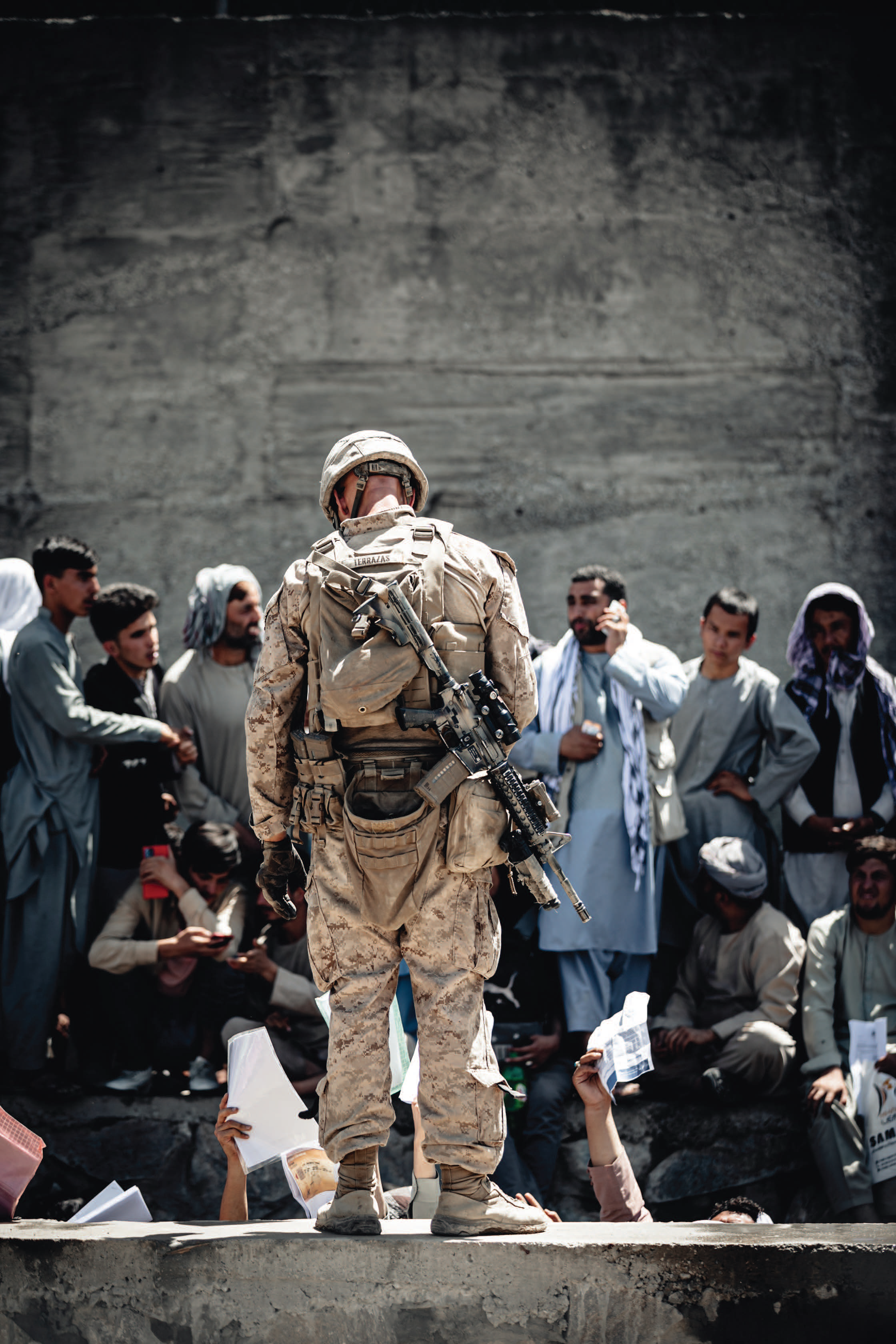
When the time came to evacuate Hamid Karzai International Airport (HKIA) in Kabul, Afghanistan, the 24th Marine Expeditionary Unit (MEU) assembled a hasty, ad hoc FET. The Marines trained for a month in the summer of 2021 to deploy at the airport’s entry gates as female search teams.

Gabby Southern, at the time the adjutant for Combat Logistics Battalion (CLB) 24, served as one of the initial officers in charge of the team when she was a lieutenant.

“I always try to be clear with people that we did not have the training going into Afghanistan that an actual Female Engagement Team would have received,” Southern said, recognizing the pioneers of FET who deployed a decade earlier. “When it was finally identified that we were deploying, several of us went to the MEU leadership and said we would need females to search people at the gates. We formed on ship in June before going to Afghanistan that August.”

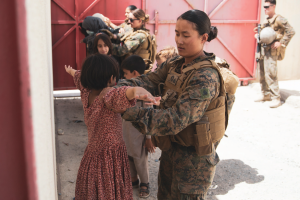
On the ground, the FET divided between gates searching females and children. As the days dragged on and the crowds increased in size and volatility, the Marines stretched thin. Females from other commands on deck joined them to boost the ranks.

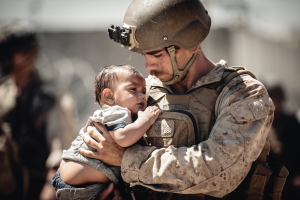
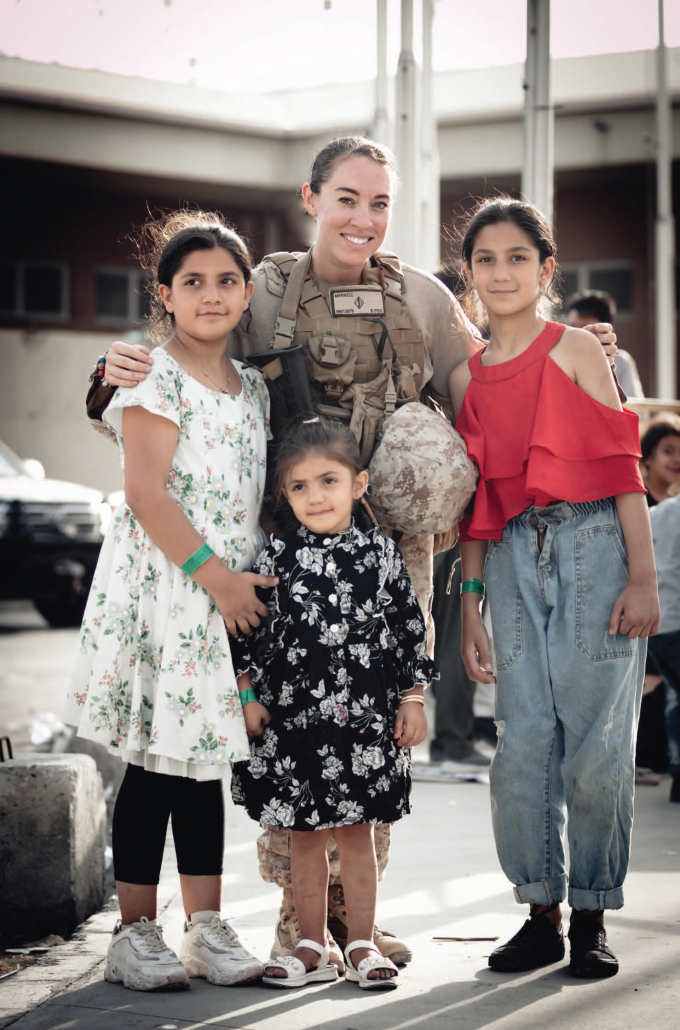
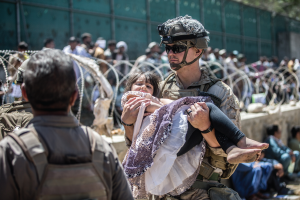
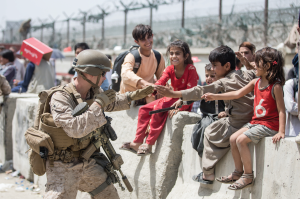
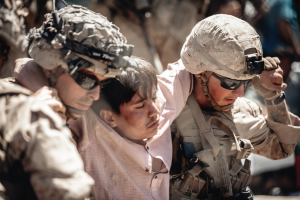
Among the women from CLB-24, Sergeant Nicole Gee volunteered. Her name and photograph are now tragically forever intertwined with the fatal disaster at HKIA. One of the unrehearsed collateral duties the FET undertook was to gather lost or abandoned children at improvised orphanages near each gate. Some of the most heartwarming and heartbreaking photographs from this period, including the now viral photos of Gee, are set in these locations.
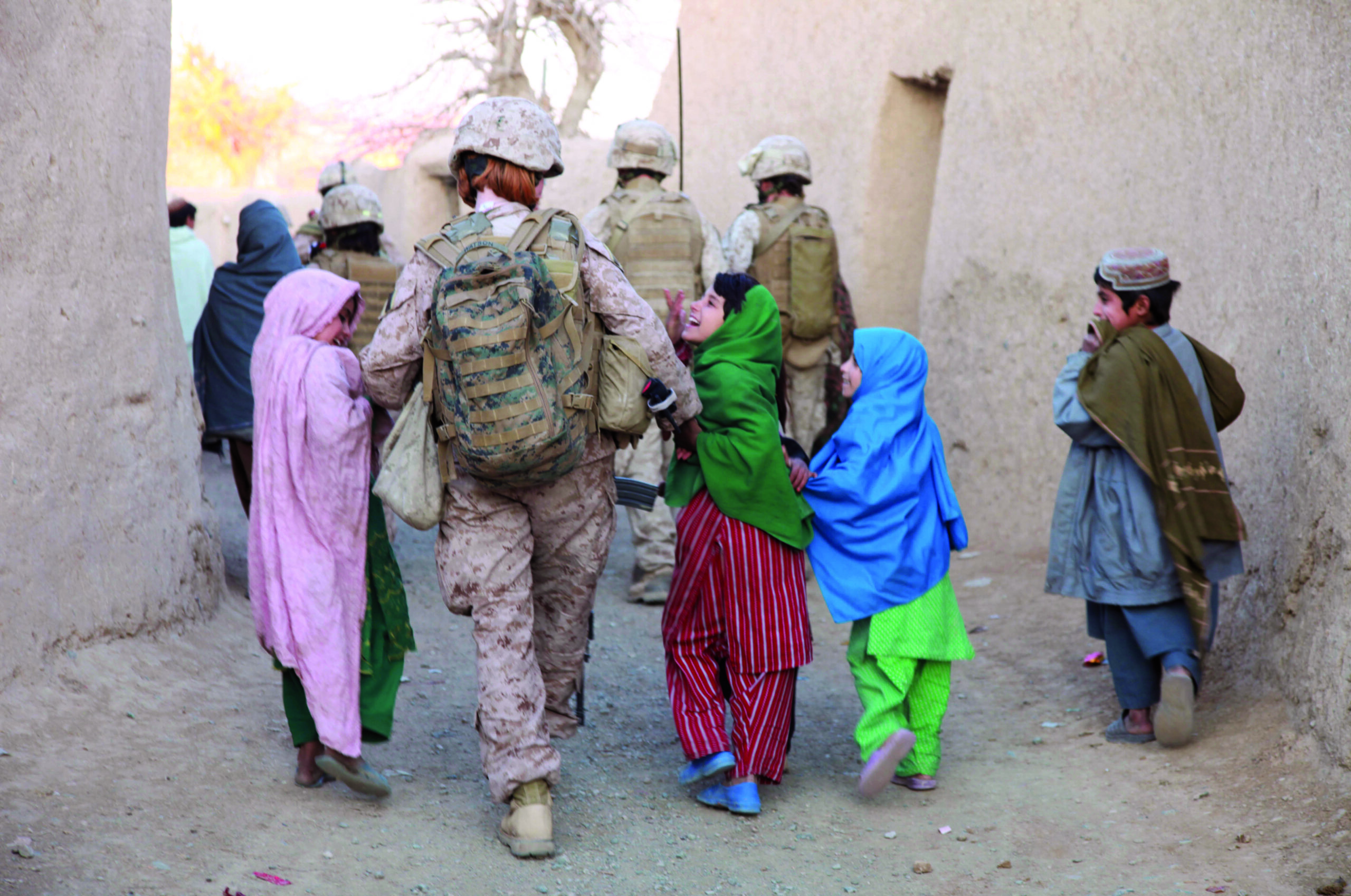
MSgt Julia Watson walks with Afghan girls while on the way to meet with women in the area of Khwaja Jamal, Helmand Province, Afghanistan, on Dec. 29, 2009. (USMC Photo Courtesy of MCRD San Diego Command Museum)

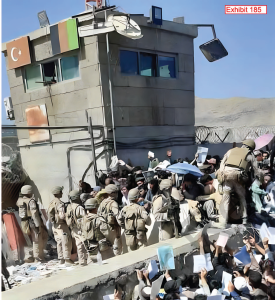
By Aug. 26, 2021, mayhem surrounded the airport. Most gates shut down entirely, diverting the riotous crowd to a single entry point at Abbey Gate. Here, a team of females stood side by side with Marine infantrymen from 2nd Battalion, 1st Marines, processing civilians through. Gee and Corporal Kelsee Lainhart, an intelligence specialist with 2nd Recon Battalion, stood in front of the gate conducting hasty searches on women and children before sending them through for a more detailed search. Sgt Johanny Rosario Pichardo, another volunteer from Naval Amphibious Force, Task Force 51/5th Marine Expeditionary Brigade, worked outside the gate alongside them. Around 5:40 p.m., a suicide bomber detonated an explosive device. Rosario Pichardo and Gee both died in the explosion, along with 11 other U.S. servicemembers. Lainhart was gravely injured.
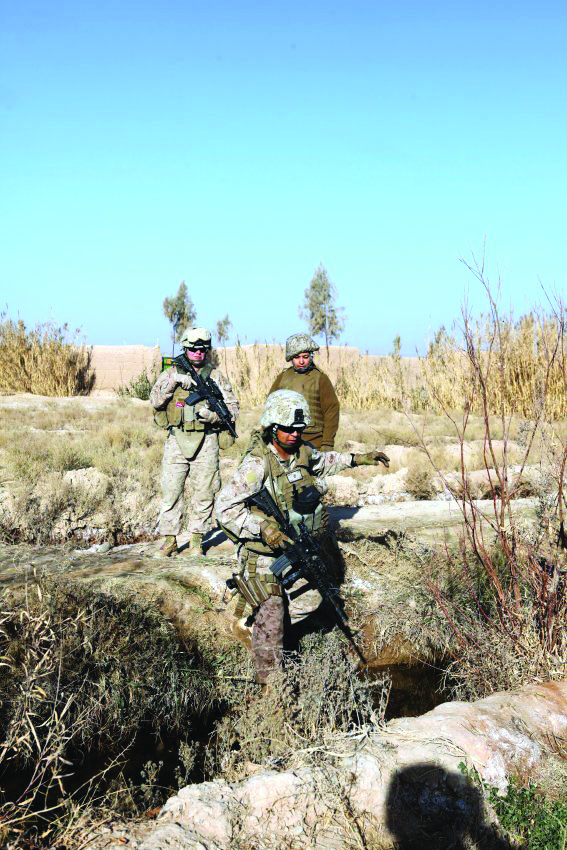
GySgt Rosalia Scifo crosses a canal during a patrol in Marjah, Afghanistan, on Dec. 30, 2010. (USMC Photo Courtesy of MCRD San Diego Command Museum)

The actions of the FET in August 2021, though far removed in training, capability and purpose from their predecessors, show-cased to a modern audience the necessity of special female teams and the courageous, indomitable women brave enough to volunteer for them. Even in the era of integrated, gender-neutral military occupational specialties (MOSs), these warriors added to the legacy and lineage of female Marines placed in extraordinary situations throughout the global war on terror, executing a duty that only they could accomplish, and committing to it, even at the cost of their lives.

The nation previously shined the spot-light on FETs almost a decade earlier, as the women who served on the initial, namesake teams adjusted to life at home after combat. At the end of 2012, Corporal Amber Fifer found herself near the center of attention in a raging national controversy. She survived extensive wounds in Afghanistan earlier that spring. She endured month after month of surgery, therapy and recovery. Photos from her Purple Heart ceremony circulated on Facebook, amassing a terrible collection of anonymous hate. Policy at the time mandated that every Friday Marines arrive for work in their service uniform, a prospect Fifer came to dread. She saw in the mirror at home a resilient young woman and warrior, one of an incredibly small handful of female Marines wearing both the Combat Action Ribbon and Purple Heart. She stood proud. At work, however, the ribbons on her blouse felt more like a scarlet letter. Some froze speechless as their heads involuntarily swiveled to follow her. Others glared, their nonverbal barbs flying. A few had the gall to actually comment.
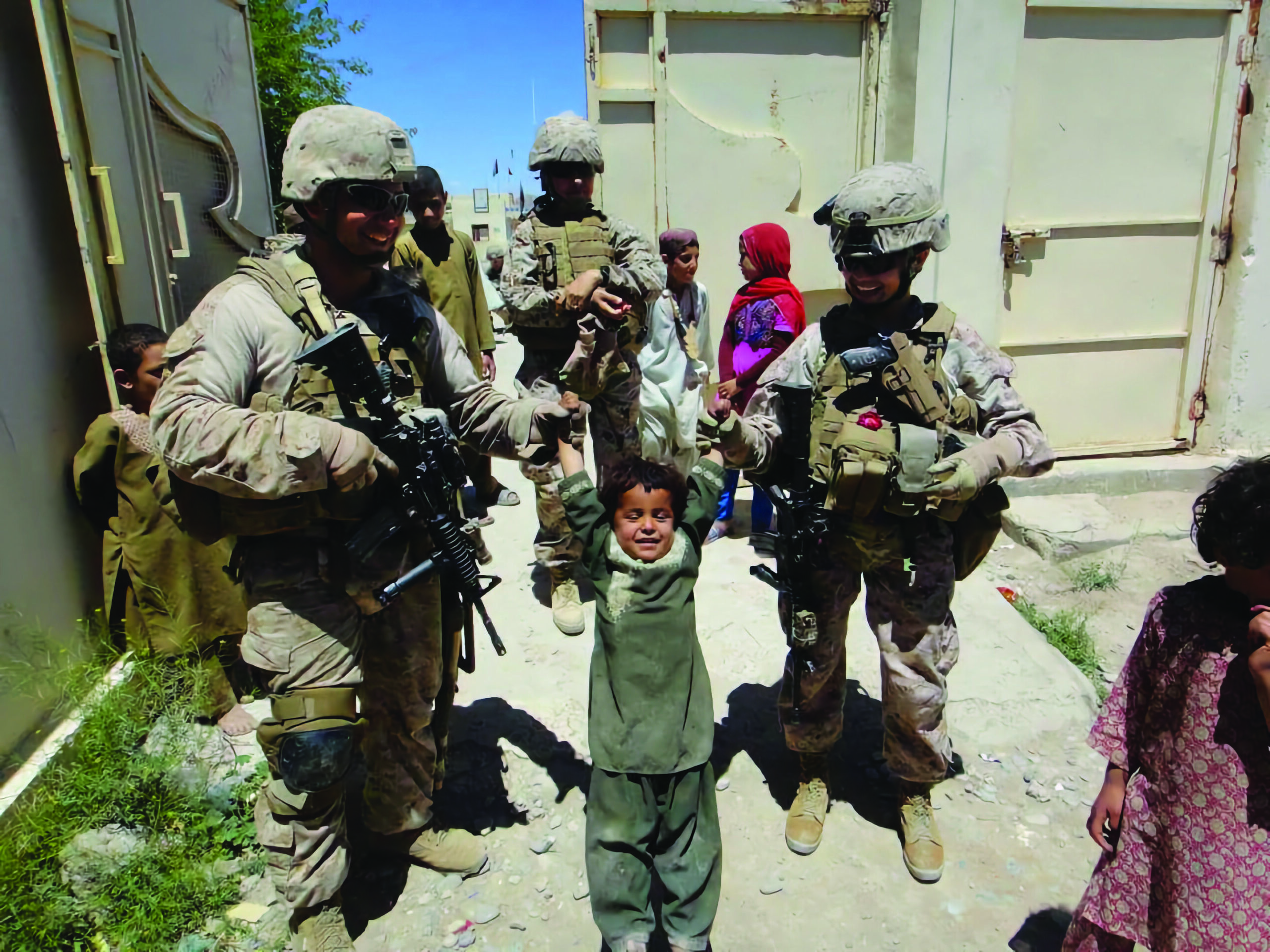
Cpl Amber Fifer, right, and an infantryman from 2/5 interact with an Afghan child while on patrol in April 2012. (Courtesy of Amber Fifer)

“What happened? You get blown up by a mayo jar in the kitchen?”

The timing of her injuries coincided with broader events that thrust her into the limelight. A group of female servicemembers sued the Department of Defense that November to lift restrictions on women serving in combat. As the latest instance of a woman who went to war, and even got shot in the process, several news outlets pummeled Fifer as the unwitting face of the movement. Who was she? How did she end up in combat? What happened to her? Did she really think women should be allowed in combat arms? 
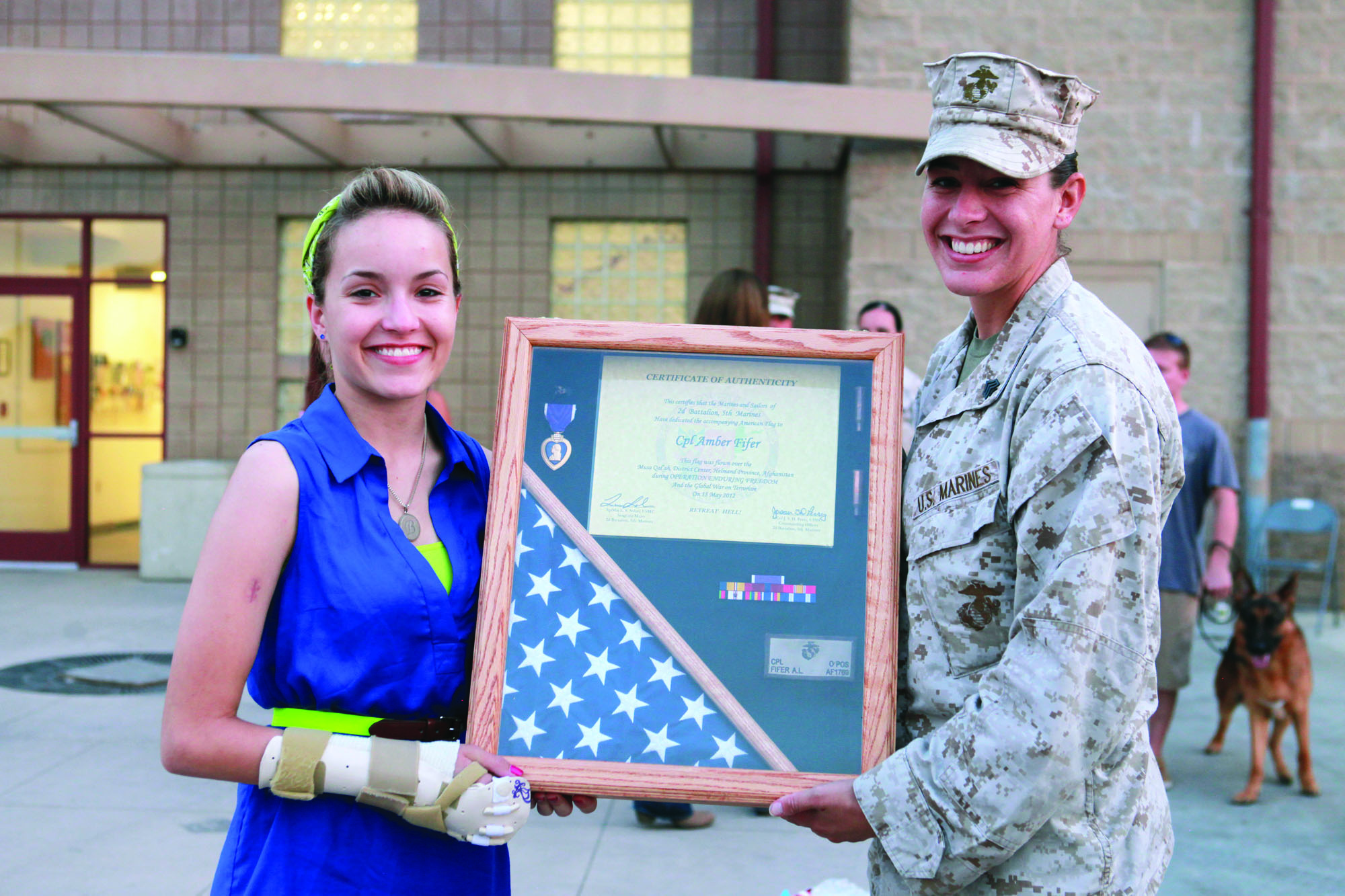
Cpl Amber Fifer, left, and Sgt Mallory Ortiz, members of Female Engagement Team 12.1, hold the Purple Heart plaque that was presented to Fifer during a I Marine Expeditionary Force (Forward) homecoming event on Aug. 9, 2012. Fifer and Ortiz served as FET teammates in Afghanistan before Fifer was wounded on May 15 of that year.

Discerning between truly open dialogue and those who simply wished to antagonize her eroded Fifer’s spirit. Answers to the controversial topics eluded her. Fifer’s recovery exhausted her time and energy. She had not yet even begun to process how she felt about her traumatic experience in Afghanistan and what it meant for her. How should she, one Marine with one experience, speak on questions so broad? The answers, she knew, lay in a combination of experience from women across American history. The most recent and compelling experiences included Fifer and hundreds more who served on the original Marine Corps FETs, or similar U.S. Army teams, in Afghanistan. These women now stood as the prime case study of how females performed in combat. Not just in a combat zone, but on the front lines.
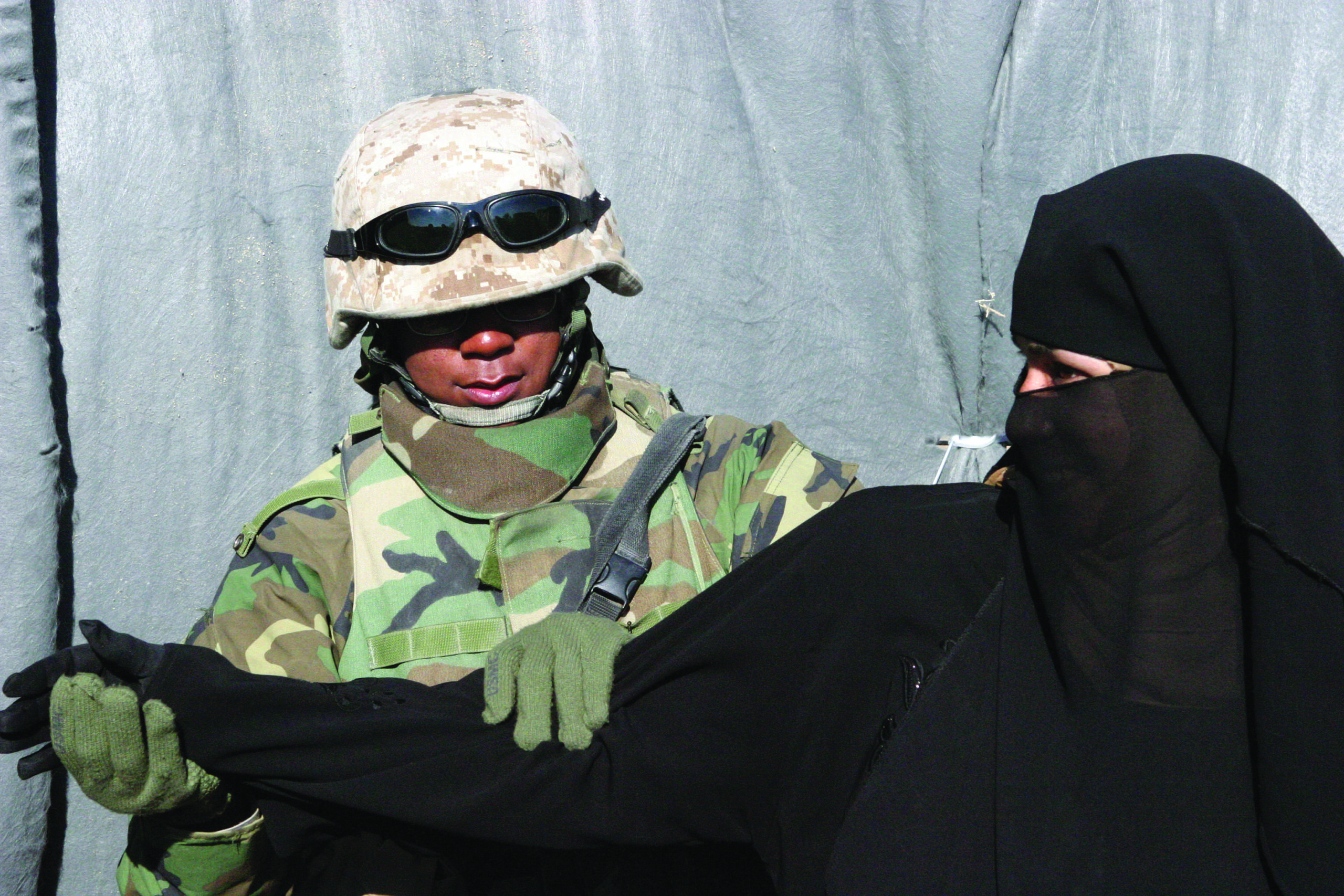
Cpl Erica Steele searches an Iraqi woman on the outskirts of Fallujah on Dec. 28, 2004, before the Lioness program was officially adopted. (LCpl Ryan B. Busse, USMC)
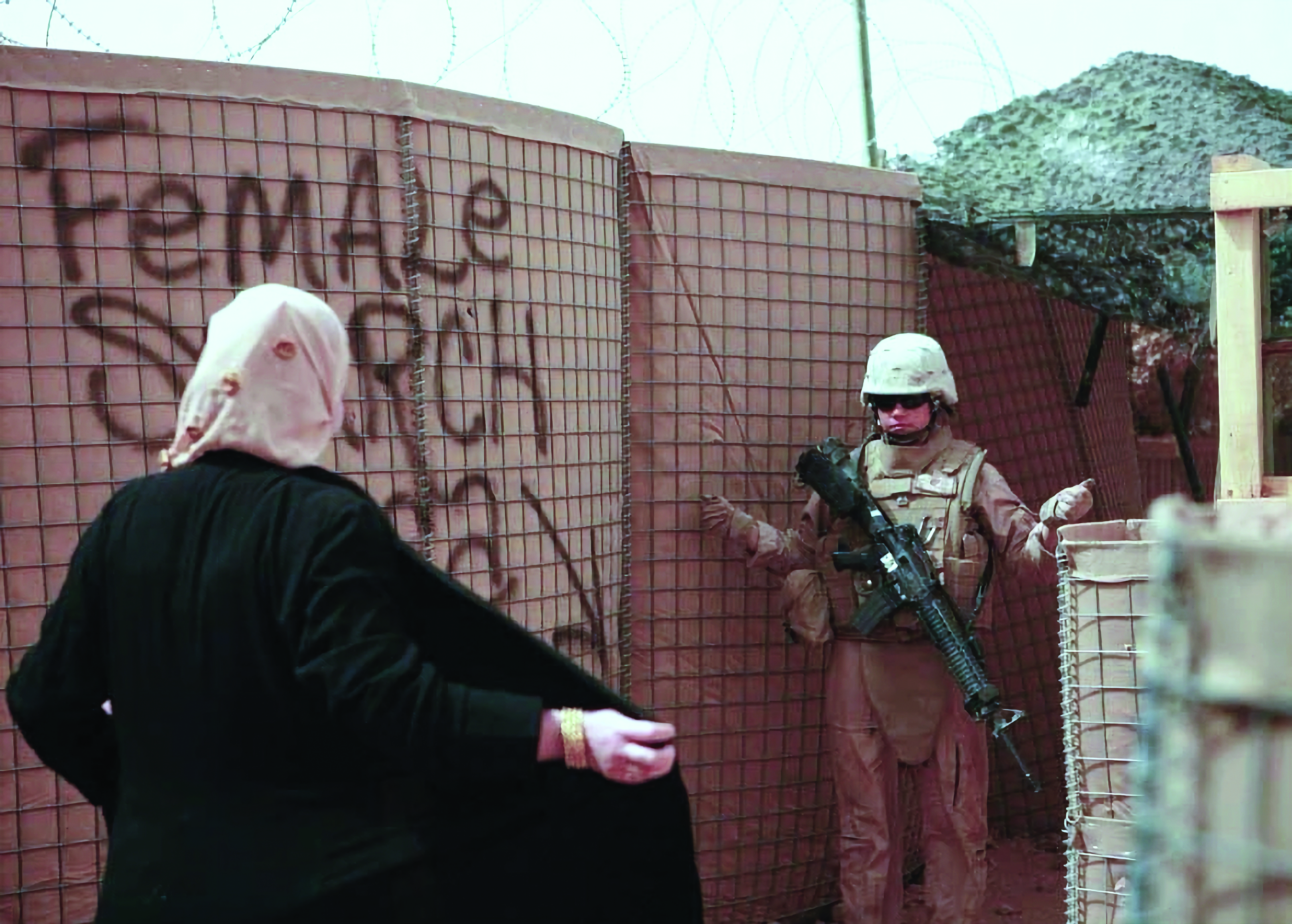
Cpl Nicole K. Estrada (above), a Lioness supporting India Btry, 3/11, instructs a woman to search herself at the female search area in Rutbah, Iraq, on March 14, 2008. (LCpl Cindy Alejandrez, USMC)
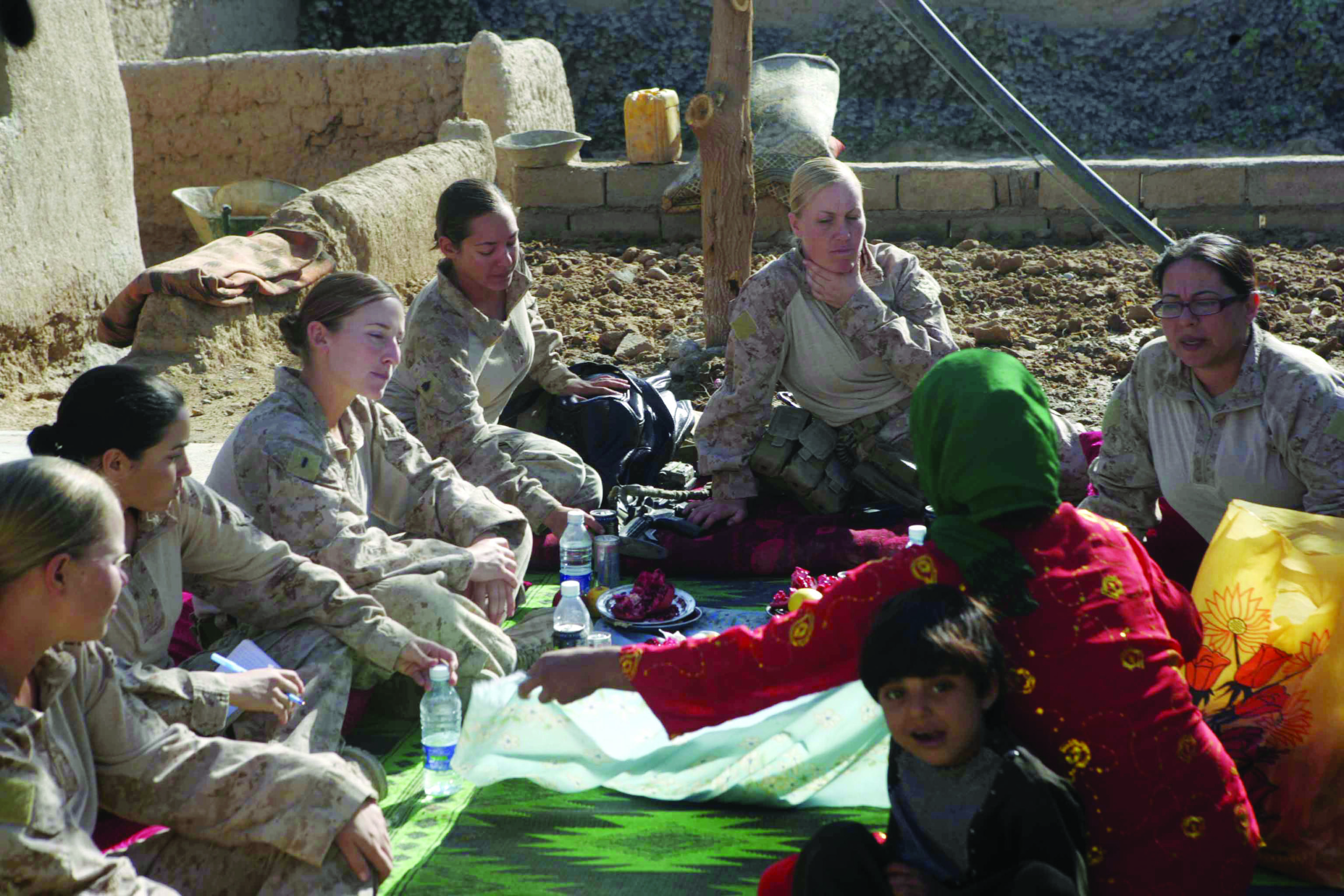
Female Engagement Team Marines with 2/6, RCT 1, meet with an Afghan doctor in Marjah, Afghanistan, on Nov. 15, 2010. (USMC Photo Courtesy of MCRD San Diego Command Museum)

The Marine FETs trace their lineage back to the early days of the global war on terror. U.S. forces entering Iraq collided with cultural differences from the western world. The society influenced by Islam placed clear boundaries on limiting interactions between unrelated men and women—boundaries that U.S. forces were careful to respect. Insurgents took advantage of this glaring security gap and utilized women and children to smuggle arms and contraband though checkpoints. Men in women’s clothing evaded Marines searching the crowd. As the war transitioned from invasion to stability operations in 2004 and 2005, the Corps established an all-female volunteer program called “Lioness,” for the purpose of searching women. Female mechanics, fuel specialists, admin clerks and more volunteered to leave their primary MOSs for the opportunity.

Lionesses stood side by side with the infantry at checkpoints around the country. Their presence achieved a significant boost in security and built rapport with the Iraqi people. Before the term “Lioness” was even recognized back in the States, horrific and historic tragedy struck. On June 23, 2005, a Marine 7-ton drove around the city of Fallujah at shift change, picking up Lionesses from their assigned entry control points. Fully loaded, the truck waited to return through a check-point when a suicide car bomb attacked. The explosion ignited the truck’s massive fuel tank and launched bodies through the air. Several Marines died instantly. More were killed or wounded in a subsequent ambush.

Lance Corporal Holly A. Charette, a mail clerk, and Cpl Ramona M. Valdez, a radio operator, were both part of the teams searching women and children in Fallujah that day. They became the first female Marines killed in Iraq. U.S. Navy Petty Officer First Class Regina Clark, a 43-year-old culinary specialist and Operation Desert Storm veteran who volunteered for Lioness, was also killed. Male Marines Cpl Chad W. Powell and Private First Class Veashna Muy died in the explosion, while Cpl Carlos Pineda was shot and killed trying to rescue others from the burning truck. The blast wounded 13 additional Marines. Eleven of those were women. The suicide bombing endured as the deadliest and most devastating attack against women servicemembers during Operation Iraqi Freedom.

The program expanded. 

In 2007, 20-year-old Cpl Jennifer M. Parcell left her role as a landing support specialist to help. She assumed her new duties on Feb. 1. One week later, on Feb. 7, an Iraqi female entered her checkpoint and detonated a suicide explosive vest hidden beneath her clothes, killing Parcell. Through her death, Parcell became the tragic face of the program and one of the reasons Lioness became a widely recognized part of the Iraq war.

By 2009, the Lioness program garnered the admiration of new recruits back home.

“When I was in boot camp, one of my drill instructors had been a Lioness,” remembered Fifer. Fifer enlisted in August 2009 at age 17 along with her older sister, both of whom attended boot camp at the same time. “At first, I didn’t really know what that meant, but I remember being so enamored, like, ‘Wow, what a powerful woman, what an incredible thing to do.’ Especially at that time, with that political climate, it wasn’t lost on any of us that we could advance in our careers and we could push ourselves, but there were limitations. We were women. We were not allowed to be in combat roles. We would always be on the outskirts of all of this. I always felt we were not as special as the men, and that was so agitating, so I took it as a challenge to do anything I set my mind to.”

“One of my drill instructors was also a Lioness,” added Saje Mrowinski, who also enlisted in 2009. “I knew Lioness was not the only thing happening where females got outside the wire, but knowing the program was specifically stood up to reach the female population and utilizing female Marines, it all sounded extremely exciting to me. You get to be a part of the fight, and that’s exactly where I wanted to be.”
LCpl Saje Mrowinski, standing far left, and her partner, Cpl Maryrose Sierra, standing front row, second from right, with infantry Marines from Weapons Co, 2/9, at COP Bandini in Marjah, Afghanistan. Mrowinski and Sierra spent most of their deploy­ment with 2/9 before the battalion changed over. (Photo courtesy of Saje Mrowinski)

Like many thousands of their male counterparts, scores of women across the nation enlisted through the mid and late-2000s. In high school or middle school, they watched the Twin Towers fall in New York City on Sept. 11, 2001, followed by an exodus of friends joining up to fight. Many women joined with an open contract, allowing the Corps to select their job for them in order to get to the fleet as quickly as possible. Rather than discussing opportunities the Marine Corps could provide and the jobs available to them, some women were first handed a list of the jobs they could not do. They proceeded, undeterred.

Also, by 2009, Lionesses achieved enough success in Iraq that senior leaders sought ways to rebuild and rebrand the program in Afghanistan. Even as U.S. troops withdrew from Iraq and the pioneering Lioness program shut down, the lessons learned translated over to the new front. The new program, called FET, would be much broader in scope; more ambitious in pushing the limits of what women were allowed to do in combat. 

Lionesses served the sole purpose of conducting searches on women and children. These duties were carried out primarily from static positions, co-located with male Marines at checkpoints. The primary mission of FETs would be to build rapport with the Afghan people. Searching women and children, more than half the Afghan population, played a crucial factor in adopting the new teams, but the “hearts and minds” counter-insurgency strategy formed their basis. To accomplish this goal, the new structure attached two or three-woman teams directly to infantry units in the field. FETs would be mobile, live on the same combat outposts as the infantry, patrol with the men daily and integrate into the local Afghan communities.

Initial FETs deployed in much the same fashion as Lionesses had. Women already in country were hastily assembled and plugged in where needed. The first official FET, designated 10-1, assembled volunteers at Marine Corps Base Camp Pendleton, Calif. They arrived in Afghanistan with little more training than the Marines already there but worked to establish themselves. Despite myriad hardships and barriers to overcome, these early FETs discovered the Afghan people largely appreciated their presence. FETs also tapped into the wealth of knowledge and influence hidden beneath the veils of Afghan women.

Perhaps the greatest challenge confronting the initial FETs was the DOD’s Combat Exclusion Policy, barring women from jobs or units assigned to direct combat. The nature of the global war on terror produced a murky definition of “the front.” Female servicemembers throughout Iraq and Afghanistan took part in numerous firefights or other combat engagements. Now, with FETs attached directly to the infantry, some lawmakers viewed their creation as a manipulation of the policy for women and an exploitation of the war’s ambiguity. By mid-2010, FETs were recalled from their outposts while senior leaders in the States debated their legality, arguing the spirit of the law versus the letter of the law. Do combat enablers, such as military police, logistics, and now FET, remain simply a support unit when directly attached and involved in combat? Or, does their mission in direct support of combat operations categorize them now as a combat unit?

In the end, FETs endured. They returned to the field, however, with restrictions in order to make them adhere to DOD policy. The Marines were not allowed to participate in infantry patrols where the express purpose was to pursue and kill the enemy. Some teams were told they could not operate at night. Most arbitrary and frustrating of all, each FET was ordered to return to the main operating base at Camp Leatherneck every 45 days for a two-day stay before returning to the field. These “resets” served simply to circumvent the policy, showing on paper that FETs were not permanently attached to the grunts.

FET 10-2 formed in summer 2010 amidst all the obstacles their predecessors were facing.

“The opportunity to be part of 10-2 came up that May,” recalled Colleen Farrell, at the time a new second lieu-tenant and air support control officer. “I didn’t really know anything about it, but it sounded incredibly rewarding and like an opportunity to be at the tip of the spear, close to the heart of the mission. There were four officers on the team, and we were really trying to just build the program. 10-1 was already in country and running into a lot of difficulties just being allowed to go out and execute their mission. So, we were trying to define what our mission would be and how to brief commanding officers of infantry battalions on how we could best help execute their mission and be a force multiplier.”

More than 50 Marines and female U.S. Navy corpsmen volunteered from around the West Coast. Saje Mrowinski was one of them. A 19-year-old open contract enlistee now stuck in a MOS she disliked, Mrowinski bucked against her command in order to create the opportunity for herself.

“I had found out about the program earlier before it was even officially released. It instantly became the one thing I wanted. I was very naive about the Marine Corps when I enlisted. I knew a couple infantry guys, one of whom was already out, and hearing their stories and seeing who they were, I thought, ‘Wow, I want to join that.’ I didn’t know females weren’t allowed in combat, didn’t know about all these laws and restrictions that would be my reality. Once I got to the fleet and learned FET could be a possibility, I immediately fought my way onto the team.”

2ndLt Colleen Farrell in Afghanistan with FET 10-2. Farrell served as one of four officers deployed with the team. She later joined FET 12-1 through their predeploy­ment training. (Courtesy of Colleen Farrell)

Sergeant Sheena Adams seized the opportunity in a similar fashion. She left the Marine Corps for nearly two years after an uneventful first enlistment as a diesel mechanic. She reenlisted as a helicopter mechanic, hoping for a chance to go to war.

“Shortly after I got to my new unit, they told all the females there about the FET program. My gunny told me I shouldn’t do it since I just arrived, but I was like, ‘No, absolutely not.’ This was everything I ever wanted to do. This was the whole reason why I got back in. I wanted to do something from the front.”

Kimberly Martin’s path onto FET 10-2 proved unique, one of a limited number to be part of both Lioness and FET. She enlisted after high school into aviation ordnance, but in 2007 was offered the chance to become a Lioness. The following January, she deployed to Haditha, Iraq, for four months manning checkpoints and conducting searches. Her enlistment ended in August 2008. She left the Marines to work toward a college degree.

“I still had time in the IRR (Individual Ready Reserve) and one day I got a call from a prior service recruiter trying to get me back in. I told him I had done Lioness in Iraq and really wanted to do something similar again. He connected me with another recruiter at Camp Pendleton who signed me up to join FET as a reserve Marine.”

The women gathered at the Advisor Training Cell (ATC) at Camp Pendleton to begin their predeployment workup. A far cry from the bare-bones training 10-1 received, 10-2 underwent a comprehensive and taxing three-month program. Training included combat marksmanship, combat life-saving training, Tactical Combat Casualty Care, language courses, cultural courses, situational training exercises and final integration into the Mojave Viper combined arms exercise at Twentynine Palms, Calif. In August 2010, the FET boarded a waiting aircraft and flew to Afghanistan.

The Marines divided into pairs and dispersed to their assigned infantry units. Some groups possessed a third, their Navy corpsmen, to join them at the front. With no one but their sister by their side to count on, and little precedent of experience on which to build, each FET in Afghanistan encountered trials as unique as the individual women who comprised the teams. Factors far outside their control predestinated the influence they might achieve and the freedom with which they might operate. The topography of each area of operation (AO) and the level of violence it contained, the demographics of their local populations and the sway the Taliban held over them, the cooperation of each grunt unit; all of it dictated how the deployment would take shape. Regardless of their circumstances, the Marines embraced each challenge, battling to prove their worth and make a difference.

Working with the infantry proved the most immediate and persistent obstacle. Some teams found themselves attached to units who did not ask for them and did not want them. Perhaps, in some cases, a previous FET left a bad impression, or in others a team had never been with them. Some FETs attached to units where the grunt leadership embraced their presence and directed the Marines to do the same. In either case, the infantry companies mostly greeted each FET with hesitation. They weren’t grunts, weren’t guys and existed for a softer purpose, seemingly at odds with the infantry’s mission to locate and destroy the enemy.

“We were looked at with a lot of suspicion,” said Martin. “For a lot of guys, the attitude was that we were just there to get them in trouble.”

“One of the first patrols my team went on, our unit took us 8 miles, out and back, for no reason other than to try to break us off,” remembered Adams. “We carried all the gear, kept up, and didn’t complain. That was just the beginning. Every new squad, every new guy we worked with, you had to prove yourself over and over again. Initially, they viewed us as these girls they would have to take care of. They’d have to wait because we were not fast enough. They’d have to carry the weight because we were not strong enough. We had to do everything the same or better and never complain. We had to do extra to show that we were just as capable, if not more so, than some of them.”

The Afghan population simultaneously presented unique circumstances to evaluate and overcome. Some areas of the country were very receptive. Others, especially kinetic, Taliban-infested regions like Sangin, remained hostile. The pervading cultural attitude toward women hindered their efforts. Some men refused to speak with FETs without their heads covered by a hijab. Some berated or spit on them, refusing to let them speak under any conditions.

Amidst all circumstances, FETs learned to take advantage of their alien ethnicity. They were outsiders to the grunts, non-infantry types trespassing on exclusively male turf. They were outsiders to the Afghans, not the Marines they’d grown used to dealing with and not the same as the women within their own villages. FETs felt they existed as an apparent new “species,” a “third gender” evolved by the necessity of modern warfare. They were disdained by many on every side but also free to establish their role without precedent. They were Marines, but there to help, not to fight. Once the people understood this, trust took root. Villages welcomed their presence in a way the infantry might never have accomplished. Once the infantry accepted their presence, FETs worked with them to creatively generate success and access to places and information previously unreachable.

“We found incredible success with the infantry units that used each FET as a force multiplier and really believed in the added value that we brought,” Farrell stated. As an officer, Farrell oversaw three to five teams at a time, in addition to working with her staff sergeant as their own FET. “Even the male Afghans shared information with us that they would not share with the male Marines. We just had a different relationship and a different dynamic. And because of their strict cultural customs, male Marines were not allowed to interact with or do anything near Afghan women. Oftentimes, when we’d knock on a door and ask to speak with them, the women would be put in a completely separate room so that the male Marines could not engage with them. From a security standpoint, if you’re going to hide something in your house, you’re going to put it in the room where the Marines can’t go. Without FET, we were missing those areas and the entire perspective and information that women had. We had tremendous success gathering information on things like weapons caches or locations of improvised explosive devices that enabled us to save lives, but also, if you’re trying to do village stability operations, the women might have a very different perspective on what that village needs. By engaging with everyone, you have a better understanding of how the Marines can turn the tide against the Taliban and how we can actually help.”

Success resulted through hard-fought, tenacious persistence, but was ever accompanied by hardship, heartache and failure. The very nature of their work placed FETs at the center of a foreign culture steered by rampant gender discrimination; a culture they were neither equipped to change nor expected to change. By simply involving women into their conversations, FETs amplified their voices and supported their rights. In some cases, their work flourished. In others, the local male leadership trashed their efforts.
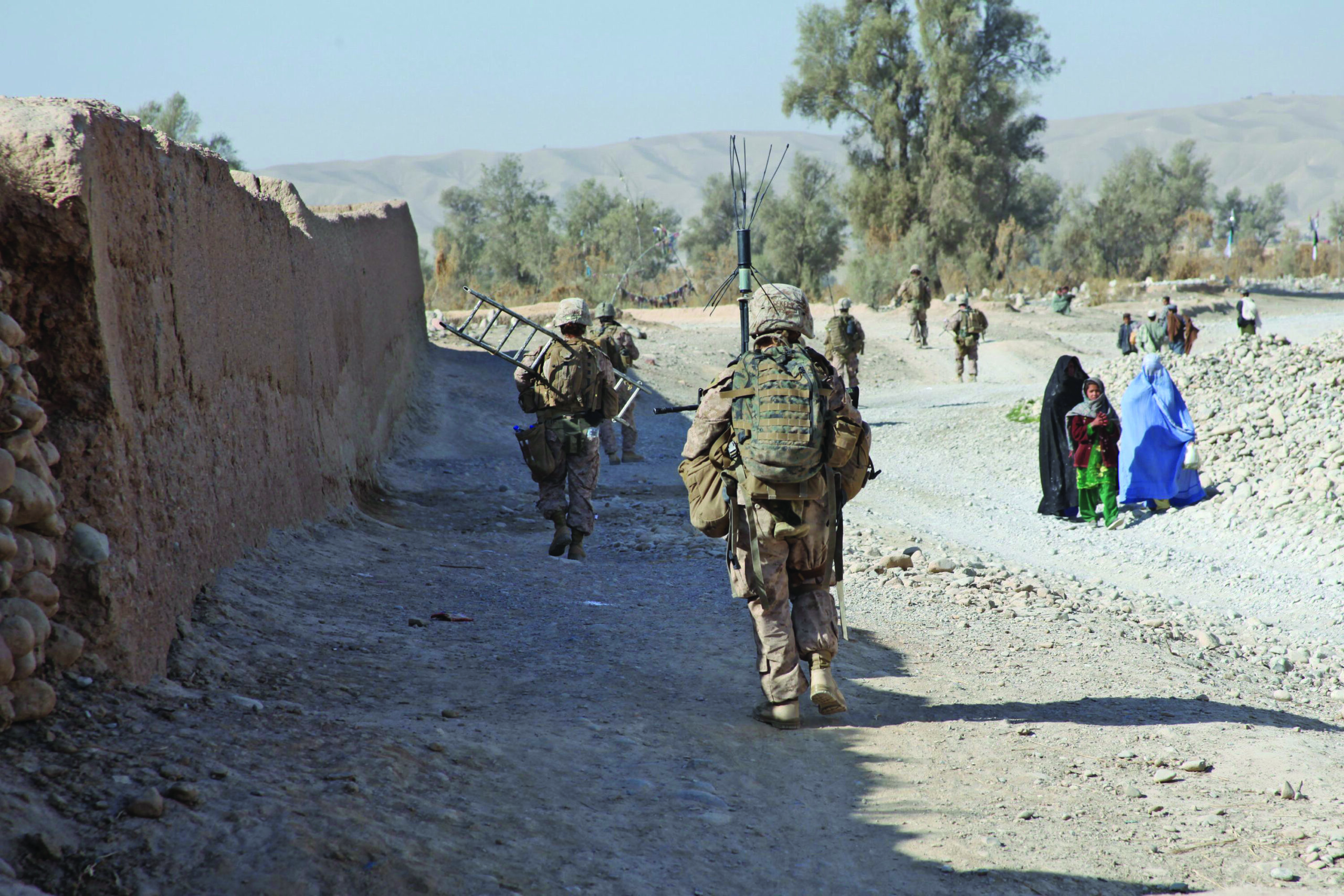
Sgts Autumn Sekely, back, and Jessica Lugo, front, provide support on patrol with Weapons Co, 3/7, in Sangin district, Helmand Province, Afghanistan, on Dec. 15, 2011. (Cpl Katherine Keleher, USMC)

Martin helped build a school in one village. Beginning in a tent outside the American outpost, Martin and her partner worked with families to gather the local children. Families received constant threats from the Taliban not to work with the Marines, but the FET persisted, even finding ways to convince the local leaders to allow little girls to attend lessons. By the time Martin’s deployment ended, 15 or 20 girls were included. Watching them seated next to the boys in school became Martin’s proudest moment from her time in Afghanistan.

Simultaneously, Adams helped create a school in her AO. After nearly seven months of work, between 30 to 70 boys were in attendance four days a week. The FET worked to include girls in the school, but the men of the community refused to allow it, even beating the girls who briefly attended. The experience endured with Adams as an intensely bittersweet memory.

Additional setbacks occurred each time the FETs attached to a new infantry company. Deploying on a different schedule than the grunts, teams worked with multiple units moving in and out of country, which caused distrust among the local population.

“Every time a battalion changeover happened, things got extremely hostile again,” said Mrowinski. “All the locals figured it out quickly, and it reset all the progress you’ve made. As soon as you stepped outside the wire, that was very evident.”

Friction increased not just with the locals, but with the grunts. FETs started from scratch through each battalion changeover to reestablish bonds with the infantry squads and prove to the local population their commitments remained the same. 

Through all the challenges, work, success and setbacks, FETs remained very much in combat. Their “resets” at Camp Leatherneck occurred with maddening regularity, skirting the Combat Exclusion Policy, but failing to alter their experience on the ground.

“I was being shot at on my first day in Afghanistan,” Mrowinski said. “It was just like being fully immersed into everything you ever thought might be a possibility, and now it is your reality.”

In the Nawzad District of northern Helmand Province, Adams’ FET was tasked with rebuilding relationships in Salaam Bazar after previous units razed it to the ground. Their efforts yielded no progress. On Nov. 2, 2010, after another failed engagement, their four-vehicle convoy departed the town. The second vehicle, with Adams on board, struck an IED. The blast rocked the occupants, inflicting traumatic brain injuries on each Marine and an injured ankle and broken clavicle on the gunner.

“This happened in the afternoon and there were no wreckers available,” Adams said. “We ended up in a small firefight, but things calmed down after dark. We stayed there all night. We had another firefight first thing in the morning, then the first wrecker assigned to come get us hit another IED on the way. Throughout the day, we could see black figures moving into the area. Later in the afternoon, by the time another wrecker was coming out to us, we ended up in a significant firefight taking fire from three sides. We were too close for air support, so an F-18 did a low flyover as a show of force. That gave us time to get the truck hooked up to the wrecker and pulled out. Everybody survived, but we ended up out there for about 36 hours.”
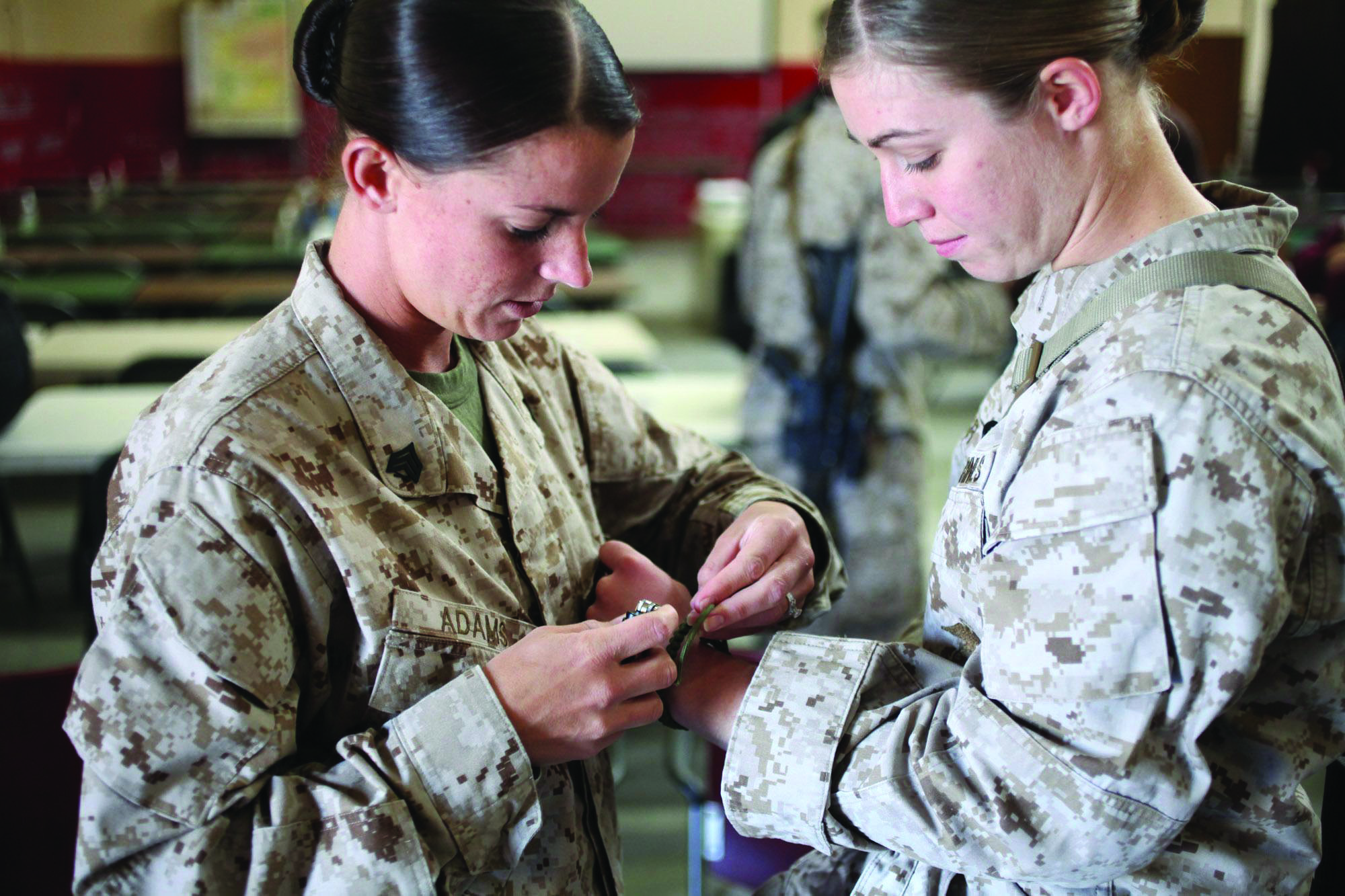
Sgt Sheena Adams, at the time an instructor with I MEF Advisor Training Cell, ties a handmade bracelet on the wrist of Cpl Charity Thacker, a team leader with FET 12-1, at Camp Pendleton, Calif., on March 20, 2012. Adams deployed with FET 10-2 before returning as an instructor, helping prepare FET 12-1 through their predeployment training. (LCpl Joshua Young, USMC)
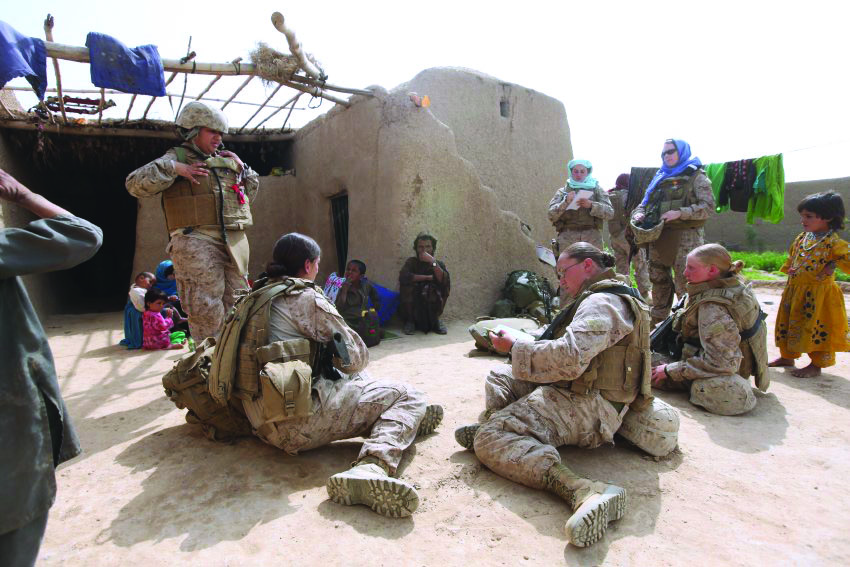
A Female Engagement Team sits with the women of an Afghan family to discuss their medical needs in Habib Abad, Helmand Province, Afghanistan, on March 28, 2010. (USMC Photo Courtesy of MCRD San Diego Command Museum)

Adams was evaluated and given 24 hours bed rest. She remained in country performing her duties until the 10-2 deployment concluded. Headaches tormented her throughout that time. Over the next several years, migraines increased in frequency and ferocity until a doctor finally recommended brain surgery to relieve the pressure inside her skull. To the present day, Adams has not received a Purple Heart.

The 10-2 deployment ended in April 2011. Many of the Marines requested extensions. Seven months was nowhere near long enough. They worked tirelessly earning respect, proving their worth, improving communities and establishing themselves within their AO. Passing it all off to the next green team felt unfathomable. The FET disbanded as soon as the Marines returned to Camp Pendleton.

“When our Marines got home, we had no decompression period at all,” remembered Farrell. “Within three days, everyone went back to their original commands. These were commands who hadn’t deployed and hadn’t gone through the same combat experiences. The FET didn’t get R&R. They didn’t get the types of services that units typically get when they are returning home, either physically or mentally.”

“This was unique to FET and incredibly detrimental in many ways,” Mrowinski reflected. “Most Marines coming home from a combat deployment return with their units that they just experienced life changing events with, death, destruction, humanity at its most raw, but they have a group with which they have understanding and can process together. … Then, you have a bunch of women who just experienced things that will be questioned, downgraded and misunderstood by others once they return to their parent commands that have often not seen combat. Not to mention, the FETs had common experiences, but the only person you deployed with was your teammate, and they too would be ripped away from you in less than three days’ time as you are trying to reacclimate to being back on safe American soil. In a sense, it’s like being left behind, where most will never know what you had done or been through, and just about everyone wouldn’t believe you, as well as being told you will not get to do this ever again. It was a very profound experience.”

Responsibility shifted to II Marine Expeditionary Force on the East Coast to provide the next year’s FETs. While 11-1 and 11-2 worked up and deployed from Camp Lejeune, N.C., the ATC at Camp Pendleton prepared for 12-1, the next team they would be responsible for training. Adams and Mrowinski remained involved as ATC instructors. Farrell joined as one of the 12-1 officers set to deploy again. These three Marines, with their firsthand experience, helped evolve the training program into the most robust version it had ever seen. The three-month work-up they experienced nearly doubled, spanning from the fall of 2011 through spring 2012. Fifer and 40 other women volunteered and completed the training—perhaps the best prepared FET ever assembled and ready to go.

Broader national events conspired against the team, even as it completed the intense training cycle. In June 2011, President Barack Obama announced the final phase of his plan to withdraw from Afghanistan, to be completed by summer 2012. FET 12-1 suffered the consequences.

“Two weeks before we were set to deploy, they cut the team in half,” said Farrell, one of the team members slashed from the final roster.

Fifer remained on the team and landed in Afghanistan in March 2012. Paired with her team leader, Corporal Mallory Ortiz, the Marines attached to Weapons Company, 2nd Battalion, 5th Marines.

“Going to Afghanistan was wild,” she said. “I just remember feeling very out of my depth. It was a whole entire social landscape that we had to navigate.”

They worked to overcome stereotypes and assumptions. Slowly, they developed relationships with the infantrymen surrounding them.

“Every single chance we got, we tried to get out on patrol. I’m sure the men we were working alongside were like, ‘Ugh, another patrol,’ and then you’ve got these two women who are super freaking jazzed to go out. We just tried to take advantage of every opportunity. Some of the guys seemed annoyed by our presence and didn’t want us there. Don’t get me wrong, I’m not dogging on them. This is their job. We’re coming in and we’re creating this potentially hazardous environment for them. They didn’t know what our training looked like. They didn’t know how capable we were. They had to approach us with caution.”

At the beginning of May, the FET departed with Weapons Company’s 3rd platoon on a multi-day mounted patrol to a village in the Musa Qal’eh District of Helmand Province. They found the village evacuated except for a single family: one man with his brother, his two wives and 10 children. The Marines spent the night in a wadi below the town. The next morning, May 11, 2012, the convoy planned to return home. Fifer’s vehicle struck an IED on the way out of town, knocking off a front wheel.

“The whole patrol halted and we were just like, ‘What the hell? We were just here the day before and this wasn’t here.’ ” Fifer remembered. “Everybody dismounted and went back into the village. The infantry detained the two men from that family. To us, it was obvious they were part of this.”

The Marines returned to their vehicles as they waited for permission to bring in the men for questioning. Hours passed. The sun climbed higher, pushing the temperature well over 100 degrees. Fifer sat in the back seat of her disabled vehicle, surrounded by Marines in other seats and one standing next to her in the turret. She propped her door open, inviting a merciful breeze into the cab. Finally, battalion headquarters advised the platoon did not have enough information to detain the Afghans and to release them. Outside Fifer’s vehicle, grunts cut the two men loose. One of them ran into the poppy field next to her. He disappeared momentarily, unearthing an AK-47. He stood, swiveled and opened fire.
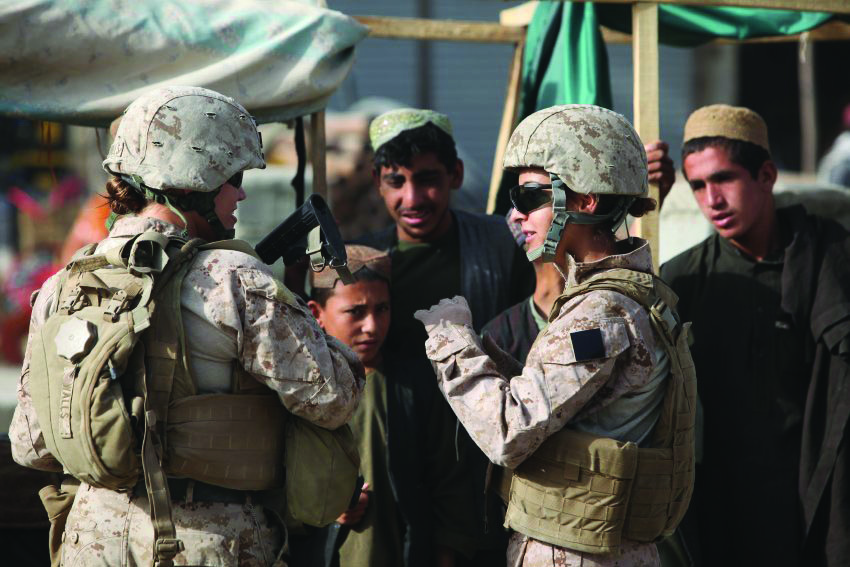
Cpl Mary Walls and an interpreter speak with Afghan civilians in Musa Qa’leh, Helmand Province, Afghanistan, on Aug. 2, 2010. (USMC Photo Courtesy of MCRD San Diego Command Museum)

Fifer occupied the seat closest to the shooter. In seconds, five bullets tore through both her arms and both her legs. Another bullet struck the leg of the Marine standing in the turret. Sergeant Wade D. Wilson was outside the vehicle when the shooting began. He drew his M9 service pistol and charged the insurgent, firing as he closed the distance. He pressed ahead, even as enemy rounds struck him over and over, until fatal wounds overwhelmed him. His jaw-dropping, unhesitating actions drove the insurgent away and into the fire of other Marines, who killed him.

On the third deployment of his career, Wilson served as the platoon sergeant in charge of his platoon. He had already received meritorious promotion to private first class, lance corporal and corporal, and at the time of his death, was up for meritorious promotion to staff sergeant. For his astounding, selfless sacrifice, Wilson posthumously received the Silver Star.

“Sergeant Wilson saw what was happening and put himself between us and the shooter,” Fifer remembered. “He put himself between us, and he saved us. God, it couldn’t have been more than a minute. It was just so fast. He was really a wonderful person. I didn’t know him that well, but I was so grateful for the opportunity to know him at all. He was incredibly kind and gracious to Ortiz and I. He was so accepting of our presence, and he wanted us to be there alongside them. His support for us felt so genuine.”

Fifer was evacuated to the United States for treatment and recovery. Having hardly begun her work, leaving Afghanistan devastated her. The abrupt and unexpected ending of her deployment sadly mirrored the end of FET as a whole. The rest of 12-1 closed out their deployment in the fall of 2012. When they returned home, the entire program shut down. Adams remained assigned as an ATC instructor by that point. She was tasked to reinvent a condensed version of the FET training she had helped evolve to be utilized moving forward by MEUs preparing for deployment.

“I asked for two months to put them through everything,” Adams explained. “They told me, ‘You get two weeks.’ ”

Adams cherry-picked the most important aspects from her own experience and the feedback of other FET Marines to craft the MEU course. In April 2013, the 13th MEU assembled female Marines from its different subordinate units. Now, in addition to the rest of their predeployment training, these Marines attended the hurried FET instruction. For them, FET would look dramatically different; a subordinate, collateral duty assembled as needed, if at all, while on deployment. After barely three years in operation, the dedicated, deployable teams ceased to exist.

The women of FET returned to their MOS fields and determined their next steps. Leaders like Farrell continued advocating even after their disbandment.

“As an officer, it was very hard to ensure that my Marines received Combat Action Ribbons, which obviously affects their career and impacts them to this day if they try to get VA healthcare or services.”

U.S. Army female servicemembers witnessed similar struggles. Cultural Support Teams (CSTs), the Army equivalent of FET, formed in support of Special Operations on classified missions. In November 2012, Farrell joined forces with another female Marine officer and two female U.S. Army soldiers, all combat veterans, as plaintiffs in the lawsuit against the DOD arguing for the repeal of combat exclusion. Their personal experiences, along with hundreds of other women in Iraq and Afghanistan, held legal standing in the case. They contended the policy was outdated, harmful and unnecessarily limiting for female servicemembers.

“I was still on active duty when I joined the lawsuit, so I had to think through those initial implications, but my instinct was that it was the right thing to do” Farrell said. “I felt, as an officer, it was my obligation to use my voice to get rid of this policy that was harming my Marines, and also harming the Marine Corps’ capability. It was incredibly challenging, but I knew it was the right decision. I was very surprised how quickly the policy was repealed.”

Less than two months later, on Jan. 24, 2013, Defense Secretary Leon Panetta signed the order lifting combat exclusion. It would take several more years before women truly integrated into combat roles. Still, the effects of combat exclusion linger into present day. In November 2025, U.S. Congressmen Darrell Issa reintroduced a bill called the “Jax Act,” named after U.S. Army veteran Jaclyn “Jax” Scott. The bipartisan legislation aims to correct the service records of hundreds of Army CST members who served with Special Operations in Iraq and Afghanistan but never received recognition for being in combat. The legislation would enable female soldiers access to additional disability compensation and benefits through the Department of Veterans Affairs. As of this writing, the Jax Act is still pending approval and applies specifically to Army CSTs. Marine FETs who may also have gone unrecognized or misclassified are not included. 

Today, the legacy of original Marine FETs and Lionesses manifests in a palpable juxtaposition of pride and sorrow.

“Having been part of FET was one of the biggest accomplishments of my life,” Fifer reflected. “I’m still so honored for the opportunity to have been part of something so impactful. Us being women in that climate was so important, and yet we were overlooked by so many. We were such a small piece of such a large picture that we just get washed out really easily. There are a lot of women who had to sacrifice a lot in order to be on these deployments and be part of something so controversial.”

Throughout her healing during the months after combat exclusion was lifted, Fifer remained an advocate for female servicemembers amidst a flak storm of discrimination. She absorbed repeated blows, some even blaming her for Wilson’s death. Her nine-year career ended when she was medically retired.

“FET was everything I ever wanted to do,” said Adams. “I got to go make a difference. I got to go be the Marine I never thought I’d get the chance to be. For that I am
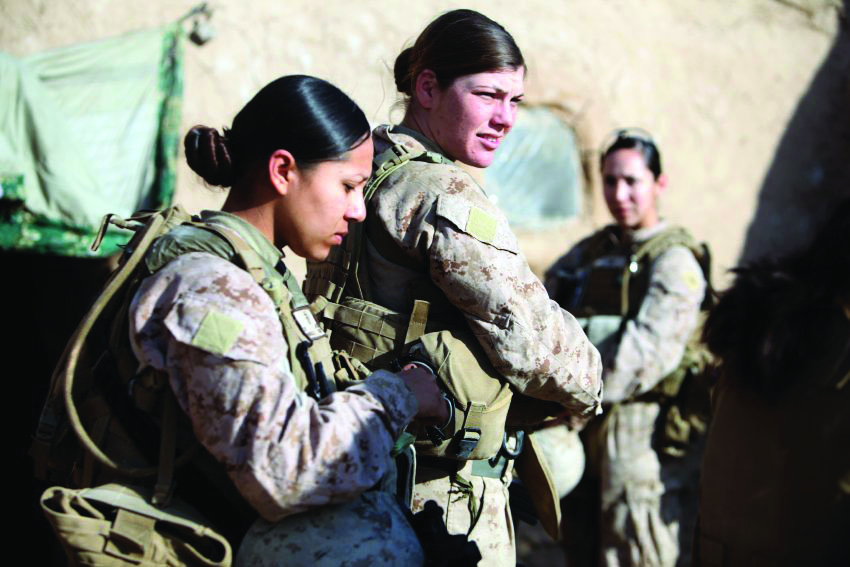
Sgt Jessica Domingo and Cpl Daisy Romero stop to speak with locals in a compound during a patrol in Marjah, Afghanistan, on Dec. 30, 2010. (USMC Photo Courtesy of MCRD San Diego Command Museum)

thankful. But, the pullout from Afghanistan was extremely saddening. All the work that we did, all the potential we saw in communities; we should have never gone there if that’s the way we were going to treat it. People are still trying to get out because they helped us there. I know we made a difference there, it just didn’t last as long as we hoped it would. I still think about those kids.”

“Being part of Lioness and FET was probably the greatest and worst experience of my life,” Martin reflected today. “It was great because it was groundbreaking stuff, something I would never trade, and definitely changed the way I deal with people today. The whole Afghan withdrawal though, seeing the way it went down, just made me feel like the biggest fraud. We told these people, ‘We’re here to help you, here to support you, here to make your lives better. Don’t be afraid of the Taliban, you can stand up for yourself.’ That’s not true at all anymore. It makes you feel like a failure. You made these promises that ultimately weren’t kept, and now who knows what’s going on over there. I think about those little girls. They’re grown women by now. What happened to them?”

What does the future hold for FET? With an integrated infantry, what roles might special female teams play in the next war? It feels inefficient and half-hearted to task a female infantry Marine with executing her primary job while simultaneously taking up the “hearts and minds” mission of cultural support on the front lines. It seems clear women will be required to perform this type of dedicated duty wherever Marines may go. For certain, there will always be inspired Marines who volunteer, standing proudly on the shoulders of the trailblazing women who came before. Their legacy endures in its impact on the entire U.S. military.

“The work that female servicemembers did in Iraq and Afghanistan directly led to the repeal of combat exclusion,” Farrell stated. “All FET members, and everyone who contributed to this mission, should be proud. It’s much broader than the individual things we did over there on a daily basis. It’s history changing, and it impacted generations of men and women in the service.”

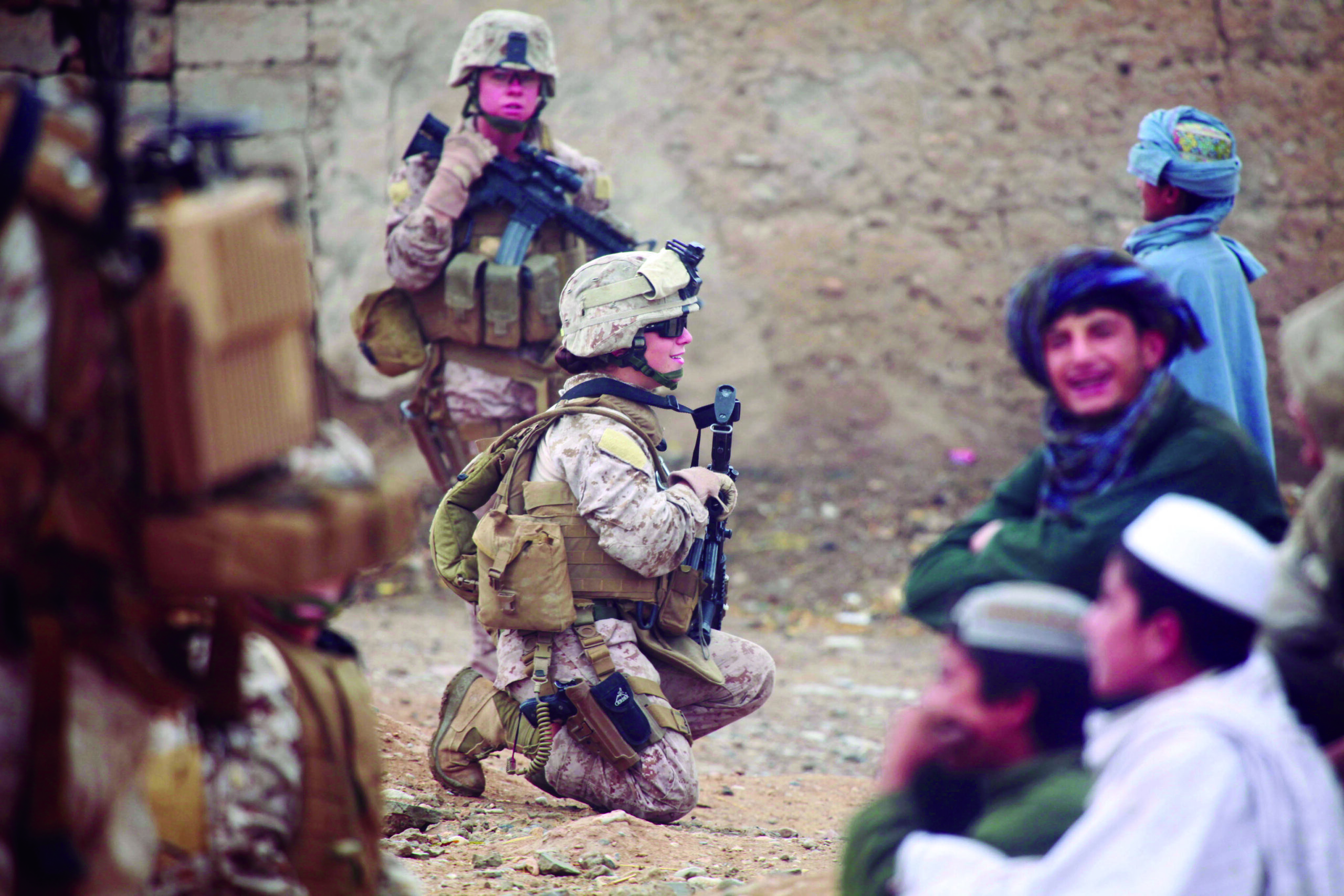
Featured Photo (Top): LCpl Sienna De Santis and HM3 Heidi Dean, both with Female Engagement Team, India Co, 3/5, RCT 2, greet children during a patrol in Sangin Valley, Afghanistan, on Oct. 29, 2010. (Photo by Cpl David Hernandez, USMC)


About the Author
Kyle Watts is the staff writer for Leatherneck. He served on active duty in the Marine Corps as a communications officer from 2009-13. He is the 2019 winner of the Colonel Robert Debs Heinl Jr. Award for Marine Corps History. He lives in Richmond, Va., with his wife and three children. 


Enjoy this article?

Check out these similar Leatherneck and Scuttlebutt features..
Safeguarding The Airspace: Marine Air Traffic Controllers’ Critical Role In Marine Aviation

Leatherneck
May 2024
By: Kyle Watts

HOLDING THE LINE: Marines Confront Abbey Gate Memories Two Years Later

Leatherneck
August 2023
By: Kyle Watts

Muster Up, Women Marines!

Leatherneck
February 2026
By: Kimberly Ussery
All Guns Blazin’: The Legend of Sgt Matthew Abbate

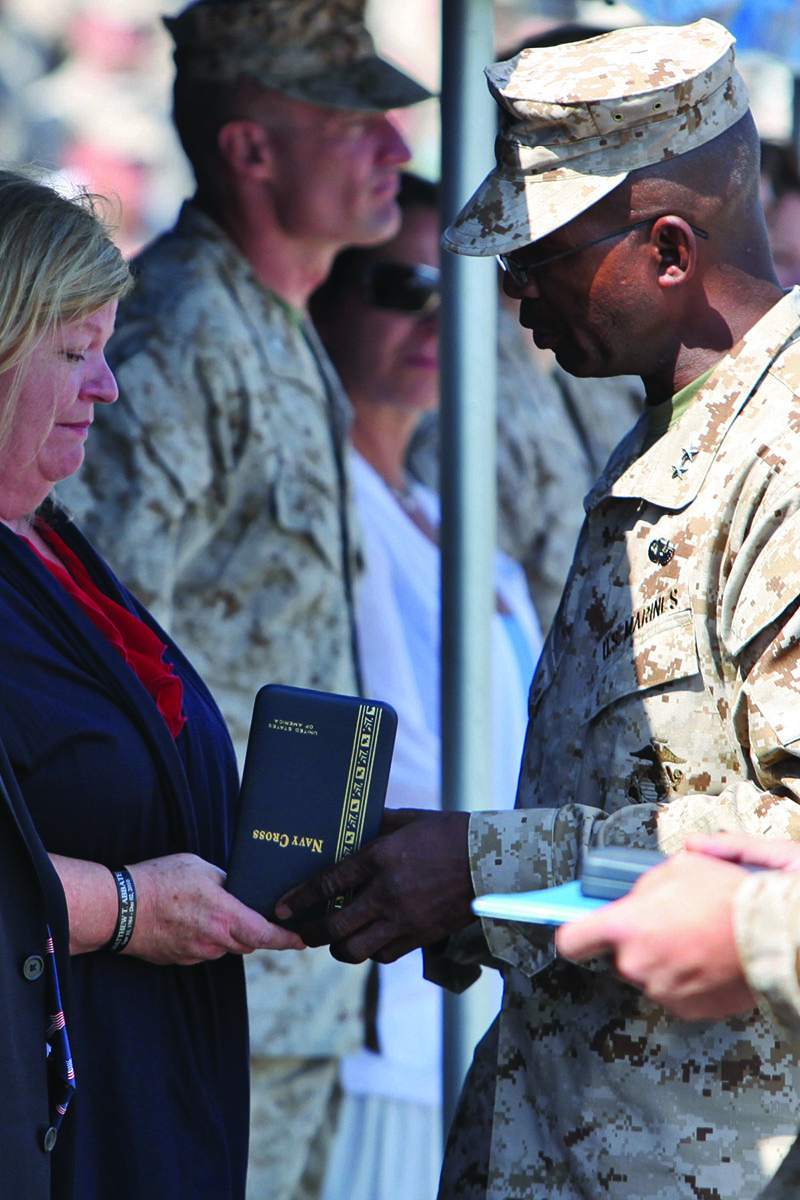
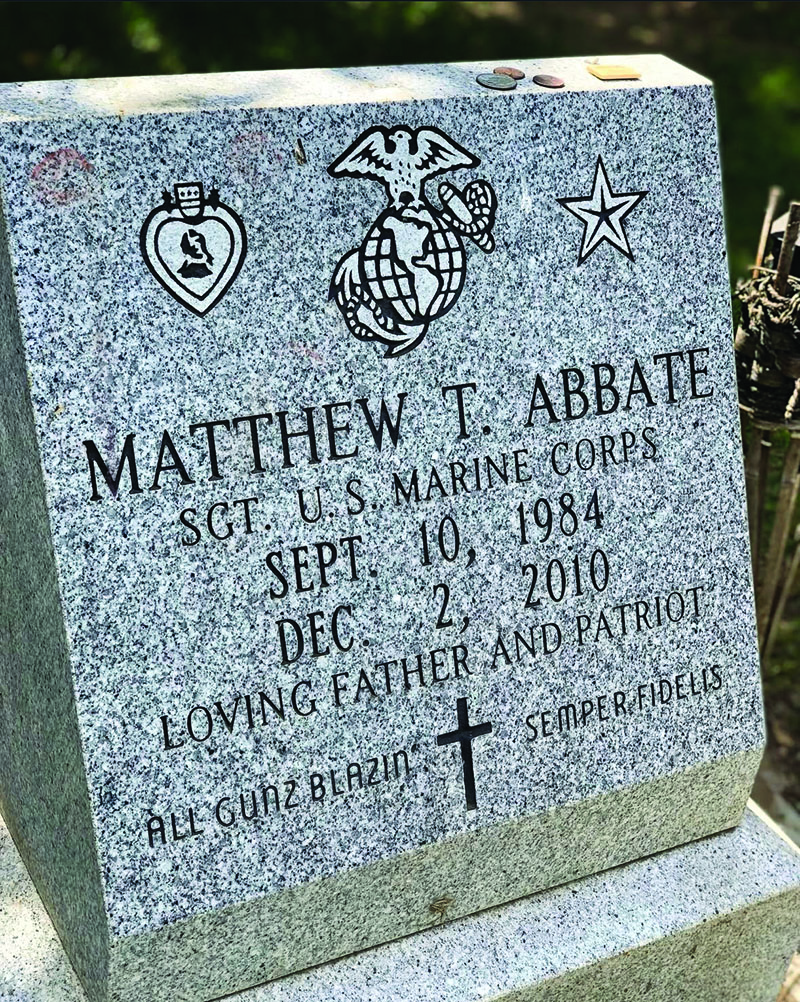
Author’s note: By the time I left active duty in 2013, I knew the name “Abbate.” Sergeant Matthew Abbate posthumously received the Navy Cross in August of 2012, almost two years after his heroic actions while deployed with “Kilo” Company, 3rd Battalion, 5th Marines, in Sangin, Afghanistan. Abbate evolved into a living legend before he was killed in combat. His posthumous medal further propelled his stature within the history of his storied infantry battalion and cemented his place in the Marine Corps’ history of the war in Afghanistan. When I was asked to develop a story idea fitting under the umbrella of the global war on terror for Leatherneck, Abbate immediately stood out in my mind as a preeminent example from that generation; one of the best sons our nation had to offer. I knew the name and had read the Navy Cross citation but failed to grasp his importance to the Marines who served alongside him or the traits that made him purely “Abbate,” inevitably propelling him to the greatness he achieved and limited only by his untimely death.

Matthew Abbate deserves a place in our history, standing prominently alongside others such as Smedley, Chesty, Daly and Basilone. The Marines who knew him understand this best and can offer the rest of us a glimpse as to why. What follows may, hopefully, provide this insight. Thank you to Britt Sully and Jake Ruiz, both veteran Marine sergeants; Sergeant First Class John Browning, USA (Browning previously was a Marine sergeant); Gunnery Sergeant Chris Woidt, USMC (Ret); Staff Sergeant Ryan Salinas, USMC (Ret); Lieutenant Colonel Tom Schueman, USMC; and the other warriors interviewed for this story. Thank you for allowing me to laugh through the good times you shared with Matt and grieve with you through his death. If anyone can show us who Matt really was, it’s you guys.

The Boot

Britt Sully: Let me try to start at the beginning. When I graduated the school of infantry, all I wanted was to go Recon, but Recon was full, so they sent me to 3/5. I thought that was a death sentence. This was 2007. When I showed up, the battalion was still in Iraq, so we sat around for like a month waiting for them to get back. I viewed everyone around me as stupid and lazy; all these corporals serving as our temporary seniors that yelled at us and lightly hazed us.  The battalion finally got back from Iraq. We unloaded all their seabags for them into their rooms and began our first experience dealing with salty lance corporals and drunk corporals fresh from deployment, further cementing for me, I have to get the f—k out of here.

A few days later, it was a Thursday evening, I was out in the barracks hallway cleaning the deck with a scuzz brush; just playing more stupid games for drunk 20-year-olds. While I’m outside cleaning the stairs, I see rounding around the corner of the barracks this 6-foot-2, handsome, square-jawed, tan-skinned man in boots and utes wearing a loaded Vietnam-era Alice pack. Long, glorious, thick black hair—WAY too long for a PFC to dream of having—and he’s running with a sledgehammer at break-neck speed. All these other Marines are standing around cheering him along as he’s just smiling and laughing holding up the sledgehammer above his head. I stopped cleaning and asked my senior, “Uh, Lance Corporal, who is that?” He snaps back, “That’s Matt Abbate and you don’t even f—king rate to look at him, now get back to cleaning!” Everyone else is just drinking and yelling at privates while this dude has a clearly heavy backpack and a sledgehammer and is sprinting towards First Sergeant’s Hill on a Thursday night. In that moment, I said to myself, “Whoever that guy is, whatever that guy is doing, wherever he is going, I want to follow him.”

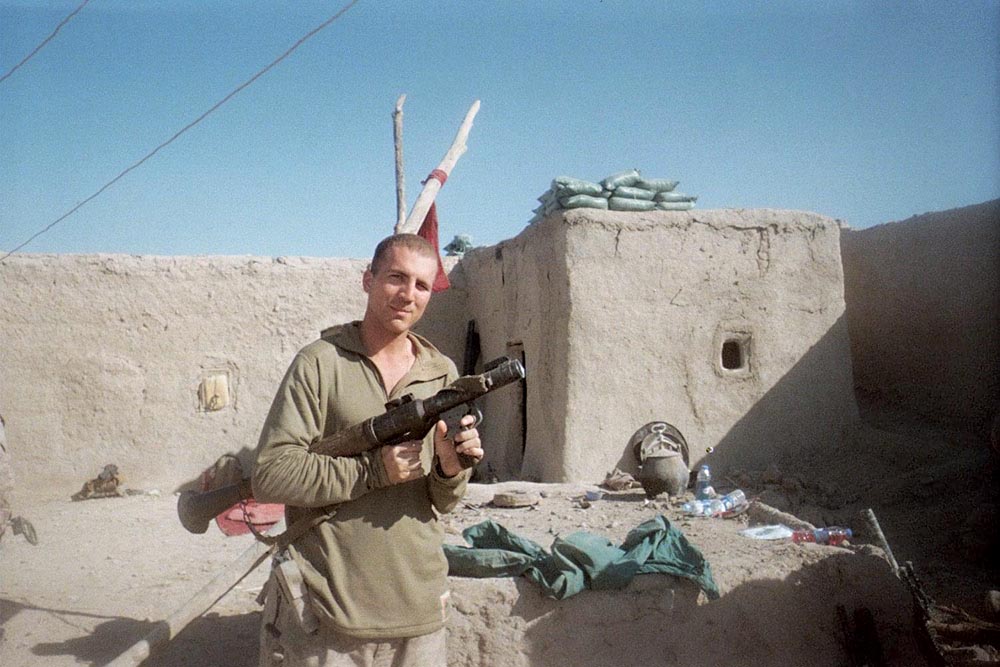
Sgt Matthew Abbate at Twentynine Palms, Calif., during predeployment training.

At this point, Matt had been in for maybe two years. After he enlisted, he graduated boot camp as company honor man, making meritorious lance corporal, then finished the school of infantry as honor grad with a gung ho award. His character, demeanor and enthusiasm were just so genuine and magnetic that instructors were all talking about him, to the point that the Recon cadre got wind of who he was and poached him for Basic Recon Course. He goes to day one of MART, Marines Awaiting Recon Training, and is told to show up in green on green at 0530 for their initial PFT. He somehow f—ks it up and showed up in boots and utes. They were all told if they didn’t run a first class PFT, they would be immediately dropped. They tell Abbate, “You showed up in the wrong uniform, we don’t care. You still need to get a first class PFT.” Boom, Matt knocks out a 300 PFT in boots and utes. They made him run it a second time just to see if he could. Matt ran a second 300 PFT.

After a few weeks, while out on liberty, Matt met a girl from Tijuana and disappeared. He showed up after a week AWOL. At this point, usually if a guy shows up after a week, that’s like grounds for getting kicked out, but because he was impossible not to love, the instructors just NJP’d him, busted him down in rank and dropped him from the program. He showed back up to 3/5 as a PFC.

Ryan Salinas: Abbate wasn’t in my platoon initially, but everybody in Lima Company kinda knew that kid when he arrived as a boot. He was just super motivated, running around crazy. You tell him to go do something, it was like 100 miles per hour, no quit, no questions asked.

I first met him in Yuma at WTI while we were setting up cammie netting out at tent city. At one point, a group of us looked over and saw all these boots just standing around. We walk over there like, “What the f—k are you doing?” and we see one kid just getting after it by himself, swinging a sledgehammer and e-tool and whatever else he had. While the other guys started yelling at the other boots for letting this guy do all the work by himself, I went up to him and was like, “Hey, what the f—k are you doing?” He says, “Corporal, I’m gonna get this tent set up.” I told him he needed to get all these other guys just standing around to help him, and he just said, “I don’t got time for that bulls—t.” He kept working, meanwhile, it’s like 100 degrees, he’s pale white, and I noticed he had stopped sweating. I told him to go get some water, but he’s like, “No, no, I’m good.” Finally, I had to force him to go sit down in the shade. He was super upset he didn’t get the job finished. He wasn’t even in my platoon, I just saw it and was like, “What the hell is wrong with this kid?” So, I sat down and talked to him about understanding your limits and learning how to delegate within your peer group.

Chris Woidt: We came back from Iraq the first time in August of ’06. That’s when we got Matt in Lima Company. We knew then that we were already going back to Fallujah again. By that point, 3/5 had already done three previous OIF deployments. We still had guys around who were OIF 1 vets from ’03, OIF 2 vets from Operation Phantom Fury in ’04, then obviously all of us from the ’06 deployment, and we knew we were going back in ’07-’08. Initially, I was a squad leader and Matt was one of the junior Marines in the platoon. During our workup for the deployment, it became clear that Matt was pretty much a physical specimen. He always wanted more, which makes sense why he ended up coming into the sniper community.

Matt was a SAW gunner starting off. Prior to the deployment, we were at Twentynine Palms during the workup doing a shoot house with non-lethal Simunition rounds. With each scenario, they randomly changed the setup of the house. You’d bust into the room, and it may be full of enemy in an all-out gunfight, or it may be just a family. Your adrenaline is pumping, and it’s trying to teach escalation of force through these shoot, no shoot scenarios. Well, there was one scenario where there was just one woman sitting on a couch reading a book. She’s wearing a paintball mask and everything, and Abbate charges into the house blazing and just drills her like four times. Obviously, the instructors were like, “What are you doing?? She didn’t have a gun!” You could see Abbate was very self-critical, but he had a good sense of humor. During the debrief, when an instructor asked him why he “killed” a woman reading a book, Abbate held out both hands with palms up and smiled wide with those big, white teeth, and made a joke: “Because knowledge is power.”

Our deployment to Iraq was definitely kinetic, but there was a lot of political pressure to downplay the issues. There were numerous suicide bombers and casualties occurring around Fallujah, but the combat was waning. It was frustrating because there were a lot of handcuffs with the escalation of force and rules of engagement. Matt ended up getting meritoriously promoted to corporal during the deployment, so by the time we came back he was one of my peers.

After he was promoted, Matt was made a vehicle commander. We were primarily doing mounted patrols throughout the southern half of Fallujah. Matt would get really frustrated … from the mundane patrols and the lack of aggressive stance. That was just kind of a hard time too because the way we had fought the Iraq war and what had been drilled into his mind was now different. We were trying to do a lot more of civil affairs-type stuff. Matt had a lot of frustration because he wanted to do more. There were definitely times where we could have shot some people and done some stuff, but the reins were being pulled very hard because they were trying to bring down the number of firefights with the enemy to show a de-escalation in violence. We had pounded into his head and everyone else’s head the company’s experience in Fallujah over the previous deployments. We went back again very much with the expectation that we were going to take casualties. We were going to get in gunfights and kill people. But then we got there and transitioned from hot and heavy into more stability and security operations.

The Brotherhood

Chris: When we got back from Iraq, I don’t know if it was intentional, but they put all the 3/5 guys on the same street in base housing. All the Lima Company guys were neighbors living around a cul-de-sac. Matt was living in the barracks, but naturally whenever we’d do barbecues and hang out in the cul-de-sac, he would come over. One night I was in my house and I’m upstairs asleep. I heard noises downstairs, so I got up. I didn’t have a gun in base housing, so I grabbed a knife. I get down the stairs, and I can hear somebody right around the corner. I jump out ready to stab somebody, and there’s Matt standing in the kitchen with a bowl of Mac n cheese from the fridge, shoveling it into his mouth and laughing his ass off.

Matt was somebody who was welcoming, immediately part of your family, almost to his detriment. So many guys talk very highly of Matt because he died, but it almost doesn’t show his true personality. He was absolutely a flawed character, but his flaws really made us love him more. To the guys who really knew him, the tattoos, the long hair, the jokes, the bar fights, those were all part of the things that we loved about him. He had a really interesting childhood. We would really only get glimpses and pieces of it. There were definitely time periods where it wasn’t smooth. There were times he spoke about where he was sleeping on a beach in Hawaii where some other homeless dudes taught him how to catch eel and cook it over a fire. He worked as a waiter on a cruise ship one summer and had been to Thailand. He just had a big hunger to see the world, push the boundaries, and do big things, so coming into the Marine Corps made perfect sense, especially with the wars going on. Matt was the quintessential “break glass in case of war” type Marine. He joined for that, and that’s what he wanted to do.

Ryan: While we were in Iraq, we had a buddy who had a Harley back in the States and he got me and Matt interested. We started doing a bunch of research, looking up different bikes whenever we could get internet. As soon as we got back to California, the first thing we did was buy bikes, and all we did was ride.

Armando Hurtado, left, Ryan Salinas, center, and Matthew Abbate, then a lance corporal, in Iraq during their 2007 deployment with Kilo Co, 3rd Bn, 5th Marines.

We were in my garage at my house in the cul de sac one day and he brought his bike over. We were changing the oil or whatever on my bike and he decided to do some work on his bike too. Well, there’s this metal derby cover over the clutch that he decided to pull off. I walk inside the house to grab some drinks for us and as I’m walking back around the side of the house, all of the sudden, I see this shiny metal disk go skipping down the driveway and stick in the grass in the neighbor’s yard across the street. I ran into the garage …   he’s like, “Go look at that f—king derby cover!” So, I go grab it and I’m like, “Well yeah, it’s all scratched now.” He’s like, “No, turn it over bro.” So I turn it over and it says, “Made in China.” I look at Matt and he yells, “How the f—k are you gonna have a Harley and it says made in … f—king China?! Get in the truck! We’re going to buy an American-made … derby cover!” We drove all over southern California to every damn bike shop just to find one … derby cover that was made in the U.S.A. so he could put it on his bike. I mean, he was absolutely pissed off that this thing was made in China. He was just like the patriotic, steak-eating, red-blooded American. I can still see his face right now the way he looked at me when he found that out.

The Beast

Britt: My first experience personally meeting Matt was a few days after I saw him running out of the barracks. I was a PFC, he was a corporal. As a young PFC, speaking to a corporal meant like parade rest, don’t look him in the eyes, especially in the infantry. I did not expect to be spoken to like a human by anyone who had been in the Marine Corps more than 40 seconds longer than I had. I met Matt on the basketball courts with our gear list to begin sniper indoc. Matt was just like, “What’s up, bro? Are you excited? You ready to do this?” I was just speechless, like, “Uh, why don’t you hate me?” He just gave me a slap on the shoulder and said, “Let’s f—king go!” He was always in front of the rest of the pack, finishing everything ahead of everyone else, then looping back to make sure the last guy made it in.

Jake Ruiz: I met Matt during scout sniper indoc. I was a junior Marine. They actually gave Matt time away from squad leader’s course to do the indoc. My first impression was just how much of a beast he was. He was just destroying all of us on the physical events. I was like, “Who is this guy?” I didn’t really get to know him until a couple weeks later when me, Britt and Matt all joined the sniper platoon working up for the MEU, but we all got close quickly. He graduated honor grad from squad leader’s course, even though he missed part of it for the sniper indoc. His ability to learn military skills in general was second to none. That’s one thing that gets lost in all the stories about Matt. Everyone talks about how much of a beast he was. I mean the dude was huge. 6 foot 2, 220 pounds, strong as an ox; everyone talks about that, but they don’t talk about how smart he was. His intelligence related to military skills blew me away.

Matt started getting tattoos while we were gone on the MEU, and he didn’t stop until we left for Afghanistan. So, over the course of maybe a year and a half, he got two full sleeves. At the time, it was that weird policy on tattoos; couldn’t be visible or had to be spaced a certain way or whatever, but Matt never really got in trouble for anything. He was just untouchable. Everybody in the battalion knew who Abbate was, from the sergeant major down to every PFC. Over the course of the MEU, everybody in the MEU knew who he was. He was that guy who would talk to you once and you’d think, “Man, this guy is my best friend!” Matt liked his hair, he liked his tattoos, he was high risk on libo, but that’s just part of what you get when you have a man like Matt. You’re not gonna get one without the other. 

While we were gone, Matt tried to lateral move back to Recon, but something kept getting messed up with his package and it never worked out.  We were all pretty downtrodden being on the MEU. Everybody just wanted to go combat. We got back in September 2009. Right before Christmas leave, we found out 3/5 was going to Afghanistan. Matt could not have moved faster to get the paperwork done and reenlist. I had to extend my contract to stay with the battalion for the deployment. We were all like, “OK, send us to sniper school and let’s get this done.” We deployed on the MEU with the sniper platoon, but we were not yet school trained. I lucked out, and I got to go with Matt.

While we were getting ready to go to sniper school, Matt pushed us super hard everywhere we went. He had to work out every day, it didn’t matter what we did that day. We’re doing all this deployment workup training during the day, then we get back to the barracks and Matt is dragging me out of my bunk to the pull-up bar and dragging his 53-pound kettlebell with him. We’d be driving all over base getting our medical paperwork or whatever else all signed off so we could go to sniper school, he’d see a pull-up bar and make me pull over. Looking back, that’s just how he was, who he was. He never missed an opportunity to make himself better. By the time we went to sniper school, I knew Matt really well; I knew what kind of performer he was. But under the microscope in a school like that, he elevated his already high performance and outshone everybody. It was wild watching him perform at that level. He finished sniper school number one in every skill except for stalking. Stalking is extremely hard. It’s a very, very patient skill, and Matt was terrible at it. It was his kryptonite. 

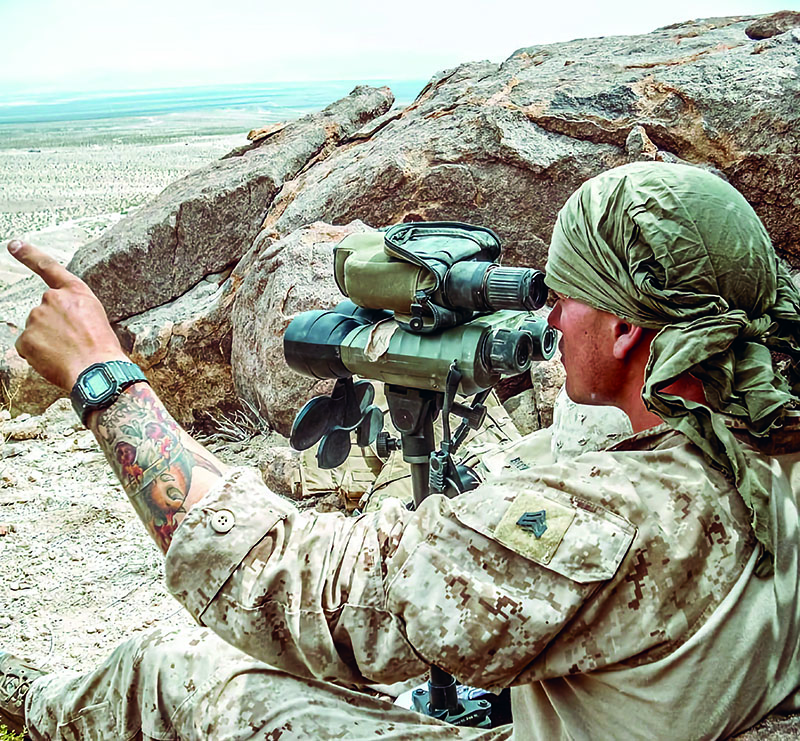
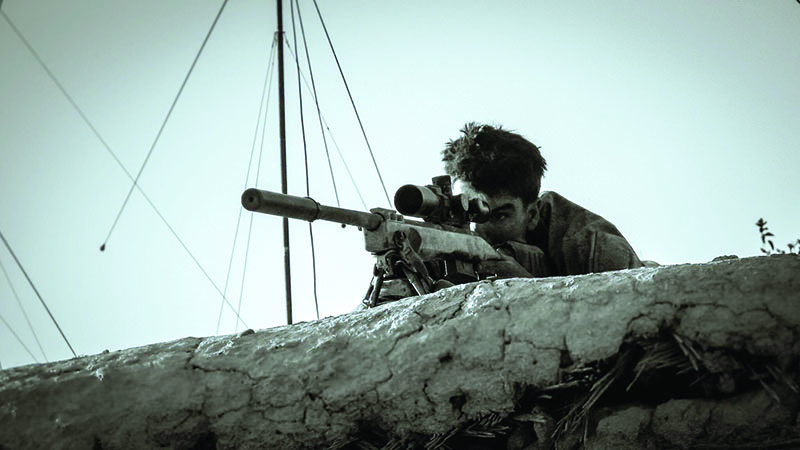
Sgt Matthew Abbate sighting in on an enemy target in Sangin, Afghanistan, during 3rd Bn, 5th Marines’ 2010 deployment.

Britt: During our workup for Afghanistan, Matt was given meritorious sergeant. In the sniper platoon, he only wanted to be called Matt, he never wanted to be called sergeant, because he truly believed that you didn’t follow people because of their rank. You follow people because you trust their decision making, maturity, experience and character. He went to scout sniper team leader’s course, finishing high shooter and honor grad. He eventually became our team leader, working with John Browning, our assistant team leader, in charge of the 10 snipers of “Banshee Three” attached to Kilo Company.

The Artist

John Browning: I had done three previous deployments, two in Iraq, but 2010 was my first time in Afghanistan. Iraqi insurgents were more just thugs with guns; they were pretty easy to dominate, at least around Ramadi and Habbaniyah where I was. The Taliban were much better fighters, much more dangerous. They were there to fight. They did a lot of support by fire with machine guns, just like we do. As the sniper team, we took advantage of that. We’d hunt in places where we thought they might set up; opportunistic-type stuff. An infantry squad would go out on a pre-planned patrol route, and we’d have already been there all night. When the Taliban engaged the squad, we were there to shoot them.

Chris: When Matt got to Afghanistan, he finally had gotten into the free-fire zone of a highly kinetic area. Sangin was the canvas, and he was the artist. We knew him as a junior Marine, up and coming, but making dumb boot mistakes and those kinds of things. By the time he made it to Afghanistan—a sergeant, a sniper team leader, on his third deployment—he was highly developed. He’d mastered the art.

Jake: Our sniper team arrived to Afghanistan at the end of September 2010. We were forward staged in Sangin, operating out of Patrol Base Fires. Matt and John got there before the rest of us and were doing left-seat-right-seat patrols with the sniper team we were relieving. They got into a TIC [Troops in Contact] and killed some guys before we even got there. From that point forward, Matt was absolutely relentless. He wanted to do nothing but go out, find Taliban and shoot them. Once we all got there and started operating, he was personally going out two or three times a day, to the point where John would have to be like, “Dude, you need to take a break.” Matt just didn’t want to ever slow down. It was almost like he took it as a personal challenge that he had to keep people safe. It’s like he just knew that he was better that anybody else and he needed to be out there.

At that point in the deployment, we were extremely active. We were going out, either on our own as snipers or in small teams with the squads, two or three times a day. It was just so much combat. Those first couple months, it felt like you didn’t go outside the wire without getting into a firefight or somebody hitting an IED, or both. The days really ran together. It just felt like one continuous firefight and mass casualty incident.

Very early on, Matt wanted to go out super early one day. He got us all up probably 3 or 4 in the morning, we do our pre-combat checks and leave the wire under night vision. Matt wanted to set up near an area where the squads had been getting hit from when they left the patrol base. We made it a couple hundred meters outside the wire. Matt was running point behind the engineer with the metal detector. We hit an IED, but it low-order detonated, so a small portion of the homemade explosives inside detonates, but most if it just kind of gets thrown out. I was four or five people behind Matt. When we hit this thing, it scared the s—t out of me. I thought Matt was gone, thought the engineer was gone; what the hell are we going to do now? All the sudden, I just see Matt pop up and ask if everybody was alright. We made our way back to the patrol base, and I was just terrified. We get back and realize that Matt and the engineer are coated head to toe in the explosive material. They looked like they were covered in glitter from the aluminum powder in the explosives. 

Britt: Matt just laughed it off and told us it looked like he was at a rave. He went right back out on patrol when the sun came up.

Jake: Later that day, the EOD techs went out to investigate and dismantle the IED. Well, they found it was a daisy-chained IED, and the secondary explosive on the daisy chain was so big that, had it gone off, it would have killed our entire team. I want to say that was unique, but it wasn’t for Sangin. It was just like that everywhere; the IEDs and the level of danger. To be honest, it was scary realizing how vulnerable we really were and how little we could mitigate that. I remember telling Matt, “Dude, I don’t know how are we gonna do this?” He was just like, “Bro, it’s our job.” That’s when it really clicked for me that Matt was just a different breed.

Britt: Matt was always so willing to go out where there was 100% probability there was going to be a gunfight. He would put himself there, and he would aggressively maneuver. He got his first patrol and first kill in before the rest of us touched down. For most people, when there’s machine guns and rockets going off, it’s intuitive to seek cover. But Abbate would just maneuver. He’d trudge off through the mud with his tree trunk quads in the direction of where he thought he could smoke people, like a Belgian Malinois unaware of what bullets are. Honestly, Matt doing something like action-movie heroic was just a day-to-day occurrence. When we heard about what he did on Oct. 14, it was really just more of Matt continually doing his thing; more of Matt just being Matt. To us, the real significance of that day was that we took a lot of casualties.

The Hero

Jake: On the morning of Oct. 14, 2010, we had gone out and done our own thing, and the patrol had been uneventful. We were just kind of kicked back relaxing when we heard a firefight start, and it sounded pretty heavy. After a while without breaking contact, the squad requested QRF. Matt jumped up and threw his gear on and was like, “Come on, let’s go!” So, four of us kitted up and jumped in with a squad getting ready to push outside the wire. The idea was that we were going to set up a blocking position and either draw the contact away from the other squad or at least provide them some covering fire as they withdrew back to the patrol base. At some point, the Taliban realized we were out there and broke contact, so the other squad was able to start making their way back to the base. The squad leader we were with decided to head back as well.

There was a huge open farming field that we bounded across from one irrigation canal to another on the opposite side. Generally, in recently planted fields like that we weren’t too worried about IEDs, so me and another guy just sprinted across and got to the canal. Some of the Marines in the squad made it right after us, and the SAW gunner immediately detonated an IED along the canal. I was probably 15 feet away and my bell was rung. After that, all hell broke loose. It felt like the sky opened up, and we were under fire. By that point, then entire squad was moving. The squad leader got shot in the leg as he reached the canal and fell down right next to me. A bunch of the rest of the guys tried to take shelter in this mud hut that was just to our left. We knew better, but that machine-gun fire was just so intense that I think it just pushed them in there, like an involuntary reaction to seek cover. They moved in, and one of the guys immediately hits an IED inside. The corpsman from the squad knew the Marine was down inside the compound, so he went inside and stepped on another IED. All the while, we’re taking heavy machine-gun fire.

By this time, Matt was in the canal with me. I was trying to pull the SAW gunner out of the water. I was so disoriented. One of the guys helped me get him up on the bank and that’s when I realized that he was gone. I assessed the squad leader and was trying to get a tourniquet on his leg. Meanwhile, Matt is realizing, “Oh s—t, I’m it. I’m the only one here who can do this.”

Matt jumped up with the minesweeper and made his way into the mud hut. Funny thing is, Matt didn’t even know how to use the thing. So, looking back, you realize he was just doing that to make other people feel better. In reality, he was clearing that compound with his feet. He cleared it and one of the other snipers started treating the casualties inside.

I was on the radio calling for a medevac. The whole time, Matt was super composed, getting people on task. Calm is contagious, and that is what he was; he was the calm. We finally started to make some headway, and the machine-gun fire died off a little bit. I was shook up. This was the first mass casualty I’ve been in. The first dead Marine I’ve dealt with. It was pretty overwhelming. Had Matt not been Matt, I don’t know that I would have composed myself.

Author’s note: According to other sources and eyewitness accounts of Abbate’s actions on Oct. 14, Abbate ordered the remaining Marines to freeze following the three IED blasts that decimated the patrol. Ignoring his own order, Abbate swept the ground for IEDs all the way to the structure where multiple bombs already exploded, then arranged the remaining Marines in a defensive posture. When the sounds of medevac choppers echoed overhead, Taliban fighters resumed machine-gun fire from the opposite side of the open field that would serve as the landing zone. Abbate charged across the open, unswept field, initially on his own, driving the Taliban away in a hail of gunfire. He then single-handedly swept the entire landing zone with his feet for IEDs to ensure it was safe for the helicopters to land.

Jake: We got told the Brits were coming in for medevac, so I popped smoke to mark our location. The bird came in out of nowhere, flying low to avoid RPGs. It circled the LZ then hit the deck so hard I could feel it through the ground. Some dudes ran out the back with guns and started laying down rounds, while some others ran out with stretchers. I was trying to get the SAW gunner to the bank of the canal and onto a stretcher. He was bigger than me, and I was just struggling. I grabbed … his hand to pull him up, and I felt his hand come apart inside his glove. It was the most surreal thing, and I just froze, standing there in the open. Matt came up and put his hand on my shoulder and just said, “I got this.” And he did it. He got the kid up on the stretcher.

The bird lifted off with the casualties, and we bounded back all the way until we made it inside the wire. All of us were absolutely smoked; just that huge adrenaline dump and a rush of emotion. I was crying. Matt came up and put his arm around me and said, “You feel that?” I said, “Yeah, yeah I feel that.” He said, “That’s why we’re gonna kill more.” That was his mentality. He wasn’t going to let them get away with hurting the Marines. Within the hour, I went back to hooch, and I fell asleep. It was early, probably like 5 or 6 in the afternoon. I didn’t wake up until like 9 the next morning. Matt was already back out on another patrol. He let me and the other snipers sleep. It was just his way of looking out for us. He knew we needed a break, but he wasn’t going to take a break.

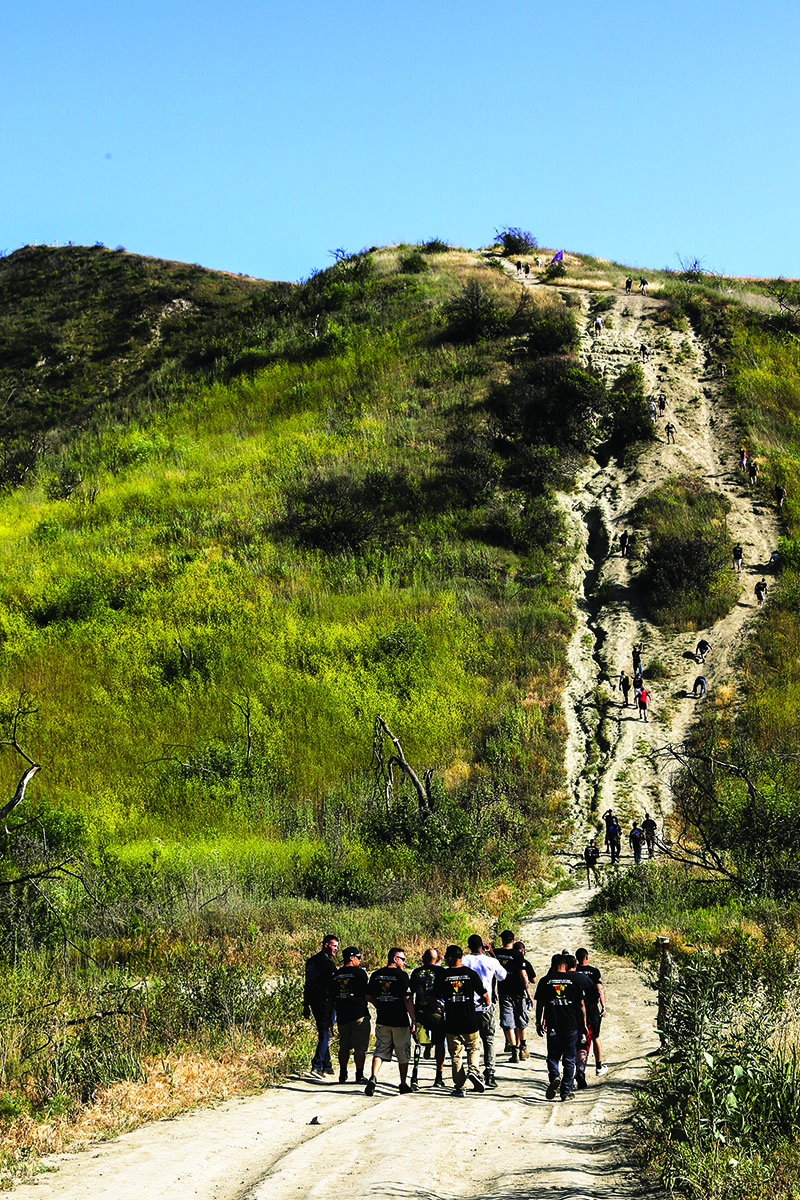
U.S. Marines, veterans, and family members of 3rd Battalion, 5th Marine Regiment (3/5), hike up First Sergeants Hill while attending a memorial ceremony for the Battle of Sangin on Marine Corps Base Camp Pendleton, Calif., April 29, 2016. During the Battle of Sangin in 2010, 3/5 sustained heavy casualties in what is considered the bloodiest battle ground of Afghanistan. (U.S. Marine Corps Combat Camera photo by Lance Cpl. Sergio RamirezRomero/ Released)

The Symbol

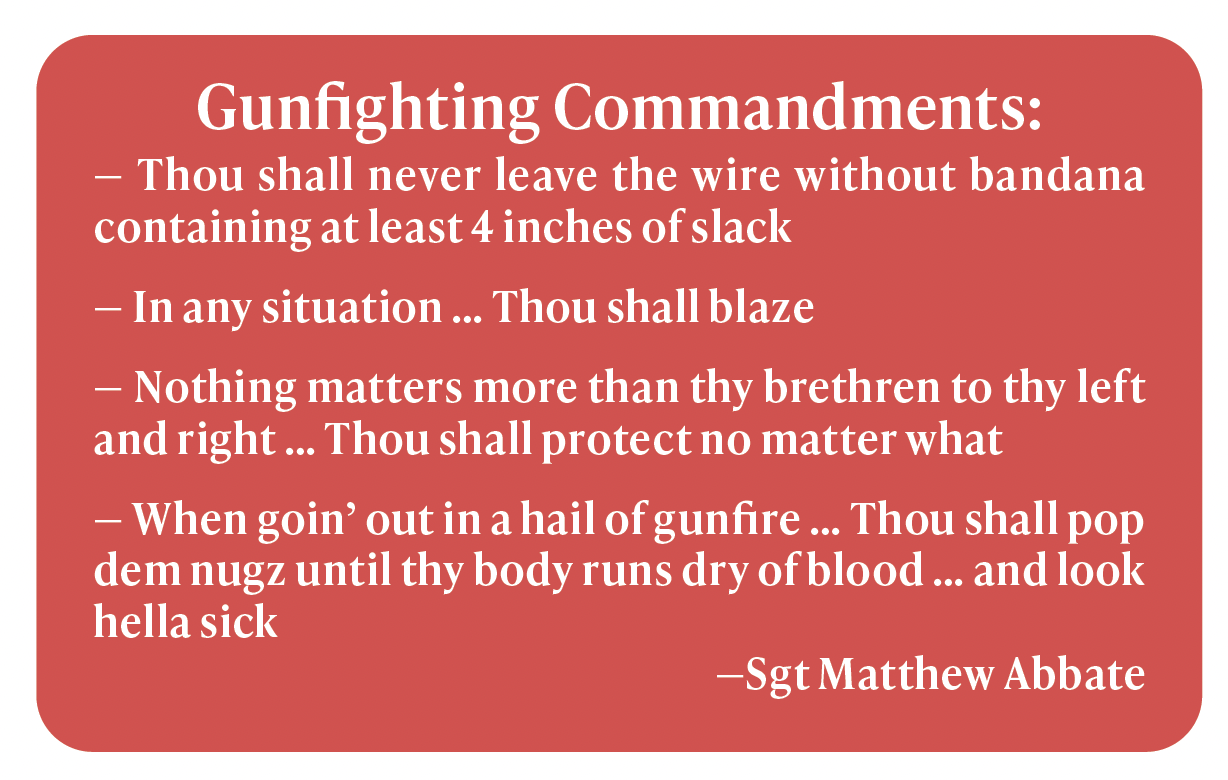
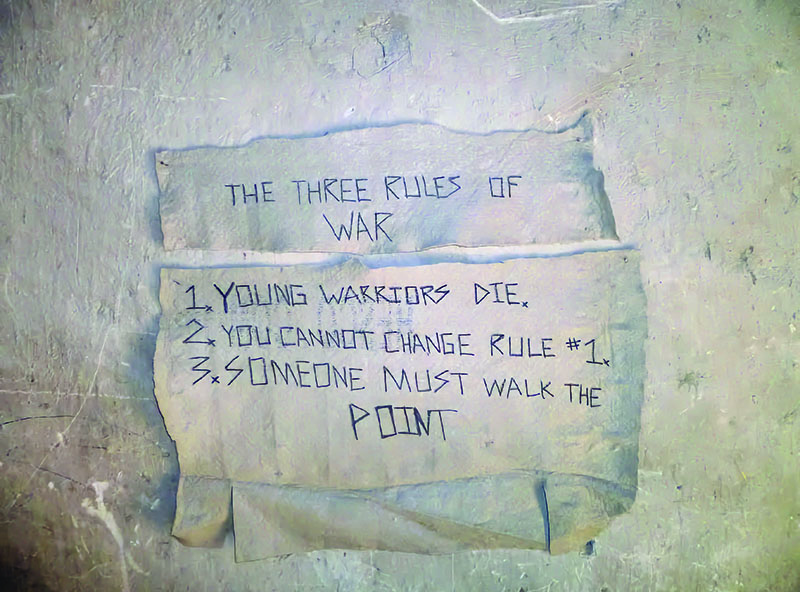
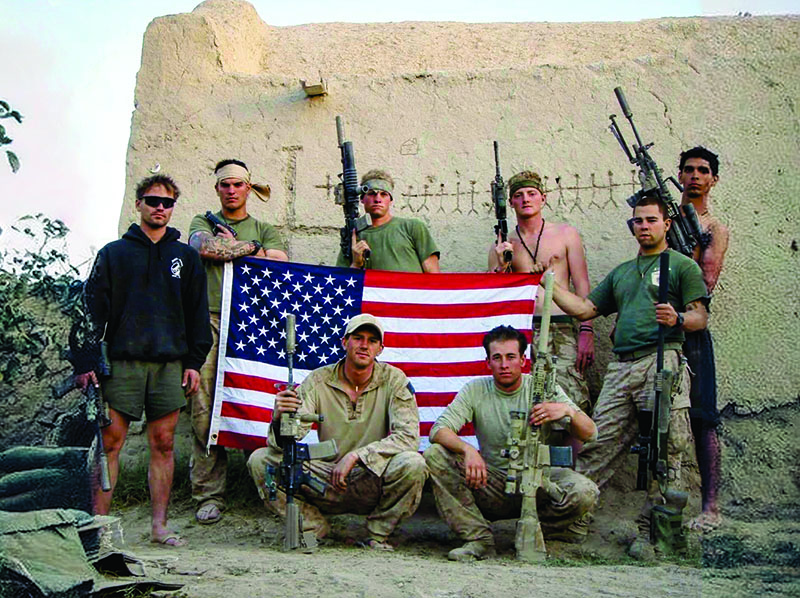
Jake: Throughout the deployment, Matt was really big on symbols. We had a wall where we carved stick figures for all the enemy we killed or even buildings we destroyed in air strikes. Matt encouraged it because he wanted people to know what we were doing. He wanted us to know that we were making a difference, and whenever we would leave, he wanted them to know that we made a difference. The gunfighting commandments and rules of war were his own creation. To me, they were reflective of his personality.

Matt was a really over the top guy. His favorite movies were ’80s and ’90s action flicks. He just thought they were awesome. When he showed us the gunfighting commandments, he thought it was hilarious, but he also thought it was badass. I think for Matt it was a way to make light but also be serious.

John: Matt came up with this thing called, “slack” in his bandana. Matt loved bandanas. His first gunfighting commandment was, “Thou shall never leave the wire without a bandana containing at least 4 inches of slack.” He’d always say it in his surfer voice, and it was funny as hell. The slack was the loose ends of the bandana dangling like a ponytail. We’d be getting ready to go out and he’d be like, “Ok everybody, get your slack” as he’s tying on a bandana before he put his helmet on. I still do it to this day when I ride my motorcycle.

Britt: The gunfighting commandments were just Matt’s mentality towards wearing the uniform that were unspoken but lived. Not necessarily the words themselves, but the attitude he took towards everything. He so much loved wearing camouflage, sweating and carrying guns with the potential of blasting holes in people, and he lived that. He could have written the gunfighting commandments a million different ways, but it all would have said the same thing; look cool, feel cool, protect your homies and kill the people trying to kill you. In the least eloquent way, that’s just who he was.

Jake: His rules of war I think were based off something he read in a book, but he put his own spin on it, but it hit home for all of us. Someone’s got to walk point, that was just reality, and some of us weren’t going to go home. I think what separated Matt from the rest of us was that he had already accepted that before we even got there. John, too, already knew. He had significant combat experience and was blown up by an IED in Iraq. He knew the consequences of what we were going to deal with and was OK with it. I guess the wild part for Matt is that he was prepared for the reality but had not yet experienced anything like it. By the time we left Afghanistan, we all could go out, and we knew what we were looking for, we knew what the contact would be like, we knew we could step on an IED, but that fear was kind of gone. Matt was like that from day one. I think his gunfighting commandments and rules of war were just helping the rest of us get accommodated.

Courtesy of Patrol Base Abbate

The One in Ten Million

Britt: On Dec. 2, 2010, me and Jake had just come back from a two-man sniper operation. We went out at dawn and came back four or five hours later with nothing really happening. I’d been back inside the wire for maybe 30 minutes cleaning my gear and refilling my water. We heard a gunfight start up in the distance. We heard the radio traffic, and it sounded like Matt and the rest of the guys out there totally had the initiative, but I geared back up just in case they needed a QRF. The guys saw some Taliban go inside a building. On the radio, we heard jets get called in for air support. We watched both birds go overhead, and we watched both bombs drop. We had made a habit of calling in the first bird to drop a short delay 500-pound bomb so that it would penetrate inside the building and blow it up. The second bird would follow up with an air burst above the same target to kill anyone who survived the first drop and was trying to flee.

Maybe 30 seconds after the second bomb dropped, we hear that there is an urgent surgical wounded. Abbate threw his gun back up on the berm and started scanning for somebody to shoot after the first bomb. Just the geometry of chance unluckily caught him in the neck with a piece of metal from the second bomb. We didn’t know that then, we just heard Abbate’s kill number come across the radio. But, Abbate was larger than life. I’m thinking, “Matt will be fine. He’s Abbate. Nothing can touch him.”

Jake: Within a few minutes of the medevac bird taking off, we all received notification that we were “River City,” which means that we’ve got somebody dead and all communications with home were cut off to prevent anyone from communicating with the Marine’s family. My heart sank; just gut wrenching. I was trying to reach our Kilo Company HQ to confirm what we just heard, because I just couldn’t believe it. I ran up to the patrol base’s comm shack and got on the radio. I said, “Kilo main, this is Banshee, confirm your last traffic.” Our forward air controller, a great guy, came back and was just like, “I’m so sorry, Banshee.” 

Britt: It felt totally unreal to all of us. Everyone felt very mortal in Sangin, but nobody thought you could touch Matt. He was invincible. We all just felt like, “If Abbate can get killed out here, there is no way I’m going to survive this.” His death reverberated through the entire battalion.

Author’s Note: 3/5 remained in Sangin until April 2011. The battalion suffered 25 killed in action and more than 200 wounded. Throughout the entire 20-year war in Afghanistan, 3/5 suffered the worst casualty rate of any Marine battalion.

Jake: Our deployment to Sangin 100% shaped everything about the remainder of my time in the Marine Corps and still does to this day. Matt’s relentless nature in everything he did, his relentless strife to be the best and outperform his best pushed me to be a better performer and made me push my Marines to outperform their best.  Matt never had an ounce of quit and never left anything on the table. As a Marine, you can’t have any quit because, ultimately, no matter what you do, the enemy always has a vote.

Marines with 3rd Battalion, 5th Marine Regiment, salute during the playing of taps during a memorial ceremony, April 29. Moments before, the Marines fired a 21-gun salute in honor of the 25 fallen warriors of the battalion.

Britt: Be as excited and proud to wear the uniform and do the job that you were the day you went to MEPS. When you didn’t know any better, when you didn’t know how stupid the games could be, when you didn’t know how lame the regulations are, and all the things it takes to get to wear the uniform and do the job; just show up every day excited to wear that uniform. Matt was just excited to get to be a Marine. To take off his uniform drenched in sweat and dirt, sore from trudging up hills carrying a machine gun. That was a good day to Matt.

It’s tough to call him anything close to an example of a window into what the Marine Corps was like during our era because Abbate was truly one in 10 million. I don’t know how many Marines served in the GWOT, but in that 20 years, there are only a few other dudes that had the impact on the people around him and the larger-than-life impact in the day to day. His exemplary character, attitude and performance in everything he did had so much gravity. Everyone who served with him on a day-to-day basis knew this guy was what you think of when you think ‘real Marine.’ When I say ‘real Marine,’ I don’t mean textbook recruiting poster, handsome, barrel-chested, shaved face dude. I mean absolute f—king killer, that’s a libo risk, that takes care of his dudes and leads from the front.

Jake: Matt taught me that you have to love your subordinates, whether you like them or not. He took every opportunity to train hard. He was the epitome of a Marine. He set the standard that I strive to reach, both through my time in the Marines and my current career in law enforcement. The lessons that I learned by watching Matt have shaped my entire adult life. I count myself very fortunate to have known him.

Author’s note: Matt Abbate was 26 years old at the time of his death. He is survived by his wife, Stacie Rigall, his son, Carson Abbate, his mother, father and three siblings.

A U.S. Marine Corps carry team transfers the remains of Marine Sgt. Matthew T. Abbate of Honolulu, Hawaii., at Dover Air Force Base, Del., Dec. 4, 2010. Abbate was assigned to the 3rd Battalion, 5th Marine Regiment, 1st Marine Division, I Marine Expeditionary Force, Camp Pendleton, Calif. (U.S. Air Force photo by Jason Minto)

Major Gen. Ronald L. Bailey, commanding general, 1st Marine Division, presents the Navy Cross to Sgt. Matthew T. Abbate’s mother during a Navy Cross award ceremony aboard Camp Pendleton, Calif., Aug. 10. Abbate was posthumously awarded the medal for the actions he took on Oct. 14, 2010 in Sangin, Afghanistan during his deployment as a scout sniper with Company K, 3rd Battalion, 5th Marines, 1st Marine Division. Abbate was killed in action in Helmand Province later that year.

Courtesy of Patrol Base Abbate

Featured Image (Top of page): Sniper Team “Banshee Three” at Patrol Base Fires, Sangin, Afghanistan, during their 2010 deployment with 3rd Bn, 5th Marines. Sgt Matthew Abbate, wearing a tan bandana, is holding the left side of the flag. Abbate’s story was shared with Leatherneck by several Marines including Sgt Britt Sully, standing far left, Sgt Jake Ruiz, holding the right side of the flag, and then-Sgt John Browning, kneeling, front right. Etched into the wall behind them is the sniper team’s running tally of confirmed kills during their deployment.

Author’s bio: Kyle Watts is the staff writer for Leatherneck. He served on active duty in the Marine Corps as a communications officer from 2009-2013. He is the winner of the Robert Debs Heinl Jr. award for Marine Corps History. He lives in Richmond with his wife and three children.


HOLDING THE LINE: Marines Confront Abbey Gate Memories Two Years Later

By Kyle Watts

The U.S. Air Force C-17 began its final descent in preparation for landing. Corporal Von Straight sat packed in among the 25 Marines of his stick. Gear of every sort filled the expansive interior of the aircraft, leaving barely enough room for the Marines, as Straight contemplated the mission ahead. What that mission was he did not fully understand, but it was Afghanistan. After watching Marines fight there for most of his life, Straight yearned to finally have his turn. Would it be a fight, though? Nobody seemed to know. The Marines aboard the plane could never have imagined the world in which they were about to spend the next two weeks.

The aircraft touched down at Hamid Karzai International Airport (HKIA) in the capital city of Kabul during the early morning hours of Aug. 14, 2021. A few other personnel from 1st Battalion, 8th Marines had arrived earlier, but as a combat engineer, Straight’s squad arrived with the advance party.

Events on the ground outside the air­port had decayed rapidly over the weeks prior. The Afghan government and mil­itary, propped up by the U.S., collapsed under a Taliban onslaught in every city and province. After vacating Bagram Air Base on July 1, the airfield at HKIA stood as the last American toehold in the coun­try. U.S. soldiers and Marines from Joint Task Force-Crisis Response operated out of HKIA preparing for the possibility of a noncombatant evacuation operation (NEO). The 24th Marine Expeditionary Unit, with 1/8 attached, and Central Com­mand’s Special Purpose Marine Air Ground Task Force, with 2nd Battalion, 1st Marines attached, were called in for support as the situation deteriorated.

As Cpl Straight prepared for the com­ing evacuation, the entire world watched events happening outside the perimeter wall. On Aug. 15, Taliban forces sur­rounded Kabul and Afghan President Ashraf Ghazi fled the city with numerous other officials of the American-backed government. Afghan army soldiers threw away their weapons and melted into the civilian populace. Taliban flooded the city and seized control of the country. American helicopters evacuated more than 5,000 personnel still on the ground at the U.S. embassy.

News of the takeover spread quickly, and civilians massed at the airport in fear for their lives. The sudden lack of Afghan soldiers left holes on the airfield perim­eter, and crowds seized the opportunity.

Straight was working with his team processing civilian contractors for evac­uation as night fell on the 15th when a frantic call suddenly rose over the radio. Someone across the airfield said they were under fire and civilians had breached the perimeter. The Marines joined forces with Turkish soldiers and moved out. Ambient city lights washed out all night vision devices so vehicles trailed the line of Marines pushing over the open ground, illuminating their way.

Sparks jumped off the tarmac in front of Straight. A vehicle-mounted machine gun behind him opened up on a shadowy figure hiding in a ditch. As they con­tinued, a C-17 lumbered through the dark­ness down the runway. Marines dodged the aircraft and took cover as it throttled up on an emergency takeoff. Farther ahead, a line of black-clad men carrying AK-47s sprinted across the field. By the time the sighting made its way up the chain for permission to engage, the men disappeared into a distant crowd.

Two shots cracked through the air past Straight’s head. He stopped in his tracks. He’d never been shot at before.

“My platoon sergeant standing next to me started dying of laughter as he saw the thought process working through my head,” Straight recalled. “My first thought was that I was not wearing my eye protection, like I was on another damn field exercise at Lejeune or something. We saw the guy who shot at us on the edge of a crowd, but he disappeared. Things just got progressively worse from there.”

A civilian family gives their baby to Marines on the wall at North Gate. Tragically, this desperate act was not isolated or uncommon during the evacuation from HKIA. USMC photo.

When dawn rose on the 16th, just a few hundred Marines and U.S. Army soldiers occupied the airfield amid a rising tide of civilians. Estimates range as high as 24,000 civilians breaching the perimeter. A brief and unintended firefight broke out between Marines and Taliban with two Taliban killed. Air Force airplanes made last-minute emergency takeoffs through the crowds on the runway. At midday, civilians on the ground recorded the now infamous footage of people cling­ing to the outside of a C-17 and bodies plum­meting from the sky as they lost their grip after lifting off. Apache hel­icop­ters flew back and forth over the flight line mere feet off the ground, forcing people back with their rotor wash. Noth­ing worked. The crowd proved largely peaceful but refused to budge.

The swell of people reduced as night fell. No planes would land or take off as long as they remained on the tarmac. Afghan special forces arrived and used extreme crowd control tactics, beatings and shooting civilians who stubbornly refused to retreat. Finally, after more than 24 hours of effort to regain control, U.S. forces reopened the airfield.

Cpl Mike Markland waited in Qatar with the remainder of 1/8 for a flight to Kabul as different news agencies reported the fall of the city to the Taliban. Some Marines were told to prepare for a landing under fire. No one knew what to expect or what was happening on the ground.

As Markland’s C-17 waited for permis­sion to take off, another aircraft landed nearby and stopped on the runway. The aircrew from Markland’s plane exited and ran over. Marines stirred and grumbled over the delay as the C-17 crews gathered around the landing gear of the other plane. Markland eventually learned that the body of an Afghan civilian re­mained lodged inside the aircraft, crushed be­neath the landing gear and frozen solid by the frigid temperatures at high altitude during the flight.

Markland’s plane finally departed and arrived at HKIA on the night of the 16th after the airfield was secure. Upon their arrival, the Marines from 1/8 set up around the north and east gates of the airport to process civilians for evacuation. Markland reached North Gate and climbed above the wall. People were spread out as far as his eyes could see. Strands of concertina wire placed outside the wall lay flat beneath discarded clothes, luggage, and bodies shoved over them.

Marines pushed outside the gate, fight­ing to create space between the wall and the crowd. They screamed at the top of their lungs for people to get back or sit down. Civilians screamed back at the Ma­rines and at each other, holding aloft every kind of paperwork imaginable that they hoped could get them out of the country. Marines scanned for threats as civilians crushed in, and warning shots filled the air, originating from any nation­ality present with a rifle. Taliban soldiers lurked along a road running parallel to the wall less than 100 meters away beat­ing and shooting people who didn’t com­ply with their orders. Afghan army soldiers waded into the crowd outside the gate beating and shooting people for the same reasons.

Marines assigned to the 24th MEU await a flight to Afghanistan at Al Udeied Air Base, Qatar, Aug. 17, 2021.Photo courtesy 1stLt Mark Andries, USMC.

“Nothing in your life gets you ready for something like that,” reflected Markland. “I was immediately met with something so different from anything I ever thought I would encounter; a situation I never even realized could happen with humanity. Everything you’ve learned as a man and as a Marine is constantly being used. It became exhausting very quickly.”

The young Marines knew Afghanistan as a war zone for all of their lives. Many of the older Marines had fought there on previous deployments but were now there under the pretense of an NEO, not combat, and they expected some form of order to make that happen. The chaos that greeted them left everyone looking to each other to determine what was acceptable and what was not.

“We wanted so badly to help these people,” Markland said, “but the only thing messing up the order and regulation of everything was the people. It’s like a two-edged sword. Any time you help one person, everyone sees that, and they get all riled up.”

In one example outside North Gate, Cpl Benjamin Lowther stood shoulder to shoulder with other Marines keeping civilians back. The crowd grew agitated and surged ahead. Warning shots and screaming filled the air. Suddenly, a can of tear gas erupted in the middle of it all. No one knew who threw it—a Marine, ANA soldier, or one of the other nation­alities present. Marines withdrew back toward the gate to shut down processing until the crowd settled. As Marines backed away from the gas, civilians pushed ahead into the void, crushing some of their own beneath the weight of an un­stoppable mass.

Their momentum pinned Cpl Lowther against a thigh-high jersey barrier. He drew his service pistol and fired into the air but could not create enough space to free his legs. He shouted for help and two Marines grabbed hold of his gear. Pulling at his belt and flak jacket, they finally freed his feet and safely returned behind the gate.

Marines hardened themselves to main­tain their sanity. One of the worst duties involved returning “rejected” civilians back outside the gate. With limited guid­ance from the Department of State (DOS) on what paperwork a civilian needed for evacuation, Marines ushered in people who did not meet the criteria. Other times, foreign nations brought in large groups without proper vetting and left them at the Marines’ entry control point. On one occasion, Cpl Markland helped bring in a man who had been shot in the genitals. They rushed him to medical care, but when he was stabilized, were forced to bring the man back outside the wall because he had no paperwork. Many other men, women, and children were forced back outside. Civilians resisted, begging Marines to let them stay, or plead­ing for the Marines to kill them. Unbelievably, they deemed this a more merciful death than being thrown out and left once more to the Taliban.

At the same time as 1/8 occupied North and East gates, 2/1 touched down in waves and moved to Abbey Gate. Unlike a typi­cal combat deployment, the Marines arrived lacking much of the gear that normally came with them. They relied on whatever they could carry, but Marines being Marines, they quickly adapted.

“It’s like if Stephen King and Dr. Seuss got together and wrote a book, that would be all of HKIA,” recalled Gunnery Sergeant Melissa Marnell, a combat photographer attached to 2/1. “It was like the Wild West. Marines were doing anything they could to get by. I saw rifle squads traveling on bicycles, or entire sections moving on bulldozers or fire engines. I had no idea so many Marines knew how to hot-wire vehicles. If you found a vehicle and could get it started, spray paint your name on the side, and it was yours.”

Sergeant Dalton Hannigan served as the assistant team leader for a seven-man sniper team called Reaper 2. He went to work “acquiring” assets. An Army Ranger taught Hannigan how to hot-wire a vehicle, and he picked one out of many scattered around the airport. Now with wheels, the team made their way to the terminal.

Reaper 2 received the task of providing overwatch at Abbey Gate. The team set up in a two-story guard tower presiding over the outer gate and exterior wall of the airport. The position offered a unique perspective. A road led straight out from the gate below, and a high wall rimmed with concertina wire lined one side served as the airport’s outer wall. A shallow canal lined the other side of the road, running directly below the tower and continuing beyond the gate in the opposite direction. A pedestrian walkway ran along the opposite side of the canal with another tall, chain link fence separating the walkway from the rest of the city beyond. In total, less than 50 feet stood between the tower and the fence beyond the canal.

A view from Reaper 2’s sniper tower at Abbey Gate. The Taliban checkpoint at the “chevron” of shipping containers can be seen in the distance on the right side of the photo. (Photo courtesy of SSgt Dalton Hannigan, USMC)

Turmoil enveloped the world within the snipers’ view. A sea of people pressed toward Abbey Gate from up and down the canal. Other Marines from 2/1 held the ground outside, struggling to keep the peace. The canal proved to be an open sewer, and the Marines nicknamed it “shit creek.” The smells of feces, urine, blood and decaying bodies rose into the tower, creating a toxic and intolerable environment around the gate, but the filth and stench failed to dissuade civilians. They waded through the knee-high water up to the side nearest the gate. Marines stood on the wall preventing some from climbing out and helping up others who showed appropriate documents.

Less than 200 yards down the road, a bridge spanned the canal, leading out of the airport toward the Baron Hotel. The British set up their base of operations there, processing people for evacuation. Maintaining the path of entry and exit for the Brits was critical.

Marines worked for hours clearing the road in front of Abbey Gate. The sheer weight of the desperate crowd seemed impossible to push back. After nearly 24 hours, 2/1 finally cleared the road out to the bridge over the canal. Engineers hauled in large shipping containers and placed them in a chevron-shape at the bridge, blocking vehicle entry to the gate.

The chevron morphed into one of the great incongruities representing those ending days of the war in Afghanistan. Taliban soldiers, operating in partnership with U.S. forces, occupied the chevron as an outer checkpoint. Their armed pres­ence at this blocking position prevented the possibility of vehicle-borne impr­ovised explosive devices (VBIED) from reaching Abbey Gate. In theory, the Taliban also provided an initial screening of civilians for evacuation. To the Ma­rines of Reaper 2 observing the Taliban from their sniper tower, reality appeared quite different.

“We saw people getting beaten and executed, but there was nothing we could do,” remembered Sgt Hannigan. “At different points, we’d see the Taliban sit down on the shipping containers and grab a couple kids and the kids would just sit up there with them. What the Taliban were doing with their families I don’t know. But it was just weird seeing a toddler holding their baby brother or sister, sitting up there in the heat alone with the Taliban.”

Random shootings at the chevron drove civilians into the canal, where they by­passed the Taliban checkpoint. The Tali­ban presence left everyone on edge although the crowd remained mostly peaceful.

Marines arriving at Abbey Gate found themselves in a position no training could prepare them for. DOS officials appeared sporadically and in short intervals over the first several days. They alone made the determination on “acceptable” doc­umentation for evacuation. They operated inside the gate, however, and Marines outside acted independently to determine who should be let in. Every Marine rec­ognized an American passport or green card and identified those rare individuals to be let in but what does a German work visa look like? Or an Australian visa? What if a civilian handed you a cellphone and an English-speaking voice on the other end claimed to be a congressman or a colonel or someone else “important” enough to vouch for the person who handed you the phone?

Complicating matters, guidance on ac­ceptable documentation shifted con­stantly. Just like 1/8 experienced at North Gate, 2/1 Marines grew frustrated and exhausted as they processed civilians through to safety, only then to discover the papers they possessed were unaccept­able. Hundreds of civilians fit inside the inner holding area at Abbey Gate await­ing DOS approval. Sometimes, more than 2/3 of these groups were forced back out.

Desperation grew as time passed. Families stood on the road or in the canal for days. Many succumbed to thirst and heat exhaustion. Whenever DOS person­nel left or the airfield shut down flight operations, processing halted. The crowd grew agitated and teetered on the brink of rioting. Marines witnessed unimagin­able scenes as men, women, and children trampled each other to death, were crushed against concrete barriers, or were left for dead in the canal.

Marines clung to a sense of decency. They wanted to help but felt incapable in the wake of so much terror and tragedy. Even so, opportunities arose. Without clear guidance, young Marines acted in­de­pendently, making decisions that meant life or death for people outside the gate.

“The first couple days I was looking around to see everybody else’s reaction, or to see how they handled things, but eventually I realized it doesn’t come down to me asking somebody if I can do something if it’s going to help,” said Cpl Markland. “It came down to understand­ing that right now, no decision is the worst decision for these people.”

Markland found a distraught family at North Gate one day, just after they made it through the initial screening. The family of five entered HKIA, prepared to leave their entire lives behind with a single blue backpack. It contained all their money, documents, and whatever other possessions they could fit inside. Somehow, the backpack disappeared. The frantic mother approached Markland with broken English, explaining their bag went missing during the initial search. As Marines held the family off to the side, Markland backtracked into the holding area looking for the bag. He spotted a blue bag in the crowd, but another civilian claimed it. Markland finally gave up and returned. The mother begged Markland to take her with him to search a second time.

He knew the uncleared civilians pre­sented a security risk and taking her back through the entrance created a problem for everyone else trying to get in. He also understood that without the backpack, the family would not have the required documents and would be kicked out. He took the risk. They walked 100 yards back towards the gate. The woman immediately identified her bag as the one Markland had noticed before and retrieved it from the other civilian, who offered no resistance. They returned to the rest of the family, who wept with joy and thanked Markland for his help.

At another point near North Gate, Cpl Straight received the task of guarding an Afghan interpreter named Reggie. Reggie served with U.S. forces as an interpreter in 2012, then immigrated to the U.S. and enlisted in the Marines. After serving his time on active duty, he returned to Afghanistan as an interpreter once more. Now, Reggie sought evacuation to the U.S., and Straight helped him search the crowds for his wife and children. Miraculously, they found Reggie’s family and got them on a plane.

In the personnel terminal, GySgt Marnell learned firsthand how the smallest of gestures meant the world to the civilians. She found a refrigerator full of water bottles and took several out to a crowd waiting to board their plane. After enduring the heat with no food or water for days, the people beamed with gratitude. Marnell and one of her Marines made trip after trip, emptying the fridge for the people outside.

“I’ve never seen someone so thankful for something so minor in my life,” she remembered. “That was the one time I was happy over there, doing something so small for those people.”

Of all the Marines immersed in the good and the bad playing out at HKIA, the Female Engagement Teams (FETs) held a unique role. Afghan culture dic­tated women and children could only be handled by females. Female Marines across the commands on deck formed together to support processing operations. The significant number of women and children present and the limited number of female Marines available required the FETs to work non-stop.

“They were being worked to a degree where they didn’t have any down time,” said Markland. “We at least changed between the gate, the airfield perimeter, and rest. They didn’t have that as much, it was just gate to gate to gate. And the things they were being used for, with the women and kids, was very emotionally draining.”

Some of the most widely publicized photos to come out of HKIA featured FET members caring for babies. Many desperate families handed their babies to Marines over the gates or left them lying outside where they knew Marines would rescue them, just to give the kids a chance at life. An orphanage was formed on the airfield to care for and protect all the children separated from their parents. Marines cherished the moments playing with all the kids, while wrestling inside with the terrifying reality surrounding them.

Marnell waited with three young girls for their flight out of HKIA. The girls and their parents were cleared and approved for evacuation, but the youngest of them was still unaware of their circumstances. The girl, only 4 or 5 years old, pulled off her bracelets and handed them to Marnell.

“You can have these,” the girl said. “I won’t need them when the Taliban kill me.”

Marnell stared, taken off guard. How could this be the thought of a 5-year-old? She noticed the girls all wore a cross on a necklace. She learned the girls’ parents were English teachers at a school. Marnell reassured the girls they were safe now, held them, and stayed with them until they boarded their flight.

As days passed, units at the gates adopted rest plans to finally relive those who had been on guard for days. Many Marines endured 72 hours or more without sleep. They cycled back for rest and witnessed some results of their work; C-17s loaded with civilians taking off.

By Aug. 25, the situation declined from bad to worse. The President’s deadline to withdraw from HKIA by Aug. 31 approached and the crowds understood their chances of evacuation diminished rapidly. Their desperation increased pro­portionally. Marines felt the pressure, not just from the crowd surrounding the airport, but from desperate people around the world. An avalanche of “special re­quests” overwhelmed the Marines. Thou­sands upon thousands arrived in every way imaginable; from the White House to the Vatican, from congressmen to re­tired colonels, foreign officials, or anyone with someone they knew still outside the airport. The senior officers at HKIA re­ceived emails from the highest levels of government. Lance corporals at the gates who still had working phones found their numbers somehow had gotten out, and they received texts or phone calls about specific people to look for in the crowd. Sometimes the special requests helped identify individuals in the sea of people. More often than not, the special requests, and corresponding efforts to act on them served only to disrupt or even cripple the mass evacuation efforts.

Credible threat streams reached the intelligence community. VBIEDs threatened North Gate with the civilian road running parallel to the wall. Suicide vest IEDs (SVIEDS) were suspected as well with detailed descriptions of bags and people to watch out for. The threat at North and East Gates increased so dramatically that both entrances per­manently closed operations. Abbey Gate remained the only operational entrance for civilians to enter. By nightfall on Aug. 25, commanders decided to also close Abbey Gate for good.

GySgt Melissa Marnell stayed with these three sisters as they awaited evac­ua­tion from HKIA. Visible on Marnell’s right wrist are the bracelets given to her by the youngest of the girls. Photo courtesy of Sgt Benjamin Aulick, USMC.

Cpl Straight arrived at Abbey Gate the morning of Aug. 26 with the task of barricading the gate once Marines from 2/1 pulled back inside. The morning wore on and operations continued as normal, but no word came to shut it down. Straight asked around about the delay. The Brits continued operating out of the Baron Hotel with the road from Abbey Gate as their only means of reaching the airport. Until they ceased processing civilians, the Marines needed to keep Abbey Gate open.

The closure of North and East Gates forced an influx of people toward Abbey. Civilians filled the canal and walkway. The frustrated crowd boiled over, throw­ing trash left on the ground, and grabbing at the Marines’ gear. Marines used flash bangs and other crowd control measures but found little success. Some Marines witnessed one man hold a baby over his head as a tiny human shield when a flash bang exploded nearby. Other civilians threw their children at the wall in a last hopeless act.

“Moms were trying to give away their kids. They would throw the kids to us,” stated one Marine in an interview from Central Command’s declassified investi­ga­tion into the attack at Abbey Gate. “We didn’t have a choice then because the kids would be hurt. You’d be surprised how many people threw babies. You have no idea.”

“They would throw the kids over the fence, hitting the ground,” stated another Marine in the investigation. “Throwing like baseballs. It was crazy.”

IED threats poured in, adding to the mayhem. Marines were told to look for a black backpack with white arrows, but bags and suitcases littered the entire area. Intel provided a full description of a clean-shaven man as a possible suicide bomber. Snipers from Reaper 2 spotted a man matching the description in the crowd and reported the sighting. Other Marines spotted suspicious individuals acting far too calm amid the chaos, ob­serving the gate and taking pictures.

Several reports of an imminent attack arrived throughout the day. On at least one occasion, an incredibly specific IED report arrived with a countdown. Marines received the warning with 10 minutes until detonation, then reiterated at five minutes. Snipers in the tower took shelter and the search platoon outside the gate knelt behind a concrete barrier. Everyone remained sheltered well beyond the expired timeline before resuming oper­ations. The substantial increase in threats led the Marines to collapse back from the road leading to the chevron and hold a small perimeter around the outer gate.

First Platoon from Golf Company, 2/1, assumed duty outside the gate, lining the canal wall directly below the sniper tower. Three FET members exited the gate helping to pull women and children from the canal. A U.S. Army psychological operations (PSYOPS) vehicle arrived at the gate to assist with crowd control. One official estimate placed 2,000 to 3,000 civilians at Abbey Gate. At around 5:40 p.m., roughly 30 minutes after the PSYOPS team arrived, a bomb detonated.

The suicide bomber stood on the op­posite side of the canal, directly across from the Marines. The explosion imme­diately killed or wounded hundreds of people packed into the area beneath the sniper tower. Tear gas canisters held by Marines closest to the blast ruptured, spreading their contents in a cloud over the scene. Screaming civilians fled the area along the canal. Bodies piled against the canal wall, blocking their path and restricting escape.

Cpl Straight stood inside the gate nearly 200 feet away. Even at that distance, the blast wave knocked him off his feet. Sgt Hannigan had just returned to the sniper tower and parked his truck inside the gate less than 100 feet away. He immediately climbed up the tower and found several of his Marines dazed and concussed. He learned one team member, Sgt Tyler Vargas-Andrews, was wounded on the ground outside.

Marines sprinted from every direction toward the unfolding mayhem. Some assumed security positions, expecting a complex ambush or follow up IED. Gun­fire filled the air after the blast. Several Marines interviewed for the CENTCOM investigation reported armed men in a building on the opposite side of the canal. Others witnessed men on their cellphones or taking pictures.

In the sniper tower, Sgt Hannigan ducked as three rounds struck a window facing the canal. The bulletproof glass splintered but stopped the incoming fire. Marines outside on the ground opened fire briefly, some at perceived targets, others blasting warning shots into the air to keep people back from the casualty evacuation efforts.

Marines grabbed stretchers, riot shields, and anything else that could carry the wounded. Navy corpsmen and Marines applied tourniquets and plugged puncture wounds with their fingers. The number of civilians, dead, alive, and wounded, piled up or running for their lives, com­plicated all efforts to help. The individual decisions of Marines on the ground re­mained the only thing holding the situa­tion together.

A chain link fence separated the ma­jority of the casualties from the Ma­rines attempting their rescue. Thinking quick­ly, Reaper 2 team leader, Sgt Charles Schilling, grabbed a pair of bolt cutters and cut a hole in the fence. This single action dramatically reduced the time it took to reach the wounded.

Sgt Jonathan Painter received shrapnel wounds from the explosion but overcame the chaos and pain to set his squad in a security position along the canal before running into the tear gas to help evacuate the wounded. Cpl Wyatt Wilson was blown through the air with ball bearings peppering his entire body. Somehow, in spite of his own grievous injuries and the cloud of tear gas enveloping him, Wilson found another critically wounded Marine lying nearby and dragged him to safety until blood loss prevented him from going farther. Wilson passed the Marine off but refused care for his own life-threaten­ing wounds. Numerous other Marines, corpsmen, and Army medics put them­selves at risk to help their brothers and sisters, as well as the wounded civilians.

As of this writing, the majority of them have gone unrecognized. Sgt Schilling’s life-saving initiative making the hole in the fence is just one example of unreco­gnized actions. Sgt Painter received the Navy and Marine Corps Commendation Medal with combat “V.” Cpl Wilson received a Bronze Star with combat “V.”

In less than 15 minutes, all American casualties, both dead and wounded, were evacuated to the initial casualty collection point. Medical facilities at HKIA over­flowed. Aircraft departed with the most severely wounded. The rapid evacuation of casualties no doubt prevented more Ameri­cans from losing their lives. In fact, it happened so quickly that those re­spon­sible for patient tracking struggled to keep up, temporarily misidentifying some of the dead or wounded. In total, the explo­sion killed 13 U.S. service­mem­bers and initially wounded close to 30. This num­ber grew in the following weeks as con­cus­sions and traumatic brain in­juries con­­nected to the blast were identi­fied. More than 150 Afghan civilians died in the attack with an untold number wounded.

The Marines of 1st Platoon, Golf Company, 2/1, on Aug. 26, 2021, immediately prior to taking over responsibilities as the search platoon outside Abbey Gate. Many of the Marines in this photo were among the killed or wounded in the attack that day. Photo courtesy of GySgt Melissa Marnell, USMC.

Following the evacuation, Abbey Gate fell eerily quiet. The civilian crowd dis­appeared, leaving stacks of bodies piled against the canal wall or floating in the water. The ground attack alarm blared from speakers across HKIA, providing the only background noise. Taliban sol­diers remained at the chevron, where they observed and filmed the attack in silence. Engineers blockaded the gate. From then on, apart from special requests, evacua­tion operations ceased.

On the morning of Aug. 27, explosive ordnance disposal Marines conducted a post-blast analysis. They concluded the bomber utilized a suicide vest or back­pack containing 20 pounds of explosives and hundreds of ball bearings. He det­onated the device from the canal wall opposite the Marines outside the gate, only 20 feet away.

At noon, U.S. servicemembers gathered on the runway at the ramp of a C-17. One by one, pallbearers escorted 13 flag-draped caskets onto the aircraft. The lives claimed by the attack ranked as one of the highest numbers of U.S. fatalities in a single incident from the entire 20-year war in Afghanistan.

Marines spent the final days before the Aug. 31 deadline preparing to leave. Many engaged in the “demilitarization” of the airport. The intent was to deny the Taliban use of any military equipment. Hundreds of vehicles, aircraft, weapons, computers, radios, and every other type of gear imaginable would be left at HKIA. Commanders tasked the Marine and U.S. Army units with destroying all of it. Marines dropped thermite gre­nades through engine blocks, slashed tires, and smashed control panels to pieces. Sledge­hammers, halligan bars, axes, and any­thing else they could find replaced rifles as their chosen weapons of opportunity. However, the “demil” order originated, the expectation of what should be de­stroyed swiftly expanded in its translation down to those carrying it out. At the gates, Marines were often left on their own to make life and death decisions for civilians. Now, throughout the airport, Marines were left on their own to decide what items warranted destruction.

“The Turkish military left their bar­racks, and we were standing in their liv­ing quarters,” remembered Cpl Markland. “We just thought OK, if we aren’t going to be here to use it, then certainly not the Taliban. We were going to do everything we could to make it uninhabitable for them. We were going to take away the amenities that anyone would appreciate.”

Marines smashed TVs and refrigera­tors. They broke apart tables and chairs. They forced open every locked door and demolished anything found on the other side. Across the airport, Marines everywhere unleashed nearly two weeks of pent-up anxiety and aggression. They felt helpless in the face of ongoing horror outside the gates. They thirsted for re­venge in the wake of the attack that killed 13 of their brothers and sisters. Every window begged to be smashed. Every blank wall space looked naked without “F–K ISIS” in spray paint. Before them lay an entire base full of cathartic opportunity.

HKIA reserved a final bad memory for many Marines. In their last hours on the ground, Marines were ordered to police call the airport and clean up the destruction just completed. They were told that they took the order too far. They returned to specific areas to pick up the pieces and flip vehicles back onto shredded tires. Some unlucky few were stuck policing the areas where civilians waited in groups to board aircraft. With­out adequate facilities, civilians defecated in whatever container they had or directly on the ground. Trash and filth of every kind imaginable remained. The police call seemed a fitting end to their time in Afghanistan.

The final American aircraft lifted out of HKIA before midnight on Aug. 30, completing the largest NEO airlift in U.S. history. Officially known as Operation Allies Refuge (OAR), 800 military or civilian aircraft evacuated nearly 125,000 civilians over a 17-day period.

The impressive numbers did little to assuage the feelings of the Marines who endured HKIA. Now two years later, the memories are ever-present, and reminders are constant. Tyler Vargas-Andrews, the Reaper 2 team member severely wounded by the blast, gave a compelling testimony before Congress in March, highlighting the questions and concerns about the operation echoed by many Marines. As recently as April, the Taliban announced they killed one of the key ISIS-K players who planned the bombing at Abbey gate.

In August 2022, on the one-year anni­ver­sary of the attack at Abbey Gate, Cpl Joe Laude worked through the contact list on his phone, checking in with everyone he knew from HKIA. Laude served as a machine-gunner with Echo Co, 2/1, working at Abbey Gate and rushing 100 meters to the scene of the attack to evacuate casualties after the bomb went off. An idea arose; rather than contacting everyone individually, what if he created a hub where everyone could come for community when they needed it?

“At that one-year anniversary, I already knew OAR veterans had a lot of un­answered questions, a lot of guilt and shame about their service,” Laude said. “I needed to do something.”

He formulated a plan and worked with others to develop the idea. The group founded a 501(c)(3) called OAR Foundation with the mission to provide a community for OAR veterans, preserve the history of the evacuation, and explore the operation’s “moral injury” on those who were there.

“Moral injury is a guilt or shame-based ailment,” Laude explained. “It can be co-occuring with post-traumatic stress, but I think the biggest difference is the guilt. I think many times, the guilt is what can more quickly lead someone toward suicide. We are slowly researching all of these things and recently brought on a psychologist into the organization to help us build up that research.”

U.S. soldiers and Marines carry the body of a fallen servicemember to a waiting aircraft for transport home on Aug. 27, 2021. (Photo by 1stLt Mark Andries, USMC)

As the vast majority of OAR veterans leave the Corps or move on to different commands, they try to decipher how that horror-packed two weeks will fit into the rest of their lives. Even for veterans with combat deployments prior to August 2021, HKIA held experiences unlike anything they had ever seen before. OAR Foundation hopes to play a key role in finding answers and accountability, while providing a forum for veterans to share their experience. As they forge ahead, those stories will shape the legacy of the Marines and Navy corpsmen whose lives were changed at HKIA and preserve the memories of the 13 servicemembers killed in action.

The lessons learned from this tragedy remain in infancy, even two years later. Most will only be revealed as more truth comes to light. When something horrific occurs, the duality of man emerges. The evacuation of HKIA brought out the worst that humanity has to offer. It also brought out the best. No matter how bad it gets, no matter how completely evil holds the day, there will always be someone willing to act for good, even in the face of chaos and utter exhaustion. Someone will always be willing to hold the line. At HKIA, Marines held.

Author’s note: Our tribute to the fallen servicemembers from HKIA is on page 72 of this month’s issue. For the Marines who served at HKIA, thank you for allowing me to share a glimpse into your experience. Each of you has a story worth telling. I encourage you to do so. It would be impossible to capture everything that happened there in one article. I hope my efforts have done you justice. For more information on OAR Foundation, visit www.operationalliesrefugefoundation.org. For additional photos and information about HKIA and the attack at Abbey Gate, see the expanded version of this story at www.mca-marines.org/magazines/leatherneck/.

The Golf Course

By Maj Tom Schueman, USMC And Zainullah Zaki

Editor’s note: This excerpt from the book “Always Faithful” by Maj Tom Schueman and his translator, Zainullah “Zak” Zaki, is told from Schueman’s perspective. It was reprinted with per­mission of William Morrow, an imprint of HarperCollins Publishers.

We almost always started patrols out of Patrol Base (PB) Vegas by going through Kodezay since the Taliban were less likely to put an improvised explosive device (IED) there. They had long since learned they were better off not killing the village kids. I explained the facts of life in the moment to the lieutenant replacing me as we discussed the final familiarization patrol we would accompany them on. Most of 1st Platoon had already headed to Camp Leatherneck to begin the movement back to Camp Pendleton. But Sergeant Decker; Zainullah “Zak” Zaki; my machine-gun squad leader, Sergeant Nikirk; and I would serve as tour guides for a patrol otherwise composed of newly arrived Marines. The lieutenant leading the platoon replacing us was a brave, intelligent and talented officer. But I could tell that not everything I said was getting through.

“Ninety-eight percent of the world’s opium poppies grow in Afghanistan,” I told him. “Helmand Province, specifically Sangin district, is the heart of the drug market that funds the Taliban.”

He nodded. Training had already armed him with this fact. “Between September and December 2010, we were in a firefight on every patrol. Every. One. For 100 days.” Again, he nodded, face impassive.

I knew what he was thinking and feel­ing. I had been there seven months before, armed with training-based understanding rather than understanding born of exper­ience. Every infantry officer who truly has the calling wants direct combat. After all, our stated mission is to locate, close with, and destroy the enemy. But the truth is that it’s all academic until combat is a present reality. Then you start thinking hard about the implications of everything you thought you wanted. You start feeling things that just can’t be fully understood until the possibility of violent death is truly manifest.

Image
Schueman and the Marines of 1st Plt, “Kilo” Co, 3rd Bn, 5th Marines at Camp Leatherneck in Afghanistan.

“Before January, we found hundreds of IEDs. But, man, look, back in January, the Taliban told the farmers they were behind on poppy production. The poppy farmers said they could not farm for fear of getting killed in the crossfire between us and the Taliban. So, the Taliban signed a fake-ass treaty, saying they were sick of fighting, and they just wanted to join the government. They said they would clean up the IEDs, turn in their weapons, and farm.”

I had the lieutenant’s attention. IEDs, and their effects, are the common thread of the global war on terror. A reduction in their use mean fewer potential casualties for his Marines. Zak interrupted us. Some children from Kodezay had arrived at PB Vegas to tell Zak that while we had been patrolling near the adjacent river the day before, the Taliban took advantage of our absence to spend a day digging in 15-20 IEDs all over the golf course. That was the perfect segue for me.

“So, the Taliban and the Afghan govern­ment signed the treaty. All of us here on the ground knew it was bullshit. The terms meant we stayed on our base for several days to allow these assholes to supposedly clear the IEDs that they had laid before without us shooting them. What they actually did was turn in three rusty antique rifles, like this treaty required, then used the time to reseed the area with two to three times what they laid previously. Then they told the farmers to get back out there and farm poppy to make them money to fight us with. So, when we went back out in January, there were no more firefights but way more IEDs. Which brings us to today.”

My replacement lifted his eyebrows and exhaled through pursed lips. IEDs are frankly terrifying. They are not what any of us signed up to fight. As long as a Marine has someone to shoot at, he is generally OK. Marines want to fight an enemy that wants to fight them. An IED kills without recourse beyond a medical evacuation and a hope that your legs are only gone below the knee. I could see his thoughts churning. Today was his patrol. In Marine lingo, he was in the left seat, the driver’s seat. I was in the right seat, as a passenger and tour guide to a pastoral paradise where poppies and IEDs were both planted in abundance. And he wanted to go through the golf course.

Image
Afghan interpreter Zainullah “Zak” Zaki in Sangin Province, Afghanistan, 2011.

I shook my head and said, “We shouldn’t go through that field, man.” He looked at me and I saw the certainty the Corps trains in its leaders. “I don’t want to set a pattern of always going through the village,” he said.

“Dude, we always go through the vil­lage because the assholes don’t put IEDs in the village.”

“Not today. We’re going through the golf course.”

Image
Schueman and his Marines visited with residents of Sangin during a patrol. From the left: Cpl Justin McLoud, Schueman, “Doc” Rashad Collins and LCpl Eric Rose.

There was not much to do but say “OK” and get my guys ready for the patrol.
A Marine leader is expected to be where he or she can best control the unit and affect events at the point of friction. When accompanying one of my squads, I usually patrolled in the first third of the patrol, usually as the third or fourth man. The patrol was a bit larger than normal since we were augmenting the newly arrived platoon. Thus, there were five Marines across the golf course when Sergeant Nikirk stepped onto the field and disappeared in a cloud of smoke and mud, accompanied by a loud “POP!”

When you see one of your Marines injured or killed by an IED, it is an im­potent feeling. Your enemy typically dis­appears long before they inflict actual damage upon you and your Marines. Unless they reveal themselves by firing at you, there is nothing to fight, but time as you try to stabilize a critically injured young man, convincing him to hold on through evacuation to the next level of care, and hope that you did not miss any­thing vital as you evaluated his injuries. I ran to Nikirk with Zak on my heels as always. There would be no need for him to interpret. He had simply become one of us over the months we spent together, and he was preparing to help me attempt to hold someone together as a Navy corpsman rendered lifesaving first aid.

But as the smoke cleared and the mud and dust settled from the air, I arrived at Nikirk’s side to see he was standing next to a partially ruptured, 40-pound jug of home­made explosive, much of it now dusted across his face. He was alive, per­ceptibly shaking from the experience of a low-order, partial detonation of am­mo­nium nitrate homemade explosive (HME) intended to sympathetically detonate a 105 mm howitzer shell right under his feet. The combination should have left Nikirk a pink vapor drifting in the air with the lingering smell of ammonia. But because the area had recently experienced a lot of rain and Taliban quality control was low, the IED pushed him aside, plastered his face in the ammonium nitrate and aluminum used to make the explosive, and exposed the artillery shell that would have left him nothing but a memory. Since we had barely left friendly lines, and it had become clear that Nikirk was largely unharmed, I called for explosive ordnance disposal (EOD) to come out and destroy the IED. After an hour, they arrived and confirmed that the IED should have meant the end of more than one of us. They also noted that the IED was triggered by a tripwire, the first we had seen of such. Typically, IEDs in Sangin were triggered by the victim’s weight pushing down a pressure plate, which completed an ignition circuit.

Image
Zaki in Kabul, July 2021.

Sgt Nikirk and Sgt Decker came to me and asked to return to base with EOD. I sent Nikirk back but told Decker he would have to remain. We needed his experience if things continued to go downhill. Sgt Decker looked at me, reminded me he had a son whom he had never met, and said, “This is bullshit, sir. These guys are going to get us killed.” Decker had never needed more than a direction and distance to and description of the thing I wanted attacked and destroyed. He was both courageous and cautious, a force of nature in combat. Now, for the first time in his life, Sgt Decker was ready to pack it in on a combat operation. I told Decker we were continuing on, then turned my attention to my incoming lieutenant counterpart and asked him his plan.

“We’re going to continue to push across the field.” Aggression aside, I was stunned.

“The only way we are going across that field,” I said, “is if you have the combat engineer back-clear from his position to us, then reclear it, since he had obviously missed at least one of the IEDs.”

Image
Schueman and Cpl Aguilar discuss security issues with Sangin residents.

Combat engineers accompanied us on most patrols and carried a metal-detecting sweeper intended to find IEDs and land mines. The incoming platoon commander gave the order.

We had been stationary for more than an hour as we dealt with Nikirk’s IED detonation, then EOD’s arrival and de­parture with Nikirk. That was way too long and now the Taliban certainly knew exactly where we were as the combat engineer began the exhaustive process of sweeping back across the flat, open ex­panse of the golf course from 500 meters away. He was halfway across the field, coming back to us, his sweeper ticking back and forth like a metronome, when the second IED blew. This time it was a complete detonation.

The combat engineer disappeared in the fire and mud and smoke. Before the debris had stopped falling, the Taliban unloaded on us with rifles, rocket-propelled gre­nades, and medium machine-gun fire. They knew someone had to go get the combat engineer. They knew there were more IEDs in the field. They wanted us moving around to hit them.

Image
Zaki and his family outside of Hamid Karzai International Airport, August 2021, as they made one of several attempts to get inside the gate in order to secure seats on a flight to the U.S.

With the incoming fire everyone hit the deck. You could tell the difference be­tween new guys and 3/5 Marines. The new guys were face-down in the dirt or neck-deep in an irrigation canal, rifles firing in no particular direction. Those of us on our last patrol were up on an arm, scanning for muzzle flashes and smoke. Painful experience told us we had to determine the source of the fire and put our own on them before they could hit one of us.

I was furious. This was our last patrol and after seven months, stupidity was going to kill us. I looked at Zak. All I could say was, “Son of a bitch! Can you believe this shit!?” He just shook his head in disbelief and said, “Lieutenant Tom, this is crazy.” Of course, Zak wasn’t leav­ing with us. He would stay here.

As I continued to scan for the enemy, out of the corner of my eye I saw Sgt Decker run onto the field toward the wounded combat engineer. The man who had asked me to let him return to PB Vegas, the one who reminded me he had never met the child he’d named Maximum Danger Decker, was running into the midst of an uncleared field planted with double digits’ worth of IEDs to retrieve a wounded Ma­rine he didn’t know. I thought about the fact that it was our last patrol, that I had, only moments before, denied Decker a chance to return to safety, and that I now assumed I would soon be living with the fact that I denied a dead man a chance to meet his child.

I screamed, “DECKER!!!” He kept mov­ing into the field. I screamed again, “SGT DECKER! STOP!” He looked back. I had no children.

“Come back here! You’re not going, I am!” I yelled.

Image
Zaki, the interpreter, pro­viding security in Sangin.

Decker started moving back to me. I looked at Zak and asked, “Are you ready to go?”

Of course, he was. Zak’s eyes were open a bit wider than normal, but he was always ready to go. Even when, as was the case now, there was no reason for an interpreter. I just needed an extra set of hands to save an American life. I looked at the canal we had to cross. It was frothing from the bullets striking the water’s sur­face, as if a tropical rainstorm had set down in Sangin, but only on the golf course. I looked at the rest of the patrol, spread out in single file and hugging the earth, looking at nothing, just spraying bullets everywhere in a death blossom.

Zak and I were the only people up. We made convenient targets for the Taliban machine gunners as we ran up the column, me screaming, “WHERE IS THE CORPSMAN!?!?” The guy tasked with providing lifesaving care should have been up and moving already.

I saw a hand go up, inches above the dirt, his face pressed into the mud. I grabbed the drag strap on the back of his body armor, yelling, “Follow me!”

Time slowed down. I was moving for­ward, dragging the corpsman into the field toward the combat engineer, the extent of whose wounds I still did not know. Zak pushed him from behind as we all winced against the incoming hail of steel. I was thinking about what we needed to do. Simultaneously I thought, “My last f—ing day! My last f—ing day! Best-case scenario, I am not leaving Sangin with my legs. Worst-case scenario, I’m gonna be turned into pink mist by a 105 shell.”

There are often absurdity and serious­ness in equal amount during combat. As we ran into the field, knowing that the first IED had been initiated by a tripwire, something we had never seen in Sangin, I was running like a football player doing high knee drills, trying to avoid additional tripwires. Every time my right foot struck the ground, I yelled, “Motherf—er!” like some absurdist running cadence.

For 250 meters it was, left foot, “Motherf—er!” left foot, “Motherf—er!” left foot, “Motherf—er!”

We reached the casualty, and I threw the corpsman at him so he could begin to do his job. Rain and the weight of the mud had again been our friend. The blast had thrown the combat engineer through the air, but the weight of the mud had tamped down the explosion. His major injury was an arm bone sticking out through his flesh, a relatively benign result.

Image
Schueman and Zaki were reunited in Minneapolis, Minn., in February 2022.

I had been carrying an M32 grenade launcher for two months simply because I wanted to use it in a firefight. Imagine the world’s most powerful revolver as a six-shot, rotary-magazine, 40 mm weapon. Now I had my chance. It seemed like the thing to do since I still expected to die recrossing the field. As the corpsman worked on the wounded Marine, I started slinging grenades.

With 40 mm explosions not to their liking, Taliban fire slackened to an accept­able level. The corpsman pronounced the combat engineer ready to move and we headed back across the field without hitting any more of the IEDs we knew were there.
I got back to the incoming lieutenant and hissed, “This patrol is over!”

“I guess I should have maybe listened to you on the route.” No shit.

I was a good kid. Never drunk in high school, never in trouble. I’d never had a cigarette in my life. My grandmother died of emphysema. We got back to PB Vegas, and my first words were “Who has a cigarette?”

I stood and smoked my first cigarette, a Camel Blue, with Zak and it was so, so good. I never coughed once.

Authors’ bios:

Maj Tom Schueman served in Helmand Province, Afghani­stan, as a platoon commander with 3rd Battal­ion, 5th Marines. He later redeployed to Afghanistan as a JTAC and advisor to the Afghan National Army while he was a member of the 1st Recon Bn. He later earned a master’s degree in literature. He is a graduate of Naval War College and is currently the ops officer with 3/5. He is the founder of the non-profit Patrol Base Abbate.

Zainullah “Zak” Zaki was raised by subsistence farmers in Afghanistan. He served as an interpreter for U.S. forces with the 3rd Bn, 5th Marines in Helmand Province beginning in 2010 and later worked for the U.S. government in Kunar Province. After more than six years battl­ing bureaucracy, with Maj Schueman as his advocate, Zak successfully immigrated to America with his family in 2021.