


MCCE Convergence Overview
By: Expeditionary and Enterprise Services Branch, IC4Posted on March 15,2026
IC4’s Strategy for Transforming Network Resourcing and Cybersecurity
In an era defined by peer competition and ubiquitous information, the ability to decide and act faster than the adversary is the central requirement for victory. Recognizing this, the Information Command, Control, Communications, and Computers (IC4) for Headquarters Marine Corps drafted a Deputy Commandant of Information strategy to transform the Marine Corps’ approach to network operations and cybersecurity. The blueprint for this transformation is the Marine Corps Cyberspace Environment (MCCE) Convergence Strategy, a focused effort to build a communications and cybersecurity ecosystem that is more lethal, connected, and capable of enabling command and control in the most complex and contested environments.
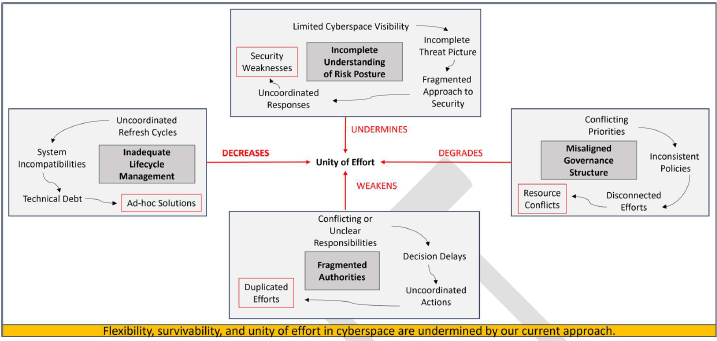
For years, the Marine Corps has operated a collection of purpose-built networks and information systems. While effective for their intended functions, these systems often created information silos, fragmented environments where data could not be easily defended. This stove-piped architecture limits situational awareness, slows decision making, and inhibits the Corps’ ability to fully leverage its information-gathering assets. In a modern conflict, where victory is measured in seconds, these limitations present an unacceptable risk.
The MCCE Convergence Strategy directly addresses this challenge and is IC4’s contribution to Force Design and Project Dynamis Pillar 1. It is not a single program or a new piece of technology but rather a guiding vision for a multi-year effort. The strategy aims to converge the disparate elements of the MCCE into a single, data-centric ecosystem. The goal is to ensure that critical information is visible, accessible, understandable, and trustworthy for any Marine, on any device, in any clime and place. This article, based on the drafted foundational strategy, will outline the core logic, guiding principles, and intended outcomes of this essential transformation.
Defining the MCCE
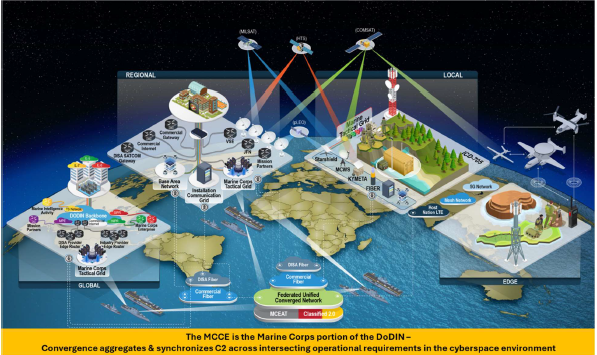
The Marine Corps Information Environment Enterprise is an ecosystem of people, processes, and systems that together provide capabilities that connect users with data to accomplish a mission, unifying organizations, data, and processes across both classified and unclassified networks. The MCCE is the Marine Corps’ specific portion of the larger DOD information network. The MCCE encompasses all Marine Corps information systems used for collecting, processing, storing, and transmitting information on all network classifications, and it includes the cyber elements of the Marine Corps Intelligence, Surveillance, and Reconnaissance Enterprise. This enterprise is composed of various components, including programs of record, tactical networks, the Marine Corps Enterprise Network, extensions to commercial cloud providers, and Commercial Solutions for Classified, among others.
(Figure provided by authors.)
The Strategic Imperative: Why Convergence is Necessary
The modern battlespace is information-saturated. Adversaries employ sophisticated methods to contest the electromagnetic spectrum, cyberspace, and the information environment itself. To succeed, the Marine Corps must achieve and maintain information advantage, a state where the friendly force can exploit a persistent and decisive information superiority over the enemy. The current C4 architecture, however, was not designed for the speed and complexity of this environment.
The Marine Corps’ ability to provide assured command and control (C2) is at significant risk due to a fragmented MCCE management approach. This fragmentation creates a cascade of problems that jeopardize Service-level compliance and resourcing, and it fuels misaligned investments and engineering efforts that hinder operational success. When seconds matter, our forces struggle to share common operating pictures and targeting data, creating self-imposed limitations that our pacing threats are positioned to exploit. This challenge is set to intensify, as departments increase mandates for advanced capabilities, such as artificial intelligence and Combined Joint All Domain Command and Control.
The Vision: A United, Federated Information Environment Poised to Support Global Operations
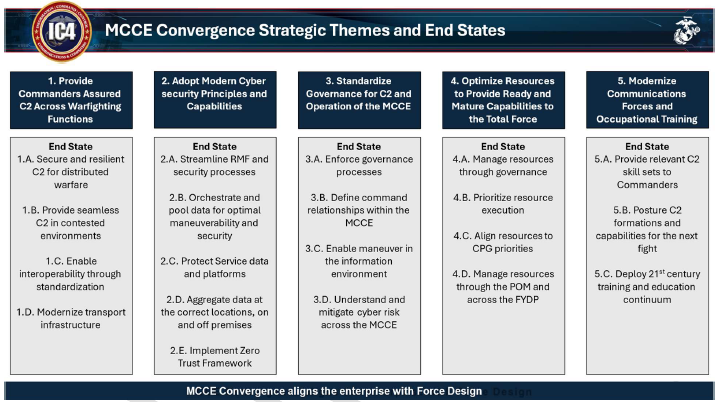
The central vision of the MCCE Convergence Strategy is the creation of a unified digital ecosystem with assured access to capabilities spanning from undersea to orbit. By integrating diverse networks, from garrison to the tactical edge, into a seamless platform, it will connect Marines across every warfighting domain. This comprehensive approach is aligned with five strategic themes.
The Five Strategic Themes
The MCCE Convergence is built upon five interconnected themes that guide its implementation. First, it will provide commanders assured C2 across warfighting functions, enabling rapid decision-making at every echelon. Second, it will adopt modern cybersecurity principles and capabilities by increasing visibility and automation to allow for timely incident response. Third, the plan will standardize governance for C2 and the operation of the MCCE with clear lines of authority. Fourth, it will optimize the application of resources to provide ready and mature capabilities to the total force by realigning personnel and funding. Finally, it will modernize communications forces and training to ensure Marines and their formations are prepared for the future fight.
The Way Forward: End State and Immediate Action
The end state is clear: a unified, federated information environment poised to support global operations. Whether coordinating fires, sharing data, or enabling supporting establishment functions, Marines will have secure, reliable access to the digital capabilities they need to fight and win. While detailed implementation guidance is forthcoming, the work has already begun. Critical initiatives to modernize transport infrastructure, implement the Zero Trust Framework, unify the Marine Corps Enterprise Network, and modernize the communications occupational field and its formations are already being executed to secure immediate gains while the full transformation roadmap is developed.
The ultimate outcome of this strategy will be a Marine Corps that is better equipped for the challenges of the 21st century. By breaking down information silos and creating a united, data-centric C4 ecosystem, the MCCE Convergence Strategy will empower Marines at every level. It will shorten the kill chain, enhance situational awareness, and provide commanders with the information advantage needed to out-maneuver and defeat any adversary. It is a foundational effort that will ensure the Marine Corps remains the Nation’s premier expeditionary force in readiness for years to come.
>As the driving force behind MCCE Convergence, this Information Command, Control, Communications and Computers branch develops the vision, strategy, and policy for future communications, governs the Marine Corps Tactical Grid, and serves as the primary interface between Headquarters Marine Corps and Operational Force Communicators, ensuring MAGTF’s continued command, control, communications, and computers operational effectiveness.


