


2026 AVPLAN
By: LtCol Marianne CarlsonPosted on April 15,2026
Balancing crisis response with modernization for the future fight
“Aviation provides the lion’s share of killing power on the battlefield … we must maximize this critical MAGTF capability.”
—39th Commandant of the Marine Corps, 2026 Marine Aviation Plan
The Commandant’s directive is both affirmation and mandate. Marine Aviation is not a supporting arm of the MAGTF; it is the principal source of combat power that enables maneuver, sustains distributed forces, and delivers decisive effects across the battlespace. In an era defined by contested logistics, precision fires, and persistent sensing, maximizing this capability requires more than platform modernization alone. It demands a deliberate balance between sustaining crisis response readiness today and transforming the Aviation Combat Element (ACE) for the fight of tomorrow.
The central challenge facing Marine Aviation is unchanged but increasingly complex: we must remain ready to fight tonight while modernizing for the future fight. The 2026 Marine Aviation Plan (AVPLAN) deliberately balances these imperatives by sequencing modernization without sacrificing crisis response capacity. It operationalizes distributed aviation operations (DAO) as the central warfighting concept and aligns platforms, sustainment, data, and talent management. The result is a more survivable, more distributed, and more lethal ACE that remains combat credible today and prepared for the future.
Balancing Readiness and Modernization
Readiness remains Marine Aviation’s most important measure of success. The 2026 AVPLAN reinforces funding and prioritization of sustainment, flight hours, and training to ensure mission-capable aircraft, proficient aircrew, and expeditionary enablers are ready to respond to global contingencies. A global presence remains essential for deterrence and crisis response. Modernization efforts described in the AVPLAN are deliberately sequenced to avoid creating capability gaps during platform transitions.
This balance also requires disciplined risk management as we integrate new technologies and operational concepts. The Safety North Star, “26 in 26,” establishes a measurable commitment to reduce Class A through D mishaps by 26 in fiscal year 2026. Readiness and safety are inseparable. As we modernize the enterprise, brilliance in the basics, strict adherence to standards, and engaged leadership remain foundational to sustained combat power.
At the same time, the character of warfare demands transformation. Strategic competition, contested logistics, complex sensing networks, and precision fires require a more agile and distributed aviation enterprise. The 2026 AVPLAN positions modernization as a readiness enabler rather than a competing priority. Through Project Eagle, initiatives are aligned across three Future Years Defense Programs (FYDPs) to ensure coherence, affordability, and operational relevance.
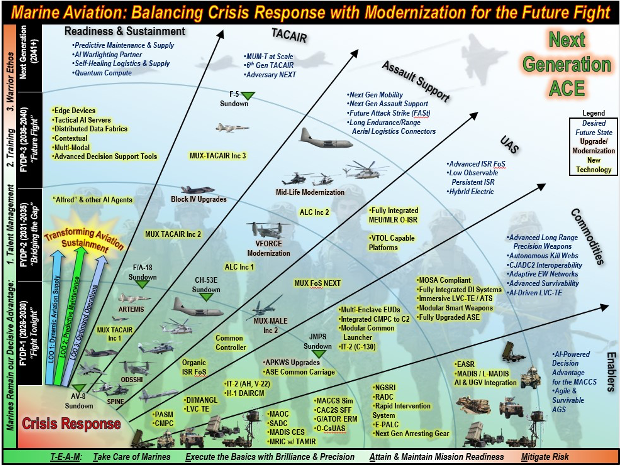
The accompanying figure illustrates this deliberate balance, which depicts Marine Aviation’s progression across successive FYDPs. It shows how platform transitions, sustainment modernization, and next-generation capabilities are sequenced to preserve today’s crisis response capacity while accelerating transformation for the future fight. The visual reinforces the plan’s central premise: Marine Aviation must remain combat credible now while deliberately building the Next Generation ACE required for tomorrow.
Aviation Ground Support: The Backbone of DAO
A defining shift in the 2026 AVPLAN is the full elevation of aviation ground support (AGS) as the seventh function of Marine Aviation. While the 2025 plan expressed intent to codify AGS doctrinally, the 2026 AVPLAN institutionalizes AGS as the backbone of DAO. Expeditionary fuel distribution, airfield damage repair, forward arming and refueling points, and resilient aviation logistics are decisive capabilities rather than supporting enablers. This shift strengthens the ACE’s ability to persist and generate combat power from austere and dispersed locations. By aligning AGS modernization with platform transitions and digital interoperability initiatives, the 2026 AVPLAN ensures sustainment capabilities evolve in parallel with operational concepts.
Transforming Sustainment: From Reactive to Predictive
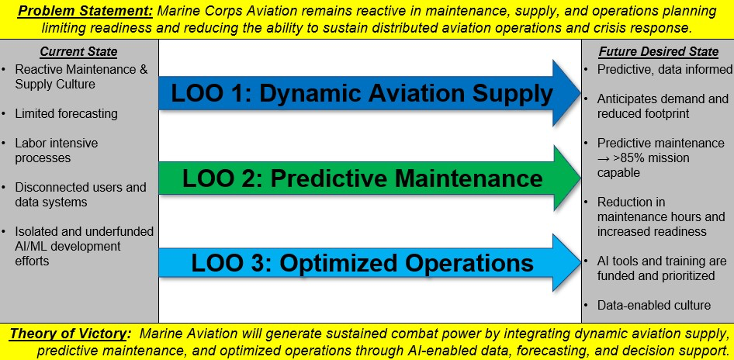
The 2026 AVPLAN marks a fundamental evolution in aviation sustainment philosophy. Where the 2025 plan emphasized traditional sustainment and incremental supply chain reform, the 2026 plan integrates predictive maintenance, dynamic aviation supply, and optimized operations as core components of a transformed sustainment system. These initiatives anticipate readiness trends, reduce downtime, and increase aircraft availability across distributed environments.
The figure illustrates this transformation through three deliberate lines of operation (LOO): LOO 1, Dynamic Aviation Supply, shifts the enterprise from reactive resupply toward demand forecasting, reduced logistical footprint, and resilient distribution networks capable of supporting distributed operations. LOO 2, Predictive Maintenance, leverages AI-enabled data analysis to anticipate component failures, reduce maintenance hours, and increase readiness. LOO 3, Optimized Operations, integrates maintenance, supply, and operational data into a unified decision-support framework that improves scheduling and planning. Together, these lines of operation move Marine Aviation from a reactive sustainment culture toward a proactive, predictive, and data-informed enterprise aligned to the demands of the future fight.
Decision Advantage and AI/ML Integration
Decision advantage is foundational to success in distributed operations. The 2026 AVPLAN elevates artificial intelligence/machine learning (AI/ML) from conceptual discussion to an active modernization effort. Artificial intelligence/machine learning initiatives are now integrated into aviation decision-making processes, consolidating enterprise data, and enhancing operational visualization.
Through decision-centric aviation operations, Marine Aviation seeks to sense, process, share, and act faster than any adversary. The AI/ML-enabled tools reduce cognitive burden on commanders, provide predictive readiness insights, and enable faster, more informed decisions. Data architecture, sensing networks, and Digital Interoperability/MAGTF Agile Network Gateway Link integration receive significantly greater depth in the 2026 AVPLAN, reflecting the increased emphasis on networked warfighting and kill-web integration.
This approach transforms data from an operational byproduct into a decisive warfighting capability. By integrating digital tools across maintenance, logistics, and operations, the ACE strengthens its ability to rapidly close kill webs and operate effectively in contested, denied, and degraded environments.
Platform Modernization and Future Force Design
Platform modernization in the 2026 AVPLAN is more detailed, sequenced, and explicitly aligned with DAO requirements. The Tactical Aircraft Transition Plan advances F-35 integration while deliberately sequencing the sundown of legacy platforms to prevent capability gaps. The CH-53K transition continues, alongside modernization of the MV-22, H-1, and KC-130J fleets. Digital upgrades, survivability enhancements, and expanded unmanned capabilities further strengthen operational flexibility.
The unmanned aerial systems enterprise grows substantially, with increased focus on collaborative combat aircraft and manned–unmanned teaming. Platform roadmaps are tied to distributed operations and kill-web integration rather than being viewed as isolated modernization efforts. Additionally, the 2040+ future force design is more clearly articulated, providing a long-term vision for the Next Generation ACE beyond the immediate FYDPs.
This deliberate sequencing ensures modernization remains coherent and operationally grounded. It aligns resources, capability development, and concept evolution across the aviation enterprise, reinforcing that transformation is cumulative and strategically synchronized.
Marines Remain Our Decisive Advantage
Despite the emphasis on digital integration and advanced platforms, the 2026 AVPLAN underscores that Marines remain the decisive advantage. Mission readiness depends on properly manned, trained, and equipped Marines who execute with discipline and initiative. Talent management, instructor quality, technical training, and leadership development are priorities to sustain world-class aviation professionals.
As new technologies emerge, the plan deliberately aligns subject-matter expertise with these capabilities. Immersive training environments and standardized best practices empower maintenance professionals, aircrew, and support personnel. A culture of trust and a team-of-teams approach strengthens integration across squadrons, wings, and headquarters elements.
Modernization without leadership is fragile. The 2026 AVPLAN reinforces that technology enhances, but does not replace, disciplined Marines capable of exercising judgment in uncertainty. By investing in people alongside platforms and data systems, Marine Aviation ensures its competitive advantage endures.
Conclusion
The 2026 AVPLAN represents the maturation of Project Eagle from strategic blueprint to operational execution. Distributed aviation operations is no longer emerging; it is central. The AGS is no longer aspirational; it is institutionalized and recapitalized. Additionally, AI/ML is no longer conceptual; it is embedded in sustainment and decision-making processes. Platform modernization is sequenced across FYDPs and tied explicitly to distributed warfighting requirements.
Through this deliberate balance, Marine Aviation ensures it remains combat credible today while building the Next Generation ACE required for the future fight. The 2026 AVPLAN and Project Eagle provide the roadmap to do both, strengthening the MAGTF’s principal source of combat power and ensuring that the lion’s share of battlefield lethality remains firmly in the hands of Marine Aviation.
ABOUT THE AUTHOR
>LtCol Carlson is a UH-1Y Pilot. She is currently assigned as the Aviation Strategy and Plans Officer for Headquarters, Marine Corps Department of Aviation.