DESERT SHIELD/ DESERT STORM— Ten Years Later

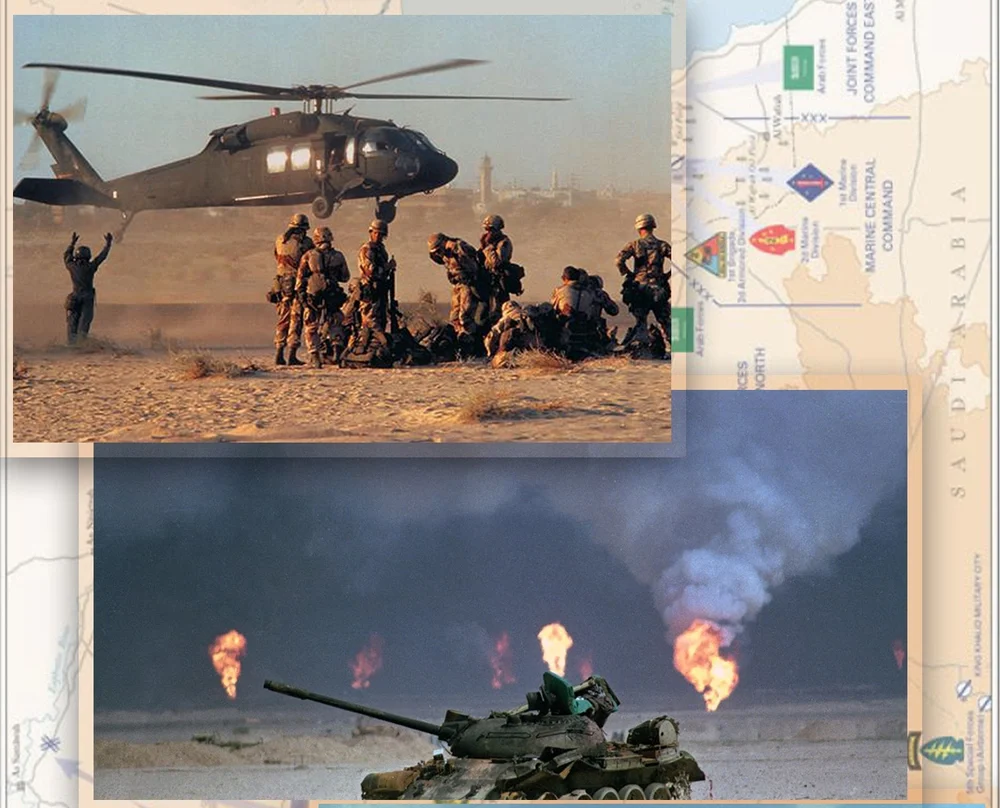
On 1 March the Marine Corps Association sponsored a PME session on the role of the Marine Corps in the Gulf War. The Association assembled a team of officers that had held key billets at the theater, division, wing, force service support group, and amphibious brigade levels. This article records their observations and compares them to the way I MEF does business today.

>Originally published in the Marine Corps Gazette, May 2001. The authors biography is available in the original edition.

Manning
In 1990, the I Marine Expeditionary Force (MEF) staff was not manned, trained, or equipped to be a warfighting staff. The 1st Division was clearly seen as the main effort of the MEF, and 3d Marine Aircraft Wing (MAW) and 1st Force Service Support Group (FSSG) were seen as simply supporting them. Until August 1990, the division commander was also the MEF commander and the component commander. It was only after the changes of command on 8 August 1990 that the MEF and division had separate commanders. Unfortunately, the MEF commander was dual-hatted also as the base commanding general (CG).

The MEF staff was relatively small and not configured to man the current operations, future operations, and plans cells that are standard in today’s MEFs. In fact, there were only six officers in the G-3 shop.

The professional military education (PME) highlighted three points that summarize the MEF’s lack of preparation to be a warfighting headquarters.

• First, the G-2 was not prepared to deal with a battlespace the size that a MEF has to fight. In fact, the G-2 had never heard of intelligence preparation of the battlespace. A team of Army officers came over to train the MEF—while they were on the ground in Saudi.

• Second, the MEF had no fires cell. They had to build one—mostly by taking Marines from the 2d MAW staff.

• Third, the MEF had never fought with a joint force air component commander (JFACC) running the air war for the commander in chief (CinC). All involved had to learn the procedures for getting the MEF aviation into the fight.

Corps Troops
A U.S. Army Corps has “corps troops” that provide the essential command and support functions necessary to fight at the corps level. They include a signals brigade, intelligence brigade, military police (MP) brigade, corps artillery headquarters (for counterfire role), corps support command, and other assets essential in multidivision operations.

In 1990, I MEF had only a single communications battalion, a radio battalion, an intelligence company, no MPs, no force artillery headquarters, and an FSSG that was really configured to provide direct support for the division rather than general support for a corps.

Today, Marines understand the need for corps-level troops and have planned accordingly. However, we have not bought significantly more structure. We can only get the number and type of corps units needed by drawing from all three Active MEFs, Marine Forces Reserve (MarForRes), and the Navy and Army Reserve/Guard units. To execute our operation plans (OPlans):

• MEF-level communications requires both 9th Communications Battalion and 6th Communications Battalion.

• The MEF requires assets from all active intelligence battalions, the radio battalions, Active and Reserve force reconnaissance, unmanned aerial vehicles, and the intelligence elements of MarForRes. Yet, a MEF has significantly fewer intelligence assets than an Army Corps or Numbered Air Force.

•  I MEF is working with the Navy to establish a I MEF engineering group led by commander, 3d Naval Construction Brigade (NCB– Seabees). 3d NCB is composed mostly of Reserve battalions with an active duty nucleus. It provides the two star commander and staff necessary to deal with the extensive general support engineering assets (a division-sized organization) the MEF requires.

• The MEF force artillery headquarters is 14th Marines. Although currently configured as a divisional artillery regiment, it is working through the challenges of being the force fires headquarters for I MEF.

• MPs remain in short supply. Although II MEF is testing the concept of forming a single “functional” battalion by consolidating the MPs from the entire MEF, this represents a very small capability compared to the MP brigade assigned to an Army corps.

• The I MEF Augmentation Command Element provides Reserve staff augmentation, liaison teams, and a deployment support group to fill out the MEF staff. In addition, they provide the tactical headquarters for the rear area operations group that fights the MEF rear area battle.

Compositing
Compositing was one of the key issues identified by every speaker except the CinC staff member. (Compositing is defined as merging several organizations to make a single command. Task organization is defined as attaching and detaching complete organizations to existing headquarters.) All speakers agreed that in 1990 no doctrine or plan existed for compositing the Marine expeditionary brigades (MEBs). At that time, the Corps thought in terms of fighting MEBs and had full-time MEB staffs that were nearly as large as the very small MEF staff. An even greater problem was that while everyone knew you cannot fight multiple MEBs, they also knew that compositing meant entire units went away. The Marines of each MEB, like all Marines, had become very attached to their organizations. If the MEBs composited, organizational flags had to go away. General officers who had worked an entire career to command at this level were not anxious to see their commands go away just as the war started.

Since there was no plan, Marine commanders and staff were exploring options on the fly. One option, which was actually discussed, was to build a composite Marine division “Saudi Arabia” out of the 3d Marines (Hawaii maritime prepositioning shipping (MPS)) and 7th Marines (Pendleton MPS) with the division staff a combination of the elements of the brigade staffs and augments. In other words, rather than using the existing, organized 1st Marine Division staff, we actually considered building a new staff from scratch. Under such a plan, it is unclear how we would create a headquarters and service battalion and all its elements—communications company, motor transport company, MP company, reconnaissance company, and headquarters company. Fortunately, wiser heads prevailed and the division headquarters was brought over, intact, to conduct the fight.

The wing tried a different approach to compositing. The wing commander decided to beef up his first deployers, the Marine aircraft group (MAG) staff that deployed as part of 7th MEB. Then when the wing CG deployed, he brought only a small staff element with him and fell in on the MAG staff. Unfortunately, by the time the wing CG arrived with only 10 staff members, the augments he had sent ahead with MAG–70 had become critical members of the MAG staff and were fully employed running the MAG. The wing staff had to be rebuilt in theater.

In contrast, task organizing was not as difficult for the squadrons and groups due to Marine Aviation Weapons and Tactics Squadron One (MAWTS–1). MAWTS–1, as the lead trainer and developer of aviation tactics, had developed and taught standing operating procedures (SOPs) and tactics to each class. These standards had spread throughout the Corps. Therefore, it was much easier to composite squadrons into groups and groups into the wing than it was to rebuild the wing staff and headquarters.

The FSSG faced a somewhat different problem. Since they do not fight in their peacetime battalion structure, they must always composite. However, in peacetime, they usually composite from units in their own FSSG to support exercises such as the Combined Arms Exercise.

In Saudi, 1st FSSG had to initially composite from 1st Brigade Service Support Group (BSSG) from Hawaii, 7th BSSG from southern California, and 31st Marine Expeditionary Unit’s (MEU’s) service support group from Okinawa. To smooth the process, the FSSG CG went around and talked to each unit. He knew no one would like compositing, so he thought it was important that he explain the reasons for it. He then had to do it again when 2d FSSG showed up and had to be composited. At that time, 2d FSSG took on the role of general support while 1st FSSG took on the role of direct support to the divisions—obviously the assets had to be redistributed.

The 4th and 5th MEBs, being amphibious, faced even greater problems. They decided that compositing at sea would not work. In the future, Marine forces will have to composite before embarkation or download in theater, composite, and reload. Keep in mind that this will require concurrence from the Navy so that we have parallel Navy commands. This has significant implications for expeditionary maneuver warfare concepts.

A final caution was given for commanders and staff officers involved in a compositing process. Ensure you do not offend the commanders and staff members of the organizations being absorbed. You will have to work with them in their new jobs, and they may well end up on the staff of your next higher headquarters.

The consensus clearly was that compositing did not go smoothly and is not likely to do so in the future.

Today, with the advent of the embedded MEB staff, we do not really composite at the MEF level. Since the MEB is embedded in the MEF, when the MEF moves forward to reinforce the MEB, the MEB headquarters is simply reabsorbed into the MEF. All staff officers return to their regular MEF staff jobs, and the MEB CG becomes deputy CG of the MEF. Just as important, the key elements of communications, intelligence, etc. are reabsorbed into their parent units.

There are still two issues of concern for the MEF headquarters. First, the staff will require extensive augmentation which must be sourced worldwide. Therefore, at the same time the MEF is dealing with deploying and employing forces, it must absorb and train new staff members. In addition to staff augmentation, the Marine Corps will have to provide significant staffing to the JFACC, joint force land component commander, joint force maritime component commander, and the various coordinating boards run at those levels. Fortunately, we train for this during major exercises and have worked out the basic procedures.

Second, given that the MEF lacks sufficient “corps troops,” these elements will have to absorb forces of similar types from the other MEFs, MarForRes, Navy, and even Army Reserve and Guard forces. We practice this selectively in exercises but, unfortunately, we cannot afford to exercise entire units.

Like the MEF, the major subordinate commands will also have to absorb additional staff members to bring their staffs to wartime strength.

For the wing, MAWTS-1 continues to provide a common base to assist with the integration of squadrons and groups. At the wing headquarters level, regular participation in MEF-level exercises identifies the augmentation required. Often these requirements can be filled by Reserves during exercise. However, the regular augmentation normally comes out of the wing units. In wartime, these Marines will deploy with their units, and the billets they fill in exercises will have to be filled by active duty Marines from all over the Corps.

For division and FSSG, task organization remains a challenge. Current strategic lift limitations mean that the division and FSSG will be composed of elements from all four of the divisions and FSSGs in the Corps. The division and FSSG headquarters will flow intact but must be heavily augmented from worldwide sources. In addition, the regiments and battalions working for them will have to task organize based on the forces provided in the force flow.

Amphibious compositing remains a challenge. However, the OPlans designate the headquarters and forces for each plan. Thus we should not embark extra headquarters. The regiments, groups, and logistics elements know who they will be working for in the OPlans and can embark accordingly.

No Deliberate Plan or TPFDD
At the time the war started there was no written plan. The CinC had conducted an INTERNAL LOOK exercise early in the summer, but most of the Marines who had participated in that exercise departed in the course of the normal summer rotations. This, combined with the turnover of key commanders, meant the MEF had virtually no one with a good grasp of the plan or the theater.

The lack of a plan meant there was no bed down plan, no force modules, and no time-phased force and deployment data (TPFDD). This created a number of problems. Some are very obvious, such as Marine aviation elements being sent to Saudi with no idea where they would bed down. Others are not so obvious, such as sending too many “gunfighters” and not enough sustainers. Since the forces were not in “packages” that flowed combat forces with their combat support and service support, we had Marines who were thirsty, hungry, and out of gas. In fact, since the CinC stated he wanted gunfighters first, the MPS ships had to supply not only the Marines but the 82d Airborne, elements of the 24th Mechanized, and the 101st Air Assault Divisions until early October. In addition, the Air Force had not planned to provide tanker support for Marine self-deploying aircraft. This created a long delay in the deployment of Marine aviation.

The FSSG commander, who was in-country early, wanted force modules so that the forces arriving could be sustained as they fought, but with the Worldwide Military Command and Control System, it was not possible.

Today we have mature TPFDDs for all current OPlans. Even more important, the forces in the TPFDD can be divided into force modules so, in the event of an unplanned crisis, we can send a balanced, sustainable force immediately.

Operational Planning
Once the forces were deployed, the planning process created different challenges for the MEF. The war was being planned in three places—the Secretary of Defense’s office, the Chairman of the Joint Chiefs office, and in theater. Complicating the overlapping efforts, the final plan could not be written until November when the National Command Authority finally added VII Corps out of Europe.

Despite extensive planning effort, the divergent philosophies of the air planners and the ground planners resulted in different approaches to the fight. The air campaign was tasked to set conditions for the ground campaign. However, the Air Force planners were working under Col Worden’s “Concept of Five Rings.” Therefore, the Air Force focused on the inner rings with intent to win the war with airpower. It was only Army and Marine complaints that gave birth to the Joint Targeting Coordination Board so that all components got their voice in targeting and the deputy CinC made decisions for CinC, not for JFACC.

The consensus of the participants in the PME was that there probably should have been a ground component commander with Marine and Army staffing to coordinate the ground campaign.

A major deficiency from the Corps’ point of view was a lack of Marine planners at the CinC level. GEN Norman H. Schwarzkopf brought in a team of U.S. Army School of Advanced War‑
fighting graduates to plan the ground campaign. The Air Force brought in a plans cell to plan the air war. There were no Marine planners in either cell.

Today, there are Marine planners on the CinC staffs. In addition, the component and the MEF send liaison teams to the next higher headquarters. Finally, the joint community has come a long way in both planning and execution with future operations cells, plans cells, and joint boards for targeting and intelligence collection.

Component Lessons
In 1990, the MEF commander was dual-hatted also as the component commander; however, the Corps had no doctrine, tables of organization or equipment for a component commander. Quite frankly, we did not know exactly how a component should function.

Early on, the Marine Corps had no representative at the CinC’s forward headquarters in Riyadh. Unfortunately, key decisions were made during this period. One of the outcomes was that I MEF had no battlespace assigned. It had a strip of land 12 kilometers wide along the coast of Saudi Arabia but did not own the airspace above it. In addition, host-nation support was divvied up before Marines had a significant say in the process with the obvious results. The MEF would spend the rest of the time in Southwest Asia trying to recover from this early oversight.

Even when I MEF did send a team to the CinC’s headquarters, it consisted of a single brigadier general, his aide, his driver, and one Arabic speaking major. Due to the culture of the other Services, the MEF still could not participate in the key decisions because all key decisions were made at the three star level. In the other Services, it is rank not billet that gets one into key discussions. Both the Army and Air Force had three star generals to attend. I MEF could not get to the three star table until LtGen Walter E. Boomer arrived in country.

Fortunately, we have come a long way in learning what componency entails. CG, Marine Forces Pacific (MarForPac)/Marine Forces Central Command (MarForCent) is the Marine component commander for the current major theater war OPlans. This will give us a three star officer and his staff at the component level from the very beginning of any conflict. Further, this staff participates in peacetime exercises and as a result knows their counterparts at MEF and the CinC staffs.

Unfortunately, the MarForPac/MarForCent staff remains a very small staff with very limited assets for such a major task. They will require extensive augmentation to execute both their deployment functions (working for CinCPac) and employment functions (working for CinC United Nations Command [Korea] or CinCCentCom).

One major improvement came as a direct result of the Marine Air-Ground Task Force Staff Training Program (MSTP) and the evolution of the MEF as a warfighter. Staff officers at the component and MEF level understand the MEF requirements for battlespace, logistics support, communications assets, etc., and are prepared to engage the CinC staff from the very beginning of any crisis.

FSSG Lessons
One of our deficiencies prior to the Gulf War was the lack of recognition of the requirement for two levels of logistics—tactical and operational. Prewar, Marines focused on tactical logistics—direct support to the division and wing. Unfortunately, we had not considered the operational-level requirement to coordinate and execute logistics across the theater.

During DESERT SHIELD, the FSSG worked it out on the ground by developing direct support and general support organizations. Since the war, this concept has been refined with the designation of a Marine Logistics Command (MLC) for each OPlan. The MLC will work directly for the component commander and be responsible for Marine logistics up to the MEF rear boundary. While planning and preparation are light years ahead of 1990, creating an MLC still requires taking an FSSG structured for tactical logistics and reorganizing it for operational-level logistics.

Compounding the FSSG’s problems in 1990 was the fact that our supply system simply did not work. The Supported Activities Supply System (SASSY) was a demand-based system and drew its information from peacetime databases. Clearly, demand changed entirely during the high-tempo training of DESERT SHIELD and the short but intense operations of DESERT STORM.

Today, the Corps is attempting to resolve the supply problems with the introduction of the Asset Tracking Logistics and Supply System II+, commonly known as ATLASS II+. Unfortunately, the system is currently funded only for II MEF. In addition, we have not resolved the problems of interfacing with the Marine Integrated Maintenance Management System and SASSY. The Corps hopes to solve these problems by transitioning to a web-based system.

The MPS concept proved brilliant in providing sustainment stocks immediately. Unfortunately, the concept was not executed well. We had no asset visibility for the stocks offloaded. It was taking one full manday to pull an item from the stocks. Marines literally had to open containers and find out what was in them. As a result, FSSG had to shut down supply operations for 10 days to rewarehouse the material from the containers to warehouses.

Even worse, the supply system was not credible to the Marines of the MEF. No one trusted it, therefore, everyone created their own parts block. When MPS units left southern California, they took most of the SL–3 components, tools, sets, and chests because they didn’t believe they would be there when they arrived. This not only greatly increased the lift footprint but also gutted the remain-behind equipment (RBE) that is an essential part of mobilization. Once in country, the hoarding continued. This resulted in shipping in more of everything because each unit kept extensive unit-level stocks.

Another point stressed during the PME was that there are things we do in garrison that we cannot do in the field. In combat, the FSSG must focus on getting fuel, water, ammo, and chow forward. We did not do as well on services such as post exchange (very important to tobacco users) and mail (up to 130 tons a day that would not have been delivered without the 60 doctors and nurses from Fleet Hospital who volunteered to help sort mail). Commanders must be ready for this deficiency.

A critical shortage was line haul transportation. While inter-Service agreements state the Army will provide this support, they are short of transportation assets themselves. Fortunately, the FSSG was able to contract “Saudi Motors” to fill this deficiency.

PME participants thought we should never do a major rebuild in the field—it creates too many problems. Instead, we must evacuate the component from the forward area to a support area with permanent buildings and rebuild it there. This will actually be faster and more reliable. The key requirement to execute such a plan is the availability of intratheater air.

The final comment was that we had too much equipment, too many echelons of maintenance, and too much stuff automatically delivered to the theater via the prepositioned war reserve program. To reduce these problems, we need to first reduce the number of echelons of maintenance. Next, we need to develop better logistics command and control in FSSG so we can see what we need, request only the needed material, and then track it in transit.

Today, the MLC remains one of the biggest unresolved questions in our OPlans. The functions it provides are vital, yet it is an additional duty to an already overtasked FSSG. We have developed the concept but are just beginning to test it in exercises.

Wing Lessons
In 1990, the 3d MAW was very good at deploying squadrons in support of the special operations capable MEU, or MEU(SOC), and unit deployment programs (UDPs). This was the wing’s mission, and they focused on it. Frankly, the wing did not train as a wing. At the time, the wing staff did not practice operating out of the tactical air command center (TACC). In fact, the wing G–3 stated that only the 7200s understood the TACC and what went on inside. Upon arrival in theater, the wing had to levy a tax of two officers per squadron to man the TACC. The DESERT SHIELD period provided absolutely essential time for the wing to train to fight as a wing.

The wing deployed with no intention of using an air tasking order (ATO). Quite simply, no one had used a theater ATO to run a war plan up to this point. Needless to say, the CinC’s decision to use the JFACC as his executive agent for the air war and the ATO as the primary tool caused some significant friction between the JFACC staff and the wing staff.

Some of the friction arose from the simple fact the Marine Corps had neither the manning to participate in the JFACC process nor the equipment to receive the ATO in digital form. 3d MAW developed work arounds to both problems but, again, the long preparation period prior to the war was essential.

One of the key inter-Service disagreements was how to measure success in use of aviation assets. The Air Force tends to measure efficiency and expresses it in terms of number of sorties generated. The Marine Corps measures effectiveness in terms of targets eliminated and sorties executed in support of the MEF. During the war, this created friction when the Air Force planners complained that the Marine sorties scheduled for close air support (CAS) but not flown should have been declared excess to the JFACC. The Air Force planners did not accept the idea that keeping aviation available for immediate response to the maneuver commander’s needs may be the most effective use of aviation.

A partial solution was the use of a CAS stack over each division. Aircraft moved to the CAS stack and loitered until employed. If not employed, they waited until relieved by the next section of CAS. They then moved forward to the “kill box manager,” who was fighting part of the MEF deep battle. While the Air Force agreed with the kill box concept, they did not like the idea of a kill box manager. They saw this as a diversion of aviation assets since the aircraft were controlling rather than striking. In contrast, 3d MAW saw the kill box managers as a very efficient and effective use of the sorties. The F/A-18D crews maintained situational awareness over the battlefield where they could quickly guide other Marine aircraft onto targets.

As mentioned in the section on componency, airspace was apportioned before I MEF arrived in theater. Therefore, I MEF did not own airspace over the divisions. To ensure Marine aviators were still able to respond quickly to Marines on the ground, 3d MAW kept aircraft airborne just off the coast. This was clearly a point of pride for Marine aviators.

Some other anomalies that created problems for the wing were:

• Separate rules of engagement (ROE) for over land and over water. The CinC never established a single theater ROE for aviation.

•  A high-density airspace control zone was created to give Marines airspace over the divisions. However, JFACC would change it arbitrarily—3d MAW operators had to look at the special instructions each day to find out exactly what the altitude was.

• The “green” computers did not work. Since they were much slower, more expensive, and used proprietary software, they were not used in garrison. Therefore, they couldn’t be used in the war. Fortunately, the “white” computers worked very well. Bottom line recommendation was that when you deploy, use the gear you use in garrison.

• Best dressed, first out! Those squadrons with the most capable aircraft were requested first in the flow.

• The TAVB (aviation logistics support ship) is a great capability but was poorly used. Again, a lack of planning and exercising at the MEF level reduced the effectiveness of this exceptional asset.

• Since this was pre-MSTP, the Corps had not developed the single battle manager concept. As a result, many in the wing had the genuine feelingly that the MEF was “meddling in the fight.”

Division Lessons
The 1st Marine Division had a change of command on 8 August—6 days after the invasion of Kuwait. The heavy summer turnover also transferred almost all key staff members that had participated in INTERNAL LOOK.

Complicating the division’s deployment was the lack of a plan, lack of a TPFDD, the departure of the old MEF CG (which meant there was no base CG to supervise the absolutely critical base deployment support functions), and the uncertainty of whether the division was even going to deploy.

Like the wing, the division was also skilled in deploying battalions and detachments in support of the MEU(SOC) and UDP programs. They had not planned or trained to deploy the whole division. In the haste to get out of town, the division left the RBE in bad shape. Unfortunately, stripping the RBE slowed the deployment of the Reserve elements which had to draw the RBE as their “going to war” gear.

One thing the division discovered quickly was that Marine and Navy wives were critical to solving problems. Many Marines left their families without cars, driver’s licenses, paychecks, etc. The fact that there were no disgruntled Marine wives on TV complaining about the lack of support was due to efforts of other wives.

Upon arrival, the 1st Marine Division was given time to train in the desert. While the division headquarters finally deployed as a unit, the regiments had to task organize. Tanks, assault amphibious vehicles, light armored infantry (LAI), and engineers had to be integrated into regimental-sized tactical organizations. In addition, most infantry regiments had battalions from other regiments assigned to them. Each organization had to refine its SOPs and ensure that those battalions/companies joining from outside the regiment were familiar with them. The 51/2 months of training made the forces very tight. In fact, the relationship between LAI and the Cobras saved the lst Marine Division’s headquarters the night of the counterattack.

One tool the division commander used to smooth the integration of battalions into other regiments was a task force name. While the Marines from 1/5 might not think of themselves as part of 7th Marines, they did think of themselves as part of Task Force Ripper.

The divisions had to work out SOPs  and procedures for tactical evolutions not addressed in peace-time training such as a regimental-level breach of an obstacle belt. Even the mechanics of terrain management for force lay down had to be worked out—for both sides of the breach.

The panelists cautioned today’s commanders to make sure they have air/naval gunfire liaison company (ANGLICO)-type units with any coalition forces next to them. In 1990, Special Forces provided liaison teams to the Saudis but were suddenly pulled out for “higher priority” missions. Fortunately, ANGLICO teams were with the Saudis the entire time so there was no break in communications between the Saudis and us.

Other items the presenters felt might be helpful to future commanders were:

• The use of artillery raids covered by Marine air, conditioned the Iraqis to be afraid of Marine air.

• The biggest problem in-country was communications. 1st Marine Division was spread out over 100km from nose to tail during the fight. 3d MAW provided a C–130 for communications relay. In addition, the division put a lieutenant colonel from division staff, who was intimately familiar with the plan, in the aircraft and invited the C-130 crew to all division sand table briefs.

• Commands must practice mobile command post (CP) operations. 2d Marine Division needed 2 trucks and 38 other vehicles for their forward CP.

• Once the fight started, 3d MAW provided the only reliable information from outside division concerning what was in front of the divisions.

• Do not bypass company-sized units, they caused too much disruption for CPs and logistics units following. Bypass platoon and below.

• Artillery units can not lift basic allowance (BA) of artillery ammunition with the designated ammunition trucks. The batteries had to take everything else out of every vehicle to move the BA.

• Personalities count! Don’t create friction by the people you place in key roles.

• The best intelligence the divisions received prior to the start of the war was a brief by LtGen Bernard E. Trainor, USMC(Ret). It was based on his observations of Iraqi forces as a journalist during the Iraq-Iran War. The key observation was that Iraqi units will fight if you attack from the front. They would not fight if you attack their flank or rear. Combat engineers were the Iraqis best combat arm. Artillery was the next best. Iraqi tactics called for building obstacles to keep the enemy in a fire sack then destroying them with artillery. The divisions used this information to develop their plans.
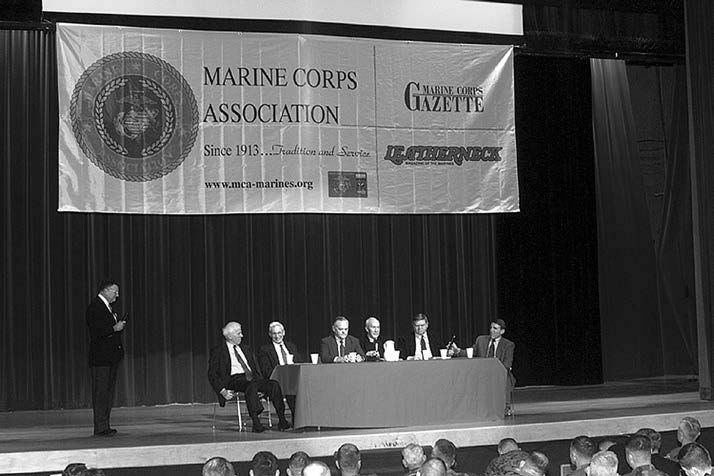
From left to right: LtGen Trainor, Gen Dake, LtGen Brabham, MajGen Jenkins, MajGen Myatt, LtGen Keys, and Gen Neal.

Amphibious Forces
The presenter noted that only 13 amphibious ships were provided per MEB. This is the same number for a MEB in today’s OPlans. As a result, each MEB needed an additional five foreign roll-on/roll-off ships to load the assault follow-on echelon. Then, since they had no instream offload capability, the MEB had to download in Jubayl and reload on MPS ships that had been withheld from the common user pool. This process took 6 weeks.

To simplify operations, big deck amphibs were designated for specific aircraft types—Harriers, CH–53s, CH–46s, and AH/UH–1s. This greatly improved both operations and maintenance.

The full MEB and amphibious group headquarters would not fit on an LPH or LHA. As a result, they had to create alpha and bravo command groups on different ships.

The MEBs never received an initiating directive or establishing directive. They were just told to load and go. They could not be combat loaded because they didn’t have a mission. Further complicating the planning was the fact that 4th MEB had to transit in three different groups because only four ships at a time could load at Morehead City, NC. Finally, the commanders could not communicate between groups as they crossed the ocean.

Command relations created additional problems. 4th MEB, 5th MEB, and 13th MEU had to work for the naval component (Fifth Fleet). Unfortunately Fleet staffs have very few amphibious sailors or Marines on the staff. The planning process simply did not go smoothly until the Marine Corps put a general officer and six-man staff at Navy Central Command (NavForCent) headquarters. Even this did not solve all of the problems since that general and his very small staff were also the liaison between MarForCent and NavForCent.

Summary
Since 1990, the concept of the MEF as the warfighter has matured in our Corps. The combination of the MSTP and major exercises such as ULCHI FOCUS LENS and INTERNAL LOOK have  taught our MEFs to function as single battle managers. The same factors have driven the learning and growth of our Marine components. Out of necessity, I MEF has integrated the Reserves into all major MEF exercises and is a better warfighter because of it. Finally, the Corps is now a full player in the deliberate planning process and ensures Marine forces have the lift to get to the fight and the battlespace to fight as a MAGTF when they get there.

Clearly our doctrine is good and getting better. Our training has improved dramatically. Yet this PME reminds us that we still have areas that need work. Our Corps has solved many of the problems I MEF encountered in 1990 but not all of them. The speakers at the PME provided the guidance and the challenge, it’s up to today’s Marines to accept it.

>At the conclusion of the PME, LtGen Trainor, as moderator, asked each presenter to provide a single piece of advice to Marines who may have to fight a MEF in the future. This is what they said.

• Gen Richard I. Neal: Be doctrinally sound but not bound. Flexible and adaptable. Know doctrine of guys on right and left.

• LtGen William M. Keyes: Small unit leadership remains heart of Corps. NEVER think we will get another fight with so few casualties.

• MajGen James M. Myatt: Study your profession. Don’t try to do other guy’s job. Trust each other.

• MajGen Harry W Jenkins: Teach Navy brothers.

• LtGen James A. Brabhams: Relationships between commanders are more important than command relations.

• Gen Terrance R. Dake: It’s come as you are. Be ready for it.
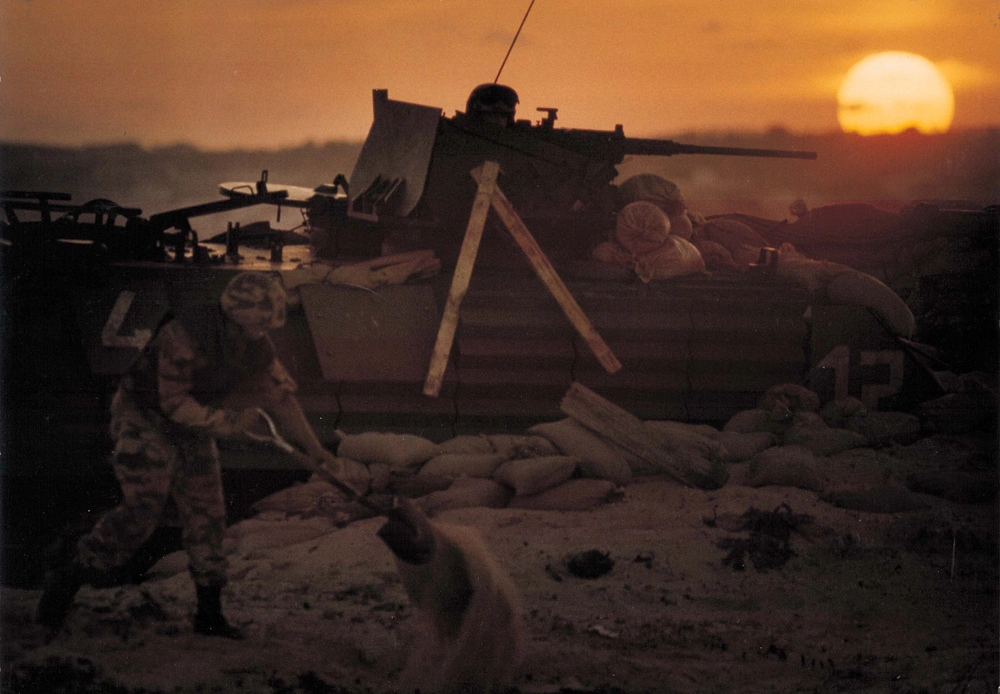
Operation RESTORE HOPE in Somalia

A Tactical Action Turned Strategic Defeat

>Originally published in the Marine Corps Gazette, September 2001. The authors biography is available in the original edition.

‘Me and Somalia against the World, me and my clan against Somalia, me and my family against the clan, me and my brother against my family, me against my brother.’
-Somali Proverb

From 1992 to 1994, U.S. forces deployed to the African nation of Somalia to conduct humanitarian and peacekeeping missions as part of Operations PROVIDE RELIEF and RESTORE HOPE. Initiated during the Bush Administration and continued under the Clinton Administration, the United States undertook these operations in support of a greater United Nations (U.N.) effort. The United States’ primary role evolved into providing security for various humanitarian relief units and agencies while attempting to rebuild the nation’s infrastructure. In short, the United States assumed responsibility for providing the muscle for the operation. An overly ambitious U.N. mandate, coupled with an exceptionally poor command and control apparatus, eventually inhibited the operational commander’s ability to properly shape the battlespace for the introduction of forces at the tactical level. A skilled Somali tribal warlord capitalized on this weakness by confronting U.S. military power asymmetrically, bringing U.S. forces into the close confines of a city he largely controlled. This resulted in an embarrassing, though arguably successful, tactical mission that, in turn, produced a strategic defeat for both the United States and the U.N.

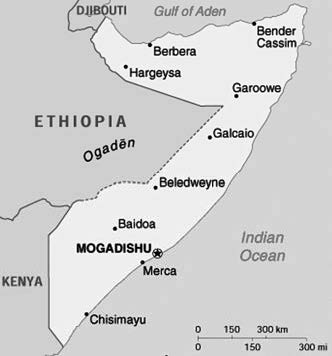
Figure 1. Somalia.

Strategic Setting and Conflict History
Somalia is a landmass of approximately 250 square miles on the Horn of Africa—the northeast coast of that continent. (See Figure 1.) It is 24 hours away from the United States by air, and several weeks away by sea. Mogadishu, the nation’s capital, is a typical Third World city. Normally a city of about 500,000, it had grown to as many as 1.5 million by 1992, due to a refugee problem generated by drought, civil war, and an accompanying humanitarian crisis. The city’s infrastructure is largely inadequate for the size of its populace. Densely filled with poorly constructed concrete buildings, Mogadishu’s overcrowding and poor sanitation have created a breeding ground for disease. Lines of communication (LOC) within the nation are virtually nonexistent. Mogadishu contains the nation’s largest airport, while the entire nation contains just seven other paved airstrips. No functioning telephone or communications system exists in the nation.

Food and water in Somalia are scarce due to the drought that has stricken much of east Africa during the last decade. The situation has generated an
attitude of hopelessness among most of the inhabitants, many of whom seem only to wait for death. Many Somali men are addicted to khat, a mild amphetamine. While some Somalis fish in an attempt to provide for themselves and their families, most seem to have forgotten how to work altogether. Looting and black market activities are commonplace.

Since 1988, a savage civil war between approximately 14 clans and factions that make up Somali society has severely exacerbated the food shortage. For more than a decade, the area was at the forefront of Cold War competition and, as a result, large numbers of individual and heavy weapons were available to the clans. Although Somalis are devout Muslims (in many of the war-ravaged locations, mosques were the only buildings left standing), Somali culture stresses the unity of the clan above all else. Alliances are made with other clans only when necessary to elicit some gain. Weapons, overt aggressiveness, and an unusual willingness to accept casualties are intrinsic parts of the Somali culture. Women and children are considered part of the clan’s order of battle. People of western culture and heritage typically have great difficulty in accepting the Somali view of life. As MG Thomas M. Montgomery, who served as Commander, U.S. Forces, Somalia (USForSom), stated, “It’s impossible for an American mother to believe that a Somali mother would raise children to avenge the clan.”

The most powerful of these clans in Mogadishu, and the largest in all of Somalia, was the Habr Gidr, led by warlord Mohamed Farrah Aideed. Aideed had been educated in both Italy and the Soviet Union. He had served Somalia’s dictator, Mohamed Siad Barre, as Army chief of staff and then as ambassador to India, before leading a coup against him in 1991. Siad Barre had ruled a united Somalia by terror for 20 years. Aideed had worked with other clans to overthrow Siad Barre, but following the successful coup, the Habr Gidr could not consolidate power. Several of the northern clans attempted to secede. With drought conditions worsening and starvation setting in, clan warfare and banditry became commonplace. Pillaging and looting became methods of survival, and most of the young Somali men were “guns for hire.” Somalia sank into total anarchy. By early 1992, more than one-half million Somalis died of starvation with at least one million more threatened.

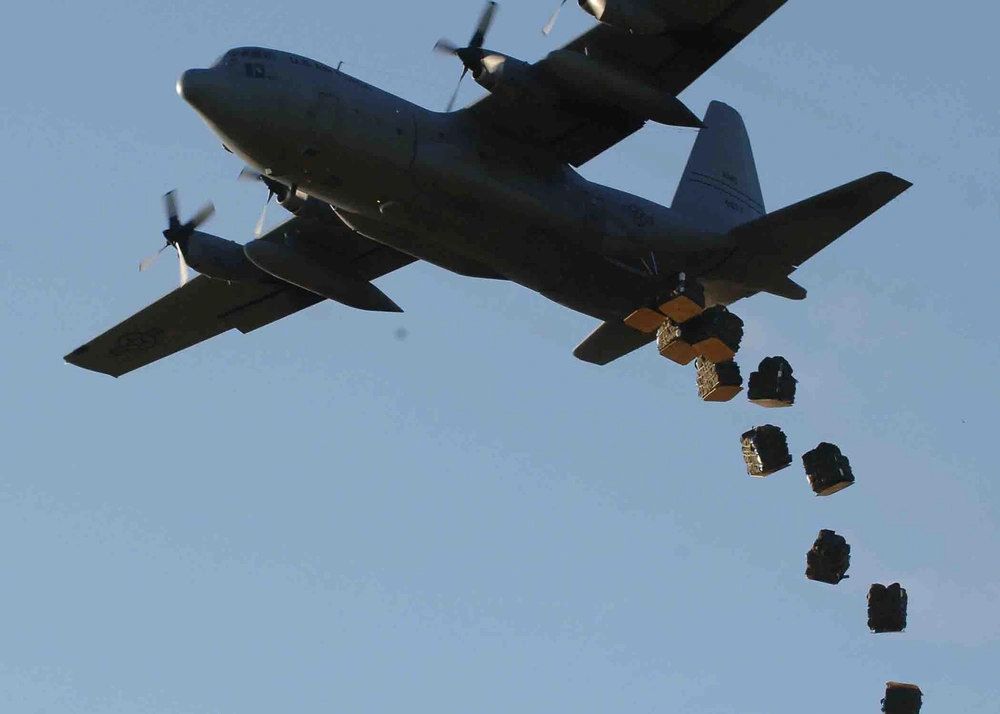
Recognizing the human tragedy ongoing in Somalia, in April 1992, the United Nations Security Council adopted Resolution 751, establishing United Nations Operations in Somalia (UNOSom). UNOSom was tasked to provide humanitarian assistance and to “facilitate” the end of hostilities in Somalia. It soon became evident, though, that not enough food, water, and medicines were making it to the people who needed it. Instead, bandits and the warring Somali clans were stealing and confiscating the relief supplies. The 50 UNOSom observers could not fulfill their mission alone, prompting the U.N. to request assistance from the United States. The Bush Administration responded by initiating Operation PROVIDE RELIEF that lasted from 15 August through 9 December 1992. This operation, predominantly an Air Force effort, airlifted food into Somalia from the neighboring nation of Kenya. Commanded by BGen Frank Libutti, PROVIDE RELIEF brought more than 28,000 metric tons of desperately needed supplies into Somalia.

Nevertheless, by December 1992, it was clear that the combined U.S. and U.N. effort was still insufficient to protect the humanitarian effort as bandits continued to inhibit relief distribution. In order to mitigate the disaster, the United States would need to commit ground forces to provide security for international relief distribution points. Subsequently, on 3 December 1992, the U.N. passed Resolution 794, stipulating that the United States would both lead and provide forces to a multinational coalition titled the United Task Force, or UniTaf. To fulfill this role, on the following day President Bush announced the initiation of Operation RESTORE HOPE, under the command of Marine LtGen Robert B. Johnston. The UniTaf and RESTORE HOPE combined the humanitarian relief mission with purposeful, limited military action to ensure the security of the relief effort. Both the United States and the U.N. intended that these operations would be of short duration and that the United States would pass its responsibility back to UNOSom once the situation was stabilized.

UniTaf remained in existence from 9 December 1992 through 4 May 1993, and involved more than 38,000 troops from 21 nations (including 28,000 Americans). Leading the UniTaf, U.S. Marines initiated the operation with an amphibious assault as a show-of-force demonstration. The effects of this highly publicized, predawn landing were somewhat compromised by the barrage of western reporters spotlighting Marines on the beach. Nonetheless, the Marines followed up with a series of quick, decisive, and largely unopposed air and ground tactical maneuvers that seized key terrain in and around Mogadishu. The fact that the major warring factions agreed to an armistice within 2 days of the initial landing proved the Marines’ effectiveness in establishing operational dominance in the region.

On 13 December 1992, the Army’s 10th Mountain Division (Light) joined the Marines in Mogadishu and along with other U.N. forces, moved to secure relief distribution facilities in established humanitarian relief sectors (HRS). The UniTaf created the HRS to provide command and control boundaries between the participating units. Within these HRS, U.N. forces were responsible for supporting and providing security to various nongovernmental organizations (NGOs). The focus during this period was to disarm the Somalis, to include locating and seizing arms caches, as well as encouraging the Somalis to voluntarily turn in their weapons. As a result, increasing amounts of relief supplies were successfully distributed throughout the nation, curtailing starvation in many areas.

The UniTaf, under the leadership of LtGen Johnston and U.S. Ambassador to Somalia, Robert Oakley, made it a point to actively work with the various clan leaders as the only recognized leadership in the country. Then-MajGen Anthony C. Zinni, who served as UniTaf’s director of operations, later explained UniTaf’s reasoning when he stated:

Everybody with some degree of authority, even if it’s out of the barrel of a gun, you’d better give them a forum in which to bring their case. When they’re isolated, there’s no recourse other than to violence.

They ensured that their disarmament efforts were done in such a way as to avoid embarrassing or provoking them. During an interview, MajGen Zinni further noted:

Our headquarters was in [Aideed’s] area, Mogadishu, our main logistic lines and bases, the air base and the airfield, and the port were in his area of control, so it was very important that we had him cooperating, especially in the beginning.

Zinni recalled that, because the U.S. actively engaged Aideed, he often assisted U.S. operations by offering advice:

… he would tell us, ‘Don’t just go out to the hinterlands unannounced. You may have an unintended clash with the militia or a group out there. Make sure they know you’re coming and the purpose of your visit. It will prevent any unintended violence. Come with NGOs … with food, so they look at you as not just another gun club out there, but associate the food and medicine with you so you’re there for some positive purpose.’

Largely because of this engagement strategy, the UniTaf succeeded in its missions of stabilizing the security situation to facilitate humanitarian relief. Prior to its departure, the UniTaf also worked with the 14 major Somali factions to agree to a plan for a transitional or transnational government. Realizing the importance of the large U.S. contribution, U.N. Secretary-General Boutros Boutros-Ghali repeatedly delayed the termination of UniTaf in hopes of effectively disarming the Somalis and creating conditions conducive to nation building. Ali Mahdi, leader of the Darod clan (the clan of former dictator Siad Barre), and several other leaders of smaller clans were enthusiastic about the U.N.’s nation building efforts, but Aideed was determined that power would not be shared. Aideed felt that his Somali National Alliance (SNA), comprised of the Habr Gidr and three allied Somali clans, had earned the right to rule the country since they had borne the lion’s share of risk and pain in overthrowing Siad Barre. The Habr Gidr was highly distrustful of Boutros-Ghali. A long-time enemy of Aideed, Boutros-Ghali had worked against the SNA’s revolutionary movement when he was an Egyptian diplomat. Accordingly, the Habr Gidr believed that Boutros-Ghali was attempting to restore the Darod to power. Thus, many Somalis questioned Boutros-Ghali’s legitimacy from the beginning.

With the United States impatient to withdraw its forces, Boutros-Ghali finally acquiesced, and Security Council Resolution 814 formally created UNOSom II on 26 March 1993. This resolution comprised the first U.N.-directed peacekeeping operation under the Chapter VII enforcement provisions of the U.N. Charter. It required the UNOSom II forces to disarm the Somali clans while providing humanitarian relief and conducting significant nation building and peace enforcement tasks. Special Representative of the Secretary-General Jonathan Howe, a retired U.S. Navy admiral, headed UNOSom II, while Turkish Gen Cevik Bir served as the commander of the U.N. multinational contingent. The majority of American forces within Somalia soon redeployed home. Just 4,500 American troops remained in the country, now under the command of MG Thomas M. Montgomery, USA, as Commander, USForSom. Over 3,000 of these troops were logistics support personnel, but they also included approximately 1,150 soldiers from the 10th Mountain Division who were designated as UNOSom II’s quick reaction force (QRF). The QRF would assist UNOSom II in military operations that were beyond the latter’s capabilities. MG Montgomery operated under two chains of command, serving as the U.N. military forces’ deputy to LtGen Bir, while remaining under the command of the commander in chief, U.S. Central Command (CinCUSCentCom), Marine Gen Joseph Hoar.

ADM Howe and LtGen Bir adopted a philosophy and operational strategy very dissimilar from that employed by their UniTaf predecessors, Ambassador Oakley and LtGen Johnston. Instead of engaging the clan leaders, Howe attempted to marginalize and isolate them. ADM Howe ignored Aideed and the other clan leaders in an attempt to decrease the warlords’ power. Disregarding the long-established Somali cultural order, the U.N. felt that, in the interest of creating a representative, democratic Somali Government, they would be better served by excluding the clan leadership. The policy reeked of arrogance coupled with cultural ignorance.

Consistent with this strategy, U.S. operations became increasingly aggressive under the U.N. mandate. American and other U.N. forces conducted several air assault operations to deny the warring factions freedom of movement by securing key points in and around Mogadishu. U.S. force protection concerns escalated when a sniper killed a U.S. soldier. When a convoy of technicals (civilian pickup trucks mounting machineguns) attempted to enter a restricted area in the town of Kismayo, the Army used firepower as a means of force protection by destroying it with a flight of AH-1 attack helicopters. Many Somalis began to view the U.N. forces, and particularly the U.S. forces, as a direct threat instead of an impartial mediator and legitimate stabilizing force. As Aideed saw it, ADM Howe was subordinating the U.S. forces to his nemesis, Boutros-Ghali. Somali antagonism toward the Americans grew proportionally with the increasing U.S. willingness to restrict native movement and enforce these restrictive policies with lethal fires. U.S. forces, highly concerned with force protection, began to adopt a siege mentality within their HRS. Maintaining a working relationship with the local populace in Mogadishu and other urban areas now took a backseat to force protection concerns. 

Tensions continued to escalate as the United States began to redeploy its forces and gradually turned command and control over to the UN. Since the U.N. did not replace many of the Americans responsible for controlling access within the HRS, several warlords, no longer operationally isolated, made their way back into the urban areas. In February, a Somali faction led by Col Morgan seized Kismayo. Fighting rapidly broke out with another Somali gang led by an ally of Aideed, Col Jess. Four Marines were wounded before Morgan was persuaded to withdraw. The U.N. blamed this incident on Aideed and soon labeled him the biggest obstacle to creating an environment within Somalia that was conducive to long-term conflict resolution. From Aideed’s viewpoint, the ambitious U.N. peace enforcement and nation-building mandate ultimately threatened his power base.

Under ADM Howe’s direction, U.N. forces then began conducting operations, such as armory inspections, without giving the warlords advance warning. On 5 June 1993, they conducted an inspection on an Aideed militia armory in Mogadishu. Aideed’s militia feared that the U.N. was actually moving to seize control of their clan radio station, “Radio Aideed.” They reacted by killing 24 Pakistani soldiers and injuring several more during an ambush as the U.N. forces returned from the inspection. The angry Somali backlash was so spontaneous and violent that Pakistani soldiers in the area guarding feeding stations were also attacked. Women and children, who were often rifle carrying combatants, opened these attacks. These tactics shocked the U.N. troops, who were unaccustomed to Somali culture. The Pakistanis were later heavily and unfairly criticized because they opened fire on the women and children. This incident led to a U.N. resolution calling for the arrest of those responsible for the ambush, thus adding the apprehension of Aideed to UNOSom II’s mission. The U.N. mission effectively transitioned from a neutral, peacekeeping role into a counterinsurgency campaign oriented at eliminating a specific clan’s influence. In hindsight, this resolution ignored the fact that the clans were the most deeply imbedded aspects of Somali society and culture. It would prove to be the decision that set the stage for strategic failure.

The day following the SNA ambush of the Pakistanis, ADM Howe began lobbying the Clinton Administration for special forces to assist in capturing Aideed. Initially unable to obtain this support, ADM Howe and LtGen Bir directed 3 days of AC–130H and AH–1 helicopter attacks and QRF raids on Aideed’s weapon storage sites and radio station. On 12 July 1993, ADM Howe directed an AH–1 attack on an SNA headquarters building, known as the Abdi House, in an attempt to eliminate the more radical members of Aideed’s clan. The raid resulted in several deaths and caused the more moderate members of Habr Gidr to lean further against the United States. ADM Howe then reversed course, halting his offensive and labeling Aideed a war criminal. He put a bounty of $25,000 on Aideed’s head in hopes that members of his clan would be persuaded to betray him. Because the amount was considered so small, however, the SNA actually viewed it an insult. All the while, the American presence in Somalia continued to decrease as U.S. forces redeployed home.

Analyzing the American and United Nations Campaign Plans
The shared U.N. and U.S. strategic objective in Somalia was to create conditions within the nation that would facilitate humanitarian relief and promote a lasting resolution of the conflict. During the UniTaf period, Ambassdor Oakley and LtGen Johnston believed that the best means of pursuing this objective was by working with the leaders of the various clans—the center of Somali society that they correctly identified as the Somali operational center of gravity. With a robust ground force, they demonstrated their resolve while playing the role of an honest broker. Conversely, during UNOSom II, U.N. Special Representative Howe began to view a single clan, Aideed’s Habr Gidr, as the center of gravity blocking mission progress. Similarly, he saw Aideed’s personal security as a critical vulnerability. If Aideed could be captured and brought to justice, he would be isolated from his public support, and the Habr Gidr could be persuaded to share power with their rival clans.

After ADM Howe’s repeated political cajoling, the Clinton Administration, although still committed to withdrawing U.S. forces from Somalia, finally agreed to deploy a special operations unit to begin strike operations to capture Aideed and other key leaders of the Habr Gidr. This decision was made against the advice of Gen Hoar, CinCUSCentCom. The special operations unit—Task Force Ranger (TF Ranger) commanded by MG William F. Garrison—would conduct a three-phase operation. Phase I, from 23–30 August, would constitute a preparation period immediately following their deployment. During Phase II, which would last until 7 September, TF Ranger would locate and capture Aideed. Finally, during Phase III, they would target Aideed’s command structure. Despite the fact that ADM Howe’s overzealousness in conducting attacks on Habr Gidr headquarters and posting a bounty on Aideed’s head had long ago forced the warlord into hiding, U.S. officials optimistically felt that the Habr Gidr leadership could be removed within the month.

Analyzing Aideed’s Campaign Plan
Aideed’s objective remained to consolidate control of the Somali nation under his leadership. This required him to defeat the competing warlords, but he could not do so given the presence of the U.N. and U.S. forces. The U.N.’s operational center of gravity was clearly the superbly trained and technologically advanced American military forces, which Aideed knew he could not attack directly. Yet, Aideed had a clear understanding of the difference between western culture and his own. This understanding helped him identify a potential American vulnerability. Aideed knew that Americans had a profound distaste for casualties and doubted their resolve with regard to the humanitarian effort in Somalia. If he could convince the American public that the price for keeping troops in Somalia would be costly, or that their forces were hurting as many Somalis as they were helping, he believed that they would withdraw their forces. If they left, the powerless U.N. would leave soon thereafter, leaving him free to pursue his goal of consolidating Somalia under SNA leadership.

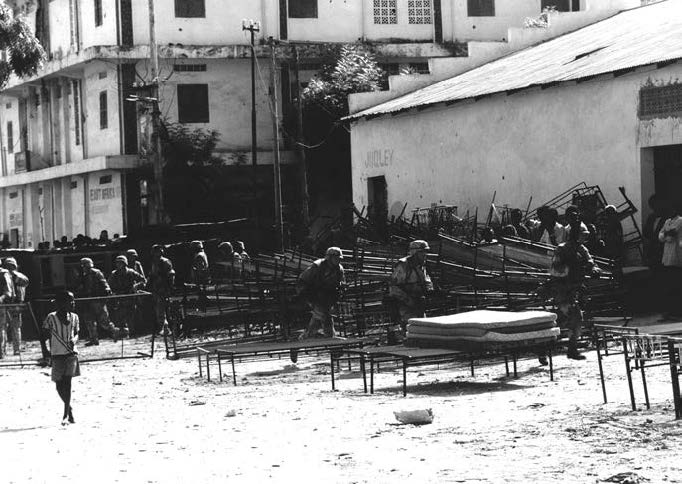
Accordingly, Aideed’s strategy centered on Mao Ze Dong’s asymmetric, or “indirect,” approach. He would attack the American public’s desire to remain involved in Somalia. By drawing U.S. forces into an urban fight on his home turf in Mogadishu, Aideed believed that the city’s noncombatants would make it difficult for U.S. forces to employ their robust firepower (upon which they relied heavily) without serious strategic repercussions. In the close confines of the city, much of America’s technological superiority would be moot. (See Figure 2.) If the Americans were unwilling to risk harming civilians, his forces would inflict heavy casualties on U.S. servicemen, thereby degrading U.S. public support for operations in Somalia. If, on the other hand, the U.S. forces were willing to fire indiscriminately as a means of self-preservation, the Somali casualties produced would likely have the same intended effect.

Aideed had approximately 2,000 loosely organized SNA militia at his disposal. The SNA were well armed with large quantities of assault rifles, rocket propelled grenade (RPG) launchers, antiaircraft guns, mortars, and light artillery, as well as a small number of tanks. It also had a significant number of technicals. In the wake of UniTaf’s departure, Aideed reentered Mogadishu and quickly rearmed and reorganized while seeking to regain his control over the populace. Together with Col Sharif Hassen Giumale, an officer familiar with guerrilla insurgency tactics and likely the SNA’s senior tactical commander in Mogadishu, Aideed recognized that the American helicopters were potentially a critical tactical vulnerability. The warlord sensed that if he shot down a helicopter, it would cause the U.S. forces to consolidate around the helicopter, thereby allowing the Somalis to pin them in one area. This would inhibit “quick in, quick out” U.S. tactics and, instead, the Americans would be forced to remain in the confines of the city for longer periods of time where the SNA could extract a price. Accordingly, he brought in some fundamentalist Islamic soldiers from Sudan, who had experience in downing Russian helicopters in Afghanistan, to train his men in RPG firing techniques. Complementing his strategy, Aideed paid and threatened civilians to participate in “rent-a-crowds” that would cover his militiamen.

Figure 2. Mogadishu.

Campaign Execution
By the time TF Ranger deployed to Somalia, Aideed was in hiding. MG Garrison was forced to rely heavily on paid Somali informants to locate and track Aideed and others in the Habr Gidr. This intelligence collection technique met with mixed results and several embarrassments, as they experienced great difficulty in locating Aideed. As a result, Phases II and III of the planned operation merged, and they sought to capture Habr Gidr leaders whenever and wherever they could find them. On TF Ranger’s first mission, poor human intelligence (HumInt) caused them to greatly embarrass Washington by inadvertently arresting a group of U.N. employees. A later raid similarly proved disastrous as they stormed the residence of Somali Gen Ahmen Jilao, a close U.N. ally and the man they were grooming to lead the Somali police force. Operational security remained difficult. In one of their first “top secret” missions, the troops of TF Ranger were surprised to see themselves on CNN before they had even removed their gear. Because the Rangers employed the same aerial raid techniques repeatedly, they largely forfeited the advantage of tactical surprise. Meanwhile, Washington continued to grow impatient with MG Garrison.

The United States’ inability to locate Aideed turned him into a folk hero. TF Ranger’s violent surprise attacks were also causing Somalis outside the Habr Gidr to question the legitimacy of U.S. forces in the country and further swayed the moderates toward Aideed. It was fine to intervene in the country to feed the starving and even to help establish a peaceful government, but purposefully targeting Somali leaders as criminals was a different thing entirely. TF Ranger’s aggressive employment of firepower during a number of surprise raids caused several noncombatant casualties and created a general fear and hate of the Rangers.

On 3 October, TF Ranger prepared to strike a target within Somalia’s Bakara Market district, where two of Aideed’s lieutenants were reported to be in hiding. Since the Marines had pulled out of Mogadishu with the end of UniTaf, the U.N. forces, comprised mostly of Pakistanis, had refused to enter the Bakara Market area. It was well known that this area was filled with weapons and that very aggressive Habr Gidr militia units protected the weapons trade there. As a result, Aideed controlled his own fiefdom within the city.

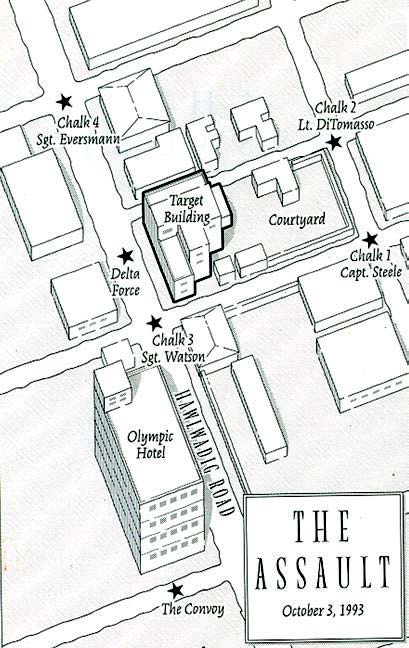
The tactical plan for the raid was one that TF Ranger had employed several times before. First a Delta Force team would insert by helicopter directly onto the three-story target building while four Ranger teams isolated the building by securing the four street corners immediately around it. (See Figure 3.) Once Delta secured the prisoners, a convoy of cargo trucks, escorted by assault-configured HMMWVs, would arrive at the target building from the American base just 5 minutes away and pick them up. All the while, attack helicopters would loiter in the area to provide rotary-wing close air support if needed. Simultaneously, OH–58 observation helicopters, P–3 spy planes, and satellites would ensure that MG Garrison could watch the situation unfold on the video screen in his command post. The raid was to take no longer than 1 hour.

Even as the Blackhawk helicopters were approaching the target buildings, Somalis could be seen setting tires ablaze—a technique they used to mobilize the SNA militia. The Somali’s had witnessed six TF Ranger raids now and knew what to expect. As the Delta troops inserted, throngs of Somalis began to crowd toward the target building. The rules of engagement (ROE), which stipulated that the Rangers were to shoot only when someone pointed a weapon at them, quickly became unrealistic. The SNA fired from crowds filled with women, children, and the aged and infirm. In one instance, a Somali

shooter had the barrel of his weapon between the women’s legs, and there were four children actually sitting on him. He was completely shielded in noncombatants, taking full cynical advantage of the Americans’ decency.

The Rangers had to decide between killing all those in the crowds or watching their fellow soldiers be killed. They logically chose the former.

Figure 3. TF Ranger’s Bakara Market raid.

The situation became increasingly confused as friction came into play. A young soldier fell from his fast rope as one of the Ranger teams was inserted at the wrong intersection. Some Rangers began firing at Delta Force soldiers. Others were immobilized with fear. Ground RPG fire struck one of the loitering Blackhawk helicopters, causing it to crash. Within just a few minutes, a second Blackhawk crashed. Several other helicopters were disabled. Aideed’s strategy was working. The convoy was forced to split to deal with casualties. One portion of the convoy got lost while attempting to move to the site of the first downed helicopter under intense Somali fire from all directions. Excessive layers of control prohibited the P–3 spy planes from communicating directions directly to the convoy, causing a delay of instructions that caused the convoy to miss turns. The convoy literally circled through the most dangerous part of the city, repeatedly stumbling into kill zones. Casualties continued to mount. The second downed helicopter site was overrun. All but one American pilot at the site, CWO Michael Durant, were killed. CWO Durant became a prisoner, and the Habr Gidr later paid the rival clan that captured him so that they could use him as a bargaining chip with the United States.

     Because Secretary of Defense Les Aspin had denied an earlier request by MG Montgomery to deploy U.S. armored forces, it took precious hours to augment the U.S. light infantry QRF with Malaysian and Pakistani armored units. The QRF had not trained with the Malaysians and Pakistanis. Twenty-four hours after TF Ranger was initially inserted, the QRF was finally able to rescue them near the first helicopter’s crash site.

The United States suffered 91 casualties during the Battle of Mogadishu, to include 18 killed and 73 injured. The task force also lost five downed Blackhawk helicopters and numerous damaged vehicles. SNA militia losses during the battle are unknown but, by all estimates, collateral damage was significant. U.S., U.N., and SNA estimates all indicate that 3,123 Somalis were killed and another 814 injured during TF Ranger’s raid. According to one of Aideed’s lieutenants, just 133 of these casualties were members of SNA militia.

Despite the fact that TF Ranger had accomplished its original tactical mission by capturing 24 Habr Gidr clansmen, the American public viewed the price as far too high. By the next day, pictures of dead American soldiers being brutalized and dragged through the streets of Mogadishu were being broadcast on television screens throughout the world. The Congress, sensing a backlash in public opinion, pressured the President to end U.S. involvement. Accordingly, the President decided that the United States would withdraw not later than the end of March 1994. President Clinton brought back former U.S. Ambassador Oakley to negotiate Durant’s release. Ambassador Oakley told Aideed that TF Ranger’s mission was over and that U.S. military involvement was to end in March, but the President wanted CWO Durant released immediately without conditions. A strong U.S. force was deployed to the region to reinforce America’s intention of rescuing Durant if Aideed refused. The warlord released the pilot almost immediately. Within a few weeks, U.S. Marines escorted Aideed to renewed peace negotiations. As a result of those negotiations, President Clinton ordered the release of every man previously captured during TF Ranger’s missions. Soon after the U.S. withdrawal in March, the U.N. mission failed. Without U.S. muscle, the U.N. could not hope to build a government in Somalia without Aideed’s assistance, and Aideed would not accept sharing power with other clan leaders.

Operational-Level Assessment
Tactically, one might argue that the battle of Mogadishu was a success. TF Ranger succeeded in capturing 24 suspected Aideed supporters, to include two of his key lieutenants. Given the appropriate response at the strategic level, some even argue that it had the potential to be an operational success. After accompanying Ambassador Oakley to a meeting with Aideed soon after the battle, MajGen Zinni described the clan leader as visibly shaken by the encounter. He believed that the SNA leadership had had enough of the fighting and was prepared to negotiate. Unfortunately, the Clinton Administration failed to shape the strategic battlespace for operational success from the outset by neglecting to inform and convince the American public—and its elected members of Congress—of the necessity for employing American forces to capture Aideed. The President was left with little recourse after the battle in Mogadishu but to avoid further military confrontation.

Despite this strategic failing, the operational commanders might nonetheless have avoided the casualties in Mogadishu, and the subsequent public and congressional backlash, had they better communicated among themselves and worked with unity of effort. Recognizing the complications created by the separate U.S. and U.N. chains of command and missions, ADM Howe, along with Gen Hoar and MGs Montgomery and Garrison should have established the architecture needed to facilitate integrated planning and execution for each mission conducted. These commanders failed to “operationalize” their plan. They did not properly link U.S. strategic objectives and concerns to the tactical plan. The TF Ranger mission was an ill-conceived, direct operational attempt to obtain a strategic objective in a single tactical action. Yet, apparently neither Gen Hoar nor MG Garrison considered the implications of a failure given the lack of strategic groundwork. Were they to have made such an assessment, it is doubtful that they would have elected to pursue such a high-risk evolution. In this light, U.S. military operations in Somalia during the UNOSom II phase must be viewed as an operational failure.

Command and Control
MajGen Zinni summed up UNOSom II’s command and control failure well:

We had a U.N. operation. We had General Bir in charge of the U.N. forces. The U.S. forces were really under his deputy, General Montgomery, but then General Montgomery [didn’t have] operational command authority [of those forces]. The CinC, General Hoar, provided the forces in some sort of tactical control, but obviously never relinquished command. That’s another myth; the command was never relinquished to U.N. forces, so all but U.S. forces were under this U.N. command and control. I think there were forces on the ground that were under Chapter VI instructions. I think you might find the Germans and others that were there under Chapter VII. There were forces off the coast that would come in and react that had another chain of command, Marines and naval forces. You had the special operation forces and Task Force Ranger there that had another kind of direct chain of command that really weren’t under Montgomery even though they were U.S. forces. It became very confusing, and in part I think caused a problem with intelligence, whose intelligence was being used, how the reporting chain went. There is a principle of war that says unity in command is desirable in any kind of conflict; it certainly was not there between U.S. and U.N. and even within the U.S. structure.

During a recent lecture to the students of the Marine Corps Command and Staff College, Gen Zinni described his efforts to coordinate among the various military headquarters prior to accompanying Ambassador Oakley into Mogadishu to negotiate with Aideed for the release of CWO Durant. The general wanted to ensure that no military actions took place to compromise the Ambassador’s efforts. Despite the fact that then-LtGen Zinni coordinated with five separate commands within the theater (each of whom referred him to another), a helicopter still dropped propaganda leaflets declaring Aideed a war criminal in the middle of the negotiations. The general later discovered that this particular propaganda effort was directed by yet another command. His point was clear: you could not coordinate with a single commander in charge of all operations in the theater because no such single commander was given that authority.

There simply was no unity of command or effort in Somalia during UNOSom II. Command and control was further complicated by the fact that the U.N. lacks standardized doctrine, training, and equipment. This made coordinating the efforts of the numerous participating international militaries, as well as the 49 international agencies—including U.N. bodies, NGOs, private voluntary organizations (PVOs), and humanitarian relief organizations—exceptionally difficult. Adding to the difficulty, no effective host-nation government existed since Somalia was in a state of general anarchy. Finally, unity of command was jeopardized by U.S. attempts to operate independently outside of the UNOSom II command structure. As a result, the logistics components of USForSom were under U.N. operational control, while the QRF remained under the combatant command of USCentCom. TF Ranger operated in the theater independently of the QRF and, like the QRF, answered directly to USCentCom. Their instructions required them only to coordinate with the 10th Mountain Division “as needed.” Had there been a single commander controlling both TF Ranger and the QRF, Americans may have never seen the bodies of their dead sons dragged through the streets of Mogadishu.

Operational command was vested in Gen Hoar as CinCUSCentCom, and he must bear some responsibility for the lack of unity of effort between his two immediate subordinates in Somalia, MGs Garrison and Montgomery. Gen Hoar and his staff did not adequately integrate the operations of these two subordinate commanders. Beyond CinCUSCentCom’s initial reservations concerning TF Ranger’s deployment to Somalia, he and his staff appear not to have recognized or questioned the vulnerability of the TF and its helicopters given the Somalis’ ability to adapt to its tactics and techniques after repeated missions. Even at the tactical level, within MG Garrison’s TF Ranger itself, there were dual chains of command between Delta Force and the Rangers. It is clearly imprudent to create dual or multiple chains of command along functional lines within a single urban environment.

The UniTaf successfully met the span of control challenges through two innovations. First, they created a civil-military operations center to facilitate unity of effort between the NGOs, PVOs, and the military forces. This was exceptionally important in light of the fact that many of the private relief organizations had hired local security forces from the clans dominant in their areas of operations to protect their individual efforts. Secondly, they divided the country into nine humanitarian relief sectors that facilitated both relief distribution and military areas of responsibility. Where unity of command was not feasible, Gen Hoar reinforced unity of effort by requiring liaison officers from each of the multinational contingents supporting RESTORE HOPE to report to USCentCom for coordination before dispatching their forces to the theater. As LtGen Johnston emphasized, “Unity of command can be achieved when everyone signs up to the mission and to the command relationship.”

UNOSom II, however, proved incapable of exploiting the advantages of these arrangements as the scope of the mission expanded. Instead, U.S. impatience and U.N. resistance regarding the withdrawal of U.S. forces from Somalia compromised UNOSom II’s efforts. U.S. forces were withdrawn on schedule despite the fact that the handoff between UniTaf and UNOSom II remained incomplete. Only 30 percent of the UNOSom II staff had arrived in country by the time the mission was launched. Moreover, despite their vastly more ambitious mission, the UNOSom II and USForSom headquarters were not built around a standing, well-organized nucleus, trained and equipped to serve as a joint battle staff. (A standing Marine expeditionary force headquarters performed this function during the UniTaf operation.) Instead the USForSom staff was built largely from officers recruited from Army commands worldwide who had never before trained together as a battle staff.

MG Montgomery addressed the unity of purpose problems among the UNOSom II forces when he stated:

The nations didn’t all agree with the policy, and many of them were just not happy with the way the course of the mission was going. …Gen Bir could not turn to the Italian commander or the French commander, or somebody and give him a mission and expect that it would be done. It doesn’t happen in a U.N. context.

As it was, the QRF commander, MG Montgomery, had to negotiate with hesitant Malaysian and Pakistani forces for armored support while TF Ranger was trapped in Mogadishu. Documented accounts of the Italian contingent commander opening separate negotiations with Aideed, with the full approval of his home government, serve as a case in point concerning the unity of effort problems among U.N. forces. When the U.N. requested that this officer be relieved of command for insubordination, the Italian Government refused. The Somalis fully recognized the lack of unity of command and effort among the UNOSom II forces and sought to exploit it. One of Aideed’s militia commanders in Mogadishu stated in an interview that:

What we did is to concentrate our attacks on the Americans, and the forces who were taking their order(s) directly from the Americans, such as the Pakistanis. And we had some understanding with the other forces not to attack us and that we would not attack them.

Following TF Ranger’s catastrophic mission in Mogadishu, the command structure was complicated even more with the creation of a new Joint Task Force (JTF) Somalia. USCentCom designed this JTF to protect American forces while facilitating their complete withdrawal. JTF Somalia came under the operational control of USCentCom, but fell under the tactical control of USForSom. While the JTF headquarters was formed around the Army’s 10th Mountain Division, that unit lacked the staff structure needed to support joint operations. To further complicate matters, neither the JTF nor USForSom controlled the naval forces that remained under USCentCom’s operational control. The American experience in Somalia, therefore, suggests the need for standing JTF headquarters specifically trained to facilitate operational control of joint forces in complex environments. Arguably, campaigns that include urban operations are always complex.

The lack of operational communications infrastructure in Mogadishu and elsewhere in Somalia caused the operational commanders to rely extensively on satellite communications as a means of control. There was never enough equipment to facilitate this effort given the inordinate number of headquarters. Moreover, MG Garrison and his staff did not tailor TF Ranger’s communications architecture to facilitate decentralized execution. Employing the joint operations center as an intermediary between the P–3 giving directions overhead and the ground reaction force convoy, for example, significantly contributed to the confusion that prevented the convoy from successfully maneuvering to the crash sites. The intensity and tempo of urban operations demand a flattened communications architecture that maximizes lateral force communications without depending on retransmission at each level of the traditional chain of command.

Finally, the ROE, among the most useful command and control measures in urban military operations other than war, were unrealistic in Mogadishu. Logically, the soldiers on the ground violated the ROE in order to survive. Operational planners who understand the Somali culture should have recognized the potential for the SNA to use the women and children as shields. Accordingly, they should have avoided entering the densely populated Bakara Market district with such restrictive ROE. As legitimacy was a concern (in fact, it should have been more of a concern), TF Ranger should have employed non-lethal weapons, to include riot control gas, as an alternative to killing innocent civilians or dying themselves. In this case, the operational commander was responsible for making such weapons and munitions available and encouraging their use.

Intelligence
The nature of the mission in Somalia initially complicated identifying a single threat, thereby creating a focus of effort dilemma for the intelligence architecture. As is typical in urban environments, HumInt served as the most timely and useful collection resource during the campaign. Unfortunately, because no reliable U.S. HumInt network existed in Somalia prior to the operation, much of the information had to be obtained through the bribery of largely unknown sources. Thus, its reliability was always in question. In these instances, it is critical to verify the information via multiple sources. Additionally, the operational commander must coordinate between his joint and coalition forces as well as the PVOs and NGOs in his area of operations in order to ensure consistent policies for dealing with local informants. In Somalia, units from several different nations rotated responsibility for specific geographical areas, and the means used to garner information differed among the various units. Some armies paid local nationals for information. Later, when a less wealthy unit assumed responsibility for the area, the locals became vindictive when they were not offered the same bribe.

The best HumInt sources were the gang leaders themselves. The UniTaf met on a regular basis with Aideed and other clan leaders. As LtGen Johnston stated:

You may not like the characters you have to deal with but you are better able to uncover their motives and intentions if you keep a communications link open.

UNOSom II and USForSom, on the other hand, abandoned all interaction with the Habr Gidr once the manhunt for Aideed began.

The unreliability of HumInt sources among the Somali populace contributed significantly to the most obvious intelligence failure—the inability of the U.S. and U.N. forces to locate Aideed. The initial plan for TF Ranger’s mission called for the Central Intelligence Agency’s lead Somali spy to present Aideed with a hand-carved cane containing a hidden homing beacon as a gift. This plan ended when the spy shot and killed himself while playing Russian roulette. TF Ranger and UNOSom II intelligence sections also significantly underestimated the quantity of rounds in Aideed’s RPG stockpiles, possibly influencing the commander’s decision to keep the helicopters loitering in the target area. A serious shortage of people proficient in the Somali language in the U.N. and U.S. forces further complicated the effort to gather HumInt. Especially troubling is that the HumInt effort apparently did not warn the commander about the dramatic change in the perceived legitimacy of U.S. forces among the Mogadishu populace.

Collection via signals intelligence (SigInt) was severely hampered by the fact that the Somalis are not a technology dependent society. Upon learning that U.S. forces were monitoring his communications transmissions, Aideed effectively thwarted U.S. SigInt collection by merely turning off his radios. He relied on messengers, again taking advantage of the U.S. HumInt failure. Well-trained, but high-technology dependent U.S. forces were confounded by a foe with absolutely no technological tools of his own. You cannot jam or intercept enemy communications without an inside HumInt resource when his communications system is word of mouth.

The multiple and confused command structures in Somalia severely inhibited intelligence dissemination. Although USCentCom established an intelligence support element to facilitate dissemination of information gathered from U.S. sources, protection of those sources necessitated several filters before the information could be shared with other U.N. forces. The lack of communications infrastructure in Somalia further complicated dissemination from USCentCom headquarters to the theater with all of the links relying on limited satellite communications. 

Nonetheless, intelligence was not a complete U.S./U.N. failure. The UniTaf used aerial photography of the authorized weapon storage sites to inventory them and ensure that Aideed and other warlords were not withdrawing weapons from them. Although maps were initially outdated or available only in scales inappropriate to urban fighting, satellite imagery and aerial photography rapidly remedied the problem. TF Ranger planned their raid on instant photomaps relayed from the aerial observation platforms. Timely intelligence on the port facilities in Mogadishu also greatly facilitated the initial employment of maritime prepositioned shipping.

Far and away, the chief intelligence failure lay in the inability of some operational commanders to appreciate the nuances of the Somali culture. While this knowledge was available, and used extensively during the UniTaf phase, ADM Howe and MG Garrison chose to ignore it. According to Gen Zinni, what the U.S. intelligence effort lacked most was:

… the ability to penetrate the faction leaders and truly understand what they were up to, or maybe [the ability to] understand the culture, the clan association affiliation, the power of the faction leaders, and maybe understanding some of the infrastructure … [that] maybe led to things like not understanding where a particular individual was, or who he was, or what his relationship was, and maybe caused mistargeting in some cases by those that were after Aideed or his lieutenants.

Thus, the greatest operational intelligence failure was one of net assessment. MG Garrison did not accurately assess the SNA’s capabilities or intent with regard to his own plan and capabilities. He underestimated the number of SNA militia and its supporters as well as its determination.

Maneuver
TF Ranger’s mission resulted in a strategic failure largely because neither USCentCom nor UNOSom II employed operational maneuver to isolate the urban objective area. TF Ranger did not have the force structure to perform this task alone. During the UniTaf phase, U.S. forces kept the Somali warlords out of the populated areas and their people disarmed. With the Americans’ hasty departure and responsibility for those areas passing to other U.N. forces and a Somali coalition, the warlords returned to the urban areas, reorganized and rearmed.

During the UniTaf mission, LtGen Johnston and Ambassador Oakley went to great lengths to shape the battlespace at the operational level to facilitate tactical maneuver. The initial combined amphibious and air assaults to seize key terrain and control the region sent a clear message and were highly effective. U.S. forces rapidly gained control of Mogadishu and the surrounding area and forced the major factions into a cease-fire. Recognizing the primacy of the clan, Ambassador Oakley and LtGen Johnston then actively engaged the clan leaders and openly advised them of when they would conduct tactical missions and for what purpose. When conducting armory inspections, for example, the UniTaf advised the clan leaders of the time and place of those inspections, and then monitored the armories via SigInt to ensure the clan leaders did not remove weapons in bad faith prior to the inspection.

Conversely, during UNOSom II, U.S. operational maneuver and fires actually jeopardized their legitimacy with the Somali people. The diplomatic nature of U.N. operations required the U.N. leadership to issue a formal resolution announcing that it was their intent to arrest Aideed. This announcement forfeited one of the strongest advantages in operational maneuver—surprise. Moreover, by targeting Aideed, ADM Howe and LtGen Bir effectively took sides in the conflict, compromissing the legitimacy of the force.

Finally, TF Ranger failed to develop and execute an operational maneuver plan that protected its critical tactical vulnerability—its helicopters. Instead, they kept their most vulnerable helicopters, the MH-60 Blackhawks, loitering for 40 minutes over the target area in an orbit that was well within Somali RPG range. No crisis on the ground existed that required any more fire support than that which could have been provided by the smaller, faster, and more maneuverable AH-6s and MH-6s. TF Ranger underestimated the enemy’s ability to shoot down its helicopters even though they knew the Somalis had previously attempted to employ massed RPG fires to bring them down during earlier raids. In fact, the Somalis had succeeded in shooting down a UH-60 flying at rooftop level, and at night, just 1 week prior to the battle. Since the greatest threat to any TF Ranger mission was a scenario with multiple downed helicopters, planners should have provided ready ground reaction forces at the start of each mission. The task force’s mission failed when the second helicopter crash site was overrun. This permitted the Somalis to use the captured pilot and the dead Americans as political weapons. As a result, the news media opened what was supposed to be a covert operation to the scrutiny of the American people and the world.

Fires
Operational fires throughout the U.S. involvement in Somalia focused too greatly on lethal options and promoted Somali hostility toward U.S. forces. The UNOSom I helicopter attack on the Kismayo technical convoy and the employment of AC–130s against Aideed’s suspected locations serve as examples of how not “to win friends and influence people.” While lethal fires were somewhat balanced with a non-lethal approach during UNOSom I and the UniTaf, the lethal approach became increasingly dominant during UNOSom II. The 17 June attack on an Aideed stronghold, for example, incorporated a helicopter gunship attack that killed at least 60 Somali noncombatants. U.S. forces’ overreliance on firepower during UNOSom II alienated the Somali populace and forfeited the perceived legitimacy of the U.S. presence. In the densely populated urban confines of Mogadishu, UNOSom II lived by lethal fires and it died by lethal fires.

Because ADM Howe and LtGen Bir largely discounted information operations, they did not establish significant public affairs and psychological operations (PsyOp) initiatives. U.S. forces participating in UNOSom II lacked a public affairs organization altogether. In contrast, the UniTaf countered Aideed’s own PsyOp campaign, which he conducted primarily through Radio Aideed, by creating its own radio station. This technique proved so effective that Aideed called MajGen Zinni over to his house on several occasions to complain about the UniTaf radio broadcasts. MajGen Zinni responded that “if he didn’t like what we said on the radio station, he ought to think about his radio station and we could mutually agree to lower the rhetoric.” This technique worked. ADM Howe’s technique of shutting Aideed’s radio station down did not. The warlords had both the weapons and the popular support. Thus, the U.N. would have been better served by making them the target of an information campaign as the UniTaf had done.

Logistics
Despite other failings during U.S. operations in Somalia, the U.S. logistics effort was well executed. This was a significant achievement, since the infrastructure within the country was almost completely destroyed and the logistics environment was exceptionally austere. This is typical of most Third World urban areas to which U.S. forces can expect to deploy in the future. U.S. and U.N. forces had to transport virtually all of their materiel support into the country by sealift or airlift. During Operation RESTORE HOPE, military and commercial aircraft moved more than 33,000 passengers and over 32,000 short tons of cargo into Somalia in 986 airlift missions. Additionally, 11 ships moved 365,000 measurement tons of cargo, 14 million gallons of fuel, and 1,192 sustainment supply containers into the country. Receiving these supplies required U.N. forces to rebuild and repair airfields and ports. Finally, the humanitarian mission required U.N. forces to use extensive wheeled transport assets to distribute the supplies to both the populace and friendly forces along difficult internal LOC. Security along these LOC necessitated the diversion of troops from other responsibilities. Finally, given the lack of adequate port facilities, Marine Corps maritime prepositioned shipping proved invaluable in bringing essential supplies and equipment ashore early in the deployment.

While very successful, the logistics effort in Somalia should not be viewed as flawless. A number of “hiccups” were experienced. The excessive drafts of Army prepositioned ships, for example, made it impossible for them to enter Mogadishu’s shallow harbor. Additionally, the weather impeded their attempts to offload supplies “in stream.” The logistics effort was also complicated by international and inter-Service rivalries. This could have been eased by a more efficient operational command and control structure. U.S. forces should anticipate special logistics challenges unique to operating with or within the U.N. One unit after-action report described the U.N. procurement system as “cumbersome, inefficient, and not suited to effectively support operations in an austere environment.”

Force Protection
U.S. forces relied far too heavily on lethal fires for force protection in an environment where maintaining perceived legitimacy was critical to mission accomplishment. Instead of moving about Mogadishu in an effort to promote relations and keep in touch with the attitudes of the local populace—as was the case during the UniTaf phase and with several other national military units within the U.N. force—U.S. forces during UNOSom II adopted a siege mentality. As a result, they lost the support of the Somali populace and effectively turned themselves into the enemy.

Despite the American forces’ unwillingness to leave their base in Mogadishu without assuming an aggressive and provocative posture, the base was poorly protected. Open to public view and with Somali contractors moving freely about the premises, the American base was an operational security nightmare. Somalis had a clear view, day and night, of U.S. forces in their hangar barracks. The U.S. billets were subjected to routine mortar strikes from the SNA. Whenever they would prepare for a mission, the word would go out throughout the city that TF Ranger was preparing to move. During an interview with PBS’ Frontline, Capt Haad, a sector commander for Aideed’s militia in Mogadishu, said of TF Ranger’s mission, “As soon as the aircrafts (sic) took off from the air bases we immediately knew.” He also pointed out that they knew when and where U.S. forces landed:

We knew that immediately after their arrival because we were in all the places where they would have arrived, say in the port, airport, the American compound, some people of us were always there, and the minute they arrived we knew that they were there.

Some evidence suggests that the Italians of the U.N. force also warned the Somalis of U.S. troop movements. MG Garrison’s failure to provide an armored, rapid reaction force capable of immediately moving to reinforce TF Ranger and a second airborne rescue and recovery crew, in the event that the first crew was lost, proved to be additional serious errors in operational force protection.

Rampant disease was also a force protection concern in Somalia and one that U.S. forces can expect to encounter in most Third World urban environments. American servicemembers were constantly exposed to the sick and dying. When U.N. forces operated earthmoving equipment to repair the infrastructure in and around Mogadishu, tuberculosis spores that lay dormant in the soil were released into the air. Medical intelligence and preventive immunizations are vitally important in these locales.

Conclusion and Lessons Learned
U.S. operations in Somalia provide a clear example of how “thin” the operational level can become while battling urban guerrillas. During UNOSom II, special operations forces were employed tactically, in an urban environment, to achieve a strategic objective (seizing Aideed) in a single decisive action. This operation failed because U.S. commanders did not establish favorable operational conditions prior to committing those tactical forces. U.S. involvement in Somalia further illustrates the limitations of both military force and of the U.N. in managing ethnic urban conflicts. In the immediate post-Cold War era, the world deceived itself into believing that the U.N. could become more decisively involved than was actually possible. Until structures are created within U.N. military forces that afford a far greater degree of unity of effort and command, Chapter VII peace enforcement operations—particularly in urban environments—will continue to be difficult if not impossible.

One should be careful, though, in drawing lessons from this conflict. First, it would be wrong to look upon the military as a completely ineffective tool in such environments. When used as a complement to other elements of national and international power, the military can be productive in these circumstances. These elements, however, must be well coordinated. In Somalia, they were not. Second, there is a danger that tactical force protection measures will inadvertently outweigh strategic and operational mission accomplishment. This very tendency contributed to the U.S. failure in Somalia. The best form of force protection is shaping the battlespace at the operational level. Relying extensively on lethal fires and entering urban areas in a provocative manner cost more than they gain if they alienate the populace. Finally, despite Congress’ initial assumption, recent evidence seems to indicate that American resolve for capturing Aideed in hopes of bringing peace to Somalia was stronger rather than weaker after viewing the images of American soldiers being mutilated. As Gen Zinni has stated:

The lesson and the effect as it relates to casualties isn’t that the Americans can’t take casualties … it’s they can’t take casualties for causes and reasons that aren’t understood and clearly laid out before you get in.

The Battle of Mogadishu and U.S. operations in Somalia overall suggest several operational considerations for urban areas. The Somalia experience reemphasized several lessons learned in Hue, among them, the importance of crafting suitable ROE and of maneuvering to isolate the urban area. The Somalia experience also suggests the following additional considerations:

• dhering to the principle of unity of command is critical to success in urban conflicts. Where unity of command cannot be established between different agencies (U.N. bodies, NGOs, PVOs, etc.), the operational commander must make special arrangements to ensure unity of effort. These arrangements may range from regular coordination meetings to the establishment of a civil-military operations center. In all cases, tactical operations must be thoroughly coordinated among all operational commanders.

• JTF headquarters formed to execute missions that include urban operations should, at a minimum, be formed around cohesive, standing Service component staffs. The complexity of urban operations suggests the need for standing JTF headquarters.

• The communications architecture for operations within cities should facilitate the direct transfer of information from supporting forces to the decentralized tactical forces on the streets, without successive transmissions through the chain of command.

• Consistent with the U.S. experience in Hue, HumInt was the most effective collection means within the urban areas of Somalia. The nontechnical nature of the Somali clans severely restricted the value of other collection means. Methods used to recruit HumInt collectors from local urban populations should be consistent among all forces in the coalition. To do otherwise can compromise the legitimacy of one or more of the forces involved. In cases of urban ethnic conflict, maintaining open communications links with faction leaders involved in the dispute can be the most important HumInt source. • ultural assessment is a critical step in the intelligence preparation of the urban battlespace. Often, it will disclose enemy critical vulnerabilities or means to influence the actions of the noncombatant populace.

• Maintaining the support or neutrality of the noncombatant population is critical to success in urban fighting. The operational commander and staff must keep this in mind when planning both operational and tactical fires.

• Non-lethal fires, to include information operations, are important means of separating the adversary from noncombatants without creating casualties among the latter. Non-lethal weapons and munitions can make ROE more flexible, giving tactical forces an option between compromising legitimacy and accepting unreasonable risk. Civil affairs and media campaign plans can be vitally important to shaping conditions for tactical success in the urban battlespace. Likewise, PsyOp can effectively and favorably influence the actions of the noncombatant populace.

• Third World urban areas, with poor infrastructure, present enormous logistical challenges to U.S. forces. Strategic and operational lift as well as procurement systems must accommodate combatant and civilian needs well beyond those in other environments.

>Editor’s Note: This article is the second case study from Maj Cooling’s treatise on MOUT written when he attended the Marine Corps Command and Staff College in 1999–2000.

Operation PROVIDE COMFORT

Humanitarian and Security Assistance in Northern Iraq

>Originally published in the Marine Corps Gazette, November 1991.

The multinational relief effort to aid Kurdish refugees in southern Turkey and northern Iraq was a “joint” operation in every sense of the word. Here the commanding officer of the principal Marine unit involved, the 24th MEU(SOC), details the events that triggered this humanitarian mission.

Hoping to take advantage of the allies victory over Iraq in DESERT STORM, dissident factions within Iraq seized on the moment to launch a courageous, but unsuccessful attempt to topple Saddam Hussein from power this past March. In the aftermath of his army’s defeat, Saddam Hussein unleashed the still-capable remnants of his battered force against the Kurdish population of northern Iraq, triggering a desperate human exodus towards sanctuaries in the bordering nations of Turkey, Iran, and to a lesser extent, Syria.

As the media of the world focused on the developing human tragedy of the Kurdish people fleeing by the hundreds of thousands before a vengeful Iraqi Army, worldwide outrage galvanized allied coalition support. From the moment the decision was made to air drop supplies to the fleeing refugees on 7 April, it was clear that there was yet another chapter to be written about DESERT SHIELD/DESERT STORM. It would become known as PROVIDE COMFORT.

As the situation unfolded during March and early April, the Kurds’ flight ended in the mountains of southern Turkey, where an estimated 500,000 refugees were massed, having been pushed over the border and herded into so-called “sanctuaries” by Turkish forces. To the east and south, an estimated 1.3 million Kurdish refugees huddled in similar camps along the Iranian border. The fate of this group has yet to be determined.

It was during the last few days of March that BGen Richard Potter, USA, was ordered to insert his 10th Special Forces Group into the refugee camps. At this time there were 12 such camps with an average population of approximately 45,000. Conservative estimates had approximately 600 people dying of exposure, malnutrition, and disease daily. In this area of the world, March is still a winter month and many camps abutted snow-capped peaks. The many trails from Iraq were littered with abandoned possessions that no longer served any utility—broken-down cars, appliances, family heirlooms, furniture, suitcases that had become too heavy to carry, and tragically, people who were unable to withstand the rigors of the march and simply stopped walking, waiting for the cold to end their suffering.

Within days of its insertion, the 10th Special Forces Group organized and identified camps and drop zones, provided medical assistance as needed, and made plans for security requirements. The 10th Special Forces Group formed the first element of what became Joint Task Force Alpha (JTF-A), whose principal mission was resupply of the Kurdish refugees. JTF-A was based in Incirlik, Turkey, along with the headquarters for Combined Task Force (CTF) PROVIDE COMFORT, initially commanded by MGen James Jamerson, USAF, and subsequently by LtGen John M. Shalikashvili, USA.

On 9 April, the 24th Special Operations Capable Marine Expeditionary Unit (MEU(SOC)) was into its third month of a planned six-month Mediterranean deployment when the call went out to respond to the rapidly developing situation in northern Iraq. Embarked aboard the USS Guadalcanal (LPH 7), USS Austin (LPD 4), and USS Charleston (LKA 113), the 24th MEU(SOC) was in the midst of a landing operation in Sardinia, Italy, when the commander, U.S. Sixth Fleet, ordered the amphibious ready group to begin backload, depart the waters of the western Mediterranean, and proceed to the port of Iskenderun, Turkey, for duty with CTF PROVIDE COMFORT. The backload was completed the next morning and the three ships arrived on station on 13 April. The following morning, the 24th MEU(SOC) and Amphibious Squadron 8 (PhibRon-8), commanded by Capt Dean Turner, USN, reported to MGen Jamerson and his deputy, BGen Anthony C. Zinni.

The mission was clear. The 24th MEU(SOC) was to establish a forward support base at Silopi, Turkey, from which helicopters could begin to carry supplies to refugee camps in the mountains. Implied in the mission was the establishment of a forward arming and refueling point (FARP) and a Marine air control detachment to run the airfield. By 15 April, HMM-264, the aviation combat element of the 24th MEU(SOC), had displaced itself 450 miles inland, set up its base, and had begun its humanitarian mission with 23 helicopters in support of BGen Potter and JTF-A (see “Into a Sea of Refugees”). During the following two weeks the Squadron would deliver over 1 million pounds of relief supplies and fly in excess of 1,000 hours without mishap.

Rapidly changing events revealed that the entire 24th MEU(SOC) would be required ashore in short time. Within a few days, the unit was operating out of Silopi, Turkey, preparing to be part of the security force that was to enter northern Iraq. On 19 April, Marines provided the security element for a meeting between LtGen Shalikashvili and an Iraqi delegation at the Habur Bridge border crossing in Iraq. At that meeting, Iraqi representatives were informed that coalition forces intended to enter Iraq on 20 April; the mission was to be humanitarian; there was no intent to engage Iraqi forces; Iraqi forces were to offer no resistance; and a Military Coordination Committee would be formed for the purpose of maintaining direct communication with both Kurdish and Iraqi authorities.

While plans to cross the border to the west of the city of Zakhu were being finalized on 19 April, allied coalition forces received instructions from their respective governments to proceed towards the Turkish-Iraqi border. CTF PROVIDE COMFORT responded to the orders of the Supreme Allied Commander Europe, Gen John R. Galvin, USA, the unified commander in Germany who had cognizance over all operations in the area, to proceed into northern Iraq and establish security zones to expedite the safe transfer of refugees from their mountain havens to the countryside they had originated from. LtGen Shalikashvili quickly activated Joint Task Force-Bravo (JTF-B), which would be responsible for this part of the mission. Its focus would be to neutralize the Iraqi Army in the northern region of Iraq and implement a plan to reintroduce 500,000 Kurdish refugees back into that country.

The problem for JTF-B was in creating conditions in Iraq that would entice the refugees to return voluntarily to the region. Climatic conditions are such that there are only two seasons in the region—winter and summer. Coalition forces were already witnessing winter’s last gasp. Soon the mountain streams, which were the main source of water for many of the refugees, would dry up under the intense heat of summer. For obvious reasons, it was critical that the refugees be out of the hills before this occured.

On 17 April, MajGen Jay M. Garner, USA, arrived in Silopi from his post as deputy commanding general, V Corps, in Germany, with the lead element of what was to become the JTF-B staff. At the outset his troop list consisted of the 24th MEU(SOC), which was given the task of conducting a heliborne assault into a valley to the east of Zakhu on the morning of 20 April. Overhead U.S. Air Force A–10s, F–15s, and F–16s provided air cover, while the Iraqi Army watched precariously from the high ground surrounding Zakhu. Previously inserted force reconnaissance Marines and Navy SEALs had established observation posts along the main avenues of approach and key terrain around the city. Assault helicopters were deployed carrying Marines from Battalion Landing Team 2/8 (BLT 2/8), commanded by LtCol Tony L. Corwin, to designated zones near the city. Reports from the recon units confirmed the presence of a significant number of Iraqi reinforcements billeted near the MEU command element. Consequently, LtCoI Corwin sent emissaries to the Iraqi positions with clear instructions concerning the movements he expected the Iraqi Army to make in withdrawing from the region and the city of Zakhu. As a demonstration of humanitarian intent, Marines erected 12 refugee tents before nightfall on 20 April in what was to ultimately become one of the largest resettlement camps ever built. Patience and firmness paid off within a few days as the Iraqi Army issued orders to withdraw. By nightfall on 23 April, Marines occupied the key positions and road network around the city.

MajGen Garner and his JTF-B staff were headquartered along with the command element of the 24th MEU(SOC) in the deserted headquarters of the Iraqi 44th Infantry Division. Garner immediately directed the bridge and road leading from the border to Zakhu to be opened for traffic. This was particularly significant as the Habur Bridge at the border would become the only means by which surface convoys could pass from Turkey into Iraq.

On 22 April, LtCol Jonathan Thompson, commanding officer, 45th Commando, Royal Marines (United Kingdom), and LtCol Cees Van Egmond, 1st Air Combat Group, Royal Netherlands Marines, reported for duty to MajGen Garner, who placed both units under the tactical control of the 24th MEU(SOC). With a total force of 3,400 Marines from three nations, MajGen Garner lost no time in developing a plan to rid Zakhu of Iraqi oppression

Zakhu, a city of 150,000 under normal times, was a ghost town when coalition forces arrived there on 20 April. Fewer than 2,000 inhabitants remained. Those missing were still in the mountain camps of southern Turkey. Their homes had been looted and vandalized by the Iraqi Army, which continued pillaging local towns and villages as it retreated south.

Despite agreeing to withdraw his army, Saddam was not about to surrender Zakhu without a last effort to retain control of the city. He did so by ordering 300 “policemen” into Zakhu to maintain law and order and protect coalition forces from Kurdish rebels. Clearly, the few residents left in Zakhu were still being terrorized. Something had to be done.

Col Richard Naab, USA, the recently assigned head of the Military Coordination Committee, met daily with BGen Danoun Nashwan of the Iraqi Army to explain coalition intent and expectations. After several meetings, a demarche was drafted and released on 24 April. Its key points are listed below:

• Iraqi armed forces will continue to withdraw to a point 30 kilometers in all directions from Zakhu (in other words, out of artillery range).

• Iraqi police will be immediately withdrawn from Zakhu.

• Iraq will be allowed no more than 50 uniformed policemen in Zakhu at any one time. They would have to be indigenous to the region, carry only one pistol, and display coalition force identification badges at all times.

• In 26 April coalition forces will enter Zakhu for the purpose of verifying compliance and would begin to regularly patrol the city.

• Coalition forces will establish a security zone complete with checkpoints within a 30-kilometer radius around Zakhu. No weapons other than those of coalition forces will be permitted in the zone.

• No members of the Iraqi Army will be permitted in the security zone—in or out of uniform—without approval from the Military Coordination Committee.

Shortly after the issuing of this de-marche, the Iraqi police were observed boarding buses headed south. While the full impact of the demarche was being studied by the Iraqis, LtGen Shalikashvili and MajGen Garner lost no time in directing the 24th MEU(SOC) to establish this security zone, which it was thought would permit the Kurds to consider coming out of the mountains without fear.

During the hours of darkness on 25 April, BLT 2/8 cordoned off the city from the south, east, and north, while Dutch Marines sealed off the western approaches and ensured the integrity of the bridges at the border. British Royal Marines from 45th Commando, having just arrived from Northern Ireland, were tasked with patrolling the streets of Zakhu, sending what few Iraqis remained scurrying for an escape route. By nightfall on 26 April, Zakhu enjoyed its first taste of freedom.

During this time, the resupply effort continued. On 26 April alone, HMM-264 delivered 24.5 tons of relief supplies to the refugees. They were soon augmented by helicopter assets from other coalition forces that had begun to arrive in the area, making operational the Combined Service Command (CSC) at Silopi, Turkey. Other reinforcements were forthcoming as well. On the morning of 27 April, the 3d Battalion, 325th (3/325) Airborne Combat Team, commanded by LtCoI John Abizaid, was placed under the tactical control of the 24th MEU. The 18th Engineer Brigade, commanded by Col Steven Windsor, USA, reinforced by Naval Mobile Construction Battalion 133 (SeaBees), also arrived during this same timeframe, providing much needed relief for the Sailors and Marines of the 24th MEU(SOC) who, alone, had raised 1,100 tents in 10 days.

Another capability of critical impor-tance throughout PROVIDE COMFORT was the presence of the U.S. State De-partment Disaster Assistance Relief Team headed by Fred Cuny, a former Marine. This team was critical in help-ing coordinate the actions of the many multinational government and nongov-ernmental organizations that played a role in the operation. Bolstered by years of expertise in such matters, Cuny was invaluable in prosecuting a humanitarian campaign that ultimately relocated 500,000 Kurds in 60 days.

24th MEU(SOC)’s MEU Service Support Group (MSSG-24), commanded by LtCoI Richard T. Kohl, also showed its mettle early on by installing a reverse osmosis water purification unit and establishing medical/dental civic action projects in Zakhu. Almost overnight, the local hospital sprang to operating capability. Coalition engineers sought to restore electricity and water to a city that had been without for months. Stores slowly reopened and people once again took to the streets, (see “Pushing Logistics to the Limit”). These initiatives were key in convincing the citizens of Zakhu that this was an army, perhaps the first in memory, that only meant them goodwill.

It didn’t take long for the message to reach the mountains. Local community leaders and Pesh Merge chiefs began arriving in Zakhu to verify for themselves the changes underway and to give proper guidance to their people in the mountains. The allies referred to Zakhu and its growing refugee camp to the east as the coalition security zone. As the demarche noted, it was to be free of visible weapons, rules which were meant to apply to Kurds as well as the Iraqi Army.

At first, only a trickle of refugees dared to leave the camps to begin the trip back to Zakhu. Soon, however, as news of a secure city inside Iraq spread to the mountains, many residents slowly began to return to their former homes. A large number of refugees, however, still refused to budge from their hilltop havens. They were waiting to see what coalition forces would do next.

As Zakhu was being repopulated, coalition leaders decided that the next move should be to the east. Already, British and French forces had probed in that direction and plans to extend the zone eastward were put into effect. First, 45th Commando pushed to the town of Batufa, a small but strategically important city, then onto the airfield at Sirsenk, another important objective, and finally to the city of Al Amadiyah, a veritable fortress dating back some 3,000 years; this became the eastern limit of what was referred to as the British sector under the 3d Commando Brigade, commanded by BGen A.M. Keeling, OBE. Again, the instruction to the Iraqis via the Military Coordination Committee was clear and unequivocal—back off and let us do our job. Compliance occurred shortly thereafter. 

One area that received special consideration was Saddam Hussein’s palace complex, which was a series of partially completed mansions intended for use by Iraq’s elite. These modern structures, erected on choice properties, were guarded by elements of the Iraqi army. Iraqi negotiators did not want coalition forces to take possession of these properties and an agreement was reached that allowed Iraq to retain control of the palaces, maintain a small numerically controlled security force on the grounds, and that coalition forces would not enter the properties.

Of far greater value to coalition forces, however, was the airfield at Sirsenk. The airfield was a DESERT STORM-damaged runway, which, when repaired, could accommodate C–130 aircraft. The airfield was being looked at as the key supply point for JTF-B in northern Iraq. Soldiers, Sailors, and Airmen worked feverishly for six days to repair the damaged runway. By 14 May, the airfield was operational, and a key logistical forward base in Iraq had been established.

Another key element in PROVIDE COMFORT’S logistical network involved Marines and Sailors from the 3d Force Service Support Group (FSSG), which was based with III Marine Expeditionary Force on Okinawa. Early in the operation it became apparent that additional skills resident in the landing support battalion of an FSSG would be needed. Consequently, a request was sent from CTF headquarters asking for two companies to meet combat service support requirements. As the flow of relief supplies grew, the need for this unit became greater. In response, Contingency Marine Air-Ground Task Force 1–91 (CMAGTF 1–91), under the command of LtCol Robert L. Bailey, was formed and flown in theater from Okinawa, setting up initially at Silopi. CMAGTF 1–91 organized CSS detachments that were spread out over the entire CTF operating area. Throughout the operation, CMAGTF 1–91’s element remained headquartered in Silopi, providing combat service support detachments to various nodes in the relief supply network that had been established.

Gen Danoun Nasituan of the Iraqi Army meets with two of his counterparts in the JTF, Col Richard Naab, USA, and MajGen Jay Garner, USA.

The expansion of our security zone, however, was still incomplete. Coalition forces continued to press eastward, beyond Al Amadiyah. French forces, under the command of BGen Xavier Prevost, pushed out to the town of Suri, which was to become the easternmost point of advance for the allies. The famous 8th Regiment Parachutiste d’Infanterie de Marine, reinforced with medical and humanitarian capabilities (not to mention a field bakery capable of producing 20,000 loafs of bread per day), formed the centerpiece of the French sector.

By this time, the skies of northern Iraq were becoming crowded. French Pumas, British Sea Kings and Gazelles, Dutch Alouettes, Italian and Spanish Hueys, Spanish CH–47s, and American transport, cargo, and attack helicopters of every type and variety contributed heavily to the humanitarian and security missions. The 4th Brigade of the 3d Infantry Division, commanded by Col Butch Whitehead, USA, reported for duty on 26 April. This maneuver element gave Gen Garner the “eyes” he needed—day and night—to see exactly what the Iraqi Army was up to in the south. To this day, these units still patrol the skies of the coalition zone, reminding both Kurds and Iraqis that there will be no repeat of last winter’s human tragedy.

By 10 May 1991, the coalition security zone, from east to west, was 160 kilometers in length and was secured by the physical presence of allied forces. This was an important point for the Kurds who maintained that they would only return to those areas that were physically occupied by coalition forces. As dramatic as it was, the expansion of the zone to the east did not have the desired effect of launching a human exodus from the camps back into Iraq. By now, however, the reason was becoming clear. The majority of refugees in Turkey came from the city of Dahuk, the provincial capital located 40 kilometers south of the allies security zone. Kurds were willing to use resettlement camps as temporary way stations en route to their former homes, but they were unwilling to accept these camps as a permanent solution. Thus, moving toward this city became the key to resolving the refugee problem in southern Turkey where approximately 350,000 refugees still remained.

In early May, overflights of Dahuk revealed that the city was abandoned except for elements of the Iraqi Army. During normal times, Dahuk is a bustling city of 350,000, modern by contrast to most other villages or cities in the security zone. Two major roads intersect just west of the city, one going to Zakhu, the other toward Al Amadiyah. Built for the efficient movement of Iraq’s army, these roadways were also the economic lifeline of the region.

The remaining refugees in the mountains were getting restless, waiting and watching for any sign that coalition forces would move south. On the 12th of May, perhaps celebrating their new found freedom, 1,500 Kurds demonstrated in Zakhu calling for allies to move toward the city of Dahuk.

Tent camp east of Zakhu, Iraq.

Soon after, JTF-B ordered the 24th MEU(SOC), reinforced by the 3d Battalion, 325th Regiment, Airborne Combat Team, to move south and establish checkpoints to the west and east of the city at the edge of the allied security zone (see “BLT 2/8 Moves South”). Ongoing negotiations between the Iraqis and the Military Coordination Committee resulted in an agreement that would allow humanitarian and logistical forces to enter the city along with United Nations (U.N.) forces and nongovernment organizations. Combat forces were to advance no further beyond their present positions. In return, Iraq agreed to withdraw all armed forces and secret police from Dahuk and take up new positions 15 kilometers to the south of the city. On 20 May, a small convoy of coalition vehicles entered Dahuk and established a forward command post in an empty hotel in the heart of the city. The security zone now extended 160 kilometers east to west and 60 kilometers north to south below the Turkish-Iraqi border.

Although there was considerable doubt as to whether this would be enough to attract refugees from the camps, the presence of an airborne combat team to the east of Dahuk and BLT 2/8 to the west, the patrols of the 18th Military Police Brigade throughout JTF-B’s main supply routes, the increasing capabilities of Italian and Spanish forces around Zakhu, and the presence of British, Dutch, and French forces nearby, all seemed to convince Kurdish leaders that the time was right to repopulate the security zone. Thousands of Kurds began leaving their temporary shelters heading for Dahuk.

All available transportation was used during this movement. Many refugees walked, but once on the roads and footpaths, they helped one another using cars, mule-driven carts, buses, tractors, motorcycles—whatever could be found. Coalition forces sent teams of mechanics and fuel trucks into the mountains to provide assistance to those attempting to return home. Intermediary way stations were set up by civil affairs units under the command of Col John Easton, USMCR, JTF-B’s chief of staff, to provide food, water, and medical assistance at various points along the journey.

By 25 May, the movement of refugees reached its peak. 55,200 refugees sought temporary refuge in what had become three camps in the valley east of Zakhu. The activity was feverish, but incredibly well controlled. People who had never dreamed of an operation of this magnitude were thrust together to make critical decisions. They overcame language, cultural, and ethnic barriers. Nongovernmental workers from all parts of the world joined with military forces to make this effort successful. Even U.N. representatives joined in the race against time to get the Kurdish people out of the mountains. By 2 June, the U.N. had taken over the administration of both refugee camps from coalition forces, which by this time numbered over 13,000 personnel.

At the 90-day mark, it was clear that coalition objectives were achieved. Kurdish refugees were out of the mountains and either back in their villages of origin, on their way there, or in camps built by coalition forces. In the Mediterranean, the USS Theodore Roosevelt (CVN 71), which had flown air cover over northern Iraq for much of PROVIDE COMFORT, was relieved on station by the USS Forrestal (CV 59). At Silopi, Turkey, the Combined Support Command, under the direction of BGen Hal Burch, USA, was now functioning as the logistical pivot for all supplies flowing into Iraq.

On 8 June, JTF-A was deactivated and BGen Potter’s troops began their retrograde out of Turkey. On 12 June, the Civil Affairs Command was also deactivated.

The remaining days of coalition presence in northern Iraq were devoted to continuing to stabilize the region and reassuring Kurdish leaders that although coalition forces would soon be leaving, this act would not signify a change in the resolve of the allied forces to support the Kurdish people. It was also a period of planning for the allies, who were now tasked with retrograding their forces and material from northern Iraq. At this time the unannounced date for coalition forces to be out of Iraq was 15 July. A second demarche was drawn up and presented to the Iraqi government outlining the type of conduct coalition forces expected of Iraq in the future. In essence, its terms were as follows:

• Iraqi fixed- and rotary-wing aircraft were not to fly north of the 36th parallel, which is approximately 60 kilometers south of Dahuk.

• The Iraqi Army and secret police were not to enter the security zone.

•  Coalition ground combat force, composed of forces representing several nations, would be maintained across the border in Silopi, Turkey.

• Coalition aircraft, both fixed- and rotary-wing, would continue to patrol the skies above the security zone.

• The Military Coordination Committee would continue to monitor the security zone and Iraqi compliance of the terms of the demarche.

In the ensuing days, coalition forces continued their drawdown. On the morning of 15 July, Marines from BLT 2/8 along with paratroopers from 3/325 Airborne Combat Team were the last combat elements to withdraw from northern Iraq. In the early afternoon, the American flag was lowered for the last time at JFT-B headquarters at Zakhu. Minutes later, U.S. military leaders, who had entered Iraq on 20 April, walked across the bridge over the Habur River, leaving Iraq for the last time. Two Air Force F-16s followed by two A-10s made low passes over the bridge as the group made its way across the bridge. On 19 July, the 24th MEU(SOC), now back aboard amphibious shipping watched as the city of Iskenderun and the Turkish horizon slipped into the sea. After a six-month deployment, it too was finally on its way home.

Dahuk, Iraq

>The author wishes to thank SSgt Lee J. Tibbets for his assistance in preparing this article.

American Marines in the Battles of Trenton and Princeton

The First Recruits, December 1775. (Painting by Col Charles Waterhouse, USMCR, from The U.S. Marine Corps: An Illustrated History, by Merrell L. Bartlett and Jack Sweetman, [Annapolis, MD: Naval Institute Press, 2001].)
>Originally published in the Marine Corps Gazette, September 1921.

Great deeds were done by the American Marines in the World War, and of these every school child knows. Only the historian and the antiquarian know of the part played by the Continental Marines in the Revolution, yet in that desperate struggle in which our forefathers won freedom and the right to exist as a nation, the Marines of that day acted a role fully as important and spectacular as that of the immortal Fourth Brigade in the war with Germany, covering their Corps with undying honor in battles more fruitful in their effect on our history than Belleau Wood and more smashing and decisive in results than the Meuse-­Argonne.

Few Americans, aside from avowed historians and other searchers of Colonial and Continental documents, know that there were American Marines with Washington at the Battle ofTrenton, yet recent investigation of the records of that period disclose that fully a quarter of the entire strength of the heroic band of patriots with whom the First Commander-in-Chief crossed the Delaware on Christmas Eve, 1776, and smote the Hessians in the midst of their revels was made up of Soldiers of the Sea. The archives also show that on that occasion as well as at the equally decisive Battle of Princeton, the Marines conducted themselves in a manner worthy of the high traditions of their Corps and won the warmest praise from Washington himself by their valor, steadiness, discipline and efficiency.

On the roster of officers who led the Marines under Washington are names borne by families distinguished in Colonial annals and woven throughout the history of the United States. Some of these continued in the service of the Corps and won added glory on later occasions. Others transferred to different branches of Washington’s forces in need of their services, particularly to the artillery of the Army, where their experience with heavy cannon on shipboard rendered them particularly useful. Others made the supreme sacrifice in the cause of their country on the fields of Trenton and Princeton and were buried on the ground that their blood had hallowed.

In dealing with the Battles of the Revolution, writers of popular histories of the United States have paid little attention to the identity of corps or divisions of troops of the regular branches of the service. When the militia of the colonies appeared upon the field, their presence has been noted by writers of their respective states but with the regulars of Washington’s forces, little attempt has been made to preserve a record as to the troops which took part in the various battles and skirmishes, except as to the names of general officers and commanders of groups, with the result that the specific achievements of the Marines and of the regiments and other organizations of the Revolutionary Army have been to a great degree lost.

Recent search of the records reveals that of Washington’s force of about twenty-four hundred men with whom he crossed the Delaware on that momentous Christmas Eve, 1776, more than six hundred were Marines. These were made up of the “Famous Battalion” of Major Samuel Nicholas, the Marine Guards of the Andrea Doria, Hancock, Montgomery, and other vessels. Coming as they did, as a fresh, well-fed, well-equipped, well-trained reenforcement to Washington’s worn-out veterans, exhausted by the constant forced marches and desperate rear-guard actions of their retreat across the Jerseys, they may well have been the factor, which supplied the fresh strength and aggressive force, which made possible the decisive strategic successes of Trenton and Princeton.

With the coming of December, 1776, the position of Washington’s Army was indeed a precarious one, and the cause of the newly born United States trembled in the balance. Worsted in the battles of Long Island and forced to cross the Hudson to New Jersey, Washington was obliged to look on helplessly while the City of New York was occupied by a British Army and Fort Washington and Fort Lee captured. While this was going on a detachment of the main British force overran the surrounding territory, driving a wedge between New England and the more southern colonies, cutting vital avenues of communication.

Furiously pursued by an overwhelming force across the Jerseys, Washington reached the Delaware near Trenton, and rapidly assembled a fleet of boats and barges while the Continental Navy and Pennsylvania State Navy combed the banks of the river fifty miles above and below Trenton, sweeping up everything that would float. On December 8th, Washington’s Army completed the passage of the river, taking the most serviceable of the boats with it and destroying those not needed for its own transportation. So effective had been the work of the naval detachments, that when the British reached the river a few days later, not a boat was to be found, and Lord Howe and his commanders quickly decided that it would be impossible to cross until the river should freeze.Accordingly detachments of the British Army occupied Trenton while other details spread up and down the eastern bank of the Delaware pillaging and burning the homes of those colonists loyal to the new government and occupying towns and strongpositions.

Meanwhile consternation struck into the hearts of the leaders of the Revolution, and itseemed that nothing could save the Americans from complete subjugation.Disheartened by the defeats of their Army and the rapid advances of the British forces, the Continental Congress adjourned from Philadelphia to Baltimore, and adopted a resolution arming Washington with absolute dictatorial powers for a period of six months.

All the able-bodied citizens of Philadelphia were enrolled in the Militia, and the Council of Safety of Pennsylvania organized a Home Guard of all such persons who were not fit to march with the Militia. On December 12,1776, bounties were offered to all Volunteers enlisting  “who shall join General Washington” for six weeks’ service, “at this inclement season, to assist in defending their country, threatened with instant invasion.”

From New England to Virginia, disheartenment reigned and the affairs of the Thirteen States seemed without hope or promise of success. Among the British, confidence was supremely evident, and Lord Howe and his generals openly boasted that with the coming of colder weather they would cross the frozen Delaware without opposition and occupy Philadelphia, the capital city of the new nation, without striking a blow.

Under these discouraging conditions Washington rallied his shattered Army with desperate energy, sending a call to Philadelphia for all available reenforcements to join him in the most urgent haste. His appeal was immediately answered by the dispatch of approximately 1,500 men, nearly half of whom were Marines. These were made up of a battalion numbering about three hundred Marines under command of Major Samuel Nicholas, which had been raised and drilled in Philadelphia to furnish Marine Guards for a number of frigates being built for the Continental Navy.Added to this were other Marine detachments, hastily withdrawn from naval vessels in Philadelphia and operating on the Delaware River, bringing the total up to approximately six hundred Marines.

On account of the pride which Philadelphia, even at that early date, took in its connections with the Marine Corps, these Marines were well-equipped with clothing, arms and ammunition. Practically all of their officers had seen active service against the British on board the vessels of theContinental Navy and for several months they had been occupied in daily drill and frequent skirmishes with small British detachments. As a consequence they had reached an extremely high state of training and discipline and from the numerous successes which had attended their operations, their confidence and morale were excellent.

In addition to the Marines the forces sent to Washington from Philadelphia consisted of several hundred troops of that State, including the famous Philadelphia City Troops and detachments of Bluejackets, used to firing guns under command of Captain Thomas Read of the Navy. The arrival of these reenforcements greatly encouraged Washington and served to raise the morale of his small Army to a great degree. Seeing the scattered and overconfident state of the British forces opposing him, the American Commander-in-Chief resolved to profit by these conditions and strike a blow at the earliest possible moment. He selected the city of Trenton, at that time occupied by a body of about 1,200 Hessian mercenaries in the British service under the command of a German, Colonel Rahl, as the point at which his first stroke should be directed. Knowing that it was the custom of these troops to celebrate Christmas with feasting and unrestrained drunkenness, Washington selected Christmas Eve as the night for the blow. On the evening of December 24th, he gathered together a force of about 2,400 men with which he crossed the Delaware in open boats through drifting ice, landing at about three o’clock in the morning, several miles above Trenton.

He had originally planned to attack that city in the dark before daybreak Christmas morning, but owing to the difficulties in crossing it was found that he would be unable to reach the city until after daylight. Undaunted, however, he determined to persevere in his attempt, trusting to the overconfidence of the British and the demoralization of the Hessians following their Christmas feast, to make good his surprise. In this hope he was not disappointed. Although the American columns did not reach their positions for the attack until eight o’clock the surprise was complete. Not a shot was fired until the attack was well underway, and the American troops were in the heart of the city almost before the astonished Hessians were aware of their proximity. The success of the attack was assured before a blow was struck. Scarcely any casualties were sustained by the patriots while of the Hessians, Colonel Rahl and about a hundred of his men were killed and the rest surrendered. More than a thousand prisoners were taken by Washington, who retreated with them at once again to the west bank of the Delaware.

Encouraged by his success at Trenton, Washington determined upon a further stroke. Crossing the Delaware again on December 30th, here occupied Trenton as a feint. General Cornwallis, who commanded a large British force occupying the town of Princeton, at once responded by marching towards Trenton to give battle. After a skirmish at Assanpink Creek, on January 2, 1777, Washington retreated to the eastward, drawing the British force after him.

Nightfall found him hemmed in by Cornwallis, with the British Army in front and rough country with practically no roads or trails, in his rear. Full of confidence the British commander made his camp, believing that at last he had caught the elusive Colonial chief, and that with the dawn of day, he would be able to scatter or crush his patriot force. Washington had other ideas, however. When night had fallen he gathered his forces, leaving guards to keep his camp-fires burning through the night, and set out to force his way through the rough country to his rear, around to the Princeton road.

Accustomed to travel, through wild and unbroken country, the Colonials effected this manoeuvre without loss of time or attracting attention, and at daybreak on the following morning when Cornwallis was preparing to advance against their empty camp, Washington’s advance guard appeared on the outskirts of Princeton, more than ten miles distant. Here they found three British regiments, constituting the rear-guard of their army.

Completely surprised, these were beaten in battle in the early morning and retreated with a loss of more than 400 men, leaving quantities of military stores in the hands of the victors. The loss of the American force was extremely small, and after destroying the stores which fell into their hands, Washington continued the march with his Army, and before the British main body around his vacant camp at Assanpink could pursue, he had broken entirely through the British cordon and taken up a strong position at Morristown. Here he was joined by other units of the scattered American forces, and soon found himself at the head of a force sufficiently numerous to give battle to the British on equal terms.

The effect of the news of the successes of Trenton and Princeton on the cause of the Colonies was magical. Congress returned at once from Baltimore to Philadelphia and public rejoicing reigned from New England to Savannah. Through their defeat of the Red-Coats in superior numbers at Princeton the Continentals lost all their awe of the British regulars as fighting men and even the prestige of the dreaded Hessians was shaken. Patriots everywhere renewed their hopes and redoubled their activities, and everywhere militia companies were recruited with new zeal and sent off to join Washington’s forces in northern Jersey.

The British were correspondingly discouraged and dispirited. From overrunning southern Jersey and confidently preparing to march on Philadelphia, they were gradually driven back and forced to abandon town after town and concentrate on New Brunswick, where they were constantly harassed and hemmed in until it became a question as to whether they would be able to effect their retreat to the protection of the guns of their fleet at New York without further severe reverses and great loss.

Of the part played by the Marines in these decisive battles of the Revolution, much evidence is scattered through the Continental records, and through the historical archives ofPennsylvania and New Jersey.

Even before the retreat of Washington across New Jersey, the Marines commenced to wage a campaign in connection with the Navy on the Delaware which ended in the complete destruction of British influence in the Delaware valley. It was this campaign which rendered that river an impassible barrier to the British forces, and a safe defense behind which Washington was able to retire to rally his army.

The campaign on the Delaware began in the summer of 1776 following the return of Esek Hopkin’s Continental Fleet from its exploit in the Bahamas, where it captured New Providence, together with the British Governor and much military stores. Several vessels of the Continental Navy and the State Navy of Pennsylvania, based on Philadelphia, turned their attention to the work of weeding out, by means of naval expeditions, the British garrisons and groups of armed Tories along the shores of the river, and in parts of New Jersey which could be reached from that waterway and its branches.

Vessels which are named in the Continental records as sending their Marines ashore to take part in these actions are the Montgomery, Flagship of the Pennsylvania State Navy, the Virginia, Hancock and the Andrea Doria, of the Continental Navy, and it is very probable that several others participated from time to time.

In addition to the above named, the following vessels carried Marine Guards: Congress, Franklin, Effingham, Dickinson, Chatham, Burke, Camden, Bull Dog, Experiment and Convention.

A careful count from the muster rolls of the vessels of the Pennsylvania State Navy at this time shows that there were 529 Marines serving on board them. In addition Captain Thomas Forest, in command of 31 Marines, was serving with the Arnold Battery. Captain William Brown commanded the 64 Marines, and his Junior Officer, First Lieutenant James Morrison, on board the Montgomery.

The intimate relations between the Pennsylvania State Marines and the Continental Marines is shown by the fact that during this period two Marines of the Effingham were turned over to Captain Robert Mullan since that Continental Marine Officer claimed to have first enlisted them. In the course of the campaign, which was conducted for the control of the Delaware River, these Marines played a vital part.

By means of their ships’ boats, and galleys specially constructed for river warfare, they were able to commandthe river completely and drive the disloyal forces far inland, burning small forts and capturing garrisons and sweeping up all boats and means ofwater transportationthatmightbeusedagainstthe States.

One of the notable exploits by the Marines during this campaign was the landing at Burlington on December 12, 1776, from the galleys of the Continental Fleet, where they threatened to burn houses in which it was supposed Hessians were concealed. Similar landings were made at other places with similar success, and forces of Marines in boats were constantly at work sweeping the creeks and estuaries between Philadelphia and the rapids above Trenton, keeping detachments of the British forces on the move, and breaking up bands of Tories and pro-British colonists.

When the news came of  Washington’s defeat on Long Island and his forced retreat across the Jerseys came, the activities of the Marines was redoubled, as it seemed self-evident that it was his intention  to retreat beyond the Delaware and make a stand, using that river as a barrier between himself and the British Army. As a result, when Washington reached the Delaware an ample number of boats and barges were at hand for the transportation of  his Army, and so complete had been the work of the Marines and the Navy on the river, that his scouts reported that for fifty miles above Trenton and as far below, not a boat remained in disloyal hands.

Commissioning documents. (Photo: Marine Corps History Division.)

Andrew Porter 1743–1812. (Photo from wikipedia. com.)

The value of this work to Washington’s harrassed army it is not possible  to overestimate.  Reaching the Delaware in hot pursuit, the victorious British were compelled to come to an abrupt halt. Not a boat could be found for their transportation across the river, and Lord Howe was faced with the alternative of  building a bridge, or of waiting for the freezing of the river, either alternative necessitating a delay of weeks or months, affording Washington a vital interval for reorganizing his forces and allowing them to recuperate and repair their shakened morale.

In addition to the British lack of boats, the American Navy held command of the Delaware, rendering operations by the British near the banks of that stream hazardous in the extreme.American Marines still operated in New Jersey in connection with the vessels of the Navy, attacking small parties of the British, cutting off stragglers and dispersing bands of Tories, retiring to the ships when menaced by overwhelming numbers.In these, constant success seems to have attended the Marines, and these unvaried successes relatively unimportant though they were, proved a great factor in raising the morale and inspiring Washington’s main army.

It was in this period, between the Battles of Trenton and Princeton, that an exploit was planned with characteristic dash, which promised to rival the most daring feats of the war. Hearing that Elisha Laurence, Sheriff of Monmouth, New Jersey, who had been appointed Lieutenant Colonel by the British, was raising a force of Tories at Monmouth Court House and had imprisoned twenty Americans for refusing to bear arms under the Royal Standard, Major Nicholas of the Marines requested permission of General Cadwalader “of going after Laurence’s Party.” The incident was of such importance that on December31, 1776, General Cadwalader wrote to General Washington, asking authority to permit Major Nicholas to start out on his expedition, but the skirmish at Assanpink Creek and the Battle of Princeton intervened to prevent its accomplishment.

On account of their daring and success it was accordingly natural that when Washington appealed for all possible troops prior to his decisive strokes at Trenton and Princeton, the Marines who had proved that they could fight so well ashore should be sent. As a nucleus of these reenforcing Marines, the powerful new Marine battalion recently formed in Philadelphia was selected.

Commissioning documents. (Photo: Marine Corps History Division.)

Major Samuel Nicholas commanded this battalion with Captain Isaac Craig as his adjutant. The first company was commanded by Captain Andrew Porter, the second by Captain Robert Mullan, and the third by Captain Robert Deane. Since Captain Craig had taken the Marine Guard of the Andrea Doria ashore, and also acted as Adjutant of Major Nicholas’ Battalion, it would appear that his Marines were also attached directly to this battalion.

A payroll of Captain Mullan’s company, serving in the battalion of Major Nicholas, signed by Major Nicholas and Lieutenant Montgomery, shows that First Lieutenant David Love, Second Lieutenant Hugh Montgomery, four Sergeants, four Corporals, one drummer, one fifer, and seventy-three other Marines, composed this company. This and other rolls appear in a book containing also minutes of a Masonic Lodge which met at the Tun Tavern on Water Street, Philadelphia, beginning with the year 1749. Robert Mullan, it seems, was a member of the Lodge, proprietor of the tavern and Captain of the Company of Marines, the rolls of which are written in the book. The book was found at “Mill Bank,” formerly the residence of Nathan Sellers, in Upper Darby, near Philadelphia, and now the property of his grandson, Coleman Sellers.

In addition to Major Nicholas’ Battalion many of the Marine Guards which had participated so successfully in the river campaign were assembled and sent as a part of the reenforcement. It is a matter of known record that the Marine Guards from the Flagship Montgomery, the Hancock, and the Continental warships Virginia and Andrea Doria, were sent, and since there were over five hundred Marines serving on board other naval vessels in the river, it is reasonable to conclude that a considerable number of them also participated in these battles.

There is no doubt but that the arrival of this veteran contingent, well-equipped and with the confidence arising from victories over the British, was a vital element in supplying the stamina and spirit necessary for the achievement of the victories of Trenton and Princeton.

In the Battle of Trenton there were very few casualties on the side of the Americans, and so far as is known, none of these were Marines.In the succeeding frays of Assanpink and Princeton, however, the Marines were not so fortunate.

After the Battles of Trenton and Princeton the Marines accompanied Washington to his winter quarters at Morristown, where, during the reorganization of the Army, a number of them were assigned to the artillery. Major Nicholas’ Battalion served as infantry up to February 1777, and later as artillery. Some acted as convoys for prisoners taken at Trenton and Princeton. For instance, a list dated February 27, 1777, shows that Captain Robert Mullan escorted twenty-five British prisoners of war to Philadelphia. The remainder returned to their ships on the Delaware or to their stations in Philadelphia, and resumed their duties in connection with the Navy.

* Much of the material included in this article was published in the magazine of the Daughters of the American Revolution, and is reprinted here by the courtesy of that magazine and its editor, Miss Natalie S. Lincoln.

The First of Many

The Marines’ first amphibious assault on New Providence
>Originally published in the Marine Corps Gazette, November 2019. Editor’s Note: The authors biography is available in the original edition.

Within his logbook, Lt James Josiah wrote, “At 2 P.M. Cast off from ye Warf In Company with ye Commodore Ship Alfred, Columbus & Cabot, Light airs from ye Westward & much Ice in ye River.”1 The date was 4 January 1776. The wharf that Lt Josiah was writing about is located outside of Philadelphia, and he was on board the Continental Navy ship Andrew Doria. As Josiah looked over the rails of the Andrew Doria, he saw the newly formed Continental Marines board his ship and the surrounding Continental Navy vessels. Led by Capt Samuel Nicholas, over 200 Marines loaded aboard the ships. The Continental Marines were not even three months old, but they were embarking on what would be their first amphibious assault in a long and illustrious future that lay ahead.

At this time of the year, the water was frigid and many parts were frozen. This made movement difficult, delaying their departure date by a few days. Eight ships were in the fleet. The Alfred was the largest with multiple cannons. She had 20 nine-pounders and 10 six-pounders. On her bow, she had an elaborate figurehead of a man in armor drawing his sword as if riding into battle.2 Most of the ships were top of the line, newly built by the Continental Navy. They were commanded by Commodore Esek Hopkins, who made his flagship the Alfred. The other ships in the fleet were the Columbus, Cabot, Andrew Doria, Wasp, Hornet, Fly, and the Providence.3 Once on board, the Marines did not know where they were going or what their mission would be. This was all to be briefed on the way down to their target.

Commodore Hopkins was the only person who knew the destination and targets before he passed on the information to Capt Nicholas. Hopkins was ordered by the Naval Committee to sail down to Virginia. If he chose not to do so, the Naval Committee and the Continental Congress surely thought Hopkins would sail to Georgia or South Carolina as the possibility of a large campaign in the South was becoming more real. However, Hopkins had a better idea. He was going to sail to the Caribbean islands of the Bahamas. This proved to be a wise decision because the British had just sent two frigates and two sloops-of-war to Virginia, and Hopkins’ fleet could very well have been destroyed. The same may have occured in Georgia and the Carolinas as the British built up their military mass there for a southern campaign.4 The British Sailors hinted to their superiors the idea of an American attack in the Bahamas, but when Hopkins’ fleet eventually sailed, the British believed his destination to be New York City or Boston. In picking the Bahamas, Hopkins understood what others did not: the logistical needs of the army as well as the importance of surprise and strategy. 

Before the war, many American Sailors had traveled throughout the Caribbean for trading purposes when they were loyal to the British Crown. The Americans were familiar with the waters and knew the islands and their inhabitants quite well. In fact, the islanders cared for the Americans more than the British because they benefited more from their relationship; however, they generally cared for whichever deal benefited them the most.5 

Map of the New Providence Island, as seen from satellite images. (Image from NASA.)
Map of the island. (Image from NASA.)

The logistics of the Continental Army were poor. There was a serious lack of heavy artillery and black powder. Over the years, the British had established forts in the Bahamian capital city of Nassau. These forts consisted of cannon and huge armories full of gunpowder. The British assigned a company of the 14th Regiment of Foot to protect these supplies and weapons. However, the Americans found that this company of the 14th Regiment of Foot had been called to Boston to reinforce the British garrisons there. Additionally, the British sloop HMS Savage only visited the harbor occasionally.6 While Hopkins’ orders were to sail down to Virginia as reinforcements, his decision to attack the Bahamas was not totally against the Continental Congress’ will. On 29 November 1775, just nineteen days after the creation of the Marine Corps, the Continental Congress realized the Bahamas provided mass stores of gun powder and cannon, so they issued a resolution:

Information being given to Congress that there is a large quantity of powder in the Island of Providence, Ordered that the foregoing Committee take Measures for securing & bring[ing] away the said powder.7

Hopkins saw the opportunity for glory and was not going to let it slip away. 

The fleet finally set sail in February after being stuck for six weeks behind the thick ice of the Delaware Bay.8 While they waited in the ice, more reports came to Hopkins about how desperate GEN George Washington was for gun powder. Hopkins wanted to take action. Nicholas was in command of over 200 Marines with his two main lieutenants: Matthew Parke and John Fitzpatrick.9 As the fleet left the Delaware Bay, the Marines still believed they were heading to Virginia or further south. What the Marines did not know what Hopkins’ orders were after dealing with Virginia. His orders ended with the phrase, “You are then to follow such course as your best judgment shall suggest to you as most useful to the American cause.”10 

As Hopkins sailed into the Atlantic, the risk grew. This was the first fleet that the Continental Navy had put together, and its destruction would surely devastate the morale and future of the Continental Navy. The men were poorly trained for maritime warfare as they had only been merchants and knew only the basics of sailing and little of fighting on the open ocean. The threat of a growing number of British warships in the area loomed. The British had already deployed a 28-gun frigate, the HMS Liverpool, and there was a good chance it could cross paths with the American fleet.11

From the beginning, luck was not on the side of the Americans. Disease found its way onboard most of the ships. Smallpox was a huge concern; on 18 February 1776, it became a reality when the Alfred had to bury a man at sea who had succumbed to the disease. The next day, the Columbus did the same. Fear of the disease spreading grew among the men, lowering morale.12 In the days following the deaths of the two Sailors, storms appeared and the winds grew heavy. The fleet had lost visual contact of the Hornet and the Fly. In reality, the two ships had collided with each other; the Hornet was forced to return to port, the closest being Charleston, SC, to make repairs. However, the Fly made repairs and rendezvoused with the fleet on 1 March in the Caribbean.13 Two more weeks went by and nothing horrendous happened; the Sailors’ morale was lifting, and they were only about one day of sailing from their anchor point. Then tragedy struck again. On 1 March, the Columbus buried another sailor who died from smallpox. Hopkins reported in his logbook that four of his ships were infected with the disease.14

Later that same day, the fleet was sailing down the coast and spotted two sloops from New Providence belonging to the British Navy. The flagship quickly caught up to them and seized them as the first prizes of the Continental Navy.15 Later that afternoon, the fleet anchored on the southwest side of Grand Abaco in twelve fathoms of water.16

The assault on New Providence had two objective points: Fort Nassau and Fort Montagu. Both had guns and powder the Marines could take back to the colonies for use in Washington’s army only. Over the past few months, the British had moved some of the guns and troops from the fort to help reinforce Boston, but there were still enough guns and powder to make the mission a successful one. Fort Nassau was built in 1697 and overlooked the western entrance to the harbor. It was a fort of superior technology and heavy firepower. The fort was armed with cannon, including twelve-pounders, eighteen-pounders, eight-inch bronze mortars, five and one-half inch howitzers, and bronze Coehorn mortars. However, at the time of the attack, the fort was falling apart. The local loyalist militia thought the British infantry would kill themselves by simply firing the guns because of how old the guns were and because the walls were probably not sturdy enough to withstand artillery fire.

Fort Montagu was a different story. It was built between 1741 and 1742 and was located approximately one mile east of Fort Nassau. It was more simplistic than Fort Nassau, but larger, and it guarded the vulnerable rear entrance to Fort Nassau. Fort Montagu, at the time of the attack, maintained a strong defense, including eighteen-pounders, twelve-pounders, nine pounders, and six pounders. It also contained a large powder magazine, barracks, and a guardroom. Fort Montagu was not falling apart like Fort Nassau, but it did have one major flaw: its simple square shape made it extremely vulnerable to any type of assault.17

The assault was scheduled for 2 March. Hopkins knew the forts could be easily taken because the British failed to leave enough infantry to defend them, and the local loyalist militia was unprepared. The plan was to take the two sloops that had been captured the day before and hide the Marines below deck. The ships were known to the locals, so the Americans believed they could come into port, unload the Marines, and take their objectives. Once the sloops entered the sight of Fort Nassau, however, the plan fell apart. There were warning shots fired, and it was clear that the British knew the sloops had been captured and were not friendly. Hopkins’ fleet and the two sloops fled, hoping to attack the next day.18 That night, Hopkins called for a council of war to figure out the next move. He wanted to go to the western side of the island to have the Marines attack the town from the rear; however, there was no road for a march and no water deep enough to make anchor. Despite these issues, a decision was finally made.

As the American fleet sailed over the horizon and into the view of the British in the early morning of 3 March, the alarm guns were sounded and troops were called to arms. The British governor, Montfort Browne, decided it was necessary to defend the powder and put Fort Nassau’s commander, Maj Robert Sterling, in charge.19 The Marines made an amphibious landing at a point called “The Creek,” which was located a mile and a half south of Fort Montagu. This was the first amphibious assault in the history of the Marine Corps.

Fort Montagu today. Fort Nassau no longer stands. (Photo from http://www.thebahamasweekly.com.)

Over 200 Marines and 50 Sailors took the beach with the Wasp and Providence in support;20 they landed near a group of free slaves, and the Marines encountered no resistance. Capt Nicholas made a report in his journal about the first amphibious landing:

The inhabitants were very much alarmed at our appearance, and supposed us to be Spaniards, but were soon undeceived after our landing.21

The Marines under Nicholas formed into two columns and marched toward Fort Montagu. Despite being under cannon fire from 110 local militia under the command of Browne, not a single American casualty was taken. Browne then took his militia to Fort Nassau, and the Marines easily captured Fort Montagu. The militia tried to “spike” its artillery but failed to do so properly.22 Nicholas and his Marines were tired. Nicholas later wrote,

I thought it necessary to stay all night, and refresh my men, who were fatigued, being on board the small vessels, not having a convenience to either sleep or cook in.23

Hopkins knew he could now take Fort Nassau, but to help save American lives and show the courtesy of eighteenth century warfare, he sent a message to the British:

If I am not Opposed in putting my design in Execution the Persons and Property of the Inhabitants Shall be Safe, Neither shall they be Suffered to be hurt in Case they make no Resistance.24

Browne understood this and knew he could not defend the city or the harbor from the outnumbering American force. Knowing the Americans wanted the powder he did what he knew best. The powder was the single most important item Browne possessed; thus, he loaded it all onto the HMS St. Johns. In total, there were over 100 barrels of powder, and Browne sent them to the British-occupied town of St. Augustine, FL. This was Hopkins’ major fault of the operation that later found him in trouble with the Naval Committee and in the likings of Congress. He failed to use the other ships of his fleet to block the few lanes out of the harbor. The powder escaped under the cover of darkness aboard the HMS St. Johns and made it to its destination safely.25

The following day, Nicholas was met with an invitation from Browne to take the city and Fort Nassau if he liked. Nicholas wrote in his journal,

On our march I met an express from the Governor … The messenger then told me I might march into the town, and if I thought proper, into the fort, without interruption.26

Not a single shot was fired, and the Marines took the city and the fort. Browne was arrested in chains and taken aboard the Alfred. 

The raid was a huge success. The Americans did manage to capture some barrels of powder. The fleet then spent two weeks loading all of its captured prizes onto its ships. The prizes consisted of a city, two forts, 88 guns, and over 16,500 shells of shot.27 On the Andrew Doria alone, 38,240 pounds of round shot were loaded into her storage areas. Hopkins had to hire a private sloop to carry some of the prizes back with him because there was not enough room on his own ships.28 However, sickness was still killing some of the men, and many took desertion on the island to get away from it.29 The fleet finally set sail on 16 March back toward Rhode Island, and along the way it captured four prize ships. The Marines performed these captures with outstanding musket fire. They finally returned on 8 April with seven dead and four wounded from the trip back. One of the dead included Lt Fitzpatrick, one of Nicholas’ personal friends.30 

The First Recruits, December 1775. (Painting by Col Charles Waterhouse, USMCR, from The U.S. Marine Corps: An Illustrated History, by Merrell L. Bartlett and Jack Sweetman, [Annapolis, MD: Naval Institute Press, 2001].)
Upon return, individuals were both praised and reprimanded. Capt Nicholas was promoted to major for his brave actions. Hopkins’ repution was tarnished for disobeying orders and attacking the Bahamas despite documentation stating he could. He was also reprimanded for failing to secure the lanes of escape from the harbor and allowing the most important asset, the powder, to escape.31

It was the first of many overseas attacks by the United States. It is astonishing that even though most of the Sailors and Marines were untrained, they performed as if they had been doing it for years. The seized cannon greatly helped the artillery-starved Continental Army. 

The raid at Providence did have one major impact that was more important than guns or powder. The British were now forever paranoid. They knew they had been vulnerable where they least expected it, and now they had to concentrate more naval powers in other areas that held guns and powder. It also hurt the British because the guns and shot seized in the raid would be used against the British five years later at Fort Griswold and other battles.32 Over the years, the Marines and the United States took what they learned on the Raid of Nassau and transformed it into an art form. 

Notes

1. Charles Smith, Marines in the Revolution: A History of the Continental Marines in the American Revolution 1775–1783, (Washington, DC: Library of Congress, 1975).

2. Ibid.

3. Ibid.

4. Staff, “The New Providence Expedition,” American War at Sea, (Online: April 2012), available at http://www.awiatsea.com.

5. John McCusker, Essays in the Economic History of the Atlantic World (London, UK: Routledge, 1997). 

6. Ibid.

7. Ibid.

8. Marines in the Revolution.

9. Ibid.

10. Essays in the Economic History of the Atlantic World.

11. Marines in the Revolution.

12. “The New Providence Expedition.”

13. Marines in the Revolution.

14. “The New Providence Expedition.”

15. Ibid.

16. Marines in the Revolution.

17. Essays in the Economic History of the Atlantic World.

18. “The New Providence Expedition.”

19. Ibid.

20. Essays in the Economic History of the Atlantic World.

21. Ibid.

22. Ibid.

23. Ibid. 

24. Ibid.

25. Ibid.

26. Ibid.

27. United States Marine Corps History Division, Marine Corps University, (Online), available at https://www.usmcu.edu. 

28. Essays in the Economic History of the Atlantic World.

29. “The New Providence Expedition.”

30. Marine Corps University.

31. Ibid.

32. Essays in the Economic History of the Atlantic World.