
Fortifying the Foundation

Winning when demands rise and margins shrink

There is a conversation we must have as a Corps. It is a difficult, uncomfortable conversation that strikes at the heart of our culture, our expectations, and the future of our warfighting readiness. In my estimation, there is a perfect storm gathering on the horizon, a storm that is now approaching our bases and stations. The collision of our necessary and ambitious modernization with the brutal reality of our fiscal constraints has brought us to a breaking point with facilities. We can no longer afford what we have, let alone what we say we need.

Installations serve as the crucible where Marines are forged and prepared for combat, providing the critical infrastructure for training, equipping, and deploying our forces. Failure to invest in these platforms directly compromises our ability to project power and deter aggression. Realistic training environments that simulate the complexities of modern warfare are essential, including ranges equipped with advanced targetry, urban training facilities, and cyber ranges. Investment in live, virtual, and constructive training capabilities allows Marines to hone their skills across varied, realistic scenarios, preparing them for the multi-domain battlefield they will face. This is the reason we exist; however, none of this can be accomplished without power, water, wastewater, and other basic utilities. Likewise, our commitment to warrior and family readiness through adequate housing, healthcare, and support services is not a luxury. A positive living environment is a necessity that directly impacts training, morale, and our ability to recruit and retain the high-caliber Marines and families that our Nation requires.

For two decades, as a Corps, we made the right and necessary choices. We prioritized the immediate needs of the warfighter in Iraq and Afghanistan, ensuring they had the weapons, armor, and technology to win on the battlefield. We consciously accepted risk in our installations portfolio, leveraging sustainment, restoration, and modernization funds to pay for urgent operational requirements. This was the correct answer at the time, but the installations bill is now due. The accumulated debt from years of deferred maintenance has collided with a perfect storm of external pressures: staggering inflation, a strategic pivot to the highly expensive Pacific theater, and the necessary, but costly, demands of accelerated Force Design modernization. The result is a fiscal crisis that threatens the very foundation of our readiness. As Marines, we must face this problem, attack, and win.

The challenge before us is not academic; it is a clear danger to our warfighting ability. The gap between what our installations require and the resources we receive is no longer a gap; it is a chasm.  Analysis reveals an average shortfall of 55 percent between the requirement and the budget received for our facilities. Compounding this, military construction costs have exploded by an average of 30 percent since 2020, while unpredictable budget cycles and continuing resolutions have made long-term planning an exercise in futility. We are being asked to do more with less, but the laws of physics and finance are unforgiving.

The consequences of this resource crisis are not abstract. They are visible in the crumbling interior conditions of our barracks and the at-risk electrical grids that threaten our high-tech training simulators. The Marine Corps faces a $28 billion backlog in deferred maintenance, with a significant portion concentrated in the Pacific region, that grows each passing day. In a recent Naval Facilities Command analysis of 200 buildings in the East and National Capital regions, eleven percent were found to be at moderate to severe risk of structural failure. This is about operational risk. An F-35 is a museum piece without a powered hangar. A cyber warrior cannot train for network defense on a system that is constantly down. A Marine cannot maintain focus on their mission when their barracks room has mold, and the chow hall is closed for emergency repairs. For too long, we have viewed our installations as sanctuaries, administrative rear areas separate from the fight. That view is now dangerously obsolete. Our installations are operational platforms, integral to every phase of conflict, from deterrence to high-end combat. Continued underfunding is no longer a budget problem; it is an operational failure in the making.

But in this crisis lies our opportunity. This is not a time for despair; it is a time for action. The future we envision is one of operationally ready, resilient, and lethal installations that directly generate readiness, but more importantly, are ready to fight. Imagine our bases not as liabilities, but as unsinkable aircraft carriers and forward logistics hubs—the very springboards of power projection. From the shores of Camp Lejeune to the forward-deployed positions of Camp Hansen, our installations are part of the battlespace. This must be reality in today’s environment, and it is within our grasp if we have the courage to shed the institutional habits of a bygone era and forge a new, more disciplined path.

First, we must have the discipline to fund what is foundational. These are the must-pay bills: the minimum set of infrastructure, services, and security measures necessary, regardless of the installation’s mission, to sustain assigned personnel, protect assets, and support training. Think protection, power, water, barracks, and chow halls. These are not discretionary items to be traded away; they are the bedrock that underpins all other capabilities. This funding must be incorporated into every Program Objective Memorandum and remain untouchable—similar to the manpower account.

Second, for every new requirement, we will relentlessly pursue the concept of Minimum Viable Project. This is not about building cheap facilities; it is about building smart. It is the architectural equivalent of our “fight light” ethos—stripping away every non-essential feature and every square foot that does not directly contribute to putting rounds on target.

Third, we will attack our own footprint. We have too much aging, inefficient, and costly infrastructure. Our goal is to execute an aggressive, deliberate, and conditions-based demolition plan that reduces our total facility footprint by more than ten percent of the existing square footage.  Every square foot we take off our books is a recurring cost we no longer must pay, freeing up resources to invest where they matter most. This is not retreat; it is shedding dead weight to become faster and more lethal.

Fourth, our first question for any facility requirement will no longer be where do we build new? but what can we renovate or repair? We must pivot from a reliance on new military construction to a smarter, more sustainable model of restoration and modernization. A well-renovated maintenance bay that is back in the fight in eighteen months is far superior to a new MILCON project that will not break ground for five years.

This is not just a theory; we at Marine Corps Installations Command are already on the attack. We have declared war on inefficiency. We are developing a portfolio of standardized facility designs, challenging the outdated Unified Facilities Criteria, and using more advanced construction methods. And we are leveraging new Other Transaction Authorities granted by Congress to accelerate project delivery. These are our proof points—concrete actions that demonstrate a faster, leaner, and more affordable model is not just possible  but is already being implemented.

This brings us to the final, unavoidable truth. The principles of Minimum Viable Project, demolition, and renovation will make us far more efficient, but they cannot reverse decades of underinvestment by themselves. Efficiency alone cannot blunt a $28 billion maintenance backlog and simultaneously modernize our bases to support the exquisite and complex equipment of Force Design. To do that, the Service must make a committed, sustained investment in its platforms.

The professional, data-driven standard for maintaining a large and complex infrastructure portfolio is to fund Facilities Sustainment, Restoration, and Modernization at a set percentage of the total Plant Replacement Value. The Marine Corps must commit to funding our installations at a sustainable and consistent rate of Plant Replacement Value annually. This level of investment is not for building monuments. It is the fuel required to work off our crushing maintenance backlog, to execute our plan of targeted demolition, and to resource a sustainable cycle of repair and renovation that will ensure our platforms can support the warfighter.

The path ahead requires a unified effort and a profound cultural shift. It demands that our leaders champion the 80 percent solution that can be delivered now over the 100 percent solution that may never arrive. Our mission is to defend the force and our families, support the MEF, and improve the lives of our warriors. By embracing this new, leaner approach, and resourcing it appropriately, we are not diminishing our capabilities; we are sharpening them. We are converting fiscal discipline into a strategic advantage, ensuring our installations are the resilient, operational platforms our Corps requires to meet any challenge, anywhere on the globe. The storm is here, but we have a plan. We are Marines. We will attack this problem, and we will win.

That path forward, the bridge from our current crisis to our future vision, is built on a ruthless return to our core identity as a frugal and expeditionary force. It is not about simply asking for more money—though we must; it is about fundamentally changing how we spend every dollar we get. This new model is built on four unwavering principles.


ABOUT THE AUTHOR

MajGen Woodworth currently serves as Commander, Marine Corps Installations Command; Commanding General, Marine Corps National Capital Region; and Assistant Deputy Commandant, Installations and Logistics, Facilities and Services.
Beyond the Kill Chain

Logistics Support to Maneuver Warfare

The Marine Corps has mastered the kill chain—finding, targeting, and engaging threats—through constant innovation in fires and maneuver. Yet, the logistics chain that sustains those operations remains underdeveloped. The Corps still lacks the doctrine, culture, and training mechanisms to command and control sustainment with the same rigor as combat functions.

Logistics too often becomes an afterthought. Resupply plans go unrehearsed, timelines drift, and the tempo collapses when sustainment fails. The absence of standardized logistics control measures and overlays on the Common Operational Picture (COP) prevents timely decisions about resupply, risk, and the protection of critical units. Meanwhile, the logistics combat element (LCE) generally operates without a clearly enforced training and readiness sustainment, leaving Marines underprepared for convoy operations involving live-fire and night maneuvers. This reflects a lingering bias that treats logistics as secondary to combat arms—an assumption incompatible with modern war.

As the 39th Commandant warned, contested logistics is now a top priority: the Corps must “close and sustain the force” in a communications-degraded, threat-heavy environment. We must move beyond merely supporting maneuver to making logistics a driving force that enables it. As Col Angell and Mark Schouten wrote, “Tactical prowess is irrelevant for a force that cannot get to the fight or lacks the material to endure.”1

This article proposes four lines of effort (LOEs) that will better enable logistics units and logisticians to catch up to other elements of the MAGTF we are supporting in all phases of an operation—from planning throughout execution. The purpose is to conduct business as deliberately, rehearsed, and agile as the kill chain itself:
• Rehearse sustainment as you rehearse fires.
• Make sustainment visible and controllable on the COP.
• Train the LCE like an aviation squadron.
• Institutionalize the logistics support playbook.

Together, these efforts will transform the sustainment of the MAGTF from a passive tail getting proverbially left in the dust into the proactive combat system as designed.

LOE 1: Rehearse Sustainment as You Rehearse Fires

In the Marine Corps, nothing is “ready” until it is rehearsed. Fire-support teams walk through calls-for-fire; maneuver units practice schemes of maneuver to friction-proof execution. Yet, logistics rehearsals remain rare. During MAGTF Warfighting Exercise 1-25, for example, the LCE operations officer was told to “hurry along” so more time could be given to the fires discussion. The result was brilliant maneuver plans that faltered when fuel, water, or medical evacuation failed to align. A concept of logistics support written in an order is meaningless unless commanders and logisticians walk through it together. Rehearsing sustainment at confirmation briefs and rehearsal of concept drills exposes critical gaps: Where are the resupply points? What are the unmasking criteria or decision authorities for redirecting support? How do logistics units conduct link-ups in a communications-degraded environment? Such questions belong at every rehearsal table.

Every field exercise should integrate sustainment rehearsals alongside tactical ones, using realistic injects such as casualty evacuation, link-up between supporting and supported units, and no-communications plans. Commanders should discuss the criteria to unmask logistics and make this known across the formation. Is it the supported company commanders’ authority to push forward a low-density, high-value logistics formation? Is

“The history of war proves that nine out of ten times an army has been destroyed because its supply lines have been cut off.”
GEN Douglas
MacArthur

survivability more important than supporting the supported unit­—how and who makes these risk-based decisions? These questions must be addressed with commanders across the MAGTF discussing decision-making criteria and authorities. Rehearsing sustainment with the same intensity as fires signals a cultural shift: logistics is part of the fight, not an administrative detail. The outcome is a MAGTF that fights with confidence, knowing the logistical links will hold fast and or support across is understood.

LOE 2: Make Sustainment Visible and Controllable on the COP

Today’s operations centers display impressive digital maps of maneuver units and fires. Yet, too often, logistics is invisible—convoys, refuel points, casualty collection sites are absent from the picture. Without that visibility, commanders are having difficulty with command and control of logistics formations as evidenced by the Marine Corps Logistics Operations Group during MAGTF warfighting exercise and other collective training events. Further, MAGTF headquarters often struggled to locate dispersed convoys or distribution sites. Leaders could not answer the simplest questions: How much water remains? When is the next resupply mission scheduled? This uncertainty paralyzed tempo. As MCDP 4 reminds us, “Logistics visibility provides insight on reach and endurance … shaping decisions to adjust tasks, priorities, and resources.”2 You cannot protect or maneuver what you cannot see or control—or it becomes unnecessarily difficult to communicate perceived air superiority to desperate units.

A logistics overlay—updated and layered onto the main COP—turns sustainment into a controllable system. Logistics-oriented tactical control measures, like rapid resupply points, ambulance exchange points, and other critical areas, should appear on every COP. When an infantry commander can plan around their next resupply, they can develop courses of action that are feasible and prevent culmination, as logistics is intended. In one MAGTF warfighting exercise instance, once LCE movements were plotted, the GCE coordinated fires to shield a convoy under threat—saving the sustainment flow from interdiction.

Technology can help. Emerging “LOGCOP” tools fuse data on convoy locations, stock levels, and maintenance status using real-time data. The goal is secure, near-real-time sustainment visibility without revealing positions to the enemy. However, the procedures matter more than the software: standardized logistics tactical control measures, clear update cycles, and mandatory log-status reporting must become habitual across the MAGTF. Commanders must enforce the importance of Logistics Status, akin to positional reports, to support the timely application of fires.

Once visible, sustainment becomes controllable. Commanders can dynamically redirect convoys, shift resupply priorities, or activate contingency routes. Logistics thus becomes a maneuver system—one that sets the fight’s tempo rather than merely trailing behind it.

LOE 3: Train the LCE Like an Aviation Squadron

While deployed as part of the 13th MEU embarked aboard the USS Makin Island on the WESTPAC 23.1 deployment, we observed the strict training and readiness standards, deck qualification landings, or night qualifications of the air combat element and asked why this does not exist in the LCE? This discipline ensures combat readiness. Yet, no equivalent culture exists for logistics formations. Too often, LCE units spend training time on administrative or garrison tasks rather than tactical proficiency.

Doctrinally, “effective logistics depends on continuous, challenging, integrated training.”3 However,  many logisticians reach major exercises having never executed a live-fire convoy or having conducted night convoy operations. Yet, we can generally all agree that there is a need for logistics units to conduct force protection and conduct movement using the concealment of night. Why is it that we can track individual training like combat and physical fitness tests or cyber awareness, yet we do not know if our sustainment interval is maintained for operating crew-served weapons and driving vehicles at night? Both are critical individual tasks required to accomplish the collective tasks associated with the assigned mission of the LCE. The LCE formations must treat logistics as a warfighting formation, not a service provider, and begin tracking these intervals during weekly command meetings—like command and staff or review via existing systems such as the Marine Corps Training Information Management System. When logistics Marines train like aviators—constantly evaluated, continuously improving—the result is a force that can maneuver, survive, and sustain under pressure. In a peer fight, there will be no safe rear area.

LOE 4: The Logistics Support Playbook

Even with rehearsed plans and trained units, combat chaos will disrupt communications and command. To thrive amid that friction, logisticians need tools that enable rapid, decentralized execution. The logistics support playbookis one such tool: a menu of pre-planned, flexible sustainment “plays” that can be executed with minimal comms—analogous to a fire-support matrix for logistics.

MCDP 4 emphasizes that maneuver warfare demands “flexibility and agility in our logistics plans … ensuring logistics itself does not become a critical vulnerability.”4 The playbook builds that flexibility by pre-deciding how to act when the unexpected occurs. It also enables the discussion between the supported and supporting units to conduct quick and detailed planning to enable link-up during execution.

Each “play” is a predetermined package of support or contingency action, rehearsed and encoded for quick execution. Suppose a battalion burns through ammunition repelling an ambush. Instead of drafting a long request, it transmits a simple code: “7-Eleven Option 1 execute.” Everyone already knows what that means—perhaps a six-pallet resupply of 155 mm, water, and MREs.

The LCE immediately launches the designated convoy “Lucky” to the pre-set linkup grid. A single burst transmission accomplishes what would normally take multiple messages.

These plays compress decision cycles, sustain tempo, and enable initiative at the lowest level. They embody mission tactics—allowing subordinate leaders to act within the commander’s intent even when cut off. Developing the playbook requires deliberate staff work. MAGTF planners identify likely sustainment challenges—emergency casualty evacuation, mobile fuel runs, alternate routes—and craft shorthand solutions. Each play includes triggers, responsibilities, and code words. Plays are standardized, disseminated, and rehearsed across the force. Used in the same manner as we observe any given Sunday.


The Marine Corps can perfect its kill chain, but without an equally disciplined sustainment chain, combat power will grind to a halt.

Like immediate-action drills, playbook codes do not restrict flexibility—they empower it. Because decisions are front-loaded, Marines can act faster when friction strikes. Training cycles should validate these plays, including emission control and degraded-comms scenarios. RAND analysis supports this approach: distributed operations require sustainment forces to “operate effectively with inconsistent communications.”5 The playbook provides precisely that capability. It also aligns with Force Design 2030 and Expeditionary Advanced Base Operations concepts, emphasizing distributed, autonomous sustainment. Commanders, depending on the command relationships, must trust subordinates to execute playbook codes without seeking permission. That trust converts logistics from a centrally managed process into a responsive network. Like a well-drilled football team executing an audible, a MAGTF using its logistics playbook can adjust instantly—maintaining tempo given the anticipated fog and friction as part of the nature of war.

Logistics is commonly referred to as the linchpin of maneuver warfare. The Marine Corps can perfect its kill chain, but without an equally disciplined sustainment chain, combat power will grind to a halt. The four LOEs outlined here chart a path forward: rehearse sustainment like fires; make it visible and controllable on the COP; train logisticians to the same warfighting standard as aviators; and institutionalize the Logistics Support Playbook to thrive in degraded conditions.

These reforms rely upon and demand leadership emphasis, doctrinal updates, and cultural change. They require time, resources, and persistence. But their payoff is immense: a MAGTF capable of sustaining itself in any clime and place, with logistics functioning not as a vulnerability but as a decisive weapon system. To win tomorrow’s fight, the Marine Corps must go beyond the kill chain—and command and control logistics as deliberately as it commands and controls firepower.

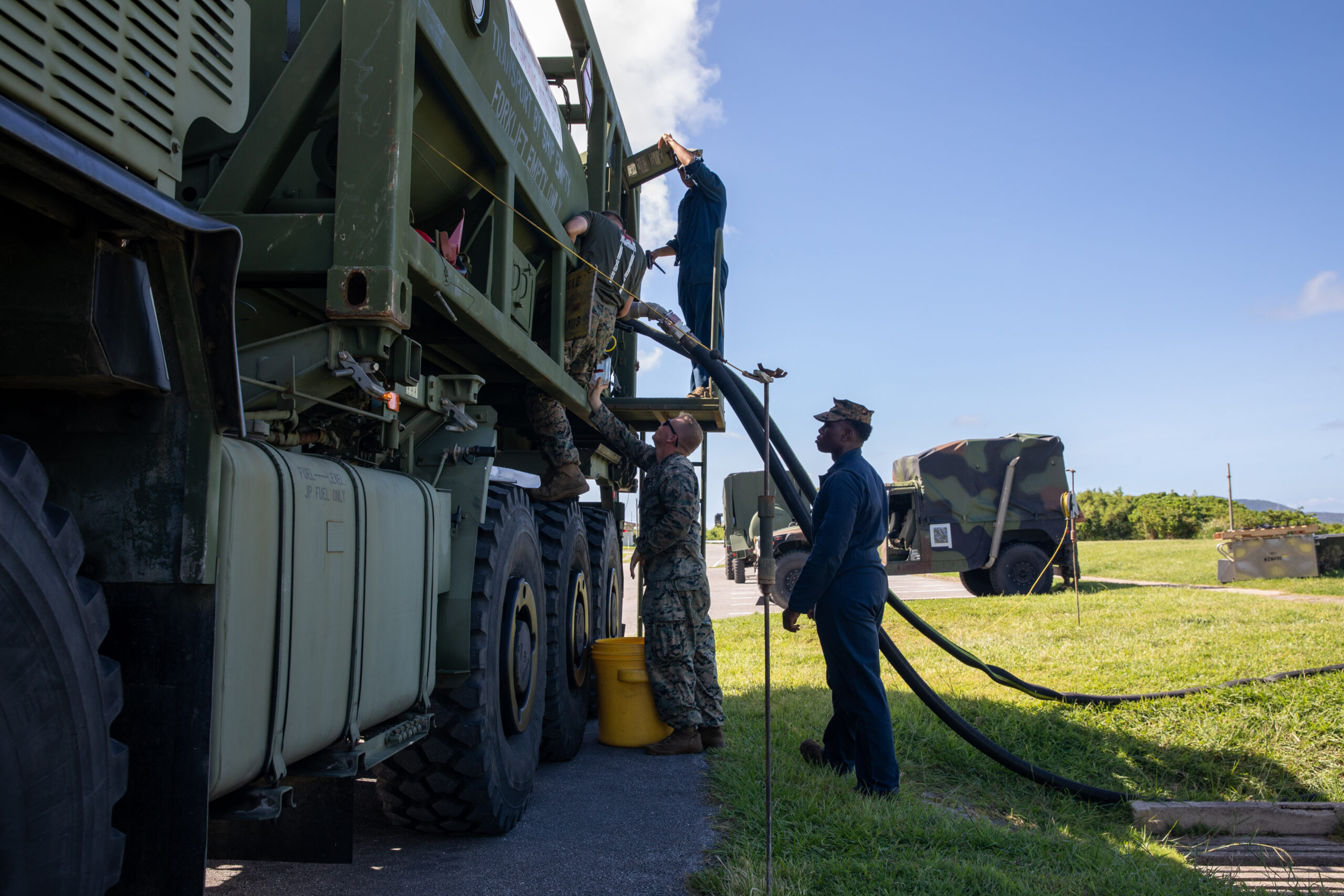
Featured Photo (Top): An accurate logistics COP can ensure visibility of critical classes of supply including bulk fuel.(Photo provided by Cpl Eric Allen.)


ABOUT THE AUTHOR

Col Zimmerman is a Logistics Officer and is currently serving as the Commanding Officer of Combat Logistics Regiment 17, 1st Marine Logistics Group.

Maj Zimmer is a Logistics Officer currently serving as a Faculty Advisor at the Marine Corps Logistics Operations Group.


NOTES:

1. Col Aaron Angell and Jeff Schouten, “Leveraging Logistics above the MAGTF,” Marine Corps Gazette 107, No. 3 (2024).

2. Headquarters Marine Corps, MCDP 4, Logistics (Washington, DC: 2019).

3. Ibid.

4. Ibid.

5. M. Priebe et al., Distributed Operations in a Contested Environment (Santa Monica, CA: RAND Corporation, 2019).

Sustaining the Naval Expeditionary Force

Any beach is a sustainment pathway

Sustaining the Naval Expeditionary Force (NEF) in a distributed maritime operating environment requires methods for assured logistics over the shore. This means bringing warfighting capabilities and life-sustaining supplies from ship-to-shore, shore-to-shore, and potentially shore-to-ship. For survivability in a contested operating environment, the NEF will need the flexibility of operating over opportune landing sites versus known and routine port facilities.

Traditional NEF operations have been tied to the Navy amphibious force. This force includes amphibious ships with attached landing craft, beach master units, and Marine elements task-organized for throughput across designated beaches. These Navy and Marine Corps forces train together during pre-deployment exercises for operational certification. Through operational experience, policies have been developed and refined to govern landing operations with deliberate collection and analysis of hydrographic data.

These policies relate to institutional confidence in a ship and landing craft commander to navigate safely through seas and to land the landing force. This approach of capabilities and policy has worked well for today’s amphibious readiness group and MEU (ARG/MEU) team.

A different approach is necessary for the employment of a NEF that is not tied to amphibious ships. Stand-in forces (SIF) operating from a distributed network of seabases and expeditionary advanced bases (EABs) in a maritime operating environment require logistics over the shore through opportune beach landing sites to survive, particularly in a contested operating environment. These forces will not have a direct tie to amphibious ships and will, therefore, not have access to the landing craft, beach master units, and Marine Corps landing support teams that are traditionally part of the ARG/MEU.

The Marine Corps’ premiere SIF is the Marine littoral regiment (MLR), which is designed to be sustained even when amphibious ships are not present. Sustainment of the SIF will occur through multi-domain distribution platforms that are likely to flow from shore-to-shore, versus the traditional ship-to-shore method that is enabled by the continuous presence of amphibious ships. The MLR will enable sea denial for the NEF, which implies there will be some presence of Navy ships in the operating area, though not necessarily amphibious ships. For the NEF to persist in a contested, distributed maritime operating environment, policies, organizations, and training must be adapted.

Policies
Intentionally beaching a ship or vessel is not a normal practice, and determining where a vessel can be safely beached is nearly a lost art. Historically, the Navy operated tank landing ships designed for landing capability directly onto a beach. This dates back to World War II. These ships have since been decommissioned in the 1990s—many of which were sold to partner nations like Mexico, Australia, Brazil, Chile, Malaysia, and Spain. Since World War II, the Navy and Army have gradually shifted from beaching larger vessels to the use of ship-to-shore connectors designed for maritime-domain theater distribution. These craft include the landing craft utility, landing craft mechanized, and landing craft air cushion.

Ship commanding officers (COs) are responsible for the safe navigation of their ships, informed of the maritime operating environment across the oceans, seas, and littoral areas of operation. Most ships are not designed to beach and recover as a routine, and accidentally running a ship aground can be disastrous for the ship, and the CO. Further, there may also be impacts on the flow at the port, harbor, or canal (ex. Ever Given in the Suez Canal, 2021). Commanding officers are informed by updated maps and charts, trained navigators, experienced maritime pilots, and hydrographic safety officers. This layered combination is designed to prevent grounding and safely execute intentional beaching for deliberate
amphibious and littoral maneuver.

By policy, the Navy is responsible for providing oceanographic services for all elements of the DOD.1 Specifically, the Navy is tasked with collecting source data necessary for oceanographic, hydrographic, and bathymetric (OHB) surveys to “produce the maps, charts, and databases needed to support
navigation, operational plans (OPLANS), joint and naval operations and exercises, and intelligence preparation of the environment.”2

Today, the Navy has approximately 65 military and civilian members assigned to the Fleet Survey Team (FST) as an “expert, efficient, and responsive resource for littoral battlespace characterization and hydrographic surveys.”3 This FST construct has proven to be sufficient for a deliberate response for a crisis or disaster (such as Hurricane Katrina and Haiti earthquake relief). However, this is not responsive enough to support landings at varying opportune beaches across a distributed maritime operating environment during campaigning and when the emergent situation escalates to contested crisis response.

As an operational visualization of this challenge, consider the NEF operating with Marine Corps and Naval support elements ashore in the Philippines. The Philippine archipelago includes over 7,500 islands. The NEF will leverage this whole maneuver space to extend the range of capabilities with survivability. Not all coastlines on these islands are accessible by current landing craft and vessels, which narrows the focus on potential landing sites. Even if the entire 65-member FST were positioned in the Philippines, this would not be very responsive and efficient due to the operational necessity for tactical distribution. Fleet Survey Team members may not need to be on-site if they have the appropriate data to advise a ship CO. However, some collection of accurate, realtime data will always be necessary for safe navigation and the beaching of vessels to support littoral maneuver. Thus, the existing challenge is to have the right capability in many places at once to provide operational agility in the distributed maritime operating environment.

Organizations
Positioning the right capability at the right place and at the right time is the essence of sustainment, yet ensuring this littoral maneuver enabler capability is positioned effectively is the challenge. The organization to provide assured littoral maneuver over opportune landing sites can be accomplished by Navy and Marine Corps elements who have the expertise, the equipment, and the access.

Since forward positioning elements of the limited-capacity FST at all the possible global hot spots is not feasible, there are ways to leverage organizations that are already forward every day. In competition, the SIF has access geographically and politically to collect marine data in the littoral operating area. This includes military surveys, hydrographic surveys, and marine scientific research, all of which help to inform potential opportune beach landing sites.4 A key to collecting this data on foreign soil is diplomatic clearance, which the SIF will already have in competition.

Expanding organization options for collecting marine data will propagate beach landing site opportunities. Marine Corps meteorology and oceanography specialists may seem an obvious choice to collect marine data, though there are current limitations of capacity, and their primary focus is to support aviation operations. Intelligence specialists are another choice, though there can be some challenges to diplomatic clearance for these Marines. Explosive ordnance disposal technicians are increasing organic abilities for operations in littoral operating areas with equipment designed to operate in near-shore water. Another option may be to use infantry or engineers to conduct reconnaissance. Of note, engineers are trained to conduct tactical and technical reconnaissance for mobility. Any of these options can be appropriate with the right equipment and training. However, a key factor for these options is the acceptability of the collection and analysis by ship COs to navigate waters and beaches.

Emerging technology can be used to ensure standardized collection for integrated realtime analysis to assure safe navigation at sea. Marine data may be collected using strategic geospatial capabilities integrated with tactical-level autonomous means. In competition, forces operating ashore can use unmanned or uncrewed multi-domain systems with multi-spectral sensors. Integrating these systems in realtime, and tying them to reach-back experts can effectively identify and validate potential opportune landing sites. From the sea, unmanned or uncrewed surface, subsurface, or aerial systems may be launched from littoral maneuver connectors, or other maritime platforms, to do the same. Autonomous systems used to inform OHB surveys need not be fully dedicated to these sensors; instead, these sensors may just be bolt-on sensors that can be affixed or carried by any vehicle or craft and networked to appropriate analysis teams.

Beyond the organization to collect marine data, the SIF requires an organization to support the landing of vessels at opportune beaches. Recall the traditional shore party teams attached to an ARG/MEU to enable a landing and assure mobility at these beach landing sites. This includes Navy beach group yellow patchers, Marine Corps landing support red patchers, and engineers. For SIF, who do not have assigned, attached, or supporting amphibious ships, these same capabilities are required to assure sustainment can flow across opportune beach littoral transition points. Therefore, the SIF must organize elements to support the landing of shore-to-shore vessels.

Historical precedence exists for shore party teams to conduct reconnaissance and support beach landing areas. Australia established its first pioneer battalion in the aftermath of the failed Gallipoli campaign, forming a unit with light combat engineer functions to support beach landings. During World War II, the Marine Corps formed pioneer battalions to conduct shore-party operations during amphibious assaults to provide mobility support across beaches. Pioneer battalions were eventually redesignated to engineer battalions within the Marine Division and then to combat engineer battalions.

Today, the Navy and Marine Corps no longer have a unit exclusively organized for shore party operations, though the precedence exists and the concept has been rekindled from history. An output of the Marine Corps force design efforts since 2019 was the publishing of a Pioneer Battalion Concept of Employment. This concept presents a standing organization consisting of Navy and Marine Corps engineer and landing support specialists that would support the MLRs operating across the western Pacific area of operations. While the standing organization from this concept has not been embraced by the Navy and Marine Corps, the general concept is employed regularly during combined training and large-scale exercises.

Training
Building the institutional experience for sustaining the NEF across littoral transition points requires training. While the ARG/MEU teams conduct cyclic training for certification before deployment, units operating routinely across the distributed maritime operating area do not routinely build the same integrated training experience. The NEF must train as they will respond to crisis and fight in conflict. Deliberately training to identify and validate opportune landing sites, and then emplace the shore party team for assured mobility across littoral transition points is necessary to assure sustainment for the SIF.

In recent years, Navy and Marine Corps engineers have trained to increase integration toward the missions of expeditionary advanced base operations. Exercises Pacific Pioneer, Summer Pioneer, and Winter Pioneer have strengthened interoperability between Marine Corps engineer support battalions and Navy Seabees. These exercises have incorporated scenarios of beach landing sites and port operations, though they have not drawn in the full mission profile of OHB collection and analysis.

Transitioning from annual exercises to routine interoperability training is the next step for assured mobility. Today, Navy and Marine Corps elements are already operating forward day-to-day in a competition context. Supporting the landing of maritime vessels at opportune beaches is not the only mission for any of these units, yet they must be agile enough to shift on-call to support this mission. Even without the availability of landing craft and vessels, these elements can collect OHB data to update potential landing sites. Doing so overseas also increases interoperability with partner and host nations, and potentially has an integrated deterrent effect.

Conclusion
Sustaining the NEF in a distributed maritime operating environment necessitates the ability to maneuver between seabases and EABs using opportune landing sites that provide flexibility and survivability. To navigate across these littoral transition points, the Navy and Marine Corps must refine policy, organize, and train in competition to be always ready for crisis and conflict. The necessity of accurate OHB collection and analysis for safe maritime navigation should be matched with the existing SIF access. Additionally, transitioning from the occasional exercising of the Navy and Marine Corps Pioneer Battalion concept to routine interoperability training will ensure the NEF can persist in the contested, distributed littoral operating environment.

>Col Angell is a Logistics Officer currently assigned as the Director, Logistics Combat Element Division within Headquarters Marine Corps, Combat Development and Integration.

Notes

1. Department of the Navy, OPNAVINST 3140.55C, Oceanographic, Hydrographic, and Bathymetric Survey Program, (Washington, DC: December 2018).

2. Ibid. Oceanography is the study of the ocean surface, water column, and bottom features including the propagation of acoustic, optical, and other forms of energy. Hydrography is the depiction of shallow water bottom features, coastline, beach, tides, and surf characterization. Bathymetry is the measurement of water depths and bottom contour lines with precise geographic locations. 

3. Naval Meteorology and Oceanography Command, “Fleet Survey Team,” Naval Meteorology and Oceanography Command, n.d., https://www.cnmoc.usff.navy.mil/Our-Commands/Naval-Oceanographic-Office/Fleet-Survey-Team.

4. Department of the Navy, OPNAVINST 3128.9G, Diplomatic Clearance for U.S. Navy Marine Data Collection Activities in Foreign Jurisdictions, (Washington, DC: April 2021). 

Think, Act and Operate Differently

Our nation faces its most significant threat to national security in generations. China’s relentless military modernization and expansion has disrupted the Indo-Pacific region and threatens American interests, those of our allies and partners, and the overarching global order. Other actors seek to further destabilize the globe, adding to the continually growing and evolving challenges we face. The requirement for us to answer the call—every call—necessitates a unique mindset among all of us, one that can deal with multiple, disparate, even seemingly unrelated yet subtly connected events that require agility in thought and action. Logistics remains a common thread throughout these varying warfighting scenarios and often drives what we can and cannot do.

Logistics breathes life into strategy, and the changing character of war means we must think differently about delivering logistics readiness to the Fleet Marine Force (FMF). We must acknowledge that sustaining the force throughout the next conflict will require many changes from our previous twenty-five years of combat to stay ahead of China’s pacing threat. These changes must be viewed through the lens of all warfighting functions—logistical readiness is not just the purview of logisticians; it requires a whole of Marine Corps commitment. This will require hard decisions to balance optimizing our current capabilities with the need to develop and apply new capabilities as force offerings to Combatant Commanders. In doing so, we ensure our logistics and installations capabilities are fully integrated with the overall Force Design plan and we provide combat credible forces to serve as effective deterrents and, if necessary, will undoubtedly prevail in conflict.

Our 39th Commandant believes that innovation keeps us ready—and I agree with him. Real innovation begins with your courage to vocalize and actualize your recommended solutions to our challenges. Innovation helps optimize current capabilities and develop new approaches against today’s problem sets to mitigate risk and increase lethality. The Marine Corps Gazette is a perfect forum for this discourse. To remain relevant in a modern fight, we need to be a modern force—our Corps needs your thoughts, voices and action to keep us most ready when our Nation is least ready.

I owe a huge thanks to all contributors. I personally read every submission and am exceptionally grateful for the tremendous commitment, thought, and time they took in drafting their respective articles. Each one was superb, and I wanted to publish all, but we had to make hard choices. The articles address many Fleet Marine Force requirements necessary to enable our Marine forces to provide relevant and credible combat forces. Critical topics such as intelligence, artificial intelligence and information systems, advanced manufacturing, the Marine Corps Global Positioning Network, health and mortuary services in a contested environment, and building installation resilience are examined in detail. Other equally valuable topics are addressed in the on-line edition of the Gazette, and I recommend those as well. The mandate to “Think, Act, and Operate Differently” is more than a tagline; it defines how we approach the multitude of challenges we face. The time to act is now.

Stephen D. Sklenka
Lieutenant General, U.S. Marine Corps
Deputy Commandant for Installations and Logistics