

Desert Storm: The “Speed Bump” Battalion And the Snipers Who Led the Way
By: Kyle WattsPosted on January 15, 2026
On Aug. 14, 1990, infantrymen from 3rd Battalion, 9th Marines, 7th Marine Expeditionary Brigade, debarked their aircraft after a long, transoceanic flight. The Saudi Arabian sun broiled each Marine as they heaved their packs onto their backs and plodded out onto the tarmac. Saudis around the flight line ushered them into barren metal warehouses, the Marines’ new home away from home. The structures adopted qualities more characteristic of an oven than a barracks as men packed inside. The more time passed, the more each Marine longed to set out into the open desert and do what they had trained for.
Their base at Al Jubayl lay undefended, barely 150 miles south of the Iraqi army staged in Kuwait. Less than two weeks earlier, Saddam Hussein had launched his forces across the Iraq-Kuwait border in a nighttime invasion, wrapping up the neighboring nation with stunning speed. He skillfully portrayed his army as an intimidating foe. The Iraqi forces numbered on paper as the fourth-largest army in the world. They appeared battle hardened following the Iran-Iraq War, which had lasted nearly the entire previous decade. The Iraqis proved ruthless through their willingness to utilize weapons such as poison gas. Without knowing the extent of Hussein’s intentions, the United States landed Marines in Saudi Arabia to deter further aggression and stop the Iraqi assault if it continued south.
For the initial Marines on the ground, the prospect of halting Iraq’s advance felt overly optimistic.
Iraqi soldiers surrender to Marines with 2nd LAR, 2ndMarDiv, in Kuwait. (Photo by Sgt J.L. Roberts, USMC)
“We went in with just our individual equipment and were really nothing more than a speed bump,” recalled retired Sergeant Major Michael Barrett, the 17th Sergeant Major of the Marine Corps. During Desert Storm, Barrett served as the platoon sergeant of 3/9’s surveillance and target acquisition (STA) platoon. “We actually called ourselves ‘the speed bump.’ That was the term our whole battalion used.”
Maritime prepositioning forces arrived offshore with equipment as the days passed. Barrett’s sniper platoon commandeered gear and vehicles as more and more U.S. forces piled into the base. The humvees they acquired rolled off the cargo vessels bright green, standing in stark contrast to the drab browns and greys coloring their world. Lacking any other tools, the Marines mixed water with the talcum powder-like sand, creating a sludge to “paint” their vehicles brown. They staged with the battalion at Al Jubayl for more than five months. Meanwhile, American diplomats ramped up the pressure on Hussein, and senior military commanders drafted a plan to forcibly expel him from Kuwait, should the need arise.
The United Nations Security Council set Jan. 15, 1991, as the deadline for Iraq to voluntarily leave Kuwait. Hussein refused to cooperate as the date expired. Two days later, the United States opened Operation Desert Storm with a massive bombing campaign, stunning in both its scope and its swift destruction. Marine Captain Charles J. Magill, flying a U.S. Air Force F-15C Eagle in an exchange pilot program, scored an air-to-air kill on the same night the air war opened.

Bagging an Iraqi MiG-29, Magill remains the only Marine aviator with an aerial victory since the Vietnam War. The following morning, on Jan. 18, Iraqis shot down the first Marine aircraft of the war, striking an OV-10 Bronco from Marine Observation Squadron 2 with a surface-to-air missile. The two crewmembers survived the attack and were captured on the ground. They were the first of five Marine aviators shot down and detained as prisoners of war until the conflict ended.
While the air war raged, 3/9 waited. As the first arriving battalion in Saudi Arabia, these Marines were perhaps the most eager to get into the fight. They learned of aviators virtually erasing the entire Iraqi air force and wiping dozens of ground defense positions off the map. At the end of January, they heard of Hussein’s forces finally vaulting south across the Saudi border, the very contingency for which the battalion had landed months earlier. On Jan. 29, Iraqi forces seized the border town of Khafji, touting the advance as a propaganda victory. Three days later, though, his forces retreated back into Kuwait, leaving a trail of destruction in their wake. The battle to recapture the city cost coalition forces 43 killed, including 11 Marines. Tragically, several of those killed in action were victims of friendly fire. As February began, the scout snipers of 3/9’s STA platoon increased the tempo of patrols and observation posts north of Al Jubayl. The climactic event of the war, the final ground assault and liberation of Kuwait, now approached. Commanders scheduled the advance to begin on Feb. 24.
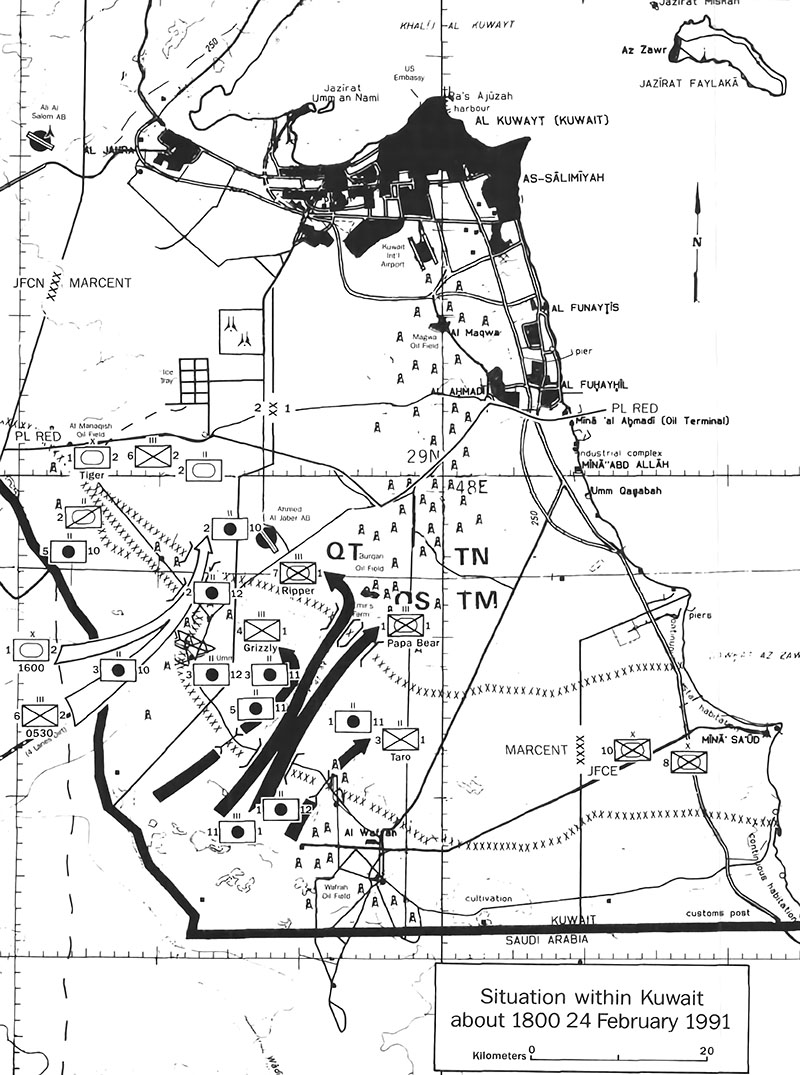
U.S. Marine and Army forces, along-side joint forces from multiple nations, divided across a massive front extending 300 miles inland from the Persian Gulf. While some units staged along the Saudi border with Iraq, those closest to the coast prepared to advance directly into Kuwait. Here, the Iraqi army constructed two defensive obstacle belts to impede the Americans’ progress, consisting of barbed wire, minefields, antitank ditches and more. Well before dawn on the 24th, the STA Marines deployed in advance of the rest of the battalion to identify breach points through the belts.
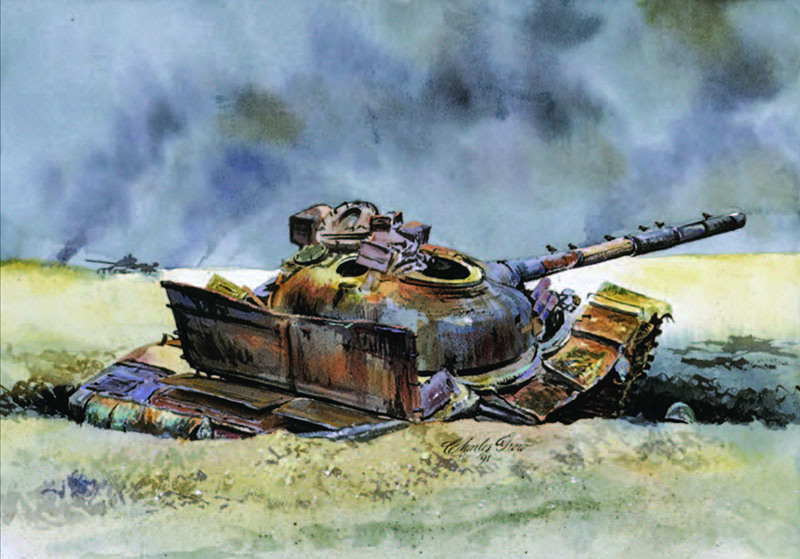
“Damaged Iraqi Tank” is a watercolor painting created by Marine artist, Capt Charles G. Grow.
“Our platoon was tasked with route recon for our entire battalion,” Barrett recalled. “We were 15 kilometers for-ward of the battalion, observing the battle area and identifying release points where our tanks and tracks would roll through the breach and deploy the ground forces. 3/9 had two battalions’ worth of 81-millimeter mortars. We had to find them a site as well where they could set up and fire into and beyond the breach. I don’t believe, in history, Marine snipers had ever been used in such a fluid environment mounted in vehicles. How do you employ snipers in a battlespace like that that was so fast, aggressive, and fluid? We kind of were creating those tactics as we went.”
Divided into two universal fire support vehicles, called “Wolf” and “Badger,” sniper teams roamed the battlefield alongside forward air controllers, forward observers and additional communications Marines while the remainder of the battalion advanced behind as part of Task Force Papa Bear. Engineers approached the breach site identified by STA on the first obstacle belt and cleared a path. Tanks equipped with mine-clearing plows followed, bulldozing a path wide enough for the battalion to safely filter through. By 9 a.m., the battalion passed the obstacle belt unopposed.
The enemy refused to cede the second defensive belt so easily. Iraqi artillery and mortars fell around the battalion as the Marines positioned into staging areas before the line of obstacles. Far ahead in the Badger vehicle, 23-year-old Corporal Bryan Zickefoose spotted an enemy forward observation post and mortar battery. Exposed and under fire, Zickefoose held his position with a laser designator, marking the targets for incoming airstrikes. Shrapnel from indirect fire explosions tore into the vehicle as the enemy walked rounds closer. Zickefoose held his ground until two jets soaring overhead wiped out the targets with precision bombs.
“We called in a ton of airstrikes and artillery missions that first day,” Zickefoose said. “At one point, we had an Iraqi tank shooting at us that I called in air support on, and we got a kill on that.”
As the day progressed and Marines penetrated deeper into Kuwait, surrendering Iraqi soldiers flooded the battlefield. They appeared at first in small groups. The snipers in their vehicles far ahead of the battalion instructed the Iraqis through interpreters to just keep walking. Eventually, they would meet someone equipped to handle them. In some places across the front, the surrendering soldiers arrived in groups so large it overwhelmed the rear units and hindered the Marine advance.
Despite the hordes of surrendering enemy, many chose to fight. At one point, while pressing toward the second breach, Badger and Wolf drove up on an extensive enemy trench line. Enemy mortars were still exploding in the vicinity and sporadic gunfire targeted the snipers. The entire battalion halted until the snipers could determine the threat posed by the enemy defenses. With time working against them,
Barrett, Zickefoose and Lance Corporal Michael Kilpatrick exited their vehicles and sprinted forward.
“The rest of our STA teams got out and deployed their weapons systems to provide overwatch for us while we jumped into the trench,” Barrett stated. “We kept coming up on these hardened positions within the trench that we didn’t know if they were occupied, so each time one of us would throw a grenade in there, then we’d enter once it went off. Myself, Zickefoose, and Kilpatrick took turns going first, leapfrogging for 300 meters down the trench. It was an exciting moment. There was abandoned equipment everywhere, papers, comm gear, they left their weapons just laying inside the trench line, but after about an hour’s worth of clearing, we didn’t find any enemy.”
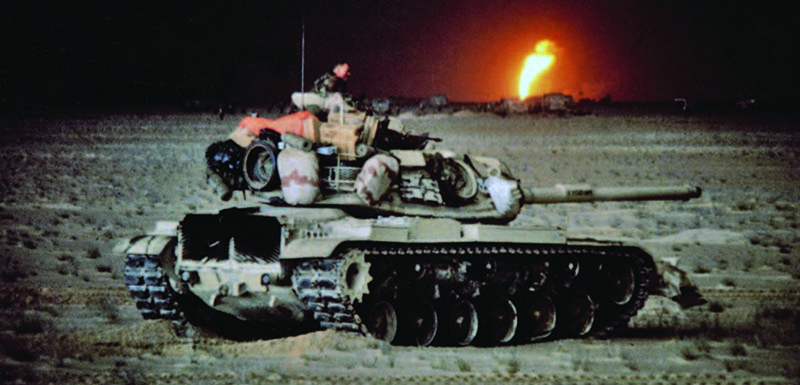
An M60A1 tank with Task Force Papa Bear sits near a burning oil well on Feb. 24, 1991. Note that this photograph was taken during daylight hours in the afternoon. (Photo by: LtCol Charles H. Cureton, USMC)
Enemy fire increased further when the battalion finally assaulted through the second breach that afternoon. LCpl Kasey Krock, an engineer assigned to 3/9, heroically distinguished himself when the charge from his MK154 mine-clearance launcher malfunctioned. The rocket-propelled line charge extended fully, carrying the 1,800-pound string of C4 100 meters in front of his vehicle, but the explosives failed to detonate. With the entire battalion waiting behind him, Krock gathered his equipment and ran ahead to manually detonate the charge. When he returned, the MK154’s second shot failed even worse. Not only did the charge fail to detonate, but the rocket failed to extend the line, leaving portions of it dumped on the ground in a winding mess. Once again, Krock exited his vehicle under direct and indirect enemy fire. He calmly pressed forward into the obstacle belt’s live minefield, following the line charge to prime it for detonation. He returned, detonated the second line and successfully opened the breach for the assault force to surge through. For his courage and decisive actions, Krock would receive the Silver Star.
“We were watching all of this unfold as we were going through the breach site,” said Barrett. “Off to our right flank, I remember watching some amtracs receiving artillery or mortar fire. A couple of them were hit, and we took some wounded. I remember one of our tanks hitting a mine and blowing the track right off of it.”
Through the breach, Task Force Papa Bear approached the Al Burqan oil field. Iraqi soldiers set oil wells aflame as they retreated, leaving a hellish landscape in the Marines’ path. Enormous columns of fire burned uncontrollably. Thick, choking black smoke enveloped the area. It was only midafternoon, but the smoke so thoroughly blotted out the sun it appeared to be midnight. Some units encountered smoke so thick their visibility reduced to less than 100 meters. With the oil fields ahead obscuring an unknown enemy and the obstacle belts successfully left in their wake, the Marines halted and arranged defensive positions for the night.
“That night, it got so dark it was pitch black. It was like something right out of the Bible,” Zickefoose remembered. “At one point, I jumped off the hood of the vehicle and turned around and literally could not see the vehicle I jumped off. So, we dug in that night right where we were at.”
Unknown to the Marines, Iraqi commanders spent the night rallying forces for a counterattack. Dozens of tanks and armored personnel carriers crept slowly through the fire and smoke approaching Marine positions. In 3/9’s area, dawn over the desert illuminated a hazy world. Thick morning fog combined with the smoke, reducing visibility to less than 50 feet. Around 8 a.m., Task Force Papa Bear’s
leadership gathered at the regimental command post (CP) to lay out a plan for the day. The snipers assigned to the Badger and Wolf vehicles staged nearby, having transported the battalion commander to the meeting. Suddenly, through the fog, the unmistakable rumble of mechanized armor approached. The first tank materialized a stone’s throw away from the CP and halted. Before the Marines could react, the Iraqi brigade commander in charge of the mechanized force exited the tank and surrendered to the Marines conducting the staff meeting. The surrender message failed to extend any further than the commander’s own tank, however. Even as this ironic and startling exchange took place, additional Iraqi units appeared with guns blazing. Marines hit the deck and took cover as tank main gun fire, machine-gun tracers and even small arms rounds from the Marines’ own rifles tore through the CP.
“We were getting briefed up on the plan and preparations to take Kuwait International Airport and that’s when all hell started breaking loose,” said Barrett. “You could barely see anything, but you could hear that mech rolling up. Everything started during that briefing, and so all of the sudden, that plan just went right out the window.”
Zickefoose and Kilpatrick stood with their vehicle when two Iraqi armored personnel carriers (APCs) emerged. Soldiers streaming out were cut down quickly by Marine fire, which also ignited the enemy vehicles into a burning conflagration. Unable to see anything else and unwilling to wait for whatever else may be coming, the two snipers jumped in their vehicle and drove ahead into the fog. Kilpatrick inched forward into an area where visibility was around 50 yards. Two Iraqi tanks sat idling on the sand. Zickefoose yelled for Kilpatrick to back out before the tanks could react.
Back near the burning APCs, both Marines grabbed rocket launchers and moved on foot back into the fog. Zickefoose snuck around the flank of one tank and shouldered his weapon. He’d never before fired an AT4 rocket, but at less than 50 yards away he scored a direct hit, disabling the tank.
“After I fired, the second tank decided to shoot at me with his heavy machine gun on top of the tank,” Zickefoose said. “I started running back and Kilpatrick fired his LAW and took out the second tank. I don’t know if we just got mobility kills, but when we later drove up there, both those tanks were stuck in the sand.”
With the two tanks knocked out, Zickefoose and Kilpatrick withdrew under fire back to the CP. Additional Marines fought off the remainder of the imminent Iraqi threat. The task force’s tanks from 1st Tank Battalion rolled into the fray.
“Everybody immediately geared up and got to our vehicles ready to move forward into whatever we were going to do next, but there was really nothing we could do in this battle. It was an armor thing. Our M-60 tanks came up, and both sides just started lobbing rounds back and forth, hence the big tank battle. But two young guys from 3/9 STA just said, ‘Here we go,’ and started the whole thing,” SgtMaj Barrett said.
The rising sun steadily burned off the fog, increasing visibility. The snipers watched the show as their tanker brethren lay waste to the enemy on the field before them. Cobras from 3rd Marine Aircraft Wing swooped in overhead, adding to the destruction. In an epic fight lasting more than three hours, the Marines virtually annihilated two Iraqi brigades. According to the USMC History Division publication covering the battle, 1st Tank Battalion accounted for 50 Iraqi tanks disabled, 25 APCs destroyed and 300 prisoners captured—all with no Marine casualties.
The Iraqi counterattack that morning affected Marine and Army units across the entire front. Captain Eddie Ray of Company B, 1st Light Armored Infantry Battalion, 1st Marine Division, would receive a Navy Cross for his initiative and heroism maneuvering around the battlefield in his light armored vehicle, attacking the enemy and designating targets. Others, such as Lance Corporal Chris Sweeney serving as an antitank missile gunner with 1st Battalion, 8th Marines, would earn a Silver Star for singlehandedly eliminating six tanks and one APC from the turret of his vehicle with TOW missiles. In total, the Battle of Burqan, or the “Reveille Counterattack” as it is sometimes called, is today widely considered the largest tank battle in Marine Corps history. For their initiative and courage seeking out and destroying the enemy in the initial surprising moments of the counterattack, in combination with their actions identifying and destroying targets during the advance the day prior, Kilpatrick and Zickefoose both received the Silver Star.

One of two Iraqi tanks taken out on the morning of Feb. 25, 1991, by Cpl Bryan Zickefoose and LCpl Michael Kilpatrick. After the morning fog and smoke lifted, the Marines found both tanks disabled and stuck in the sand. For their heroic actions and initiative, both Zickefoose and Kilpatrick were awarded the Silver Star. (Photo courtesy of SgtMaj Bryan Zickefoose, USMC (Ret))
The assault continued for two more days. Having led the battalion’s advance through the obstacle belts and across the border, the STA platoon took a back seat for the remainder of the operation. The Marines remained on the cordon around Kuwait International Airport while LAVs secured the facility on the 26th. Following the airport’s capture, 3/9’s leadership presented the STA platoon with a more humanitarian mission.
“Once the airport was secure, we received direction from our battalion CO that we no longer needed our two wonderful Kuwaiti freedom fighters, our interpreters, so we loaded them up in our Wolf and Badger vehicles and drove them home,” remembered Barrett. “We drove them right to their home addresses there in Kuwait City. It was so neat. We got there and their families came outside and invited us in for tea and cake. It was really a wonderful moment because they had not seen their families in over six months and we got to witness that reunion.”
The battalion returned to the port in Saudi Arabia. As the first Marine battalion arriving in country nearly seven months earlier, 3/9 would be the first to return home. Driving south, the Marines witnessed scene after scene of the incredible destruction left in their wake during the advance. Hundreds upon hundreds of destroyed or abandoned Iraqi vehicles lined the roads. Groups of surrendering soldiers lingered, waiting to be processed. In total, during the four-day operation, I Marine Expeditionary Force estimated its forces accounted for 460 tanks destroyed, 600 tanks captured, 218 APCs destroyed, 390 APCs captured, 432 artillery pieces destroyed, 1,500 enemy soldiers killed and more than 22,000 captured.
The Marines of 3/9 STA moved on from the platoon following the successful conclusion of Operation Desert Storm. For Kilpatrick, the Silver Star he received held a special and unique personal meaning. When Kilpatrick was less than a year old, his father was killed in Vietnam. CPT Donald R. Kilpatrick served as a U.S. Army helicopter pilot with the 187th Assault Helicopter Company. On Sept. 2, 1969, Kilpatrick piloted his chopper on a combat mission when an enemy machine-gun round tore through the canopy and struck him in the head. The rest of the crew remained uninjured and kept the bird aloft, but Kilpatrick died en route to the hospital. Twenty-two years later, the summer after his son returned home from the war of his generation, the younger Kilpatrick visited the Vietnam Veterans Memorial in Washington, D.C. Kilpatrick left his medal at the base of the panel inscribed with his father’s name, stating his father was the one who truly deserved the medal. Kilpatrick remained in the Marine Corps for a total of 10 years, serving as a sniper and Force Reconnaissance Marine.
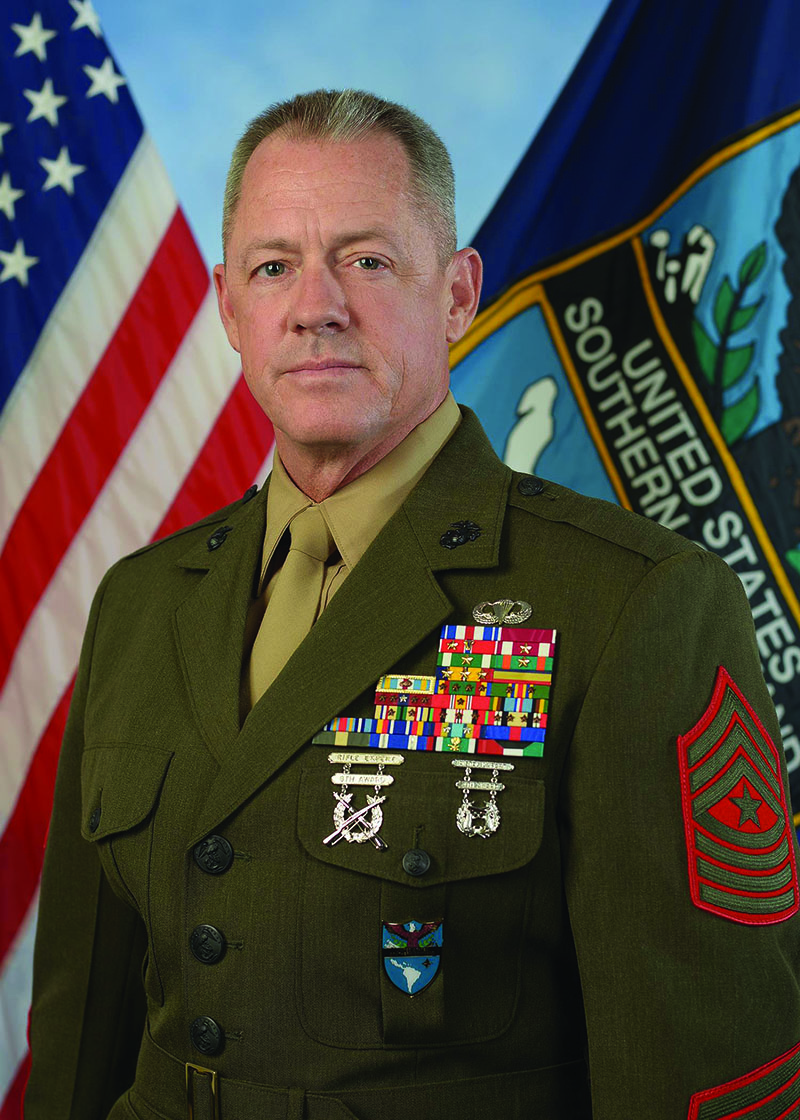
Zickefoose progressed in his career after the war. By that point, already six years in, the corporal was very much still at the beginning of what would become a long and historic career. Zickefoose enlisted as a rifleman in 1985 and, over the course of his career, held every infantry billet from 0311 to senior enlisted advisor, and performed duties in Marine Security Forces, as a drill instructor, as a scout sniper instructor and in recruiting. He retired in September 2020 after 36 years in the Corps. His final billet was serving as the command senior enlisted leader for U.S. Southern Command. At the time, Zickefoose was recognized as the longest currently serving enlisted Marine.
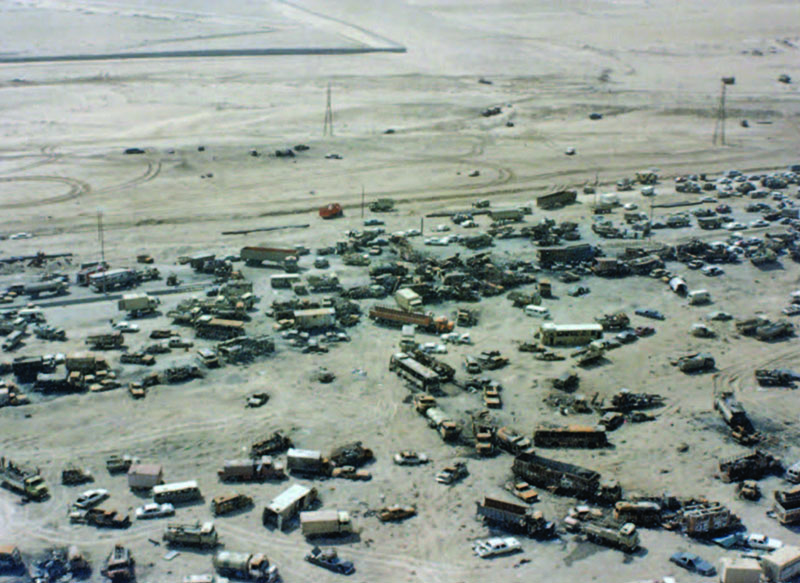
The “Highway of Death” photographed in March 1991. This was the road running west out of Kuwait City used by Iraqi troops and vehicles during their retreat. (Photo by BGen Granville Amos, USMC)
With 11 deployments under his belt, including combat in Somalia and Kosovo, and during Operations Desert Shield, Desert Storm, Iraqi Freedom and Enduring Freedom, Zickefoose always remembered his experiences as a young Marine in the Gulf War.
“My first platoon sergeants were all Vietnam vets,” he reflected today. “They had all gotten out by the time the Gulf War started, so most of our combat experience was gone. There were a lot of little things that we just didn’t know what to expect. By the time I went back to combat later in my career, all the things I’d been through in Kuwait and Somalia and Kosovo and the different places we went, all that combat experience helped me talk to the young Marines and help get them through whatever was going to happen.”
Barrett went on to an equally distinguished career, retiring in 2015 as the Sergeant Major of the Marine Corps after 34 years of service.
“I was the battalion sergeant major for 2/7 during two deployments to Iraq,” he said. “I would always tell the Marines to trust your training. When in doubt, when the combat is right in your face, trust your training. Through Iraq and all the times I went to Afghanistan, I would always tell young Marines the same message. Marines like Kilpatrick and Zickefoose, two young stud warriors, they were magnificent to have in that platoon, and what did they do then? They trusted their training. It was truly an honor to stalk across the battlefield with them, and to have served with such wonderful human beings.”
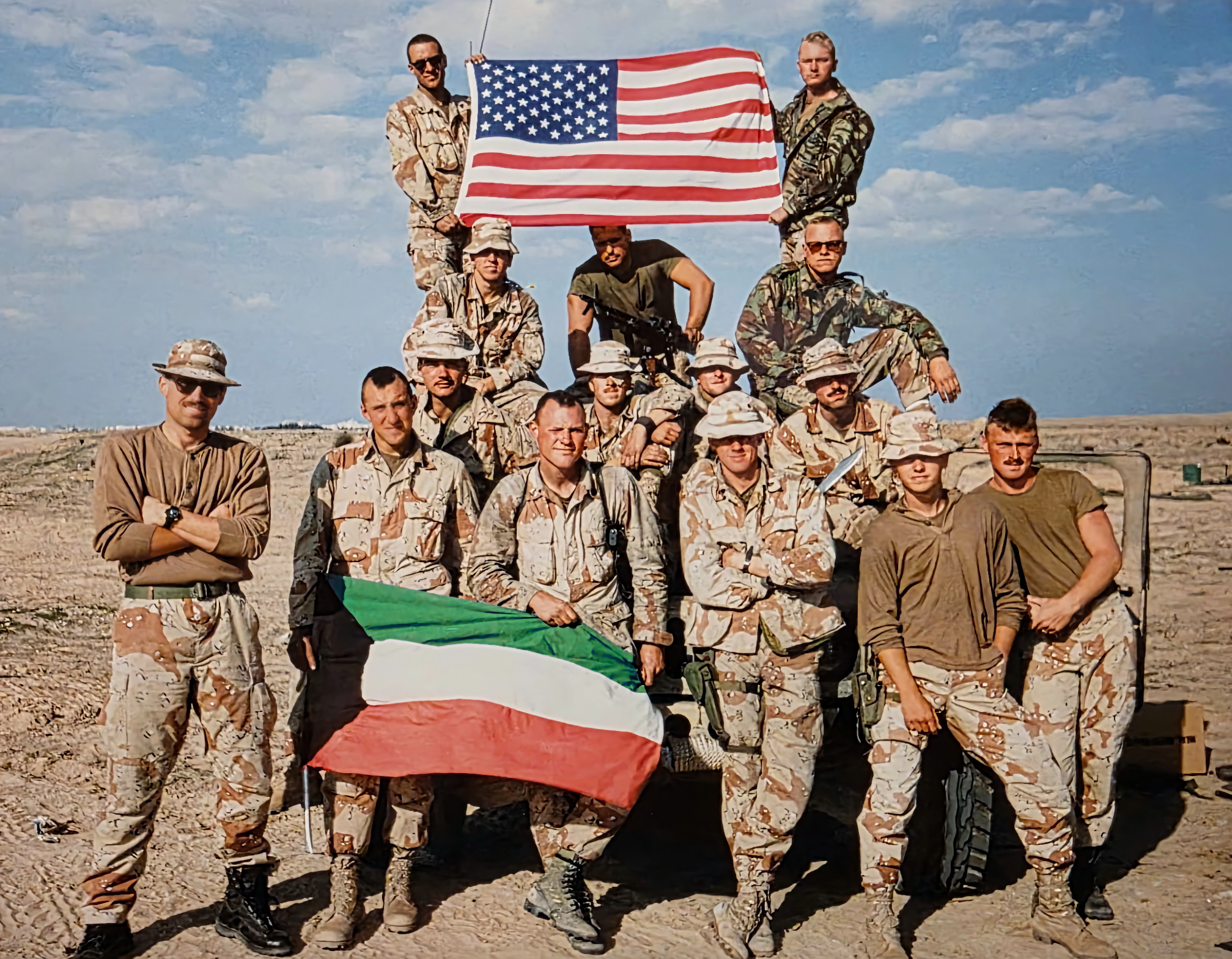
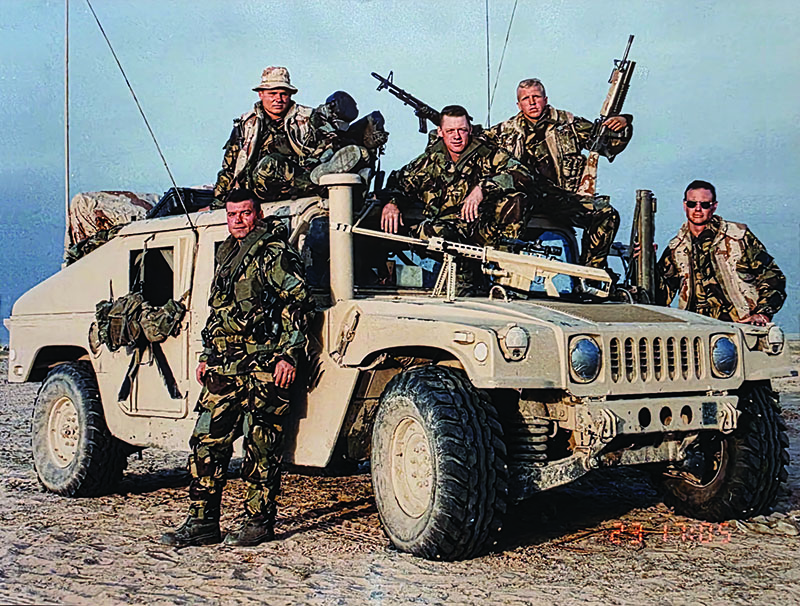
The Marines of 3/9’s surveillance and target acquisition platoon during Operation Desert Storm. Then-SSgt Michael Barrett holds the Kuwait flag, center-left, while Cpl Bryan Zickefoose stands beside him, center-right. LCpl Michael Kilpatrick kneels on top of the vehicle, to the left beneath the U.S. flag. (Photo Courtesy of SgtMaj Bryan Zickefoose, USMC (Ret))
Featured Photo (Top): The “Badger” reconnaissance and fire support vehicle of 3/9, manned through Operation Desert Storm’s ground assault by Cpl Bryan Zickefoose, center, and LCpl Michael Kilpatrick, center right.
About the Author
Kyle Watts is the staff writer for Leatherneck. He served on active duty in the Marine Corps as a communications officer from 2009-13. He is the 2019 winner of the Colonel Robert Debs Heinl Jr. Award for Marine Corps History. He lives in Richmond, Va., with his wife and three children.
Enjoy this article?
Check out these similar Leatherneck and Scuttlebutt features..
The Gulf War: Two Marine Divisions Breached A Minefield and Vanquished Iraqi Forces in a Desert Set Aflame
Leatherneck
January 2001
By: Otto Kreisher

It’s War! Five Days on the Road to Baghdad
Leatherneck
May 2003
By: Renaldo Keene
Desert Shield / Desert Storm
Leatherneck
April 1991
By: Compilation


