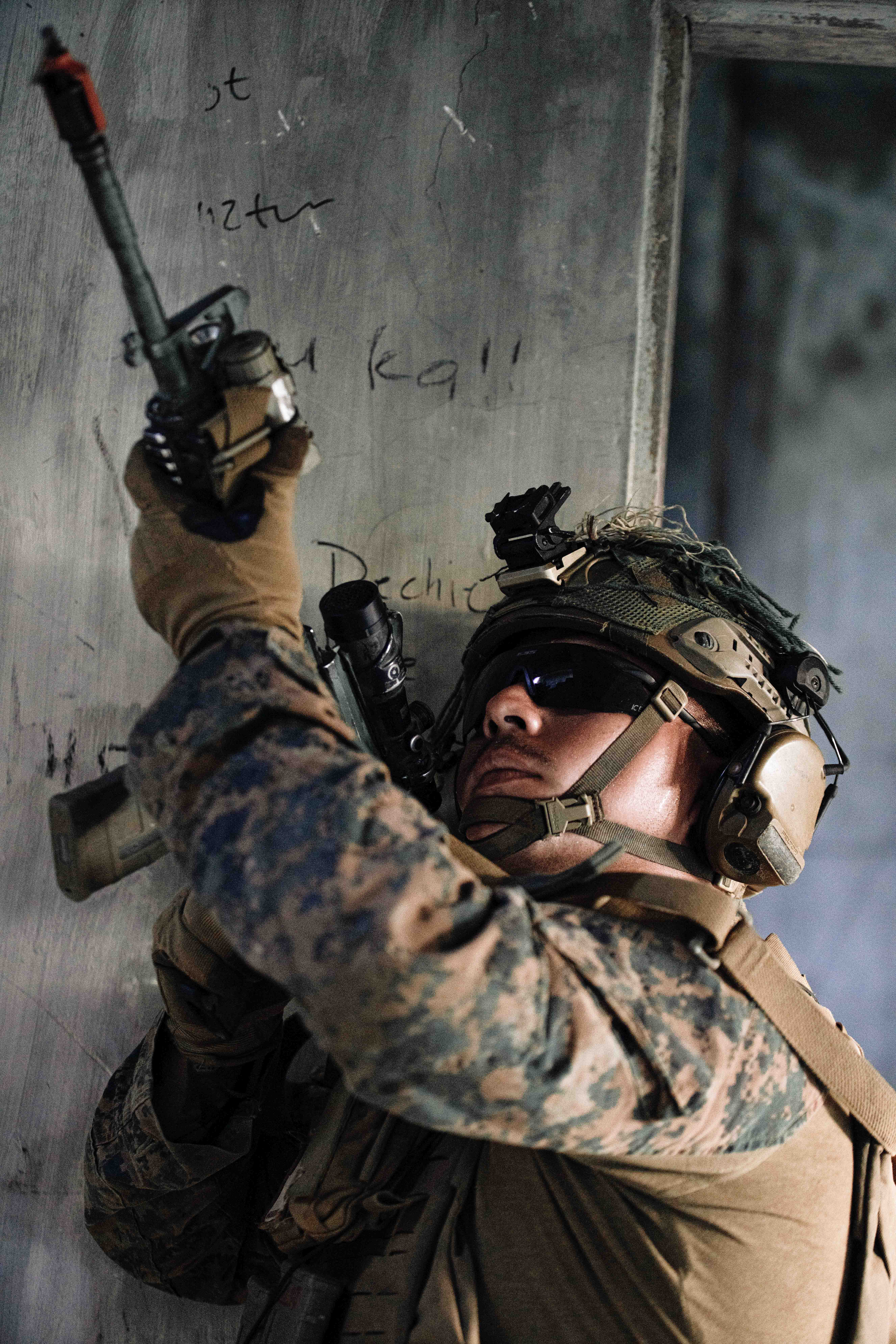
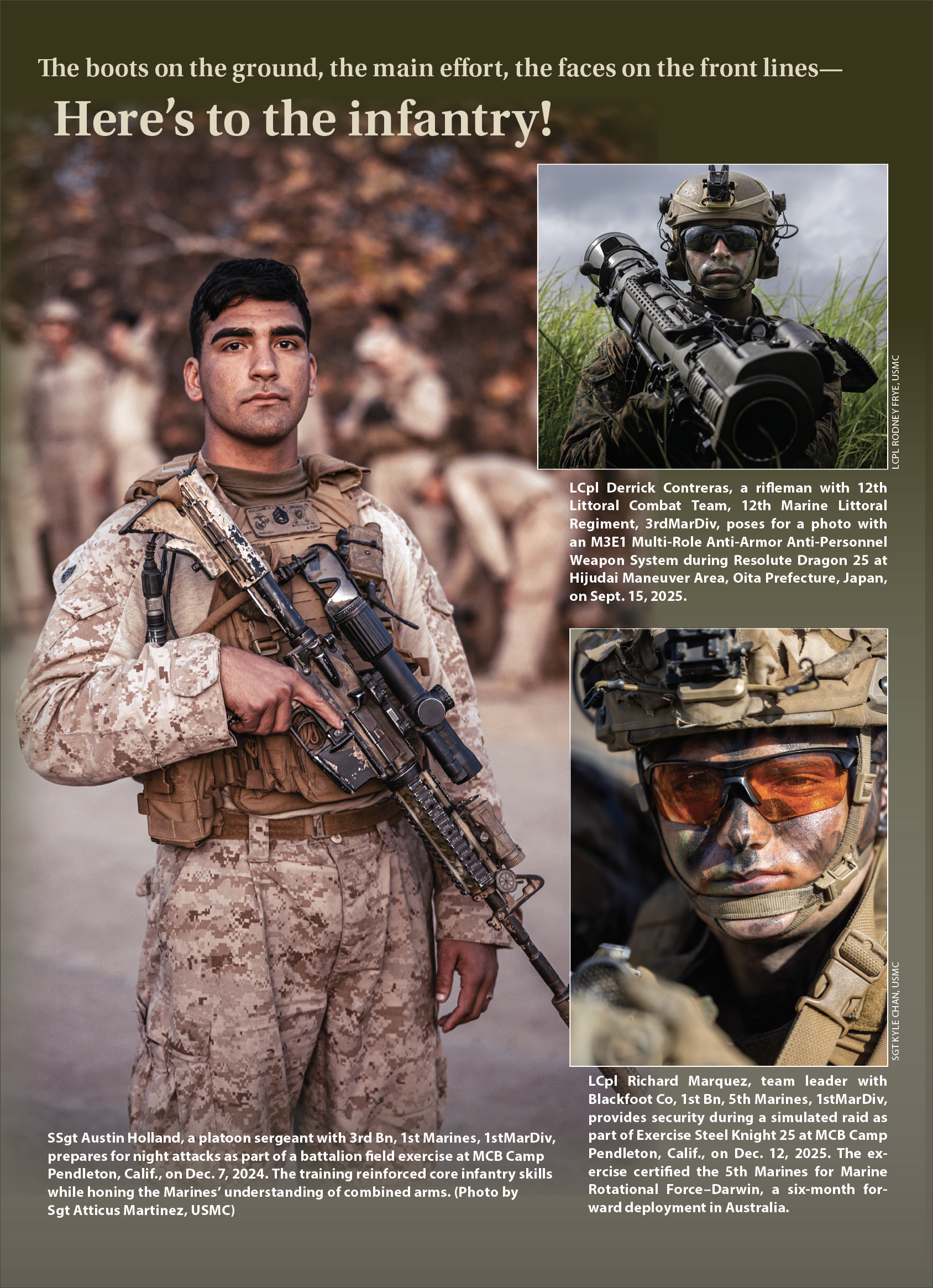
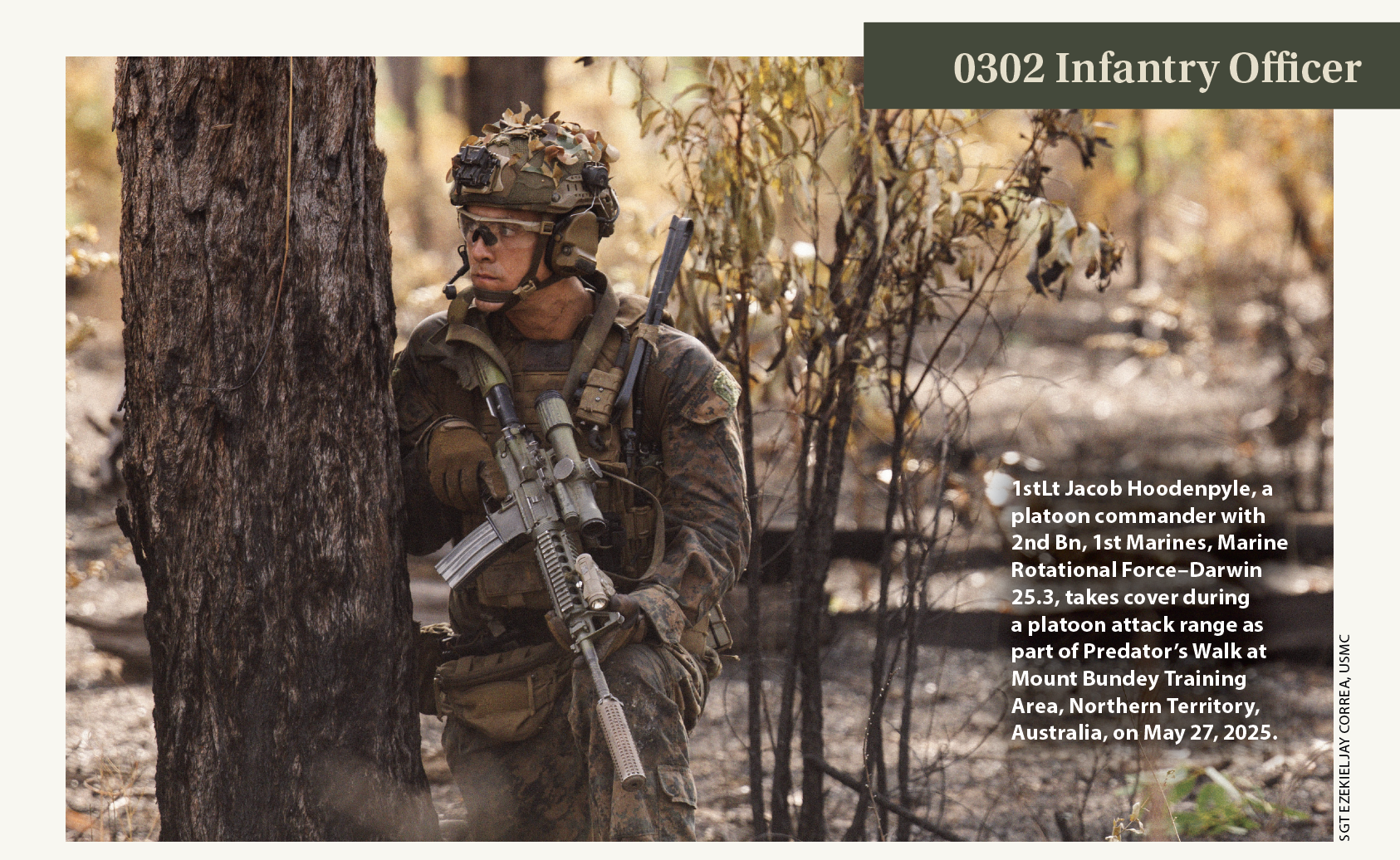
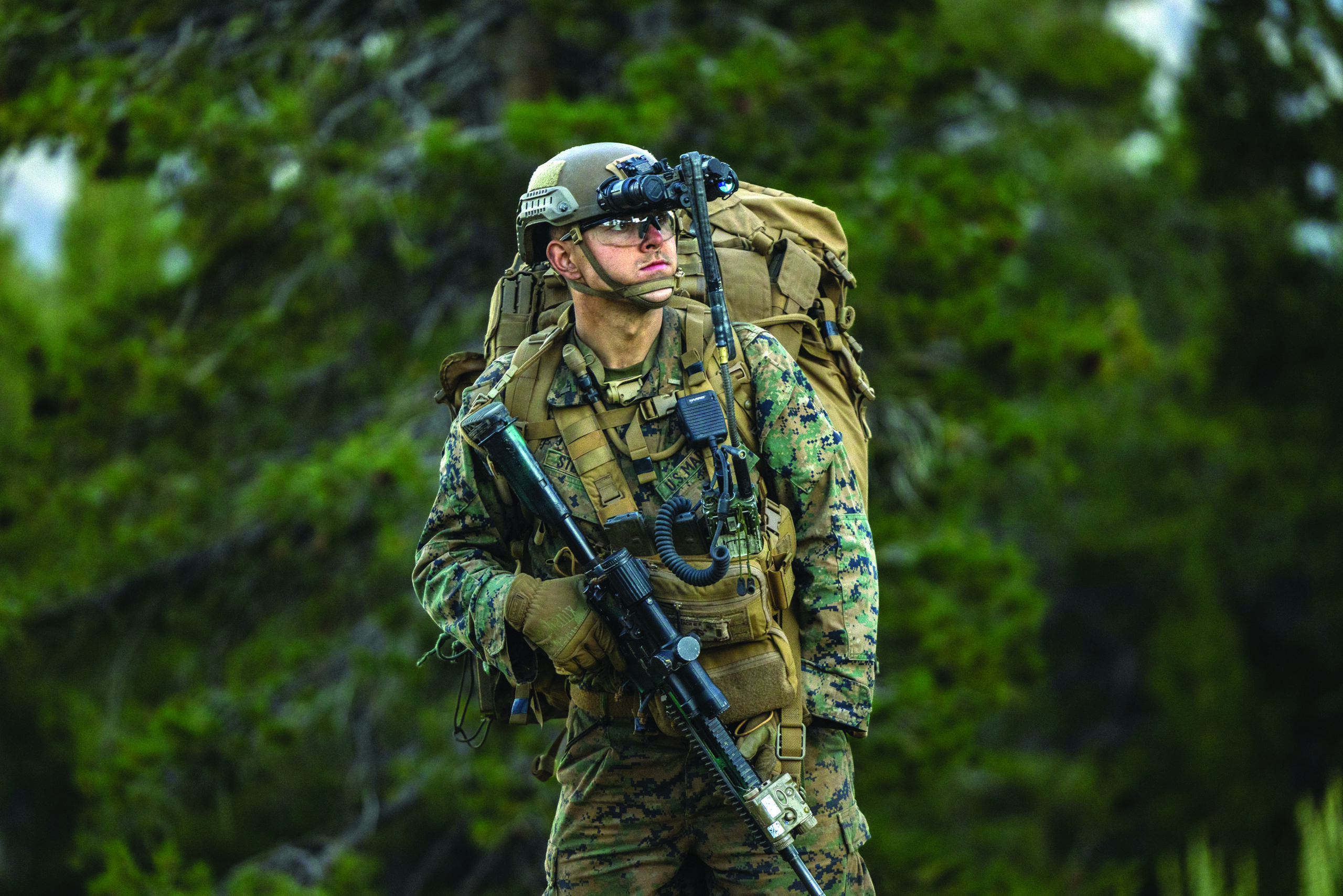
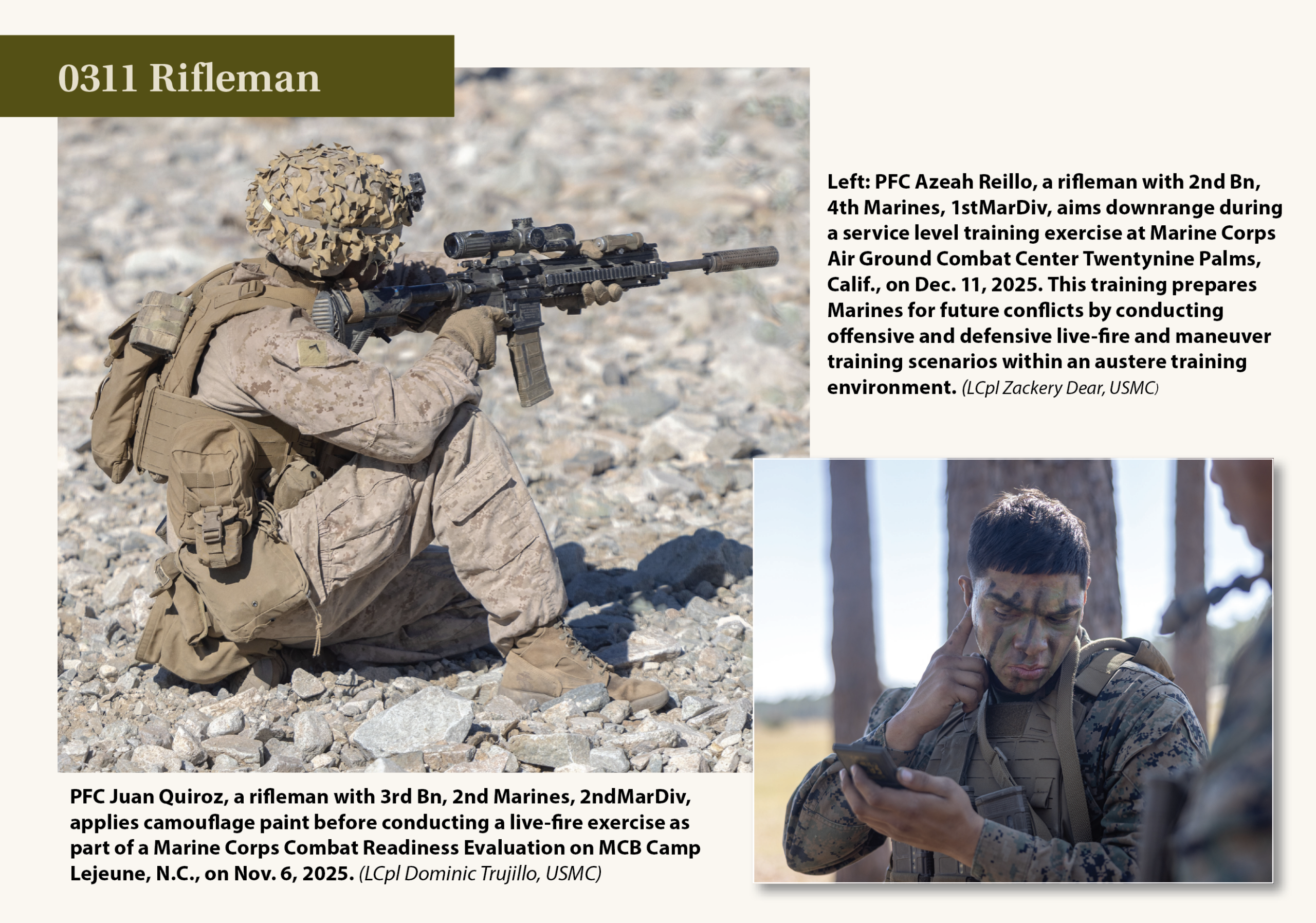
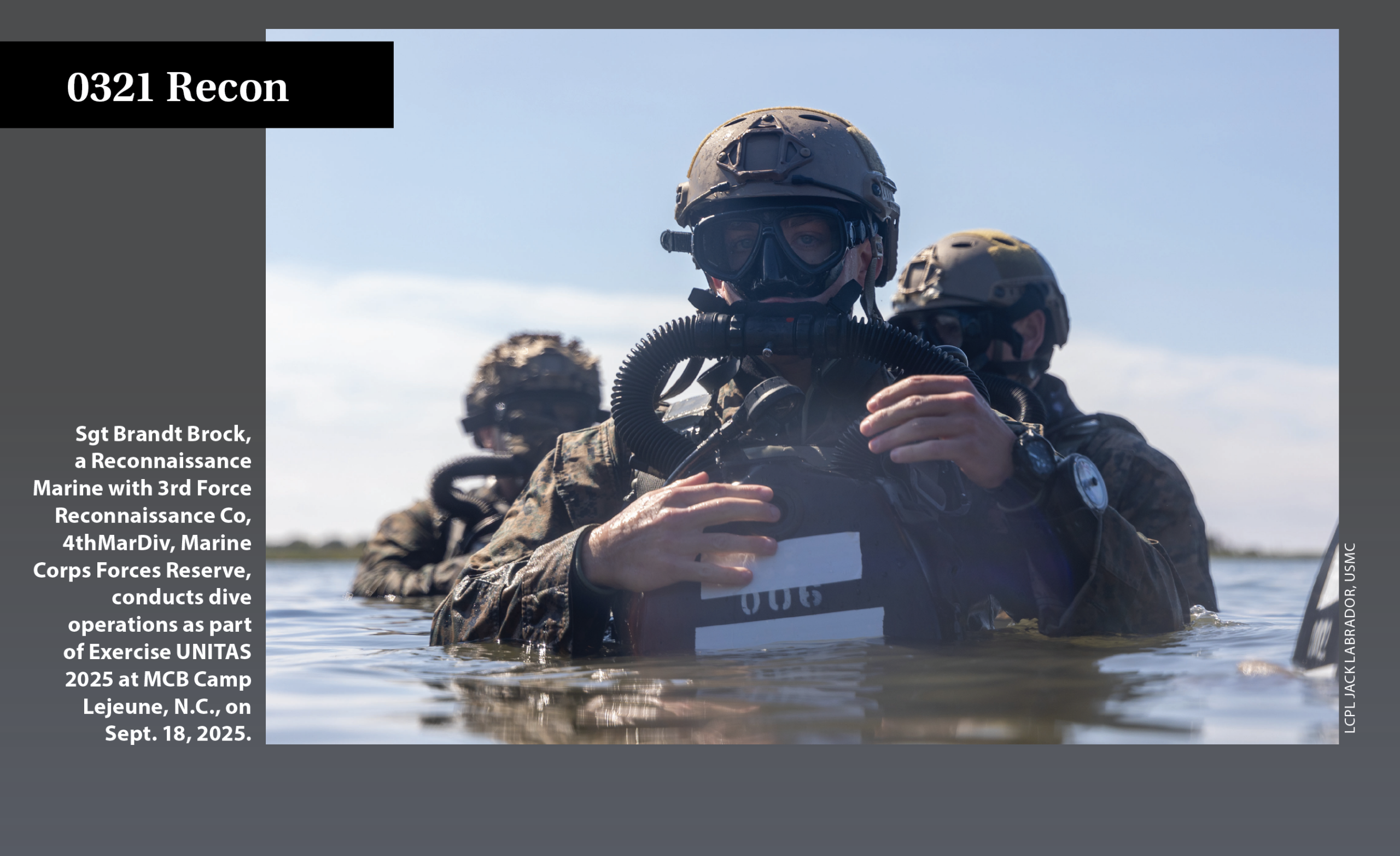
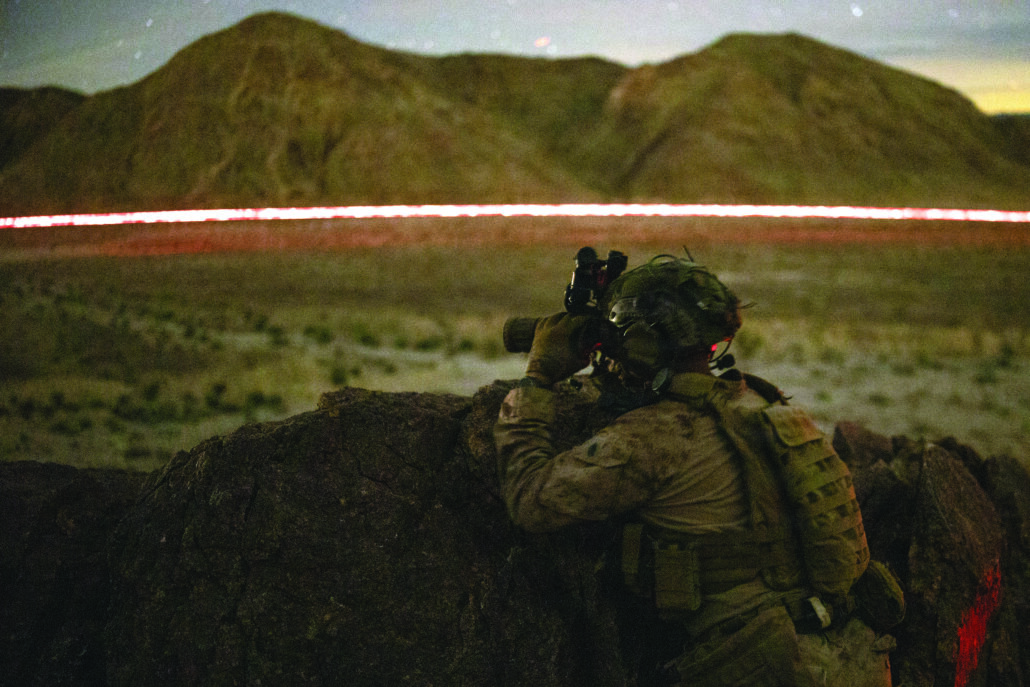
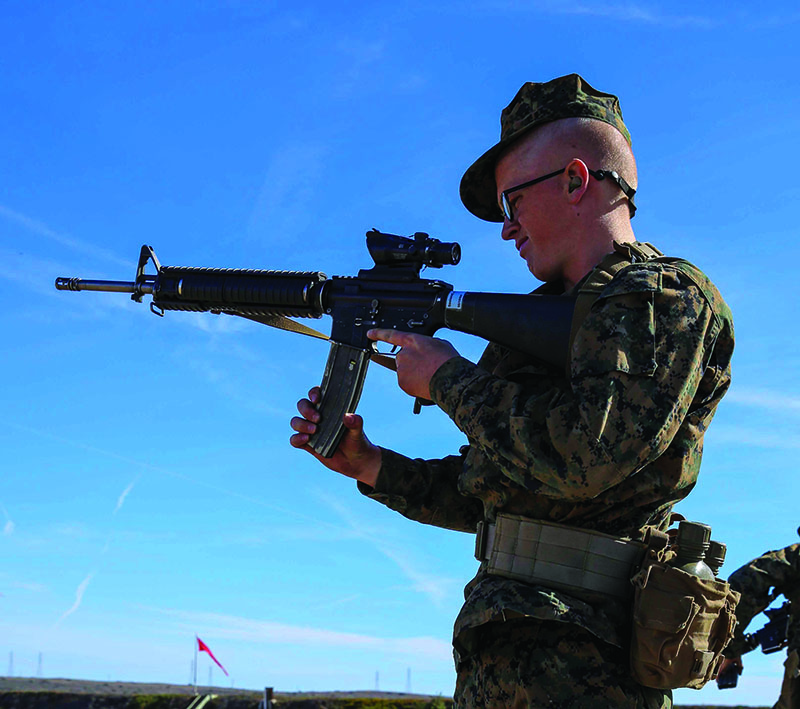
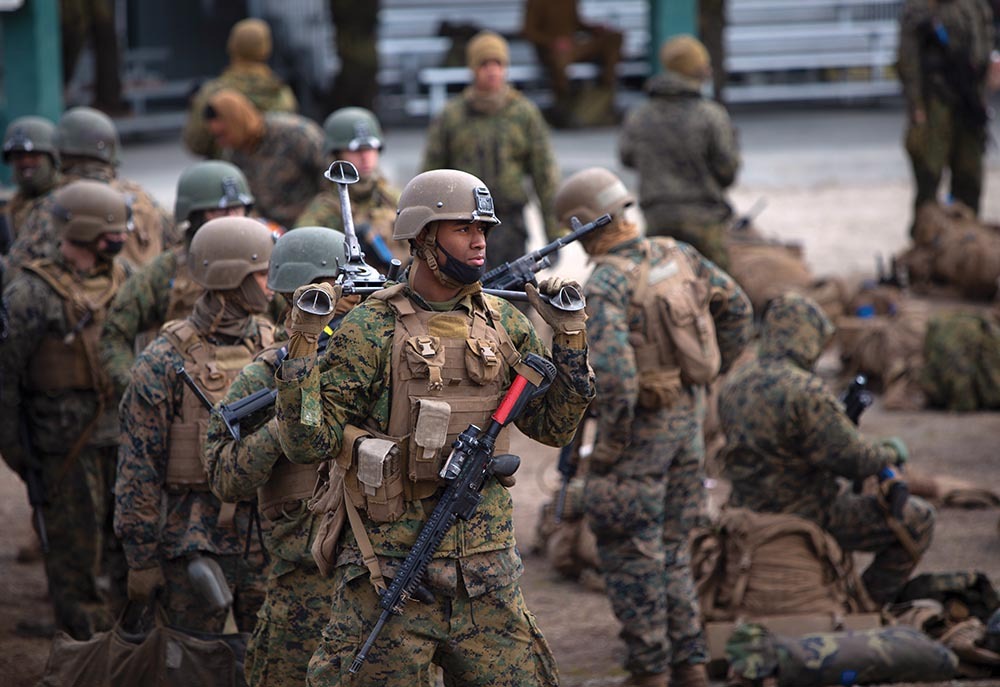
Below: 2ndLt Maximillian Steinbach, a platoon commander with Echo Co, 2nd Bn, 4th Marines, 1stMarDiv, prepares to start a night hike as part of Mountain Training Exercise 4-25 at Marine Corps Mountain Warfare Training Center Bridgeport, Calif., on Aug. 8, 2025. MTX is a month-long exercise designed to prepare units to survive and operate effectively in austere, mountainous terrain, further developing mental, spiritual and physical endurance and resiliency.(Sgt Migel A. Reynosa, USMC)
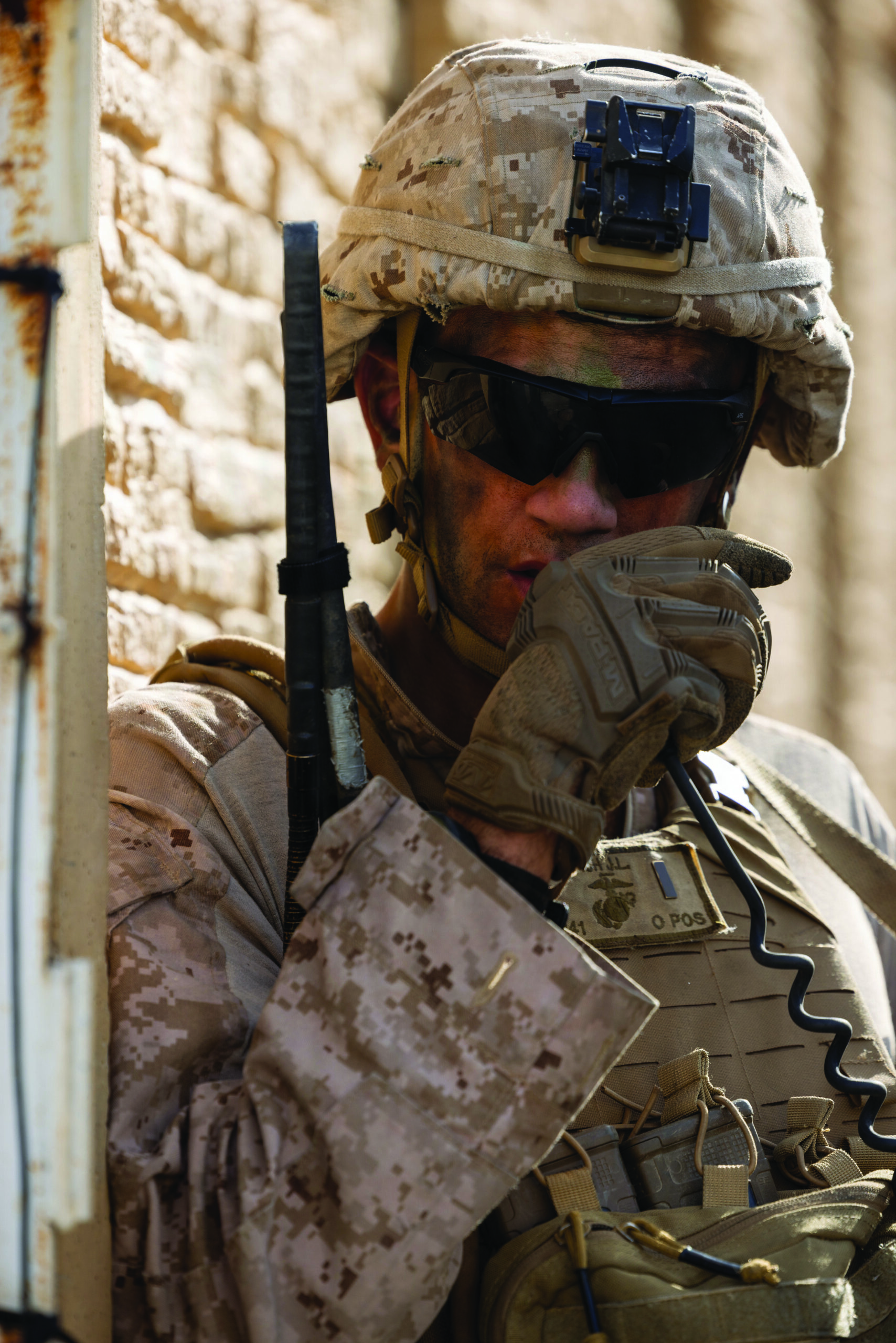
1stLt John Fischbach, a platoon commander with Blackfoot Co, 1st Bn, 5th Marines, 1stMarDiv, talks on a radio during a simulated raid as part of Exercise Steel Knight 25 at MCB Camp Pendleton, Calif., on Dec. 12, 2025. Steel Knight is an annual exercise that strengthens the Navy-Marine Corps team’s ability to respond forward, integrate across domains and sustain Marine Air-Ground Task Force readiness.(Sgt Kyle Chan, USMC)
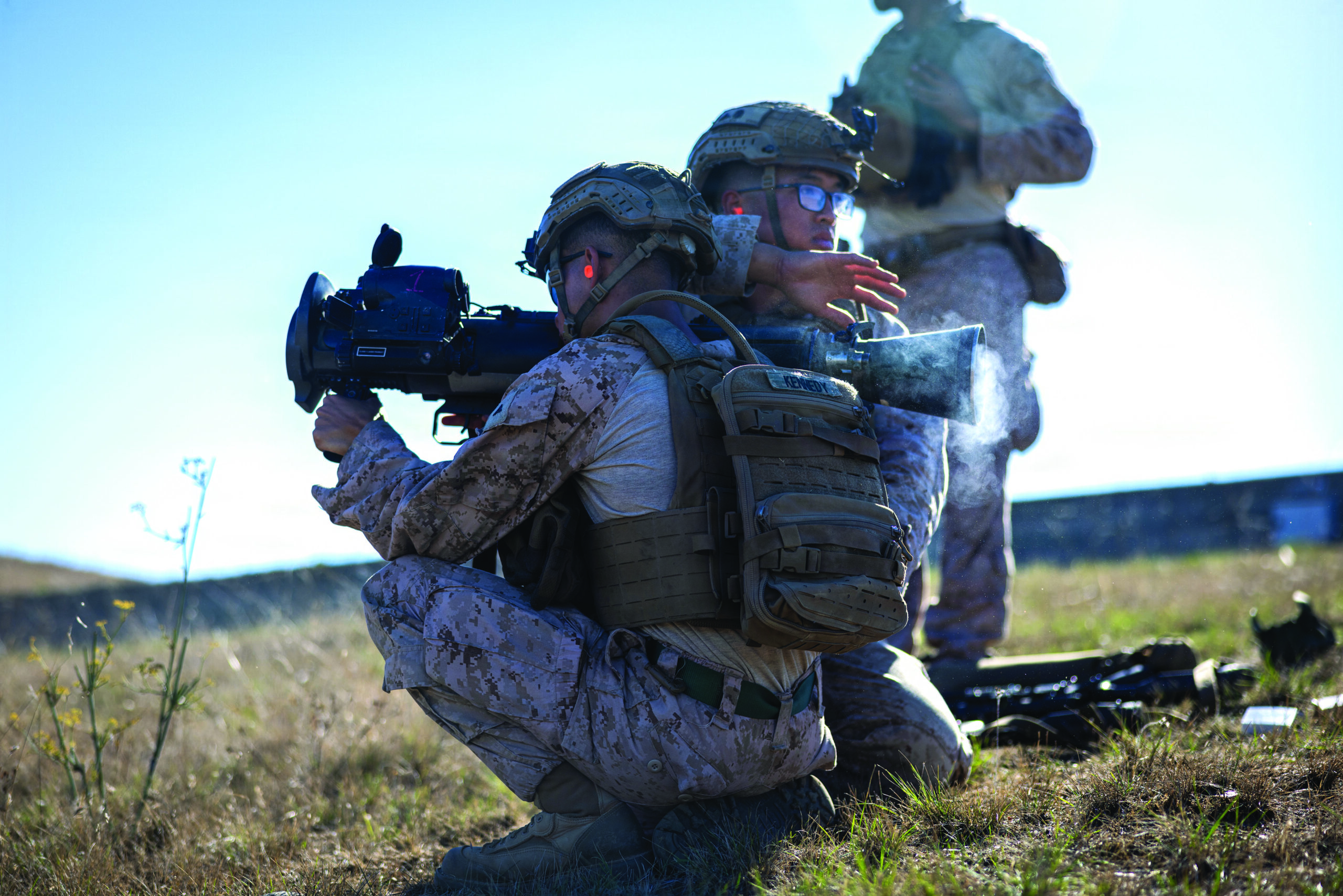
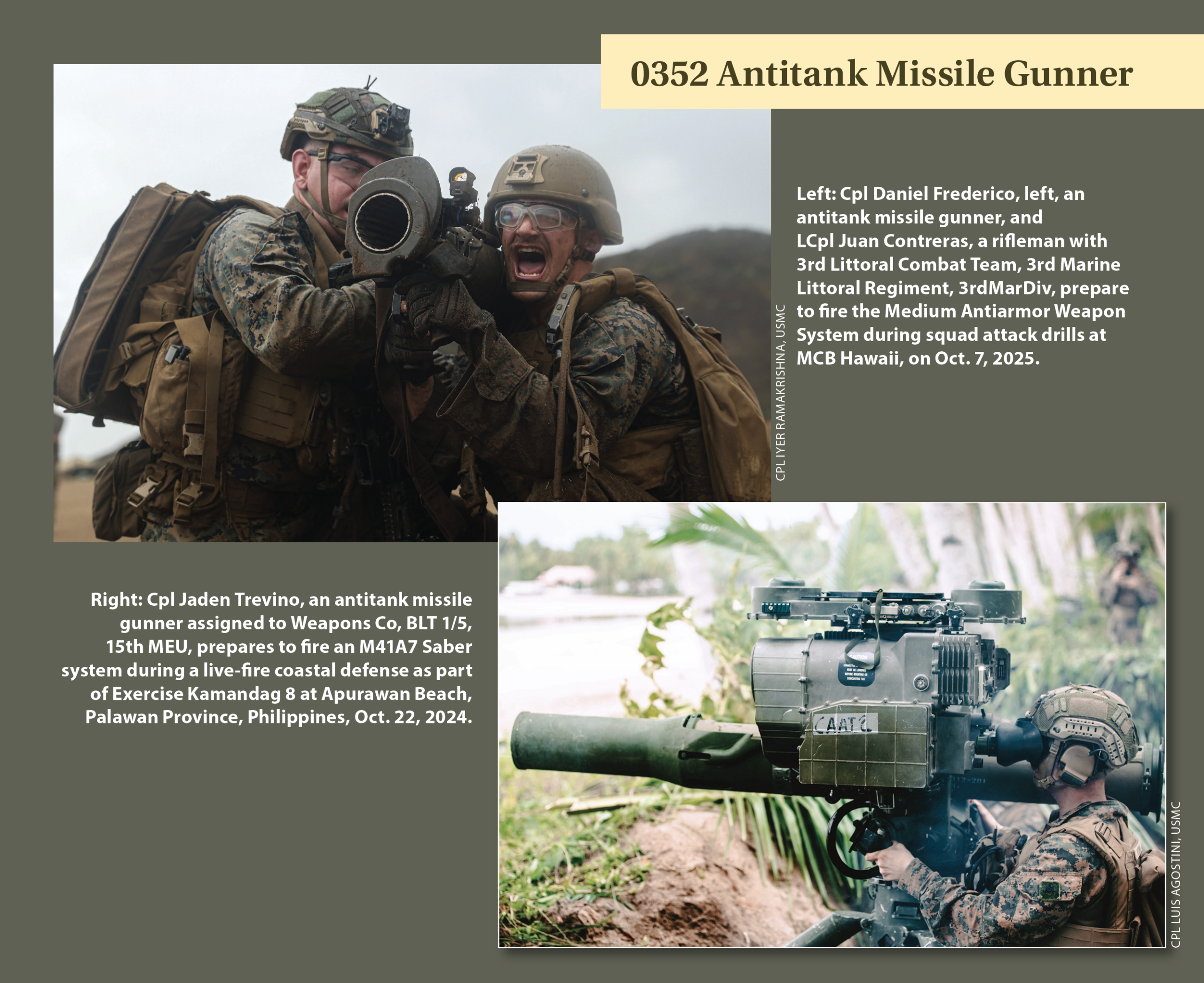
LCpl Bradon Kennedy, front, a rifleman with Kilo Co, BLT 3/5, 11th MEU, fires an M3E1 Carl Gustaf MAAWS during a live-fire range as part of MEU Exercise 26.1 at MCB Camp Pendleton, Calif., on Oct. 28, 2025. During MEUEX, BLT 3/5 conducted company-level training, live-fire ranges and battle drills while employing various weapon systems to maintain mission readiness.(Sgt Trent A. Henry, USMC)
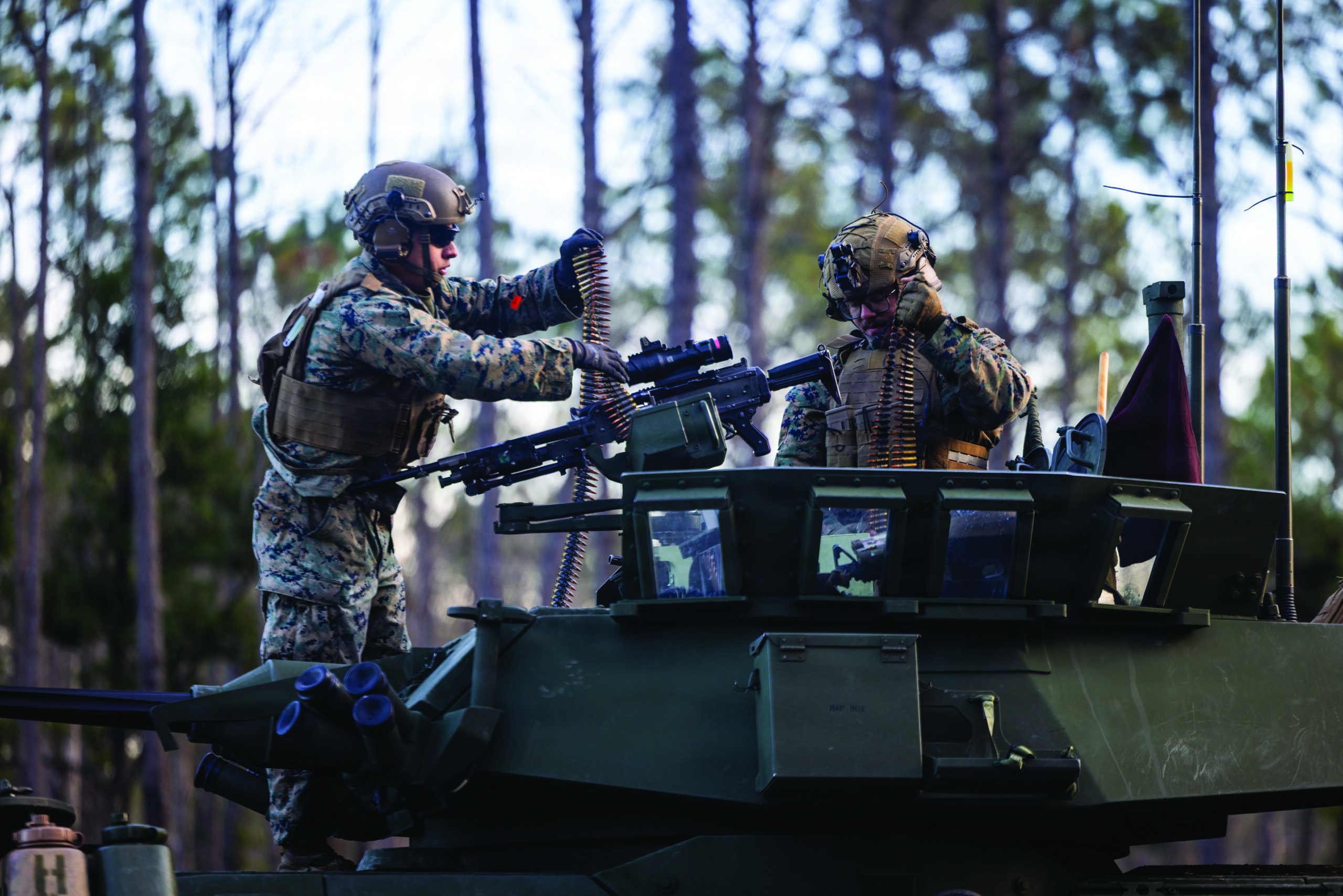
Sgt Gerald Nolan, left, and Sgt Tristan Diaz, both light armored vehicle crewmen with 2nd Light Armored Reconnaissance Battalion, 2ndMarDiv, load ammunition during a missile range at MCB Camp Lejeune, N.C., on Dec. 11, 2025.(LCpl Brian Bolin Jr., USMC)
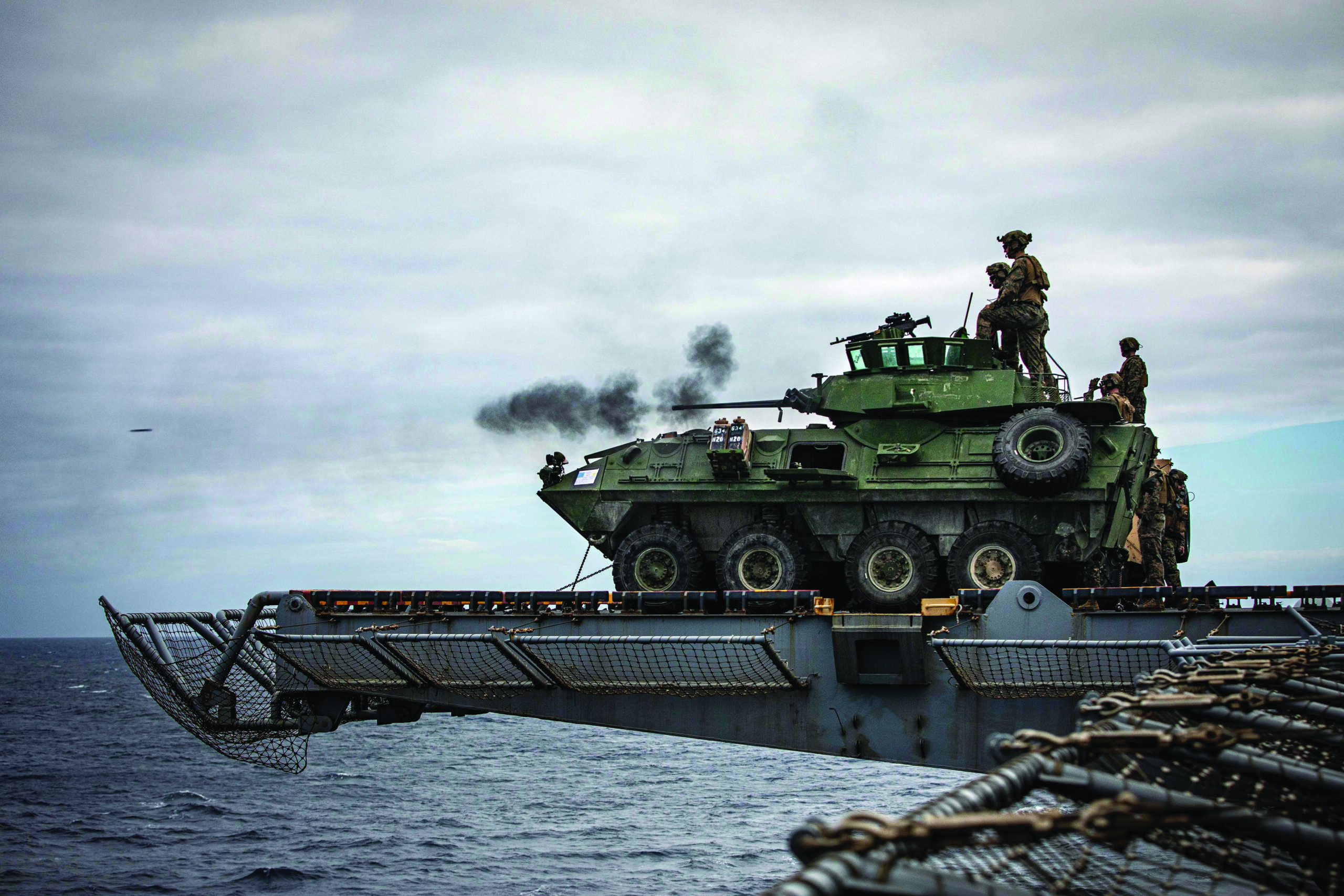
A light armored vehicle 25 with Bravo Co, Ground Combat Element, 22nd MEU, fires at targets during a live-fire exercise aboard the Wasp-class amphibious assault ship USS Kearsarge (LHD-3) in the Atlantic Ocean, on June 28, 2022. (Sgt Armando Elizalde, USMC)
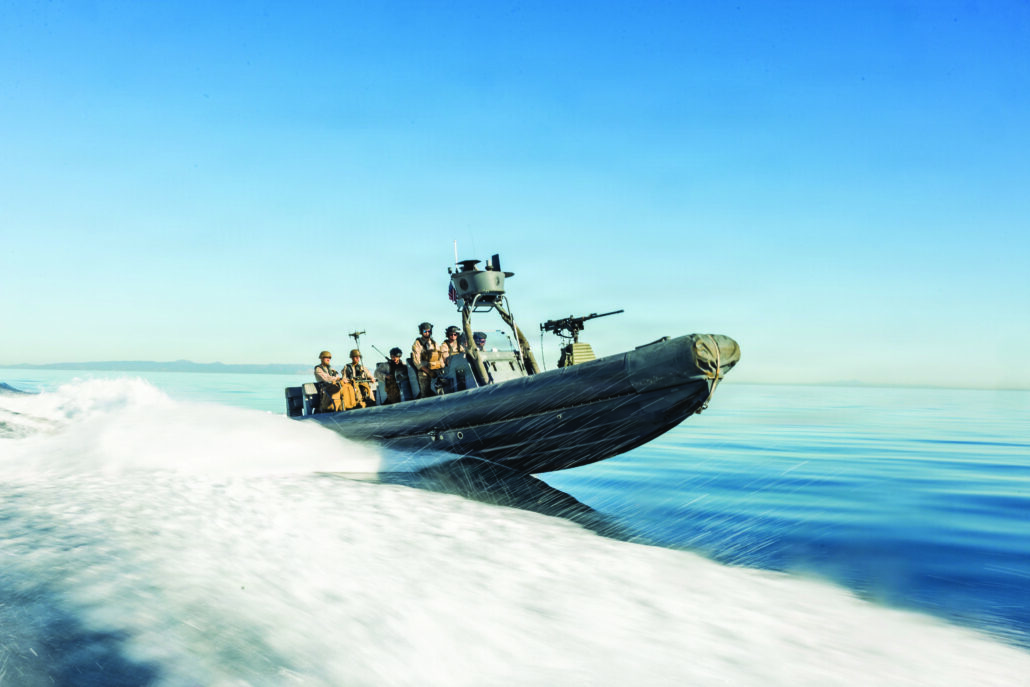
Marines with Maritime Reconnaissance Platoon, 1st Reconnaissance Bn, 1stMarDiv, drive a rigid inflatable boat during Exercise Steel Knight 25 at San Clemente Island, Calif., on Dec. 9, 2025. (LCpl Alan Gomez, USMC)
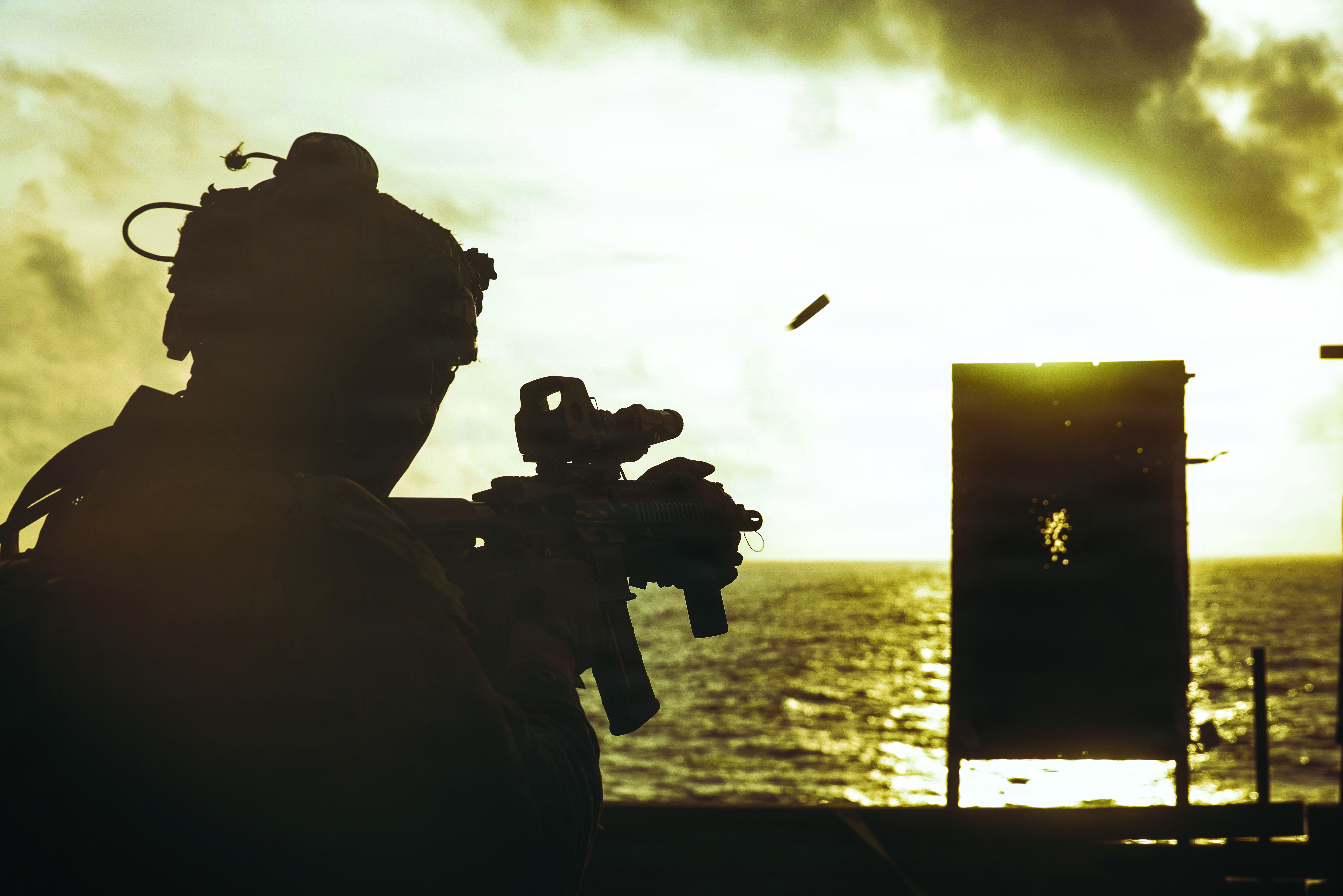
A Marine with Force Reconnaissance Platoon, Maritime Raid Force, 31st MEU, fires an M27 infantry automatic rifle during a live-fire deck shoot aboard the forward-deployed amphibious assault carrier USS Tripoli (LHA-7) on Dec. 13, 2025, while conducting routine operations in the U.S. 7th Fleet area of operations.
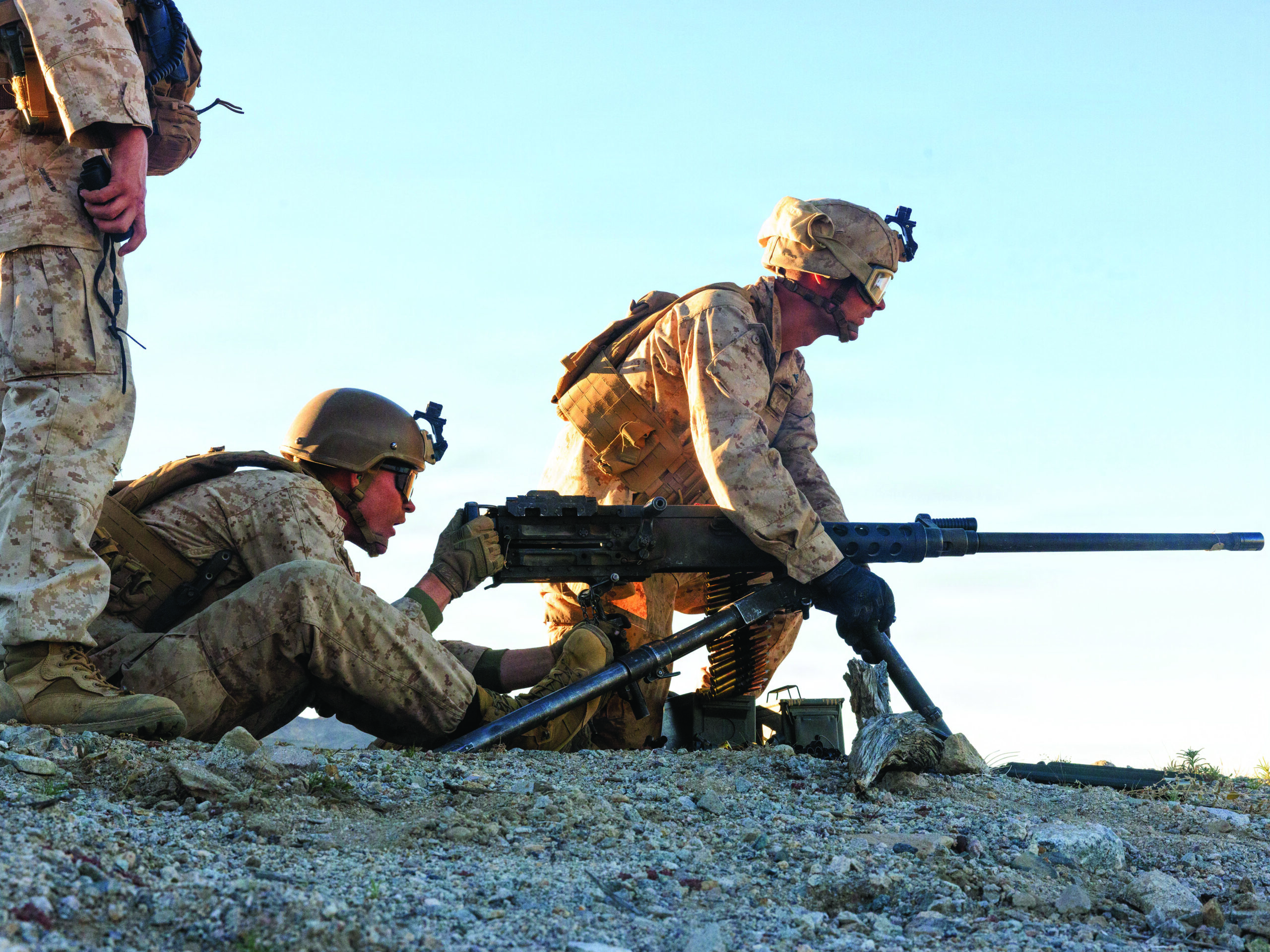
LCpl Dylan Butler, left, a machine-gunner, and LCpl Garrison Leavitt, a team leader, both with 3rd Bn, 7th Marines, 1stMarDiv, fire an M2 .50-caliber heavy machine gun during a fire support coordination exercise at Marine Corps Air Ground Combat Center Twentynine Palms, Calif., on Dec. 12, 2025. The exercise was conducted to evaluate integration at the platoon and fire support coordination center level with live-fire execution. (Sgt Ezekieljay Correa, USMC)
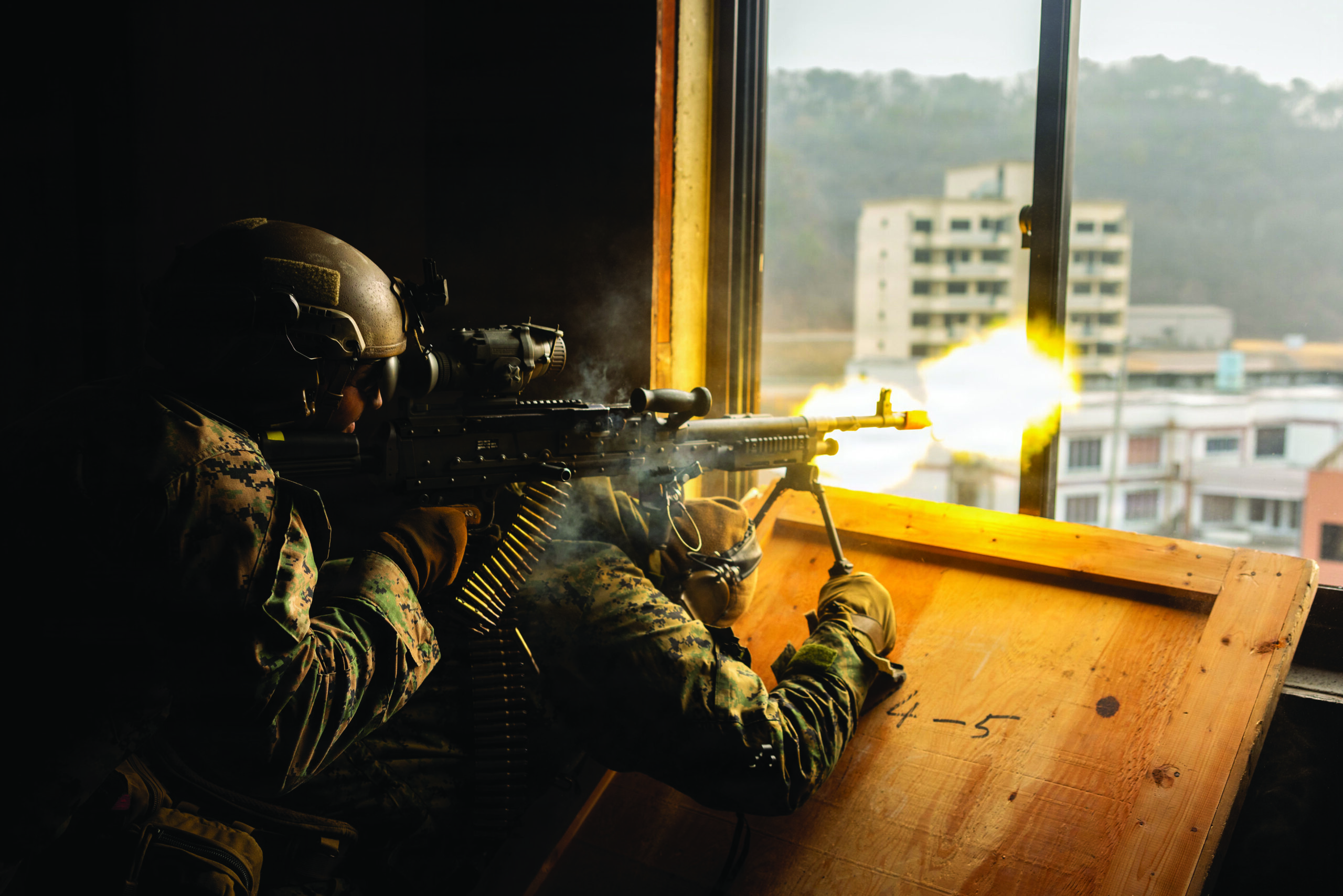
LCpl Aaron Duran, left, and LCpl Juan Hilario, machine-gunners with 1st Bn, 6th Marines, fire on simulated adversary forces with an M240B machine gun while conducting platoon attacks in an urban environment during Korea Viper 26.1 in South Korea, on Dec. 17, 2025. (Cpl John Simpson, USMC)
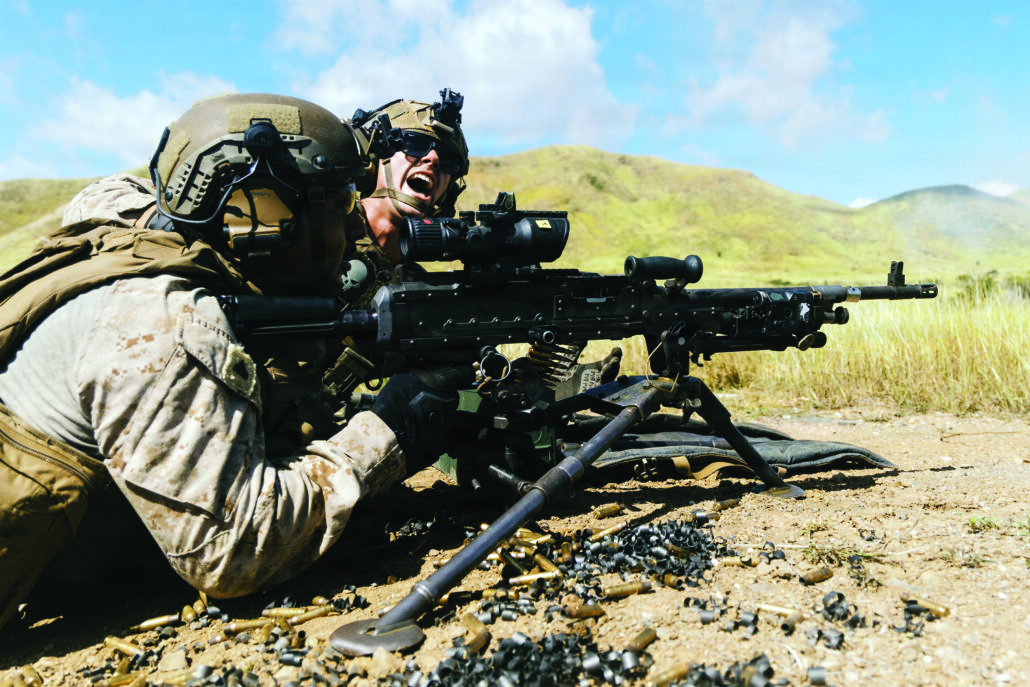
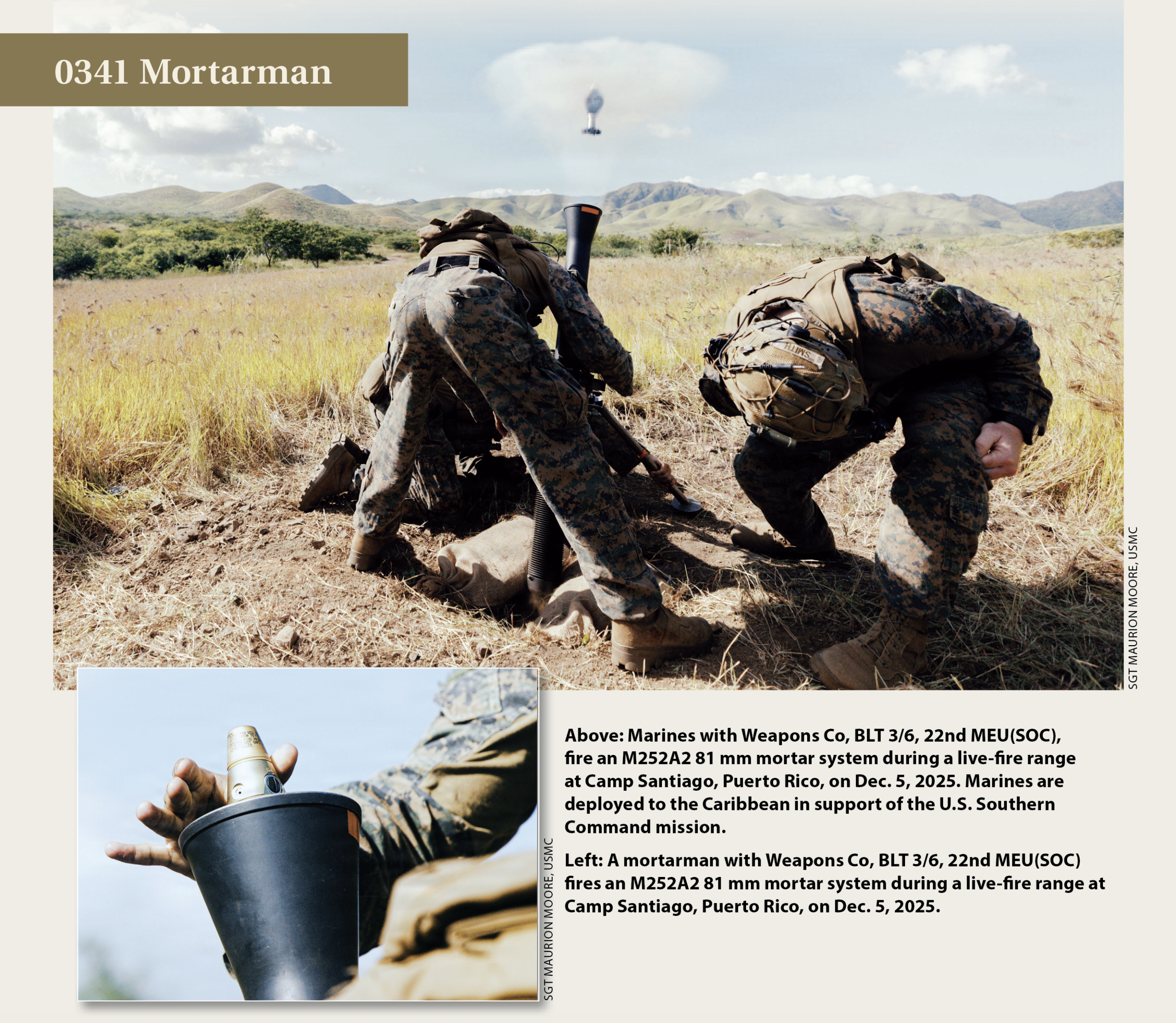
Machine gunners with Lima Co, BLT 3/6, 22nd MEU(SOC), conduct an M240B machine gun live-fire range on Camp Santiago, Puerto Rico, on Dec. 8, 2025.(Sgt Maurion Moore, USMC)
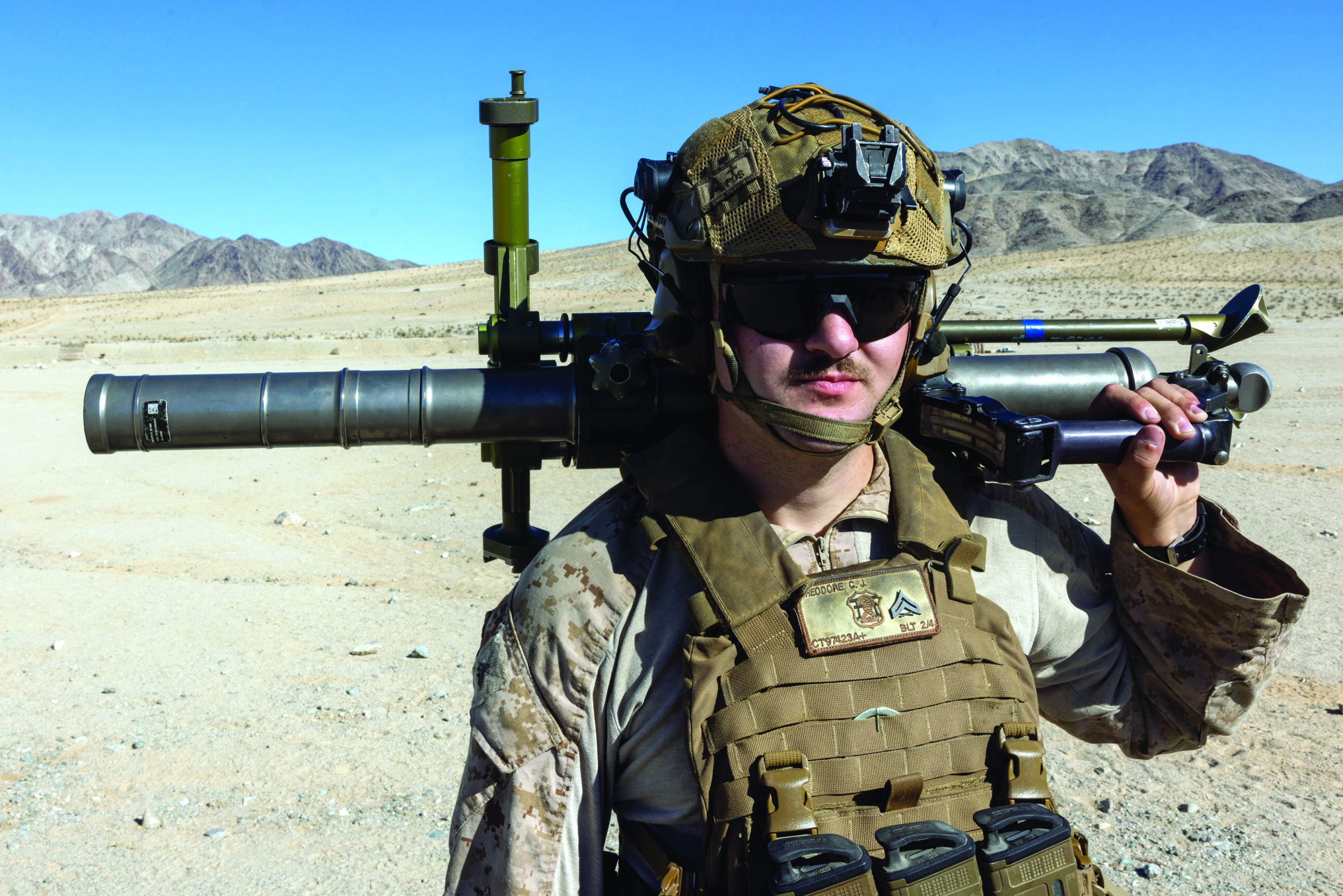
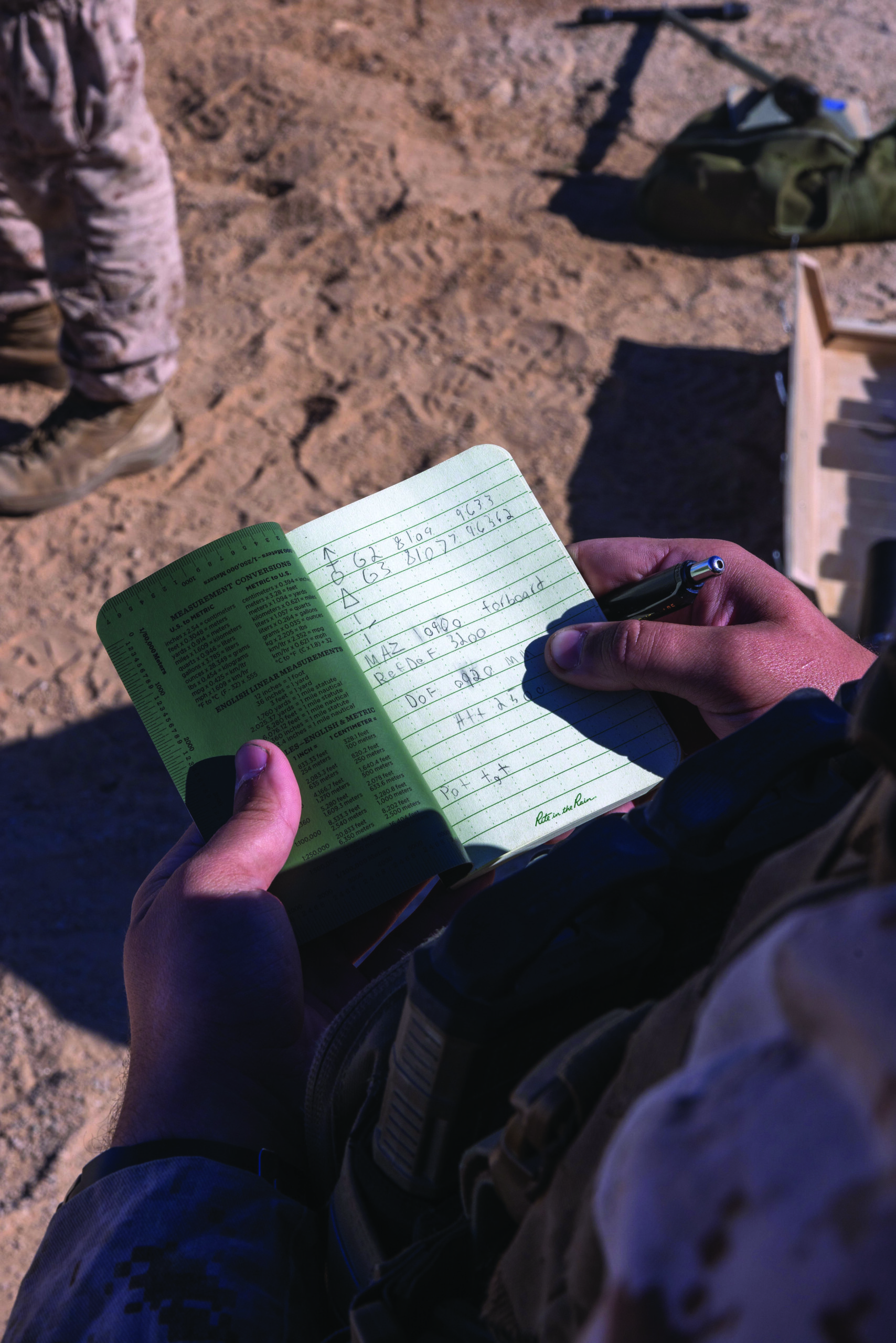
Cpl Conner Theodore, a mortarman with 2nd Bn, 4th Marines, 1stMarDiv, carries an M224 60 mm lightweight mortar (above left) during a service-level training exercise at Marine Corps Air Ground Combat Center Twentynine Palms, Calif. Theodore took notes (above right) during the Dec. 9 training, which prepared Marines for future conflicts by conducting offensive and defensive live-fire and maneuver training scenarios within an austere training environment.(LCpl Zackery Dear, USMC)
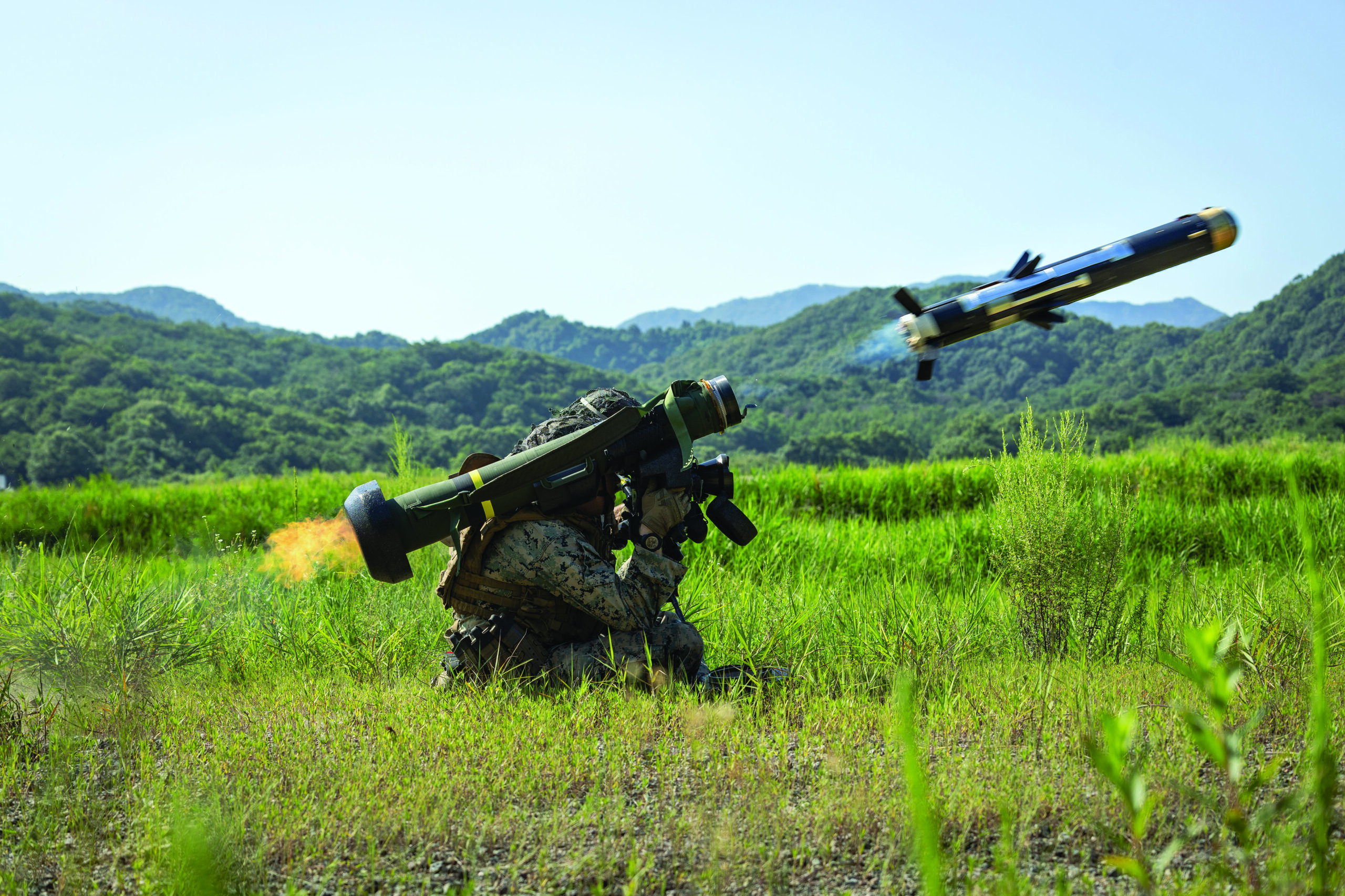
Sgt Zachary Savage, an antitank missile gunner with 2nd Bn, 23rd Marines, forward deployed with 4th Marine Regiment, 3dMarDiv, as part of the Unit Deployment Program, fires a Javelin shoulder-fired antitank missile during the Korean Marine Exercise Program 25.2 in Pocheon, South Korea, on July 29, 2025. (LCpl Van Hoang, USMC)
SSgt Jacob Bustamante, an infantry unit leader with 2nd Bn, 4th Marines, 1stMarDiv, coordinates suppressive fire during a night live-fire range during Service Level Training Exercise 0-25 at Marine Corps Air-Ground Combat Center, Twentynine Palms, Calif., on Dec. 17, 2025.(Cpl Christian Cutter, USMC)
Featured Photo (Top):LCpl Enrique Hernandez, a grenadier assigned to “Alpha” Co, BLT 1/5, 15th MEU, helps clear a building during a combined urban attack as part of Archipelagic Coastal Defense Continuum at San Vicente, Palawan, Philippines, May 22, 2024. Photo by LCpl Peyton Kahle, USMC.
Enjoy this article?
Check out similar member exclusive articles on the MCA Archives & Scuttlebutt Episodes:
Editor’s note: The following article, written by the commander of Weapons Company, pro-vides a firsthand account of 3rd Battalion, 6th Marine Regiment along the Emerald Wadi in Al Qa’im, Al Anbar Province, Iraq, in October 2005.
The 3rd Battalion, 6th Marine Regiment deployed to the Al Qa’im region of Iraq in late August 2005. When 3/6 assumed control of the battlespace from 3/2 late in the summer of 2005, the entire region was strongly influenced by insurgents and foreign fighters.
Operation Iron Fist began on Oct. 1, 2005, in the towns of Sadah and eastern Karabilah in the Al Qa’im region of Al Anbar province. Task Force 3/6 was given the arduous mission of clearing insurgents and disrupting the lines of communication along the Euphrates River Valley from Syria. The intent was to establish battle positions (BPs), maintain a presence in the towns and create relationships with the locals. The mission was accomplished, and both towns were cleared as the battalion began to conduct patrols and build a rapport with the local population.
The Emerald Wadi, running left to right above, is the dry creek bed separating eastern and western Karabilah, Iraq. The 3rd Bn, 6th Marines’ Scout Sniper Plt, known as Reaper, was tasked with maintaining observation of its two bridges.
After the success of Operation Iron Fist, elements of Weapons Company, 3/6 oriented to the west along the dried creek bed known as the Emerald Wadiin order to disrupt and interdict insurgents attempting to move to the east. According to Captain Brendan Heatherman, the commanding officer of Co K, 3/6, the positions along the wadiled the insurgency to believe that a push into Karabilah and Husaybah from the east was imminent. This mistaken belief would be especially beneficial in later months during Operation Steel Curtain when 3/6 came from the opposite direction.
Lieutenant Colonel Julian D. Alford, CO, 3rd Bn, 6th Marines, assigned Weapons Co’s First Mobile Assault Platoon (MAP 1), led by First Lieutenant Jeremy Wilkinson, and its Scout Sniper Plt (Reaper), led by Gunnery Sergeant Donald Rieg, with the mission of maintaining continuous observation of the two bridges (one north and one south) over the Emerald Wadiseparating western and eastern Karabilah. Gunny Rieg had recently taken command of the platoon when 1stLt Tom Wilberg was wounded after his up-armored HMMWV (high-mobility, multipurpose, wheeled vehicle) struck an improvised explosive device (IED) a few days earlier.
Gunny Rieg, along with two four-man sniper teams (Sergeant Jeremy Riddle’s and Lance Corporal George Hatchcock’s teams), established a position in a building along the wadi. It was a typical large two-story concrete house with a walled roof that provided clear observation of both bridges and good fields of fire. The house, known as Reaper base, also had an unusually tall and thick concrete-walled yard where two or three gun trucks could be parked.
It did not take long for the enemy to take umbrage at Reaper’s presence, and they launched a volley of rockets, mortars, small-arms and machine-gun fire at Reaper’s position. During the fight, one Marine finished staging ammunition and equipment in a ground-floor room when a C5 rocket exploded in the house, narrowly missing both the Marine and the ammunition. Reaper exchanged fire across the wadi for at least two hours until shortly after nightfall.
It was an indication of what was to come for the next 21 days.
On the morning of Oct. 7, other Reaper teams and two tanks (Tiger teams 3 and 4) arrived, and improvements for the defense of the house began immediately. The plan was for Tigers 3 and 4 to rotate with Tigers 1 and 2 every few days. Loopholes were created, and sandbags were trucked in to reinforce the walls and sniper hides. During the day, the enemy launched more than a half-dozen rockets and rocket-propelled grenades (RPGs) at the house and tanks—with little effectiveness. The tanks returned fire with main gun rounds at the enemy firing positions, silencing the rocket and RPG fire. Sporadic and inaccurate small-arms fire was received throughout the day, which proved to be more annoying than effective. The pattern continued for the next two days.
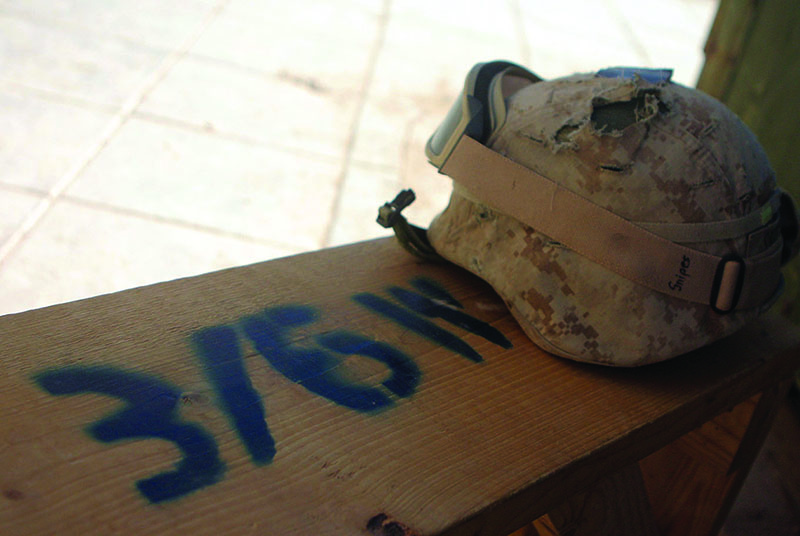
CAMP AL QA’IM, Iraq (Oct. 26, 2005) — A shot helmet, belonging to Lacey Springs, Ala., native Lance Cpl Bradley A. Snipes, antitank assaultman, 3rd Mobile Assault Platoon, Weapons Company, 3rd Battalion, 6th Marines, rests on a benched marked as property of Weapons Company, 3rd Bn., 6th Marines. (Official U.S. Marine Corps photo by Sgt. Jerad W. Alexander)
On Oct. 10, a squad of “Kilo” Co Marines arrived from BP Chosin to help with security as sniper teams were pulled from Reaper base to conduct other missions. Capt Heatherman, the Co K commander, said, “We didn’t feel our mission was to go out and find firefights because they would find us.” His words were proven true that day as the squad from Kilo Co was welcomed by the enemy opening up with RPGs and small-arms fire.
Reaper teams led by Sgt Riddle and Sgt Thomas Smith departed Reaper base early the next morning across Route Diamond to set up an ambush on an enemy firing position. At 0700, two men were spotted with rockets moving to another firing position. Shortly afterward, rockets were fired at Reaper base, causing no damage. Knowing the probable egress route the men would take, the Reaper teams prepared for their return. The two men, carrying their rocket launchers, soon returned the same way they had come; they would not fire at Reaper base, or anyone else for that matter, again.
Later that day, one of the Tiger teams engaged with and killed three men who were preparing to launch RPGs from a house across the wadi. Two main gun rounds ensured no fire was received from that house again. Later that night, mortar rounds landed just outside the house walls. Reaper remained on alert throughout the night, expecting a night attack that did not materialize.
The morning of Oct. 12 dawned with sporadic rifle fire on Reaper base, but the origin of the shots could not be determined. Two hours later, Sgt Smith was in the firing position on the north side of the house when he spotted two insurgents shooting at the base. He took two shots with his heavy barrel M16, putting one man down immediately and hitting the other. The second insurgent managed to find cover before he was killed. It had become clear that as long as Reaper base was occupied, the insurgents would try to force out the Marines.
The leadership of 3/6: Capt Clinton Culp (CO, Wpns Co); Capt Conlon Carabine (CO, Co I); Capt Justin Ansel (CO, H&S Co); Maj Chris O’Connor (S-3); LtCol Julian “Dale” Alford (Bn CO); Maj Toby Patterson (Bn XO); Capt Rich Pitchford (CO, Co L); Capt Brendan Heatherman (CO, Co K); Capt Mike Haley (CO, Co B, 3rd AA Bn) and Capt Robb Sucher (CO, Wpns Co, 1st LAR).
LtCol Alford sent one of the battalion’s forward air controllers, Capt Ryan Pope, call sign “Zero,” and his radio-telegraph operator, Corporal Kevin Williams, to assist in the fight. They went right to work as, yet again, machine-gun and mortar fire was inbound. With marking assistance from the tanks, Marine Light Attack Helicopter Squadron (HMLA) 369, the “Gunfighters,” made several gun runs on the insurgent firing position and forward observer.
At the same time, Kilo Co was under mortar attack at BP Iwo Jima. Cpl Scott Royal’s Reaper team 2 and LCpl Hatch-cock’s team 7 had moved to a building in eastern Karabilah to observe Main Supply Route (MSR) Diamond, west of BP Iwo, looking for the insurgent mortar crews. Within five minutes of the mortar fire stopping, two men forced their way into the building where the Reaper teams were located but were shot by the security man on LCpl Hatchcock’s team as they entered the building. The insurgents started to fire on Reaper base early on the morning of Oct. 13 and continued to do so with small arms until midday when machine guns began firing from multiple positions.
Kilo Co’s 3d Plt had a BP to the south, and it began to receive fire as well. The accuracy of the insurgents’ rounds seemed to improve dramatically. Reaper identified one building across the wadi from which insurgents were firing; Zero had the Gunfighters engage with hellfire missiles, and the fire from the enemy decreased significantly.
Cpl Eliel Quinones, or “Q” as his fellow Marines called him, was in the “crow’s nest” on the roof of Reaper base when he took a single round to the head. The round cracked his skull, removing his hair and portions of his scalp, yet somehow he remained conscious. As he was pulled out of the firing position and moved into the house, he managed to identify the building from which the insurgent shot him. A medevac was called for, but Army helicopters were out too far to assist.
Zero and Cpl Williams worked diligently to get a UH-1N Huey on station from the Gunfighters to conduct the medevac, and with two tank teams and a light armored reconnaissance (LAR) platoon providing covering fire, the Huey was able to conduct the medevac. In an incredible feat of flying prowess, the helicopter put down in the tiny landing zone, with less than 6 feet from the rotors to light poles. It took less than eight minutes from the time Cpl Quinones was hit until the time he was placed in the Huey. He was awarded a Navy and Marine Corps Achievement Medal with combat “V” for his efforts in identifying the source of fire despite his wounds.
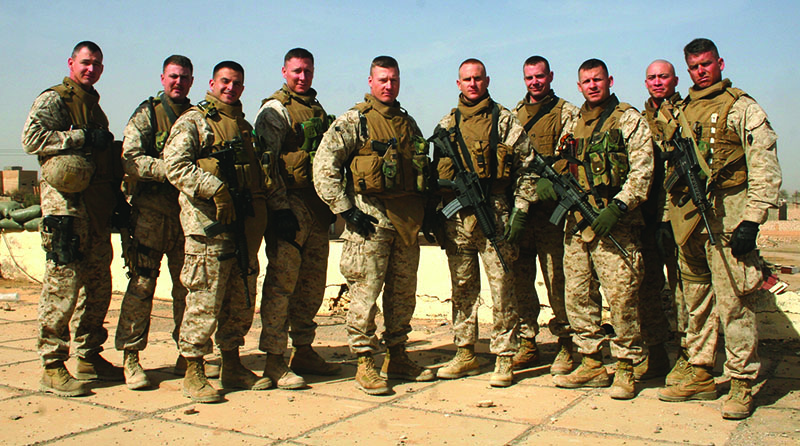
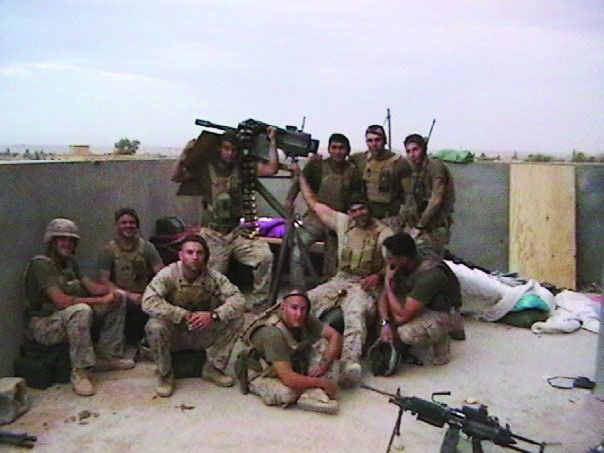
Marines from the Scout Sniper Plt on the roof of Reaper base in October 2005. (Photo courtesy of Maj Clinton A. Culp, USMC (Ret)
As the insurgents’ accuracy increased, Reaper Marines took more and more care with their movements, even ducking behind curtained windows. A C5 rocket sailed just over Reaper base and hit the house to the south. It missed Reaper base by only a foot or so.
On Oct. 14, Zero vectored in ScanEagle, to take a look at the buildings and road just to the west side of the buildings that were directly adjacent to the wadi. As the afternoon began, enemy machine-gun and small-arms fire began anew. ScanEagle located the source of fire, and a GBU-12 bomb was dropped on the position. Shortly afterward, the tank platoon commander was struck by small arms while moving down MSR Diamond. The tanks returned fire as the tank moved back to a covered position for the medevac. As the sun went down, so did the incoming fire.
The morning of the 15th brought more of the same, including more accurate small-arms fire from one or two shooters. The tank teams needed to pull back to the railroad station at Al Qa’im (3/6’s main base) for some maintenance, so the LAR Plt took up positions to Reaper’s immediate flanks. No sooner had it pulled into position than it began to receive RPG fire. The platoon returned fire while Zero dropped another GBU-12 on the insurgents’ position. Insurgent fire died off for the rest of the day.
Before sunup on Oct. 16, Cpl Royal’s and Sgt Erik Rue’s Reaper teams moved to a hide position that would cover the flank of the LAR Plt. At 0815, the teams spotted two insurgents moving along MSR Bronze with RPGs and AK-47s in order to get a firing position on the light armored vehicles (LAVs) and tanks. The enemy was dispatched, but the teams began to take fire from other insurgents.
As the LAR Plt moved to extract the teams, more insurgents were spotted mov-ing to get a line of fire on the LAVs. Mean-while, Zero brought in rotary-wing close air support (CAS), and it seemed the per-fect time to try the MK19, which had re-cently been installed on the roof of Reaper base after one of the snipers had remarked, “If 240s are good, MK19s are better!”
The tall mount was then taken off a cargo HMMWV and sandbagged on the roof and a tarp placed over it for concealment. The MK19 thumped away as the Gunfighters made a few runs in support of the extraction. The engagement escalated as more insurgents moved to isolate the Reaper teams; even 3rd Plt, Kilo Co got into the mix as the fire and movement spilled over into its sector. LAR Plt and the Reaper teams were able to return to the Reaper base around 1230. Every vehicle had taken multiple small-arms and machine-gun hits. Each also had at least one flat tire and several near misses of RPGs. At least 18 insurgents had been killed with no Marine casualties.
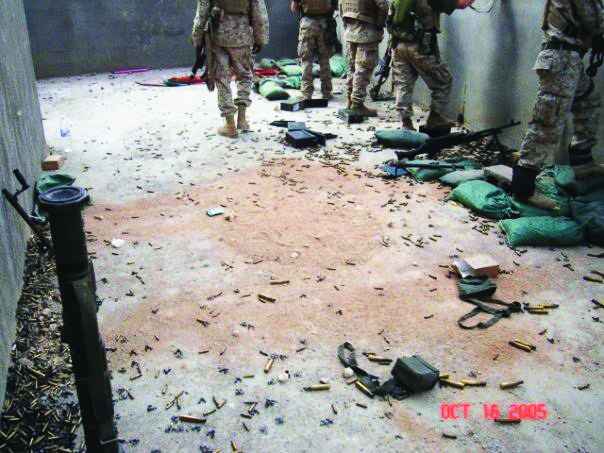
Brass litters the rooftop of Reaper base after one of many firefights during October 2005.
The next few days were relatively quiet, and on the 19th, Air/Naval Gunfire Liaison Co’s (ANGLICO’s) Wild Eagle 3-1 arrived on deck to assist Zero with the CAS fight. One of the Reaper teams spotted several insurgents setting up a mortar on a roof-top. After waiting until the insurgent mortar team was ready to fire, Reaper opened up with the MK19. It took a few rounds to get on target, but all five insurgents and their weapon system were eliminated. The battalion took a hard hit that same day when a suicide vehicle was driven into a squad of Marines from Co K just north of BP Iwo Jima. LCpl Norman Anderson III was killed and every other squad member wounded. The next day brought another near miss from a C5 rocket, which impacted the house to the south again.
On the morning of Oct. 22, a large dust cloud formed in front of one of the tanks after an RPG impacted less than one meter in front of it. The tanks returned fire with .50-caliber rounds and a main gun round. About an hour later, Reaper teams spotted two insurgents with AKs and RPGs trying to sneak across MSR Diamond; the teams dispatched them. Only light fire was received throughout the rest of the day and for the next few days.
After a relatively quiet few days, six insurgents were spotted on MSR Diamond on Oct. 25; one was shot before the LAVs maneuvered on the insurgents’ anticipated route and caught them in the open. Mortar fire was called in to close off the insurgents’ egress. At the same time, Reaper base was receiving small arms and machine-gun fire. Tanks returned fire with the help of a Hellfire missile from one of the Gunfighters’ Hueys.
The highlight of the day occurred shortly after the engagement ended as LtCol Alford reenlisted Sgt Riddle on the roof of Reaper base.
The morning of the 26th started at 0625 as more than 20 insurgents with AKs and RPGs were spotted moving on the west side of the Emerald Wadi. Reaper base, tanks and LAR were put on “stand-to,” and air was requested. Reports were received of several of the insurgents placing IEDs along the roads on the west side of the bridges that crossed the wadi. Both 3rd Plt, Kilo Co and MAP 1 were put on notice as well. Before the air arrived on station, the tanks and LAR Plt maneuvered into position and mortars were called in as Reaper, tanks and LAR engaged. Several of the insurgents fell in the initial volley, and the rest fled into the surrounding buildings. The insurgents tried to consolidate their position and returned AK, RPK (Soviet light machine gun) and RPG fire to no avail as rotary-wing and fixed-wing CAS arrived on station.
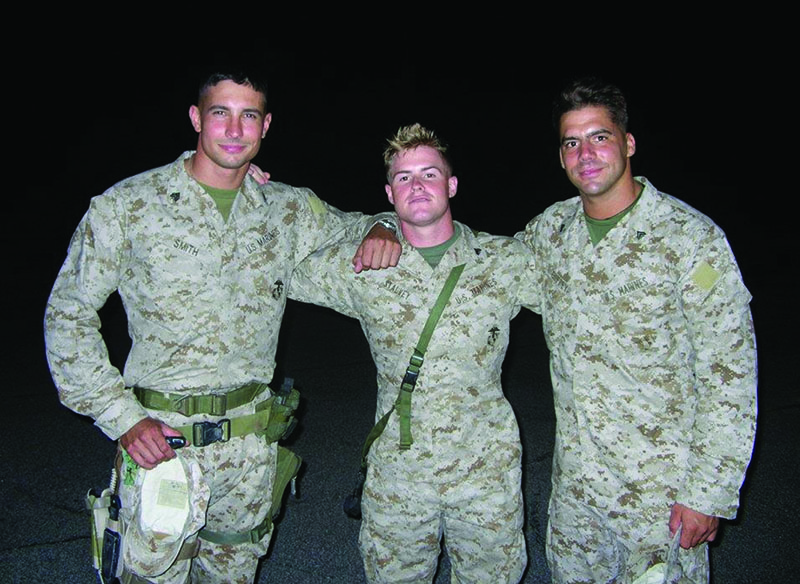
From left: Sgt Thomas Smith, Reaper team 5 leader; Cpl John Stalvey; and Cpl James Guffey, Reaper team 1, before the Battle of the Emerald Wadi. Cpl Stalvey, one of the battalion’s snipers, was killed by an IED, Oct. 3, 2005.
Capt Phil Laing and his LAR Co arrived at the same time for a battle handover. The 27th saw light small-arms fire which Laing’s company easily returned. On the morning of the 28th, 1stLt Durand Tanner’s MAP 2 arrived to extract Reaper. The LAR Co provided cover for Reaper as they withdrew to Al Qa’im to rest and refit for the next mission: Operation Steel Curtain.
The Scout Sniper Plt, with the help of MAP 1, 3rd Plt, Kilo Co, tanks, LAR and CAS had kept the insurgents looking in the wrong direction for 22 days. Alford later reflected proudly, “Those boys had a hell of a fight for those three weeks, and it allowed us to move behind the enemy and attack them in the rear. Classic operational flanking movement.”
The Battle of the Emerald Wadiwas a critical element in 3/6’s ability to consolidate combat power in Al Qa’im before the launch of Operation Steel Curtain.
Executive Editor’s note: The November issue of Leatherneck will include an article about the “Fox” Co, 2/1 Marines who were fighting in New Ubaydi during Operation Steel Curtain.
Author’s bio: A prior enlisted Marine, Maj Clinton A. Culp was commissioned in 1997 and served as an advisor to the Afghan Commando Battalion during Operation Enduring Freedom and as the CO of Weapons Co, 3rd Bn, 6th Marines during Operation Iraqi Freedom. He re-tired in 2009.
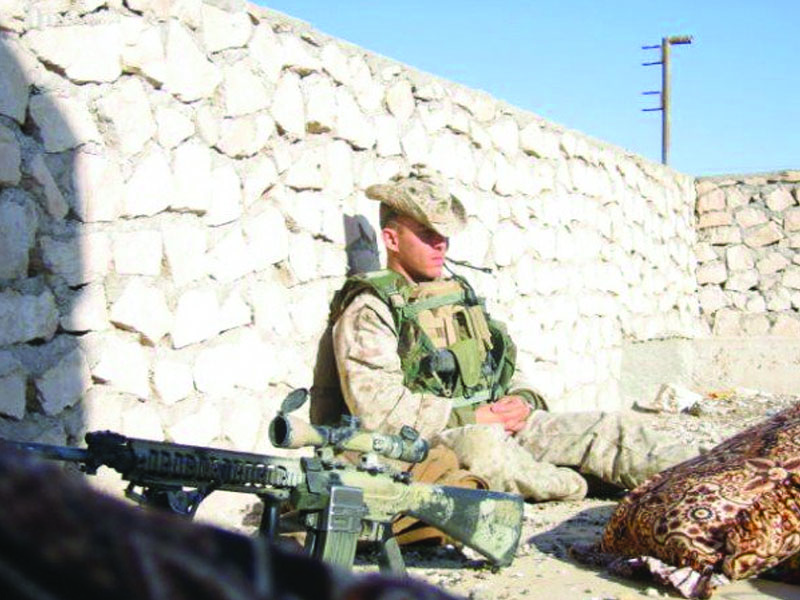
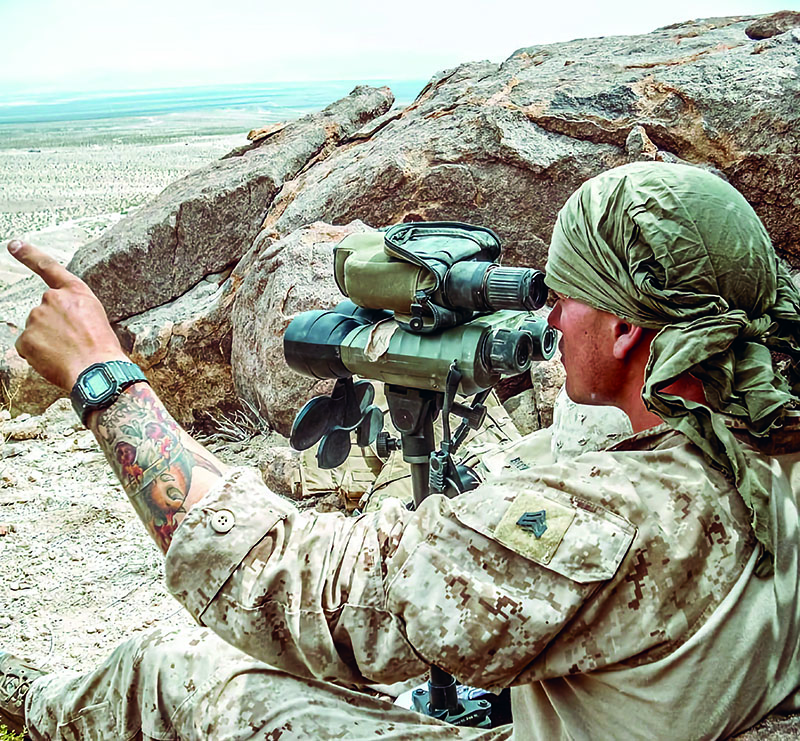
Featured Image (Top): A Marine sniper from 3/6 takes a well-earned break.
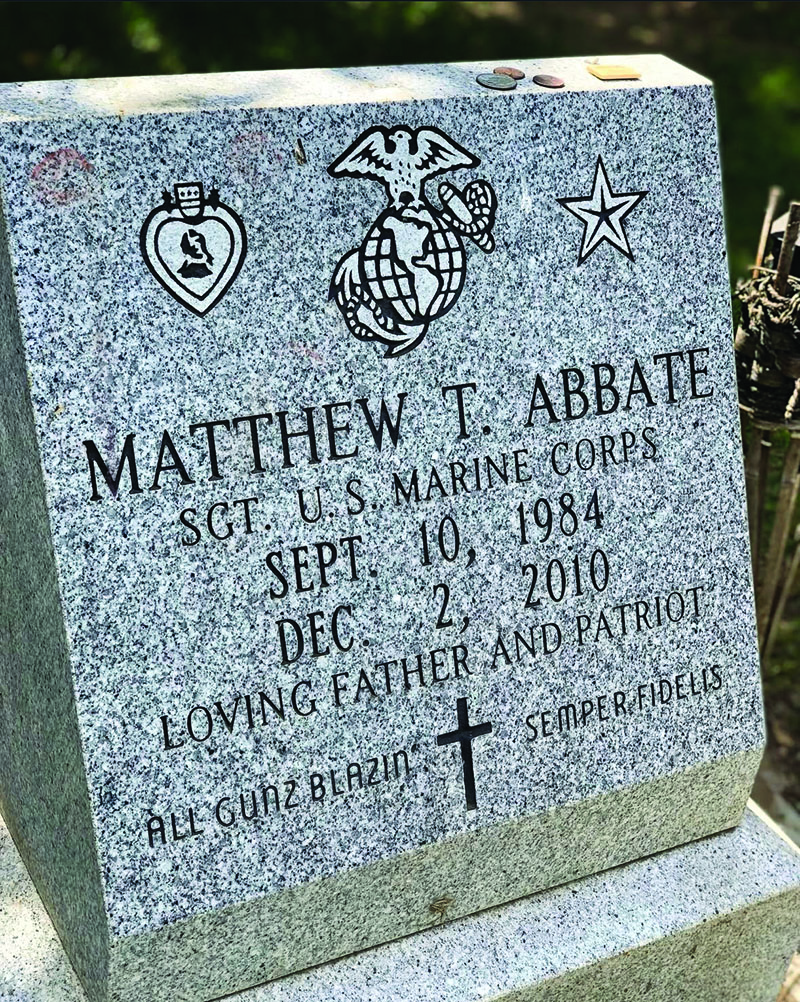
Author’s note: By the time I left active duty in 2013, I knew the name “Abbate.” Sergeant Matthew Abbate posthumously received the Navy Cross in August of 2012, almost two years after his heroic actions while deployed with “Kilo” Company, 3rd Battalion, 5th Marines, in Sangin, Afghanistan. Abbate evolved into a living legend before he was killed in combat. His posthumous medal further propelled his stature within the history of his storied infantry battalion and cemented his place in the Marine Corps’ history of the war in Afghanistan. When I was asked to develop a story idea fitting under the umbrella of the global war on terror for Leatherneck, Abbate immediately stood out in my mind as a preeminent example from that generation; one of the best sons our nation had to offer. I knew the name and had read the Navy Cross citation but failed to grasp his importance to the Marines who served alongside him or the traits that made him purely “Abbate,” inevitably propelling him to the greatness he achieved and limited only by his untimely death.
Matthew Abbate deserves a place in our history, standing prominently alongside others such as Smedley, Chesty, Daly and Basilone. The Marines who knew him understand this best and can offer the rest of us a glimpse as to why. What follows may, hopefully, provide this insight. Thank you to Britt Sully and Jake Ruiz, both veteran Marine sergeants; Sergeant First Class John Browning, USA (Browning previously was a Marine sergeant); Gunnery Sergeant Chris Woidt, USMC (Ret); Staff Sergeant Ryan Salinas, USMC (Ret); Lieutenant Colonel Tom Schueman, USMC; and the other warriors interviewed for this story. Thank you for allowing me to laugh through the good times you shared with Matt and grieve with you through his death. If anyone can show us who Matt really was, it’s you guys.
The Boot
Britt Sully: Let me try to start at the beginning. When I graduated the school of infantry, all I wanted was to go Recon, but Recon was full, so they sent me to 3/5. I thought that was a death sentence. This was 2007. When I showed up, the battalion was still in Iraq, so we sat around for like a month waiting for them to get back. I viewed everyone around me as stupid and lazy; all these corporals serving as our temporary seniors that yelled at us and lightly hazed us.The battalion finally got back from Iraq. We unloaded all their seabags for them into their rooms and began our first experience dealing with salty lance corporals and drunk corporals fresh from deployment, further cementing for me, I have to get the f—k out of here.
A few days later, it was a Thursday evening, I was out in the barracks hallway cleaning the deck with a scuzz brush; just playing more stupid games for drunk 20-year-olds. While I’m outside cleaning the stairs, I see rounding around the corner of the barracks this 6-foot-2, handsome, square-jawed, tan-skinned man in boots and utes wearing a loaded Vietnam-era Alice pack. Long, glorious, thick black hair—WAY too long for a PFC to dream of having—and he’s running with a sledgehammer at break-neck speed. All these other Marines are standing around cheering him along as he’s just smiling and laughing holding up the sledgehammer above his head. I stopped cleaning and asked my senior, “Uh, Lance Corporal, who is that?” He snaps back, “That’s Matt Abbate and you don’t even f—king rate to look at him, now get back to cleaning!” Everyone else is just drinking and yelling at privates while this dude has a clearly heavy backpack and a sledgehammer and is sprinting towards First Sergeant’s Hill on a Thursday night. In that moment, I said to myself, “Whoever that guy is, whatever that guy is doing, wherever he is going, I want to follow him.”
Sgt Matthew Abbate at Twentynine Palms, Calif., during predeployment training.
At this point, Matt had been in for maybe two years. After he enlisted, he graduated boot camp as company honor man, making meritorious lance corporal, then finished the school of infantry as honor grad with a gung ho award. His character, demeanor and enthusiasm were just so genuine and magnetic that instructors were all talking about him, to the point that the Recon cadre got wind of who he was and poached him for Basic Recon Course. He goes to day one of MART, Marines Awaiting Recon Training, and is told to show up in green on green at 0530 for their initial PFT. He somehow f—ks it up and showed up in boots and utes. They were all told if they didn’t run a first class PFT, they would be immediately dropped. They tell Abbate, “You showed up in the wrong uniform, we don’t care. You still need to get a first class PFT.” Boom, Matt knocks out a 300 PFT in boots and utes. They made him run it a second time just to see if he could. Matt ran a second 300 PFT.
After a few weeks, while out on liberty, Matt met a girl from Tijuana and disappeared. He showed up after a week AWOL. At this point, usually if a guy shows up after a week, that’s like grounds for getting kicked out, but because he was impossible not to love, the instructors just NJP’d him, busted him down in rank and dropped him from the program. He showed back up to 3/5 as a PFC.
Ryan Salinas: Abbate wasn’t in my platoon initially, but everybody in Lima Company kinda knew that kid when he arrived as a boot. He was just super motivated, running around crazy. You tell him to go do something, it was like 100 miles per hour, no quit, no questions asked.
I first met him in Yuma at WTI while we were setting up cammie netting out at tent city. At one point, a group of us looked over and saw all these boots just standing around. We walk over there like, “What the f—k are you doing?” and we see one kid just getting after it by himself, swinging a sledgehammer and e-tool and whatever else he had. While the other guys started yelling at the other boots for letting this guy do all the work by himself, I went up to him and was like, “Hey, what the f—k are you doing?” He says, “Corporal, I’m gonna get this tent set up.” I told him he needed to get all these other guys just standing around to help him, and he just said, “I don’t got time for that bulls—t.” He kept working, meanwhile, it’s like 100 degrees, he’s pale white, and I noticed he had stopped sweating. I told him to go get some water, but he’s like, “No, no, I’m good.” Finally, I had to force him to go sit down in the shade. He was super upset he didn’t get the job finished. He wasn’t even in my platoon, I just saw it and was like, “What the hell is wrong with this kid?” So, I sat down and talked to him about understanding your limits and learning how to delegate within your peer group.
Chris Woidt: We came back from Iraq the first time in August of ’06. That’s when we got Matt in Lima Company. We knew then that we were already going back to Fallujah again. By that point, 3/5 had already done three previous OIF deployments. We still had guys around who were OIF 1 vets from ’03, OIF 2 vets from Operation Phantom Fury in ’04, then obviously all of us from the ’06 deployment, and we knew we were going back in ’07-’08. Initially, I was a squad leader and Matt was one of the junior Marines in the platoon. During our workup for the deployment, it became clear that Matt was pretty much a physical specimen. He always wanted more, which makes sense why he ended up coming into the sniper community.
Matt was a SAW gunner starting off. Prior to the deployment, we were at Twentynine Palms during the workup doing a shoot house with non-lethal Simunition rounds. With each scenario, they randomly changed the setup of the house. You’d bust into the room, and it may be full of enemy in an all-out gunfight, or it may be just a family. Your adrenaline is pumping, and it’s trying to teach escalation of force through these shoot, no shoot scenarios. Well, there was one scenario where there was just one woman sitting on a couch reading a book. She’s wearing a paintball mask and everything, and Abbate charges into the house blazing and just drills her like four times. Obviously, the instructors were like, “What are you doing?? She didn’t have a gun!” You could see Abbate was very self-critical, but he had a good sense of humor. During the debrief, when an instructor asked him why he “killed” a woman reading a book, Abbate held out both hands with palms up and smiled wide with those big, white teeth, and made a joke: “Because knowledge is power.”
Our deployment to Iraq was definitely kinetic, but there was a lot of political pressure to downplay the issues. There were numerous suicide bombers and casualties occurring around Fallujah, but the combat was waning. It was frustrating because there were a lot of handcuffs with the escalation of force and rules of engagement. Matt ended up getting meritoriously promoted to corporal during the deployment, so by the time we came back he was one of my peers.
After he was promoted, Matt was made a vehicle commander. We were primarily doing mounted patrols throughout the southern half of Fallujah. Matt would get really frustrated … from the mundane patrols and the lack of aggressive stance. That was just kind of a hard time too because the way we had fought the Iraq war and what had been drilled into his mind was now different. We were trying to do a lot more of civil affairs-type stuff. Matt had a lot of frustration because he wanted to do more. There were definitely times where we could have shot some people and done some stuff, but the reins were being pulled very hard because they were trying to bring down the number of firefights with the enemy to show a de-escalation in violence. We had pounded into his head and everyone else’s head the company’s experience in Fallujah over the previous deployments. We went back again very much with the expectation that we were going to take casualties. We were going to get in gunfights and kill people. But then we got there and transitioned from hot and heavy into more stability and security operations.
The Brotherhood
Chris: When we got back from Iraq, I don’t know if it was intentional, but they put all the 3/5 guys on the same street in base housing. All the Lima Company guys were neighbors living around a cul-de-sac. Matt was living in the barracks, but naturally whenever we’d do barbecues and hang out in the cul-de-sac, he would come over. One night I was in my house and I’m upstairs asleep. I heard noises downstairs, so I got up. I didn’t have a gun in base housing, so I grabbed a knife. I get down the stairs, and I can hear somebody right around the corner. I jump out ready to stab somebody, and there’s Matt standing in the kitchen with a bowl of Mac n cheese from the fridge, shoveling it into his mouth and laughing his ass off.
Matt was somebody who was welcoming, immediately part of your family, almost to his detriment. So many guys talk very highly of Matt because he died, but it almost doesn’t show his true personality. He was absolutely a flawed character, but his flaws really made us love him more. To the guys who really knew him, the tattoos, the long hair, the jokes, the bar fights, those were all part of the things that we loved about him. He had a really interesting childhood. We would really only get glimpses and pieces of it. There were definitely time periods where it wasn’t smooth. There were times he spoke about where he was sleeping on a beach in Hawaii where some other homeless dudes taught him how to catch eel and cook it over a fire. He worked as a waiter on a cruise ship one summer and had been to Thailand. He just had a big hunger to see the world, push the boundaries, and do big things, so coming into the Marine Corps made perfect sense, especially with the wars going on. Matt was the quintessential “break glass in case of war” type Marine. He joined for that, and that’s what he wanted to do.
Ryan: While we were in Iraq, we had a buddy who had a Harley back in the States and he got me and Matt interested. We started doing a bunch of research, looking up different bikes whenever we could get internet. As soon as we got back to California, the first thing we did was buy bikes, and all we did was ride.
Armando Hurtado, left, Ryan Salinas, center, and Matthew Abbate, then a lance corporal, in Iraq during their 2007 deployment with Kilo Co, 3rd Bn, 5th Marines.
We were in my garage at my house in the cul de sac one day and he brought his bike over. We were changing the oil or whatever on my bike and he decided to do some work on his bike too. Well, there’s this metal derby cover over the clutch that he decided to pull off. I walk inside the house to grab some drinks for us and as I’m walking back around the side of the house, all of the sudden, I see this shiny metal disk go skipping down the driveway and stick in the grass in the neighbor’s yard across the street. I ran into the garage … he’s like, “Go look at that f—king derby cover!” So, I go grab it and I’m like, “Well yeah, it’s all scratched now.” He’s like, “No, turn it over bro.” So I turn it over and it says, “Made in China.” I look at Matt and he yells, “How the f—k are you gonna have a Harley and it says made in … f—king China?! Get in the truck! We’re going to buy an American-made … derby cover!” We drove all over southern California to every damn bike shop just to find one … derby cover that was made in the U.S.A. so he could put it on his bike. I mean, he was absolutely pissed off that this thing was made in China. He was just like the patriotic, steak-eating, red-blooded American. I can still see his face right now the way he looked at me when he found that out.
The Beast
Britt: My first experience personally meeting Matt was a few days after I saw him running out of the barracks. I was a PFC, he was a corporal. As a young PFC, speaking to a corporal meant like parade rest, don’t look him in the eyes, especially in the infantry. I did not expect to be spoken to like a human by anyone who had been in the Marine Corps more than 40 seconds longer than I had. I met Matt on the basketball courts with our gear list to begin sniper indoc. Matt was just like, “What’s up, bro? Are you excited? You ready to do this?” I was just speechless, like, “Uh, why don’t you hate me?” He just gave me a slap on the shoulder and said, “Let’s f—king go!” He was always in front of the rest of the pack, finishing everything ahead of everyone else, then looping back to make sure the last guy made it in.
Jake Ruiz: I met Matt during scout sniper indoc. I was a junior Marine. They actually gave Matt time away from squad leader’s course to do the indoc. My first impression was just how much of a beast he was. He was just destroying all of us on the physical events. I was like, “Who is this guy?” I didn’t really get to know him until a couple weeks later when me, Britt and Matt all joined the sniper platoon working up for the MEU, but we all got close quickly. He graduated honor grad from squad leader’s course, even though he missed part of it for the sniper indoc. His ability to learn military skills in general was second to none. That’s one thing that gets lost in all the stories about Matt. Everyone talks about how much of a beast he was. I mean the dude was huge. 6 foot 2, 220 pounds, strong as an ox; everyone talks about that, but they don’t talk about how smart he was. His intelligence related to military skills blew me away.
Matt started getting tattoos while we were gone on the MEU, and he didn’t stop until we left for Afghanistan. So, over the course of maybe a year and a half, he got two full sleeves. At the time, it was that weird policy on tattoos; couldn’t be visible or had to be spaced a certain way or whatever, but Matt never really got in trouble for anything. He was just untouchable. Everybody in the battalion knew who Abbate was, from the sergeant major down to every PFC. Over the course of the MEU, everybody in the MEU knew who he was. He was that guy who would talk to you once and you’d think, “Man, this guy is my best friend!” Matt liked his hair, he liked his tattoos, he was high risk on libo, but that’s just part of what you get when you have a man like Matt. You’re not gonna get one without the other.
While we were gone, Matt tried to lateral move back to Recon, but something kept getting messed up with his package and it never worked out.We were all pretty downtrodden being on the MEU. Everybody just wanted to go combat. We got back in September 2009. Right before Christmas leave, we found out 3/5 was going to Afghanistan. Matt could not have moved faster to get the paperwork done and reenlist. I had to extend my contract to stay with the battalion for the deployment. We were all like, “OK, send us to sniper school and let’s get this done.” We deployed on the MEU with the sniper platoon, but we were not yet school trained. I lucked out, and I got to go with Matt.
While we were getting ready to go to sniper school, Matt pushed us super hard everywhere we went. He had to work out every day, it didn’t matter what we did that day. We’re doing all this deployment workup training during the day, then we get back to the barracks and Matt is dragging me out of my bunk to the pull-up bar and dragging his 53-pound kettlebell with him. We’d be driving all over base getting our medical paperwork or whatever else all signed off so we could go to sniper school, he’d see a pull-up bar and make me pull over. Looking back, that’s just how he was, who he was. He never missed an opportunity to make himself better. By the time we went to sniper school, I knew Matt really well; I knew what kind of performer he was. But under the microscope in a school like that, he elevated his already high performance and outshone everybody. It was wild watching him perform at that level. He finished sniper school number one in every skill except for stalking. Stalking is extremely hard. It’s a very, very patient skill, and Matt was terrible at it. It was his kryptonite.
Sgt Matthew Abbate sighting in on an enemy target in Sangin, Afghanistan, during 3rd Bn, 5th Marines’ 2010 deployment.
Britt: During our workup for Afghanistan, Matt was given meritorious sergeant. In the sniper platoon, he only wanted to be called Matt, he never wanted to be called sergeant, because he truly believed that you didn’t follow people because of their rank. You follow people because you trust their decision making, maturity, experience and character. He went to scout sniper team leader’s course, finishing high shooter and honor grad. He eventually became our team leader, working with John Browning, our assistant team leader, in charge of the 10 snipers of “Banshee Three” attached to Kilo Company.
The Artist
John Browning: I had done three previous deployments, two in Iraq, but 2010 was my first time in Afghanistan. Iraqi insurgents were more just thugs with guns; they were pretty easy to dominate, at least around Ramadi and Habbaniyah where I was. The Taliban were much better fighters, much more dangerous. They were there to fight. They did a lot of support by fire with machine guns, just like we do. As the sniper team, we took advantage of that. We’d hunt in places where we thought they might set up; opportunistic-type stuff. An infantry squad would go out on a pre-planned patrol route, and we’d have already been there all night. When the Taliban engaged the squad, we were there to shoot them.
Chris: When Matt got to Afghanistan, he finally had gotten into the free-fire zone of a highly kinetic area. Sangin was the canvas, and he was the artist. We knew him as a junior Marine, up and coming, but making dumb boot mistakes and those kinds of things. By the time he made it to Afghanistan—a sergeant, a sniper team leader, on his third deployment—he was highly developed. He’d mastered the art.
Jake: Our sniper team arrived to Afghanistan at the end of September 2010. We were forward staged in Sangin, operating out of Patrol Base Fires. Matt and John got there before the rest of us and were doing left-seat-right-seat patrols with the sniper team we were relieving. They got into a TIC [Troops in Contact] and killed some guys before we even got there. From that point forward, Matt was absolutely relentless. He wanted to do nothing but go out, find Taliban and shoot them. Once we all got there and started operating, he was personally going out two or three times a day, to the point where John would have to be like, “Dude, you need to take a break.” Matt just didn’t want to ever slow down. It was almost like he took it as a personal challenge that he had to keep people safe. It’s like he just knew that he was better that anybody else and he needed to be out there.
At that point in the deployment, we were extremely active. We were going out, either on our own as snipers or in small teams with the squads, two or three times a day. It was just so much combat. Those first couple months, it felt like you didn’t go outside the wire without getting into a firefight or somebody hitting an IED, or both. The days really ran together. It just felt like one continuous firefight and mass casualty incident.
Very early on, Matt wanted to go out super early one day. He got us all up probably 3 or 4 in the morning, we do our pre-combat checks and leave the wire under night vision. Matt wanted to set up near an area where the squads had been getting hit from when they left the patrol base. We made it a couple hundred meters outside the wire. Matt was running point behind the engineer with the metal detector. We hit an IED, but it low-order detonated, so a small portion of the homemade explosives inside detonates, but most if it just kind of gets thrown out. I was four or five people behind Matt. When we hit this thing, it scared the s—t out of me. I thought Matt was gone, thought the engineer was gone; what the hell are we going to do now? All the sudden, I just see Matt pop up and ask if everybody was alright. We made our way back to the patrol base, and I was just terrified. We get back and realize that Matt and the engineer are coated head to toe in the explosive material. They looked like they were covered in glitter from the aluminum powder in the explosives.
Britt: Matt just laughed it off and told us it looked like he was at a rave. He went right back out on patrol when the sun came up.
Jake: Later that day, the EOD techs went out to investigate and dismantle the IED. Well, they found it was a daisy-chained IED, and the secondary explosive on the daisy chain was so big that, had it gone off, it would have killed our entire team. I want to say that was unique, but it wasn’t for Sangin. It was just like that everywhere; the IEDs and the level of danger. To be honest, it was scary realizing how vulnerable we really were and how little we could mitigate that. I remember telling Matt, “Dude, I don’t know how are we gonna do this?” He was just like, “Bro, it’s our job.” That’s when it really clicked for me that Matt was just a different breed.
Britt: Matt was always so willing to go out where there was 100% probability there was going to be a gunfight. He would put himself there, and he would aggressively maneuver. He got his first patrol and first kill in before the rest of us touched down. For most people, when there’s machine guns and rockets going off, it’s intuitive to seek cover. But Abbate would just maneuver. He’d trudge off through the mud with his tree trunk quads in the direction of where he thought he could smoke people, like a Belgian Malinois unaware of what bullets are. Honestly, Matt doing something like action-movie heroic was just a day-to-day occurrence. When we heard about what he did on Oct. 14, it was really just more of Matt continually doing his thing; more of Matt just being Matt. To us, the real significance of that day was that we took a lot of casualties.
The Hero
Jake: On the morning of Oct. 14, 2010, we had gone out and done our own thing, and the patrol had been uneventful. We were just kind of kicked back relaxing when we heard a firefight start, and it sounded pretty heavy. After a while without breaking contact, the squad requested QRF. Matt jumped up and threw his gear on and was like, “Come on, let’s go!” So, four of us kitted up and jumped in with a squad getting ready to push outside the wire. The idea was that we were going to set up a blocking position and either draw the contact away from the other squad or at least provide them some covering fire as they withdrew back to the patrol base. At some point, the Taliban realized we were out there and broke contact, so the other squad was able to start making their way back to the base. The squad leader we were with decided to head back as well.
There was a huge open farming field that we bounded across from one irrigation canal to another on the opposite side. Generally, in recently planted fields like that we weren’t too worried about IEDs, so me and another guy just sprinted across and got to the canal. Some of the Marines in the squad made it right after us, and the SAW gunner immediately detonated an IED along the canal. I was probably 15 feet away and my bell was rung. After that, all hell broke loose. It felt like the sky opened up, and we were under fire. By that point, then entire squad was moving. The squad leader got shot in the leg as he reached the canal and fell down right next to me. A bunch of the rest of the guys tried to take shelter in this mud hut that was just to our left. We knew better, but that machine-gun fire was just so intense that I think it just pushed them in there, like an involuntary reaction to seek cover. They moved in, and one of the guys immediately hits an IED inside. The corpsman from the squad knew the Marine was down inside the compound, so he went inside and stepped on another IED. All the while, we’re taking heavy machine-gun fire.
By this time, Matt was in the canal with me. I was trying to pull the SAW gunner out of the water. I was so disoriented. One of the guys helped me get him up on the bank and that’s when I realized that he was gone. I assessed the squad leader and was trying to get a tourniquet on his leg. Meanwhile, Matt is realizing, “Oh s—t, I’m it. I’m the only one here who can do this.”
Matt jumped up with the minesweeper and made his way into the mud hut. Funny thing is, Matt didn’t even know how to use the thing. So, looking back, you realize he was just doing that to make other people feel better. In reality, he was clearing that compound with his feet. He cleared it and one of the other snipers started treating the casualties inside.
I was on the radio calling for a medevac. The whole time, Matt was super composed, getting people on task. Calm is contagious, and that is what he was; he was the calm. We finally started to make some headway, and the machine-gun fire died off a little bit. I was shook up. This was the first mass casualty I’ve been in. The first dead Marine I’ve dealt with. It was pretty overwhelming. Had Matt not been Matt, I don’t know that I would have composed myself.
Author’s note: According to other sources and eyewitness accounts of Abbate’s actions on Oct. 14, Abbate ordered the remaining Marines to freeze following the three IED blasts that decimated the patrol. Ignoring his own order, Abbate swept the ground for IEDs all the way to the structure where multiple bombs already exploded, then arranged the remaining Marines in a defensive posture. When the sounds of medevac choppers echoed overhead, Taliban fighters resumed machine-gun fire from the opposite side of the open field that would serve as the landing zone. Abbate charged across the open, unswept field, initially on his own, driving the Taliban away in a hail of gunfire. He then single-handedly swept the entire landing zone with his feet for IEDs to ensure it was safe for the helicopters to land.
Jake: We got told the Brits were coming in for medevac, so I popped smoke to mark our location. The bird came in out of nowhere, flying low to avoid RPGs. It circled the LZ then hit the deck so hard I could feel it through the ground. Some dudes ran out the back with guns and started laying down rounds, while some others ran out with stretchers. I was trying to get the SAW gunner to the bank of the canal and onto a stretcher. He was bigger than me, and I was just struggling. I grabbed … his hand to pull him up, and I felt his hand come apart inside his glove. It was the most surreal thing, and I just froze, standing there in the open. Matt came up and put his hand on my shoulder and just said, “I got this.” And he did it. He got the kid up on the stretcher.
The bird lifted off with the casualties, and we bounded back all the way until we made it inside the wire. All of us were absolutely smoked; just that huge adrenaline dump and a rush of emotion. I was crying. Matt came up and put his arm around me and said, “You feel that?” I said, “Yeah, yeah I feel that.” He said, “That’s why we’re gonna kill more.” That was his mentality. He wasn’t going to let them get away with hurting the Marines. Within the hour, I went back to hooch, and I fell asleep. It was early, probably like 5 or 6 in the afternoon. I didn’t wake up until like 9 the next morning. Matt was already back out on another patrol. He let me and the other snipers sleep. It was just his way of looking out for us. He knew we needed a break, but he wasn’t going to take a break.
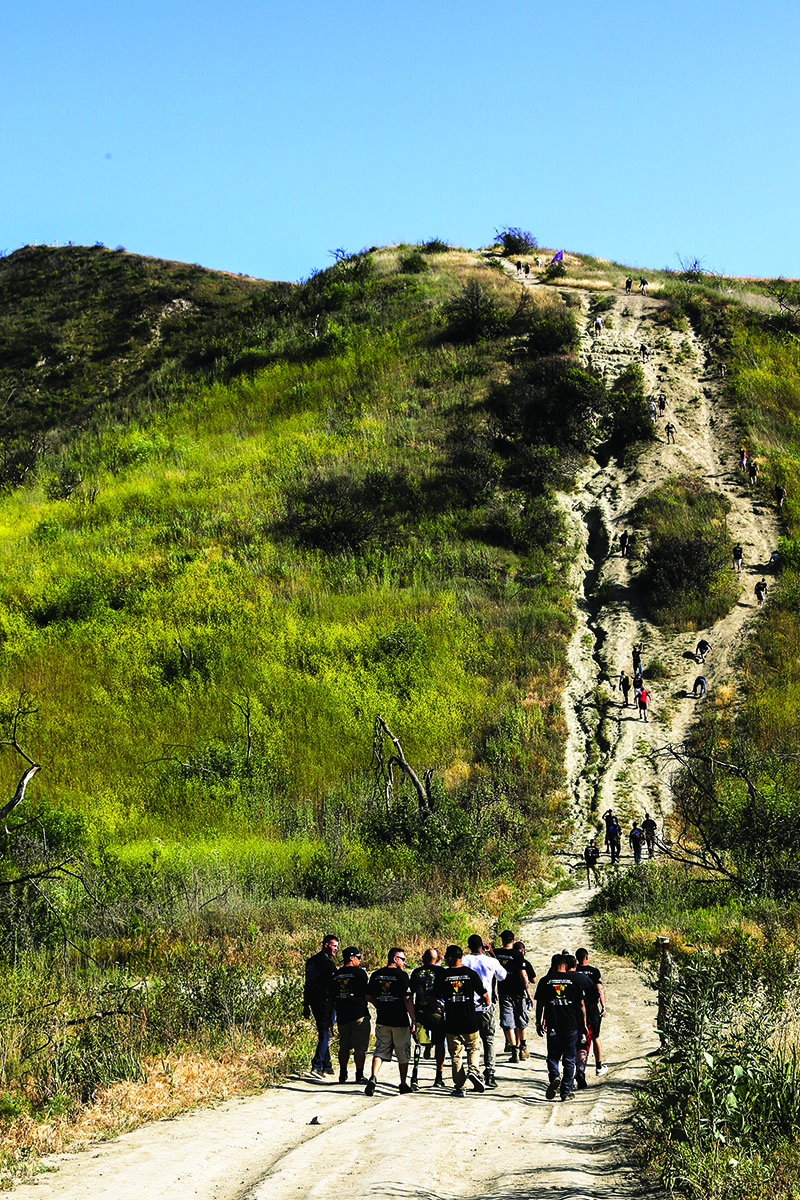
U.S. Marines, veterans, and family members of 3rd Battalion, 5th Marine Regiment (3/5), hike up First Sergeants Hill while attending a memorial ceremony for the Battle of Sangin on Marine Corps Base Camp Pendleton, Calif., April 29, 2016. During the Battle of Sangin in 2010, 3/5 sustained heavy casualties in what is considered the bloodiest battle ground of Afghanistan. (U.S. Marine Corps Combat Camera photo by Lance Cpl. Sergio RamirezRomero/ Released)
The Symbol
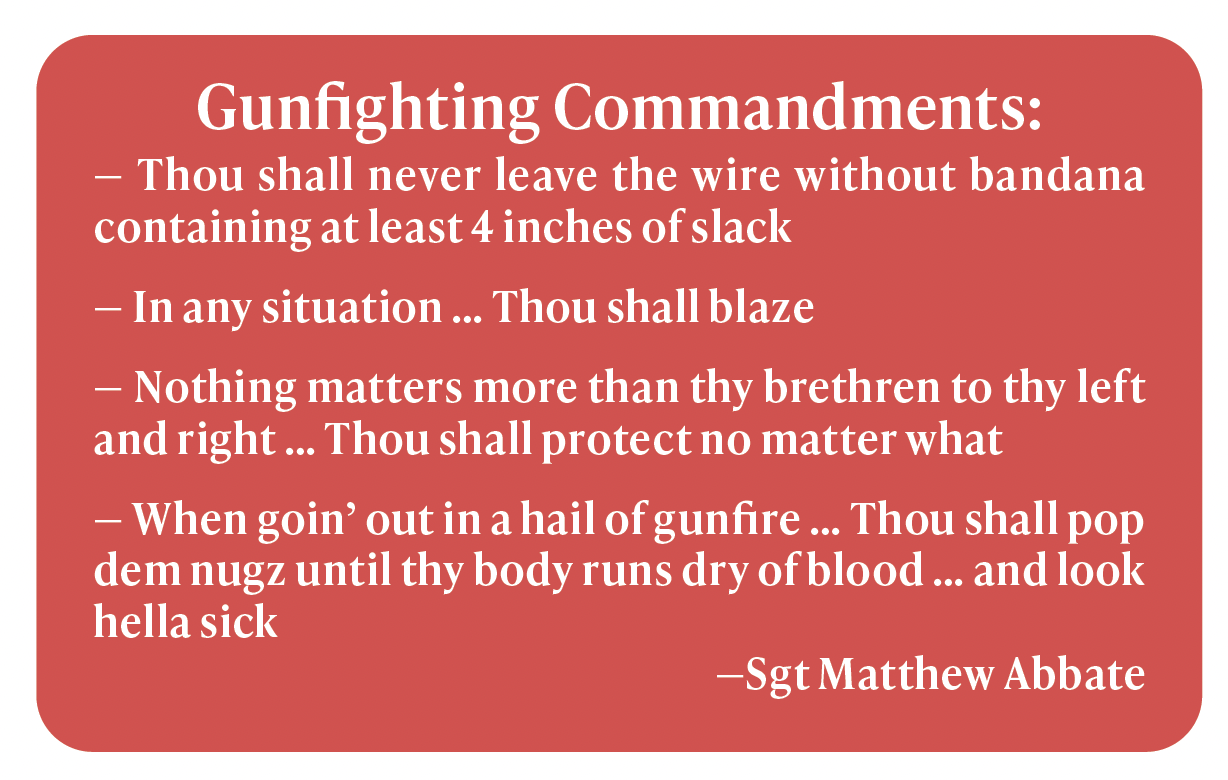
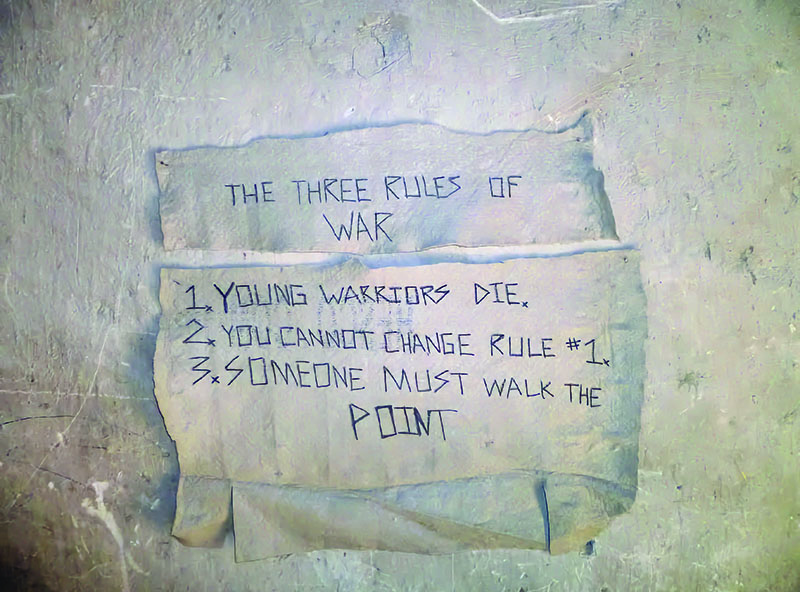
Jake: Throughout the deployment, Matt was really big on symbols. We had a wall where we carved stick figures for all the enemy we killed or even buildings we destroyed in air strikes. Matt encouraged it because he wanted people to know what we were doing. He wanted us to know that we were making a difference, and whenever we would leave, he wanted them to know that we made a difference. The gunfighting commandments and rules of war were his own creation. To me, they were reflective of his personality.
Matt was a really over the top guy. His favorite movies were ’80s and ’90s action flicks. He just thought they were awesome. When he showed us the gunfighting commandments, he thought it was hilarious, but he also thought it was badass. I think for Matt it was a way to make light but also be serious.
John: Matt came up with this thing called, “slack” in his bandana. Matt loved bandanas. His first gunfighting commandment was, “Thou shall never leave the wire without a bandana containing at least 4 inches of slack.” He’d always say it in his surfer voice, and it was funny as hell. The slack was the loose ends of the bandana dangling like a ponytail. We’d be getting ready to go out and he’d be like, “Ok everybody, get your slack” as he’s tying on a bandana before he put his helmet on. I still do it to this day when I ride my motorcycle.
Britt: The gunfighting commandments were just Matt’s mentality towards wearing the uniform that were unspoken but lived. Not necessarily the words themselves, but the attitude he took towards everything. He so much loved wearing camouflage, sweating and carrying guns with the potential of blasting holes in people, and he lived that. He could have written the gunfighting commandments a million different ways, but it all would have said the same thing; look cool, feel cool, protect your homies and kill the people trying to kill you. In the least eloquent way, that’s just who he was.
Jake: His rules of war I think were based off something he read in a book, but he put his own spin on it, but it hit home for all of us. Someone’s got to walk point, that was just reality, and some of us weren’t going to go home. I think what separated Matt from the rest of us was that he had already accepted that before we even got there. John, too, already knew. He had significant combat experience and was blown up by an IED in Iraq. He knew the consequences of what we were going to deal with and was OK with it. I guess the wild part for Matt is that he was prepared for the reality but had not yet experienced anything like it. By the time we left Afghanistan, we all could go out, and we knew what we were looking for, we knew what the contact would be like, we knew we could step on an IED, but that fear was kind of gone. Matt was like that from day one. I think his gunfighting commandments and rules of war were just helping the rest of us get accommodated.
Courtesy of Patrol Base Abbate
The One in Ten Million
Britt: On Dec. 2, 2010, me and Jake had just come back from a two-man sniper operation. We went out at dawn and came back four or five hours later with nothing really happening. I’d been back inside the wire for maybe 30 minutes cleaning my gear and refilling my water. We heard a gunfight start up in the distance. We heard the radio traffic, and it sounded like Matt and the rest of the guys out there totally had the initiative, but I geared back up just in case they needed a QRF. The guys saw some Taliban go inside a building. On the radio, we heard jets get called in for air support. We watched both birds go overhead, and we watched both bombs drop. We had made a habit of calling in the first bird to drop a short delay 500-pound bomb so that it would penetrate inside the building and blow it up. The second bird would follow up with an air burst above the same target to kill anyone who survived the first drop and was trying to flee.
Maybe 30 seconds after the second bomb dropped, we hear that there is an urgent surgical wounded. Abbate threw his gun back up on the berm and started scanning for somebody to shoot after the first bomb. Just the geometry of chance unluckily caught him in the neck with a piece of metal from the second bomb. We didn’t know that then, we just heard Abbate’s kill number come across the radio. But, Abbate was larger than life. I’m thinking, “Matt will be fine. He’s Abbate. Nothing can touch him.”
Jake: Within a few minutes of the medevac bird taking off, we all received notification that we were “River City,” which means that we’ve got somebody dead and all communications with home were cut off to prevent anyone from communicating with the Marine’s family. My heart sank; just gut wrenching. I was trying to reach our Kilo Company HQ to confirm what we just heard, because I just couldn’t believe it. I ran up to the patrol base’s comm shack and got on the radio. I said, “Kilo main, this is Banshee, confirm your last traffic.” Our forward air controller, a great guy, came back and was just like, “I’m so sorry, Banshee.”
Britt: It felt totally unreal to all of us. Everyone felt very mortal in Sangin, but nobody thought you could touch Matt. He was invincible. We all just felt like, “If Abbate can get killed out here, there is no way I’m going to survive this.” His death reverberated through the entire battalion.
Author’s Note: 3/5 remained in Sangin until April 2011. The battalion suffered 25 killed in action and more than 200 wounded. Throughout the entire 20-year war in Afghanistan, 3/5 suffered the worst casualty rate of any Marine battalion.
Jake: Our deployment to Sangin 100% shaped everything about the remainder of my time in the Marine Corps and still does to this day. Matt’s relentless nature in everything he did, his relentless strife to be the best and outperform his best pushed me to be a better performer and made me push my Marines to outperform their best.Matt never had an ounce of quit and never left anything on the table. As a Marine, you can’t have any quit because, ultimately, no matter what you do, the enemy always has a vote.
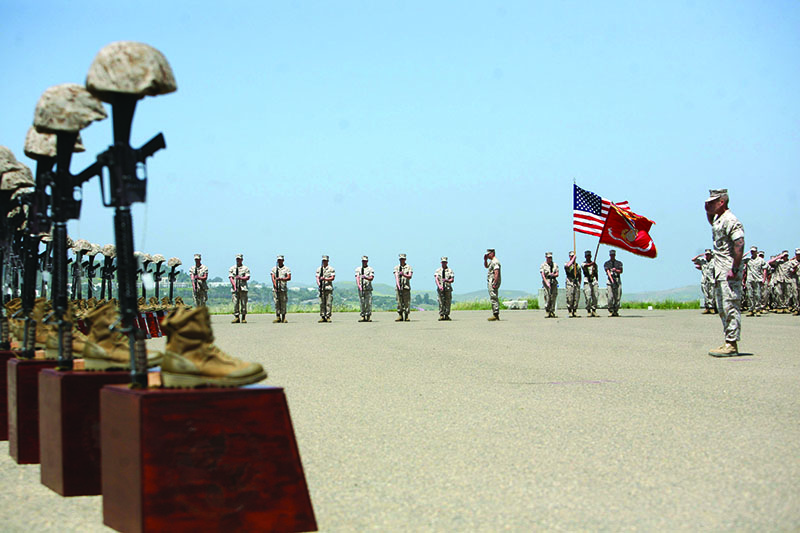
Marines with 3rd Battalion, 5th Marine Regiment, salute during the playing of taps during a memorial ceremony, April 29. Moments before, the Marines fired a 21-gun salute in honor of the 25 fallen warriors of the battalion.
Britt: Be as excited and proud to wear the uniform and do the job that you were the day you went to MEPS. When you didn’t know any better, when you didn’t know how stupid the games could be, when you didn’t know how lame the regulations are, and all the things it takes to get to wear the uniform and do the job; just show up every day excited to wear that uniform. Matt was just excited to get to be a Marine. To take off his uniform drenched in sweat and dirt, sore from trudging up hills carrying a machine gun. That was a good day to Matt.
It’s tough to call him anything close to an example of a window into what the Marine Corps was like during our era because Abbate was truly one in 10 million. I don’t know how many Marines served in the GWOT, but in that 20 years, there are only a few other dudes that had the impact on the people around him and the larger-than-life impact in the day to day. His exemplary character, attitude and performance in everything he did had so much gravity. Everyone who served with him on a day-to-day basis knew this guy was what you think of when you think ‘real Marine.’ When I say ‘real Marine,’ I don’t mean textbook recruiting poster, handsome, barrel-chested, shaved face dude. I mean absolute f—king killer, that’s a libo risk, that takes care of his dudes and leads from the front.
Jake: Matt taught me that you have to love your subordinates, whether you like them or not. He took every opportunity to train hard. He was the epitome of a Marine. He set the standard that I strive to reach, both through my time in the Marines and my current career in law enforcement. The lessons that I learned by watching Matt have shaped my entire adult life. I count myself very fortunate to have known him.
Author’s note: Matt Abbate was 26 years old at the time of his death. He is survived by his wife, Stacie Rigall, his son, Carson Abbate, his mother, father and three siblings.
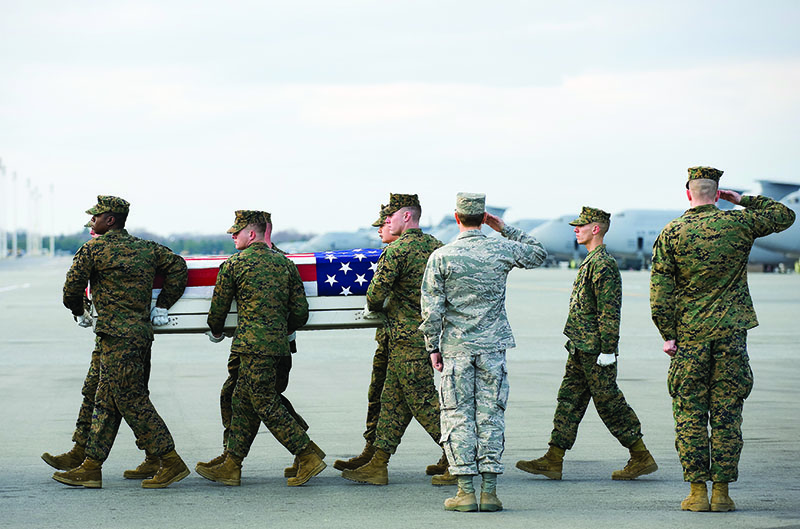
A U.S. Marine Corps carry team transfers the remains of Marine Sgt. Matthew T. Abbate of Honolulu, Hawaii., at Dover Air Force Base, Del., Dec. 4, 2010. Abbate was assigned to the 3rd Battalion, 5th Marine Regiment, 1st Marine Division, I Marine Expeditionary Force, Camp Pendleton, Calif. (U.S. Air Force photo by Jason Minto)
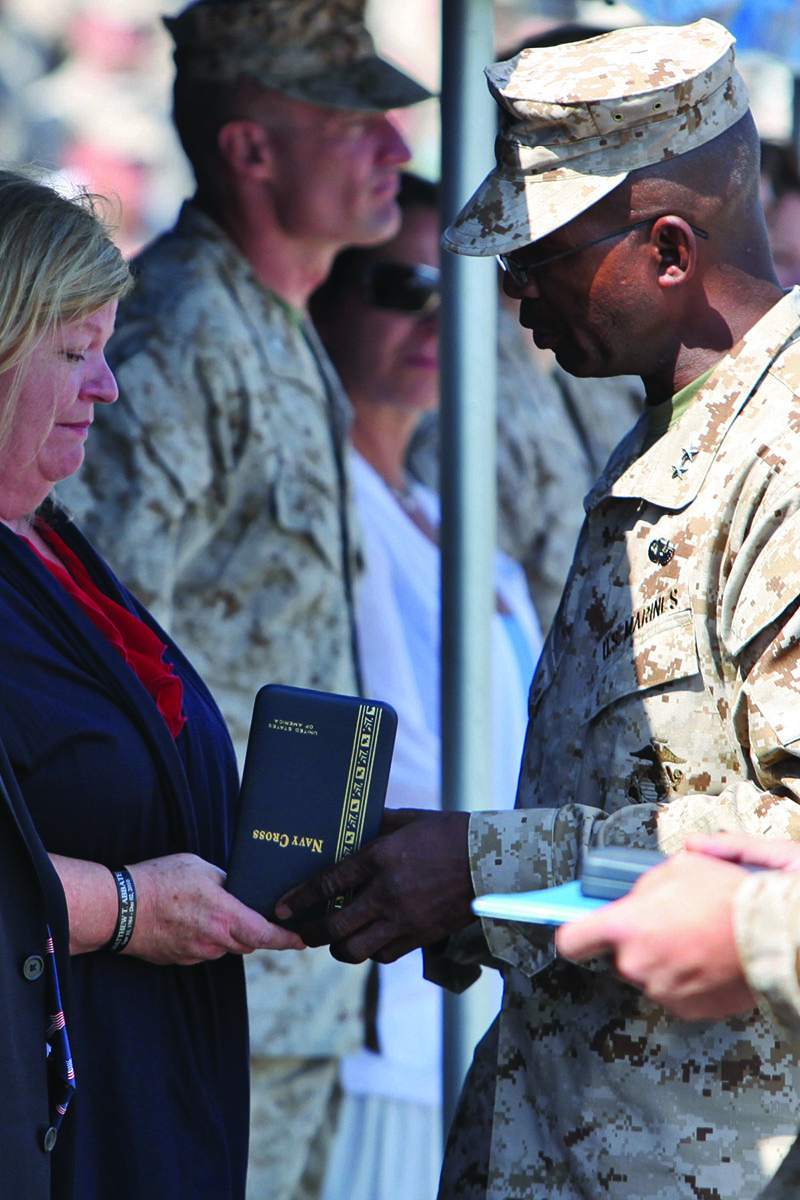
Major Gen. Ronald L. Bailey, commanding general, 1st Marine Division, presents the Navy Cross to Sgt. Matthew T. Abbate’s mother during a Navy Cross award ceremony aboard Camp Pendleton, Calif., Aug. 10. Abbate was posthumously awarded the medal for the actions he took on Oct. 14, 2010 in Sangin, Afghanistan during his deployment as a scout sniper with Company K, 3rd Battalion, 5th Marines, 1st Marine Division. Abbate was killed in action in Helmand Province later that year.
Courtesy of Patrol Base Abbate
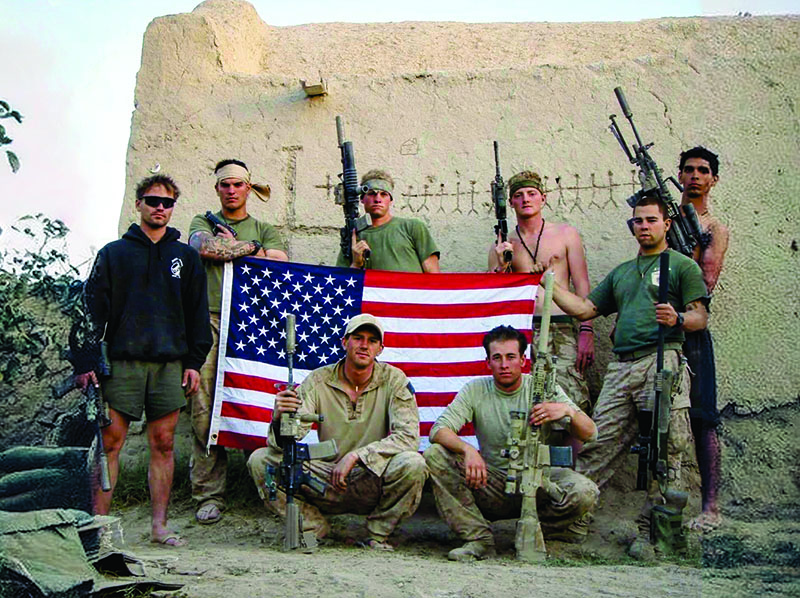
Featured Image (Top of page): Sniper Team “Banshee Three” at Patrol Base Fires, Sangin, Afghanistan, during their 2010 deployment with 3rd Bn, 5th Marines. Sgt Matthew Abbate, wearing a tan bandana, is holding the left side of the flag. Abbate’s story was shared with Leatherneck by several Marines including Sgt Britt Sully, standing far left, Sgt Jake Ruiz, holding the right side of the flag, and then-Sgt John Browning, kneeling, front right. Etched into the wall behind them is the sniper team’s running tally of confirmed kills during their deployment.
Author’s bio: Kyle Watts is the staff writer for Leatherneck. He served on active duty in the Marine Corps as a communications officer from 2009-2013. He is the winner of the Robert Debs Heinl Jr. award for Marine Corps History. He lives in Richmond with his wife and three children.
The date, April 30, 1967. The place, a few miles northwest of Khe Sanh. The 2nd and 3rd Battalions of the 3rd Marine Division are preparing to assault Hill 881 and dislodge the North Vietnamese Army (NVA) forces emplaced in fortified bunkers on the hill. With 105 mm artillery at their backs and the new M16 rifles in hand, it seems like nothing can stand in their way as they attempt to take the hill.
Within just a few short hours, however, nothing is going according to plan. Because the defenders on the hill are more numerous and far better dug in than anticipated, the air strikes and artillery bombardment preceding the assault have had little practical effect. To make matters worse, Marines have been experiencing serious problems with their high-tech M16 rifles—critical malfunctions are causing them to seize up in the heat of combat. It seems nearly inconceivable that the U.S. military would issue fatally flawed equipment, but the Battle of Hill 881 and several other conflicts during the Vietnam War serve as grim reminders that it did indeed happen.
So, why were soldiers and Marines using rifles that often malfunctioned in battle? To understand how and why this happened, we need to travel more than a decade back in time and thousands of miles away to a small office complex in Hollywood, Calif.
Fairchild Airplane and Engine Company created its ArmaLite division in 1954 to design and produce firearms. As a subsidiary of a major aerospace contractor in the 1950s, ArmaLite’s designs were unconventional and highly innovative. Where a rifle was traditionally constructed out of a milled or pressed sheet steel receiver mated to a steel barrel in a wood or metal stock, ArmaLite’s AR-1, AR-5, and AR-7 rifles made heavy use of space-age materials like aluminum and fiberglass.
In the mid-1950s, ArmaLite engineer Eugene Stoner designed a revolutionary new military rifle he hoped would replace the venerable M1 Garand. Stoner’s rifle, designated “AR-10,” was a radical departure from conventional designs. Its barrel, operating components, and stock were all arranged in a straight line, trans-ferring recoil directly back into the shooter’s shoulder and minimizing muzzle rise on full-auto. With its aluminum receiver, fiberglass furniture, and composite barrel, the AR-10 was a full pound or more lighter than any of its more mainstream competitors. Unfortunately, military trials showed that the AR-10 was perhaps too far ahead of its time, and without years of refinement behind it, the rifle suffered a number of teething troubles which couldn’t be corrected quickly enough to prevent its disqualification from the trials. The U.S. Army would ultimately go on to adopt the T44E4 prototype, essentially just an improved M1, as the M14 rifle.
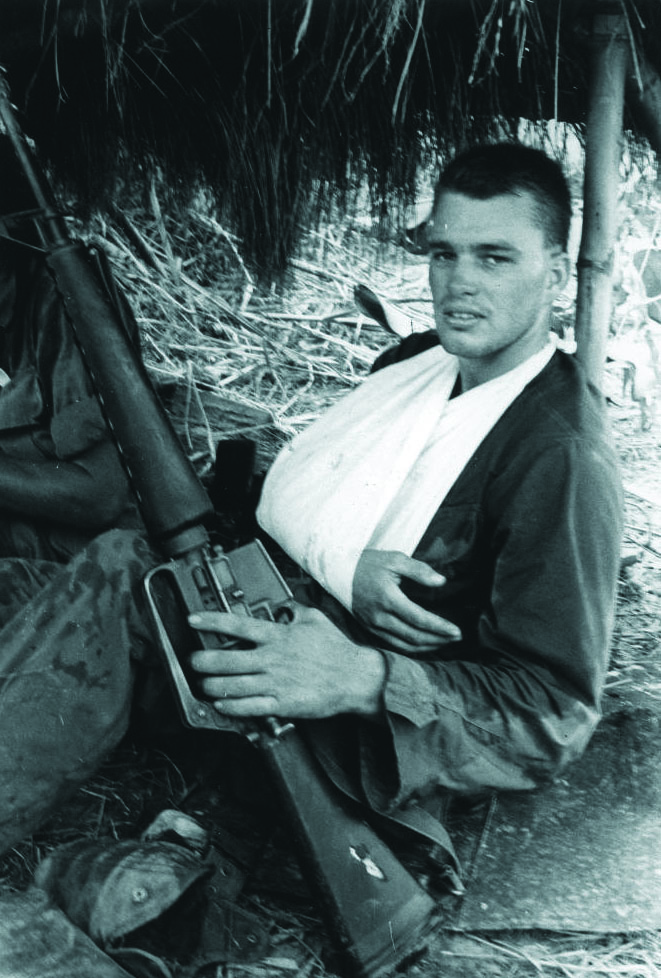
PFC Tommy Gribble displays his M16 rifle, which was hit by a round from an enemy AK-47 on Sept. 6, 1968. The round pierced Gribble’s forearm, passing between both bones, then smashed through the Marine’s rifle stock. Gribble, assigned to Co I, 3rd Bn, 5th Marines, was walking point during a patrol in Vietnam when the round hit.
But all was not lost for Eugene Stoner and ArmaLite. The Department of Defense was investigating a small-caliber, high-velocity rifle cartridge concept based on research and testing from the Aberdeen Proving Grounds in the early 1950s, and they wanted ArmaLite to help develop the new ammunition and a lightweight rifle to fire it. While Stoner worked on the design for the pro-jectile itself, ArmaLite engineers L. James “Jim” Sullivan and Robert Fremont worked with Remington on the design for the case. What they came up with was a more powerful version of the .222 Remington capable of propelling a 55-grain full-metal jacket projectile at an astounding 3,250 feet per second from a 20-inch barrel.
To go with this new so-called “.222 Remington Special” or “.223 Remington” ammunition, Sullivan and Fremont created a new rifle based on the AR-10. It used the same operating principle and retained many of the same desirable features as its predecessor, but testing showed that the new prototype was capable of superior accuracy and reliability. They called it the AR-15.
The first AR-15 was an impressive weapon for its time. It was demonstrated to have better reliability and accuracy than the M14 while being nearly two pounds lighter. The new .223 ammunition was much lighter and produced less recoil than 7.62 NATO, allowing infantrymen to carry twice as many rounds and fire accurately in both semi-automatic and fully automatic modes. A 1959 test by the Army showed that a squad of five to seven men armed with AR-15s was just as effective as an 11-man squad armed with M14s.
Despite its lighter weight and lower recoil, the new high-velocity ammunition produced devastating wounds in soft targets. Whereas conventional rifle bullets had the potential to pass through their targets and leave behind small wound tracks, high-velocity projectiles had a tendency to fragment shortly after impact. Jim Sullivan would later recount an informal test at a shooting range between a conventional 7.62 NATO rifle and an .223-caliber AR-15 wherein the ArmaLite employees shot at jerrycans filled with water. The full-power rifle punched a hole straight through a can—the bullet went in one side and out the other, leaving nothing behind but a pair of holes. The AR-15, firing ammunition nominally half as powerful, caused a can to explode from the sudden shock. Battlefield reports later confirmed the lethality of this effect on enemy combatants.
The AR-15 showed great promise as a combat rifle, but it couldn’t have come at a worse time. The Army and Marine Corps had just adopted the M14 after 12 years of development and amid a great deal of controversy; they weren’t about to go out and order hundreds of thousands of AR-15s. Furthermore, top generals were extremely conservative about small arms designs, and the AR-15 was easily the most innovative and unconventional rifle of its time. By this time, ArmaLite was on the verge of bankruptcy. Years of work on the AR-10 project without a major contract to show for it had left the company in deep financial trouble, and the Army passing on the AR-15 was the final nail in the coffin. ArmaLite was finally forced to sell the rights to the AR-15 to a larger and more established arms manufacturer. Colt quickly snapped up the new design and began shopping it around to militaries around the world, as well as creating its own version lacking the fully automatic functionality for the civilian market.
The initiating event that led to the AR-15’s popularity in military service for the past half-century and counting was not an elaborate multi-year military R&D program, but a backyard barbecue party.
July 1960. Richard Boutelle, former president of Fairchild (ArmaLite’s parent company) is hosting an Independence Day party in his backyard. Among the high-powered friends on the guest list are Colt representative Robert Macdonald and legendary Air Force General Curtis LeMay. Eager to show off the capabilities of the AR-15, they offer to let Gen LeMay test the new rifle on some watermelons. A few magazines and a lot of pulp later, LeMay is so impressed by the rifle that he immediately places an order for 80,000. At that time, Air Force security personnel were still using the M2 Carbine. A variant of the M1 carbine, it was popular with troops when it was adopted during the Second World War, but by the early 1960s the design was beginning to show its age. The airmen still using it appreciated its light weight, but the carbine lost much of its lethality and accuracy beyond about 100 yards.
Congress delayed LeMay’s order, but other top officials soon came to realize why he was so enamored with the new rifle. After another brief round of trials, the AR-15 entered service with the United States Air Force and United States Army special forces. It would see its first combat use by American advisors in a bush war that was just beginning to heat up in the small, relatively unknown country of Vietnam.
The United States Army and the Marine Corps went into the Vietnam War using the M14. According to conventional American military doctrine of the time, infantry combat would take place at long range, therefore accuracy was king. The M14 worked well with this theory, firing the powerful 7.62×51 mm NATO round with an effective range farther than most people can identify a man-sized target. However, the jungles of Vietnam were suited to a very different kind of combat, a kind of combat with which the NVA and Viet Cong insurgents were intimately familiar. The thick brush and rugged terrain reduced visibility and obscured targets from view even at relatively close range, forcing combatants much closer together and making conventional long-range marksmanship all but impossible at times.
In an effort to simplify logistics, U.S. military officials had intended the M14 to replace most of the small arms in the inventory. However, the rifle was too light and too powerful for fully automatic fire to be useful, yet too long and heavy for effective use in close-quarters combat. NVA soldiers, by contrast, were using Soviet-designed rifles supplied by communist China, namely the AKM—an improved variant of the AK-47. Lighter and much more compact than the M14, it fired the 7.62×39 mm Soviet cartridge. Sacrificing effective range to achieve lower recoil, the AKM could be fired in bursts with reasonable accuracy. These traits suited the AKM perfectly for poorly trained soldiers fighting in the jungle, allowing them to overwhelm even seasoned American combat vet-erans through sheer volume of fire. Furthermore, the M14 suffered from an unexpected problem of its own—in humid conditions, its wooden stock would swell and place uneven pressure on the barrel, causing the rifle’s point of impact to shift dramatically.
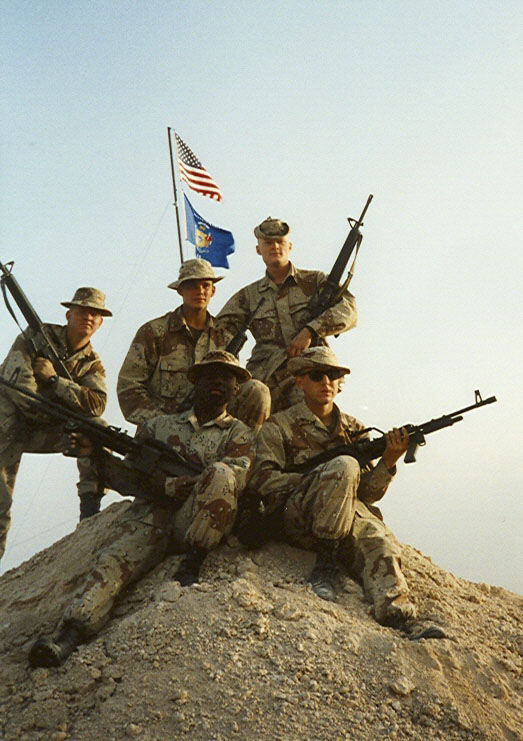
Marines during Operation Desert Storm deployed with M16A2 rifles and M60E3 machine guns.
The AR-15 could not have come at a better time for the United States military. Initial testing suggested that it surpassed the M14 in accuracy, reliability, and projected combat effectiveness, so the only thing left to do was bring it into service with the Army and Marine Corps. Yet another round of military trials resulted in the AR-15’s official adoption as the M16 rifle in 1964. Con-tracts were signed, hands were shaken, and Colt began converting its civilian tooling for the military variant. Within a few years, the first M16s began to show up in the hands of U.S. military advisors and special forces operatives in theater.
Initial combat reports were positive. Its light weight and high volume of fire suited it well to the dense jungle environment of Vietnam, and the enemy quickly learned to fear the so-called “black rifle.” According to co-designer Jim Sullivan, enemy combatants wounded in the arm or leg by the new M16 would often die from blood loss due to the fragmentation effect of the projectile. One of the M16’s first trials by fire was at the Battle of Ia Drang in November 1965. Elements of the U.S. Army 5th and 7th Cavalry, numbering approximately 1,000 men total, were able to repel nearly three times their number in hardened veterans from the NVA.
When Marines were first issued the M16, its lethal reputation preceded it. But what they didn’t know was that it would soon develop a reputation for a very different kind of lethality.
All of this brings us back to the Battle of Hill 881. Some combat reliability prob-lems with the M16 had begun to show, but the Marines of 3rdMarDiv didn’t know about any of this. They found out as soon as their rifles began jamming in combat. The rifles ran extremely dirty, causing the delicate mechanics inside to seize up at the most inopportune times. Furthermore, spent casings would often get stuck in the chamber with no way to knock them out except by disassembling the rifle while under fire or by shoving a cleaning rod down the barrel. And the rifles weren’t issued with cleaning kits.
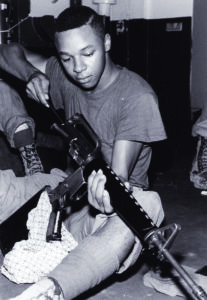
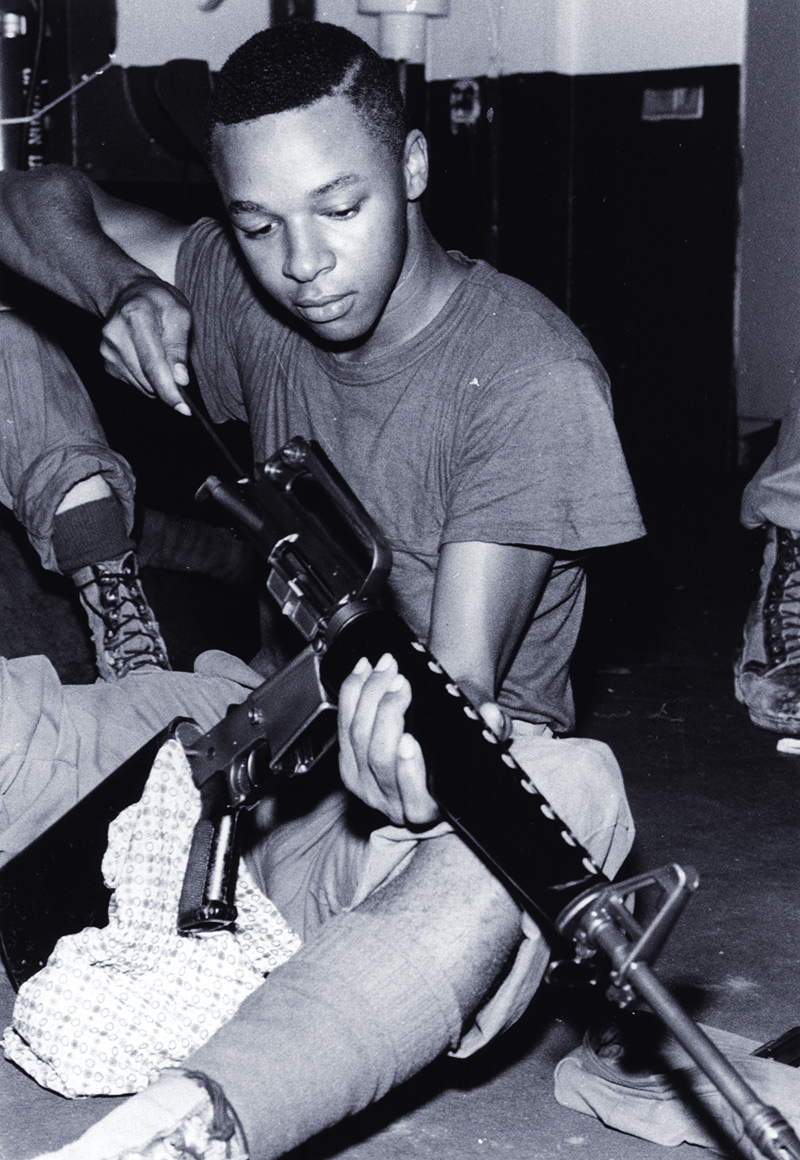
PFC Ricardo King, 3rd Bn, 1st Marines, cleans his early-pattern M16 aboard the helicopter assault ship USS Valley Forge (LPH-8) along the coast of Vietnam, Dec. 19, 1967. Early M16s required careful maintenance to withstand the humid jungle environment of Vietnam.
The so-called Hill Fights ended in a strategic American victory. The North Vietnamese were pushed out and the U.S. Marines were able to secure the area around Khe Sanh. But the question remained: what had happened to the rifles? What went wrong? This revolutionary new piece of technology that had promised to give American fighting men a decisive advantage now appeared to have cost many men their lives. The answer lies in a place almost no-one would immediately think to look—the military acquisitions system.
Recall that the M16 had been designed around the 5.56×45 mm M193 cartridge designed by ArmaLite and Remington. It was loaded with thin sticks of so-called “Improved Military Rifle” gunpowder, specifically IMR 4475, supplied by Du Pont Chemical. In Army testing, the am-munition yielded an average muzzle velocity around 3,150 feet per second—blisteringly fast, but about 100 feet per second lower than the specified velocity. In order to remedy this perceived problem, the Army had Remington switch to a different type of gunpowder, known as WC846, supplied by Olin Mathieson. The pressures and velocities looked just fine on paper, but like with many things, the devil is in the details. The new powder came in the form of small grains, coated in a special chemical blend to improve shelf life. The only problem was that the Army, thinking the powders to be interchangeable, didn’t test the rifles with the new ammunition. The new powder placed additional strain on the M16’s gas operating mechanism, and the protective coating left chalky deposits inside the rifle’s delicate internals. A seemingly simple change to the ammunition was able to multiply the rifle’s failure rate by six without anyone noticing.
The Marines of the 2/3 and 3/3 didn’t know any of this. What they did know was that their fancy new rifles, which had been billed as “self-cleaning,” ran so dirty that they often stopped working—sometimes after only a few rounds. Without training on how to clean the rifles and no cleaning kits to do so anyway, the chalky residue clogging up the rifles became a deadly problem.
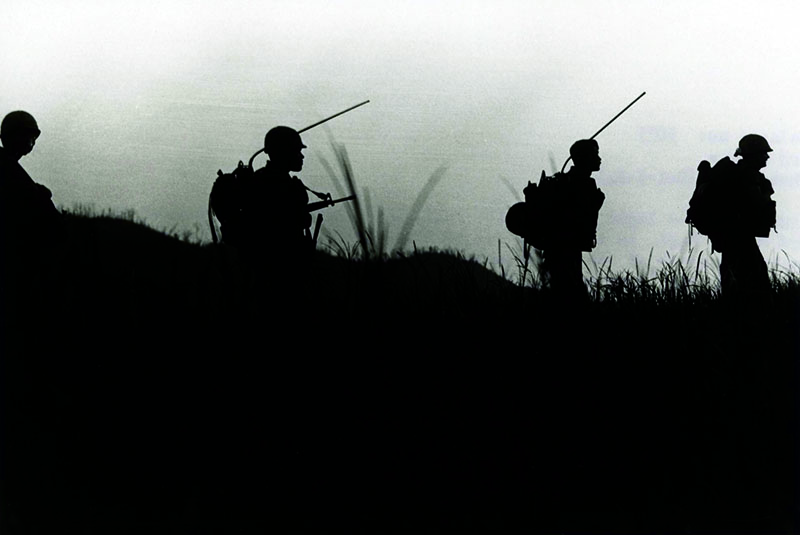
Marines of C/1/3 move out on an early morning patrol in Vietnam, 1969. (Photo by Cpl Philip R. Boehme, USMC)
As if that wasn’t bad enough, the humid jungle environment of Vietnam created microscopic deposits of rust inside the barrels and chambers of the M16 rifles. Once the invisible rust pitting in the chamber of a rifle was severe enough, cases would begin sticking inside without any way to remove them.
When the M16’s numerous problems began to surface, Congress had a field day. A committee, led by Congressman Robert Ichord of Missouri, set out to identify the causes and solve the problems to get American soldiers and Marines a weapon that wouldn’t get them killed. The corrosion problem was the easiest to fix. All barrels and bolt carrier groups rolling off the production line at Colt would be coated in a thin layer of chromium metal, preventing the underlying steel from rusting. The fouling issue, however, was a little bit more difficult. Du Pont had long since stopped manufacturing IMR 4475, and the military desperately needed large supplies of ammunition as soon as possible. Contrary to the Ichord committee’s recommendation to immediately switch back to the old powder, the new powder was reformulated slightly and the rifle’s recoil buffer system redesigned to accommodate it. The most controversial change of all was the addition of the for-ward assist. This button on the side of the receiver was designed to engage with scalloped cuts on the side of the bolt carrier to allow it to be forced into battery. Eugene Stoner and the other ArmaLite engineers who had designed the system were vehemently opposed to this change—testing showed that failures to feed were only worsened by forcing the action closed. Nevertheless, these changes were incorporated by Colt onto the next pattern of M16 rifle, the M16A1.
The reliability problems all but disappeared when the M16A1 entered service, but the damage to the rifle’s reputation was done. Hardliners continued to deride the futuristic-looking rifle with its small-caliber ammunition and plastic furniture contract-made by Mattel. But most of all, what the M16 showed the world was that the assault rifle paradigm was the way of the future. When the Warsaw Pact began issuing select-fire intermediate-caliber rifles like the AKM, military strategists in the West had derided it as a “peasant’s weapon,” designed to maximize the combat effectiveness of a poorly trained conscript army. What the M16 proved was that even the best-trained fighting forces in the world could take advantage of the lighter weight and higher volume of fire provided by this revolutionary new weapon.
Recruit Jared C. Seeland, Plt 3229, “Kilo” Co, 3rd Recruit Training Bn reloads his M16A4 Service Rifle in the standing position at Edson Range, Weapons and Field Training Bn, Marine Corps Base Camp Pendleton, Calif., Nov. 24, 2014. (Photo by Cpl Jericho Crutcher, USMC)
In the 1970s, NATO member countries began developing their own 5.56 mm rifles and tinkering with the ammunition to optimize it. The Belgian SS109 cartridge, based on the earlier American M193 but with improved penetration on hard targets, was adopted by most of NATO as stan-dard. When the Marine Corps requested an improved version of their rifle in response, Colt modified the M16A1 slightly to create the M16A2, which entered service in the early 1980s.
With the A2 variant, the M16 had finally fully matured. It used a different barrel for better accuracy and compatibility with a wider variety of ammunition types. The sights were made more adjustable, improving the individual rifleman’s ability to hit targets at long range. Even though most infantry combat thus far during the 20th century had taken place at 300 meters or less, a rifleman armed with an M16A2 could reliably hit man-sized targets out to at least twice that.
The M16’s final evolution in Marine Corps service was the M16A4. Taking a cue from the civilian aftermarket, the M16A4 is essentially just an M16A2 with enhanced modularity. The rear sight and carry handle assembly was made re-mov-able so an optical sighting system could be mounted, dramatically increasing the rifle’s combat effectiveness. The currently issued Trijicon TA31 RCO can mount to this rail with two thumb screws, a far cry from the intricate machining required to mount optics on previous service rifles.
The round plastic handguards were replaced by long segments of MIL-STD-1913 rail, where Marines could attach a variety of accessories to fit almost any kind of mission. Even after the Army switched to the shorter M4A1 carbine, the Marine Corps continued using the M16A4 until a few years ago. With its longer barrel, the M16 is able to reliably hit targets, well past the effective range of the M4. While the M27 IAR has already replaced the M16A4 in frontline infantry units, hundreds of thousands of M16 rifles are still in Marine Corps inventory and will continue to see use for many years to come.
Editor’s note: This article is the first in a serious of features detailing the small arms U.S. Marines have used since 1775. What were your experiences like with your issue weapons? Do you have a favorite one you would like to see featured next? Let us know at [email protected].
Author’s bio: Sam Lichtman is a college student and licensed pilot. He works part-time as a salesman and armorer at a gun store in Stafford, Va., and occasionally contributes content to Leatherneck. He also has a weekly segment on Gun Owners Radio.
Featured Photo (Top): A Marine armed with an M16A1 checks in with his command post via field radio during Operation Urgent Fury in Grenada, Oct. 25, 1983.
By MGySgt Beau F. Hornsby, USMC • MGySgt Robert N. Robinson, USMC •
MGySgt Justin W. Aiken, USMC, MGySgt Tim P. Hanson, USMC and MGySgt Joshua P. Adkins, USMC
The infantry Marine and the greater Ground Combat Element have been, is, and will remain the main effort of the United States Marine Corps. No single element of the MAGTF wins the war because we are a combined arms team capable of integrating every command and potential new fighting domain, but the infantry remains central.” SgtMaj Troy E. Black
Sergeant Major of the Marine CorpsFrom Iwo Jima to Pusan; Khe Sanh to Kandahar; Fallujah to Marjah, one thing has remained constant: Infantry Marines were tasked to seize and hold key terrain. The “in order to” may change, but tomorrow’s battlefield still requires infantry Marines to seize and hold key terrain. This is why the infantry is and remains the main effort.
In the last three years, there has been a lot of discussion regarding the transitions that the Marine Corps must go through in order to remain ahead of the competition and a lethal warfighting organization, able to respond to all manners of crises. The Marine Corps recently began fielding modernized and technologically advanced platforms like the F-35B variant of the Joint Strike Fighter, the CH-53K heavy lift helicopter, the AH-1Z and UH-1Y light attack helicopters, the Amphibious Combat Vehicle, improved communication systems, and updated precision strike capabilities, just to name a few. These advancements are all designed to improve the lethality of ground forces engaged in close combat.
In the face of these advancements, one thing remains unchanged: the infantry must seize and hold key terrain. Without this essential contribution to the warfighting effort, nothing else matters.
History demonstrates this has always been true for the Marine Corps and remains true even in our newest concepts of seizing and holding expeditionary advanced bases in support of larger joint force and naval campaign plans. When nuclear weapons were introduced, infantry formations were deemed obsolete and no longer necessary. However, infantry formations are indeed deployed to deter the use of such strategic weapons.
History would argue that the infantry, too, is a strategic weapon of deterrence. Advanced technology alone will not win the future fight. Warfighters win battles when their boots are on the ground, armed with little more than a rifle, and look their adversary in the eye and say, “Not on my watch.”
Infantry Marines do not fight alone, however. They are often the first or last line of defense, where the stakes are higher, operating in full view of the enemy. They are asked to fight the country’s battles like no other; they do more with less and always come out on top. Infantry Marines pride themselves on being among the first to run to the sound of gunfire and engage the enemy. Considered fearless yet unassuming, they don’t boast or brag but just work hard for the fellow Marine to their right and left.
Pvt Dahe C. Gibbs, a student with the School of Infantry-East, lays down suppressive fire during the Infantry Marine Course on MCB Camp Lejeune, N.C., on July 22, 2021. (Photo by LCpl Isaiah Gomez, USMC)
At times, infantry Marines are often called knuckle draggers with bad attitudes and boorish behavior who are always looking for a fight. Yet, they live for the moment when the country calls. They deliver tactical victories to larger operations and strategies. Following in the footsteps of their Marine Corps forebears they are willing to sacrifice themselves for their Marines.
They fight the enemy with every weapon at their disposal to include their calloused, bloody, bare hands if needed. The Marine infantry refuses to quit or lose in the face of adversity. They will neither flag nor fail.
At the recent Ground Combat Element Operations Chief Symposium, the Commandant of the Marine Corps, Gen David H. Berger, stated flat-out that “the infantry is the Marine Corps’ main effort.” He continued by saying the infantry is the reason the service will win the next fight—either in competition or conflict.
Infantry Marines have one simple demand of themselves—to be ready for the next battle—and they know that hard, realistic training is what they need to prepare for that certainty. More importantly, it is what they want, all part and parcel of the Spartan life they chose. Infantry Marines have pride in “the suck,” pride of being an infantry Marine, pride in knowing that if something happens in the world that they will be the ones that get to make things right, they are the ones that stand tall and say “I got this” as they move forward into the fight.
Capt Philip Treglia calls in a danger close airstrike in support of his Marines with Co A, 1st Bn, 5th Marine Regiment in Fallujah, Iraq, April 7, 2004. (Photo by Cpl Matthew J. Apprendi, USMC)
They joined for the esprit de corps, to be the ones that protect others, longing to be at the tip of the spear when the decisive blow is landed.
Let this serve as a reminder to all infantry Marines: stand up tall, lift your chin, stick out your chest, and remind the world around you where the Marine Corps’ center of gravity is. The infantry is the essential element of Marine expeditionary forces and the reason this country can sleep well at night without fear.
The next generation’s infantry formation is more lethal than ever. These formations are already equipped with a rifle that delivers better accuracy and range, better optics, vastly improved night vision capability, targets that simulate enemy movement, and lighter gear that provides both better protection and improved mobility.
Sgt Bryan Early, a squad leader with 1st Bn, 9th Marine Regiment, crosses a field with a fellow Marine while under fire in Helmand Province, Afghanistan, on Dec. 22, 2013.
The service is also investing heavily in its most precious resource—the human—and holistic Human Performance programs. The new Infantry Marine Course is not just improving the quality of Infantry Marines reporting to the fleet, but it’s also improving the quality of the small unit leader that trains and leads them. This approach will very soon lead to new leaders courses that will improve all echelons of small unit leaders’ abilities to lead formations in all environments to include the critical and challenging littorals.
The Marine Corps is far from finished with this transformation. Future infantry Marines can expect to see improved assault/anti-armor capabilities, small UAS (Unmanned Aircraft Systems), organic precision fires, next generation tactical communications, and the tools to integrate all of these increased capabilities. These assets are being fielded all the way down to the smallest tactical formations. Those formations must be led by our best and most-capable young leaders. This is what drove the service-wide change of how we evaluate, promote and empower our young leaders.
SgtMaj Troy E. Black, Sergeant Major of the Marine Corps, speaks to Marines attending the Ground Combat Element Operations Chief Symposium at MCB Quantico, Va., Feb. 28.
This talent, developed and refined, must be kept within our ranks. This is a steadfast truth. These small units must, as they have always been, be led by the sturdy professionals and practitioners of war who call themselves The Few and The Proud to remain the most ready when our nation is least ready. This is how we meet the Commandant’s drive for a more capable and better trained and educated force.
Future infantry formations require educated and experienced leadership from its enlisted ranks. The Operations Chiefs, the most senior enlisted infantry leaders, were tasked by both CMC and the SMMC at the recent GCE Operations Chief Symposium to find and pursue better ways to keep our best infantry Marines in our ranks.
Infantry Marines of the future should expect to see improved opportunities to shape where and how they serve, to improve their quality of life through tough and realistic training, additional resources to take better care of their families, and rewards for continuing to answer the call.
Make no mistake, the nation will call again and need her Marines to go forward. When that happens, experienced leaders are needed in that formation—experienced infantry Marines who have been honing their craft in the swamps of Camp Lejeune, the deserts of Twentynine Palms, the hills of Camp Pendleton, the jungles throughout the Pacific, and everywhere in between, preparing their squads and platoons. Marines never have the luxury of choosing the time and place of answering the nation’s call, but no matter the clime or place, they always answer and so it will be for our future infantry formations.
Cpl Zenon Garcia Lopez asks SgtMaj Troy E. Black, Sergeant Major of the Marine Corps, a question during a town hall with Marine Corps Communication-Electronics School at MCAGCC, Twentynine Palms, Calif., March 3.
“I need you for tomorrow’s fight. The young men and women you are training right now need an experienced leader, not the next Marine up. Don’t leave it to someone else. Be a part of the change that will allow us to be great for another century. You are the main effort and our nation and our Corps need you. Seize and Hold!”
—MGySgt Robert N. Robinson, 5th Marine Regiment Operations Chief Authors’ bios: MGySgt Beau F. Hornsby, Operations Close Combat Lethality Task Force; MGySgt Robert N. Robinson, Operations Chief, 5th Marine Regiment; MGySgt Justin W. Aiken, current School of Infantry-East (SOI-E) regimental operations chief, MGySgt Tim P. Hanson, incoming SOI-E regimental operations chief, and MGySgt Joshua P. Adkins, Operations Chief, Marine Forces Europe/Africa.